×
Request Free Sample ×

Kindly complete the form below to receive a free sample of this Report

* Please use a valid business email

Leading companies partner with us for data-driven Insights

clients tt-cursor
Hero Background

Ambulance Equipment Market

ID: MRFR/HCIT/7400-HCR
100 Pages
Rahul Gotadki
October 2025

Ambulance Equipment Market Research Report By Product Type (Medical Equipment, Communication Equipment, Monitoring Equipment, Patient Transportation Equipment, Safety Equipment), By Application (Emergency Medical Services (EMS), Inter-Facility Transport, Disaster Relief, Military and Defense, Other), By End User (Hospitals and Clinics, Ambulance Services, Government Agencies, Non-Profit Organizations, Military and Defense), By Technology (Advanced Life Support (ALS) Equipment, Basic Life Support (BLS) Equipment, Telemetry and Telemedicine Eq... read more

Share:
Download PDF ×

We do not share your information with anyone. However, we may send you emails based on your report interest from time to time. You may contact us at any time to opt-out.

Ambulance Equipment Market Infographic
Purchase Options

Ambulance Equipment Market Summary

As per MRFR analysis, the Ambulance Equipment Market Size was estimated at 14.02 USD Billion in 2024. The Ambulance Equipment industry is projected to grow from 14.79 USD Billion in 2025 to 25.15 USD Billion by 2035, exhibiting a compound annual growth rate (CAGR) of 5.45 during the forecast period 2025 - 2035.

Key Market Trends & Highlights

The Ambulance Equipment Market is experiencing robust growth driven by technological advancements and increasing demand for emergency services.

  • Technological advancements are reshaping the Ambulance Equipment Market, particularly in North America, which remains the largest market.
  • The integration of telemedicine is gaining traction, especially in the rapidly growing Asia-Pacific region, enhancing patient care during transport.
  • Regulatory changes and standards are influencing market dynamics, with Emergency Medical Services being the largest segment in terms of demand.
  • The increasing demand for emergency medical services and rising awareness of patient safety are key drivers propelling market growth.

Market Size & Forecast

2024 Market Size 14.02 (USD Billion)
2035 Market Size 25.15 (USD Billion)
CAGR (2025 - 2035) 5.45%

Major Players

Stryker (US), Zoll Medical Corporation (US), Ferno-Washington, Inc. (US), Medtronic (US), Philips (NL), Hamilton Medical (CH), Graham-Field Health Products, Inc. (US), Ambulance Medical Equipment (US), Medi-Kit (FR)

Ambulance Equipment Market Trends

The Ambulance Equipment Market is currently experiencing a transformative phase, driven by advancements in technology and an increasing emphasis on patient care. Innovations in medical devices, such as portable defibrillators and advanced monitoring systems, are enhancing the capabilities of emergency medical services. Furthermore, the integration of telemedicine into ambulance operations appears to be gaining traction, allowing for real-time consultations with healthcare professionals during transport. This trend not only improves patient outcomes but also optimizes the use of resources within emergency services. In addition to technological advancements, the Ambulance Equipment Market is influenced by regulatory changes and the growing demand for high-quality emergency care. Governments and health organizations are increasingly focusing on improving emergency response systems, which may lead to increased investments in ambulance infrastructure and equipment. As a result, manufacturers are likely to adapt their offerings to meet evolving standards and expectations. Overall, the market seems poised for growth, with a focus on enhancing efficiency and effectiveness in emergency medical services.

Technological Advancements

The Ambulance Equipment Market is witnessing a surge in technological innovations, particularly in medical devices and communication systems. Enhanced equipment, such as automated external defibrillators and advanced patient monitoring tools, is becoming more prevalent, enabling paramedics to provide superior care during transport.

Integration of Telemedicine

The incorporation of telemedicine into ambulance services is emerging as a notable trend. This integration allows for immediate consultations with medical professionals, facilitating better decision-making and patient management while en route to healthcare facilities.

Regulatory Changes and Standards

The Ambulance Equipment Market is also shaped by evolving regulatory frameworks and standards aimed at improving emergency medical services. As governments prioritize healthcare quality, manufacturers are adapting their products to comply with new regulations, ensuring that equipment meets the latest safety and efficacy requirements.

Ambulance Equipment Market Drivers

Government Initiatives and Funding

Government initiatives aimed at improving emergency medical services are playing a crucial role in the Global Ambulance Equipment Market Industry. Various countries are allocating funds to upgrade ambulance fleets and enhance the quality of medical equipment. For instance, national health departments are investing in training programs and purchasing state-of-the-art equipment to ensure that emergency responders are well-equipped. This support is expected to drive market growth, with projections indicating a market value of 23.9 USD Billion by 2035. Such investments not only improve service delivery but also enhance the overall efficiency of emergency medical services.

Growing Focus on Patient-Centric Care

The Global Ambulance Equipment Market Industry is increasingly oriented towards patient-centric care, which emphasizes the importance of patient comfort and safety during transport. This shift is prompting ambulance services to invest in equipment that enhances the patient experience, such as adjustable stretchers and advanced ventilation systems. As healthcare systems globally recognize the importance of patient satisfaction, the demand for such equipment is likely to rise. This trend aligns with the projected compound annual growth rate of 5.7% from 2025 to 2035, indicating a sustained focus on improving the quality of care provided in ambulances.

Rising Incidence of Emergencies and Accidents

The Global Ambulance Equipment Market Industry is influenced by the rising incidence of emergencies and accidents, which necessitates a robust ambulance response system. With increasing urbanization and population density, the frequency of road accidents and medical emergencies is escalating. This trend drives the demand for well-equipped ambulances capable of providing immediate medical assistance. As a result, manufacturers are responding by developing more advanced equipment tailored to emergency situations. The growing need for effective emergency response is likely to sustain market growth, contributing to the projected increase in market value over the coming years.

Increasing Demand for Advanced Medical Equipment

The Global Ambulance Equipment Market Industry is experiencing a surge in demand for advanced medical equipment, driven by the need for enhanced patient care during transport. Innovations such as portable ultrasound devices and advanced cardiac monitors are becoming standard in ambulances. This trend is likely to continue as healthcare providers seek to improve outcomes and reduce response times. The market is projected to reach 13.0 USD Billion in 2024, reflecting a growing emphasis on equipping ambulances with cutting-edge technology. As a result, manufacturers are focusing on developing more sophisticated equipment to meet these evolving needs.

Technological Advancements in Communication Systems

Technological advancements in communication systems are significantly impacting the Global Ambulance Equipment Market Industry. Enhanced communication tools, such as real-time data transmission and telemedicine capabilities, are becoming integral to ambulance operations. These technologies allow paramedics to communicate with hospitals before arrival, ensuring that medical teams are prepared for incoming patients. As a result, the demand for ambulances equipped with advanced communication systems is on the rise. This trend is expected to contribute to the overall growth of the market, as healthcare providers seek to leverage technology to improve patient outcomes and operational efficiency.

Market Segment Insights

By Application: Emergency Medical Services (Largest) vs. Patient Transport (Fastest-Growing)

In the Ambulance Equipment Market, Emergency Medical Services (EMS) command the largest share due to their essential role in providing immediate medical care and transportation. This segment is driven by the increasing demand for rapid medical response and the growing number of emergency calls. Patient Transport services, while currently smaller, are experiencing significant growth. The rise in non-emergency medical transportation needs is contributing to this segment's expansion, reflecting changing healthcare dynamics where patients require safe and efficient transport services. The growth trends in the Ambulance Equipment Market are largely influenced by advancements in technology and the need for improved patient care. As health systems evolve, the requirement for advanced ambulance equipment that enhances the efficacy of emergency responses is paramount. Moreover, regulatory changes and increased funding for emergency services further bolster the growth of segments like Patient Transport, emphasizing the need for reliable transport solutions amid rising healthcare costs and aging populations.

Emergency Medical Services (Dominant) vs. Disaster Response (Emerging)

Emergency Medical Services (EMS) are the dominant segment in the Ambulance Equipment Market, characterized by their critical role in urgent care situations. This segment primarily focuses on equipping ambulances with life-saving equipment and technology essential for timely medical interventions. In contrast, the Disaster Response segment is an emerging market that focuses on equipping ambulances and emergency vehicles with specialized gear for large-scale emergencies such as natural disasters or mass casualty incidents. This segment is gaining traction due to increased awareness of disaster preparedness and response efficiency, with a rising number of collaborations between governments and private sectors to enhance capabilities in disaster scenarios. The integration of advanced communication technologies and mobile medical units is further propelling this segment.

By Equipment Type: Defibrillators (Largest) vs. Ventilators (Fastest-Growing)

In the Ambulance Equipment Market, the distribution of market share among the various equipment types reveals a significant dominance of defibrillators, thanks to their critical role in cardiac emergencies. Stretchers and ambulance cots also hold substantial shares, catering to patient transport needs, while medical monitors and ventilators, although smaller in share, play vital roles in lifesaving procedures. The overall market is characterized by a growing preference for technologically advanced solutions that enhance the efficiency and effectiveness of ambulance services. Conversely, the growth trends within this segment are driven by factors such as the increasing prevalence of cardiac diseases, the rising number of emergency incidents, and advancements in medical technology. Ventilators, in particular, have emerged as a fast-growing category due to the heightened awareness of respiratory issues and the need for immediate care in emergency situations. The market is also benefiting from the expansion of healthcare infrastructures and increased investments in emergency medical services, driving the demand for high-quality ambulance equipment.

Defibrillators (Dominant) vs. Ventilators (Emerging)

Defibrillators play a dominant role in the Ambulance Equipment Market due to their essential function in reviving patients experiencing cardiac arrest. Their importance is underscored by ongoing initiatives to train first responders and increase the availability of these devices in ambulances. On the other hand, ventilators are emerging as a crucial segment, particularly following the increased focus on respiratory care in emergency medical services. As healthcare providers seek innovative solutions to provide critical care on-the-go, ventilators are evolving with new technologies to deliver efficient and effective patient care. The synergy between defibrillators and ventilators positions them as central components of modern ambulance equipment, driving enhancements in patient outcomes.

By End Use: Public Ambulance Services (Largest) vs. Air Ambulance Services (Fastest-Growing)

The ambulance equipment market is primarily segmented by end use into public ambulance services, private ambulance services, hospital-based ambulance services, non-emergency medical transport, and air ambulance services. Among these, public ambulance services hold the largest market share, largely due to ongoing government funding and public demand for emergency medical services. Meanwhile, private ambulance services also contribute significantly, although they occupy a smaller portion of the market when compared to public services.

Public Ambulance Services (Dominant) vs. Air Ambulance Services (Emerging)

Public ambulance services are characterized by their extensive network and funding from government sources, ensuring wide availability and access to essential medical equipment. These services are the backbone of emergency medical response systems, boasting well-trained personnel and state-of-the-art devices. In contrast, air ambulance services represent an emerging market, driven by the need for rapid response capabilities in remote areas and critical care transport. They utilize helicopters and fixed-wing aircraft equipped with advanced medical technologies, catering to a growing demand for timely medical interventions in emergencies.

Get more detailed insights about Ambulance Equipment Market

Regional Insights

North America : Market Leader in Ambulance Equipment

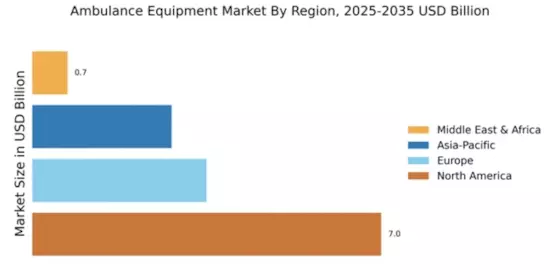
North America is poised to maintain its leadership in the ambulance equipment market, holding a significant share of 7.01 billion in 2024. The growth is driven by increasing healthcare expenditures, advancements in medical technology, and stringent regulations ensuring high-quality emergency services. The demand for innovative ambulance equipment is further fueled by the rising incidence of emergencies and the need for rapid response capabilities. The competitive landscape in North America is robust, featuring key players such as Stryker, Zoll Medical Corporation, and Medtronic. The U.S. remains the largest market, supported by a well-established healthcare infrastructure and a high level of investment in emergency medical services. The presence of leading manufacturers and continuous innovation in ambulance technology contribute to the region's dominance in the global market.

Europe : Emerging Market with Growth Potential

Europe's ambulance equipment market is valued at 3.5 billion, reflecting a growing demand driven by an aging population and increasing emergency medical service requirements. Regulatory frameworks across the EU are becoming more stringent, promoting the adoption of advanced medical technologies. The focus on improving patient outcomes and response times is a key catalyst for market growth, alongside government initiatives to enhance healthcare systems. Leading countries in this region include Germany, France, and the UK, where significant investments in healthcare infrastructure are evident. Major players like Philips and Hamilton Medical are actively expanding their product offerings to meet the evolving needs of emergency services. The competitive landscape is characterized by innovation and collaboration among manufacturers, ensuring that Europe remains a vital player in The Ambulance Equipment.

Asia-Pacific : Rapidly Growing Market Dynamics

The Asia-Pacific ambulance equipment market, valued at 2.8 billion, is experiencing rapid growth due to increasing urbanization, rising healthcare investments, and a growing awareness of emergency medical services. Countries like China and India are witnessing significant improvements in their healthcare infrastructure, which is driving demand for advanced ambulance equipment. Regulatory support for emergency services is also enhancing market dynamics, ensuring compliance with international standards. China and India are leading the charge in this region, with substantial investments from both public and private sectors. The competitive landscape features key players such as Ferno-Washington and Medtronic, who are focusing on innovation and localization of products to cater to diverse market needs. The growing emphasis on improving emergency response times is further propelling the market forward, making Asia-Pacific a critical area for future growth.

Middle East and Africa : Emerging Market with Challenges

The Middle East and Africa ambulance equipment market is valued at 0.71 billion, reflecting a nascent but growing sector. The market is driven by increasing investments in healthcare infrastructure and a rising demand for emergency medical services. However, challenges such as regulatory hurdles and varying levels of healthcare access across countries can impede growth. Governments are increasingly recognizing the importance of emergency services, leading to gradual improvements in regulations and standards. Countries like South Africa and the UAE are at the forefront of this market, with investments aimed at enhancing emergency response capabilities. The competitive landscape includes local and international players, with a focus on adapting products to meet regional needs. As the market evolves, the presence of key manufacturers will be crucial in addressing the unique challenges faced in this region.

Key Players and Competitive Insights

The Ambulance Equipment Market is characterized by a dynamic competitive landscape, driven by technological advancements, increasing demand for emergency medical services, and a growing emphasis on patient care quality. Key players such as Stryker (US), Zoll Medical Corporation (US), and Philips (NL) are at the forefront, each adopting distinct strategies to enhance their market positioning. Stryker (US) focuses on innovation in medical devices, particularly in advanced stretcher systems and monitoring equipment, while Zoll Medical Corporation (US) emphasizes the integration of digital solutions in resuscitation and monitoring technologies. Philips (NL) is leveraging its expertise in healthcare technology to develop connected ambulance solutions, thereby enhancing operational efficiency and patient outcomes. Collectively, these strategies contribute to a competitive environment that prioritizes innovation and quality in emergency medical services.

In terms of business tactics, companies are increasingly localizing manufacturing to reduce costs and improve supply chain efficiency. This approach is particularly relevant in a moderately fragmented market where smaller players coexist alongside larger corporations. The collective influence of these key players shapes the market structure, as they engage in strategic partnerships and collaborations to enhance their product offerings and expand their geographical reach.

In November 2025, Stryker (US) announced a partnership with a leading telemedicine provider to integrate remote monitoring capabilities into its ambulance equipment. This strategic move is likely to enhance real-time patient data transmission, thereby improving decision-making during emergencies. Such innovations not only bolster Stryker's product portfolio but also align with the growing trend of digital health solutions in emergency services.

In October 2025, Zoll Medical Corporation (US) launched a new line of portable defibrillators designed specifically for use in ambulances. This product introduction reflects the company's commitment to enhancing patient care through advanced technology. The portable nature of these defibrillators is expected to facilitate quicker response times, which is critical in emergency situations, thereby reinforcing Zoll's competitive edge in the market.

In September 2025, Philips (NL) unveiled a new connected ambulance solution that integrates real-time data analytics and communication systems. This initiative aims to streamline operations and improve patient outcomes by providing emergency responders with critical information before arrival at the hospital. The strategic importance of this development lies in its potential to transform ambulance operations, making them more efficient and responsive to patient needs.

As of December 2025, the Ambulance Equipment Market is witnessing trends such as digitalization, sustainability, and the integration of artificial intelligence (AI) into emergency medical services. Strategic alliances among key players are increasingly shaping the competitive landscape, fostering innovation and enhancing service delivery. The shift from price-based competition to a focus on technological advancement and supply chain reliability is evident, suggesting that future competitive differentiation will hinge on the ability to innovate and adapt to evolving market demands.

Key Companies in the Ambulance Equipment Market market include

Industry Developments

  • Q2 2024: Philips launches new portable defibrillator for ambulances Philips announced the launch of its latest portable defibrillator designed specifically for ambulance use, featuring enhanced connectivity and real-time data transmission to hospitals.
  • Q2 2024: Stryker announces acquisition of ambulance cot manufacturer Ferno Stryker completed the acquisition of Ferno, a leading manufacturer of ambulance cots and patient transport equipment, expanding its emergency medical product portfolio.
  • Q3 2024: ZOLL Medical receives FDA clearance for new advanced ventilator for ambulances ZOLL Medical received FDA clearance for its new advanced ventilator, designed for use in ambulances and emergency transport vehicles, enabling improved respiratory support for critical patients.
  • Q3 2024: Ambu and Laerdal partner to develop next-generation training manikins for EMTs Ambu and Laerdal announced a partnership to co-develop next-generation training manikins for emergency medical technicians, focusing on realistic simulation for ambulance-based care.
  • Q4 2024: GE HealthCare and BARDA collaborate on AI-powered portable ultrasound for ambulances GE HealthCare entered a collaboration with the U.S. Biomedical Advanced Research and Development Authority (BARDA) to develop AI-powered portable ultrasound devices for use in ambulances.
  • Q4 2024: Medline opens new ambulance equipment manufacturing facility in Texas Medline announced the opening of a new manufacturing facility in Texas dedicated to producing ambulance equipment, including stretchers and emergency medical kits.
  • Q1 2025: Smiths Medical launches compact infusion pump for ambulance use Smiths Medical launched a new compact infusion pump designed for ambulance environments, offering advanced safety features and portability for emergency medical teams.
  • Q1 2025: Cardinal Health secures multi-year contract to supply ambulance equipment to NHS Cardinal Health was awarded a multi-year contract to supply ambulance equipment, including stretchers and monitoring devices, to the UK National Health Service.
  • Q2 2025: Airbus delivers first batch of H140 helicopters equipped for air ambulance service Airbus delivered the first batch of H140 helicopters configured for air ambulance service, featuring expanded cabin space for advanced life support equipment.
  • Q2 2025: Ferno unveils modular ambulance interior system at EMS World Expo Ferno introduced a new modular ambulance interior system at the EMS World Expo, designed to improve workflow and equipment accessibility for emergency medical teams.
  • Q3 2025: Stryker appoints new President of Emergency Care division Stryker announced the appointment of a new President for its Emergency Care division, responsible for overseeing the company's ambulance equipment and emergency medical product lines.
  • Q3 2025: Philips secures regulatory approval for telemedicine platform integration in ambulances Philips received regulatory approval to integrate its telemedicine platform into ambulance fleets, enabling real-time patient monitoring and remote physician consultation during transport.

Future Outlook

Ambulance Equipment Market Future Outlook

The Ambulance Equipment Market is projected to grow at a 5.45% CAGR from 2024 to 2035, driven by technological advancements, increasing healthcare demands, and regulatory support.

New opportunities lie in:

  • Integration of telemedicine solutions in ambulances
  • Development of advanced patient monitoring systems
  • Expansion of eco-friendly ambulance equipment options

By 2035, the market is expected to be robust, reflecting substantial growth and innovation.

Market Segmentation

Ambulance Equipment Market End Use Outlook

  • Public Ambulance Services
  • Private Ambulance Services
  • Hospital-Based Ambulance Services
  • Non-Emergency Medical Transport
  • Air Ambulance Services

Ambulance Equipment Market Application Outlook

  • Emergency Medical Services
  • Patient Transport
  • Rescue Operations
  • Disaster Response
  • Fire Services

Ambulance Equipment Market Equipment Type Outlook

  • Defibrillators
  • Stretchers
  • Ambulance Cots
  • Medical Monitors
  • Ventilators

Report Scope

MARKET SIZE 2024 14.02(USD Billion)
MARKET SIZE 2025 14.79(USD Billion)
MARKET SIZE 2035 25.15(USD Billion)
COMPOUND ANNUAL GROWTH RATE (CAGR) 5.45% (2024 - 2035)
REPORT COVERAGE Revenue Forecast, Competitive Landscape, Growth Factors, and Trends
BASE YEAR 2024
Market Forecast Period 2025 - 2035
Historical Data 2019 - 2024
Market Forecast Units USD Billion
Key Companies Profiled Stryker (US), Zoll Medical Corporation (US), Ferno-Washington, Inc. (US), Medtronic (US), Philips (NL), Hamilton Medical (CH), Graham-Field Health Products, Inc. (US), Ambulance Medical Equipment (US), Medi-Kit (FR)
Segments Covered Application, Equipment Type, End Use
Key Market Opportunities Integration of advanced telemedicine solutions in the Ambulance Equipment Market enhances patient care and operational efficiency.

Key Market Dynamics Technological advancements and regulatory changes drive innovation and competition in the ambulance equipment market.
Countries Covered North America, Europe, APAC, South America, MEA

Leave a Comment

FAQs

What is the projected growth of the Ambulance Equipment market?

The Ambulance Equipment market is the expected increase in total market value of 25.15 USD billion over a defined forecast period 2025–2035. It is driven by factors such as demand trends, technological advances, regulatory changes, and geographic expansion.

What is the size of the Ambulance Equipment market?

Ambulance Equipment market size was valued at approximately 14.02 billion USD in 2024. This figure will reach 25.15 billion USD covering all regions (America, Europe, Asia, MEA and ROW), focusing its segments / services / distribution channels till 2035.

What is the CAGR of the Ambulance Equipment market?

Ambulance Equipment market is expected to grow at a CAGR of 5.45% between 2025 and 2035.

How much will the Ambulance Equipment market be worth by 2035?

Ambulance Equipment market is expected to be worth of 25.15 billion USD, reflecting growth driven by usage, technology and global demands by the end of 2035.

How will the Ambulance Equipment market perform over the next 10 years?

Over the next 10 years the Ambulance Equipment market is expected to shift from usd billion 14.02 to 25.15 billion USD, led by adoption of advanced tech, demographic trends, regulatory approvals, with potential headwinds from 2025 to 2035.

What was the value of the Ambulance Equipment Market in 2024?

The Ambulance Equipment Market was valued at 12.61 billion USD in 2024.

Which region held the largest market share in the Ambulance Equipment Market in 2024?

North America held the largest market share in the Ambulance Equipment Market in 2024.

What are the key factors driving the growth of the Ambulance Equipment Market?

Rising demand for advanced ambulance services, increasing prevalence of chronic diseases, and technological advancements are driving the growth of the Ambulance Equipment Market.

Who are the major competitors in the Ambulance Equipment Market?

Major competitors in the Ambulance Equipment Market include Stryker, ZOLL Medical Corporation, and Spencer.

What are the different types of ambulance equipment available in the market?

Ambulance equipment includes stretchers, patient monitors, defibrillators, suction units, and oxygen delivery systems.

Download Free Sample

Kindly complete the form below to receive a free sample of this Report

Compare Licence

×
Features License Type
Single User Multiuser License Enterprise User
Price $4,950 $5,950 $7,250
Maximum User Access Limit 1 User Upto 10 Users Unrestricted Access Throughout the Organization
Free Customization
Direct Access to Analyst
Deliverable Format
Platform Access
Discount on Next Purchase 10% 15% 15%
Printable Versions