×
Request Free Sample ×

Kindly complete the form below to receive a free sample of this Report

* Please use a valid business email

Leading companies partner with us for data-driven Insights

clients tt-cursor
Hero Background

Amino Acid For Agriculture Market

ID: MRFR/CnM/25652-HCR
111 Pages
Chitranshi Jaiswal
October 2025

Amino Acid For Agriculture Market Research Report: By Type (Proteinogenic Amino Acids, Non-Proteinogenic Amino Acids), By Application (Animal Feed, Plant Nutrition, Biofertilizers, Soil Amendments), By Source (Fermentation, Hydrolysis, Chemical Synthesis), By Crop Type (Cereals, Legumes, Oilseeds, Fruits, Vegetables), By Formulation (Liquid, Solid, Granulated) and By Regional (North America, Europe, South America, Asia Pacific, Middle East and Africa) - Forecast to 2035

Share:
Download PDF ×

We do not share your information with anyone. However, we may send you emails based on your report interest from time to time. You may contact us at any time to opt-out.

Amino Acid For Agriculture Market Infographic
Purchase Options

Amino Acid For Agriculture Market Summary

As per MRFR analysis, the Amino Acid For Agriculture Market Size was estimated at 7.21 USD Billion in 2024. The Amino Acid For Agriculture industry is projected to grow from 7.483 USD Billion in 2025 to 10.85 USD Billion by 2035, exhibiting a compound annual growth rate (CAGR) of 3.78 during the forecast period 2025 - 2035.

Key Market Trends & Highlights

The Amino Acid For Agriculture Market is experiencing a dynamic shift towards sustainable practices and innovative solutions.

  • The North American region remains the largest market for amino acids in agriculture, driven by advanced agricultural technologies.
  • Asia-Pacific is emerging as the fastest-growing region, reflecting a rising demand for sustainable agricultural inputs.
  • Proteinogenic amino acids dominate the market, while non-proteinogenic amino acids are witnessing rapid growth due to innovative applications.
  • Key market drivers include the increasing focus on soil health and the rising demand for organic produce, which are shaping industry dynamics.

Market Size & Forecast

2024 Market Size 7.21 (USD Billion)
2035 Market Size 10.85 (USD Billion)
CAGR (2025 - 2035) 3.78%

Major Players

Ajinomoto (JP), BASF (DE), Evonik Industries (DE), Archer Daniels Midland Company (US), Nutreco (NL), Kemin Industries (US), Yara International (NO), Amino GmbH (DE)

Amino Acid For Agriculture Market Trends

The Amino Acid For Agriculture Market is currently experiencing a notable transformation, driven by the increasing demand for sustainable agricultural practices and the need for enhanced crop productivity. As farmers and agronomists seek to optimize yields while minimizing environmental impact, amino acids are emerging as a vital component in modern agricultural strategies. These organic compounds play a crucial role in plant growth, nutrient absorption, and stress resistance, thereby contributing to healthier crops and improved soil quality. Furthermore, the rising awareness of the benefits associated with amino acid applications is fostering innovation in product formulations and delivery methods, which may lead to broader adoption across various agricultural sectors. In addition, the Amino Acid For Agriculture Market is likely to witness a surge in research and development activities aimed at exploring new applications and formulations. This trend appears to be fueled by the growing interest in organic farming and the increasing regulatory pressures on chemical fertilizers and pesticides. As a result, stakeholders in the agricultural sector are expected to invest in the development of amino acid-based products that align with eco-friendly practices. Overall, the market seems poised for growth, with a focus on sustainability and efficiency in agricultural production.

Sustainable Agriculture Practices

The shift towards sustainable farming is influencing the Amino Acid For Agriculture Market. Farmers are increasingly adopting eco-friendly methods, which often incorporate amino acids to enhance soil health and crop resilience. This trend reflects a broader commitment to environmental stewardship.

Innovative Product Development

There is a growing emphasis on research and development within the Amino Acid For Agriculture Market. Companies are exploring novel formulations and delivery systems to maximize the efficacy of amino acids in various agricultural applications, catering to diverse crop needs.

Regulatory Influence on Fertilizer Use

Regulatory changes regarding chemical fertilizers are impacting the Amino Acid For Agriculture Market. As governments impose stricter guidelines, the demand for amino acid-based solutions is likely to increase, as they offer a more sustainable alternative to traditional fertilizers.

Amino Acid For Agriculture Market Drivers

Increased Focus on Soil Health

The growing awareness of soil health and its impact on crop productivity is a significant driver for the Amino Acid For Agriculture Market. Healthy soil is essential for sustainable agriculture, and amino acids contribute to soil fertility by promoting microbial activity and nutrient availability. Recent studies indicate that amino acid-based fertilizers can enhance soil structure and nutrient retention, leading to improved crop yields. As farmers increasingly prioritize soil health, the demand for amino acid products is likely to rise, further stimulating the Amino Acid For Agriculture Market. This focus on sustainable practices aligns with broader agricultural trends aimed at long-term productivity.

Rising Demand for Organic Produce

The increasing consumer preference for organic produce is a pivotal driver for the Amino Acid For Agriculture Market. As consumers become more health-conscious, the demand for organic fruits and vegetables has surged. This trend is reflected in market data, indicating that organic food sales have grown significantly, with projections suggesting a continued upward trajectory. Amino acids play a crucial role in organic farming by enhancing plant growth and improving nutrient uptake. Consequently, farmers are increasingly adopting amino acid-based fertilizers to meet the rising demand for organic produce, thereby propelling the Amino Acid For Agriculture Market forward.

Advancements in Agricultural Technology

Technological advancements in agriculture are transforming farming practices, thereby influencing the Amino Acid For Agriculture Market. Innovations such as precision farming and biotechnology are enabling farmers to optimize their crop yields and resource utilization. For instance, the integration of amino acids in fertilizers has been shown to enhance plant resilience against environmental stressors. Market data indicates that the adoption of such technologies is on the rise, with many farmers recognizing the benefits of amino acid applications. This trend suggests a promising future for the Amino Acid For Agriculture Market as technology continues to evolve and improve agricultural efficiency.

Growing Awareness of Nutritional Benefits

The increasing awareness of the nutritional benefits of amino acids in agriculture is driving the Amino Acid For Agriculture Market. Farmers and agronomists are recognizing that amino acids not only enhance plant growth but also improve the nutritional quality of crops. This awareness is supported by research indicating that amino acid applications can lead to higher protein content in crops, which is particularly important for food security. As the demand for nutrient-rich food continues to rise, the Amino Acid For Agriculture Market is likely to experience growth, as more farmers adopt amino acid-based solutions to enhance crop quality.

Regulatory Support for Sustainable Practices

Regulatory frameworks promoting sustainable agricultural practices are influencing the Amino Acid For Agriculture Market. Governments worldwide are implementing policies that encourage the use of environmentally friendly fertilizers, including those based on amino acids. These regulations aim to reduce chemical runoff and promote sustainable farming methods. Market data suggests that regions with stringent environmental regulations are witnessing a shift towards amino acid-based fertilizers, as they align with sustainability goals. This regulatory support is likely to bolster the Amino Acid For Agriculture Market, as farmers seek compliant and effective solutions to enhance crop production.

Market Segment Insights

By Type: Proteinogenic Amino Acids (Largest) vs. Non-Proteinogenic Amino Acids (Fastest-Growing)

In the amino acid for agriculture market, proteinogenic amino acids hold the largest share due to their essential role in plant growth and nutrient absorption. These amino acids are critical for the synthesis of proteins that enhance crop yield and quality, making them a preferred choice among agricultural stakeholders. Non-proteinogenic amino acids, while currently smaller in market share, are gaining traction as their unique benefits in promoting plant health and stress resistance become more recognized.

Amino Acids: Proteinogenic (Dominant) vs. Non-Proteinogenic (Emerging)

Proteinogenic amino acids are the building blocks of proteins and play a pivotal role in plant physiology by facilitating nutrient uptake and promoting growth. Their dominance in the market is attributed to their established effectiveness and widespread application among farmers. Conversely, non-proteinogenic amino acids are emerging as a noteworthy segment, particularly for their ability to enhance stress tolerance and trigger plant defense mechanisms. These amino acids are increasingly adopted in innovative agricultural practices, driven by the need for sustainable farming solutions, which is contributing significantly to their rapid growth.

By Application: Animal Feed (Largest) vs. Plant Nutrition (Fastest-Growing)

In the Amino Acid For Agriculture Market, the application segment is prominently characterized by its division into Animal Feed, Plant Nutrition, Biofertilizers, and Soil Amendments. Among these, Animal Feed holds the largest market share due to its significant role in livestock health and productivity. Plant Nutrition, however, is quickly gaining ground as a vital component in enhancing crop yields and quality. As farmers increasingly adopt amino acids to optimize plant performance, the competition within this segment intensifies, marking a dynamic shift in market preferences.

Animal Feed (Dominant) vs. Plant Nutrition (Emerging)

Animal Feed has emerged as a dominant segment within the Amino Acid For Agriculture Market, attributed to its critical function in livestock nutrition, boosting animal health, and overall productivity. It focuses on enhancing feed efficiency and supporting animal growth through essential amino acids. On the other hand, Plant Nutrition represents an emerging segment, reflecting growing agronomic innovations aimed at improving crop resistance and yield through amino acids. This segment is rapidly gaining traction among farmers, driven by the increasing demand for sustainable agricultural practices that promote plant health and minimize chemical inputs.

By Source: Fermentation (Largest) vs. Hydrolysis (Fastest-Growing)

In the Amino Acid for Agriculture Market, the source segment has exhibited diverse capabilities with fermentation leading the market. This process accounts for a substantial share due to its efficiency, sustainability, and the ability to produce natural amino acids. Hydrolysis follows closely, gaining traction as organic farming practices increase, and is recognized for the rapid conversion of complex proteins into amino acids, enhancing its appeal among various agricultural applications. On the other hand, chemical synthesis, while widely utilized, represents a smaller portion of the market share, primarily due to concerns over sustainability and potential residual impacts on the environment. The growth trends within the source segment show a clear shift towards fermentation, fueled by rising demands for natural and organic inputs in agriculture. Innovations in fermentation technologies and the increasing inclination towards eco-friendly practices have spurred investments and developments in this area. Hydrolysis is also experiencing significant growth, emerging as a favored approach within sustainable agriculture due to its efficiency in producing essential amino acids that support plant growth. Chemical synthesis, although slower in growth, remains relevant in scenarios where cost-effectiveness takes precedence. The combined dynamics of these sources indicate a transformative phase in the Amino Acid for Agriculture Market driven by sustainability and agricultural productivity needs.

Fermentation (Dominant) vs. Hydrolysis (Emerging)

Fermentation stands out as the dominant source in the Amino Acid for Agriculture Market, valued for its sustainable approach to amino acid production. This method involves utilizing microorganisms to break down organic materials, making it a preferred choice for eco-conscious farmers seeking natural solutions. Its reliability in producing high-quality amino acids has solidified its position at the forefront of this segment. In contrast, hydrolysis is an emerging technique gaining traction for its ability to rapidly process proteins into amino acids, often demanded in high-efficiency agriculture practices. While fermentation is established, hydrolysis is capitalizing on advancements in technology that enhance its output and quality. The increasing awareness of sustainable agriculture is further propelling hydrolysis into the spotlight, establishing it as a strong contender in the market.

By Crop Type: Cereals (Largest) vs. Legumes (Fastest-Growing)

In the Amino Acid for Agriculture Market, the segment of Cereals holds the largest share, dominating the market landscape. This segment includes crops such as wheat, rice, and corn, which are fundamental to food security and provide essential nutrition globally. As such, their high demand ensures that cereals remain a critical focus for amino acid utilization, enhancing crop yield and quality in agricultural practices. On the other hand, Legumes are emerging as the fastest-growing segment in this market. With an increase in the popularity of plant-based diets and the necessity for sustainable farming practices, legumes such as soybeans, peas, and lentils are gaining traction. Their ability to fix nitrogen in the soil, paired with the growing awareness of their health benefits, drives their demand for amino acid application to boost productivity and nutritional value.

Cereals: (Dominant) vs. Legumes (Emerging)

Cereals are the dominant crop type within the amino acid for agriculture market, owing to their critical role as staple foods around the world. The effectiveness of amino acids in enhancing their growth, nutritional content, and resistance to pests and diseases solidifies their market position. In contrast, legumes are the emerging segment, driven by the recent trend towards sustainable agriculture and nutritious diets. With their ability to enrich soil fertility through nitrogen fixation, they are increasingly favored by farmers aiming for sustainable practices. The growing demand for plant-based protein sources makes legumes a focal point, leading to heightened interest in amino acid applications to improve crop yield and resilience.

By Formulation: Liquid (Largest) vs. Granulated (Fastest-Growing)

The formulation segment of the Amino Acid For Agriculture Market exhibits a diverse share distribution among liquid, solid, and granulated forms. Liquid formulations hold the largest share, known for their easy application and quick absorption by plants, making them a preferred choice among farmers. Meanwhile, granulated forms are gaining traction due to their ease of handling and storage, resulting in a growing share in the market. Solid formulations maintain a stable presence, serving specific agricultural needs but are less favored compared to their liquid counterparts.

Liquid (Dominant) vs. Granulated (Emerging)

Liquid formulations dominate the Amino Acid For Agriculture Market as they offer superior nutrient delivery, allowing for immediate plant uptake. This formulation type is ideal for foliar applications, making it highly effective in addressing nutrient deficiencies promptly. In contrast, granulated formulations are on the rise due to their convenience for bulk application and longer shelf life, positioning them as an emerging product in the segment. While liquid products are preferred for quick results, granulated forms are appealing for their cost-effectiveness and suitability for various crop types, enhancing their market position.

Get more detailed insights about Amino Acid For Agriculture Market

Regional Insights

North America : Agricultural Innovation Leader

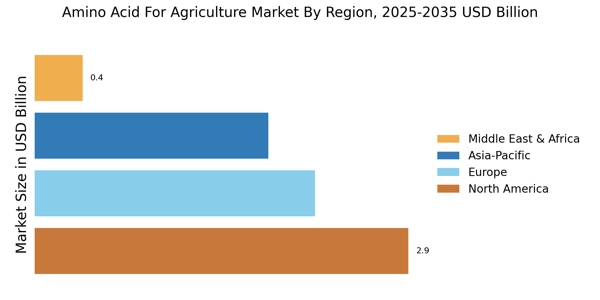
North America is witnessing significant growth in the amino acid for agriculture market, driven by increasing demand for sustainable farming practices and enhanced crop yields. The region holds approximately 40% of the global market share, making it the largest market. Regulatory support for bio-based fertilizers and a shift towards organic farming are key catalysts for this growth. The United States and Canada are the leading countries in this sector, with major players like Archer Daniels Midland Company and Kemin Industries establishing a strong presence. The competitive landscape is characterized by innovation and strategic partnerships among key players, ensuring a robust supply chain and product development in amino acids for agriculture.

Europe : Sustainable Agriculture Focus

Europe is emerging as a significant player in the amino acid for agriculture market, holding around 30% of the global share. The region's growth is fueled by stringent regulations promoting sustainable agricultural practices and the increasing adoption of organic farming. The European Union's Green Deal and Farm to Fork strategy are pivotal in shaping market dynamics, encouraging the use of amino acids as eco-friendly fertilizers. Germany, France, and the Netherlands are at the forefront of this market, with key players like BASF and Evonik Industries leading the charge. The competitive landscape is marked by innovation in product formulations and a focus on research and development, ensuring that European farmers have access to high-quality amino acid products that enhance crop productivity.

Asia-Pacific : Emerging Market Potential

Asia-Pacific is rapidly becoming a vital market for amino acids in agriculture, accounting for approximately 25% of the global market share. The region's growth is driven by increasing agricultural productivity demands and the rising adoption of modern farming techniques. Countries like China and India are focusing on enhancing crop yields through innovative solutions, including amino acid-based fertilizers, supported by government initiatives and subsidies. China and India are the leading countries in this market, with a growing number of local and international players entering the landscape. Companies like Yara International and Nutreco are expanding their operations in the region, fostering competition and innovation. The presence of diverse agricultural practices and a large farming population further contribute to the market's potential in Asia-Pacific.

Middle East and Africa : Resource-Rich Agricultural Frontier

The Middle East and Africa region is witnessing a burgeoning demand for amino acids in agriculture, holding about 5% of the global market share. This growth is primarily driven by the need for improved agricultural productivity in arid regions and the increasing focus on food security. Governments are implementing policies to support sustainable agricultural practices, which is catalyzing the adoption of amino acid-based fertilizers in the region. Countries like South Africa and Egypt are leading the charge, with a growing interest from international players looking to tap into this emerging market. The competitive landscape is evolving, with local companies and global giants like Amino GmbH entering the fray, enhancing the availability of innovative products tailored to the unique agricultural challenges faced in the region.

Amino Acid For Agriculture Market Regional Image

Key Players and Competitive Insights

Major players in Amino Acid For Agriculture Market industry are constantly seeking to expand their market share through mergers, acquisitions, and strategic collaborations. Leading Amino Acid For Agriculture Market players are also investing in research and development to innovate new products and technologies. The Amino Acid For Agriculture Market is expected to witness significant growth in the coming years, owing to the increasing demand for amino acids in animal feed and fertilizer applications. The competitive landscape of the Amino Acid For Agriculture Market is fragmented, with a large number of players operating in the market.

However, the market is dominated by a few key players, such as Evonik Industries, Ajinomoto, and Archer Daniels Midland Company. These players have a strong global presence and offer a wide range of amino acids for various applications.Evonik Industries is a leading global supplier of amino acids for animal nutrition. The company has a strong presence in the Asia-Pacific region, where it operates several production facilities. Evonik Industries offers a wide range of amino acids, including lysine, methionine, and threonine. The company is also a major supplier of amino acids for fertilizer applications.

Ajinomoto is a leading global supplier of amino acids for food and beverage applications. The company has a strong presence in the Asia-Pacific region, where it operates several production facilities. Ajinomoto offers a wide range of amino acids, including lysine, glutamic acid, and aspartic acid. The company is also a major supplier of amino acids for animal feed applications. Archer Daniels Midland Company (ADM) is a leading global supplier of agricultural commodities and ingredients. The company has a strong presence in the Americas, where it operates several production facilities.

ADM offers a wide range of amino acids, including lysine, methionine, and threonine. The company is also a major supplier of amino acids for animal feed applications.Cargill is a leading global supplier of agricultural commodities and ingredients. The company has a strong presence in the Americas, where it operates several production facilities. Cargill offers a wide range of amino acids, including lysine, methionine, and threonine. The company is also a major supplier of amino acids for animal feed applications. Chemoxy International is a leading global supplier of amino acids for animal nutrition.

The company has a strong presence in the Asia-Pacific region, where it operates several production facilities. Chemoxy International offers a wide range of amino acids, including lysine, methionine, and threonine. The company is also a major supplier of amino acids for fertilizer applications.

Key Companies in the Amino Acid For Agriculture Market market include

Industry Developments

Rising demand for amino acids in animal feed, increasing awareness about the importance of amino acids in crop production, and growing adoption of precision farming practices are driving market growth. Key industry developments in recent years include the launch of novel amino acid products tailored for specific crop and livestock needs, strategic collaborations between market players to expand product portfolios, and government initiatives promoting sustainable agriculture practices.

Future Outlook

Amino Acid For Agriculture Market Future Outlook

The Amino Acid For Agriculture Market is projected to grow at a 3.78% CAGR from 2024 to 2035, driven by increasing demand for sustainable agriculture and enhanced crop yields.

New opportunities lie in:

  • Development of customized amino acid formulations for specific crops
  • Expansion into emerging markets with tailored marketing strategies
  • Integration of amino acids in precision agriculture technologies

By 2035, the market is expected to be robust, reflecting significant advancements and strategic growth.

Market Segmentation

Amino Acid For Agriculture Market Type Outlook

  • Proteinogenic Amino Acids
  • Non-Proteinogenic Amino Acids

Amino Acid For Agriculture Market Source Outlook

  • Fermentation
  • Hydrolysis
  • Chemical Synthesis

Amino Acid For Agriculture Market Crop Type Outlook

  • Cereals
  • Legumes
  • Oilseeds
  • Fruits
  • Vegetables

Amino Acid For Agriculture Market Application Outlook

  • Animal Feed
  • Plant Nutrition
  • Biofertilizers
  • Soil Amendments

Amino Acid For Agriculture Market Formulation Outlook

  • Liquid
  • Solid
  • Granulated

Report Scope

MARKET SIZE 20247.21(USD Billion)
MARKET SIZE 20257.483(USD Billion)
MARKET SIZE 203510.85(USD Billion)
COMPOUND ANNUAL GROWTH RATE (CAGR)3.78% (2024 - 2035)
REPORT COVERAGERevenue Forecast, Competitive Landscape, Growth Factors, and Trends
BASE YEAR2024
Market Forecast Period2025 - 2035
Historical Data2019 - 2024
Market Forecast UnitsUSD Billion
Key Companies ProfiledMarket analysis in progress
Segments CoveredMarket segmentation analysis in progress
Key Market OpportunitiesGrowing demand for sustainable agriculture practices drives innovation in the Amino Acid For Agriculture Market.
Key Market DynamicsRising demand for sustainable agriculture drives innovation in amino acid formulations and application techniques.
Countries CoveredNorth America, Europe, APAC, South America, MEA

Leave a Comment

FAQs

What is the projected market valuation for the Amino Acid For Agriculture Market in 2035?

The projected market valuation for the Amino Acid For Agriculture Market in 2035 is expected to reach 10.85 USD Billion.

What was the market valuation for the Amino Acid For Agriculture Market in 2024?

The market valuation for the Amino Acid For Agriculture Market in 2024 was 7.21 USD Billion.

What is the expected CAGR for the Amino Acid For Agriculture Market from 2025 to 2035?

The expected CAGR for the Amino Acid For Agriculture Market during the forecast period 2025 - 2035 is 3.78%.

Which companies are considered key players in the Amino Acid For Agriculture Market?

Key players in the Amino Acid For Agriculture Market include Ajinomoto, BASF, Evonik Industries, Archer Daniels Midland Company, Nutreco, Kemin Industries, Yara International, and Amino GmbH.

What are the main applications of amino acids in agriculture?

The main applications of amino acids in agriculture include Animal Feed, Plant Nutrition, Biofertilizers, and Soil Amendments, with respective market valuations of 2.5, 2.0, 1.5, and 1.21 USD Billion in 2024.

How do proteinogenic and non-proteinogenic amino acids compare in market valuation?

In 2024, proteinogenic amino acids were valued at 3.61 USD Billion, while non-proteinogenic amino acids had a valuation of 3.6 USD Billion.

What is the market valuation for different formulations of amino acids in agriculture?

In 2024, the market valuations for different formulations were 2.88 USD Billion for Liquid, 2.16 USD Billion for Solid, and 2.17 USD Billion for Granulated.

Which crop types are most associated with amino acid applications in agriculture?

Cereals, Legumes, Oilseeds, Fruits, and Vegetables are the primary crop types associated with amino acid applications, with valuations of 2.5, 1.2, 1.0, 1.0, and 1.51 USD Billion respectively in 2024.

What sources are utilized for amino acid production in agriculture?

The sources for amino acid production in agriculture include Fermentation, Hydrolysis, and Chemical Synthesis, with market valuations of 2.5, 2.0, and 2.71 USD Billion in 2024.

What trends are anticipated in the Amino Acid For Agriculture Market by 2035?

By 2035, the Amino Acid For Agriculture Market is likely to experience growth driven by increasing demand in various applications, with a projected valuation of 10.85 USD Billion.

Download Free Sample

Kindly complete the form below to receive a free sample of this Report

Compare Licence

×
Features License Type
Single User Multiuser License Enterprise User
Price $4,950 $ $7,250
Maximum User Access Limit 1 User Upto 10 Users Unrestricted Access Throughout the Organization
Free Customization
Direct Access to Analyst
Deliverable Format
Platform Access
Discount on Next Purchase 10% 15% 15%
Printable Versions