×
Request Free Sample ×

Kindly complete the form below to receive a free sample of this Report

* Please use a valid business email

Leading companies partner with us for data-driven Insights

clients tt-cursor
Hero Background

Amino Acid Analyzer For Industrial Preclinical Clinical Usage Market

ID: MRFR/CnM/25651-HCR
100 Pages
Priya Nagrale
October 2025

Amino Acid Analyzer For Industrial Preclinical And Clinical Usage Market Research Report: By Application (Preclinical Research, Clinical Research, Industrial Process Control, Food and Beverage Analysis, Pharmaceutical Development), By Method (Ion-Exchange Chromatography, High-Performance Liquid Chromatography, Gas Chromatography, Isotope Dilution Mass Spectrometry, Capillary Electrophoresis), By Sample Type (Cell Culture, Tissue Homogenate, Blood, Urine, Food Products), By Configuration (Benchtop, Floor-Standing, Portable), By End-User (Phar... read more

Share:
Download PDF ×

We do not share your information with anyone. However, we may send you emails based on your report interest from time to time. You may contact us at any time to opt-out.

Amino Acid Analyzer For Industrial Preclinical Clinical Usage Market Infographic
Purchase Options

Amino Acid Analyzer For Industrial Preclinical Clinical Usage Market Summary

As per MRFR analysis, the Amino Acid Analyzer For Industrial Preclinical And Clinical Usage Market was estimated at 2.478 USD Billion in 2024. The market is projected to grow from 2.698 USD Billion in 2025 to 6.311 USD Billion by 2035, exhibiting a compound annual growth rate (CAGR) of 8.87 during the forecast period 2025 - 2035.

Key Market Trends & Highlights

The Amino Acid Analyzer market is poised for substantial growth driven by technological advancements and increasing demand for personalized medicine.

  • Technological advancements are enhancing the capabilities of amino acid analyzers, leading to more precise and efficient analyses.
  • The North American region remains the largest market, while the Asia-Pacific region is emerging as the fastest-growing market for amino acid analyzers.
  • In the clinical research segment, which is the largest, there is a notable shift towards automation and digital integration in laboratory processes.
  • Rising research and development activities, along with a growing focus on nutritional analysis, are key drivers propelling market expansion.

Market Size & Forecast

2024 Market Size 2.478 (USD Billion)
2035 Market Size 6.311 (USD Billion)
CAGR (2025 - 2035) 8.87%

Major Players

Hitachi High-Technologies Corporation (JP), Thermo Fisher Scientific Inc. (US), PerkinElmer Inc. (US), Agilent Technologies Inc. (US), Bio-Rad Laboratories Inc. (US), JASCO Corporation (JP), Sykam GmbH (DE), KNAUER Wissenschaftliche Geräte GmbH (DE)

Amino Acid Analyzer For Industrial Preclinical Clinical Usage Market Trends

The Amino Acid Analyzer For Industrial Preclinical And Clinical Usage Market is currently experiencing a notable evolution, driven by advancements in analytical technologies and increasing demand for precise amino acid profiling. This market appears to be influenced by a growing emphasis on personalized medicine, where understanding amino acid composition plays a crucial role in tailoring treatments. Furthermore, the rise in research activities across various sectors, including pharmaceuticals and biotechnology, suggests a heightened need for reliable analytical tools that can deliver accurate results efficiently. As industries continue to prioritize quality control and regulatory compliance, the adoption of amino acid analyzers is likely to expand, reflecting a broader trend towards enhanced laboratory capabilities. In addition, the integration of automation and digital technologies into amino acid analysis is becoming increasingly prevalent. This trend indicates a shift towards more streamlined processes, potentially reducing human error and increasing throughput in laboratory settings. Moreover, the focus on sustainability and environmentally friendly practices may influence the development of new analyzers that utilize less hazardous materials and energy-efficient methods. Overall, the Amino Acid Analyzer For Industrial Preclinical And Clinical Usage Market is poised for growth, driven by technological innovations and evolving industry needs, which may reshape the landscape of amino acid analysis in the near future.

Technological Advancements

The Amino Acid Analyzer For Industrial Preclinical And Clinical Usage Market is witnessing rapid technological advancements. Innovations in chromatography and mass spectrometry are enhancing the accuracy and efficiency of amino acid analysis. These developments may lead to more sophisticated analyzers that can handle complex samples with greater precision.

Increased Demand for Personalized Medicine

There is a growing demand for personalized medicine, which is influencing the Amino Acid Analyzer For Industrial Preclinical And Clinical Usage Market. As healthcare shifts towards individualized treatment plans, the need for detailed amino acid profiling becomes more critical. This trend suggests that analyzers will play a vital role in developing tailored therapies.

Automation and Digital Integration

The integration of automation and digital technologies is transforming the Amino Acid Analyzer For Industrial Preclinical And Clinical Usage Market. Automated systems are likely to improve laboratory efficiency by minimizing manual intervention and enhancing data accuracy. This trend indicates a move towards more streamlined and reliable analytical processes.

Amino Acid Analyzer For Industrial Preclinical Clinical Usage Market Drivers

Expansion of Biotechnology Sector

The Amino Acid Analyzer For Industrial Preclinical And Clinical Usage Market is benefiting from the expansion of the biotechnology sector. As biopharmaceutical companies develop novel therapies, the demand for amino acid analysis in the production and quality control processes is increasing. The biotechnology industry has seen substantial growth, with investments in biomanufacturing and therapeutic development rising. This growth necessitates the use of sophisticated analytical tools, such as amino acid analyzers, to ensure compliance with regulatory standards. The integration of these analyzers into bioprocessing workflows is likely to enhance product consistency and safety, further propelling market demand.

Growing Focus on Nutritional Analysis

The Amino Acid Analyzer For Industrial Preclinical And Clinical Usage Market is witnessing a heightened focus on nutritional analysis. As health and wellness trends gain traction, there is an increasing demand for amino acid profiling in food and dietary supplements. This trend is particularly relevant in the context of personalized nutrition, where consumers seek tailored dietary solutions. Market data indicates that the dietary supplements sector has expanded significantly, with amino acid supplements being a key component. Consequently, the need for reliable amino acid analyzers to ensure product quality and efficacy is becoming more pronounced, thereby driving market growth.

Rising Research and Development Activities

The Amino Acid Analyzer For Industrial Preclinical And Clinical Usage Market is experiencing a surge in research and development activities. This trend is driven by the increasing need for precise amino acid profiling in drug development and clinical trials. As pharmaceutical companies and research institutions invest heavily in R&D, the demand for advanced amino acid analyzers is likely to rise. According to recent data, the R&D expenditure in the pharmaceutical sector has shown a steady increase, suggesting a robust market for analytical instruments. The ability to accurately measure amino acid concentrations can significantly impact the efficacy of therapeutic interventions, thereby propelling the growth of this market.

Regulatory Compliance and Quality Assurance

The Amino Acid Analyzer For Industrial Preclinical And Clinical Usage Market is significantly influenced by the need for regulatory compliance and quality assurance in pharmaceutical and clinical settings. Regulatory bodies require stringent testing of amino acid content in various products, including drugs and supplements. This regulatory landscape compels manufacturers to adopt advanced analytical techniques, such as amino acid analyzers, to meet quality standards. The increasing emphasis on product safety and efficacy is driving investments in analytical instrumentation, thereby fostering market growth. As companies strive to adhere to regulatory requirements, the demand for reliable amino acid analysis tools is expected to rise.

Emerging Applications in Clinical Diagnostics

The Amino Acid Analyzer For Industrial Preclinical And Clinical Usage Market is poised for growth due to emerging applications in clinical diagnostics. The role of amino acids in various metabolic disorders and diseases is gaining recognition, leading to an increased need for diagnostic testing. Healthcare providers are increasingly utilizing amino acid profiling to aid in the diagnosis and management of conditions such as metabolic disorders and nutritional deficiencies. Market data suggests that the clinical diagnostics sector is expanding, with a growing emphasis on personalized medicine. This trend is likely to drive the demand for amino acid analyzers, as they play a crucial role in providing accurate diagnostic information.
Market Segment Insights

By Application: Clinical Research (Largest) vs. Food and Beverage Analysis (Fastest-Growing)

The Amino Acid Analyzer for Industrial Preclinical and Clinical Usage Market exhibits a diverse application landscape, with Clinical Research accounting for the largest share due to an increasing emphasis on precision medicine and tailored therapies. Preclinical Research and Pharmaceutical Development follow closely, reflecting the demand for extensive testing and validation stages in drug development. Meanwhile, Industrial Process Control also holds significant market relevance, ensuring quality assurance in manufacturing processes across various industries. Recent growth trends in the market highlight the Food and Beverage Analysis segment as the fastest-growing. The rising consumer demand for high-quality, amino-acid-rich products drives innovation and investment in testing technology. As regulatory standards for food safety become stricter, this segment is increasingly prioritized, contributing to a robust shift in market dynamics favoring analytical applications in food science.

Clinical Research (Dominant) vs. Pharmaceutical Development (Emerging)

In the Amino Acid Analyzer market, Clinical Research stands out as the dominant application, owing to its crucial role in advancing healthcare through rigorous testing protocols. This segment is characterized by a strong focus on accuracy and reliability, as clinical studies require stringent protocols to ensure valid results for patient treatment advancements. Conversely, Pharmaceutical Development is emerging as a prominent application led by innovative drug development practices. This segment emphasizes the need for comprehensive analysis during the drug formulation process, thus driving improvements in amino acid analyzers to meet evolving demands. The increasing collaboration between pharmaceutical companies and research institutions enhances the growth prospects for this segment, positioning it strategically within the larger analytical landscape.

By Method: High-Performance Liquid Chromatography (Largest) vs. Ion-Exchange Chromatography (Fastest-Growing)

The method segment of the Amino Acid Analyzer for Industrial Preclinical and Clinical Usage Market showcases a diverse range of analytical techniques. High-Performance Liquid Chromatography (HPLC) occupies the largest share, owing to its widespread adoption in various industrial applications and clinical settings. Following closely, Ion-Exchange Chromatography is emerging rapidly, capturing attention for its efficiency in separating amino acids with high precision. Recent trends indicate a strong growth trajectory for both HPLC and Ion-Exchange Chromatography. The increasing demand for accurate and reliable amino acid analysis in pharmaceuticals and biotechnology is propelling the market forward. Innovations in technology, coupled with the rising prevalence of amino acid-related disorders, are further driving the adoption of these methods, with Ion-Exchange Chromatography leading the charge as the fastest-growing segment within this market.

Method: High-Performance Liquid Chromatography (Dominant) vs. Ion-Exchange Chromatography (Emerging)

High-Performance Liquid Chromatography (HPLC) is recognized as the dominant technology in the amino acid analysis sector. Its superiority lies in its ability to provide high-resolution separation, making it the preferred choice for many laboratories. On the other hand, Ion-Exchange Chromatography is gaining ground as an emerging technology known for its cost-effectiveness and efficiency in specific applications. This method enables the precise separation of amino acids based on their charge, which is particularly beneficial in clinical and preclinical studies. As the industry continues to innovate, both methodologies will coexist, each serving unique analytical needs while contributing to advancements in amino acid profiling.

By Sample Type: Blood (Largest) vs. Urine (Fastest-Growing)

In the Amino Acid Analyzer for Industrial Preclinical and Clinical Usage Market, the sample type segment distribution is led by Blood, which dominates the market share due to its extensive use in clinical settings for diagnostics and research. Blood samples are preferred for their ability to provide comprehensive information regarding amino acid profiles in various conditions, making it crucial for clinical assessments. Following Blood, Urine emerges as a significant player, reflecting a growing preference for non-invasive testing methods. This trend is bolstered by the ease of collection and the increasing popularity of urine analysis in both preclinical and clinical studies. Growth trends within the sample type segment are heavily influenced by advancements in analytical technology and the rising demand for personalized medicine. The adoption of Amino Acid Analyzers has accelerated, particularly for Urine samples, which represent a fast-growing market segment. Researchers and clinicians are increasingly focusing on urine testing due to its ability to offer insights into metabolic disorders. Furthermore, the enhancement of analyzer capabilities to process diverse sample types efficiently is driving this trend, positioning Urine as the fastest-growing sample type in clinical applications.

Sample Type: Blood (Dominant) vs. Urine (Emerging)

Blood samples hold a dominant position in the Amino Acid Analyzer market due to their reliability and the richness of clinical data they provide. They are integral in diagnosing various conditions and in monitoring therapeutic interventions, which cements their status as the preferred sample type in many clinical laboratories. In contrast, Urine samples are emerging rapidly in the market due to their non-invasive nature and increasing acceptance for amino acid profiling. As diagnostic technologies improve, the utilization of Urine samples is gaining traction; they are now becoming a cost-effective alternative for routine screenings and metabolomic studies. This shift not only enhances patient acceptability but also expands the scope of amino acid analysis across diverse research fields.

By Configuration: Benchtop (Largest) vs. Portable (Fastest-Growing)

In the Amino Acid Analyzer for Industrial Preclinical and Clinical Usage market, the configuration segment is characterized by three primary categories: Benchtop, Floor-Standing, and Portable analyzers. Currently, Benchtop analyzers command a significant share of the market due to their robustness, ease of use, and suitability for laboratory environments. Floor-Standing configurations, while catering to larger throughput needs, do not hold a substantial share compared to Benchtop models. The Portable analyzers, however, are gaining traction as they meet the demands for flexibility and on-site testing capabilities, resulting in a growing market presence.

Benchtop (Dominant) vs. Portable (Emerging)

Benchtop amino acid analyzers have established themselves as the dominant choice in the market, primarily due to their efficiency and reliability in laboratory settings. These models are designed for extensive use and offer robust features tailored to meet the requirements of preclinical and clinical applications. In contrast, Portable analyzers are emerging as a significant segment, driven by the increasing need for on-the-go testing and analysis in diverse environments. Their user-friendly designs and lightweight structures make them ideal for fieldwork, allowing for rapid results without the constraints of a laboratory setup. As demand for flexibility increases, the Portable segment is expected to grow more dynamically.

By End-User: Pharmaceutical Companies (Largest) vs. Biotechnology Companies (Fastest-Growing)

The 'End-User' segment of the Amino Acid Analyzer for Industrial, Preclinical, and Clinical Usage Market showcases a diverse range of key players driving growth. Among these, pharmaceutical companies take the leading position, leveraging amino acid analyzers for drug development and quality control processes. Biotechnology companies, though currently smaller in market share, are rapidly expanding their use of these analyzers for research and development, particularly in therapeutic applications. Growth trends within this segment indicate a strong push towards personalized medicine, propelling pharmaceutical companies to adopt advanced technologies such as amino acid analyzers. Biotechnology firms are also emerging as significant players, fueled by increasing investments in R&D and innovation in bioanalytical testing. This dynamic shift highlights an evolving landscape where traditional paradigms are being challenged by cutting-edge research and technological advancements.

Pharmaceutical Companies (Dominant) vs. Biotechnology Companies (Emerging)

Pharmaceutical companies represent the dominant force in the amino acid analyzer market for industrial preclinical and clinical usage, primarily due to their established infrastructure and robust demand for analytical precision in drug development. Their focus on stringent regulatory compliance and product quality ensures they remain at the forefront of market share. In contrast, biotechnology companies are considered emerging players, characterized by their agility in research and innovation. These companies often focus on niche applications like biologics and biosimilars, driving the need for customized analytical solutions. As both segments coexist, the pharmaceutical sector's stronghold remains evident while biotech slowly carves out its own significance through agility and innovative practices.

Get more detailed insights about Amino Acid Analyzer For Industrial Preclinical Clinical Usage Market

Regional Insights

North America : Innovation and Research Hub

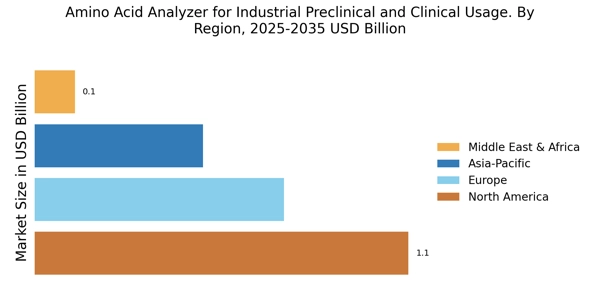
North America is the largest market for amino acid analyzers, holding approximately 45% of the global market share. The region's growth is driven by increasing demand for amino acid analysis in pharmaceuticals, biotechnology, and food industries. Regulatory support from agencies like the FDA and USDA further catalyzes market expansion, ensuring compliance and quality in product development. The United States dominates this market, with key players such as Thermo Fisher Scientific and Agilent Technologies leading the competitive landscape. Canada also contributes significantly, focusing on research and development in clinical applications. The presence of advanced laboratories and research institutions enhances the region's capabilities in amino acid analysis, fostering innovation and technological advancements.

Europe : Regulatory-Driven Market Growth

Europe is the second-largest market for amino acid analyzers, accounting for approximately 30% of the global market share. The region's growth is propelled by stringent regulations in food safety and pharmaceutical quality control, driving demand for precise amino acid analysis. The European Food Safety Authority (EFSA) plays a crucial role in establishing guidelines that enhance market growth and ensure compliance across industries. Germany and the United Kingdom are the leading countries in this market, with a robust presence of key players like Bio-Rad Laboratories and Sykam GmbH. The competitive landscape is characterized by innovation and collaboration among manufacturers and research institutions, focusing on developing advanced analytical techniques. This synergy fosters a dynamic environment for market expansion and technological advancements.

Asia-Pacific : Emerging Market Potential

Asia-Pacific is witnessing rapid growth in the amino acid analyzer market, holding approximately 20% of the global market share. The increasing focus on healthcare, biotechnology, and food safety is driving demand for amino acid analysis. Countries like China and India are investing heavily in research and development, supported by government initiatives aimed at enhancing food quality and safety standards. China is the largest market in the region, with significant contributions from local manufacturers and international players like Hitachi High-Technologies. The competitive landscape is evolving, with a growing number of startups and established companies focusing on innovative solutions. This dynamic environment is expected to propel market growth further, as the region continues to prioritize advancements in analytical technologies.

Middle East and Africa : Untapped Market Opportunities

The Middle East and Africa region is gradually emerging in the amino acid analyzer market, currently holding about 5% of the global market share. The growth is driven by increasing awareness of food safety and quality control, alongside rising investments in healthcare and biotechnology sectors. Governments are beginning to implement regulations that promote the use of advanced analytical techniques, paving the way for market expansion. Countries like South Africa and the UAE are leading the charge, with a growing number of research institutions and laboratories focusing on amino acid analysis. The competitive landscape is still developing, with opportunities for both local and international players to establish a foothold. As the region continues to invest in technology and infrastructure, the demand for amino acid analyzers is expected to rise significantly.

Amino Acid Analyzer For Industrial Preclinical Clinical Usage Market Regional Image

Key Players and Competitive Insights

Major players in the Amino Acid Analyzer For Industrial Preclinical And Clinical Usage Market are constantly looking for ways to gain an edge over their competitors. This has led to a number of developments in the Amino Acid Analyzer For Industrial Preclinical And Clinical Usage Market industry, including the introduction of new products and technologies, as well as the expansion into new markets.Leading Amino Acid Analyzer For Industrial Preclinical And Clinical Usage Market players such as Agilent Technologies, Bio-Rad Laboratories, and Shimadzu Corporation are investing heavily in research and development to bring new products to market.

This has led to a number of new products being introduced in recent years, including the Agilent 1290 Infinity II LC System, the Bio-Rad Bio-Logic LP System, and the Shimadzu Nexera X2 System. These new products offer a number of advantages over previous models, including increased sensitivity, accuracy, and speed.Amino Acid Analyzer For Industrial Preclinical And Clinical Usage Market development is also being driven by the expansion into new markets. This is particularly true in the emerging markets of Asia and Latin America, where there is a growing demand for Amino Acid Analyzers For Industrial Preclinical And Clinical Usage.

This growth is being driven by a number of factors, including the increasing awareness of the importance of amino acids in human health, the rising prevalence of chronic diseases, and the growing number of clinical trials being conducted in these regions.The Amino Acid Analyzer For Industrial Preclinical And Clinical Usage Market Competitive Landscape is expected to remain highly competitive in the coming years. This is due to the number of major players in the market, as well as the constant introduction of new products and technologies.

As a result, it is important for companies to stay up-to-date on the latest developments in the market and to invest in research and development to bring new products to market.Agilent Technologies is a leading provider of analytical instruments and software for the chemical, life sciences, and environmental markets. The company's Amino Acid Analyzer For Industrial Preclinical And Clinical Usage is a high-performance liquid chromatography (HPLC) system that is designed to provide accurate and reliable results for the analysis of amino acids.

The system is used in a variety of applications, including protein characterization, food analysis, and clinical diagnostics.Bio-Rad Laboratories is a global leader in the development, manufacture, and marketing of a wide range of life science research and clinical diagnostic products. The company's Amino Acid Analyzer For Industrial Preclinical And Clinical Usage is a fully automated system that is designed to provide fast, accurate, and reproducible results for the analysis of amino acids. The system is used in a variety of applications, including protein sequencing, peptide mapping, and clinical diagnostics.

Key Companies in the Amino Acid Analyzer For Industrial Preclinical Clinical Usage Market market include

Industry Developments

The market growth is attributed to the increasing demand for amino acid analysis in various industries, including pharmaceuticals, biotechnology, food and beverage, and clinical research.Recent developments in amino acid analyzer technology, such as the introduction of high-performance liquid chromatography (HPLC) and mass spectrometry (MS) techniques, have enhanced the accuracy and sensitivity of amino acid analysis.

This has led to increased adoption of amino acid analyzers in various applications, including protein characterization, metabolic profiling, and drug discovery.Key players in the Amino Acid Analyzer For Industrial Preclinical And Clinical Usage Market include Agilent Technologies, Danaher Corporation, Merck KGaA, Thermo Fisher Scientific, and Shimadzu Corporation. These companies are focusing on developing innovative technologies and expanding their product portfolios to meet the growing demand for amino acid analyzers.

Future Outlook

Amino Acid Analyzer For Industrial Preclinical Clinical Usage Market Future Outlook

The Amino Acid Analyzer market is projected to grow at an 8.87% CAGR from 2024 to 2035, driven by advancements in clinical research and industrial applications.

New opportunities lie in:

  • Development of portable amino acid analyzers for field research applications.
  • Integration of AI for enhanced data analysis and predictive modeling.
  • Expansion into emerging markets with tailored product offerings.

By 2035, the market is expected to be robust, driven by innovation and strategic expansions.

Market Segmentation

Amino Acid Analyzer For Industrial Preclinical Clinical Usage Market Method Outlook

  • Ion-Exchange Chromatography
  • High-Performance Liquid Chromatography
  • Gas Chromatography
  • Isotope Dilution Mass Spectrometry
  • Capillary Electrophoresis

Amino Acid Analyzer For Industrial Preclinical Clinical Usage Market End-User Outlook

  • Pharmaceutical Companies
  • Biotechnology Companies
  • Academic and Research Institutions
  • Clinical Laboratories
  • Food and Beverage Industry

Amino Acid Analyzer For Industrial Preclinical Clinical Usage Market Application Outlook

  • Preclinical Research
  • Clinical Research
  • Industrial Process Control
  • Food and Beverage Analysis
  • Pharmaceutical Development

Amino Acid Analyzer For Industrial Preclinical Clinical Usage Market Sample Type Outlook

  • Cell Culture
  • Tissue Homogenate
  • Blood
  • Urine
  • Food Products

Amino Acid Analyzer For Industrial Preclinical Clinical Usage Market Configuration Outlook

  • Benchtop
  • Floor-Standing
  • Portable

Report Scope

MARKET SIZE 20242.478(USD Billion)
MARKET SIZE 20252.698(USD Billion)
MARKET SIZE 20356.311(USD Billion)
COMPOUND ANNUAL GROWTH RATE (CAGR)8.87% (2024 - 2035)
REPORT COVERAGERevenue Forecast, Competitive Landscape, Growth Factors, and Trends
BASE YEAR2024
Market Forecast Period2025 - 2035
Historical Data2019 - 2024
Market Forecast UnitsUSD Billion
Key Companies ProfiledMarket analysis in progress
Segments CoveredMarket segmentation analysis in progress
Key Market OpportunitiesAdvancements in amino acid analysis technology enhance precision in clinical and preclinical research applications.
Key Market DynamicsRising demand for precision analytics drives innovation and competition in the amino acid analyzer market for clinical applications.
Countries CoveredNorth America, Europe, APAC, South America, MEA

Leave a Comment

FAQs

What is the projected market valuation for the Amino Acid Analyzer market in 2035?

The projected market valuation for the Amino Acid Analyzer market in 2035 is 6.311 USD Billion.

What was the market valuation for the Amino Acid Analyzer in 2024?

The market valuation for the Amino Acid Analyzer in 2024 was 2.478 USD Billion.

What is the expected CAGR for the Amino Acid Analyzer market from 2025 to 2035?

The expected CAGR for the Amino Acid Analyzer market during the forecast period 2025 - 2035 is 8.87%.

Which companies are considered key players in the Amino Acid Analyzer market?

Key players in the Amino Acid Analyzer market include Hitachi High-Technologies Corporation, Thermo Fisher Scientific Inc., and Agilent Technologies Inc.

What are the primary applications of Amino Acid Analyzers in the market?

The primary applications of Amino Acid Analyzers include Preclinical Research, Clinical Research, and Industrial Process Control.

How does the market for High-Performance Liquid Chromatography compare to other methods?

The market for High-Performance Liquid Chromatography is projected to grow from 0.992 to 2.482 USD Billion, indicating strong demand compared to other methods.

What sample types are commonly analyzed using Amino Acid Analyzers?

Common sample types analyzed using Amino Acid Analyzers include Blood, Urine, and Food Products.

What configurations of Amino Acid Analyzers are available in the market?

Available configurations of Amino Acid Analyzers include Benchtop, Floor-Standing, and Portable models.

Which end-users are driving the demand for Amino Acid Analyzers?

End-users driving demand include Pharmaceutical Companies, Biotechnology Companies, and Academic and Research Institutions.

Download Free Sample

Kindly complete the form below to receive a free sample of this Report

Compare Licence

×
Features License Type
Single User Multiuser License Enterprise User
Price $4,950 $ $7,250
Maximum User Access Limit 1 User Upto 10 Users Unrestricted Access Throughout the Organization
Free Customization
Direct Access to Analyst
Deliverable Format
Platform Access
Discount on Next Purchase 10% 15% 15%
Printable Versions