Download Free Sample
Kindly complete the form below to receive a free sample of this Report
Usage-Based Car Insurance Market Size, Share and Research Report By Vehicle Type (Passenger Cars, Commercial Vehicles), By Pricing Structure (Pay-as-you-Drive, Pay-how-you-Drive), By Technology (Telematics-based, Smartphone-based), and By Regional (North America, Europe, South America, Asia Pacific, Middle East and Africa) - Industry Forecast Till 2035
As per Market Research Future analysis, the Usage-Based Car Insurance Market Size was estimated at 63.2 USD Billion in 2024. The Usage-Based Car Insurance industry is projected to grow from 76.6 USD Billion in 2025 to 523.99 USD Billion by 2035, exhibiting a compound annual growth rate (CAGR) of 21.2% during the forecast period 2025 - 2035
The Usage-Based Car Insurance Market is experiencing robust growth driven by technological advancements and increasing consumer demand.
| 2024 Market Size | 63.2 (USD Billion) |
| 2035 Market Size | 523.99 (USD Billion) |
| CAGR (2025 - 2035) | 21.2% |
Progressive (US), Allstate (US), State Farm (US), Liberty Mutual (US), Metromile (US), Root Insurance (US), Nationwide (US), AXA (FR), Admiral Group (GB)
Our Impact
Enabled $4.3B Revenue Impact for Fortune 500 and Leading Multinationals
Partnering with 2000+ Global Organizations Each Year
30K+ Citations by Top-Tier Firms in the Industry
The Usage-Based Car Insurance Market is currently experiencing a transformative phase, driven by advancements in technology and changing consumer preferences. Insurers are increasingly adopting telematics and mobile applications to monitor driving behavior, which allows for personalized premium pricing based on actual usage rather than traditional metrics. This shift not only enhances customer engagement but also promotes safer driving habits, as policyholders are incentivized to drive more responsibly. Furthermore, the integration of artificial intelligence and big data analytics is enabling insurers to refine their risk assessment models, leading to more accurate pricing strategies and improved customer satisfaction. In addition to technological advancements, regulatory changes are also shaping the landscape of the Usage-Based Car Insurance Market. Governments are recognizing the potential benefits of usage-based models in promoting road safety and reducing accidents. As a result, there is a growing trend towards supportive legislation that encourages the adoption of telematics-based insurance products. This evolving regulatory environment, combined with increasing consumer awareness of the advantages of usage-based policies, suggests a promising future for the market. As the industry continues to innovate, it appears poised for sustained growth and expansion in the coming years.
The Usage-Based Car Insurance Market is witnessing a surge in the integration of advanced technologies such as telematics and mobile applications. These innovations allow insurers to collect real-time data on driving behaviors, enabling personalized premium pricing and fostering safer driving practices among policyholders.
There is a notable trend towards favorable regulatory frameworks that encourage the adoption of usage-based insurance models. Governments are increasingly recognizing the potential of these policies to enhance road safety and reduce accident rates, leading to supportive legislation that facilitates market growth.
As consumers become more informed about the benefits of usage-based insurance, there is a growing demand for personalized and flexible insurance solutions. This heightened awareness is driving insurers to develop more tailored offerings, aligning with the preferences of modern drivers.
The evolving regulatory landscape is shaping the Usage-Based Car Insurance Market significantly. Governments are increasingly recognizing the benefits of usage-based models, which promote safer driving habits and potentially lower accident rates. In many regions, regulatory bodies are encouraging insurers to adopt telematics-based policies, which can lead to reduced premiums for low-risk drivers. This regulatory support is likely to foster a more competitive market environment, as insurers innovate to comply with new standards. As of 2025, several countries have implemented favorable regulations that facilitate the growth of usage-based insurance, suggesting a trend towards broader acceptance and integration of these models in the insurance sector.
The rapid evolution of telematics technology is a primary driver for the Usage-Based Car Insurance Market. With advancements in GPS and mobile applications, insurers can now collect real-time data on driving behavior, including speed, braking patterns, and mileage. This data enables insurers to offer personalized premiums based on individual risk profiles, which can lead to more competitive pricing. As of 2025, it is estimated that the telematics segment within the insurance industry could reach a valuation of over 20 billion dollars, indicating a robust growth trajectory. The integration of artificial intelligence and machine learning further enhances data analysis capabilities, allowing for more accurate risk assessments and tailored insurance products.
Cost efficiency is emerging as a crucial driver for the Usage-Based Car Insurance Market. Insurers are increasingly recognizing that usage-based models can lead to reduced claims costs and improved profitability. By leveraging telematics data, insurers can more accurately assess risk and minimize fraudulent claims, which can significantly lower operational costs. Furthermore, the ability to offer competitive pricing based on actual driving behavior can attract a broader customer base, enhancing market share. As of 2025, it is projected that insurers adopting usage-based models could see a reduction in claims costs by up to 15%, indicating a strong financial incentive for companies to transition towards this innovative insurance approach.
There is a growing consumer demand for personalized insurance products, which is driving the Usage-Based Car Insurance Market. Modern consumers are increasingly seeking insurance solutions that reflect their individual driving habits and lifestyle choices. This shift towards personalization is evident in the rising popularity of pay-as-you-drive models, where premiums are directly linked to actual driving behavior. Market data indicates that approximately 30% of consumers express interest in usage-based insurance options, highlighting a significant opportunity for insurers to cater to this demand. As consumers become more aware of the potential savings associated with usage-based policies, the market is likely to expand further, encouraging insurers to innovate and enhance their offerings.
The rise of usage-based insurance is fostering increased competition among insurers within the Usage-Based Car Insurance Market. As more companies enter the market with innovative telematics solutions, existing insurers are compelled to enhance their offerings to retain customers. This competitive landscape is likely to drive down premiums and improve service quality, benefiting consumers. Market analysis suggests that the number of insurers offering usage-based policies has doubled in recent years, reflecting a shift in industry dynamics. As competition intensifies, insurers may invest more in technology and customer engagement strategies, further propelling the growth of the usage-based insurance segment.
In the Usage-Based Car Insurance (UBI) market, the segmentation by vehicle type illustrates a considerable disparity in market share between passenger cars and commercial vehicles. Passenger cars dominate this sector, accounting for the largest share of policies sold given their prevalence in daily commuting and personal use. This segment is well-established in the UBI landscape, driven by the growing demand for personalized insurance plans that cater to individual driving behaviors and preferences.
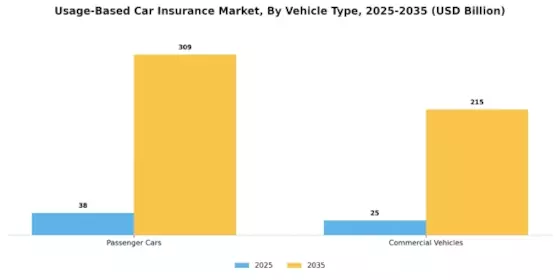
Passenger Cars (Dominant) vs. Commercial Vehicles (Emerging)
Passenger cars represent the dominant segment in the Usage-Based Car Insurance market, primarily due to their extensive ownership and high volume of individual users seeking tailored insurance solutions. This segment benefits from continuous technological advancements in telematics, enabling precise risk assessment and premium pricing based on driving habits. Conversely, commercial vehicles are an emerging segment, gaining traction from businesses looking to optimize their fleet insurance costs through UBI. The incorporation of technologies such as GPS tracking and real-time data analytics helps commercial entities monitor driver behavior, reduce accident rates, and ultimately lower insurance expenses.
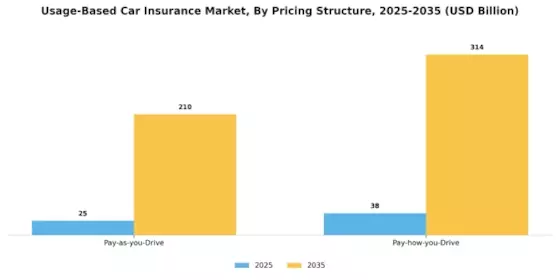
In the Usage-Based Car Insurance Market, the pricing structure is primarily segmented into 'Pay-as-you-Drive' and 'Pay-how-you-Drive'. The 'Pay-as-you-Drive' model holds the largest market share, appealing largely to consumers seeking a straightforward association between their driving behavior and insurance premiums. On the other hand, 'Pay-how-you-Drive' is gaining traction and is considered the fastest-growing segment, attracting users interested in customized insurance plans that adjust based on driving habits like speeding or sudden braking.
Pricing Structure: Pay-as-you-Drive (Dominant) vs. Pay-how-you-Drive (Emerging)
The 'Pay-as-you-Drive' model is characterized by its established presence in the market, catering to drivers who prefer predictable premium payments based on the miles they drive. This model is particularly attractive to lower-mileage drivers, leading to a strong adoption rate. In contrast, the 'Pay-how-you-Drive' model is emerging rapidly, leveraging telematics to assess driving behavior closely. This segment is appealing to tech-savvy consumers who favor personalized insurance solutions. The growth of connected car technology fuels this trend, as more consumers seek policies that reward safe driving behaviors with lower premiums.
In the Usage-Based Car Insurance Market, the telematics-based segment holds a significant market share, attributed to its ability to provide real-time data insights into driving behavior, safety metrics, and vehicle performance. This segment has been widely adopted by insurers, allowing them to tailor policies and premium rates based on actual usage patterns, which appeals to cost-conscious consumers looking to save on insurance costs. Conversely, the smartphone-based segment is gaining traction, especially among younger drivers, who prefer the convenience of using their mobile devices for insurance-related tasks. Its share, though smaller, is steadily increasing as more apps and technologies are developed, making it appealing to a tech-savvy demographic.
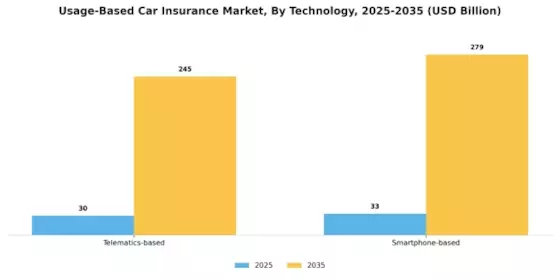
Technology: Telematics-based (Dominant) vs. Smartphone-based (Emerging)
The telematics-based insurance segment is currently the dominant player in the market, leveraging advanced GPS technology and onboard diagnostics to collect detailed driving data. This allows insurers to assess risk and customize premiums based on individual driving behavior, resulting in more personalized policies for consumers. On the other hand, the smartphone-based segment is quickly emerging as a viable alternative, popular for its user-friendliness and accessibility. Smartphone applications facilitate easy tracking of driving habits and provide instant feedback, attracting younger customers who are increasingly reliant on mobile technology. This shift reflects a broader trend towards digitalization in the insurance industry, with both segments presenting unique advantages and contributing to the evolution of usage-based insurance models.
Get more detailed insights about Usage-Based Car Insurance Market Request Free Sample
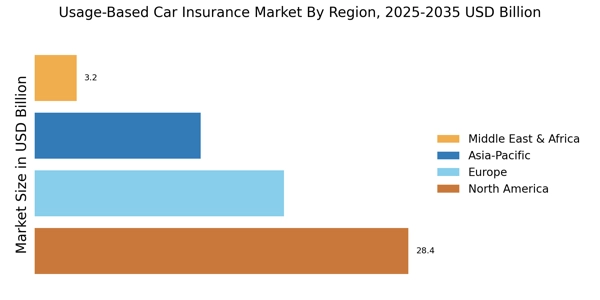
The Usage Based Car Insurance Market is segmented into North America, Europe, APAC, South America, and MEA. Among these regions, North America is expected to hold the largest market share in 2023, owing to the presence of a large number of technology providers and early adoption of advanced technologies in the region. Europe is expected to be the second-largest market, followed by APAC. The APAC region is expected to witness significant growth in the coming years, due to the increasing adoption of usage-based car insurance by insurance companies in countries such as China, India, and Japan.
South America and MEA are expected to be the smallest markets, but are expected to grow at a steady pace in the coming years.
Major players in the Usage-Based Car Insurance Market industry are focusing on developing innovative products and services to cater to the evolving needs of customers. Leading Usage Based Car Insurance Market players are also investing in research and development to improve their offerings and gain a competitive edge. The Usage Based Car Insurance Market is becoming increasingly competitive, with new entrants and established players vying for market share. To stay ahead of the competition, companies are adopting various strategies such as partnerships, acquisitions, and product launches. The Usage Based Car Insurance Market development is being driven by factors such as the rising demand for personalized insurance policies, the increasing adoption of telematics devices, and the growing popularity of shared mobility services. Progressive Corporation is a leading player in the Usage-Based Car Insurance Market, offering a wide range of usage-based insurance products. The company's Snapshot program, which tracks driving behavior and rewards safe drivers with discounts, has been a key driver of its success. Progressive is also investing in technology and innovation to further enhance its offerings and improve customer experience. Metromile is another major player in the Usage-Based Car Insurance Market, known for its pay-per-mile insurance model. The company's technology allows drivers to pay for insurance only when they drive, resulting in significant savings for low-mileage drivers. Metromile is expanding its offerings by partnering with other companies to provide additional services such as roadside assistance and maintenance.



The Usage-Based Car Insurance Market is projected to reach USD 103.6 billion by 2032, exhibiting a CAGR of 14.08% during the forecast period. Rising demand for personalized insurance policies, technological advancements, and increasing adoption of telematics devices are major factors driving market growth. Europe held the largest market share in 2023, and Asia-Pacific is expected to witness the highest growth rate during the forecast period. Recent news developments include partnerships between insurers and technology providers to enhance UBI offerings, as well as government initiatives to promote UBI adoption for safer driving.
The market is witnessing the emergence of new players and innovative solutions, such as smartphone-based UBI programs and AI-powered risk assessment tools.
The Usage-Based Car Insurance Market is projected to grow at a 21.2% CAGR from 2025 to 2035, driven by technological advancements, consumer demand for personalized pricing, and regulatory support.
New opportunities lie in:
By 2035, the market is expected to be robust, characterized by innovative solutions and widespread adoption.
| MARKET SIZE 2024 | 63.2(USD Billion) |
| MARKET SIZE 2025 | 76.6(USD Billion) |
| MARKET SIZE 2035 | 523.99(USD Billion) |
| COMPOUND ANNUAL GROWTH RATE (CAGR) | 21.2% (2025 - 2035) |
| REPORT COVERAGE | Revenue Forecast, Competitive Landscape, Growth Factors, and Trends |
| BASE YEAR | 2024 |
| Market Forecast Period | 2025 - 2035 |
| Historical Data | 2019 - 2024 |
| Market Forecast Units | USD Billion |
| Key Companies Profiled | Progressive (US), Allstate (US), State Farm (US), Liberty Mutual (US), Metromile (US), Root Insurance (US), Nationwide (US), AXA (FR), Admiral Group (GB) |
| Segments Covered | Vehicle Type, Pricing Structure, Technology, Regional |
| Key Market Opportunities | Integration of telematics and AI enhances personalized pricing in the Usage-Based Car Insurance Market. |
| Key Market Dynamics | Rising consumer demand for personalized insurance solutions drives innovation in Usage-Based Car Insurance offerings. |
| Countries Covered | North America, Europe, APAC, South America, MEA |
The market valuation reached 63.2 USD Billion in 2024.
The market is projected to grow to 523.99 USD Billion by 2035.
The expected CAGR for this market is 21.2% from 2025 to 2035.
The Passenger Cars segment accounted for 38.0 USD Billion in 2024, indicating a substantial market share.
The Pay-how-you-Drive structure was valued at 38.2 USD Billion in 2024, surpassing the Pay-as-you-Drive segment at 25.0 USD Billion.
Telematics-based technology was valued at 30.0 USD Billion in 2024, while smartphone-based technology reached 33.2 USD Billion.
Key players include Progressive, Allstate, State Farm, Liberty Mutual, Metromile, Root Insurance, Nationwide, AXA, and Admiral Group.
The Commercial Vehicles segment was valued at 25.2 USD Billion in 2024.
In the US, companies like Progressive and Allstate lead, whereas AXA represents significant European presence.
The market is likely to experience growth driven by technological advancements and changing consumer preferences towards usage-based models.


Kindly complete the form below to receive a free sample of this Report

“This is really good guys. Excellent work on a tight deadline. I will continue to use you going forward and recommend you to others. Nice job”


“Thanks. It’s been a pleasure working with you, please use me as reference with any other Intel employees.”


“Thanks for sending the report it gives us a good global view of the Betaïne market.”


“Thank you, this will be very helpful for OQS.”


“We found the report very insightful! we found your research firm very helpful. I'm sending this email to secure our future business.”


“I am very pleased with how market segments have been defined in a relevant way for my purposes (such as "Portable Freezers & refrigerators" and "last-mile"). In general the report is well structured. Thanks very much for your efforts.”


“I have been reading the first document or the study, ,the Global HVAC and FP market report 2021 till 2026. Must say, good info! I have not gone in depth at all parts, but got a good indication of the data inside!”


“We got the report in time, we really thank you for your support in this process. I also thank to all of your team as they did a great job.”


“The Automotive 48V ECU Components Procurement Intelligence Study” was a complex project, but the Market Research Future (MRFR) team handled it with quality, agility, and customer-centricity. They delivered all requested data on time and within the agreed scope. The team, including Shubhendra Anand and Rahul Gotadki, was always readily available to clarify questions and swiftly implement necessary adjustments, driving the project to a successful conclusion within a very demanding timeframe.
I would also like to specifically commend Akshay Agarwal for his responsiveness and support at every stage—from our initial inquiry on May 6th through to final delivery on June 18th. His dedication made the entire process seamless.”



