Ammonium Sulphate Market

Key Players: BASF SE, Nutrien Ltd, Evonik Industries, ArcelorMittal, Lanxess AG, OCI NV, Honeywell International, Sumitomo Chemical

Ammonium Sulphate Market

Ammonium Sulfate Market Research Report Information By Product Type (Solid, Liquid), Application (Fertilizers, Industrial, Pharmaceutical, Food & Beverage, Water Treatment, Textile Dyeing) And By Region (North America, Europe, Asia-Pacific, And Rest Of The World) - Forecast Till 2035
ID: MRFR/CnM/0222-CR
272 Pages
Chitranshi Jaiswal
Last Updated: June 15, 2026
 

Ammonium Sulphate Market Summary

The Ammonium Sulfate Market was valued at USD 6.10 Billion in 2025, with the forecast period beginning at USD 6.40 Billion in 2026 and projected to reach USD 9.88 Billion by 2035, expanding at a CAGR of 4.95% during 2026–2035. Rising global food demand, coupled with government-backed fertilizer subsidy programs across India, Brazil, and Southeast Asia, has catalyzed sustained investment in nitrogen fertilizers and sulfate fertilizers. The Indian government's Nutrient-Based Subsidy (NBS) scheme allocated over USD 7.5 billion toward fertilizer support in 2024 alone, directly boosting procurement of agrochemical fertilizers, including ammonium sulfate [2].

A notable shift is underway in how farmers approach soil nutrient additives. Traditional urea-heavy regimes are being supplemented — and in some geographies replaced — by balanced crop nutrition chemicals that supply both nitrogen and sulfur in a single application. Water-soluble fertilizers and blended fertilizer-grade chemicals are gaining traction as precision agriculture platforms expand. The International Fertilizer Association (IFA) estimated that global sulfur fertilizer consumption crossed 7.8 million tonnes in 2024, up 4.2% year-over-year, reflecting stronger demand for dual-nutrient formulations [3].

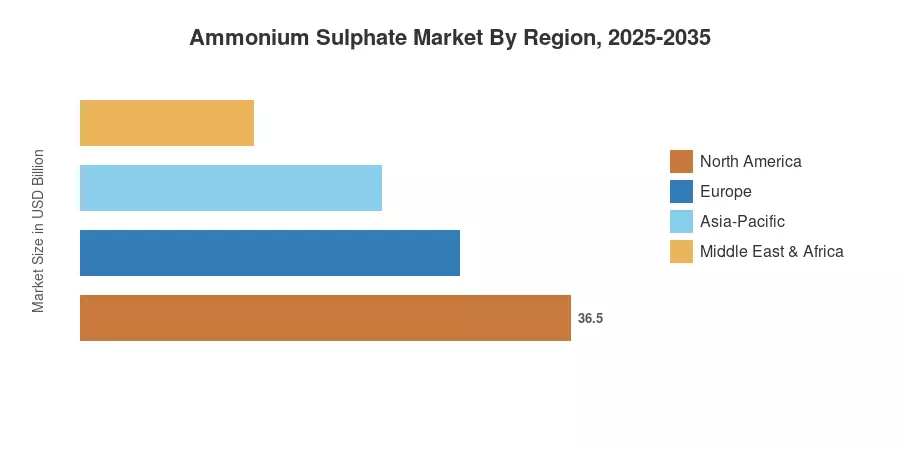
North America commands approximately 33% of the Ammonium Sulfate Market, anchored by corn-belt sulfur supplementation programs in the US Midwest Asia-Pacific represents the fastest-growing region, registering a forecast CAGR of 5.8%, propelled by agricultural intensification in India and China. Europe holds the second-largest share at roughly 24%, driven by EU Integrated Nutrient Management policies. The trajectory through 2035 points toward sustained mid-single-digit growth as sulfur-deficient soils and rising protein crop acreage keep demand firmly on an upward curve.


Key Report Takeaways

• By End-Use

  • Solid ammonium sulfate accounts for approximately 72% of the Ammonium Sulfate Market, driven by granular and crystalline demand in broadacre farming
  • Liquid ammonium sulfate is growing at a CAGR of 6.1% through 2035 as fertigation and foliar spray adoption accelerate among specialty crop growers

• By Application

  • Fertilizer applications represent USD 5.19 Billion in 2025 value, reflecting ammonium sulfate's dominance as a nitrogen fertilizer input for row crops
  • Food and Feed Additive usage is expanding at a 5.4% CAGR, supported by demand for food-grade sulfate fertilizers in protein enrichment and dough conditioning
  • Pharmaceutical applications contribute approximately 4% of market share, serving as a protein precipitation agent in biopharma production

• By Region

  • North America leads the Ammonium Sulfate Market at roughly 33% share, underpinned by corn and soybean sulfur deficiency management programs
  • Asia-Pacific is the fastest-growing region, reaching a projected USD 3.12 billion by 2035 as soil nutrient additives demand surges


Market Size and Forecast (2021–2035)

The market size series below integrates bottom-up production and trade flow analysis with demand-side consumption modeling across 35 countries. Historical figures (2021–2024) derive from customs databases, producer shipment records, and FAO nutrient-balance statistics. Forecast values (2026–2035) apply a compound growth trajectory calibrated against macroeconomic agricultural output projections and policy-driven fertilizer procurement trends.
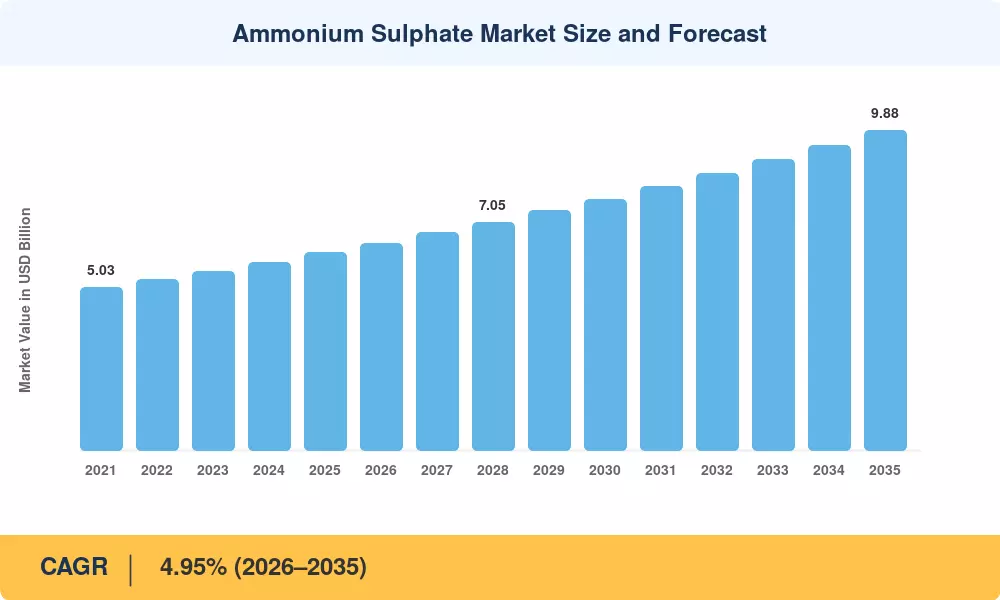
Ammonium Sulphate Market Size and Forecast
Our Impact
Enabled $4.3B Revenue Impact for Fortune 500 and Leading Multinationals
Partnering with 2000+ Global Organizations Each Year
30K+ Citations by Top-Tier Firms in the Industry
 

Driver Impact Analysis

Driver ~% Impact on CAGR Geographic Relevance Impact Timeline
Rising global population and food demand +1.1% Global Long-term (≥4 yr)
Sulfur-deficient soil remediation +0.9% North America, Europe Medium-term (2–4 yr)
Government fertilizer subsidy programs +0.8% Asia-Pacific, South America Short-term (≤2 yr)
Expansion of protein-rich crop acreage +0.6% North America, South America Medium-term (2–4 yr)
Growth in water soluble fertilizers and fertigation +0.5% Asia-Pacific, MEA Medium-term (2–4 yr)
Industrial by-product supply from caprolactam and coke plants +0.4% Europe, Asia-Pacific Long-term (≥4 yr)
Precision agriculture integration with soil nutrient additives +0.3% North America, Europe Long-term (≥4 yr)


Global Population Growth and Food Security Pressure

The world added over 71 million people in 2024 according to US Census Bureau estimates, and the UN projects 9.7 billion inhabitants by 2050 [2]. This demographic engine directly raises caloric requirements, pushing farmers toward high-efficiency crop nutrition chemicals such as ammonium sulfate. Countries like India — where agriculture employs nearly 42% of the workforce — have responded with expanded procurement mandates for nitrogen fertilizers.

Sulfur Deficiency in Global Agricultural Soils

Decades of intensive NPK fertilization with high N content have reduced soil sulfur stores in the US Corn Belt, the Canadian Prairies, and Northern Europe. A recent survey reports that >90% of US maize fields are currently sub-optimal in sulfur, leaving an annual supplementation deficit of ~1.8 million tons [6]. The dual nitrogen-sulfur composition of ammonium sulfate makes it the preferred solution for sulfate fertilizers in these weak regions. In USDA field studies, corn yields in sulfur-treated plots averaged 8–12% higher than untreated controls, confirming the economic argument for adoption [6].


Government Subsidy and Procurement Programs

Subsidy systems in India (NBS), Brazil (Plano Safra), and Indonesia (pupuk bersubsidi) channel nearly USD 15 billion yearly towards fertilizer buying [2][8]. These programs provide guaranteed demand floors by expressly listing agrochemical fertilizers such as ammonium sulfate on their approved product lists. In Brazil, the Plano Safra 2024-2025 earmarked BRL 400.6 billion in agricultural loans, of which an estimated 12% is destined to purchases of fertilizer-grade chemicals [8].


Expansion of Protein Crop Acreage

Global soybean planted area in 2024 was more than 134 million hectares, including Brazil with 46 million hectares, up 3.8% year-on-year [3]. Soybeans, canola, and pulses are high sulfur-demanding crops during protein synthesis, and ammonium sulfate is an important soil supplement. Based on the FAOSTAT statistics, the global soybean yields increased from 2,810 kg/ha in 2022 to 2,920 kg/ha in 2023, which was partly due to successful fertilization with sulfur [3].


Restraints Impact Analysis

Restraint ~% Impact on CAGR Geographic Relevance Impact Timeline
Competition from urea and UAN solutions −0.5% Global Short-term (≤2 yr)
Environmental regulation on sulfate runoff −0.4% Europe, North America Medium-term (2–4 yr)
Raw material price volatility (sulfuric acid, ammonia) −0.3% Global Short-term (≤2 yr)
Logistics and storage constraints for hygroscopic product −0.2% South America, Africa Long-term (≥4 yr)
Shift toward slow-release and enhanced-efficiency fertilizers −0.2% North America, Europe Medium-term (2–4 yr)


Competitive Pressure from Urea and UAN

Urea remains the most traded nitrogen fertilizer commodity worldwide, 15-25% cheaper than ammonium sulfate on a per unit nitrogen basis in most markets [16]. Urea is a cheaper alternative in areas where sulfur deficiency is not an issue on farms. Accordingly, the scope of the Ammonium Sulfate Market to penetrate the areas with ample soil sulfur, such as sections of Southeast Asia and sub-Saharan Africa, is thus constricted. UAN liquid solutions further depress the prices of mixed agrochemical fertilizer applications.


Environmental Regulation of Sulfate Runoff

In the US, several Midwest states have introduced voluntary — and in some cases mandatory — nutrient management plans that cap sulfur application at 25 kg/ha per season in sensitive watersheds. These constraints may slow the adoption of crop nutrition chemicals containing sulfate in environmentally sensitive geographies.

Feedstock Price Volatility

Ammonium sulfate production costs are tied to ammonia and sulfuric acid pricing, both of which experienced 20–35% swings during 2022–2024 due to natural gas price disruptions and refinery output shifts [17]. By-product supply from caprolactam manufacturing creates additional unpredictability — when nylon demand weakens, by-product ammonium sulfate volumes increase and depress spot pricing, squeezing margins for synthetic producers and adding uncertainty to the Ammonium Sulfate Market pricing outlook.


Ammonium Sulphate Market Opportunities

Precision Sulfur Application via Digital Agriculture Platforms

Variable-rate technology (VRT) systems allow farmers to apply soil nutrient additives such as ammonium sulfate in zone-specific prescriptions, reducing over-application by up to 20% while improving yield outcomes [15]. As satellite-guided VRT adoption scales beyond 35% of US farmland by 2028, demand for calibrated water-soluble fertilizers and granular ammonium sulfate formulations will follow

Emerging Market Fertilizer Infrastructure Development

Africa's fertilizer consumption intensity remains below 20 kg/ha — less than a quarter of the global average [12]. The African Development Bank's African Fertilizer Financing Mechanism deploys targeted multi-million-dollar structural credit guarantees to local distribution channels, creating a greenfield opportunity for agrochemical fertilizers suppliers. Countries such as Nigeria, Ethiopia, and Tanzania represent untapped demand pools for the Ammonium Sulfate Market

Industrial By-Product Valorization and Circular Economy Models

Approximately 55–60% of global ammonium sulfate supply originates as a by-product of caprolactam, coke-oven gas, and nickel refining operations. Companies that develop purification and branding strategies around by-product streams can capture fertilizer-grade chemical premiums while converting industrial waste liabilities into revenue. Evonik and BASF have both announced circular-supply labeling initiatives

Specialty Crop Fertigation and Foliar Feeding

The horticulture and greenhouse sections are transitioning to liquid ammonium sulphate as the input of choice for crop nutrition chemicals in drip fertigation systems. In Israel, Netafim and in India, Jain Irrigation have incorporated sulfate nutrient dosage into smart irrigation controllers, opening up a high-margin niche for water-soluble fertilizer companies


Data-Driven Fertilizer Recommendation Engines

AgTech platforms such as Nutrien's Digital Hub and Yara's AtFarm aggregate soil-test data and generate nitrogen fertilizers and sulfur prescriptions at the field level. These platforms monetize agronomic data while steering product selection toward sulfate fertilizers, presenting a channel partnership opportunity for ammonium sulfate producers seeking to influence farmer purchase decisions


Ammonium Sulphate Market Future Outlook

Precision Agriculture and Sensor-Driven Nutrient Delivery

Farm-level adoption of GPS-guided variable-rate spreaders and in-soil sulfur sensors will reshape how nitrogen fertilizers and sulfate fertilizers reach the root zone. The USDA estimates that precision nutrient management could reduce aggregate US fertilizer application volumes by 12% while maintaining yield targets, shifting demand toward higher-purity agrochemical fertilizers like ammonium sulfate that integrate well with VRT systems [15].

Circular Supply Chains and Industrial Symbiosis

As caprolactam capacity expands in China and Southeast Asia — Sinopec alone added 300,000 tonnes of new capacity in 2024 — by-product ammonium sulfate volumes will rise correspondingly. Forward-integrated producers that brand and certify their by-product supply as crop nutrition chemicals stand to capture margin premiums of 8–12% over commodity-grade material, according to IFA estimates [3].

Climate Adaptation and Sulfur-Responsive Crop Breeding

Climate variability is intensifying sulfur leaching from lighter soils, widening the global sulfur gap. The CGIAR's Accelerated Crop Improvement Program is developing sulfur-efficient crop varieties that maximize yield response to soil nutrient additives, potentially expanding the addressable Ammonium Sulfate Market by channeling breeding gains into sulfur-responsive genotypes [19].

ESG Reporting and Sustainable Fertilizer Certification

The EU's Corporate Sustainability Reporting Directive (CSRD) and Science-Based Targets initiative (SBTi) are pushing agribusinesses to disclose scope-3 fertilizer emissions. Ammonium sulfate's lower carbon intensity per unit of sulfur — roughly 40% below elemental sulfur oxidation routes — positions it favorably within ESG-compliant fertilizer grade chemicals procurement frameworks, potentially unlocking green-bond financing for producers investing in low-emission manufacturing [20].


Ammonium Sulphate Market Segmentation

By End-Use

Segment Key Metric Primary Demand Driver
Solid ~72% market share Granular and crystalline demand in broadacre nitrogen fertilizer applications
Liquid CAGR 6.1% Fertigation and foliar spray adoption in specialty crop nutrition chemicals


Solid ammonium sulfate dominates the Ammonium Sulfate Market because granular formulations integrate seamlessly with existing broadcast and banding equipment used across row-crop agriculture. The crystalline variant, a primary by-product of caprolactam production, accounts for roughly 60% of global solid supply and serves as a cost-effective sulfate fertilizer input for cereal and oilseed growers. Granular ammonium sulfate, produced through compaction or melt granulation, commands a 10–15% price premium due to superior handling properties and compatibility with blended agrochemical fertilizers.

Liquid ammonium sulfate is the fastest-growing end-use segment, propelled by the global expansion of drip irrigation and greenhouse fertigation systems. In Israel, Spain, and parts of India, growers of tomatoes, strawberries, and peppers have shifted toward water-soluble fertilizers delivered through precision drip lines, creating consistent demand for high-purity liquid ammonium sulfate solutions.

By Application

Segment Key Metric Primary Demand Driver
Fertilizer USD 5.19 Billion (2025) Global row-crop sulfur supplementation demand
Food and Feed Additive CAGR 5.4% Dough conditioning and animal feed protein enrichment
Pharmaceutical ~4% market share Biopharmaceutical protein precipitation


Fertilizer applications command over 85% of the total Ammonium Sulfate Market volume, reflecting the compound's foundational role as a soil nutrient additive product across corn, soybean, wheat, and rice cultivation. FAOSTAT data confirm that ammonium sulfate contributed an estimated 5.2% of the global nitrogen fertilizer supply in 2024 [3]. The compound's acidifying properties make it particularly valued in alkaline soils common across the US High Plains, India's Indo-Gangetic Plain, and Australia's Western wheat belt.

Food and feed additive applications are gaining momentum as the bakery and feed-milling industries incorporate fertilizer-grade chemicals-derived ammonium sulfate as a dough conditioner (E517 in the EU) and protein source in aquaculture feeds. Pharmaceutical use, while small in volume, generates high per-tonne margins as biopharma companies require USP-grade material for antibody purification via ammonium sulfate precipitation.


Regional Market Share Analysis

Region Key Metric Primary Investment Themes
North America ~33% market share Corn-belt sulfur remediation; agrochemical fertilizers modernization
Europe ~24% market share EU nutrient management regulation; circular by-product supply
Asia-Pacific CAGR 5.8% (2026–2035) Population-driven food security; soil nutrient additives expansion
South America USD 0.57 Billion (2025) Soybean acreage growth; Plano Safra credit mechanisms
Middle East & Africa CAGR 5.3% (2026–2035) AfDB fertilizer financing; irrigation-linked crop nutrition chemicals
Total USD 6.10 Billion (2025)

The Ammonium Sulfate Market exhibits distinct regional demand profiles shaped by cropping systems, soil chemistry, subsidy structures, and industrial by-product availability. North America and Europe anchor mature demand, while Asia-Pacific leads growth in nitrogen fertilizer and sulfate fertilizer consumption.


North America

Country Key Metric Key Driver
US ~78% of regional share Midwest sulfur deficiency programs
Canada CAGR 4.6% Canola sulfur requirements on Prairie soils
Mexico USD 0.08 Billion (2025) Horticultural export growth in Sinaloa and Jalisco


The US dominates North American demand for the Ammonium Sulfate Market as corn and soybean producers systematically address sulfur-depleted soils. USDA-NRCS cost-share programs have funded sulfur management plans on over 12 million acres since 2020 [6]. Canada's canola sector — which exported CAD 14.3 billion worth of canola products in 2024 — relies heavily on fertilizer-grade chemicals that deliver both nitrogen and sulfur to meet protein content specifications. Mexico's protected-agriculture segment in Baja California and Sinaloa increasingly favors water-soluble fertilizers for high-value vegetable and berry production.

Europe

Country Key Metric Key Driver
Germany ~22% of regional share Rapeseed sulfur fertilization mandates
UK CAGR 4.3% Post-Brexit ELMS nutrient management
France USD 0.21 Billion (2025) Wheat and barley sulfur programs
Italy ~8% of regional share Specialty crop fertigation demand
Spain CAGR 4.5% Olive and citrus sulfate fertilizers adoption
Nordic Countries ~7% of regional share Forestry soil amendment programs
Russia USD 0.14 Billion (2025) Caprolactam by-product supply
Rest of Europe CAGR 4.1% EU CAP cross-compliance drivers


Europe's Ammonium Sulfate Market is shaped by the EU's Farm-to-Fork Strategy, which targets a 20% reduction in nutrient losses by 2030. This regulatory push steers farmers toward balanced agrochemical fertilizers that minimize nitrogen leaching while delivering sulfur. Germany's rapeseed belt accounts for the largest single-country share, as German farmers apply 30–40 kg/ha of sulfur annually in line with DLG recommendations [10].

Asia-Pacific

Country Key Metric Key Driver
China ~38% of regional share Soil-health action plan and caprolactam supply
India CAGR 6.4% NBS subsidy and rice-wheat sulfur programs
Japan USD 0.11 Billion (2025) Tea and horticulture nitrogen fertilizers demand
South Korea ~5% of regional share Specialty crop nutrition chemicals
ASEAN CAGR 5.9% Palm oil and rice soil nutrient additives
Rest of Asia-Pacific ~4% of regional share Emerging horticultural demand


Asia-Pacific drives the highest growth trajectory in the Ammonium Sulfate Market, with China and India together consuming over 8 million tonnes annually. China's Soil Pollution Prevention and Control Action Plan explicitly recommends sulfur-containing nitrogen fertilizers to remediate acidified farmland in southern provinces [7]. India's NBS scheme provides a per-tonne subsidy of approximately INR 3,500 for ammonium sulfate, making it among the most cost-effective sulfate fertilizers available to smallholder farmers.

South America

Country Key Metric Key Driver
Brazil ~74% of regional share Soybean and sugarcane sulfur demand
Argentina CAGR 5.1% Pampas wheat and corn programs
Rest of South America USD 0.04 Billion (2025) Andean specialty crop expansion


Brazil's soybean complex is the primary engine of South American demand for agrochemical fertilizers, with the country importing over 1.5 million tonnes of ammonium sulfate in 2024. Plano Safra subsidized credit lines increasingly specify balanced fertilizer grade chemicals for eligible farms, reinforcing sulfur adoption.

Middle East & Africa

Country Key Metric Key Driver
Saudi Arabia ~18% of regional share Date palm and cereal crop nutrition chemicals
UAE CAGR 5.0% Controlled-environment agriculture demand
South Africa USD 0.07 Billion (2025) Maize sulfur supplementation
Egypt ~15% of regional share Nile Delta wheat water-soluble fertilizers
Rest of MEA CAGR 5.6% AfDB fertilizer infrastructure programs


The MEA region is an emerging frontier for the Ammonium Sulfate Market, with the African Development Bank and FAO jointly targeting a doubling of fertilizer use intensity across sub-Saharan Africa by 2035 [12]. Saudi Arabia's agricultural modernization program supports the procurement of sulfate fertilizers for arid-zone cereal cultivation.


Ammonium Sulphate Market By Region, 2025-2035
 

Competitive Benchmarking

The Ammonium Sulfate Market exhibits high concentration, with the top five players commanding an estimated 45–52% combined revenue share. The Herfindahl-Hirschman Index (HHI) is estimated at 1,400–1,700, indicating moderate-to-high concentration. Competition centers on by-product supply cost advantages, distribution network breadth, and product-grade differentiation between fertilizer-grade chemicals and specialty-grade offerings.

Company Est. Revenue Share Range Key Offerings for the Ammonium Sulfate Market Strategic Positioning
BASF SE ~10–14% Granular and crystalline ammonium sulfate from caprolactam operations Vertically integrated by-product supply; global distribution
Nutrien Ltd ~8–11% Branded crop nutrition chemicals and blended fertilizers Largest retail agrochemical fertilizers network in North America
Evonik Industries ~7–10% High-purity crystalline ammonium sulfate Circular economy by-product valorization strategy
ArcelorMittal ~5–8% Coke-oven by-product ammonium sulfate Cost leadership through steelmaking integration
Lanxess AG ~4–7% Specialty-grade sulfate fertilizers Niche positioning in European industrial markets
OCI NV ~3–6% Nitrogen fertilizers, including ammonium sulfate blends Dual-continent production (Netherlands, US, Egypt)
Honeywell International ~3–5% Caprolactam co-product ammonium sulfate Technology licensing and process optimization
Sumitomo Chemical ~2–4% Agricultural soil nutrient additives portfolio Strong Asia-Pacific distribution
AdvanSix Inc ~3–5% US-produced granular and standard-grade ammonium sulfate Dedicated single-site caprolactam integration
DOMO Chemicals ~2–4% European by-product ammonium sulfate supply Circular nylon-ammonium sulfate value chain


Recent News & Developments


  • Nutrien Ltd (January 2025): Launched a digital sulfur-prescription tool integrated into its Nutrien Ag Solutions platform, enabling field-level water-soluble fertilizer recommendations across 8,000+ retail locations in North America [22].
  • Evonik Industries (November 2024): Received ISCC-Plus certification for its by-product ammonium sulfate line, positioning the product as a circular-economy agrochemical fertilizer input.


  • OCI NV (June 2024): Progressed with its Beaumont lower-carbon ammonia project in Texas, which was subsequently acquired by Woodside Energy for USD 2.35 billion. The facility aims to be a cornerstone of the U.S. Gulf Coast’s low-carbon ammonia and nitrogen derivative supply chain upon its scheduled 2025 startup.
  • AdvanSix Inc (April 2024): Signed a five-year offtake agreement with a major Brazilian distributor for 120,000 tonnes per annum of granular ammonium sulfate, expanding its sulfate fertilizers footprint in South America [24].


Ammonium Sulphate Market Report Scope

Parameter Detail
Market Scope Global Ammonium Sulfate Market — production, trade, and consumption across 35 countries
Study Period 2021–2035
CAGR (Forecast) 4.95% (2026–2035)
Base Year Market Size USD 6.10 Billion (2025)
Forecast Endpoint USD 9.88 Billion (2035)
Fastest Growing Segment Liquid end-use (CAGR 6.1%); Asia-Pacific region (CAGR 5.8%)
Companies Profiled BASF SE, Nutrien Ltd, Evonik Industries, ArcelorMittal, Lanxess AG, OCI NV, Honeywell International, Sumitomo Chemical, AdvanSix Inc, DOMO Chemicals
Valuation Currency USD Billion


FAQs

How does ammonium sulfate compare with elemental sulfur for correcting soil sulfur deficiency?

Ammonium sulfate provides immediately plant-available sulfate-sulfur, while elemental sulfur requires microbial oxidation over 4–8 weeks before crops can absorb it [25]. For fast-response sulfur correction in-season, ammonium sulfate delivers quicker agronomic results.

What purity grades should procurement teams specify for food-additive versus fertilizer use?

Food-grade ammonium sulfate must meet FCC or E517 specifications with heavy-metal limits below 10 ppm, whereas fertilizer-grade chemicals typically allow up to 50 ppm [4]. Sourcing contracts should explicitly reference the applicable standard.

Which caprolactam producers offer the most reliable by-product supply agreements?

BASF, AdvanSix, and DOMO Chemicals operate dedicated by-product recovery lines with multi-year offtake contracts, providing supply stability that standalone synthetic producers rarely match [21][24].

How does ammonia feedstock price volatility affect ammonium sulfate contract negotiations?

Buyers typically index contracts to the Tampa ammonia benchmark, with quarterly price adjustments [17]. Locking in 6–12 month forward contracts during seasonal ammonia price troughs can reduce procurement costs by 8–15%.

What regulatory approvals are needed to import ammonium sulfate into India under the NBS scheme?

Importers must obtain a Fertilizer Control Order (FCO) registration from the Central Fertilizer Quality Control laboratory and register with the Department of Fertilizers for subsidy reimbursement [2]. The process typically takes 90–120 days.

Can liquid ammonium sulfate be blended directly into UAN-32 solutions for fertigation?

Liquid ammonium sulfate is compatible with UAN solutions at concentrations below 8% w/v, but salting-out risk increases above 5°C drops in ambient temperature [11]. Compatibility jar-testing before tank mixing is standard practice.

How are carbon-footprint labeling initiatives affecting buyer preferences in the Ammonium Sulfate Market?

EU CSRD-aligned buyers increasingly request product carbon footprint declarations, favoring by-product ammonium sulfate with 30–40% lower embedded emissions than synthetic routes [20]. Certified low-carbon supply commands a 5–8% price premium.


FAQs

What is the projected market valuation of the Ammonium Sulfate Market by 2035?

The Ammonium Sulfate Market is projected to reach a valuation of 5.4 USD Billion by 2035.

What was the market valuation of the Ammonium Sulfate Market in 2024?

In 2024, the Ammonium Sulfate Market was valued at 3.2 USD Billion.

What is the expected CAGR for the Ammonium Sulfate Market during the forecast period 2025 - 2035?

The expected CAGR for the Ammonium Sulfate Market during the forecast period 2025 - 2035 is 4.87%.

Which companies are considered key players in the Ammonium Sulfate Market?

Key players in the Ammonium Sulfate Market include Nutrien Ltd, Yara International ASA, K+S AG, Tessenderlo Group, Mosaic Company, OCI N.V., AdvanSix Inc., and SABIC.

What are the projected valuations for solid and liquid ammonium sulfate types by 2035?

By 2035, solid ammonium sulfate is projected to reach 2.6 USD Billion, while liquid ammonium sulfate is expected to reach 2.8 USD Billion.

How does the end-user segment of fertilizers compare to other segments in 2035?

In 2035, the fertilizers segment is projected to be valued at 2.6 USD Billion, significantly higher than other segments such as industrial and pharmaceutical.

What is the projected valuation for the industrial segment of ammonium sulfate by 2035?

The industrial segment of ammonium sulfate is projected to reach a valuation of 1.2 USD Billion by 2035.

What is the expected growth trend for the pharmaceutical segment of ammonium sulfate by 2035?

The pharmaceutical segment is expected to grow to a valuation of 0.5 USD Billion by 2035.

What is the anticipated valuation for the food and beverage segment of ammonium sulfate by 2035?

The food and beverage segment is anticipated to reach a valuation of 0.4 USD Billion by 2035.

How does the water treatment segment of ammonium sulfate perform in 2035?

The water treatment segment is projected to achieve a valuation of 0.3 USD Billion by 2035.
Author
Author
Author Profile
Chitranshi Jaiswal LinkedIn
Team Lead - Research
Chitranshi is a Team Leader in the Chemicals & Materials (CnM) and Energy & Power (EnP) domains, with 6+ years of experience in market research. She leads and mentors teams to deliver cross-domain projects that equip clients with actionable insights and growth strategies. She is skilled in market estimation, forecasting, competitive benchmarking, and both primary & secondary research, enabling her to turn complex data into decision-ready insights. An engineer and MBA professional, she combines technical expertise with strategic acumen to solve dynamic market challenges. Chitranshi has successfully managed projects that support market entry, investment planning, and competitive positioning, while building strong client relationships. Certified in Advanced Excel & Power BI she leverages data-driven approaches to ensure accuracy, clarity, and impactful outcomes.

Research Approach


Secondary Research

The secondary research process involved comprehensive analysis of regulatory databases, industry publications, agricultural statistics, chemical manufacturing reports, and authoritative agricultural and chemical organizations. Key sources included the US Environmental Protection Agency (EPA), US Department of Agriculture (USDA) National Agricultural Statistics Service, European Chemicals Agency (ECHA), Food and Agriculture Organization (FAO) of the United Nations, International Fertilizer Association (IFA), The Fertilizer Institute (TFI), European Fertilizer Manufacturers Association (EFMA), China National Chemical Information Center, Indian Ministry of Chemicals and Fertilizers, Brazil National Fertilizer Association (ANDA), OECD-FAO Agricultural Outlook, US Geological Survey (USGS), National Institute for Occupational Safety and Health (NIOSH), World Bank Commodity Markets, UN Comtrade Database, and national agricultural ministry reports from key producing and consuming markets. These sources were used to collect fertilizer consumption statistics, production capacity data, import-export trade flows, regulatory compliance requirements, pricing trends, and market landscape analysis for solid and liquid ammonium sulphate across fertilizers, industrial, pharmaceutical, food & beverage, water treatment, and textile dyeing applications.


Primary Research

Qualitative and quantitative insights were obtained by interviewing supply-side and demand-side stakeholders during the primary research process. The supply-side sources consisted of CEOs, VPs of Manufacturing, plant operations leaders, and commercial directors from ammonium sulphate manufacturers, chemical conglomerates, and fertilizer producing companies. Procurement managers from large-scale agricultural cooperatives, industrial chemical buyers, pharmaceutical formulation scientists, food additive procurement specialists, water treatment facility managers, and textile processing engineers constituted demand-side sources. Market segmentation was verified, capacity expansion timelines were confirmed, and insights regarding application-specific demand patterns, pricing volatility factors, and supply chain dynamics were obtained through primary research.

Primary Respondent Breakdown:

By Designation: C-level Primaries (32%), Director Level (31%), Others (37%)

By Region: North America (32%), Europe (29%), Asia-Pacific (33%), Rest of World (6%)


Market Size Estimation

Global market valuation was derived through production capacity analysis and consumption volume assessment across end-use industries. The methodology included:

Identification of over 50 significant manufacturers in North America, Europe, Asia-Pacific, Latin America, and the Middle East and Africa

Product mapping across solid crystals, granular, and liquid ammonium sulphate formulations

Application-wise analysis covering fertilizers (nitrogen-sulfur fertilization), industrial chemicals (caprolactam production, flame retardants), pharmaceutical (excipients, buffer solutions), food & beverage (processing aids, dough conditioners), water treatment (flocculation, pH control), and textile dyeing (dye bath additives)

Analysis of reported and modeled annual revenues specific to ammonium sulphate product lines

Coverage of manufacturers representing 72-78% of global market share in 2024

Extrapolation using bottom-up (application volume × ASP by region) and top-down (manufacturer revenue validation) approaches to derive segment-specific valuations, incorporating regional trade flow analysis and capacity utilization rates

Download Free Sample

Kindly complete the form below to receive a free sample of this Report

Download PDF ×

We do not share your information with anyone. However, we may send you emails based on your report interest from time to time. You may contact us at any time to opt-out.