Download Free Sample
Kindly complete the form below to receive a free sample of this Report
Amphoteric Starch Market Size, Share, Industry Trend & Analysis Research Report: By Application (Food Industry, Pharmaceuticals, Cosmetics, Paper Industry), By Source (Corn, Potato, Tapioca, Wheat), By Form (Powder, Granules, Liquid), By End Use (Bakery Products, Sauces and Dressings, Personal Care Products, Industrial Applications) and By Regional (North America, Europe, South America, Asia Pacific, Middle East and Africa) - Forecast to 2035
As per MRFR analysis, the Amphoteric Starch Market Size was estimated at 1756.12 USD Million in 2024. The Amphoteric Starch industry is projected to grow from 1846.77 in 2025 to 3054.94 by 2035, exhibiting a compound annual growth rate (CAGR) of 5.16% during the forecast period 2025 - 2035.
The Amphoteric Starch Market is experiencing robust growth driven by evolving consumer preferences and technological advancements.
| 2024 Market Size | 1756.12 (USD Million) |
| 2035 Market Size | 3054.94 (USD Million) |
| CAGR (2025 - 2035) | 5.16% |
Cargill (US), ADM (US), Tate & Lyle (GB), Roquette Freres (FR), Ingredion (US), BASF (DE), Kerry Group (IE), Emsland Group (DE), Avebe (NL)
Our Impact
Enabled $4.3B Revenue Impact for Fortune 500 and Leading Multinationals
Partnering with 2000+ Global Organizations Each Year
30K+ Citations by Top-Tier Firms in the Industry
The Amphoteric Starch Market is currently experiencing a notable transformation, driven by increasing demand across various industries such as food, pharmaceuticals, and personal care. This versatile ingredient, known for its unique properties, is gaining traction due to its ability to function as both a thickener and stabilizer. As manufacturers seek to enhance product formulations, the incorporation of amphoteric starch is becoming more prevalent, reflecting a shift towards natural and clean-label ingredients. Furthermore, the growing consumer awareness regarding health and wellness is prompting companies to explore innovative applications of amphoteric starch, thereby expanding its market reach.
In addition to the rising demand, sustainability concerns are influencing the Amphoteric Starch Market. Companies are increasingly focusing on sourcing raw materials from renewable resources, aligning with global sustainability goals. This trend is likely to foster the development of eco-friendly products, appealing to environmentally conscious consumers. Moreover, advancements in processing technologies are enhancing the functionality of amphoteric starch, making it a preferred choice for formulators. As the market evolves, it appears poised for growth, with potential opportunities emerging in untapped sectors and regions.
The food sector is witnessing a surge in the utilization of amphoteric starch due to its multifunctional properties. It serves as a thickening agent, stabilizer, and texturizer, making it ideal for various food applications. This trend reflects a broader consumer preference for natural ingredients, driving manufacturers to incorporate amphoteric starch into their formulations.
Sustainability is becoming a central theme in the Amphoteric Starch Market, as companies strive to adopt eco-friendly practices. The focus on sourcing renewable raw materials and reducing environmental impact is reshaping production processes. This shift not only meets consumer expectations but also aligns with global sustainability objectives.
Innovations in processing technologies are enhancing the functionality of amphoteric starch, broadening its application scope. These advancements enable manufacturers to create products with improved performance characteristics, catering to diverse industry needs. As technology progresses, the Amphoteric Starch Market is likely to witness an influx of novel applications.
The Global amphoteric starch Market Industry experiences a notable surge in demand from the food sector, primarily due to its multifunctional properties such as thickening, stabilizing, and emulsifying. As consumers increasingly seek clean-label products, manufacturers are incorporating amphoteric starch to enhance texture and shelf-life without artificial additives. This trend is evidenced by the projected market value of 1.63 USD Billion in 2024, indicating a robust growth trajectory. The food industry’s shift towards healthier options is likely to further propel the adoption of amphoteric starch, aligning with consumer preferences for natural ingredients.
The Global Amphoteric Starch Market Industry is witnessing significant growth in personal care applications, where amphoteric starch serves as a key ingredient in cosmetics and skincare products. Its ability to provide a silky texture and improve product stability makes it a preferred choice among formulators. The increasing consumer awareness regarding the safety and efficacy of personal care products is driving manufacturers to utilize amphoteric starch, which is perceived as a natural alternative. This trend is expected to contribute to the market's expansion, as the personal care sector continues to evolve towards more sustainable and effective formulations.
Sustainability trends in manufacturing are significantly influencing the Global Amphoteric Starch Market Industry. As industries strive to reduce their environmental footprint, the demand for biodegradable and renewable materials is increasing. Amphoteric starch, derived from natural sources, aligns with these sustainability goals, making it an attractive option for manufacturers across various sectors. This shift towards eco-friendly alternatives is likely to drive the growth of the amphoteric starch market, as companies seek to meet regulatory requirements and consumer expectations for sustainable products. The anticipated CAGR of 5.4% from 2025 to 2035 reflects the market's potential in this context.
The Global Amphoteric Starch Market Industry is experiencing an expansion in pharmaceutical applications, where amphoteric starch is utilized as a binder and disintegrant in tablet formulations. The growing demand for effective drug delivery systems is driving pharmaceutical companies to explore the benefits of amphoteric starch, which enhances the bioavailability of active ingredients. This trend is anticipated to contribute to the market's growth, particularly as the pharmaceutical sector continues to innovate and develop new formulations. The projected market value of 2.91 USD Billion by 2035 underscores the potential for amphoteric starch in this critical industry.
Technological advancements in starch processing are playing a crucial role in the Global Amphoteric Starch Market Industry. Innovations in extraction and modification techniques are enhancing the functional properties of amphoteric starch, making it suitable for a wider range of applications. These advancements not only improve the efficiency of production but also enable the development of customized starch solutions tailored to specific industry needs. As a result, the market is likely to benefit from increased product offerings and improved performance characteristics, fostering growth in various sectors including food, pharmaceuticals, and cosmetics.
The Amphoteric Starch Market exhibits a diverse distribution of applications across several industries. The food industry dominates the market, primarily due to the extensive use of amphoteric starches as thickeners, stabilizers, and emulsifiers in various food products. Following closely are the pharmaceutical and cosmetics sectors, where amphoteric starches are used for their beneficial properties in formulations. The textile and paper industries also contribute to the overall market, albeit to a lesser extent, leveraging amphoteric starches for their adhesive and binding properties.
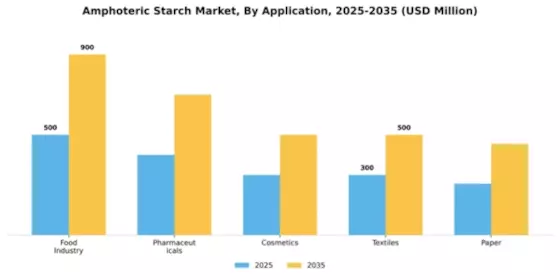
Food Industry: Dominant vs. Pharmaceuticals: Emerging
The food industry plays a pivotal role in the amphoteric starch market, characterized by its extensive application in processed foods, sauces, and dairy products. Starches here enhance texture and shelf life, making them indispensable in modern food manufacturing. On the other hand, the pharmaceutical industry is the emerging segment experiencing rapid growth, driven by increasing demand for high-performance excipients that aid drug formulations and delivery. Amphoteric starches' versatility, coupled with regulatory advancements and innovation in pharmaceutical applications, positions this segment as a vital source of expansion in the market.
In the Amphoteric Starch Market, the 'Thickening Agent' segment holds the largest market share due to its widespread application across various industries, including food and beverages, pharmaceuticals, and cosmetics. This segment is highly valued for its ability to enhance texture and viscosity, making it a preferred choice for manufacturers looking to improve product quality. In comparison, the 'Stabilizer' segment, while smaller, is rapidly gaining traction, particularly in the food sector where the demand for stable emulsions and formulations is essential for product longevity and acceptance.
Thickening Agent (Dominant) vs. Stabilizer (Emerging)
The 'Thickening Agent' category serves as the dominant force within the Amphoteric Starch Market, leveraging its essential role in enhancing product texture and consistency across various applications. Industries such as food, cosmetics, and pharmaceuticals favor thickening agents to achieve desired body and mouthfeel in end-products. Meanwhile, the 'Stabilizer' segment is emerging strongly, driven by increasing consumer demand for stable formulations that do not separate over time. This growth trend can be attributed to innovations in formulation technology and the rising focus on product quality in food and personal care applications.
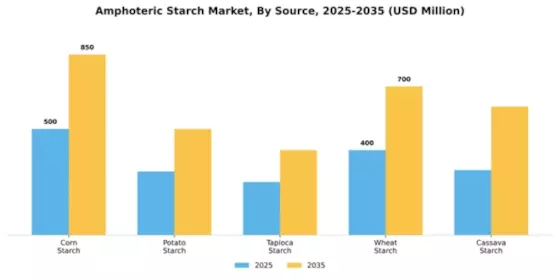
In the Amphoteric Starch Market, corn starch holds a significant share, primarily due to its widespread availability and versatility in various applications. Its extensive use in food products, pharmaceuticals, and industrial applications bolsters its position as the largest segment. Conversely, tapioca starch is emerging rapidly, driven by the rising consumer demand for gluten-free and clean-label products, marking a noticeable shift in market preferences toward healthier alternatives.
Corn Starch (Dominant) vs. Tapioca Starch (Emerging)
Corn starch remains dominant in the Amphoteric Starch Market, known for its excellent thickening and binding properties. It finds extensive applications in the food and beverage industry, contributing to its robust market position. On the other hand, tapioca starch has gained traction as an emerging player. Its hypoallergenic nature and suitability for gluten-free diets have led to increased adoption across the food sector, while its applications in cosmetics and pharmaceuticals further enhance its market presence. This growing trend signifies a shift in consumer preferences, positioning tapioca starch as a key player to watch in the future.
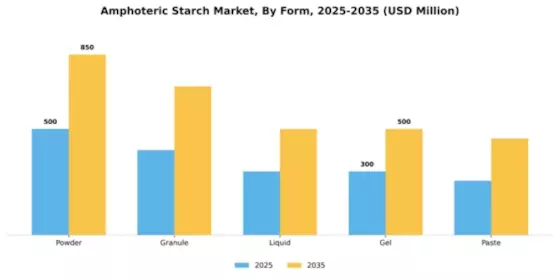
The 'Form' segment of the Amphoteric Starch Market comprises several key categories, namely powder, granule, liquid, gel, and paste. Among these, powder holds the largest market share, benefiting from its versatility across various applications such as food, cosmetics, and pharmaceuticals. The liquid form follows, gaining traction due to ease of incorporation in formulations, but its share remains smaller than the powder segment. Granule, gel, and paste forms are also present in the market but cater to more niche applications, resulting in their comparatively lower market presence.
Powder (Dominant) vs. Liquid (Emerging)
The powder form of amphoteric starch is currently the dominant player in the market, appreciated for its excellent stability and texture modification characteristics. It is extensively used in food products, personal care items, and pharmaceuticals, offering high versatility. On the other hand, liquid amphoteric starch is recognized as the emerging segment, growing rapidly owing to its convenience and compatibility with a range of ingredients, making it a preferred choice in formulations requiring easy dispersion. Both forms are critical, but the shift towards liquid formulations reflects evolving consumer preferences towards natural and clean-label products, indicating potential market shifts.
Get more detailed insights about Amphoteric Starch Market Request Free Sample
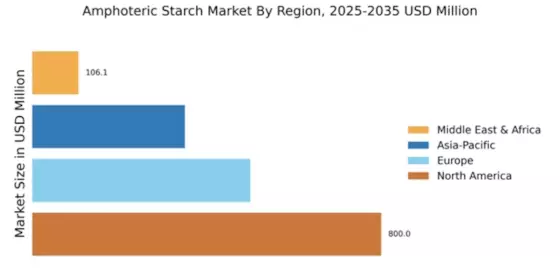
North America continues to lead the amphoteric starch market, holding a significant share of 800.0. The region's growth is driven by increasing demand in food, pharmaceuticals, and personal care sectors. Regulatory support for natural ingredients and clean label trends further catalyze market expansion. The focus on sustainable sourcing and production methods is also gaining traction, aligning with consumer preferences for eco-friendly products. The United States is the primary contributor to this market, with key players like Cargill, ADM, and Ingredion driving innovation and competition. The presence of advanced research facilities and a robust supply chain enhances the region's competitive edge. As companies invest in R&D, the market is expected to witness the introduction of novel products that cater to diverse applications, solidifying North America's position as a market leader.
Europe's amphoteric starch market is poised for growth, with a market size of 500.0. The region benefits from a strong emphasis on health and wellness, driving demand for natural and organic products. Regulatory frameworks, such as the EU's Food Information to Consumers Regulation, promote transparency and safety, further boosting market confidence. The increasing use of amphoteric starch in clean label products is a significant trend, aligning with consumer preferences for healthier options. Germany, France, and the UK are leading countries in this market, with companies like Tate & Lyle and Roquette Freres playing pivotal roles. The competitive landscape is characterized by innovation and strategic partnerships, as firms seek to enhance their product offerings. The presence of established players and a growing number of startups contribute to a dynamic market environment, fostering continuous development and expansion.
The Asia-Pacific amphoteric starch market is experiencing rapid growth, with a market size of 350.0. Factors such as urbanization, rising disposable incomes, and changing dietary preferences are driving demand for processed foods and beverages. Additionally, the region's increasing focus on health and wellness is propelling the use of natural ingredients in various applications. Regulatory support for food safety and quality standards is also enhancing market growth prospects. China and India are the leading countries in this market, with a growing number of local and international players. Companies are increasingly investing in R&D to develop innovative products tailored to regional tastes and preferences. The competitive landscape is evolving, with both established firms and new entrants vying for market share, creating a vibrant and dynamic environment for amphoteric starch products.
The Middle East and Africa amphoteric starch market, valued at 106.12, is on the cusp of significant growth. The region's expanding food and beverage industry, coupled with increasing consumer awareness of health and nutrition, is driving demand for natural and functional ingredients. Regulatory initiatives aimed at improving food safety standards are also contributing to market development, fostering a conducive environment for growth. Countries like South Africa and the UAE are leading the charge, with a mix of local and international companies entering the market. The competitive landscape is characterized by strategic collaborations and partnerships, as firms seek to leverage local knowledge and distribution networks. As the market matures, the focus on innovation and product differentiation will be crucial for capturing consumer interest and expanding market share.
The Amphoteric Starch Market is currently characterized by a dynamic competitive landscape, driven by increasing demand for clean-label products and the growing application of starches in various industries, including food, pharmaceuticals, and personal care. Major players such as Cargill (US), ADM (US), and Tate & Lyle (GB) are strategically positioned to leverage innovation and sustainability in their operations. Cargill (US) focuses on enhancing its product portfolio through research and development, while ADM (US) emphasizes partnerships to expand its market reach. Tate & Lyle (GB) is actively pursuing digital transformation initiatives to optimize its supply chain and improve customer engagement, collectively shaping a competitive environment that prioritizes adaptability and responsiveness.Key business tactics within the Amphoteric Starch Market include localizing manufacturing and optimizing supply chains to enhance efficiency and reduce costs. The market structure appears moderately fragmented, with several key players exerting influence over their respective segments. This fragmentation allows for niche players to thrive, while larger companies capitalize on economies of scale and extensive distribution networks, creating a competitive dynamic that fosters innovation and responsiveness to market demands.In November Cargill (US) announced a significant investment in a new production facility aimed at increasing its capacity for producing specialty starches. This strategic move is expected to enhance Cargill's ability to meet the rising demand for clean-label products, positioning the company favorably in a market that increasingly values transparency and sustainability. The investment underscores Cargill's commitment to innovation and its proactive approach to capturing market share.In October ADM (US) entered into a strategic partnership with a leading biotechnology firm to develop advanced starch derivatives. This collaboration is anticipated to accelerate the development of innovative products that cater to the evolving needs of the food and beverage industry. By leveraging biotechnology, ADM aims to enhance the functionality of its starch offerings, thereby strengthening its competitive position in a rapidly changing market.In September Tate & Lyle (GB) launched a new line of sustainable starches derived from non-GMO sources, reflecting its commitment to sustainability and consumer preferences. This product launch not only aligns with current market trends but also reinforces Tate & Lyle's reputation as a leader in innovation within the starch sector. The introduction of these sustainable options is likely to attract environmentally conscious consumers and enhance brand loyalty.As of December current competitive trends in the Amphoteric Starch Market are increasingly defined by digitalization, sustainability, and the integration of AI technologies. Strategic alliances are becoming more prevalent, enabling companies to pool resources and expertise to drive innovation. The competitive landscape is shifting from traditional price-based competition to a focus on technological advancements, product differentiation, and supply chain reliability. This evolution suggests that companies that prioritize innovation and sustainability will likely emerge as leaders in the market, shaping the future of the Amphoteric Starch Market.




The Amphoteric Starch Market has seen significant developments recently, particularly with key players like Emsland Group, AGRANA, and Cargill focusing on innovations to enhance product offerings. Companies such as BASF and MGP Ingredients are investing in research and development to meet the growing demand for sustainable and functional food ingredients, reflecting an increasing trend toward natural products. The need for clean-label ingredients is driving these advancements as consumers are becoming more health-conscious. In terms of market dynamics, mergers and acquisitions remain a crucial aspect of growth strategies, though specific recent transactions among the listed companies have not been disclosed.
Nevertheless, notable expansions and collaborations are becoming prevalent, highlighting the competitive landscape. The valuation of companies such as Archer Daniels Midland and Tate & Lyle indicates a positive growth trajectory driven by rising consumer demand for versatile and multifunctional starches across various sectors, including food and pharmaceuticals. As market demands evolve, firms are positioning themselves to adapt through innovation and strategic partnerships, aiming to strengthen their hold in the amphoteric starch segment.
The Amphoteric Starch Market is projected to grow at a 5.16% CAGR from 2025 to 2035, driven by increasing demand in food, cosmetics, and pharmaceuticals.
New opportunities lie in:
By 2035, the Amphoteric Starch Market is expected to achieve robust growth and diversification.
| MARKET SIZE 2024 | 1756.12(USD Million) |
| MARKET SIZE 2025 | 1846.77(USD Million) |
| MARKET SIZE 2035 | 3054.94(USD Million) |
| COMPOUND ANNUAL GROWTH RATE (CAGR) | 5.16% (2025 - 2035) |
| REPORT COVERAGE | Revenue Forecast, Competitive Landscape, Growth Factors, and Trends |
| BASE YEAR | 2024 |
| Market Forecast Period | 2025 - 2035 |
| Historical Data | 2019 - 2024 |
| Market Forecast Units | USD Million |
| Key Companies Profiled | Cargill (US), ADM (US), Tate & Lyle (GB), Roquette Freres (FR), Ingredion (US), BASF (DE), Kerry Group (IE), Emsland Group (DE), Avebe (NL) |
| Segments Covered | Application, End Use, Source, Form |
| Key Market Opportunities | Growing demand for clean label products drives innovation in the Amphoteric Starch Market. |
| Key Market Dynamics | Rising demand for clean-label products drives innovation and competition in the amphoteric starch market. |
| Countries Covered | North America, Europe, APAC, South America, MEA |
The Amphoteric Starch Market was valued at 1756.12 USD Million in 2024.
The market is projected to reach 3054.94 USD Million by 2035.
The expected CAGR for the Amphoteric Starch Market from 2025 to 2035 is 5.16%.
The main applications include the food industry, pharmaceuticals, cosmetics, textiles, and paper, with valuations ranging from 256.12 to 900.00 USD Million.
Corn starch leads with a valuation of 500.0 to 850.0 USD Million, followed by wheat starch and cassava starch, indicating diverse sourcing options.
The primary forms include powder, granule, liquid, gel, and paste, with valuations between 256.12 and 850.0 USD Million.
Key end-use categories are thickening agents, stabilizers, emulsifiers, film formers, and binders, with valuations ranging from 300.0 to 700.0 USD Million.
The market's growth potential appears robust, with a projected increase in valuation from 1756.12 USD Million in 2024 to 3054.94 USD Million by 2035.
Trends such as increasing demand in food and pharmaceuticals, along with innovations from key players, may significantly influence market dynamics.


Kindly complete the form below to receive a free sample of this Report

“This is really good guys. Excellent work on a tight deadline. I will continue to use you going forward and recommend you to others. Nice job”


“Thanks. It’s been a pleasure working with you, please use me as reference with any other Intel employees.”


“Thanks for sending the report it gives us a good global view of the Betaïne market.”


“Thank you, this will be very helpful for OQS.”


“We found the report very insightful! we found your research firm very helpful. I'm sending this email to secure our future business.”


“I am very pleased with how market segments have been defined in a relevant way for my purposes (such as "Portable Freezers & refrigerators" and "last-mile"). In general the report is well structured. Thanks very much for your efforts.”


“I have been reading the first document or the study, ,the Global HVAC and FP market report 2021 till 2026. Must say, good info! I have not gone in depth at all parts, but got a good indication of the data inside!”


“We got the report in time, we really thank you for your support in this process. I also thank to all of your team as they did a great job.”


“The Automotive 48V ECU Components Procurement Intelligence Study” was a complex project, but the Market Research Future (MRFR) team handled it with quality, agility, and customer-centricity. They delivered all requested data on time and within the agreed scope. The team, including Shubhendra Anand and Rahul Gotadki, was always readily available to clarify questions and swiftly implement necessary adjustments, driving the project to a successful conclusion within a very demanding timeframe.
I would also like to specifically commend Akshay Agarwal for his responsiveness and support at every stage—from our initial inquiry on May 6th through to final delivery on June 18th. His dedication made the entire process seamless.”



