Research Methodology on Starch Derivatives Market
1. Overview
This research methodology aims at understanding the starch derivatives market by studying the global market dynamics, market estimations and projections, and developing a comprehensive understanding of the market segmentation and dynamics. The research methodology employed in this research report focuses on primary and secondary research sources. Primary research sources, such as industry and market experts, have been used to capture industry insights, market directions, and market size. Secondary research sources, such as public databases and company reports, are used to develop a detailed market understanding and insights into the starch derivatives global market.
2. Research Approach
This research methodology employs a two-step approach: market research and mapping the market. In the first step, the report analyzes primary and secondary market data sets collected from secondary sources such as public databases, industry journals, and company reports. The primary and secondary research insights are then integrated and aggregated to develop a holistic understanding of the market. This first step is further supplemented by the second step which involves market mapping. This involves mapping consumer behaviour, competitive landscape and supplier data to develop a better understanding of the starch derivatives market and capture potential opportunities.
3. Sources of Data
Both primary and secondary sources of data are used to develop a comprehensive understanding of the starch derivatives market. Primary research sources include interviews with industry and market experts such as traders, suppliers, and manufacturers. To identify key industry trends, these interviews were conducted across multiple industry verticals such as biotechnology, industrial processing, and food and beverage. Secondary research sources, such as public databases, company reports, and industry journals, were used to gain insights into the starch derivatives market, including market size and opportunity assessment, competitive landscape, and product specifications.
4. Market Estimation and 5-Factor Analysis
To gain insights into the starch derivatives market, a market sizing exercise was conducted via a 5-Factor Analysis. This analysis includes market drivers and restraints, market attractiveness and competition, and strategic planning. The data points used for the analysis were collected via primary and secondary research sources. The calculated market size was then cross-referenced with actual market figures to ensure market accuracy. Furthermore, an extrapolation technique was used to scale up market estimates to forecast the market size.
5. Market Segmentation
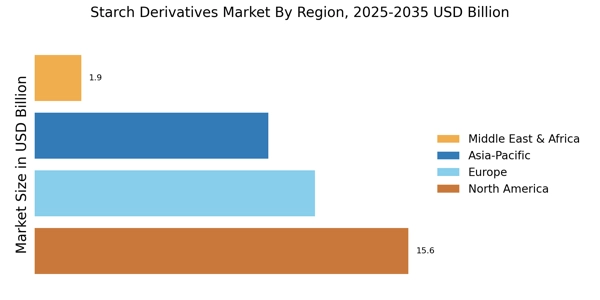
The starch derivatives market is classified based on type, application, and region. By type, the starch derivatives market is segmented into maize, wheat, potato, and others. By application, the market is segmented into food, feed, industrial, and others. Finally, by region, the starch derivatives market is segmented into North America, Europe, Asia-Pacific, and the Rest of the World.
6. Assumptions
Though this research methodology captures key insights into the starch derivatives market, certain assumptions in the research have to be considered. One of the assumptions is that there has been a steady trend in the demand for starch derivatives worldwide. This assumption has been made based on the growing usage of starch derivatives in multiple industry verticals. Another assumption measures that the average manufacturing cost remains constant over the years.