Download Free Sample
Kindly complete the form below to receive a free sample of this Report
Anechoic Chamber Market Size, Share and Research Report By Type (Faraday Cage, RF Shielded Room, Microwave Absorbing Chamber, Other), By Frequency Range (Anechoic Chamber (Below 1 GHz), Anechoic Chamber (1 GHz to 18 GHz), Anechoic Chamber (Above 18 GHz)), By Application (Electromagnetic Compatibility (EMC) Testing, Radar Cross Section (RCS) Measurement, Antenna Testing, RF Absorption Measurement), By Industry (Automotive, Aerospace and Defense, Telecommunications, Electronics, Other), By Material (Metallic, Ferrite, Carbon-Based, Other) and By Region (North America, Europe, South America, Asia Pacific, Middle East and Africa) - Industry Forecast Till 2035
As per MRFR analysis, the Anechoic Chamber Market Size was estimated at 2333.95 USD Million in 2024. The Anechoic Chamber industry is projected to grow from 2554.55 in 2025 to 6303.09 by 2035, exhibiting a compound annual growth rate (CAGR) of 9.45% during the forecast period 2025 - 2035.
The Anechoic Chamber Market is experiencing robust growth driven by technological advancements and increasing demand for sound quality.
| 2024 Market Size | 2333.95 (USD Million) |
| 2035 Market Size | 6303.09 (USD Million) |
| CAGR (2025 - 2035) | 9.45% |
The Anechoic Chamber Market is currently experiencing a notable evolution, driven by advancements in technology and increasing demand for precise acoustic testing. These specialized environments, designed to eliminate reflections and external noise, are essential for various applications, including product development, research, and quality assurance in industries such as telecommunications, automotive, and aerospace. As organizations strive for enhanced product performance and compliance with stringent regulations, the relevance of anechoic chambers continues to grow. Furthermore, the integration of innovative materials and design methodologies appears to enhance the effectiveness of these chambers, potentially leading to improved testing outcomes. In addition to technological advancements, the Anechoic Chamber Market is influenced by a rising awareness of sound quality and its implications on user experience. Companies are increasingly recognizing the importance of sound in product design, which may drive investments in acoustic testing facilities. Moreover, the expansion of research and development activities across various sectors is likely to bolster the demand for anechoic chambers. As industries evolve, the need for accurate sound measurement and analysis becomes paramount, suggesting a promising trajectory for the market in the foreseeable future.
The ongoing evolution of technology is reshaping the Anechoic Chamber Market. Innovations in materials and construction techniques are enhancing the performance and efficiency of these chambers, allowing for more accurate acoustic measurements. This trend indicates a shift towards more sophisticated testing environments that can cater to the diverse needs of various industries.
There is a growing emphasis on sound quality across multiple sectors, which is influencing the Anechoic Chamber Market. Companies are beginning to understand the critical role that sound plays in user experience, prompting them to invest in acoustic testing. This trend suggests a heightened demand for anechoic chambers as organizations seek to refine their products.
The expansion of research and development initiatives in numerous fields is likely to drive the Anechoic Chamber Market. As industries prioritize innovation and compliance with regulatory standards, the need for precise acoustic testing becomes increasingly vital. This trend may lead to a surge in the establishment of anechoic chambers to support these activities.
The Global Anechoic Chamber Market Industry is significantly influenced by stringent regulatory requirements imposed by government agencies concerning electromagnetic interference and noise pollution. Industries such as telecommunications and aerospace are particularly affected, as they must adhere to specific standards to ensure product safety and performance. Anechoic chambers provide the necessary environment for testing and validating compliance with these regulations. As industries strive to meet these standards, the demand for anechoic chambers is expected to grow, contributing to a compound annual growth rate of 9.45% from 2025 to 2035, highlighting the importance of regulatory compliance in driving market growth.
The Global Anechoic Chamber Market Industry is bolstered by increased investments in research and development across various sectors, including electronics and telecommunications. Companies are recognizing the need for advanced testing facilities to innovate and develop new products that meet consumer demands. Anechoic chambers facilitate the testing of new technologies, such as 5G and IoT devices, ensuring they perform optimally in real-world conditions. This trend is likely to enhance the market's growth, as organizations allocate more resources to R&D, thereby increasing the demand for specialized testing environments. The anticipated growth trajectory underscores the critical role of R&D in shaping the future of the market.
The Global Anechoic Chamber Market Industry is projected to experience substantial growth, with forecasts indicating an increase from 2.33 USD Billion in 2024 to 6.29 USD Billion by 2035. This growth trajectory suggests a compound annual growth rate of 9.45% from 2025 to 2035, driven by various factors such as technological advancements, regulatory compliance, and increased R&D investments. The market's expansion is indicative of the rising importance of anechoic chambers in ensuring product quality and performance across diverse industries. As the demand for precise testing environments continues to rise, the market is poised for significant development in the coming years.
The Global Anechoic Chamber Market Industry is experiencing a surge in demand due to rapid technological advancements in various sectors, including telecommunications and automotive. Innovations in wireless communication and electric vehicles necessitate precise testing environments to ensure compliance with regulatory standards. For instance, the increasing complexity of electronic devices requires rigorous testing for electromagnetic compatibility, which anechoic chambers provide. As a result, the market is projected to reach 2.33 USD Billion in 2024, reflecting a growing recognition of the need for high-quality testing facilities that can accommodate these advancements.
The Global Anechoic Chamber Market Industry is driven by an escalating demand for noise control solutions across multiple sectors, including construction, automotive, and consumer electronics. As urbanization increases, the need for effective noise reduction strategies becomes paramount. Anechoic chambers play a crucial role in testing sound insulation and absorption materials, thereby ensuring compliance with noise regulations. This trend is particularly evident in the automotive industry, where manufacturers are increasingly focused on reducing cabin noise. The market's growth trajectory suggests a potential increase to 6.29 USD Billion by 2035, indicating a robust demand for noise control technologies.
The Global Anechoic Chamber Market Industry is positively impacted by the expanding consumer electronics market, which is characterized by rapid innovation and increasing consumer expectations. As manufacturers strive to produce high-quality audio and visual products, the need for precise testing environments becomes essential. Anechoic chambers allow for accurate assessments of sound quality and performance, which are crucial for consumer satisfaction. The growth of this sector is expected to drive the market towards a valuation of 2.33 USD Billion in 2024, reflecting the interconnectedness of consumer electronics and the demand for specialized testing facilities.
In the anechoic chamber market, the application segment shows a distinct distribution of market share among key values. Electromagnetic Compatibility Testing stands out as the leading application, reflecting its critical importance in ensuring devices function correctly within their electromagnetic environment. Following this, Acoustic Testing is gaining traction, especially in developing industries where sound quality is paramount.
Electromagnetic Compatibility Testing (Dominant) vs. Antenna Testing (Emerging)
Electromagnetic Compatibility Testing serves as the dominant force in the anechoic chamber market due to its extensive application across consumer electronics, automotive, and telecommunications. This segment is characterized by rigorous standards and regulations, driving continuous innovation and investment in testing technologies. Conversely, Antenna Testing is emerging as a significant player, fueled by the increasing demand for wireless communication and the proliferation of IoT devices. Though it currently holds a smaller market position, advancements in antenna technology and the shift towards 5G networks indicate a robust growth trajectory.
In the Anechoic Chamber Market, the automotive segment holds the largest share, driven by the industry's rigorous testing requirements for vehicle noise reduction and compliance with stringent regulations. Consumer electronics and telecommunications also play significant roles, but are comparatively smaller in terms of market share. The aerospace segment, while smaller, is exhibiting rapid growth due to increased investment in aircraft noise reduction initiatives and the rising demand for quiet environments during testing phases.
Automotive (Dominant) vs. Aerospace (Emerging)
The automotive end use segment remains dominant in the anechoic chamber market, characterized by high regulatory standards for noise control and increasing consumer demand for quieter vehicles. This has led to a surge in the adoption of anechoic chambers for various applications, including r&d and quality control. On the other hand, the aerospace segment, marked as emerging, is gaining momentum as manufacturers seek to enhance the acoustic performance of aircraft. The focus on reducing noise pollution in aviation, driven by environmental concerns and regulatory compliance, positions aerospace as a key growth area in the market.
In the Anechoic Chamber Market, the distribution of segments reveals that Fully Anechoic Chambers hold a significant share, making them the most preferred choice among manufacturers and researchers focused on sound testing and measurement. With their ability to provide an environment free from reflections and external noise, these chambers are essential for high-precision acoustic testing, leading to their dominance in the market. On the other hand, Semi Anechoic Chambers are rapidly gaining traction as an emerging segment due to their versatility in testing different sound sources. The increasing demand for noise control and sound quality evaluation in various industries is propelling the growth of this segment. Moreover, advancements in technology are enhancing the capabilities of Semi Anechoic Chambers, thus attracting more users looking for a cost-effective solution for sound testing needs.
Fully Anechoic Chamber (Dominant) vs. Semi Anechoic Chamber (Emerging)
Fully Anechoic Chambers are recognized for their ability to create an ideal testing environment by eliminating all sound reflections, making them the dominant force in the Anechoic Chamber Market. They are essential for applications requiring highly accurate acoustic measurements, such as in aerospace, automotive, and telecommunication sectors. Alternatively, Semi Anechoic Chambers are emerging as a flexible solution for sound testing, offering a balance between reflection control and practical application for a broader range of sound evaluation tasks. These chambers are particularly favored in product development, as they facilitate the evaluation of sound behavior in a less controlled yet effective setting, catering to industries that prioritize sound quality in their products.
Within the anechoic chamber market, the size segments exhibit a notable distribution of market share. Medium-sized chambers dominate the landscape, capturing the largest segment of the market due to their versatility and broad applicability across various sectors such as telecommunications and automotive testing. In contrast, small chambers are becoming increasingly popular, particularly among smaller enterprises and startups that require compact solutions. This trend is aided by advancements in technology that make small chambers more affordable and efficient.
Size Segment: Medium (Dominant) vs. Small (Emerging)
Medium-sized anechoic chambers are characterized by their balanced space and utility, making them the choice for many industries requiring comprehensive testing capabilities. These chambers can accommodate a wide range of devices and are strategically designed to deliver optimal performance and reliability. On the other hand, small anechoic chambers are gaining traction as an emerging solution. Their compact design caters to businesses with limited space and budget constraints, driving demand. These chambers often feature innovative designs that enhance acoustic performance and facilitate ease of use, appealing to a growing market segment.
In the Anechoic Chamber Market, the material segment is primarily dominated by Steel, which holds the largest market share owing to its durability and ability to effectively manage sound absorption. In contrast, Composite materials are emerging rapidly and capturing attention for their lightweight properties and superior performance in specific applications. While Steel remains the traditional choice, the growing versatility of composite materials is influencing design decisions across various industries. The growth trends within this segment are largely driven by advancements in aerospace and automotive sectors, where weight reduction is critical. Composite materials are increasingly being adopted due to their ability to offer significant sound dampening while minimizing weight. Furthermore, the rising demand for high-performance anechoic chambers that require enhanced acoustic absorption is propelling the adoption of these materials, making composites the fastest-growing segment in this market.
Material Comparison: Steel (Dominant) vs. Aluminum (Emerging)
Steel serves as a dominant material in the Anechoic Chamber Market due to its robust strength and effectiveness in providing sound isolation. It is favored for its proven performance in various environments and its ability to withstand heavy usage. On the other hand, Aluminum is recognized as an emerging alternative thanks to its lightweight and corrosion-resistant characteristics, which enable easier installation and mobility of anechoic chambers. While Steel is often seen in permanent installations, Aluminum caters to the growing need for portable solutions that can be easily set up and dismantled. This emerging trend towards lightweight materials suggests a shift in application preferences, particularly in industries looking for flexibility alongside effective sound management.
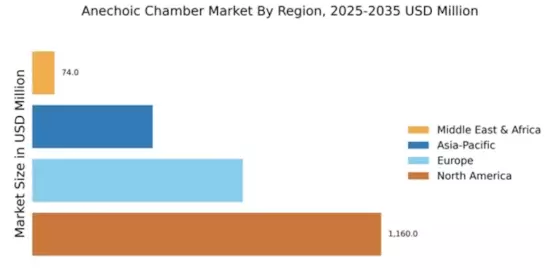
North America is poised to maintain its leadership in the Anechoic Chamber market, holding a significant share of 1160.0 million. The region's growth is driven by increasing demand for advanced testing facilities in aerospace, automotive, and telecommunications sectors. Regulatory support for noise reduction and environmental standards further catalyzes market expansion, ensuring compliance with stringent guidelines. The competitive landscape is robust, featuring key players such as Brüel & Kjær, Emerson Electric Co., and NTS. The U.S. stands out as a major contributor, with a focus on technological advancements and innovation. The presence of established companies fosters a dynamic environment, encouraging new entrants and enhancing market competitiveness.
Europe's Anechoic Chamber market is valued at 700.0 million, reflecting a growing demand for high-quality testing environments. The region benefits from stringent regulations aimed at noise control and environmental protection, driving investments in advanced acoustic testing solutions. Countries like Germany and France are at the forefront, leveraging technological advancements to enhance product offerings and meet regulatory requirements. The competitive landscape includes prominent players such as Schneider Electric and ETS-Lindgren, which are actively expanding their market presence. The European market is characterized by a mix of established firms and innovative startups, fostering a collaborative environment that encourages research and development in acoustic technologies. The region's commitment to sustainability further propels market growth.
The Asia-Pacific region, with a market size of 400.0 million, is witnessing rapid growth in the Anechoic Chamber sector. This surge is driven by increasing industrialization, urbanization, and a growing focus on quality assurance in manufacturing processes. Countries like China and Japan are leading the charge, supported by government initiatives aimed at enhancing technological capabilities and compliance with international standards. The competitive landscape is evolving, with both local and international players vying for market share. Companies such as Anechoic Technologies and MTS Systems Corporation are expanding their operations to cater to the rising demand. The region's diverse market dynamics present opportunities for innovation and collaboration, positioning Asia-Pacific as a key player in The Anechoic Chamber.
The Middle East and Africa region, with a market size of 73.95 million, presents a niche yet promising opportunity in the Anechoic Chamber market. The growth is primarily driven by increasing investments in infrastructure and technology, particularly in sectors like telecommunications and defense. Regulatory frameworks are gradually evolving to support noise control measures, enhancing the demand for specialized testing facilities. Countries such as South Africa and the UAE are emerging as key players in this market, with a focus on adopting advanced acoustic technologies. The competitive landscape is characterized by a mix of local firms and international companies looking to establish a foothold. As the region continues to develop, the demand for innovative acoustic solutions is expected to rise, creating new opportunities for market participants.
The anechoic chamber market is characterized by a competitive landscape that is increasingly shaped by technological advancements and the growing demand for precise acoustic testing. Key players such as Brüel & Kjær (DK), Emerson Electric Co. (US), and ETS-Lindgren (US) are at the forefront, each adopting distinct strategies to enhance their market positioning. Brüel & Kjær (DK) focuses on innovation in acoustic measurement technologies, while Emerson Electric Co. (US) emphasizes its commitment to sustainability and energy efficiency in its product offerings. ETS-Lindgren (US) is known for its strategic partnerships that enhance its capabilities in electromagnetic compatibility testing, thereby broadening its market reach. Collectively, these strategies contribute to a dynamic competitive environment where innovation and operational efficiency are paramount.
In terms of business tactics, companies are increasingly localizing manufacturing to reduce lead times and optimize supply chains. The market structure appears moderately fragmented, with several players vying for market share. This fragmentation allows for a diverse range of products and services, but also intensifies competition among key players. The collective influence of these companies is significant, as they drive advancements in technology and customer service, which are critical for maintaining competitive advantage.
In November 2025, Emerson Electric Co. (US) announced a strategic partnership with a leading technology firm to develop next-generation acoustic testing solutions. This collaboration is expected to leverage advanced AI algorithms to enhance the accuracy and efficiency of testing processes. The strategic importance of this partnership lies in its potential to position Emerson as a leader in innovative testing solutions, thereby attracting a broader customer base and increasing market share.
In October 2025, ETS-Lindgren (US) launched a new line of anechoic chambers designed specifically for automotive applications. This product line aims to meet the growing demand for noise and vibration testing in the automotive sector, which is increasingly focused on electric vehicle development. The introduction of this specialized product line underscores ETS-Lindgren's commitment to addressing industry-specific needs, thereby enhancing its competitive edge in a niche market.
In September 2025, Brüel & Kjær (DK) expanded its global footprint by opening a new facility in Asia, aimed at catering to the rising demand for acoustic testing in the region. This expansion not only signifies Brüel & Kjær's strategic focus on regional growth but also reflects the increasing importance of the Asian market in the global anechoic chamber landscape. Such moves are indicative of a broader trend where companies are seeking to establish a more localized presence to better serve their customers.
As of December 2025, current competitive trends in the anechoic chamber market are heavily influenced by digitalization, sustainability, and the integration of AI technologies. Strategic alliances are becoming increasingly vital, as they enable companies to pool resources and expertise, thereby enhancing their competitive positioning. Looking ahead, it appears that competitive differentiation will evolve from traditional price-based competition to a focus on innovation, technological advancements, and supply chain reliability. This shift suggests that companies that prioritize these areas will likely emerge as leaders in the market.


The global anechoic chamber market is projected to grow significantly over the next decade, driven by increasing demand from various industries such as automotive, aerospace, and telecommunications. Key market players are focusing on developing innovative solutions to meet the evolving needs of customers.
For instance, in 2023, ETS-Lindgren launched the MA6115, a compact and portable anechoic chamber designed for testing small to medium-sized devices. The chamber features a modular design, allowing for easy customization and expansion. Such developments are expected to contribute to the overall growth of the anechoic chamber market in the coming years.
The Anechoic Chamber Market is projected to grow at a 9.45% CAGR from 2025 to 2035, driven by advancements in technology, increased demand for noise control, and stringent regulatory standards.
New opportunities lie in:
By 2035, the Anechoic Chamber Market is expected to achieve substantial growth and innovation.
| MARKET SIZE 2024 | 2333.95(USD Million) |
| MARKET SIZE 2025 | 2554.55(USD Million) |
| MARKET SIZE 2035 | 6303.09(USD Million) |
| COMPOUND ANNUAL GROWTH RATE (CAGR) | 9.45% (2025 - 2035) |
| REPORT COVERAGE | Revenue Forecast, Competitive Landscape, Growth Factors, and Trends |
| BASE YEAR | 2024 |
| Market Forecast Period | 2025 - 2035 |
| Historical Data | 2019 - 2024 |
| Market Forecast Units | USD Million |
| Key Companies Profiled | Brüel & Kjær (DK), Emerson Electric Co. (US), Anechoic Technologies (US), NTS (US), ETS-Lindgren (US), Schneider Electric (FR), MTS Systems Corporation (US), Meggitt (UK) |
| Segments Covered | Application, End Use, Type, Material, Size |
| Key Market Opportunities | Growing demand for advanced acoustic testing in emerging technologies drives Anechoic Chamber Market expansion. |
| Key Market Dynamics | Rising demand for precise acoustic testing drives innovation and competition in the anechoic chamber market. |
| Countries Covered | North America, Europe, APAC, South America, MEA |
The Anechoic Chamber Market was valued at 2333.95 USD Million in 2024.
The market is projected to reach a valuation of 6303.09 USD Million by 2035.
The expected CAGR for the Anechoic Chamber Market during the forecast period 2025 - 2035 is 9.45%.
Key players in the market include Brüel & Kjær, Emerson Electric Co., Anechoic Technologies, and ETS-Lindgren.
The primary applications include Electromagnetic Compatibility Testing, Acoustic Testing, Antenna Testing, and Microphone Testing.
The market segments by end use include Automotive, Aerospace, Consumer Electronics, and Telecommunications, with valuations ranging from 233.95 to 2200.00 USD Million.
The market offers Fully Anechoic Chambers, Semi Anechoic Chambers, and Reverberation Chambers, with valuations from 533.95 to 2500.00 USD Million.
Common materials include Steel, Aluminum, and Composite, with valuations ranging from 600.00 to 2603.09 USD Million.
The market is segmented by size into Small, Medium, and Large chambers, with valuations from 466.79 to 2461.54 USD Million.
Trends influencing growth include advancements in technology and increasing demand for testing in sectors like Consumer Electronics and Telecommunications.



Kindly complete the form below to receive a free sample of this Report

“This is really good guys. Excellent work on a tight deadline. I will continue to use you going forward and recommend you to others. Nice job”


“Thanks. It’s been a pleasure working with you, please use me as reference with any other Intel employees.”


“Thanks for sending the report it gives us a good global view of the Betaïne market.”


“Thank you, this will be very helpful for OQS.”


“We found the report very insightful! we found your research firm very helpful. I'm sending this email to secure our future business.”


“I am very pleased with how market segments have been defined in a relevant way for my purposes (such as "Portable Freezers & refrigerators" and "last-mile"). In general the report is well structured. Thanks very much for your efforts.”


“I have been reading the first document or the study, ,the Global HVAC and FP market report 2021 till 2026. Must say, good info! I have not gone in depth at all parts, but got a good indication of the data inside!”


“We got the report in time, we really thank you for your support in this process. I also thank to all of your team as they did a great job.”


“The Automotive 48V ECU Components Procurement Intelligence Study” was a complex project, but the Market Research Future (MRFR) team handled it with quality, agility, and customer-centricity. They delivered all requested data on time and within the agreed scope. The team, including Shubhendra Anand and Rahul Gotadki, was always readily available to clarify questions and swiftly implement necessary adjustments, driving the project to a successful conclusion within a very demanding timeframe.
I would also like to specifically commend Akshay Agarwal for his responsiveness and support at every stage—from our initial inquiry on May 6th through to final delivery on June 18th. His dedication made the entire process seamless.”



