Animal Disinfectants Market

Key Players: Kersia Group, Lanxess AG, Evonik Industries, CID Lines (Ecolab), Diversey (Solenis), Neogen Corporation, GEA Group, Theseo Group

Animal Disinfectants Market

Animal Disinfectants Market Size, Share, Industry Trend & Analysis Research Report Information By Product Type (Iodine Compounds, Lactic Acid & Organic Acids, Chlorine-Based, Peracetic Acid, Others), By Form (Liquid, Powder, Foam), By Application (Dairy, Poultry, Swine, Cattle & Beef, Others), By End User (Livestock Farms, Veterinary Clinics, Integrated Protein Processors, Others), By Region (North America, Europe, Asia-Pacific, South America, Middle East & Africa) – Forecast till 2035
ID: MRFR/Agri/8924-HCR
90 Pages
Snehal Singh
Last Updated: June 08, 2026
 

Animal Disinfectants Market Summary

The Animal Disinfectants Market reached an estimated USD 3.29 billion in 2025 and is projected to climb from USD 3.50 billion in 2026 to USD 5.72 billion by 2035, registering a CAGR of 6.35% during the forecast period. Two forces anchor this trajectory: the European Union's accelerated phase-out of formaldehyde-based chemistries under REACH Regulation amendments [2] and a surge in government-backed livestock biosecurity programs across Southeast Asia, where avian influenza outbreaks triggered over USD 1.2 billion in emergency veterinary sanitation products procurement between 2022 and 2024 [3].

A technological shift is reshaping the Animal Disinfectants Market from manual spray-and-pray routines toward precision dosing and sensor-enabled dispensing platforms. Legacy chlorine-based dipping systems — the backbone of farm animal hygiene for decades — are giving way to automated fogging units and IoT-connected barn and stable sanitizers that cut chemical consumption by 20–30% while maintaining pathogen kill rates above 99.9% [4]. The EU's Horizon Europe program has earmarked EUR 180 million through 2027 for sustainable poultry disinfection solutions and antimicrobial stewardship research [5].

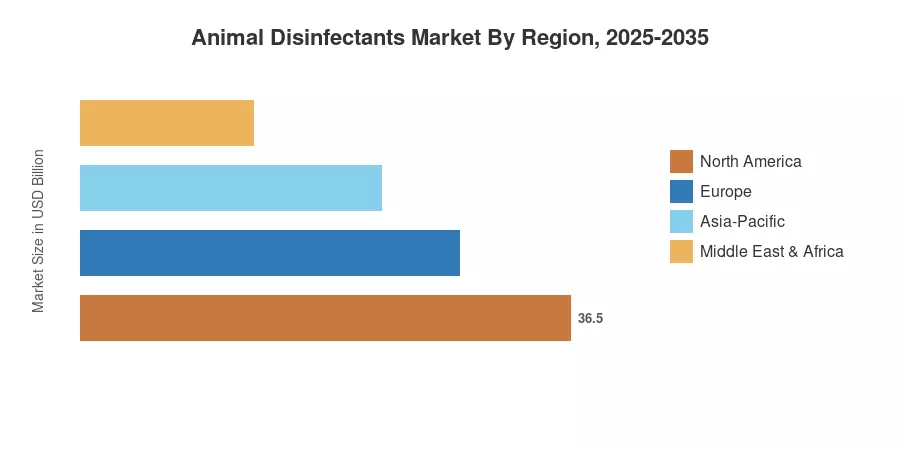
Europe commanded approximately 35% of the Animal Disinfectants Market in 2024, driven by strict livestock biosecurity mandates and early adoption of next-generation veterinary sanitation products. Asia-Pacific is the fastest-growing region at a projected CAGR of 7.95%, fueled by mega-farm expansion in China, India, and Vietnam. North America accounted for roughly 27% of global revenue, underpinned by USDA biosecurity modernization directives [6]. The decade ahead will reward suppliers who can pair chemical efficacy with digital traceability — a convergence that is redefining competitive advantage across the Animal Disinfectants Market.


Key Report Takeaways

• By Product Type

  • Iodine compounds led the Animal Disinfectants Market in 2024 with approximately 31% revenue share, driven by broad-spectrum efficacy in dairy and poultry disinfection solutions environments
  • Peracetic acid is set to expand at a 9.7% CAGR through 2035, propelled by zero-residue mandates in organic farm animal hygiene protocols
  • Chlorine-based products accounted for USD 0.58 billion in 2024, though regulatory headwinds are compressing growth

• By Form

  • Liquid formulations held 67% of the Animal Disinfectants Market in 2024, reflecting ease of integration with automated dosing lines
  • Foam formats are accelerating at an 8.1% CAGR, favored for contact-time advantages in barn and stable sanitizers applications

• By Application

  • Dairy operations captured 37% of revenue in 2024, as teat-dip protocols and milking parlor sanitation remain non-negotiable
  • Poultry disinfection solutions are poised to grow at a 10.3% CAGR, the fastest among all application segments

• By End User

  • Livestock farms represented 61% of 2024 revenue within the Animal Disinfectants Market
  • Integrated protein processors are forecast to grow at a 9.4% CAGR through 2035, as supply-chain traceability requirements expand

• By Region

  • Europe dominated with 35% share in 2024
  • While Asia-Pacific is the fastest-growing region at a 7.95% CAGR


Market Size and Forecast (2021–2035)

MRFR's sizing methodology triangulates bottom-up revenue modeling (manufacturer shipments, distributor sell-through) with top-down demand estimation (livestock population × disinfectant spend per head). Historical data draws on customs trade databases, company annual filings, and veterinary sanitation products procurement records. Forecast assumptions incorporate regulatory timelines, disease-outbreak frequency models, and raw-material price indices for iodine and quaternary ammonium compounds.
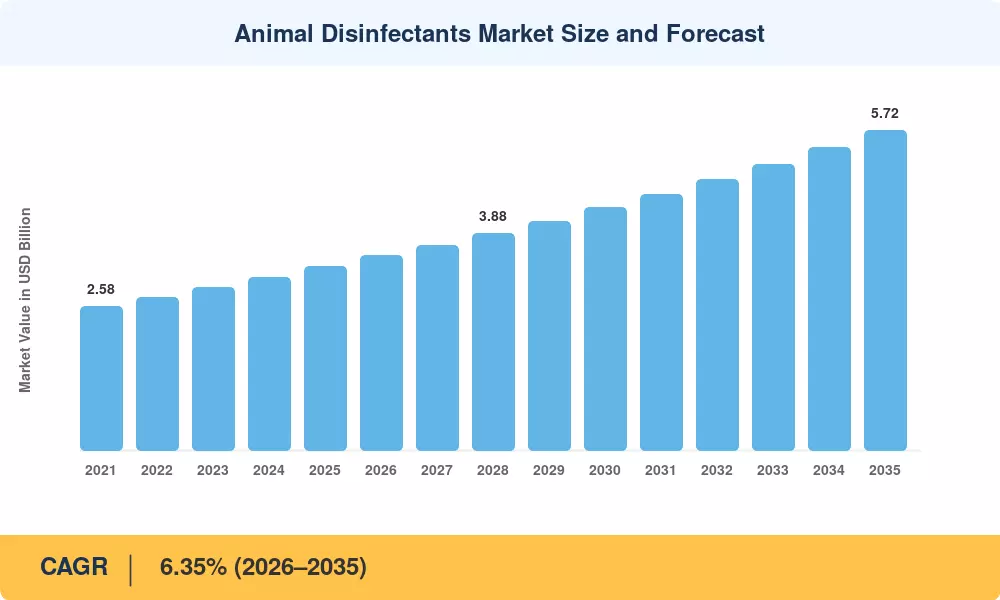
Animal Disinfectants Market Size and Forecast
Our Impact
Enabled $4.3B Revenue Impact for Fortune 500 and Leading Multinationals
Partnering with 2000+ Global Organizations Each Year
30K+ Citations by Top-Tier Firms in the Industry
 

Driver Impact Analysis

Driver ~% Impact on CAGR Geographic Relevance Impact Timeline
Tightening livestock biosecurity regulations ~18% Global Short-term (≤2 yr)
HPAI and ASF outbreak frequency increase ~16% Asia-Pacific, Europe Short-term
Precision dosing and IoT-enabled dispensing ~14% North America, Europe Medium-term (2–4 yr)
Formaldehyde and carcinogen phase-outs ~13% Europe Medium-term
Mega-farm consolidation in Asia-Pacific ~12% China, India, ASEAN Long-term (≥4 yr)
Processor-mandated disinfection protocols ~10% North America, Europe Medium-term
Organic and antibiotic-free production expansion ~8% Global Long-term


Regulatory Tightening and Livestock Biosecurity Mandates

The EU's Biocidal Products Regulation (BPR) now requires re-registration of every active substance used in veterinary sanitation products, a process that has eliminated roughly 40% of legacy formulations since 2021 [2]. In the United States, the USDA's National Poultry Improvement Plan added mandatory disinfection verification protocols for all flocks above 100,000 birds, directly boosting demand for certified poultry disinfection solutions [6]. These regulatory catalysts make compliance-grade products the default, pushing the Animal Disinfectants Market toward higher-value chemistries.

HPAI and ASF Outbreak Escalation

Over 200 million birds were culled worldwide between 2022 and 2024 due to highly pathogenic avian influenza (HPAI), which prompted the emergency purchase of farm animal hygiene supplies valued at an estimated USD 1.2 billion [7][8]. Southeast Asian governments have spent more than USD 600 million on disinfection infrastructure at border checkpoints and live-animal marketplaces due to the ongoing impact of African Swine Fever (ASF) on swine biosecurity [9].


Precision Dosing and Sensor-Enabled Equipment

Chemical sensors in automated fogging systems allow for real-time concentration adjustments based on temperature, humidity, and organic load. Field tests conducted by Diversey and Kersia Group revealed a 25% reduction in chemical use without sacrificing log-reduction performance, which is a clear economic benefit for farms controlling erratic QAC and iodine prices [4]. The use of these platforms in the dairy and poultry industries is increasing the amount of money spent on high-end automated solutions for barn and stable sanitizers.


Processor-Mandated Disinfection Protocols

Major protein processors — including Tyson Foods, JBS, and BRF — now tie supply contracts to documented disinfection compliance, effectively standardizing purchasing across integrated networks [10]. This vertical pressure creates a multiplier effect in the Animal Disinfectants Market, as contract farms must adopt approved veterinary sanitation products to retain market access.


Restraints Impact Analysis

Restraint impacts are directional estimates and are not subtracted linearly from the CAGR.

Restraint ~% Drag on CAGR Geographic Relevance Impact Timeline
Raw-material price volatility (iodine, QACs) ~–8% Global Short-term
Regulatory compliance costs for SME farms ~–6% Europe, North America Medium-term
Environmental discharge restrictions ~–5% Europe, North America Long-term
Antimicrobial resistance concerns are limiting active substances ~–4% Global Long-term
Fragmented distribution in emerging markets ~–3% Africa, South America Medium-term


Raw-Material Price Volatility

Due to supply concentration in Chile and Japan, iodine prices increased by 35% between 2022 and 2024, reducing profit margins for producers of iodine-based farm animal care products [12]. Due to double-digit price fluctuations associated with petrochemical cycles, quaternary ammonium compound feedstocks have also forced formulators to reformulate or hedge, both of which limit the pace of new products in the animal disinfectants market.


Regulatory Compliance Burden on Smallholders

Small and mid-sized livestock businesses bear a disproportionate share of the costs associated with re-registration and testing, while big integrators absorb BPR and USDA compliance costs within current quality programs. Adoption of livestock biosecurity among independent farms may be hindered by the BPR dossier costs, which in the EU alone vary from EUR 50,000 to EUR 250,000 per active substance [2].


Environmental Discharge Restrictions

Chlorine- and phenol-based disinfectant residues are increasingly regulated under the EU Water Framework Directive and the US Clean Water Act, compelling farms near sensitive watersheds to switch to costlier biodegradable alternatives [13]. These restrictions add formulation complexity and may limit the addressable market for certain barn and stable sanitizers.


Animal Disinfectants Market Opportunities

Biodegradable and Plant-Derived Disinfectant Chemistries

Consumer demand for antibiotic-free and organic animal protein is creating a pull-through opportunity for plant-derived veterinary sanitation products. Thymol- and citric-acid-based formulations are gaining OMRI and EU organic certification, opening a premium segment projected to grow at nearly twice the overall Animal Disinfectants Market rate [11].

IoT-Enabled Disinfection-as-a-Service (DaaS)

Subscription-based dosing platforms — where farms pay per cycle rather than per liter — represent a nascent business model that could shift 10–15% of the market to recurring revenue by 2032. Sensor data also enables predictive maintenance and usage analytics, creating a data-monetization layer for barn and stable sanitizers providers [4].

Asia-Pacific Mega-Farm Buildout

China's "14th Five-Year Plan for Livestock Modernization" targets 70% large-scale farm coverage by 2030, up from 52% in 2022 [9]. Each new mega-farm represents a standardized, high-volume entry point for poultry disinfection solutions and swine-facility sanitization systems, a structural tailwind for the Animal Disinfectants Market in the region

Aquaculture Biosecurity Expansion

Aquaculture disinfection — covering hatcheries, raceways, and processing lines — remains under-penetrated relative to terrestrial livestock biosecurity. FAO estimates global aquaculture output will exceed 110 million tonnes by 2030, creating incremental demand for specialized farm animal hygiene chemistries [16].

Blockchain-Verified Disinfection Traceability

Retailers and food-safety auditors increasingly require end-to-end traceability of on-farm sanitation records. Blockchain-linked dispensing logs offer tamper-proof compliance documentation, a value-add that allows veterinary sanitation products companies to justify premium pricing [10].


Animal Disinfectants Market Future Outlook

AI-Guided Biosecurity and Autonomous Dosing

By 2030, machine-learning models will ingest environmental sensor data — temperature, humidity, ammonia levels, microbial swab results — to autonomously calibrate disinfectant concentration and cycle frequency. Early pilots by Diversey and Kersia have demonstrated 30% reductions in chemical waste, a trajectory that will reshape cost structures across the Animal Disinfectants Market [4].

Platform Economics and Disinfection-as-a-Service

The shift from product sales to outcome-based contracts is gaining traction. Under DaaS models, suppliers install dosing hardware at zero upfront cost and charge per verified disinfection cycle, aligning incentives with farm animal hygiene outcomes rather than chemical volume. MRFR estimates this model could capture 12–18% of global revenue by 2033.

Sustainability Reporting and ESG-Linked Procurement

Listed protein companies face growing pressure from ESG disclosure frameworks — including the EU Corporate Sustainability Reporting Directive (CSRD) — to quantify chemical inputs per tonne of output [18]. This reporting obligation turns livestock biosecurity spending into a measurable ESG metric, favoring biodegradable veterinary sanitation products with lower environmental toxicity profiles.

Next-Generation Active Substances and Combination Chemistries

Electrolyzed oxidizing water (EOW), cold-plasma surface treatment, and synergistic peracetic-acid/hydrogen-peroxide blends are moving from lab to commercial scale. The FAO and OIE have flagged EOW as a priority chemistry for low-resource poultry disinfection solutions settings, while cold-plasma barn and stable sanitizers could eliminate chemical consumables entirely in enclosed environments by 2035 [14][16].


Animal Disinfectants Market Segmentation

By Product Type

Segment Key Metric Primary Demand Driver
Iodine Compounds ~31% share (2024) Broad-spectrum teat-dip and general livestock biosecurity use
Lactic Acid & Organic Acids 7.8% CAGR Organic-certified farm animal hygiene protocols
Chlorine-Based USD 0.58 Billion (2024) Cost-effective water treatment in large-scale operations
Peracetic Acid 9.7% CAGR Zero-residue mandates; rapid decomposition profile
Others (QACs, Phenolics, Aldehydes) ~12% share (2024) Niche specialty applications


Iodine compounds remain the workhorse of the Animal Disinfectants Market thanks to their proven efficacy across bacterial, viral, and fungal pathogens. Dairy operations alone consume over 40% of iodine-based veterinary sanitation products for pre- and post-milking teat disinfection [12]. Peracetic acid, meanwhile, is the standout growth chemistry — its rapid biodegradation and compatibility with organic certification make it the default replacement as formaldehyde-based products exit the European market under BPR mandates [2].

By Form

Segment Key Metric Primary Demand Driver
Liquid ~67% share (2024) Compatibility with automated dosing and spray systems
Powder USD 0.29 Billion (2024) Dry-litter treatment for poultry houses
Foam 8.1% CAGR Extended contact time on vertical surfaces in barn and stable sanitizers is used


Liquid formulations dominate the Animal Disinfectants Market because they integrate seamlessly with centralized dosing infrastructure. Foam formats are gaining share rapidly in poultry and swine facilities, where their visible coverage on walls and equipment surfaces improves compliance monitoring and ensures thorough farm animal hygiene in hard-to-reach areas.

By Application

Segment Key Metric Primary Demand Driver
Dairy ~37% share (2024) Mandatory teat-dip and milking parlor sanitation
Poultry 10.3% CAGR HPAI outbreak response; export-grade poultry disinfection solutions
Swine USD 0.41 Billion (2024) ASF containment programs
Cattle & Beef ~11% share (2024) Feedlot biosecurity; bovine respiratory disease prevention
Others (Aquaculture, Equine) 7.2% CAGR Emerging aquaculture livestock biosecurity demand


Dairy's dominance stems from the non-discretionary nature of teat disinfection — every milking cycle requires it, creating a high-frequency consumables demand that forms the backbone of the Animal Disinfectants Market. Poultry is the fastest-growing application as HPAI pressures expand mandated farm animal hygiene intervals and drive adoption of advanced fogging and thermal-fog veterinary sanitation products.

By End User

Segment Key Metric Primary Demand Driver
Livestock Farms ~61% share (2024) Direct on-farm livestock biosecurity spending
Veterinary Clinics USD 0.32 Billion (2024) Instrument and surface sterilization
Integrated Protein Processors 9.4% CAGR Supply-chain mandated disinfection compliance
Others (Government Agencies, Research) ~5% share (2024) Outbreak-response stockpiling


Livestock farms account for the bulk of the Animal Disinfectants Market because disinfection is a daily operational requirement rather than an episodic purchase. Integrated protein processors represent the fastest structural shift — companies like Tyson and JBS are centralizing procurement of veterinary sanitation products across contract-farm networks, creating volume leverage and standardization that reshape competitive dynamics.


Regional Market Share Analysis

Region Key Metric Primary Investment Themes
North America ~27% share (2024) USDA biosecurity mandates; processor-driven standardization
Europe ~35% share (2024) BPR enforcement; formaldehyde phase-out; organic livestock expansion
Asia-Pacific 7.95% CAGR (2026–2035) Mega-farm consolidation; HPAI/ASF outbreak response
South America USD 0.26 Billion (2024) Beef-export compliance; Mercosur SPS alignment
Middle East & Africa 5.8% CAGR (2026–2035) GCC poultry self-sufficiency programs; donor-funded veterinary programs
Total USD 3.29 Billion (2025)

The Animal Disinfectants Market exhibits distinct regional dynamics shaped by regulatory maturity, herd density, and disease-outbreak patterns. Europe's early-mover regulatory posture keeps it at the top, while Asia-Pacific's rapid scale-up of commercial livestock biosecurity infrastructure makes it the fastest-growing territory.


North America

Country Key Metric Key Driver
US ~72% of regional revenue USDA NPIP protocols; large-scale poultry and dairy operations
Canada 5.9% CAGR CFIA avian influenza response programs
Mexico USD 0.07 Billion (2024) SENASICA export-grade livestock biosecurity compliance


The US alone accounts for over USD 0.64 billion in annual farm animal hygiene spend, anchored by mandatory NPIP disinfection verification across commercial poultry and expanding dairy parlor automation [6]. Canada's CFIA has intensified barn-level surveillance following 2023 HPAI detections in Alberta, driving demand for certified poultry disinfection solutions and barn and stable sanitizers in western provinces [8].

Europe

Country Key Metric Key Driver
Germany ~21% of regional share Intensive swine and poultry sectors; strict BPR enforcement
UK 6.7% CAGR Post-Brexit independent biosecurity framework
France USD 0.12 Billion (2024) Large dairy herd; organic transition subsidies
Italy ~9% of regional share Mediterranean poultry belt expansion
Spain 6.5% CAGR Pork-export compliance with Asia
Nordic Countries USD 0.06 Billion (2024) High welfare standards; early adopter of biodegradable formulations
Russia ~7% of regional share ASF containment spending
Rest of Europe 5.9% CAGR Diverse regulatory catch-up across Eastern Europe


Europe's dominance in the Animal Disinfectants Market reflects decades of regulatory layering — from the original Biocides Directive (98/8/EC) to the current BPR — that mandates documented veterinary sanitation products use across all commercial livestock operations [2]. Germany and France together represent nearly a third of regional spend, while Spain and Italy are expanding as pork and poultry disinfection solutions export hubs.

Asia-Pacific

Country Key Metric Key Driver
China ~38% of regional revenue 14th Five-Year Plan mega-farm targets
India 9.2% CAGR Dairy cooperative modernization; FSSAI standards
Japan USD 0.07 Billion (2024) Premium livestock; high-tech barn and stable sanitizers
South Korea ~8% of regional share ASF border-control programs
ASEAN 8.5% CAGR Vietnam, Thailand, Philippines poultry boom
Rest of Asia-Pacific USD 0.04 Billion (2024) Emerging livestock biosecurity investments


China's large-scale farm buildout is the single largest incremental volume driver for the Animal Disinfectants Market globally. State-backed enterprises like Muyuan and New Hope Liuhe are specifying automated disinfection systems in new-build blueprints, embedding farm animal hygiene protocols at the infrastructure level [9].

South America

Country Key Metric Key Driver
Brazil ~62% of regional revenue Beef and poultry export compliance (MAPA regulations)
Argentina 5.7% CAGR Beef-sector modernization
Rest of South America USD 0.04 Billion (2024) Emerging livestock biosecurity programs


Brazil's MAPA agency requires documented disinfection at all federally inspected slaughter facilities, creating a compliance floor that sustains steady demand for veterinary sanitation products in the country's USD 0.16 billion Animal Disinfectants Market [15].

Middle East & Africa

Country Key Metric Key Driver
Saudi Arabia ~28% of regional revenue Vision 2030 poultry self-sufficiency targets
UAE 6.4% CAGR Food-security imports; GCC biosecurity alignment
South Africa USD 0.02 Billion (2024) Commercial poultry and HPAI response
Egypt ~12% of regional share Donor-funded livestock biosecurity campaigns
Rest of MEA 5.5% CAGR Gradual formalization of the use of veterinary sanitation products


Saudi Arabia's NEOM-linked agricultural projects and the broader GCC push for food sovereignty are channeling investment into climate-controlled poultry facilities that require integrated poultry disinfection solutions and automated barn and stable sanitizers from day one [17].


Animal Disinfectants Market By Region, 2025-2035
 

Competitive Benchmarking

The Animal Disinfectants Market is moderately concentrated, with the top five players — Kersia Group, Lanxess, Evonik Industries, CID Lines (now part of Ecolab), and Diversey — collectively controlling an estimated 48–55% of 2024 global revenue. The Herfindahl-Hirschman Index (HHI) sits in the 1,200–1,500 range, indicating moderate concentration with meaningful mid-tier competition. Strategic differentiation increasingly hinges on integrated digital-dosing platforms rather than chemical formulation alone.

Company Est. Revenue Share Range Key Offerings for the Animal Disinfectants Market Strategic Positioning
Kersia Group ~12–15% Iodine, QAC, and peracetic acid portfolios; IoT dosing systems Full-spectrum livestock biosecurity; strong EU dairy presence
Lanxess AG ~9–12% Virkon range; chlorine dioxide solutions Premium veterinary sanitation products; global distribution
Evonik Industries ~7–10% Peracetic acid; organic acid blends Specialty chemistry; sustainability-led R&D
CID Lines (Ecolab) ~7–9% Foam and liquid disinfectants; automated CIP systems Integrated protein-processor partnerships
Diversey (Solenis) ~6–8% Farm-hygiene platforms; DaaS pilot programs Digital-first barn and stable sanitizers strategy
Neogen Corporation ~4–6% Biosecurity diagnostics and disinfectants Diagnostic-disinfectant bundle cross-sell
GEA Group ~3–5% Milking-system integrated teat dips OEM equipment-linked farm animal hygiene
Theseo Group ~2–4% Foam and thermal-fog products French poultry disinfection solutions specialist
Zoetis ~2–3% Livestock health platforms; adjacent biosecurity products Vet-pharma ecosystem leverage
Stepan Company ~1–3% QAC and surfactant raw materials Upstream chemistry supplier expanding downstream


Recent News & Developments

  • Kersia Group (March 2025): Launched its SmartDose 3.0 IoT platform, integrating real-time chemical-concentration monitoring across dairy and swine facilities, targeting a 25% reduction in veterinary sanitation products waste per cycle [4].
  • Ecolab/CID Lines (January 2025): Completed the global rebranding of CID Lines products under the Ecolab Animal Health division, consolidating distribution in 45 countries and expanding poultry disinfection solutions coverage in Southeast Asia [10].
  • European Commission (November 2024): Published final BPR implementing regulation restricting formaldehyde use in livestock housing disinfection, effective January 2026, accelerating reformulation across the Animal Disinfectants Market [2].
  • Lanxess AG (September 2024): Expanded Virkon production capacity by 30% at its Leverkusen facility to meet surging HPAI-driven demand for farm animal hygiene products in Europe and Asia-Pacific [7].
  • Diversey/Solenis (June 2024): Announced a DaaS pilot with three major US poultry integrators, offering outcome-based pricing linked to verified barn and stable sanitizers' efficacy data [4].
  • FDA (June 2025): FDA finalized guidance for Priority Zoonotic Animal Drugs, streamlining the review process for disinfectants targeting emerging zoonotic diseases
  • Evonik (
  • July 2024): Evonik announced a strategic overhaul of its Animal Nutrition division, targeting USD 230 million in savings and expanding its hydrogen peroxide offerings.


Animal Disinfectants Market Report Scope

Parameter Detail
Market Scope Global Animal Disinfectants Market — chemical and equipment-based disinfection products for livestock, poultry, dairy, and aquaculture operations
Study Period 2021–2035
CAGR 6.35% (2026–2035)
Base Year Market Size USD 3.29 Billion (2025)
Forecast Endpoint USD 5.72 Billion (2035)
Fastest Growing Segment Poultry application (10.3% CAGR); Peracetic acid by type (9.7% CAGR)
Companies Profiled Kersia Group, Lanxess, Evonik, CID Lines/Ecolab, Diversey/Solenis, Neogen, GEA Group, Theseo, Zoetis, Stepan Company
Valuation Currency USD Billion


FAQs

How does iodine price volatility affect long-term supply contracts in the Animal Disinfectants Market?

Most large buyers now negotiate index-linked pricing tied to Chilean iodine spot rates, with quarterly adjustment clauses. Smaller farms face higher per-unit costs because they lack the volume to secure hedged contracts [12].

What shelf-life considerations should buyers evaluate when selecting veterinary sanitation products?

Peracetic acid formulations typically degrade within 12–18 months, while QAC-based products remain stable for 24–36 months. Buyers should match shelf life to consumption velocity to avoid costly waste [4].

How do automated fogging systems compare to manual spraying for poultry disinfection solutions?

Automated foggers deliver 40–60% more uniform droplet coverage and reduce labor costs by roughly 50% per barn cycle. Manual spraying remains viable only for small-flock operations below 10,000 birds [4].

What role does water hardness play in disinfectant efficacy for farm animal hygiene?

Hard water above 200 ppm CaCO₃ can reduce QAC and iodine kill rates by 15–25%. Farms in hard-water regions should use chelated formulations or install water softeners upstream of dosing systems [14].

Are there specific Animal Disinfectants Market certifications that processors require from contract farms?

Most major processors mandate NSF, EPA List-registered, or EU BPR-approved products. Farms lacking certification face contract non-renewal, making compliance a market-access prerequisite [10].

How does cold-plasma surface treatment compare to chemical barn and stable sanitizers?

Cold plasma eliminates the need for chemical consumables and leaves zero residue, but current systems cost 3–5× more per barn than conventional fogging. Commercialization at scale is expected by 2030–2032 [14].

What livestock biosecurity insurance incentives exist for farms using certified disinfection protocols?

Several EU and US agricultural insurers now offer 5–10% premium discounts for farms demonstrating documented disinfection compliance. These programs are expanding as outbreak-loss data increasingly validate preventive biosecurity spending [6].


Author
Author
Author Profile
Snehal Singh LinkedIn
Manager - Research
High acumen in analyzing complex macro & micro markets with more than 6 years of work experience in the field of market research. By implementing her analytical skills in forecasting and estimation into market research reports, she has expertise in Packaging, Construction, and Equipment domains. She handles a team size of 20-25 resources and ensures smooth running of the projects, associated marketing activities, and client servicing.

Research Approach


Secondary Research

The secondary research process involved comprehensive analysis of veterinary regulatory databases, agricultural journals, livestock health publications, and authoritative animal health organizations. Key sources included the US Food & Drug Administration (FDA) Center for Veterinary Medicine, US Department of Agriculture (USDA) Animal and Plant Health Inspection Service (APHIS), European Medicines Agency (EMA) Veterinary Medicines Section, World Organisation for Animal Health (WOAH), Food and Agriculture Organization (FAO) of the United Nations, US Environmental Protection Agency (EPA) Office of Pesticide Programs (disinfectant regulations), European Food Safety Authority (EFSA), UK Department for Environment Food & Rural Affairs (DEFRA), Agriculture and Agri-Food Canada (AAFC), Australian Department of Agriculture Fisheries and Forestry, China Ministry of Agriculture and Rural Affairs, National Center for Biotechnology Information (NCBI/PubMed) veterinary databases, and Centers for Disease Control and Prevention (CDC) National Center for Emerging and Zoonotic Infectious Diseases. These sources were used to collect livestock disease outbreak statistics, regulatory approval data for veterinary biocides, biosecurity protocol studies, animal husbandry trends, and market landscape analysis for iodine-based, hydrogen peroxide, lactic acid, phenolic, quaternary ammonium compound, and chlorine-based disinfectant technologies.


Primary Research

Qualitative and quantitative insights were obtained by interviewing supply-side and demand-side stakeholders during the primary research process. The supply-side sources consisted of CEOs, VPs of Animal Health Business Units, global regulatory affairs managers, and commercial directors from prominent animal disinfectant manufacturers, veterinary pharmaceutical companies, and agricultural chemical OEMs. Chief veterinarians, livestock production managers, poultry farm biosecurity officers, dairy farm operations directors, swine facility managers, aquaculture facility supervisors, and procurement leads from large-scale animal production enterprises, veterinary hospitals, and agricultural cooperatives comprised demand-side sources. Market segmentation was validated across livestock categories, product development pipelines and formulation innovations were confirmed, and insights on farm-level adoption patterns, pricing strategies per application area, and regulatory compliance dynamics across different geographies were gathered using primary research.

Primary Respondent Breakdown:

By Designation: C-level Primaries (28%), Director Level (32%), Others (40%)

By Region: North America (32%), Europe (38%), Asia-Pacific (22%), Rest of World (8%)


Market Size Estimation

Global market valuation was derived through revenue mapping and application volume analysis across livestock sectors. The methodology included:

Identification of over 50 key manufacturers in North America, Europe, Asia-Pacific, and Latin America who specialize in veterinary biocides and agricultural disinfection solutions

Product mapping across iodine-based, hydrogen peroxide, lactic acid, phenolic acid, quaternary ammonium compound, chlorine-based, and other emerging biological disinfectant categories

Analysis of reported and modeled annual revenues specific to animal disinfectant portfolios, including companion animal and livestock applications

Coverage of manufacturers representing 75-80% of global market share in 2024, including major players such as Neogen Corporation, CID Lines, Evonik Industries, Zoetis Inc., and Kersia Group

Extrapolation using bottom-up (disinfectant consumption volume × average selling price by livestock application and country) and top-down (manufacturer revenue validation against regional livestock population data) approaches to derive segment-specific valuations for dairy, poultry, swine, equine, and aquaculture applications

Download Free Sample

Kindly complete the form below to receive a free sample of this Report

Download PDF ×

We do not share your information with anyone. However, we may send you emails based on your report interest from time to time. You may contact us at any time to opt-out.
















