×
Hero Background
English
Chinese
French
Japanese
Korean
German
Spanish

Anti-Graffiti Coatings Market Share

ID: MRFR/CnM/6162-HCR
140 Pages
Anshula Mandaokar
October 2025

Anti-Graffiti Coatings Market Research Report Information by Type (Sacrificial, Semi-Permanent, and Permanent), Substrate (Metal and Wood), End-Use Industry (Construction and Transportation), and Region (Asia-Pacific, North America, and Others) - Forecast till 2035

Share:
Download PDF ×

We do not share your information with anyone. However, we may send you emails based on your report interest from time to time. You may contact us at any time to opt-out.

Anti-Graffiti Coatings Market Infographic
Purchase Options

Market Share

Anti-Graffiti Coatings Market Share Analysis

Different companies have been using smart market share positioning strategies as a result of increasing demand for anti-graffiti coatings across the globe. These coats work like shields that prevent writing from sticking on and make surfaces easy to wash. Key players employ various tactics to improve their position in the market and stay ahead of competition.

This strategy is being employed in Anti-Graffiti Coatings Market as a way of improving products. Businesses put a lot of money into research and development to make coverings that are more advanced and effective at stopping graffiti. Frequently occurring areas of innovation are longer-lasting coverings that can withstand harsh weather conditions and are easy to apply or use again. A company can become more popular by coming up with modern solutions which will attract more customers for them thus becoming market leaders themselves.

Market segmentation is heavily used by many companies so that they can have the right goods for each section of buyers. Anti-graffiti treatments must be applied to various surfaces in different ways. Companies often develop custom solutions for a wide range of applications such as public places, transportation, or building facades. By adopting this approach, firms can meet the distinct needs of various industries thereby making tailor-made products and gain a competitive advantage in some market segments.

Companies wishing to gain higher shares in the Anti-Graffiti Coatings Market should concentrate on expanding into new territories. Companies may identify new customers and expand their businesses by going into fresh areas and sites. Strategies that are reflective of area’s culture and surroundings can be employed to suit different areas’ tastes. Through adapting to different market situations, firms can attain sturdy bases in various parts of the world.

Market positioning depends greatly on the effectiveness of your marketing and branding work. Companies invest significant funds into creating a strong brand image through emphasizing features and benefits of their graffiti resistant coatings. Becoming known in your industry through digital marketing, social media efforts, attending events among others; you should be seen. A clear brand plan could set apart one company from others operating within similar spheres while altering perception about the business among its customers thus leading itself to more market share.

Quality controls system and licenses are very critical especially when it comes to getting people believe in any business under The Anti-Graffiti Coatings Market umbrella. Most times, companies subject their finishes through numerous tests for certifications that prove efficacy at workability issues over time as well as safety concerns involving lives of consumers using them respectively given those factors which was not only necessary requirement but also an opportunity created by regulators’ pressure driving research development on anti-graffiti paints which would work better yet environmental friendly coating substances.
Author
Anshula Mandaokar
Team Lead - Research

Anshula Mandaokar holds an academic degree in Chemical Engineering and has been contributing to the field for more than 5 years. She has expertise in Market Research and Business Consulting and serves as a Team Lead for a reputed Market Research firm under the Chemicals and Materials domain spectrum. She has worked on multiple projects, generating explicit results in a quick turnaround time. Her understanding of data interpretation justifies her role as a leader.

Leave a Comment

FAQs

How does the outlook of the global anti-graffiti coatings market look like?

The outlook of the global anti-graffiti coatings market looks highly profitable.

At what CAGR is the global anti-graffiti coatings market projected to grow in the forecast period?

The global anti-graffiti coatings market is estimated to register 3.5% CAGR during the forecast period.

Which is the major segment in the global anti-graffiti coatings market?

By end-use industry, the construction segment is a major revenue generator in the global anti-graffiti coatings market.

Which region holds the largest share in the global anti-graffiti coatings market?

North America holds the largest share in the global anti-graffiti coatings market, followed by Europe and the Asia Pacific, respectively.

Who are the top players in the global anti-graffiti coatings market?

Teknos Group (Finland), The Sherwin-Williams Company (US), Wacker Chemie AG (Germany), 3M (US), BASF SE (Germany), Akzo Nobel N.V. (The Netherlands), Hydron Protective Coatings (UK), CSL Silicones Inc. (Canada), Axalta Coating Systems (US), NanoTech Coatings (US), Watson Coatings, Inc. (US), Sika AG (Switzerland), DuluxGroup Ltd (Australia), A&I Coatings (Australia), and Performance Solutions NZ Limited (New Zealand), are some of the major players operating in the anti-graffiti coatings market.

Market Summary

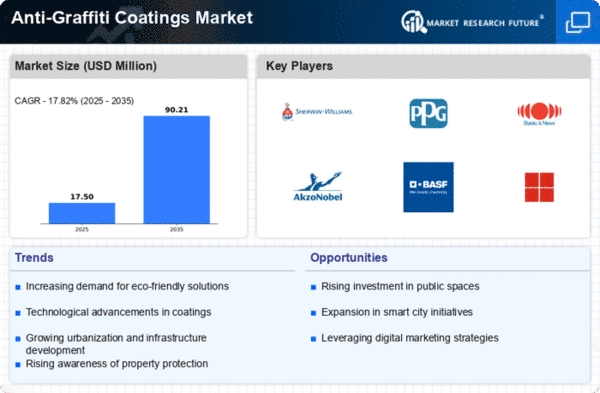
As per MRFR analysis, the Anti-Graffiti Coatings Market was estimated at 14.85 USD Million in 2024. The Anti-Graffiti Coatings industry is projected to grow from 17.5 in 2025 to 90.21 by 2035, exhibiting a compound annual growth rate (CAGR) of 17.82 during the forecast period 2025 - 2035.

Key Market Trends & Highlights

The Anti-Graffiti Coatings Market is poised for growth driven by sustainability and urbanization trends.

  • The market is increasingly influenced by a focus on sustainability and eco-friendly solutions.
  • Technological advancements are enhancing the performance and application of anti-graffiti coatings.
  • North America remains the largest market, while Asia-Pacific is recognized as the fastest-growing region.
  • The rising demand from commercial sectors and government regulations are key drivers propelling market expansion.

Market Size & Forecast

2024 Market Size 14.85 (USD Million)
2035 Market Size 90.21 (USD Million)
CAGR (2025 - 2035) 17.82%
Largest Regional Market Share in 2024 North America

Major Players

<p>Sherwin-Williams (US), PPG Industries (US), Nippon Paint Holdings (JP), BASF (DE), AkzoNobel (NL), Rust-Oleum (US), 3M (US), DuPont (US), Kansai Paint (JP)</p>

Market Trends

The Anti-Graffiti Coatings Market is currently experiencing a notable evolution, driven by increasing urbanization and the growing need for aesthetic preservation in public spaces. As cities expand, the prevalence of graffiti has become a pressing concern for municipalities and property owners alike. This has led to a heightened demand for effective anti-graffiti solutions that not only protect surfaces but also enhance the visual appeal of urban environments. The market appears to be influenced by a variety of factors, including environmental regulations and the push for sustainable products, which may shape the development of innovative coatings that are both effective and eco-friendly. Moreover, advancements in technology are likely to play a crucial role in the future of the Anti-Graffiti Coatings Market. Manufacturers are increasingly focusing on creating coatings that offer superior durability and ease of application. This trend suggests a shift towards products that not only resist graffiti but also simplify the removal process, thereby reducing maintenance costs for property owners. As awareness of the benefits of these coatings grows, it seems probable that their adoption will continue to rise, further solidifying their position in the market. The interplay of these factors indicates a dynamic landscape for anti-graffiti solutions, with potential for continued growth and innovation in the coming years.

Sustainability Focus

There is a growing emphasis on environmentally friendly products within the Anti-Graffiti Coatings Market. Manufacturers are increasingly developing coatings that utilize sustainable materials and processes, responding to consumer demand for eco-conscious solutions. This trend reflects a broader societal shift towards sustainability, influencing purchasing decisions and product development.

Technological Advancements

Innovations in coating technology are transforming the Anti-Graffiti Coatings Market. New formulations are being introduced that enhance durability and ease of application, allowing for more efficient graffiti removal. These advancements not only improve product performance but also cater to the evolving needs of consumers seeking effective solutions.

Urban Aesthetic Preservation

The desire to maintain the visual integrity of urban environments is driving demand for anti-graffiti solutions. As cities prioritize aesthetic appeal, property owners and municipalities are increasingly investing in coatings that protect surfaces from graffiti while enhancing overall appearance. This trend underscores the importance of visual preservation in urban planning.

Anti-Graffiti Coatings Market Market Drivers

Environmental Concerns

Growing environmental awareness is influencing the Global Anti-Graffiti Coatings Market Industry, as consumers and businesses increasingly prefer eco-friendly products. Traditional coatings often contain harmful chemicals, whereas newer formulations focus on sustainability and reduced environmental impact. This shift is evident in the development of biodegradable and low-VOC coatings that meet stringent environmental regulations. Companies are responding to this demand by innovating and offering greener alternatives, which may attract a broader customer base. As a result, the market is expected to grow at a CAGR of 3.5% from 2025 to 2035, reflecting the increasing importance of sustainability in coating solutions.

Government Initiatives

Government initiatives aimed at beautifying public spaces and reducing vandalism are driving the Global Anti-Graffiti Coatings Market Industry. Various local and national governments are allocating funds for anti-graffiti programs, which often include the application of specialized coatings on public infrastructure. For example, initiatives in cities such as Chicago and London have led to the implementation of anti-graffiti coatings on public transport systems and historical buildings. These efforts not only enhance aesthetic appeal but also reduce maintenance costs over time, contributing to a market growth projection of 108.7 USD Million by 2035.

Increasing Urbanization

The rapid pace of urbanization globally contributes to the growth of the Global Anti-Graffiti Coatings Market Industry. As cities expand, the prevalence of graffiti on public and private properties increases, necessitating effective protective solutions. Urban areas, particularly in developing nations, are witnessing a surge in graffiti vandalism, prompting municipalities to invest in anti-graffiti coatings. For instance, cities like Los Angeles and New York have implemented programs to combat graffiti, leading to a projected market value of 74.5 USD Million in 2024. This trend indicates a growing recognition of the need for protective coatings in urban environments.

Technological Advancements

Technological advancements in coating formulations are enhancing the performance and durability of anti-graffiti products, thereby propelling the Global Anti-Graffiti Coatings Market Industry. Innovations such as nanotechnology and advanced polymer chemistry are leading to the development of coatings that offer superior resistance to graffiti and environmental degradation. These advancements not only improve the longevity of coatings but also reduce the frequency of reapplication, which is economically beneficial for property owners. As a result, the market is witnessing increased adoption of these high-performance coatings, further solidifying its growth trajectory.

Market Trends and Projections

The Global Anti-Graffiti Coatings Market Industry is projected to experience steady growth, with key trends indicating a robust future. The market is expected to reach a valuation of 74.5 USD Million in 2024, with further growth anticipated to 108.7 USD Million by 2035. The compound annual growth rate (CAGR) for the period from 2025 to 2035 is estimated at 3.5%. These figures suggest a consistent demand for anti-graffiti solutions, driven by urbanization, government initiatives, and technological advancements. The market's trajectory appears promising, reflecting a growing recognition of the importance of protective coatings in various sectors.

Rising Property Maintenance Costs

The rising costs associated with property maintenance are driving demand for anti-graffiti solutions within the Global Anti-Graffiti Coatings Market Industry. Property owners are increasingly aware that graffiti can lead to significant repair and cleaning expenses, prompting them to invest in preventive measures. By applying anti-graffiti coatings, property owners can mitigate the financial burden of graffiti removal and maintain property value. This trend is particularly evident in commercial real estate, where maintaining a pristine appearance is crucial for attracting tenants and customers. Consequently, this growing awareness is likely to contribute to sustained market growth.

Market Segment Insights

By Application: Building (Largest) vs. Infrastructure (Fastest-Growing)

<p>In the Anti-Graffiti Coatings Market, the application of coatings across segments is pivotal. The Building sector emerges as the largest application area, garnering significant market share attributed to its vast array of structures needing protection from vandalism. Following closely, Infrastructure is identified as a promising area with fast-paced growth, highlighting an increased focus on urbanization and public works initiatives that require durable protective solutions. Growth trends indicate a robust demand for anti-graffiti coatings driven by expanding urban infrastructure projects and a heightened emphasis on aesthetic appeal in public spaces. The proliferation of smart cities and sustainable structures further propels the need for effective graffiti resistance. Additionally, urban renewal efforts often prioritize graffiti protection to maintain property values and enhance community image, reinforcing the segment's growth momentum.</p>

<p>Building: Dominant vs. Infrastructure: Emerging</p>

<p>The Building segment is recognized for its dominant position in the Anti-Graffiti Coatings Market, characterized by a wide array of architectural structures that range from commercial complexes to residential spaces. This segment benefits from the increasing demand for aesthetic enhancement and property value preservation, fueling significant investments in protective coatings. In contrast, the Infrastructure segment is emerging rapidly, particularly due to growing urbanization and infrastructure development initiatives. Government funding and policies geared towards maintaining public infrastructure contribute to this growth, making it essential for covering structures such as bridges, railways, and public transportation systems. The characteristics that distinguish the two segments include the specific protective requirements and the varying levels of regulatory compliance, underscoring the significance of tailored solutions in each application.</p>

By Type: Water-Based (Largest) vs. Solvent-Based (Fastest-Growing)

<p>In the Anti-Graffiti Coatings Market, the segmentation by type reveals that Water-Based coatings dominate the landscape due to their environmental friendliness and ease of application. These coatings are preferred in urban areas where sustainability is a major concern, leading to significant market share. In contrast, Solvent-Based coatings, while trailing in market share, are showing rapid growth due to their superior durability and performance characteristics, making them increasingly popular in industrial applications. Moreover, the increasing awareness regarding protective coatings and the need for sustainable solutions drive the growth of Water-Based products. Conversely, Solvent-Based coatings are witnessing a surge as industries seek robust solutions that withstand harsher conditions. The market dynamics are influenced by legislation promoting environmentally safe products while demanding high-performance standards, creating a balanced competitive landscape.</p>

<p>Water-Based (Dominant) vs. Powder Coatings (Emerging)</p>

<p>Water-Based coatings are recognized as the dominant force in the Anti-Graffiti Coatings market, primarily due to their eco-friendly characteristics and excellent performance on various substrates. They cater to the needs of environmentally conscious consumers and regulations aimed at reducing volatile organic compounds (VOCs). On the other hand, Powder Coatings, as an emerging segment, offer high efficiency with minimal waste during application, aligning well with modern manufacturing practices. While still carving out a niche, Powder Coatings are gaining traction for their durability and resistance to chemicals and abrasion. This positions them as a viable alternative in settings where long-term protection against graffiti is crucial, offering unique competitive advantages in specific markets.</p>

By End Use: Commercial (Largest) vs. Residential (Fastest-Growing)

<p>In the Anti-Graffiti Coatings Market, the end-use segment shows significant disparities in market share distribution. The commercial sector is currently the largest, driven by high demand from businesses needing to maintain attractive and clean facades. This demand is influenced by the increasing emphasis on aesthetics in commercial buildings, which are often targeted for vandalism. The residential segment, while smaller, is gaining traction as more homeowners are becoming aware of the benefits of anti-graffiti coatings, particularly in urban areas prone to vandalism.</p>

<p>Commercial (Dominant) vs. Residential (Emerging)</p>

<p>The commercial sector stands as the dominant force in the Anti-Graffiti Coatings Market, characterized by its focus on maintaining property value and appearance. Businesses, particularly in retail and hospitality, invest in durable anti-graffiti solutions to deter vandalism, ensuring minimal visual disruption to their brand image. Conversely, the residential market is emerging, with a growing number of homeowners seeking protective coatings to safeguard their properties against graffiti and enhance their aesthetic appeal. As more families recognize the long-term benefits of these coatings in resisting vandalism, the residential segment is expected to expand rapidly, driven by rising urbanization and increased crime awareness.</p>

By Formulation: Acrylic (Largest) vs. Epoxy (Fastest-Growing)

<p>In the Anti-Graffiti Coatings Market, the formulation segment is primarily dominated by Acrylic, which holds the largest market share. Its popularity stems from its robust features such as quick-drying times and a wide range of color options, making it the preferred choice among users. Meanwhile, Epoxy coatings are gaining traction for their superior adhesion and chemical resistance, which makes them desirable for various applications, particularly in industrial sectors.</p>

<p>Acrylic (Dominant) vs. Epoxy (Emerging)</p>

<p>Acrylic coatings are characterized by their versatility and ease of application, making them a dominant player in the Anti-Graffiti Coatings Market. They offer excellent weather resistance and color retention, appealing to both commercial and residential sectors. On the other hand, Epoxy coatings are emerging rapidly due to their enhanced durability and resistance to harsh environmental conditions. Industries that demand heavier and more protective coatings are driving this trend, indicating a shift towards Epoxy formulations as a robust alternative to the established Acrylic products.</p>

By Technology: Anti-Microbial (Largest) vs. Self-Cleaning (Fastest-Growing)

<p>The Anti-Graffiti Coatings Market is characterized by a variety of technologies, with Anti-Microbial coatings leading in market share due to their increasing demand for public health measures. Self-Cleaning technologies are rapidly gaining popularity, attributed to their ability to maintain cleanliness and aesthetics with minimal maintenance. The market for these coatings is diversifying as different applications emerge in both urban and rural settings, optimizing surface treatment effectively. Current growth trends indicate a robust interest in Self-Cleaning and Anti-Fogging technologies driven by consumers' need for easy maintenance and visibility improvement in environments frequently exposed to ink and pollutants. Factors such as urbanization, environmental regulations, and increased awareness of hygiene are accelerating the adoption of these advanced coating technologies, ultimately supporting their growth trajectories in various industries.</p>

<p>Technology: Anti-Microbial (Dominant) vs. Self-Cleaning (Emerging)</p>

<p>Anti-Microbial coatings represent the dominant technology in the Anti-Graffiti Coatings Market, catering to sectors that prioritize health and cleanliness, such as hospitals, schools, and public transportation. These coatings effectively prevent the growth of microbial populations, thus ensuring surfaces remain sanitary and reducing cleaning frequencies. Conversely, Self-Cleaning coatings are emerging technologies promising significant advantages, such as photocatalytic properties that facilitate the breakdown of dirt and pollutants, making them particularly appealing for facades and public spaces prone to graffiti. The combination of resistance and ease of application positions Self-Cleaning coatings as a valuable addition to the market, with an increasing share driven by shifting consumer preferences towards less maintenance and sustainable solutions.</p>

Get more detailed insights about Anti-Graffiti Coatings Market Research Report - Global Forecast till 2035

Regional Insights

North America : Market Leader in Coatings

North America is the largest market for anti-graffiti coatings, holding a significant share of 7.5 in 2024. The growth is driven by increasing urbanization, rising public and private investments in infrastructure, and stringent regulations promoting environmental sustainability. Demand is further fueled by the need for protective coatings in urban areas to combat vandalism and maintain aesthetic appeal. The competitive landscape is robust, with key players like Sherwin-Williams, PPG Industries, and Rust-Oleum leading the market. The U.S. is the primary contributor, supported by advanced manufacturing capabilities and innovation in coating technologies. The presence of major companies ensures a steady supply of high-quality products, catering to diverse customer needs.

Europe : Emerging Market Dynamics

Europe, with a market size of 4.5, is witnessing a growing demand for anti-graffiti coatings, driven by urban development and increasing awareness of environmental protection. Regulatory frameworks across the EU are encouraging the use of eco-friendly coatings, which is a significant catalyst for market growth. The region's focus on sustainability and reducing carbon footprints is shaping consumer preferences towards innovative coating solutions. Leading countries include Germany, France, and the UK, where major players like BASF and AkzoNobel are actively expanding their product lines. The competitive landscape is characterized by a mix of established companies and emerging startups, fostering innovation. The presence of stringent regulations ensures that only high-quality, compliant products are available in the market.

Asia-Pacific : Rapid Growth and Innovation

The Asia-Pacific region, with a market size of 2.5, is rapidly emerging as a significant player in the anti-graffiti coatings market. The growth is primarily driven by urbanization, increasing infrastructure projects, and a rising awareness of the need for protective coatings. Countries like Japan and China are leading the charge, supported by government initiatives aimed at enhancing urban aesthetics and safety through effective anti-graffiti solutions. The competitive landscape is evolving, with key players such as Nippon Paint Holdings and Kansai Paint making substantial investments in R&D. The region is characterized by a mix of local and international companies, fostering a dynamic market environment. As demand for innovative and sustainable coatings rises, the Asia-Pacific market is poised for significant growth in the coming years.

Middle East and Africa : Emerging Market Opportunities

The Middle East and Africa (MEA) region, with a market size of 0.35, is gradually emerging in the anti-graffiti coatings market. The growth is driven by increasing urbanization, infrastructure development, and a rising focus on maintaining public spaces. Governments are beginning to recognize the importance of aesthetic urban environments, which is catalyzing demand for protective coatings in cities across the region. Leading countries include South Africa and the UAE, where local and international players are starting to establish a foothold. The competitive landscape is still developing, with opportunities for growth as awareness of anti-graffiti solutions increases. As urban areas expand, the demand for effective coatings is expected to rise, presenting significant opportunities for market players.

Key Players and Competitive Insights

The Anti-Graffiti Coatings Market is currently characterized by a dynamic competitive landscape, driven by increasing urbanization and the growing need for aesthetic preservation in public spaces. Key players such as Sherwin-Williams (US), PPG Industries (US), and BASF (DE) are strategically positioning themselves through innovation and regional expansion. Sherwin-Williams (US) has focused on enhancing its product portfolio with eco-friendly formulations, while PPG Industries (US) emphasizes technological advancements in its coatings to improve durability and ease of application. BASF (DE) is leveraging its extensive research capabilities to develop high-performance coatings that meet stringent environmental regulations. Collectively, these strategies not only enhance their market presence but also contribute to a competitive environment that prioritizes sustainability and innovation.

In terms of business tactics, companies are increasingly localizing manufacturing to reduce lead times and optimize supply chains. The market structure appears moderately fragmented, with several players vying for market share. However, the influence of major companies is substantial, as they set industry standards and drive technological advancements. This competitive structure fosters an environment where smaller players must innovate or find niche markets to survive.

In November 2025, Sherwin-Williams (US) announced the launch of a new line of anti-graffiti coatings that utilize advanced nanotechnology to enhance surface protection. This strategic move is significant as it not only addresses the growing demand for high-performance coatings but also aligns with the increasing consumer preference for sustainable products. The introduction of such innovative solutions is likely to strengthen Sherwin-Williams' market position and appeal to environmentally conscious customers.

In October 2025, PPG Industries (US) expanded its partnership with a leading technology firm to integrate AI-driven analytics into its product development processes. This collaboration aims to streamline the formulation of coatings, thereby reducing time-to-market for new products. The strategic importance of this partnership lies in its potential to enhance PPG's competitive edge by enabling faster responses to market trends and customer needs, ultimately leading to increased market share.

In September 2025, BASF (DE) entered into a joint venture with a regional player in Asia to enhance its distribution capabilities in the anti-graffiti coatings segment. This strategic alliance is crucial as it allows BASF to tap into emerging markets, thereby expanding its footprint and increasing accessibility to its innovative products. Such partnerships are indicative of a broader trend where companies seek to leverage local expertise to navigate complex market dynamics effectively.

As of December 2025, the competitive trends in the Anti-Graffiti Coatings Market are increasingly defined by digitalization, sustainability, and the integration of advanced technologies such as AI. Strategic alliances are becoming more prevalent, as companies recognize the need to collaborate to enhance their competitive positioning. Looking ahead, it is anticipated that competitive differentiation will evolve, shifting from traditional price-based competition to a focus on innovation, technological advancements, and supply chain reliability. This transition underscores the importance of adaptability and forward-thinking strategies in maintaining a competitive edge in a rapidly changing market.

Key Companies in the Anti-Graffiti Coatings Market market include

Industry Developments

  • Q2 2024: AkzoNobel launches new Dulux Trade Anti-Graffiti Clearcoat for public infrastructure AkzoNobel introduced its Dulux Trade Anti-Graffiti Clearcoat, designed for use on public buildings and transport infrastructure, aiming to provide enhanced protection and easier graffiti removal.
  • Q1 2024: PPG launches next-generation anti-graffiti coating for commercial buildings PPG Industries announced the release of a new anti-graffiti coating formulated for commercial and municipal buildings, featuring improved durability and environmental compliance.
  • Q2 2024: Axalta unveils eco-friendly anti-graffiti coating for urban transit systems Axalta Coating Systems launched an environmentally friendly anti-graffiti coating specifically developed for use on trains and buses, targeting urban transit authorities.
  • Q3 2024: Sherwin-Williams opens new anti-graffiti coatings R&D facility in Ohio Sherwin-Williams inaugurated a research and development center in Ohio focused on advancing anti-graffiti coating technologies for infrastructure and public spaces.
  • Q2 2025: Hempel partners with European rail operator for anti-graffiti coating deployment Hempel announced a partnership with a major European rail operator to supply and apply its anti-graffiti coatings across the operator’s fleet and stations.
  • Q1 2025: RPM International acquires specialty anti-graffiti coatings manufacturer in Germany RPM International completed the acquisition of a German company specializing in permanent anti-graffiti coatings, expanding its product portfolio and European market presence.
  • Q2 2024: Valspar launches water-based anti-graffiti coating for schools and public buildings Valspar introduced a new water-based anti-graffiti coating designed for use in educational and municipal facilities, emphasizing safety and ease of application.
  • Q3 2024: Jotun secures contract to supply anti-graffiti coatings for Scandinavian highway project Jotun was awarded a contract to provide anti-graffiti coatings for a major highway infrastructure project in Scandinavia, aiming to reduce maintenance costs and improve aesthetics.
  • Q1 2025: Teknos launches bio-based anti-graffiti coating for urban environments Teknos released a bio-based anti-graffiti coating targeting urban infrastructure, focusing on sustainability and reduced environmental impact.
  • Q2 2025: Sika AG announces partnership with Swiss city for anti-graffiti protection program Sika AG entered into a partnership with a Swiss municipality to implement a city-wide anti-graffiti protection program using its latest coating solutions.
  • Q3 2024: BASF unveils new permanent anti-graffiti coating for public transport vehicles BASF launched a permanent anti-graffiti coating designed for use on buses and trains, offering long-term protection and simplified cleaning processes.
  • Q1 2024: Evonik Industries introduces silicone-based anti-graffiti coating for commercial real estate Evonik Industries announced the launch of a silicone-based anti-graffiti coating aimed at commercial real estate developers, highlighting its weather resistance and ease of maintenance.

Key Industrial Segments

By Type

    • Sacrificial Coatings
    • Semi-Permanent Coatings
    • Permanent Coatings

By Substrate

    • Metal 
    • Wood 
    • Concrete
    • Pre-existing Coatings
    • Others

By End-Use Industry

    • Construction
    • Transportatio

Future Outlook

Anti-Graffiti Coatings Market Future Outlook

<p>The Anti-Graffiti Coatings Market is projected to grow at a 17.82% CAGR from 2024 to 2035, driven by urbanization, environmental regulations, and demand for aesthetic preservation.</p>

New opportunities lie in:

  • <p>Development of eco-friendly, biodegradable coatings for urban applications.</p>
  • <p>Integration of smart technology for real-time graffiti detection and removal.</p>
  • <p>Expansion into emerging markets with tailored product offerings for local needs.</p>

<p>By 2035, the Anti-Graffiti Coatings Market is expected to achieve substantial growth and innovation.</p>

Market Segmentation

Anti-Graffiti Coatings Market Type Outlook

  • Solvent-Based
  • Water-Based
  • Powder Coatings
  • Nano Coatings

Anti-Graffiti Coatings Market End Use Outlook

  • Commercial
  • Residential
  • Government
  • Educational

Anti-Graffiti Coatings Market Technology Outlook

  • Self-Cleaning
  • Anti-Fogging
  • Anti-Microbial
  • Hydrophobic

Anti-Graffiti Coatings Market Application Outlook

  • Building
  • Infrastructure
  • Transportation
  • Industrial
  • Public Spaces

Anti-Graffiti Coatings Market Formulation Outlook

  • Acrylic
  • Epoxy
  • Polyurethane
  • Silicone

Report Scope

MARKET SIZE 202414.85(USD Million)
MARKET SIZE 202517.5(USD Million)
MARKET SIZE 203590.21(USD Million)
COMPOUND ANNUAL GROWTH RATE (CAGR)17.82% (2024 - 2035)
REPORT COVERAGERevenue Forecast, Competitive Landscape, Growth Factors, and Trends
BASE YEAR2024
Market Forecast Period2025 - 2035
Historical Data2019 - 2024
Market Forecast UnitsUSD Million
Key Companies ProfiledSherwin-Williams (US), PPG Industries (US), Nippon Paint Holdings (JP), BASF (DE), AkzoNobel (NL), Rust-Oleum (US), 3M (US), DuPont (US), Kansai Paint (JP)
Segments CoveredApplication, Type, End Use, Formulation, Technology
Key Market OpportunitiesGrowing demand for eco-friendly anti-graffiti coatings driven by sustainability trends and regulatory changes.
Key Market DynamicsRising demand for eco-friendly anti-graffiti coatings driven by regulatory pressures and consumer preference for sustainable solutions.
Countries CoveredNorth America, Europe, APAC, South America, MEA

FAQs

How does the outlook of the global anti-graffiti coatings market look like?

The outlook of the global anti-graffiti coatings market looks highly profitable.

At what CAGR is the global anti-graffiti coatings market projected to grow in the forecast period?

The global anti-graffiti coatings market is estimated to register 3.5% CAGR during the forecast period.

Which is the major segment in the global anti-graffiti coatings market?

By end-use industry, the construction segment is a major revenue generator in the global anti-graffiti coatings market.

Which region holds the largest share in the global anti-graffiti coatings market?

North America holds the largest share in the global anti-graffiti coatings market, followed by Europe and the Asia Pacific, respectively.

Who are the top players in the global anti-graffiti coatings market?

Teknos Group (Finland), The Sherwin-Williams Company (US), Wacker Chemie AG (Germany), 3M (US), BASF SE (Germany), Akzo Nobel N.V. (The Netherlands), Hydron Protective Coatings (UK), CSL Silicones Inc. (Canada), Axalta Coating Systems (US), NanoTech Coatings (US), Watson Coatings, Inc. (US), Sika AG (Switzerland), DuluxGroup Ltd (Australia), A&amp;I Coatings (Australia), and Performance Solutions NZ Limited (New Zealand), are some of the major players operating in the anti-graffiti coatings market.

  1. Executive Summary
  2. Scope of the Report
    1. Market Definition
    2. Scope of the Study
      1. Research Objectives
      2. Assumptions & Limitations
    3. Markets Structure
  3. Market Research
    1. Methodology
    2. Research End-Use Industry
    3. Secondary Research
    4. Primary Research
    5. Forecast Model
  4. Market Landscape
    1. Five Forces
      1. Threat of New Entrants
      2. Bargaining Power of Buyers
      3. Bargaining Power of Buyers
      4. Threat of Substitutes
      5. Segment
    2. Analysis
    3. Rivalry
    4. Value Chain/Supply Chain of Global Anti-Graffiti Coatings Market
  5. Industry Overview of Global Anti-Graffiti Coatings Market
    1. Introduction
    2. Growth Drivers
    3. Impact Analysis
    4. Market Challenges
    5. Market Trends
    6. Introduction
    7. Growth Trends
    8. Impact Analysis
  6. Global Anti-Graffiti Coatings Market, by Type
    1. Introduction
      1. Market Estimates & Forecast, 2020–2027
      2. Market Estimates & Forecast, by Region, 2020–2027
    2. Sacrificial Anti-Graffiti Coatings
    3. Semi-Permanent
      1. Market Estimates & Forecast, 2020–2027
      2. Market Estimates & Forecast, by Region, 2020–2027
    4. Anti-Graffiti Coatings
    5. Permanent
      1. Market Estimates & Forecast, 2020–2027
      2. Market Estimates & Forecast, by Region, 2020–2027
    6. Anti-Graffiti Coatings
  7. Global
  8. Anti-Graffiti Coatings Market, by Substrate
    1. Introduction
    2. Metal
      1. Market Estimates & Forecast, 2020–2027
      2. Market Estimates
    3. & Forecast, by Region, 2020–2027
    4. Wood
      1. Market Estimates
      2. Market Estimates & Forecast, by Region,
    5. & Forecast, 2020–2027
    6. Concrete
      1. Market Estimates & Forecast, 2020–2027
      2. Market Estimates & Forecast, by Region, 2020–2027
      3. Masonry
      4. Bricks
      5. Stucco
    7. & Forecast, by Region, 2020–2027
    8. Estimates & Forecast, 2020–2027
    9. by Region, 2020–2027
    10. Forecast, 2020–2027
    11. Pre-Existing Coatings
      1. Market Estimates &
      2. Market Estimates & Forecast, by Region,
    12. Forecast, 2020–2027
    13. Others
      1. Market Estimates & Forecast, 2020–2027
      2. Market Estimates & Forecast, by Region, 2020–2027
  9. Global
  10. Anti-Graffiti Coatings Market, by End-Use Industry
    1. Introduction
      1. Market Estimates & Forecast, 2020–2027
    2. Construction
  11. Market Estimates & Forecast, by Region, 2020–2027
    1. & Forecast, by Region, 2020–2027
    2. Estimates & Forecast, 2020–2027
    3. by Region, 2020–2027
    4. Forecast, 2020–2027
    5. & Forecast, 2020–2027
    6. Region, 2020–2027
    7. & Forecast, by Region, 2020–2027
    8. Estimates & Forecast, 2020–2027
    9. by Region, 2020–2027
    10. Forecast, 2020–2027
  12. Buildings
  13. Market Estimates & Forecast, 2020–2027
  14. Market Estimates
  15. Bridges
  16. Market
  17. Market Estimates & Forecast,
  18. Walls
  19. Market Estimates &
  20. Market Estimates & Forecast, by Region,
  21. Tunnels & Stations
  22. Market Estimates
  23. Market Estimates & Forecast, by
  24. Facade
  25. Market Estimates & Forecast,
  26. Market Estimates & Forecast, by Region, 2020–2027
  27. Fences
  28. Market Estimates & Forecast, 2020–2027
  29. Market Estimates & Forecast, by Region, 2020–2027
    1. Transportation
      1. Market Estimates & Forecast, 2020–2027
      2. Market Estimates
      3. Automobiles
      4. Trains
      5. Buses
  30. Global
  31. Anti-Graffiti Coatings Market, by Region
    1. Introduction
    2. North
      1. Market Estimates & Forecast, 2020–2027
    3. America
  32. Market Estimates & Forecast, by Type, 2020–2027
    1. & Forecast, by Substrate, 2020–2027
    2. Forecast, by End-Use Industry, 2020–2027
    3. Estimates & Forecast, 2020–2027
    4. by Type 2020–2027
  33. Market Estimates
  34. Market Estimates &
  35. U.S.
  36. Market
  37. Market Estimates & Forecast,
  38. Market Estimates & Forecast, by Substrate,
  39. Market Estimates & Forecast, by End-Use Industry,
  40. Canada
  41. Market Estimates & Forecast,
  42. Market Estimates & Forecast, by Type, 2020–2027
  43. Market Estimates & Forecast, by Substrate, 2020–2027
  44. Market Estimates & Forecast, by End-Use Industry, 2020–2027
    1. Europe
  45. Market Estimates & Forecast, 2020–2027
  46. Market Estimates & Forecast, by Type, 2020–2027
    1. & Forecast, by Substrate, 2020–2027
    2. Forecast, by End-Use Industry, 2020–2027
    3. Market Estimates & Forecast, 2020–2027
    4. & Forecast, by Type, 2020–2027
    5. by Substrate, 2020–2027
    6. End-Use Industry, 2020–2027
    7. & Forecast, 2020–2027
    8. Type, 2020–2027
  47. Market Estimates
  48. Market Estimates &
  49. Germany
  50. Market Estimates
  51. Market Estimates & Forecast,
  52. Market Estimates & Forecast, by
  53. France
  54. Market Estimates
  55. Market Estimates & Forecast, by
  56. Market Estimates & Forecast, by Substrate,
  57. Market Estimates & Forecast, by End-Use Industry,
  58. Italy
  59. Market Estimates & Forecast,
  60. Market Estimates & Forecast, by Type, 2020–2027
  61. Market Estimates & Forecast, by Substrate, 2020–2027
  62. Market Estimates & Forecast, by End-Use Industry, 2020–2027
    1. Spain
  63. Market Estimates & Forecast, 2020–2027
  64. Market Estimates & Forecast, by Type, 2020–2027
    1. & Forecast, by Substrate, 2020–2027
    2. Forecast, by End-Use Industry, 2020–2027
    3. Estimates & Forecast, 2020–2027
    4. by Type, 2020–2027
  65. Market Estimates
  66. Market Estimates &
  67. U.K.
  68. Market
  69. Market Estimates & Forecast,
  70. Market Estimates & Forecast, by Substrate,
  71. Market Estimates & Forecast, by End-Use Industry,
    1. Asia-Pacific
      1. Market Estimates & Forecast,
      2. Market Estimates & Forecast, by Type, 2020–2027
      3. Market Estimates & Forecast, by Substrate, 2020–2027
  72. Market Estimates & Forecast, by End-Use Industry, 2020–2027
    1. China
  73. Market Estimates & Forecast, 2020–2027
  74. Market Estimates & Forecast, by Type, 2020–2027
    1. & Forecast, by Substrate, 2020–2027
    2. Forecast, by End-Use Industry, 2020–2027
    3. Estimates & Forecast, 2020–2027
    4. by Type, 2020–2027
  75. Market Estimates
  76. Market Estimates &
  77. India
  78. Market
  79. Market Estimates & Forecast,
  80. Market Estimates & Forecast, by Substrate,
  81. Market Estimates & Forecast, by End-Use Industry,
  82. Japan
  83. Market Estimates & Forecast,
  84. Market Estimates & Forecast, by Type, 2020–2027
  85. Market Estimates & Forecast, by Substrate, 2020–2027
  86. Market Estimates & Forecast, by End-Use Industry, 2020–2027
    1. Australia
  87. Market Estimates & Forecast, 2020–2027
  88. Market Estimates & Forecast, by Type, 2020–2027
    1. & Forecast, by Substrate, 2020–2027
    2. Forecast, by End-Use Industry, 2020–2027
    3. Market Estimates & Forecast, 2020–2027
    4. & Forecast, by Type, 2020–2027
    5. by Substrate, 2020–2027
    6. End-Use Industry, 2020–2027
    7. Market Estimates & Forecast, 2020–2027
    8. & Forecast, by Type, 2020–2027
    9. by Substrate, 2020–2027
    10. End-Use Industry, 2020–2027
    11. Market Estimates & Forecast, 2020–2027
    12. Forecast, by Type, 2020–2027
    13. by Substrate, 2020–2027
    14. Industry, 2020–2027
    15. Forecast, 2020–2027
  89. Market Estimates
  90. Market Estimates &
  91. New Zealand
  92. Market Estimates
  93. Market Estimates & Forecast,
  94. Market Estimates & Forecast, by
  95. Rest of Asia-Pacific
  96. Market Estimates
  97. Market Estimates & Forecast,
  98. Market Estimates & Forecast, by
    1. Middle East & Africa
      1. Market Estimates &
      2. Market Estimates & Forecast,
      3. Market Estimates & Forecast, by End-Use
      4. Turkey
      5. Israel
  99. Market Estimates & Forecast, by Substrate, 2020–2027
    1. Estimates & Forecast, by End-Use Industry, 2020–2027
    2. Africa
  100. Market
  101. North
  102. Market Estimates & Forecast, 2020–2027
  103. Market Estimates & Forecast, by Type, 2020–2027
    1. & Forecast, by Substrate, 2020–2027
    2. Forecast, by End-Use Industry, 2020–2027
    3. Estimates & Forecast, 2020–2027
    4. by Type, 2020–2027
    5. Market Estimates & Forecast, 2020–2027
    6. & Forecast, by Type, 2020–2027
    7. by Substrate, 2020–2027
    8. End-Use Industry, 2020–2027
    9. & Forecast, 2020–2027
    10. Type, 2020–2027
  104. Market Estimates
  105. Market Estimates &
  106. GCC
  107. Market
  108. Market Estimates & Forecast,
  109. Market Estimates & Forecast, by Substrate,
  110. Market Estimates & Forecast, by End-Use Industry,
  111. Rest of the Middle East & Africa
  112. Market Estimates
  113. Market Estimates & Forecast,
  114. Market Estimates & Forecast, by
    1. Latin America
      1. Market Estimates
      2. Market Estimates & Forecast, by
      3. Market Estimates & Forecast, by Substrate,
      4. Market Estimates & Forecast, by End-Use Industry,
      5. Brazil
  115. Market Estimates & Forecast, by End-Use Industry, 2020–2027
    1. Argentina
  116. Market Estimates & Forecast, 2020–2027
  117. Market Estimates & Forecast, by Type, 2020–2027
    1. & Forecast, by Substrate, 2020–2027
    2. Forecast, by End-Use Industry, 2020–2027
    3. Market Estimates & Forecast, 2020–2027
    4. & Forecast, by Type, 2020–2027
    5. by Substrate, 2020–2027
    6. End-Use Industry, 2020–2027
    7. Market Estimates & Forecast, 2020–2027
    8. & Forecast, by Type, 2020–2027
    9. by Substrate, 2020–2027
    10. End-Use Industry, 2020–2027
  118. Market Estimates
  119. Market Estimates &
  120. Mexico
  121. Market Estimates
  122. Market Estimates & Forecast,
  123. Market Estimates & Forecast, by
  124. Rest of Latin America
  125. Market Estimates
  126. Market Estimates & Forecast,
  127. Market Estimates & Forecast, by
  128. Company Landscape
  129. Company Profiles
    1. Wacker Chemie AG
      1. Company Overview
      2. Substrate/Business
      3. Financial Updates
      4. Key Developments
      5. Company Overview
      6. Substrate/Business
      7. Financial Updates
      8. Key Developments
      9. Company Overview
      10. Substrate/Business Segment
      11. Financial Updates
      12. Key Developments
    2. Segment Overview
    3. The Sherwin-Williams Company
    4. Segment Overview
    5. Teknos Group
    6. Overview
    7. CSL
      1. Company Overview
      2. Substrate/Business Segment
      3. Financial Updates
      4. Key Developments
    8. Silicones Inc.
    9. Overview
    10. BASF
      1. Company Overview
      2. Substrate/Business Segment Overview
      3. Financial Updates
      4. Key Developments
    11. SE
    12. 3M
      1. Substrate/Business Segment Overview
      2. Financial
      3. Key Developments
    13. Company Overview
    14. Updates
    15. Akzo Nobel N.V.
      1. Company
      2. Substrate/Business Segment Overview
      3. Financial Updates
      4. Key Developments
    16. Overview
    17. Sika AG
      1. Company Overview
      2. Financial Updates
      3. Key
    18. Substrate/Business Segment Overview
    19. Developments
    20. Hydron Protective Coatings
      1. Company Overview
      2. Substrate/Business Segment Overview
      3. Financial Updates
    21. Key Developments
    22. Axalta Coating Systems
      1. Company Overview
      2. Substrate/Business Segment Overview
      3. Financial Updates
      4. Key Developments
    23. Performance Solutions NZ Limited
      1. Substrate/Business Segment Overview
      2. Financial
      3. Key Developments
    24. Company Overview
    25. Updates
    26. Watson Coatings, Inc.
      1. Substrate/Business Segment Overview
      2. Financial
      3. Key Developments
    27. Company Overview
    28. Updates
    29. NanoTech Coatings
      1. Substrate/Business Segment Overview
      2. Financial
      3. Key Developments
    30. Company Overview
    31. Updates
    32. A&I Coatings
      1. Company
      2. Substrate/Business Segment Overview
      3. Financial
      4. Key Developments
    33. Overview
    34. Updates
    35. DuluxGroup Ltd
      1. Company
      2. Substrate/Business Segment Overview
      3. Financial
      4. Key Developments
    36. Overview
    37. Updates
  130. Conclusion
  131. LIST OF TABLES
  132. World Population in Major Regions (2020–2027)
  133. Global
  134. Anti-Graffiti Coatings Market, by Region, 2020–2027
  135. North America:
  136. Anti-Graffiti Coatings Market, by Country, 2020–2027
  137. Europe:
  138. Anti-Graffiti Coatings Market, by Country, 2020–2027
  139. Asia-Pacific:
  140. Anti-Graffiti Coatings Market, by Country, 2020–2027
  141. Middle
  142. East & Africa: Anti-Graffiti Coatings Market, by Country, 2020–2027
  143. Latin America: Anti-Graffiti Coatings Market, by Country, 2020–2027
  144. Global Anti-Graffiti Coatings Type Market, by Region, 2020–2027
  145. North America: Anti-Graffiti Coatings Type Market, by Country, 2020–2027
  146. Table10 Europe: Anti-Graffiti Coatings Type Market, by Country, 2020–2027
  147. Table11 Asia-Pacific: Anti-Graffiti Coatings Type Market, by Country, 2020–2027
  148. Table12 Middle East & Africa: Anti-Graffiti Coatings Type Market, by Country,
    1. Table13 Latin America: Anti-Graffiti Coatings Type Market,
    2. by Country, 2020–2027
    3. Table14 Global Anti-Graffiti Coatings Substrate
  149. Market, by Region, 2020–2027
    1. Table15 North America: Anti-Graffiti Coatings
  150. Substrate Market, by Country, 2020–2027
    1. Table16 Europe: Anti-Graffiti
  151. Coatings Substrate Market, by Country, 2020–2027
    1. Table17 Asia-Pacific:
  152. Anti-Graffiti Coatings Substrate Market, by Country, 2020–2027
    1. Table18
  153. Middle East & Africa: Anti-Graffiti Coatings Substrate Market, by Country, 2020–2027
  154. Table19 Latin America: Anti-Graffiti Coatings Substrate Market, by Country,
  155. Global Anti-Graffiti Coatings End-Use Industry Market,
    1. by Region, 2020–2027
  156. North America: Anti-Graffiti Coatings
  157. End-Use Industry Market, by Country, 2020–2027
  158. Europe: Anti-Graffiti
  159. Coatings End-Use Industry Market, by Country, 2020–2027
  160. Asia-Pacific:
  161. Anti-Graffiti Coatings End-Use Industry Market, by Country, 2020–2027
  162. Middle East & Africa: Anti-Graffiti Coatings End-Use Industry Market,
    1. by Country, 2020–2027
  163. Latin America: Anti-Graffiti Coatings
  164. End-Use Industry Market, by Country, 2020–2027
    1. Table26 Global Type Market,
    2. by Region, 2020–2027
  165. Table27 Global Substrate Market, by Region, 2020–2027
  166. Table28 North America: Anti-Graffiti Coatings Market, by Country
  167. Table29 North America: Anti-Graffiti Coatings Market, by Type
    1. Table30 North
  168. America: Anti-Graffiti Coatings Market, by Substrate
    1. Table31 North America:
  169. Anti-Graffiti Coatings Market, by End-Use Industry
    1. Table32 Europe: Anti-Graffiti
  170. Coatings Market, by Country
    1. Table33 Europe: Anti-Graffiti Coatings Market,
    2. by Type
  171. Table34 Europe: Anti-Graffiti Coatings Market, by Substrate
    1. Table35
  172. Europe: Anti-Graffiti Coatings Market, by End-Use Industry
    1. Table36 Asia-Pacific:
  173. Anti-Graffiti Coatings Market, by Country
    1. Table37 Asia-Pacific: Anti-Graffiti
  174. Coatings Market, by Type
    1. Table38 Asia-Pacific: Anti-Graffiti Coatings Market,
    2. by Substrate
  175. Table39 Asia-Pacific: Anti-Graffiti Coatings Market, by End-Use
    1. Industry
    2. Table40 Middle East & Africa: Anti-Graffiti Coatings Market,
    3. by Country
    4. Table41 Middle East & Africa: Anti-Graffiti Coatings Market,
    5. by Type
    6. Table42 Middle East & Africa: Anti-Graffiti Coatings Market, by
    7. Substrate
    8. Table43 Middle East & Africa: Anti-Graffiti Coatings Market,
    9. by End-Use Industry
    10. Table44 Latin America: Anti-Graffiti Coatings Market, by
    11. Country
  176. Table45 Latin America: Anti-Graffiti Coatings Market, by Type
    1. Table46
  177. Latin America: Anti-Graffiti Coatings Market, by Substrate
    1. Table47 Latin America:
  178. Anti-Graffiti Coatings Market, by End-Use Industry
  179. LIST OF FIGURES
    1. FIGURE
  180. Global Anti-Graffiti Coatings Market Segmentation
  181. Forecast Methodology
  182. Five Forces Analysis of Global Anti-Graffiti Coatings Market
    1. FIGURE
  183. Value Chain of Global Anti-Graffiti Coatings Market
  184. Share of Global
  185. Anti-Graffiti Coatings Market in 2020, by Country (%)
  186. Global Anti-Graffiti
    1. Coatings Market, 2020–2027,
  187. Sub-Segments of Anti-Graffiti Coatings
  188. Market, by Type
  189. Global Anti-Graffiti Coatings Market Size, by Type,
  190. Share of Global Anti-Graffiti Coatings Market, by Type, 2020–2027
  191. Global Anti-Graffiti Coatings Market Size, by Substrate, 2020
    1. FIGURE
  192. Share of Global Anti-Graffiti Coatings Market, by Substrate, 2020–2027
  193. Global Anti-Graffiti Coatings Market Size, by End-Use Industry, 2020
  194. Share of Global Anti-Graffiti Coatings Market, by End-Use Industry,

Anti-Graffiti Coatings Market Segmentation

Market Segmentation Overview

  • Detailed segmentation data will be available in the full report
  • Comprehensive analysis by multiple parameters
  • Regional and country-level breakdowns
  • Market size forecasts by segment
Infographic

Free Sample Request

Kindly complete the form below to receive a free sample of this Report

Get Free Sample

Customer Strories

Compare Licence

×
Features License Type
Single User Multiuser License Enterprise User
Price $4,950 $5,950 $7,250
Maximum User Access Limit 1 User Upto 10 Users Unrestricted Access Throughout the Organization
Free Customization
Direct Access to Analyst
Deliverable Format
Platform Access
Discount on Next Purchase 10% 15% 15%
Printable Versions