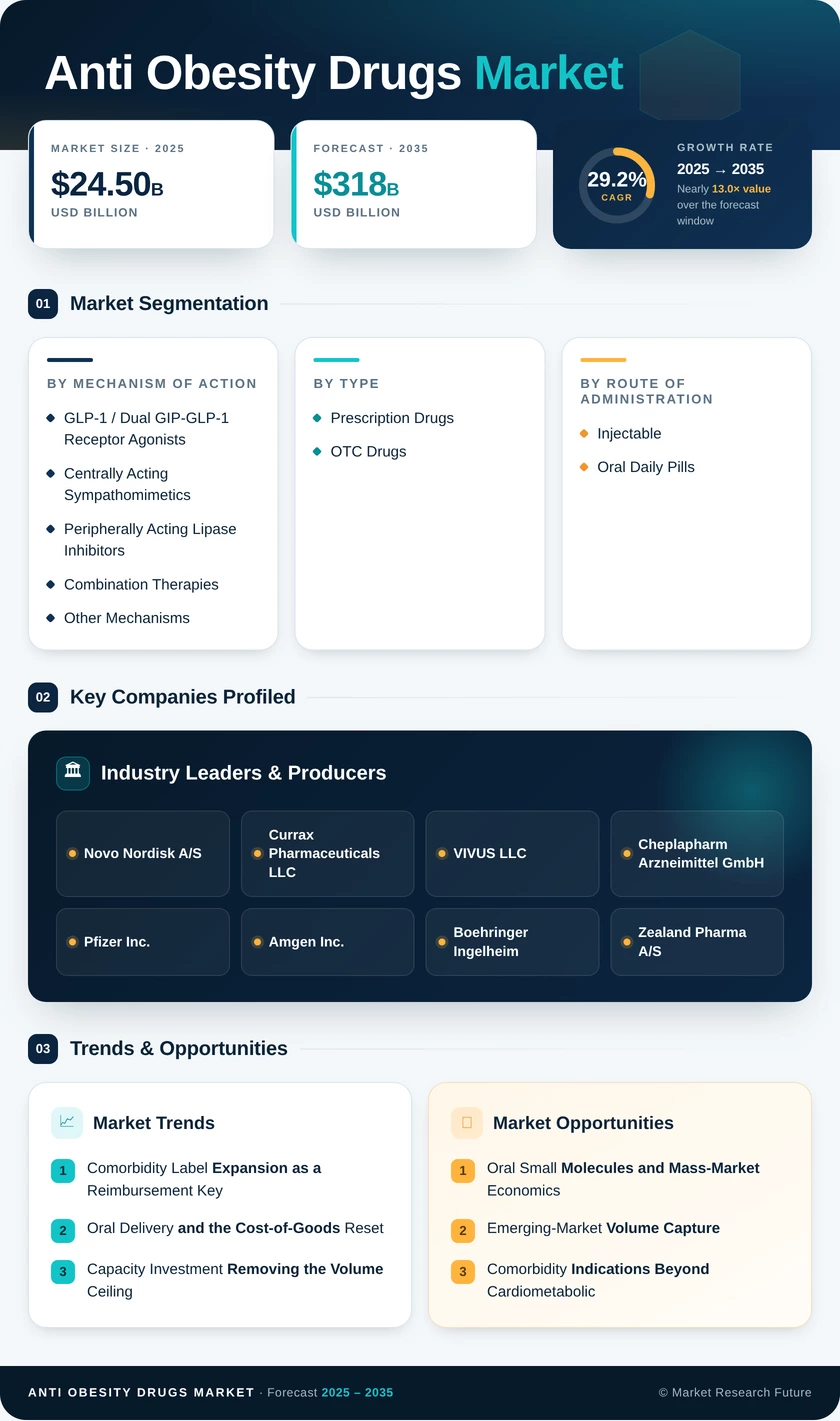
Anti obesity Drugs Market (2026 - 2035)

Anti-obesity Drugs Market Research Report: Size, Share, Trend Analysis By Treatment Type (Appetite Suppressants (Serotonin-Norepinephrine Reuptake Inhibitors, Selective Serotonin 2C Receptor Agonists, Norepinephrine-Dopamine Reuptake Inhibitors (NDRIs), Lipase Inhibitors, GLP-1 Receptor Agonists, Combination Drugs, Others), by Drug Type (Prescription Drugs and Over the Counter Drugs), by Mechanism of Action (Centrally Acting Anti-Obesity Drugs and Peripherally Acting Anti-Obesity Drugs), by Route of Administration (Oral and Subcutaneous), by Distribution Channel (Hospital Pharmacies, Retail Pharmacies, Online Pharmacies) and Region (North America, Europe, Asia-Pacific, South America, Middle East & Africa)) - Growth Outlook & Industry Forecast 2025 To 2035

Forecast Period
2026-2035
CAGR
29.2%
2025 Market Size
USD 24.5 Billion
2035 Market Size
USD 318.0 Billion
Healthcare ● Updated August 2026 Report ID: MRFR/HC/57644-CR | Pages: 184 | Author: Rahul Gotadki, Nidhi Mandole
  1. 1 Market Overview |
    1. 1.1 Study Assumptions & Market Definition |
    2. 1.2 Scope of the Study |
    3. 1.3 Research Methodology
  2. 2 Market Summary & Key Takeaways |
    1. 2.1 Key Takeaways by Mechanism of Action |
    2. 2.2 Key Takeaways by Drug Type & Route |
    3. 2.3 Key Takeaways by Geography
  3. 3 Global Market Size & Forecast (2021–2035) |
    1. 3.1 Historical Market Size (2021–2025) |
    2. 3.2 Current & Forecast Market Size (2026–2035) |
    3. 3.3 Year-over-Year Growth Analysis |
    4. 3.4 Data Sourcing & Triangulation Approach
  4. 4 Market Drivers Analysis |
    1. 4.1 Comorbidity Label Expansion as a Reimbursement Key |
    2. 4.2 Oral Delivery and the Cost-of-Goods Reset |
    3. 4.3 Capacity Investment Removing the Volume Ceiling |
    4. 4.4 Payer and Public Coverage Widening |
    5. 4.5 Driver Impact Quantification Matrix
  5. 5 Market Restraints Analysis |
    1. 5.1 Persistence and Discontinuation Economics |
    2. 5.2 Price Negotiation and Net-Price Trajectory |
    3. 5.3 Patent Cliffs Outside the United States |
    4. 5.4 Payer Exclusions and Prior-Authorisation Friction |
    5. 5.5 Safety, Tolerability & Product Integrity
  6. 6 Market Opportunity Analysis |
    1. 6.1 Oral Small Molecules and Mass-Market Economics |
    2. 6.2 Emerging-Market Volume Capture |
    3. 6.3 Comorbidity Indications Beyond Cardiometabolic |
    4. 6.4 Adherence Platforms and Recurring-Revenue Models |
    5. 6.5 Muscle-Preserving and Next-Generation Combinations |
    6. 6.6 Industry Value Chain Analysis |
    7. 6.7 Porter's Five Forces Analysis
  7. 7 Regional Analysis |
    1. 7.1 North America | |
      1. 7.1.1 US | |
      2. 7.1.2 Canada | |
      3. 7.1.3 Mexico |
    2. 7.2 Europe | |
      1. 7.2.1 Germany | |
      2. 7.2.2 UK | |
      3. 7.2.3 France | |
      4. 7.2.4 Italy | |
      5. 7.2.5 Spain | |
      6. 7.2.6 Nordic Countries | |
      7. 7.2.7 Russia | |
      8. 7.2.8 Rest of Europe |
    3. 7.3 Asia-Pacific | |
      1. 7.3.1 China | |
      2. 7.3.2 India | |
      3. 7.3.3 Japan | |
      4. 7.3.4 South Korea | |
      5. 7.3.5 ASEAN | |
      6. 7.3.6 Rest of Asia-Pacific |
    4. 7.4 South America | |
      1. 7.4.1 Brazil | |
      2. 7.4.2 Argentina | |
      3. 7.4.3 Rest of South America |
    5. 7.5 Middle East & Africa | |
      1. 7.5.1 Saudi Arabia | |
      2. 7.5.2 UAE | |
      3. 7.5.3 South Africa | |
      4. 7.5.4 Egypt | |
      5. 7.5.5 Rest of Middle East & Africa
  8. 8 Future Outlook (2026–2035) |
    1. 8.1 Near-Term Outlook (2026–2028) |
    2. 8.2 Medium-Term Outlook (2029–2031) |
    3. 8.3 Long-Term Outlook (2032–2035) |
    4. 8.4 Genericisation and Value Pool Migration
  9. 9 Segmentation Analysis |
    1. 9.1 By Mechanism of Action | |
      1. 9.1.1 GLP-1 / Dual GIP-GLP-1 Receptor Agonists | |
      2. 9.1.2 Centrally Acting Sympathomimetics | |
      3. 9.1.3 Peripherally Acting Lipase Inhibitors | |
      4. 9.1.4 Combination Therapies | |
      5. 9.1.5 Other Mechanisms |
    2. 9.2 By Drug Type | |
      1. 9.2.1 Prescription Drugs | |
      2. 9.2.2 OTC Drugs |
    3. 9.3 By Route of Administration | |
      1. 9.3.1 Oral Daily Pills | |
      2. 9.3.2 Injectable |
    4. 9.4 By Distribution Channel | |
      1. 9.4.1 Hospital Pharmacies | |
      2. 9.4.2 Retail Pharmacies | |
      3. 9.4.3 Online Pharmacies & Drug Stores
  10. 10 Competitive Landscape |
    1. 10.1 Market Concentration & Share Analysis (2026) |
    2. 10.2 Competitive Benchmarking Matrix |
    3. 10.3 Company Profiles | |
      1. 10.3.1 Novo Nordisk A/S | |
      2. 10.3.2 Eli Lilly and Company | |
      3. 10.3.3 Currax Pharmaceuticals LLC | |
      4. 10.3.4 VIVUS LLC | |
      5. 10.3.5 Cheplapharm Arzneimittel GmbH | |
      6. 10.3.6 Pfizer Inc. | |
      7. 10.3.7 Amgen Inc. | |
      8. 10.3.8 Boehringer Ingelheim | |
      9. 10.3.9 Zealand Pharma A/S | |
      10. 10.3.10 Rhythm Pharmaceuticals Inc. | |
      11. 10.3.11 Hengrui Pharmaceuticals
  11. 11 Recent Developments & News (2023–2025)
  12. 12 Report Scope & Methodology |
    1. 12.1 Study Period & Base Year |
    2. 12.2 Valuation Basis & Currency |
    3. 12.3 Abbreviations
  13. 13 Detailed Sources & Citations
  14. 14 Frequently Asked Questions (FAQs)
  15. 15 LIST OF TABLES
  16. 16 LIST OF FIGURES
Share::
Request Free Sample

Segmentation Quick Reference

DimensionSub-SegmentsDominant SegmentFastest Growing Segment
By Mechanism of ActionGLP-1 / Dual GIP-GLP-1 Receptor Agonists; Centrally Acting Sympathomimetics; Peripherally Acting Lipase Inhibitors; Combination Therapies; Other MechanismsGLP-1 / Dual GIP-GLP-1 Receptor AgonistsCombination Therapies
By Drug TypePrescription Drugs; OTC DrugsPrescription DrugsOTC Drugs
By Route of AdministrationOral Daily Pills; InjectableInjectableOral Daily Pills
By Distribution ChannelHospital Pharmacies; Retail Pharmacies; Online Pharmacies & Drug StoresRetail PharmaciesOnline Pharmacies & Drug Stores
By GeographyNorth America; Europe; Asia-Pacific; South America; Middle East & AfricaNorth AmericaAsia-Pacific


Market Segmentation Overview

By Mechanism of Action

Sub-SegmentKey Trend
GLP-1 / Dual GIP-GLP-1 Receptor AgonistsOutcomes data converts efficacy leadership into payer coverage
Centrally Acting SympathomimeticsGeneric pricing sustains a durable primary-care floor
Peripherally Acting Lipase InhibitorsRetail and OTC positioning; declining prescription relevance
Combination TherapiesAmylin and myostatin pairings target lean-mass preservation
Other MechanismsMC4R agonists serve orphan genetic obesity at premium pricing


Mechanism concentration here is extreme by pharmaceutical standards, and it will loosen only when combination regimens demonstrate body-composition advantages that single agents cannot match.

By Drug Type

Sub-SegmentKey Trend
Prescription DrugsTitration and monitoring requirements entrench physician gatekeeping
OTC DrugsRetail expansion in Asia drives growth from a small base


Switching any incretin agent to non-prescription status is not a realistic scenario within the forecast window, which leaves the split effectively fixed.

By Route of Administration

Sub-SegmentKey Trend
InjectableWeekly dosing and proven outcomes retain the efficacy premium
Oral Daily PillsRemoval of cold chain and device costs unlocks emerging markets


Route migration is the most consequential structural shift ahead, reshaping cost of goods, distribution economics, and geographic reach simultaneously.

By Distribution Channel

Sub-SegmentKey Trend
Hospital PharmaciesSpecialist initiation for high-BMI and comorbid patient cohorts
Retail PharmaciesDefault commercial fulfilment channel; volume-led
Online Pharmacies & Drug StoresManufacturer direct platforms capture data and margin


Direct-to-consumer channels remain small in absolute terms yet strategically outsized, because they generate the longitudinal evidence that outcomes-based contracts will require.




Share::
Request Free Sample
Download PDF ×

We do not share your information with anyone. However, we may send you emails based on your report interest from time to time. You may contact us at any time to opt-out.