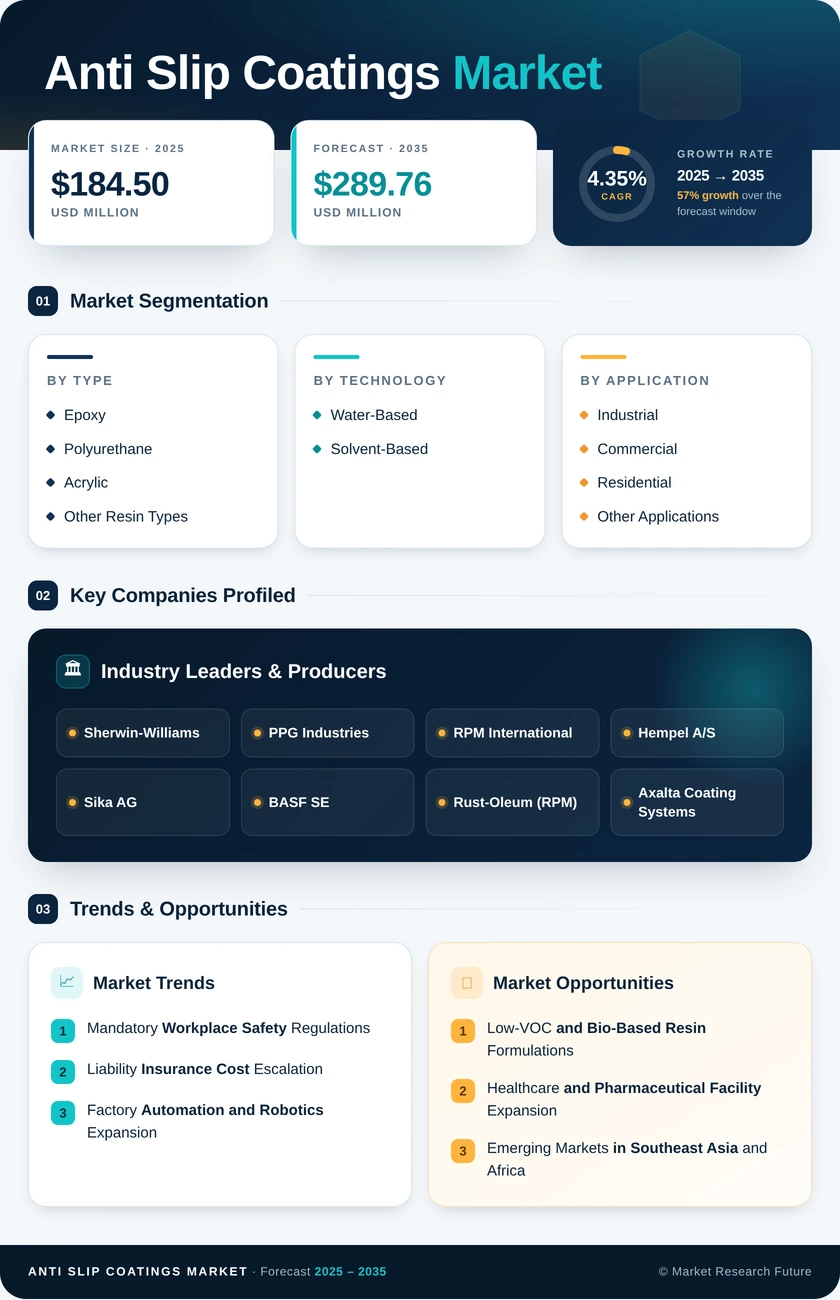
Anti-Slip Coatings Market

ID: MRFR/CnM/5925-HCR
140 Pages
Chitranshi Jaiswal
Last Updated: June 05, 2026
Anti-Slip Coatings Market Research Report Information By Type (Water-Based, Solvent-Based), By Epoxy Resin (PU, Polyaspartic, Acrylic), By Technology (Physical, Chemical), By Application (Flooring, Marine), By End-User (Construction) and By Region (North America, Europe, Asia-Pacific, And Rest of the World) –Market Forecast Till 2035
Download PDF ×

We do not share your information with anyone. However, we may send you emails based on your report interest from time to time. You may contact us at any time to opt-out.

  1. 1 Market Summary |
    1. 1.1 Study Assumptions & Market Definition |
    2. 1.2 Scope of the Study |
    3. 1.3 Research Methodology
  2. 2 Key Report Takeaways |
    1. 2.1 By Resin Type |
    2. 2.2 By Technology |
    3. 2.3 By Application |
    4. 2.4 By Geography
  3. 3 Market Size and Forecast (2021–2035) |
    1. 3.1 Historical Market Size (2021–2025) |
    2. 3.2 Forecast Market Size (2026–2035) |
    3. 3.3 Market Size by Revenue (USD Million) |
    4. 3.4 Year-over-Year Growth Analysis
  4. 4 Driver Impact Analysis |
    1. 4.1 Mandatory Workplace Safety Regulations |
    2. 4.2 Liability Insurance Cost Escalation |
    3. 4.3 Factory Automation and Robotics Expansion |
    4. 4.4 VOC Emission Restrictions and the Water-Based Shift
  5. 5 Restraints Impact Analysis |
    1. 5.1 Raw Material Price Volatility |
    2. 5.2 Skilled Applicator Labor Shortage |
    3. 5.3 Competition from Mechanical Anti-Slip Solutions
  6. 6 Opportunities |
    1. 6.1 Low-VOC and Bio-Based Resin Formulations |
    2. 6.2 Healthcare and Pharmaceutical Facility Expansion |
    3. 6.3 Smart Coatings with Embedded Sensor Technology |
    4. 6.4 Emerging Markets in Southeast Asia and Africa |
    5. 6.5 Coatings-as-a-Service and Maintenance Contracts
  7. 7 Regional Market Share and Country-Level Analysis |
    1. 7.1 North America | |
      1. 7.1.1 United States | |
      2. 7.1.2 Canada | |
      3. 7.1.3 Mexico |
    2. 7.2 Europe | |
      1. 7.2.1 Germany | |
      2. 7.2.2 United Kingdom | |
      3. 7.2.3 France | |
      4. 7.2.4 Italy | |
      5. 7.2.5 Spain | |
      6. 7.2.6 Nordic Countries | |
      7. 7.2.7 Russia | |
      8. 7.2.8 Rest of Europe |
    3. 7.3 Asia-Pacific | |
      1. 7.3.1 China | |
      2. 7.3.2 India | |
      3. 7.3.3 Japan | |
      4. 7.3.4 South Korea | |
      5. 7.3.5 ASEAN | |
      6. 7.3.6 Rest of Asia-Pacific |
    4. 7.4 South America | |
      1. 7.4.1 Brazil | |
      2. 7.4.2 Argentina | |
      3. 7.4.3 Rest of South America |
    5. 7.5 Middle East & Africa | |
      1. 7.5.1 Saudi Arabia | |
      2. 7.5.2 UAE | |
      3. 7.5.3 South Africa | |
      4. 7.5.4 Egypt | |
      5. 7.5.5 Rest of MEA
  8. 8 Future Outlook (2026–2035) |
    1. 8.1 Regulatory Convergence and Global Harmonization |
    2. 8.2 Automation-Ready Surface Engineering |
    3. 8.3 Sustainability and Circular Chemistry |
    4. 8.4 Digital Specification and Procurement Platforms
  9. 9 Market Segmentation Analysis |
    1. 9.1 By Resin Type | |
      1. 9.1.1 Epoxy | |
      2. 9.1.2 Polyurethane | |
      3. 9.1.3 Acrylic | |
      4. 9.1.4 Other Resin Types |
    2. 9.2 By Technology | |
      1. 9.2.1 Water-Based | |
      2. 9.2.2 Solvent-Based |
    3. 9.3 By Application | |
      1. 9.3.1 Industrial | |
      2. 9.3.2 Commercial | |
      3. 9.3.3 Residential | |
      4. 9.3.4 Other Applications
  10. 10 Competitive Landscape |
    1. 10.1 Market Concentration Analysis |
    2. 10.2 Competitive Benchmarking Matrix |
    3. 10.3 Company Profiles | |
      1. 10.3.1 Sherwin-Williams | |
      2. 10.3.2 PPG Industries | |
      3. 10.3.3 RPM International | |
      4. 10.3.4 Hempel A/S | |
      5. 10.3.5 Sika AG | |
      6. 10.3.6 BASF SE | |
      7. 10.3.7 Rust-Oleum | |
      8. 10.3.8 Axalta Coating Systems | |
      9. 10.3.9 Jotun | |
      10. 10.3.10 3M
  11. 11 Recent News & Developments
  12. 12 Report Scope & Methodology |
    1. 12.1 Study Period & Base Year |
    2. 12.2 Data Sources & Citations |
    3. 12.3 Abbreviations
  13. 13 Detailed Sources and Citations
  14. 14 Frequently Asked Questions (FAQs)
  15. 15 LIST OF TABLES |
  16. TABLE 1 Global Anti-Slip Coatings Market Size & Forecast, by Revenue (USD Million), 2021–2035 |
  17. TABLE 2 Global Anti-Slip Coatings Market – Year-over-Year Growth Analysis, 2021–2035 |
  18. TABLE 3 Driver Impact Analysis – Anti-Slip Coatings Market |
  19. TABLE 4 Restraints Impact Analysis – Anti-Slip Coatings Market |
  20. TABLE 5 Regional Market Share Summary – Anti-Slip Coatings Market, 2025 |
  21. TABLE 6 North America Anti-Slip Coatings Market Size, by Country, 2021–2035 (USD Million) |
  22. TABLE 7 Europe Anti-Slip Coatings Market Size, by Country, 2021–2035 (USD Million) |
  23. TABLE 8 Asia-Pacific Anti-Slip Coatings Market Size, by Country, 2021–2035 (USD Million) |
  24. TABLE 9 South America Anti-Slip Coatings Market Size, by Country, 2021–2035 (USD Million) |
  25. TABLE 10 Middle East & Africa Anti-Slip Coatings Market Size, by Country, 2021–2035 (USD Million) |
  26. TABLE 11 Global Anti-Slip Coatings Market Size, by Resin Type, 2021–2035 (USD Million) |
  27. TABLE 12 Global Anti-Slip Coatings Market Size, by Technology, 2021–2035 (USD Million) |
  28. TABLE 13 Global Anti-Slip Coatings Market Size, by Application, 2021–2035 (USD Million) |
  29. TABLE 14 Competitive Benchmarking Matrix – Global Anti-Slip Coatings Market, 2025 |
  30. TABLE 15 Company Profiles – Key Players, Global Anti-Slip Coatings Market |
  31. TABLE 16 Recent Developments & Strategic Announcements, 2023–2025 |
  32. TABLE 17 Report Scope & Methodology Summary |
  33. TABLE 18 Detailed Sources and Citations
  34. 16 LIST OF FIGURES |
  35. FIGURE 1 Anti-Slip Coatings Market Dynamics — Drivers, Restraints, and Opportunities |
  36. FIGURE 2 Value Chain Analysis — Anti-Slip Coatings Market |
  37. FIGURE 3 Porter's Five Forces Analysis — Anti-Slip Coatings Market |
  38. FIGURE 4 Global Anti-Slip Coatings Market Size Trend (USD Million), 2021–2035 |
  39. FIGURE 5 Anti-Slip Coatings Market Share, by Resin Type, 2025 |
  40. FIGURE 6 Anti-Slip Coatings Market Share, by Technology, 2025 |
  41. FIGURE 7 Anti-Slip Coatings Market Share, by Application, 2025 |
  42. FIGURE 8 Anti-Slip Coatings Market Share, by Region, 2025 |
  43. FIGURE 9 North America Anti-Slip Coatings Market, by Country Share, 2025 |
  44. FIGURE 10 Europe Anti-Slip Coatings Market, by Country Share, 2025 |
  45. FIGURE 11 Asia-Pacific Anti-Slip Coatings Market, by Country Share, 2025 |
  46. FIGURE 12 South America Anti-Slip Coatings Market, by Country Share, 2025 |
  47. FIGURE 13 Middle East & Africa Anti-Slip Coatings Market, by Country Share, 2025 |
  48. FIGURE 14 Competitive Landscape — Anti-Slip Coatings Market Revenue Share, 2025

Segmentation Quick Reference

DimensionSub-SegmentsDominant SegmentFastest Growing Segment
Resin TypeEpoxy, Polyurethane, Acrylic, Other Resin TypesEpoxyOther Resin Types
TechnologyWater-Based, Solvent-BasedWater-BasedWater-Based
ApplicationIndustrial, Commercial, Residential, Other ApplicationsIndustrialOther Applications
GeographyAsia-Pacific, North America, Europe, South America, the Middle East & AfricaAsia-PacificAsia-Pacific


Market Segmentation Overview

By Resin Type

Sub-SegmentKey Trend
EpoxyDominant chemistry for heavy-industrial and chemical-processing environments; strong adhesion and chemical resistance
PolyurethaneGrowing adoption in commercial and healthcare settings is driven by UV stability and flexibility.
AcrylicFast-cure, cost-effective option gaining share in residential and light-commercial retrofits
Other Resin TypesSpecialty formulations (vinyl ester, silicone-hybrid) for extreme-environment applications


Epoxy resin continues to anchor the Anti-Slip Coatings Market, particularly in industrial applications where chemical exposure and mechanical stress demand maximum durability. Polyurethane and acrylic alternatives are expanding their addressable segments as formulation technology improves flexibility and cure speed.

By Technology

Sub-SegmentKey Trend
Water-BasedRegulatory-driven shift from solvent systems; dominant across institutional and commercial specifications
Solvent-BasedRetained for heavy-industrial and outdoor applications requiring extreme moisture and abrasion resistance


Water-based systems lead adoption globally as VOC regulations tighten and facility operators demand low-odor, occupied-space application capability. Solvent-based formulations maintain a dedicated niche in environments where cure-time, moisture sensitivity and extreme mechanical performance are non-negotiable requirements.

By Application

Sub-SegmentKey Trend
IndustrialLargest segment: driven by factory automation, OSHA/ISO compliance, and chemical wash-down requirements
CommercialSecond-largest segment: retail, hospitality, and healthcare floor safety specification
ResidentialEmerging segment: aging-in-place renovations and DIY anti-slip product adoption
Other ApplicationsFastest-growing segment: marine, transportation, sports, and military facility applications


Industrial applications dominate consumption due to the convergence of regulatory mandates, insurance incentives, and automation-driven surface engineering requirements. The "Other Applications" category is emerging as the fastest-growing segment, as anti-slip specification extends into marine decking, rail platforms, and defense installations.