×
Request Free Sample ×

Kindly complete the form below to receive a free sample of this Report

* Please use a valid business email

Leading companies partner with us for data-driven Insights

clients tt-cursor
Hero Background

Antimicrobial Powder Coating Market

ID: MRFR/CnM/3134-HCR
140 Pages
Priya Nagrale
October 2025

Antimicrobial Powder Coating Market by Type [Metal (Silver, Copper), Microorganisms (Escherichia Coli, Listeria, Pseudomonas, and Others)], by Application (Healthcare, Food & Beverages, Textile, Air Conditioning & Ventilation System, Paints & Coatings, Building & Construction, and Others), and Region - Forecast till 2035

Share:
Download PDF ×

We do not share your information with anyone. However, we may send you emails based on your report interest from time to time. You may contact us at any time to opt-out.

Antimicrobial Powder Coating Market Infographic
Purchase Options

Antimicrobial Powder Coating Market Summary

As per MRFR analysis, the Antimicrobial Powder Coating Market Size was estimated at 12.04 USD Million in 2024. The Antimicrobial Powder Coating industry is projected to grow from 14.4 in 2025 to 86.18 by 2035, exhibiting a compound annual growth rate (CAGR) of 19.59 during the forecast period 2025 - 2035.

Key Market Trends & Highlights

The Antimicrobial Powder Coating Market is poised for substantial growth driven by increasing hygiene awareness and technological advancements.

  • The healthcare sector exhibits a rising demand for antimicrobial powder coatings, particularly in medical applications.
  • North America remains the largest market, while the Asia-Pacific region is recognized as the fastest-growing area for these coatings.
  • The automotive segment continues to dominate the market, whereas the healthcare segment is experiencing rapid growth.
  • Key market drivers include rising awareness of hygiene standards and regulatory support for antimicrobial solutions.

Market Size & Forecast

2024 Market Size 12.04 (USD Million)
2035 Market Size 86.18 (USD Million)
CAGR (2025 - 2035) 19.59%

Major Players

AkzoNobel (NL), PPG Industries (US), Sherwin-Williams (US), BASF (DE), Axalta Coating Systems (US), Nippon Paint Holdings (JP), Kansai Paint (JP), RPM International (US), Tikkurila (FI)

Antimicrobial Powder Coating Market Trends

The Antimicrobial Powder Coating Market is currently experiencing a notable transformation, driven by increasing awareness regarding hygiene and the necessity for protective coatings in various industries. This market appears to be expanding as manufacturers and consumers alike recognize the benefits of antimicrobial properties in coatings, which can inhibit the growth of harmful microorganisms. Industries such as healthcare, food processing, and consumer goods are particularly focused on adopting these coatings to enhance safety and durability. Furthermore, the growing trend towards sustainability and eco-friendly products is influencing the development of innovative formulations that meet both performance and environmental standards. In addition, advancements in technology are likely to play a crucial role in shaping the future of the Antimicrobial Powder Coating Market. The integration of smart technologies and enhanced application methods may lead to improved efficiency and effectiveness of these coatings. As the market evolves, it seems that collaboration between manufacturers, researchers, and regulatory bodies will be essential to ensure compliance with safety standards and to foster innovation. Overall, the Antimicrobial Powder Coating Market is poised for growth, reflecting a broader shift towards health-conscious and sustainable practices across various sectors.

Rising Demand in Healthcare Sector

The healthcare industry is increasingly adopting antimicrobial powder coatings to ensure sterile environments. These coatings are utilized on medical equipment, surfaces, and devices to minimize the risk of infections, thereby enhancing patient safety.

Sustainability and Eco-Friendly Innovations

There is a growing emphasis on sustainable practices within the Antimicrobial Powder Coating Market. Manufacturers are exploring eco-friendly materials and processes, which not only meet performance requirements but also align with environmental regulations.

Technological Advancements in Coating Applications

Innovations in application techniques and formulation technologies are likely to enhance the performance of antimicrobial coatings. These advancements may lead to more efficient application processes and improved durability of the coatings.

Antimicrobial Powder Coating Market Drivers

Market Growth Projections

The Global Antimicrobial Powder Coating Market Industry is projected to experience substantial growth over the next decade. With a market value of 1.51 USD Billion in 2024, it is anticipated to reach 5.51 USD Billion by 2035, reflecting a robust compound annual growth rate (CAGR) of 12.47% from 2025 to 2035. This growth is driven by various factors, including increasing demand for hygiene solutions, technological advancements, and regulatory support. The market's expansion is expected to create new opportunities for manufacturers and suppliers, fostering innovation and competition within the industry.

Rising Demand for Hygiene Solutions

The increasing global emphasis on hygiene and cleanliness is driving the Global Antimicrobial Powder Coating Market Industry. Industries such as healthcare, food processing, and consumer goods are increasingly adopting antimicrobial coatings to enhance product safety and reduce microbial contamination. For instance, hospitals are utilizing these coatings on surfaces and equipment to minimize infection risks. This trend is expected to contribute to the market's growth, with projections indicating a market value of 1.51 USD Billion in 2024, reflecting a growing awareness of hygiene in various sectors.

Diverse Applications Across Industries

The versatility of antimicrobial powder coatings across various industries is a key driver of the Global Antimicrobial Powder Coating Market Industry. These coatings find applications in sectors such as automotive, construction, and consumer electronics, where they provide protective and aesthetic benefits. For example, in the automotive industry, antimicrobial coatings are applied to interior surfaces to enhance hygiene and improve user experience. This broad applicability not only increases market penetration but also encourages innovation in product development, thereby supporting sustained growth in the coming years.

Growing Awareness of Antimicrobial Properties

The heightened awareness regarding the benefits of antimicrobial properties in coatings is propelling the Global Antimicrobial Powder Coating Market Industry. Consumers and businesses alike are recognizing the importance of reducing microbial growth on surfaces, particularly in high-touch areas. This awareness is leading to increased demand for products featuring antimicrobial coatings, as they offer long-lasting protection against bacteria, fungi, and viruses. Consequently, manufacturers are expanding their product lines to include antimicrobial options, which is expected to drive the market's compound annual growth rate (CAGR) of 12.47% from 2025 to 2035.

Regulatory Support for Antimicrobial Products

Government regulations promoting the use of antimicrobial products are bolstering the Global Antimicrobial Powder Coating Market Industry. Various regulatory bodies are establishing guidelines that encourage the adoption of antimicrobial coatings in public spaces, healthcare facilities, and food processing environments. This regulatory support is aimed at enhancing public health and safety, which in turn drives demand for antimicrobial solutions. As a result, manufacturers are increasingly aligning their products with these regulations, contributing to the anticipated market growth, with a forecasted value of 5.51 USD Billion by 2035.

Technological Advancements in Coating Processes

Innovations in coating technologies are significantly influencing the Global Antimicrobial Powder Coating Market Industry. The development of advanced application techniques, such as electrostatic spray and fluidized bed processes, enhances the efficiency and effectiveness of antimicrobial coatings. These advancements allow for better adhesion, durability, and performance of the coatings on various substrates. As manufacturers continue to invest in research and development, the market is likely to witness an increase in product offerings, catering to diverse applications across industries, thereby supporting the projected growth trajectory.
Market Segment Insights

By Application: Automotive (Largest) vs. Medical (Fastest-Growing)

The Antimicrobial Powder Coating Market is witnessing a dynamic distribution of market shares across its key application segments. The automotive sector holds a significant proportion of the market, benefiting from increasing demands for durability and longevity in vehicle components. Meanwhile, the medical application segment is rapidly gaining traction, driven by the escalating need for hygienic materials in healthcare settings, making it an essential area for innovation and development. In terms of growth trends, the automotive segment continues to evolve, with a focus on enhancing performance while adhering to stringent health and safety regulations. Conversely, the medical application segment is turning out to be the fastest-growing, spurred by advancements in technology and a rising awareness of infection control. This shift indicates a strong potential for future growth driven by escalating health standards and stringent guidelines across industries.

Automotive: Dominant vs. Medical: Emerging

The automotive sector remains a dominant force within the Antimicrobial Powder Coating Market, leveraging its established demand for protective coatings that enhance vehicle durability and surface performance. The sector's traditional appeal stems from its emphasis on aesthetic durability and resistance to microbial growth, which is vital for maintaining vehicle longevity. On the other hand, the medical application segment is emerging as a pivotal player, highlighting the increasing need for antimicrobial solutions in healthcare environments. This segment is characterized by its commitment to stringent safety standards and innovative technologies, responding swiftly to the heightened emphasis on infection prevention in hospitals and clinics. The synergy between these two segments illustrates the market's adaptive strategies to varying consumer needs.

By End Use: Consumer Goods (Largest) vs. Healthcare (Fastest-Growing)

In the Antimicrobial Powder Coating Market, the Consumer Goods segment currently holds the largest share, reflecting its widespread application across various products. This segment is characterized by a high demand for coatings that prevent microbial growth and enhance product longevity, particularly in everyday items, promoting hygiene and safety. In contrast, the Healthcare segment is the fastest-growing, driven by increasing awareness of infection control and the need for hygienic surfaces in medical environments. This segment's rapid expansion highlights the rising adoption of antimicrobial solutions in hospitals and medical equipment.

Consumer Goods (Dominant) vs. Healthcare (Emerging)

The Consumer Goods segment is dominant in the Antimicrobial Powder Coating Market, as it encompasses a range of products from appliances to toys that benefit from enhanced durability and hygiene. Manufacturers prioritize this segment due to robust consumer demand for safety and cleanliness in household items. Conversely, the Healthcare segment is emerging swiftly, spurred by innovations in medical technologies and the increasing need for sterile environments. Antimicrobial coatings in this sector are crucial for preventing infections, making it a key area for future growth as healthcare facilities continue to prioritize safety and hygiene standards.

By Type: Epoxy (Largest) vs. Polyester (Fastest-Growing)

In the Antimicrobial Powder Coating Market, epoxy coatings hold a significant share due to their excellent adhesion and durability, making them the preferred choice for various applications. Polyester coatings are gaining traction due to their superior UV resistance and weatherability, appealing to outdoor applications. Additionally, the hybrid and fluoropolymer segments are carving out their niches, although their market share remains comparatively lower than epoxy and polyester. The growth trends in this segment are propelled by the increasing demand for eco-friendly coatings and the rising need for antimicrobial properties in a variety of sectors, including automotive and construction. Polyester, in particular, is experiencing rapid growth driven by urbanization and a heightened focus on protective coatings in outdoor environments. The versatility of hybrid coatings also suggests a promising upward trajectory as manufacturers seek advanced performance attributes.

Epoxy (Dominant) vs. Hybrid (Emerging)

Epoxy coatings are recognized as the dominant force in the Antimicrobial Powder Coating Market, praised for their exceptional chemical resistance and strong adhesion. This makes them highly suitable for industrial applications, where durability is paramount. On the contrary, hybrid coatings represent an emerging category that combines the best features of epoxy and polyester coatings, offering enhanced flexibility and thermal stability. Though currently a smaller player, the hybrid segment is attracting interest for its versatility and adaptability to various substrates and conditions, indicating a potential for growth as stakeholders prioritize innovative solutions tailored for specific industry needs.

By Formulation: Water-Based (Largest) vs. Powder-Based (Fastest-Growing)

In the Antimicrobial Powder Coating Market, the formulation segment showcases a diverse range of options, with water-based coatings holding the largest market share. This dominance is attributed to their eco-friendly profile, efficiency, and versatility across various applications. Solvent-based formulations follow, appealing to certain sectors requiring specific performance attributes. Meanwhile, powder-based coatings are rapidly gaining traction due to their superior performance characteristics and growing demand in various industrial sectors, carving a significant niche in the market.

Water-Based (Dominant) vs. Powder-Based (Emerging)

Water-based formulations are characterized by their low volatile organic compound (VOC) emissions, making them a dominant choice for environmentally conscious consumers. They offer excellent adhesion, durability, and flexibility, enhancing their appeal in industries such as automotive and construction. Conversely, powder-based coatings emerge as a strong contender with their economical application and waste reduction benefits. They provide a tough, protective layer that ensures longevity and resilience, making them increasingly popular in industrial applications. The shift towards sustainable options is likely to accelerate the growth of both formulations as industries seek to comply with stringent environmental regulations.

By Technology: Electrostatic Spray (Largest) vs. Thermal Spray (Fastest-Growing)

In the Antimicrobial Powder Coating Market, the distribution of market share among the various technology segments reveals that Electrostatic Spray holds the largest share due to its established presence and wide adoption across industries. This method is preferred for its efficiency and high-quality finish, making it the go-to choice for various applications. Conversely, Thermal Spray, while currently smaller in market share, is rapidly gaining traction as more industries explore its capabilities in providing durable and protective coatings with enhanced antimicrobial properties. The growth trends in the technology segment are primarily driven by the increasing demand for sustainable and high-performance coating solutions. Rapid advancements in application technologies such as Cold Spray and Laser Cladding are attracting attention for their potential to deliver superior performance and unique characteristics. Manufacturers are increasingly investing in research and development to innovate and enhance these technologies, aiding in their market penetration and growth, particularly in high-demand sectors such as automotive and healthcare.

Technology: Electrostatic Spray (Dominant) vs. Thermal Spray (Emerging)

Electrostatic Spray technology is recognized as the dominant method in the Antimicrobial Powder Coating Market, offering excellent transfer efficiency and a smooth, uniform finish. Its ability to adhere to complex geometries and materials without dripping makes it especially favored among manufacturers seeking consistency and effectiveness in coating applications. On the other hand, Thermal Spray is emerging as an innovative solution, particularly due to its versatility in applying coatings that require high-performance characteristics. This technology allows for the application of various materials, including metals and ceramics, making it suitable for a diverse range of applications, from industrial to consumer products. The rising interest in this technology stems from its capability to create coatings that can withstand extreme conditions, thus signaling strong potential for future market growth.

Get more detailed insights about Antimicrobial Powder Coating Market

Regional Insights

North America : Market Leader in Coatings

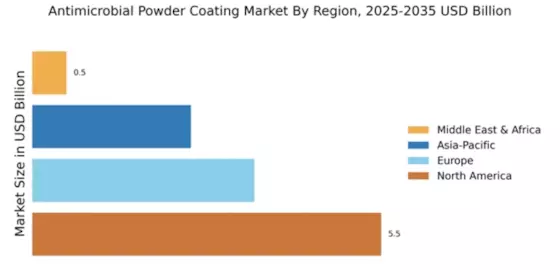
North America is poised to maintain its leadership in the Antimicrobial Powder Coating Market, holding a significant market share of 5.5 in 2024. The growth is driven by increasing health awareness, stringent regulations on hygiene, and rising demand in sectors like healthcare and food processing. The region's focus on innovation and sustainability further propels market expansion, supported by government initiatives promoting antimicrobial technologies. The competitive landscape in North America is robust, featuring key players such as AkzoNobel, PPG Industries, and Sherwin-Williams. These companies are investing heavily in R&D to enhance product offerings and meet evolving consumer demands. The presence of advanced manufacturing facilities and a strong distribution network also contribute to the region's market strength, ensuring a steady supply of high-quality antimicrobial coatings.

Europe : Emerging Market Dynamics

Europe is witnessing a growing demand for antimicrobial powder coatings, with a market size of 3.5 in 2024. This growth is fueled by increasing regulations on hygiene and safety standards across various industries, including construction and automotive. The European market is also characterized by a shift towards eco-friendly products, driven by consumer preferences and government policies aimed at sustainability and health protection. Leading countries in this region include Germany, France, and the UK, where major players like BASF and Tikkurila are actively expanding their product lines. The competitive landscape is marked by innovation and strategic partnerships, as companies seek to enhance their market presence. The European market is also supported by various regulatory frameworks that encourage the use of antimicrobial technologies in public spaces and facilities.

Asia-Pacific : Rapid Growth Potential

Asia-Pacific is emerging as a significant player in the Antimicrobial Powder Coating Market, with a market size of 2.5 in 2024. The region's growth is driven by rapid industrialization, urbanization, and increasing awareness of hygiene standards. Countries like China and India are witnessing a surge in demand for antimicrobial coatings in sectors such as healthcare, food processing, and consumer goods, supported by government initiatives promoting health and safety. The competitive landscape in Asia-Pacific is evolving, with key players like Nippon Paint Holdings and Kansai Paint leading the charge. These companies are focusing on innovation and expanding their manufacturing capabilities to meet the growing demand. The presence of a large consumer base and increasing investments in infrastructure further enhance the region's market potential, making it a focal point for future growth in antimicrobial coatings.

Middle East and Africa : Untapped Market Opportunities

The Middle East and Africa region is gradually emerging in the Antimicrobial Powder Coating Market, with a market size of 0.54 in 2024. The growth is primarily driven by increasing awareness of hygiene and safety in various sectors, including healthcare and construction. Government initiatives aimed at improving public health standards are also contributing to the rising demand for antimicrobial solutions in the region, although the market remains relatively nascent compared to other regions. Leading countries in this region include South Africa and the UAE, where there is a growing interest in advanced coating technologies. The competitive landscape is characterized by a mix of local and international players, with companies exploring partnerships to enhance their market presence. As the region continues to develop, the potential for growth in antimicrobial coatings is significant, driven by evolving consumer needs and regulatory frameworks.

Key Players and Competitive Insights

The Antimicrobial Powder Coating Market is currently characterized by a dynamic competitive landscape, driven by increasing demand for hygiene and safety in various applications, including healthcare, food processing, and consumer goods. Key players such as AkzoNobel (NL), PPG Industries (US), and Sherwin-Williams (US) are strategically positioned to leverage innovation and sustainability in their offerings. AkzoNobel (NL) emphasizes its commitment to sustainable practices, focusing on eco-friendly formulations, while PPG Industries (US) is enhancing its product portfolio through technological advancements and strategic partnerships. Sherwin-Williams (US) appears to be concentrating on expanding its market reach through acquisitions and regional diversification, collectively shaping a competitive environment that prioritizes innovation and sustainability.

In terms of business tactics, companies are increasingly localizing manufacturing to reduce lead times and optimize supply chains. The market structure is moderately fragmented, with several players vying for market share, yet the influence of major companies remains substantial. This competitive structure allows for a diverse range of products and innovations, fostering a healthy environment for growth and development.

In November 2025, AkzoNobel (NL) announced the launch of a new line of antimicrobial powder coatings designed specifically for the healthcare sector. This strategic move is significant as it aligns with the growing emphasis on hygiene in medical environments, potentially enhancing the company's market share in a sector that demands high-performance coatings. The introduction of these products could also reinforce AkzoNobel's reputation as a leader in sustainable and innovative solutions.

In October 2025, PPG Industries (US) expanded its partnership with a leading technology firm to integrate AI-driven analytics into its production processes. This initiative is likely to enhance operational efficiency and product quality, positioning PPG as a forward-thinking player in the market. The integration of AI could streamline supply chain management and improve customer service, thereby strengthening PPG's competitive edge.

In September 2025, Sherwin-Williams (US) completed the acquisition of a regional coatings manufacturer, which is expected to bolster its distribution capabilities and product offerings. This acquisition reflects a strategic focus on expanding market presence and enhancing customer access to innovative solutions. By integrating the acquired company's technologies and expertise, Sherwin-Williams may further differentiate itself in a competitive landscape.

As of December 2025, current trends in the Antimicrobial Powder Coating Market indicate a shift towards digitalization, sustainability, and the integration of advanced technologies. Strategic alliances are increasingly shaping the competitive landscape, allowing companies to pool resources and expertise. Looking ahead, competitive differentiation is likely to evolve from traditional price-based competition to a focus on innovation, technology, and supply chain reliability, underscoring the importance of adaptability in a rapidly changing market.

Key Companies in the Antimicrobial Powder Coating Market market include

Industry Developments

  • Q2 2024: AkzoNobel launches new antimicrobial powder coating for healthcare sector AkzoNobel announced the launch of a new antimicrobial powder coating specifically designed for use in hospitals and healthcare facilities, aiming to reduce the spread of bacteria on high-touch surfaces.
  • Q1 2024: PPG expands antimicrobial powder coatings production with new facility in Texas PPG Industries opened a new manufacturing facility in Texas dedicated to the production of antimicrobial powder coatings, increasing its capacity to meet growing demand in North America.
  • Q3 2024: Axalta introduces next-generation antimicrobial powder coating for public infrastructure Axalta Coating Systems launched a next-generation antimicrobial powder coating product targeting public infrastructure projects, including schools and transportation hubs.
  • Q2 2024: Sherwin-Williams partners with Medline for antimicrobial coatings in medical equipment Sherwin-Williams announced a partnership with Medline to supply antimicrobial powder coatings for use in Medline's range of medical equipment and hospital furnishings.
  • Q4 2024: AkzoNobel secures contract to supply antimicrobial powder coatings for new European hospital network AkzoNobel was awarded a contract to provide antimicrobial powder coatings for a network of newly constructed hospitals across Europe, supporting infection control initiatives.
  • Q1 2025: Jotun unveils antimicrobial powder coating for food processing facilities Jotun launched a new antimicrobial powder coating formulated for use in food processing environments, aiming to enhance hygiene and safety standards.
  • Q2 2025: PPG signs supply agreement with major appliance manufacturer for antimicrobial powder coatings PPG Industries entered into a multi-year supply agreement with a leading global appliance manufacturer to provide antimicrobial powder coatings for use in refrigerators and kitchen appliances.
  • Q3 2024: Axalta expands antimicrobial powder coating line with new eco-friendly formulation Axalta Coating Systems introduced an eco-friendly antimicrobial powder coating, reducing environmental impact while maintaining high efficacy against bacteria and fungi.
  • Q2 2024: Sherwin-Williams receives regulatory approval for antimicrobial powder coating in Japan Sherwin-Williams received regulatory approval from Japanese authorities for its antimicrobial powder coating, enabling sales and distribution in the Japanese market.
  • Q4 2024: Jotun opens new R&D center focused on antimicrobial powder coatings Jotun inaugurated a new research and development center dedicated to advancing antimicrobial powder coating technologies, with a focus on healthcare and food industry applications.
  • Q1 2025: AkzoNobel appoints new head of antimicrobial powder coatings division AkzoNobel announced the appointment of a new executive to lead its antimicrobial powder coatings division, signaling a strategic focus on innovation and market expansion.
  • Q2 2025: PPG launches antimicrobial powder coating for mass transit systems PPG Industries introduced a new antimicrobial powder coating designed for use in mass transit vehicles and stations, aiming to improve passenger safety and hygiene.

Future Outlook

Antimicrobial Powder Coating Market Future Outlook

The Antimicrobial Powder Coating Market is projected to grow at a 19.59% CAGR from 2024 to 2035, driven by increasing demand for hygiene and durability in various applications.

New opportunities lie in:

  • Development of antimicrobial coatings for healthcare equipment
  • Expansion into emerging markets with tailored formulations
  • Partnerships with manufacturers for integrated coating solutions

By 2035, the market is poised for robust growth, reflecting evolving consumer preferences and technological advancements.

Market Segmentation

Antimicrobial Powder Coating Market Type Outlook

  • Epoxy
  • Polyester
  • Hybrid
  • Fluoropolymer
  • Thermoplastic

Antimicrobial Powder Coating Market End Use Outlook

  • Consumer Goods
  • Industrial Equipment
  • Healthcare
  • Food Processing
  • Furniture

Antimicrobial Powder Coating Market Technology Outlook

  • Electrostatic Spray
  • Fluidized Bed
  • Thermal Spray
  • Cold Spray
  • Laser Cladding

Antimicrobial Powder Coating Market Application Outlook

  • Automotive
  • Aerospace
  • Electronics
  • Medical
  • Construction

Antimicrobial Powder Coating Market Formulation Outlook

  • Water-Based
  • Solvent-Based
  • Powder-Based
  • UV-Curable
  • Electrostatic

Report Scope

MARKET SIZE 202412.04(USD Million)
MARKET SIZE 202514.4(USD Million)
MARKET SIZE 203586.18(USD Million)
COMPOUND ANNUAL GROWTH RATE (CAGR)19.59% (2024 - 2035)
REPORT COVERAGERevenue Forecast, Competitive Landscape, Growth Factors, and Trends
BASE YEAR2024
Market Forecast Period2025 - 2035
Historical Data2019 - 2024
Market Forecast UnitsUSD Million
Key Companies ProfiledAkzoNobel (NL), PPG Industries (US), Sherwin-Williams (US), BASF (DE), Axalta Coating Systems (US), Nippon Paint Holdings (JP), Kansai Paint (JP), RPM International (US), Tikkurila (FI)
Segments CoveredApplication, End Use, Type, Formulation, Technology
Key Market OpportunitiesGrowing demand for sustainable and eco-friendly coatings in the Antimicrobial Powder Coating Market.
Key Market DynamicsRising demand for antimicrobial solutions drives innovation and competition in the powder coating sector.
Countries CoveredNorth America, Europe, APAC, South America, MEA

Market Highlights

Author
Priya Nagrale
Senior Research Analyst

With an experience of over five years in market research industry (Chemicals & Materials domain), I gather and analyze market data from diverse sources to produce results, which are then presented back to a client. Also, provide recommendations based on the findings. As a Senior Research Analyst, I perform quality checks (QC) for market estimations, QC for reports, and handle queries and work extensively on client customizations. Also, handle the responsibilities of client proposals, report planning, report finalization, and execution

Leave a Comment

FAQs

What is antimicrobial powder coating and its application area?

The antimicrobial powder coating is a highly engineered material designed to inhibit the growth of microorganisms such as bacteria and funguses. Major applications areas of the coating include healthcare, paints & coatings, and air conditioning & ventilation system.

Which region has the largest share in the anti-microbial coatings market?

North America has been holding the highest share in the anti-microbial coatings market.

Who are the key market players in the anti-microbial powder coatings market?

The key players working in the Anti-microbial Coatings Market are Akzo Nobel N.V., BASF SE, The Sherwin-Williams Company, PPG Industries, Inc., and Lonza.

Which region has the highest growth rate in the anti-microbial coatings market?

The Asia-Pacific has the highest growth rate in the anti-microbial powder coating market during the estimated quarter of 2024-2035

Download Free Sample

Kindly complete the form below to receive a free sample of this Report

Compare Licence

×
Features License Type
Single User Multiuser License Enterprise User
Price $4,950 $5,950 $7,250
Maximum User Access Limit 1 User Upto 10 Users Unrestricted Access Throughout the Organization
Free Customization
Direct Access to Analyst
Deliverable Format
Platform Access
Discount on Next Purchase 10% 15% 15%
Printable Versions