×
Request Free Sample ×

Kindly complete the form below to receive a free sample of this Report

* Please use a valid business email

Leading companies partner with us for data-driven Insights

clients tt-cursor
Hero Background

Antimicrobial Glass Powder Market

ID: MRFR/CnM/33198-HCR
111 Pages
Chitranshi Jaiswal
October 2025

Antimicrobial Glass Powder Market Research Report By Application (Healthcare, Food Packaging, Construction Materials, Household Products), By Formulation Type (Powder, Granules, Coating), By End Use (Residential, Commercial, Industrial), By Distribution Channel (Online, Offline, Direct Sales) and  By Regional (North America, Europe, South America, Asia Pacific, Middle East and Africa)  - Forecast to 2035.

Share:
Download PDF ×

We do not share your information with anyone. However, we may send you emails based on your report interest from time to time. You may contact us at any time to opt-out.

Antimicrobial Glass Powder Market Infographic
Purchase Options

Antimicrobial Glass Powder Market Summary

As per MRFR analysis, the Antimicrobial Glass Powder Market Size was estimated at 0.6701 USD Billion in 2024. The Antimicrobial Glass Powder industry is projected to grow from 0.7292 in 2025 to 1.698 by 2035, exhibiting a compound annual growth rate (CAGR) of 8.82 during the forecast period 2025 - 2035.

Key Market Trends & Highlights

The Antimicrobial Glass Powder Market is poised for substantial growth driven by sustainability and hygiene demands.

  • North America remains the largest market for antimicrobial glass powder, reflecting a strong emphasis on hygiene and safety.
  • The Asia-Pacific region is emerging as the fastest-growing market, propelled by rapid urbanization and increasing health awareness.
  • In the healthcare segment, antimicrobial glass powder is the largest application, while the food packaging segment is witnessing the fastest growth.
  • Rising demand for hygiene solutions and increased regulatory standards for hygiene are key drivers influencing market expansion.

Market Size & Forecast

2024 Market Size 0.6701 (USD Billion)
2035 Market Size 1.698 (USD Billion)
CAGR (2025 - 2035) 8.82%

Major Players

Schott AG (DE), Corning Inc (US), AGC Inc (JP), Saint-Gobain (FR), Nippon Sheet Glass Co Ltd (JP), Guardian Glass LLC (US), Pittsburgh Glass Works LLC (US), Kuraray Co Ltd (JP)

Antimicrobial Glass Powder Market Trends

The Antimicrobial Glass Powder Market is currently experiencing a notable transformation, driven by increasing awareness regarding hygiene and the necessity for materials that can inhibit microbial growth. This market appears to be expanding as various industries, including construction, healthcare, and consumer goods, seek innovative solutions to enhance product safety and longevity. The incorporation of antimicrobial properties into glass powder not only addresses health concerns but also aligns with sustainability goals, as manufacturers strive to create eco-friendly alternatives. Furthermore, advancements in technology and material science are likely to foster the development of more effective antimicrobial glass powders, potentially leading to broader applications across diverse sectors. In addition, the Antimicrobial Glass Powder Market seems to be influenced by regulatory frameworks that promote the use of safe and effective antimicrobial agents. As governments and organizations emphasize the importance of public health, the demand for materials that can reduce the risk of infections is expected to rise. This trend may encourage manufacturers to invest in research and development, thereby enhancing product offerings. Overall, the market appears poised for growth, with a focus on innovation, sustainability, and compliance with health standards, which could shape its trajectory in the coming years.

Sustainability Initiatives

The Antimicrobial Glass Powder Market is increasingly aligning with sustainability initiatives, as manufacturers prioritize eco-friendly materials. This trend suggests a growing demand for products that not only provide antimicrobial benefits but also minimize environmental impact. Companies are exploring sustainable sourcing and production methods, which may enhance their market appeal.

Technological Advancements

Technological advancements in material science are playing a crucial role in the evolution of the Antimicrobial Glass Powder Market. Innovations in production techniques and formulations could lead to more effective antimicrobial properties, potentially expanding the range of applications. This trend indicates a shift towards higher performance materials that meet diverse industry needs.

Regulatory Compliance

Regulatory compliance is becoming increasingly significant within the Antimicrobial Glass Powder Market. As health and safety standards evolve, manufacturers are likely to adapt their products to meet stringent regulations. This trend may drive innovation and ensure that products not only perform effectively but also adhere to safety guidelines.

Antimicrobial Glass Powder Market Drivers

Rising Demand for Hygiene Solutions

The increasing awareness regarding hygiene and sanitation is driving the Antimicrobial Glass Powder Market. Consumers and businesses alike are seeking materials that can inhibit microbial growth, particularly in high-touch surfaces. This trend is evident in sectors such as healthcare, food processing, and public spaces, where the need for cleanliness is paramount. According to recent data, the antimicrobial coatings market is projected to grow significantly, which indirectly boosts the demand for antimicrobial glass powder. As a result, manufacturers are focusing on developing innovative glass powders that offer enhanced antimicrobial properties, thereby catering to this growing demand.

Increased Regulatory Standards for Hygiene

The Antimicrobial Glass Powder Market is also being shaped by the rise in regulatory standards aimed at improving hygiene and safety. Governments and health organizations are implementing stricter regulations regarding the use of antimicrobial materials in various applications, particularly in healthcare and food industries. Compliance with these regulations is becoming essential for manufacturers, driving them to adopt antimicrobial glass powders in their products. This trend is likely to continue as public health concerns remain a priority, thus fostering growth in the antimicrobial glass powder market.

Consumer Preference for Sustainable Products

There is a noticeable shift in consumer preferences towards sustainable and eco-friendly products, which is impacting the Antimicrobial Glass Powder Market. As consumers become more environmentally conscious, they are seeking materials that not only provide antimicrobial properties but also align with sustainability goals. Manufacturers are responding by developing antimicrobial glass powders that utilize recycled materials and environmentally friendly production processes. This trend is supported by market data indicating a growing demand for sustainable building materials, which is likely to enhance the adoption of antimicrobial glass powders in various applications.

Technological Innovations in Material Science

Technological advancements in material science are significantly influencing the Antimicrobial Glass Powder Market. Innovations such as the development of advanced glass formulations and the incorporation of novel antimicrobial agents are enhancing the effectiveness of glass powders. These innovations not only improve the performance of the products but also expand their applications across various industries, including healthcare, automotive, and consumer goods. The market is witnessing a trend where manufacturers are investing in research and development to create more efficient antimicrobial glass powders, which could lead to a competitive edge in the market.

Growth in Construction and Renovation Activities

The Antimicrobial Glass Powder Market is experiencing growth due to the surge in construction and renovation activities. As urbanization continues to rise, there is an increasing need for materials that not only provide aesthetic appeal but also ensure safety and hygiene. Antimicrobial glass powder is being integrated into various construction materials, including tiles, windows, and facades, to enhance their durability and hygiene. Market data indicates that the construction sector is expected to expand, which will likely lead to a higher adoption of antimicrobial solutions in building materials, thus propelling the demand for antimicrobial glass powder.
Market Segment Insights

By Application: Healthcare (Largest) vs. Food Packaging (Fastest-Growing)

The Antimicrobial Glass Powder Market showcases a diversified application landscape, with healthcare, food packaging, construction materials, and household products being the primary segments. Among these, healthcare commands the largest market share, owing to the increasing demand for hygienic and safe environments in medical facilities. Food packaging is seeing rapid uptake, leveraging its benefits in prolonging shelf-life and ensuring product safety for consumers.

Healthcare: Antimicrobial Glass (Dominant) vs. Food Packaging (Emerging)

The healthcare segment remains dominant in the Antimicrobial Glass Powder Market due to its critical role in infection control and maintaining sterile environments in hospitals and clinics. This segment benefits from stringent regulations aimed at enhancing safety, driving adoption further. In contrast, the food packaging segment is emerging rapidly, gaining traction as manufacturers prioritize antimicrobial solutions to extend product freshness and meet consumer health concerns. As food safety becomes paramount, the demand for antimicrobial glass powder in packaging solutions is projected to rise, combining functionality with consumer trust.

By Formulation Type: Powder (Largest) vs. Coating (Fastest-Growing)

In the Antimicrobial Glass Powder Market, the formulation type segment showcases a diverse distribution among its main categories: Powder, Granules, and Coating. The Powder formulation holds the largest market share, attributed to its versatility and effectiveness in various applications, particularly in coatings and building materials. Meanwhile, Granules follow as a significant contributor but with a smaller share compared to Powder. The Coating formulation stands out as the fastest-growing segment, driven by increasing demand for surface modifications in various industries such as healthcare and construction.

Formulation Type: Powder (Dominant) vs. Coating (Emerging)

The Powder formulation is characterized by its broad applicability and established presence within the Antimicrobial Glass Powder Market. It is favored for its ease of use, compatibility with different substrates, and adaptability to various industrial needs, making it the dominant formulation. On the other hand, the Coating formulation is emerging rapidly as manufacturers seek innovative surface treatments that enhance durability and antimicrobial properties. The growth of the Coating segment is fueled by advancements in technology and increasing awareness regarding hygiene and safety in public spaces, thereby carving out a significant niche in the market.

By End Use: Residential (Largest) vs. Industrial (Fastest-Growing)

The Antimicrobial Glass Powder Market showcases a significant market share distribution across various end-use segments. The residential segment captures the largest share, driven by increasing consumer concern for hygiene and safety in home environments. Factors such as the rising trend of home improvement and renovation projects further bolster this sector, making it a prominent player in the market. In contrast, the industrial segment is recognized as the fastest-growing category, fueled by an upsurge in demand from manufacturing and construction industries that prioritize antimicrobial properties to enhance product longevity and safety. Innovations in technologies and materials have also propelled this segment forward, allowing for increased adoption in applications ranging from packaging to coatings, where performance and cleanliness are critical.

Residential (Dominant) vs. Industrial (Emerging)

The residential end-use segment of the Antimicrobial Glass Powder Market is characterized by its widespread adoption in various applications, including household items, interior decorations, and surface coatings. As consumers increasingly prioritize cleanliness and hygiene, manufacturers are leveraging antimicrobial glass powder as a solution to enhance product appeal and functionality. This segment benefits from trends in home decoration, sustainability, and health consciousness, positioning itself as a dominant force in the market. Conversely, the industrial segment is emerging rapidly, driven by the necessity for safe and durable materials in construction, packaging, and other industrial applications. The growing need for compliance with health regulations and the demand for enhanced performance without compromising safety and longevity makes this segment crucial for future market growth, indicating a strong potential for innovation and expansion.

By Distribution Channel: Online (Largest) vs. Offline (Fastest-Growing)

In the Antimicrobial Glass Powder Market, the distribution channel segment demonstrates a diverse landscape characterized by three key players: Online, Offline, and Direct Sales. Currently, the Online channel retains the largest share, leveraging the growing trend of e-commerce and digital purchasing preferences. It provides convenience and a wider reach to customers, positioning it as the preferred choice for many buyers. Conversely, the Offline channel, while trailing in overall market share, is witnessing significant growth, driven by increasing demand for tactile shopping experiences and personalized services. The growth trends within the distribution channel segment are shaped by changing consumer behavior and advancements in technology. The rise of online platforms is fueled by an increased reliance on digital solutions and online shopping, particularly post-pandemic. Meanwhile, the Offline channel's emergence is attributed to a resurgence in physical retail spaces where consumers seek more interactive and engaging experiences. This duality reflects the need for businesses to adopt multi-channel strategies to cater to diverse consumer preferences and to maximize market reach.

Online (Dominant) vs. Direct Sales (Emerging)

In the Antimicrobial Glass Powder Market, the Online distribution channel stands as a dominant force, characterized by its expansive reach and ability to cater to a global customer base. This channel benefits from digital marketing strategies and user-friendly platforms that enhance customer engagement. With the rise of e-commerce, Online sales continue to grow, making it easier for consumers to access a wide range of products without geographical limitations. In contrast, Direct Sales, while emerging, play a vital role by establishing a personal connection with customers. Companies employing direct sales often leverage specialized knowledge and tailored solutions, fostering strong relationships with their clientele. This approach not only builds trust but also encourages repeat purchases, positioning Direct Sales as a valuable complement to Online sales.

Get more detailed insights about Antimicrobial Glass Powder Market

Regional Insights

North America : Market Leader in Innovation

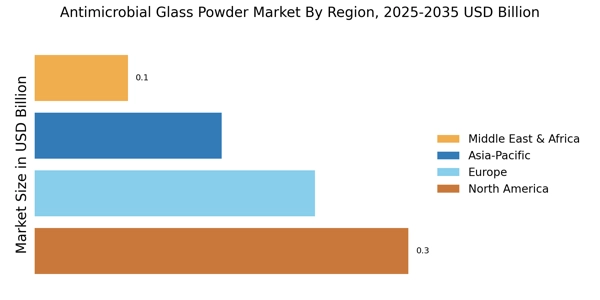
North America is the largest market for antimicrobial glass powder, holding approximately 40% of the global market share. The region's growth is driven by increasing health awareness, stringent regulations on hygiene, and rising demand in healthcare and construction sectors. The U.S. leads this market, supported by advanced manufacturing capabilities and a robust regulatory framework that encourages innovation in materials. Key players such as Corning Inc and Guardian Glass LLC dominate the competitive landscape, leveraging their technological expertise to develop innovative products. The presence of major manufacturers and a growing focus on sustainable materials further enhance market dynamics. Canada also contributes significantly, with a growing emphasis on antimicrobial solutions in various applications, including public spaces and healthcare facilities.

Europe : Regulatory-Driven Market Growth

Europe is the second-largest market for antimicrobial glass powder, accounting for approximately 30% of the global share. The region's growth is propelled by stringent regulations regarding health and safety, particularly in the construction and healthcare sectors. The European Union's focus on sustainable materials and antimicrobial properties in building products is a significant catalyst for market expansion. Leading countries include Germany, France, and the UK, where companies like Schott AG and Saint-Gobain are at the forefront of innovation. The competitive landscape is characterized by a mix of established players and emerging startups focusing on advanced antimicrobial technologies. The region's commitment to sustainability and health standards continues to drive demand for innovative glass solutions.

Asia-Pacific : Rapidly Growing Market Potential

Asia-Pacific is witnessing rapid growth in the antimicrobial glass powder market, holding about 20% of the global share. The region's expansion is driven by increasing urbanization, rising health concerns, and a growing construction industry. Countries like China and Japan are leading this growth, supported by government initiatives promoting hygiene and safety in public spaces and healthcare facilities. China is the largest market in the region, with significant investments in infrastructure and healthcare. Key players such as AGC Inc and Nippon Sheet Glass Co Ltd are actively involved in developing innovative products tailored to local needs. The competitive landscape is evolving, with both domestic and international companies striving to capture market share through technological advancements and strategic partnerships.

Middle East and Africa : Emerging Market with Opportunities

The Middle East and Africa region is emerging as a significant market for antimicrobial glass powder, accounting for approximately 10% of the global share. The growth is driven by increasing awareness of hygiene and safety, particularly in healthcare and hospitality sectors. Countries like the UAE and South Africa are leading this trend, supported by government initiatives aimed at improving public health standards. The competitive landscape is characterized by a mix of local and international players, with companies exploring opportunities in various applications. The presence of key players such as Kuraray Co Ltd is enhancing market dynamics, as they focus on innovative solutions tailored to regional needs. The growing construction sector and rising health concerns are expected to further drive demand for antimicrobial glass products in the coming years.

Antimicrobial Glass Powder Market Regional Image

Key Players and Competitive Insights

The Antimicrobial Glass Powder Market is currently characterized by a dynamic competitive landscape, driven by increasing demand for hygiene and safety in various applications, including healthcare, food packaging, and consumer goods. Key players such as Schott AG (Germany), Corning Inc (US), and AGC Inc (Japan) are strategically positioned to leverage their technological expertise and innovative capabilities. Schott AG (Germany) focuses on enhancing its product portfolio through continuous research and development, while Corning Inc (US) emphasizes partnerships with technology firms to integrate advanced antimicrobial properties into its glass products. AGC Inc (Japan) appears to be concentrating on expanding its manufacturing capabilities to meet rising global demand, thereby shaping a competitive environment that is increasingly reliant on innovation and strategic collaborations.

In terms of business tactics, companies are localizing manufacturing to reduce lead times and optimize supply chains, which is particularly crucial in the context of the global market. The competitive structure of the Antimicrobial Glass Powder Market is moderately fragmented, with several players vying for market share. This fragmentation allows for a diverse range of products and innovations, although the collective influence of major players like Saint-Gobain (France) and Nippon Sheet Glass Co Ltd (Japan) is significant in setting industry standards and driving technological advancements.

In August 2025, Saint-Gobain (France) announced the launch of a new line of antimicrobial glass products specifically designed for the healthcare sector. This strategic move is likely to enhance their market presence and cater to the growing demand for safe and hygienic materials in medical environments. By focusing on this niche, Saint-Gobain positions itself as a leader in specialized applications, potentially increasing its competitive edge.

In September 2025, Corning Inc (US) revealed a partnership with a leading technology firm to develop smart glass solutions that incorporate antimicrobial properties. This collaboration not only signifies Corning's commitment to innovation but also reflects a broader trend towards integrating technology with traditional materials. Such advancements may redefine product offerings and enhance customer value, thereby influencing market dynamics.

In July 2025, AGC Inc (Japan) expanded its production facilities in Southeast Asia to meet the increasing demand for antimicrobial glass in the region. This expansion is indicative of AGC's strategy to localize production and improve supply chain efficiency, which could lead to reduced costs and faster delivery times. Such operational enhancements are essential for maintaining competitiveness in a rapidly evolving market.

As of October 2025, current trends in the Antimicrobial Glass Powder Market are increasingly defined by digitalization, sustainability, and the integration of artificial intelligence in production processes. Strategic alliances among key players are shaping the landscape, fostering innovation and enhancing product offerings. Looking ahead, competitive differentiation is likely to evolve from traditional price-based competition to a focus on technological innovation, supply chain reliability, and sustainable practices, suggesting a transformative shift in how companies approach market challenges.

Key Companies in the Antimicrobial Glass Powder Market market include

Industry Developments

Recent developments in the  Antimicrobial Glass Powder Market reflect a growing trend towards health and hygiene products amid rising consumer awareness. Companies like JIANGSU SUNCHEM and Saint-Gobain are innovating within this sector, focusing on sustainable antimicrobial solutions. Meanwhile, Wienerberger AG and Corning are enhancing their production capabilities to meet increasing demand from sectors like construction and healthcare. There has been notable activity in mergers and acquisitions, with firms looking to expand their market share; for example, Guardian Glass has been actively seeking partnerships to bolster its presence in the antimicrobial segment.

The market valuation for these companies is on an upward trajectory, significantly influencing competitive dynamics and prompting others like Asahi Glass Co and AGC Inc. to explore strategic alliances. Such growth is supported by robust demand across multiple applications, making the antimicrobial glass powder segment an essential focus for innovation and investment among key industry players, including Pittsburgh Glass Works and Schott AG. The continuous evolution in regulatory frameworks concerning health standards also shapes the operational strategies of these companies, driving further advancements within the sector.

Future Outlook

Antimicrobial Glass Powder Market Future Outlook

The Antimicrobial Glass Powder Market is projected to grow at an 8.82% CAGR from 2024 to 2035, driven by increasing demand for hygiene and safety in various applications.

New opportunities lie in:

  • Development of antimicrobial coatings for construction materials
  • Expansion into emerging markets with tailored product offerings
  • Partnerships with healthcare providers for specialized applications

By 2035, the market is expected to achieve substantial growth, solidifying its position in various industries.

Market Segmentation

Antimicrobial Glass Powder Market End Use Outlook

  • Residential
  • Commercial
  • Industrial

Antimicrobial Glass Powder Market Application Outlook

  • Healthcare
  • Food Packaging
  • Construction Materials
  • Household Products

Antimicrobial Glass Powder Market Formulation Type Outlook

  • Powder
  • Granules
  • Coating

Antimicrobial Glass Powder Market Distribution Channel Outlook

  • Online
  • Offline
  • Direct Sales

Report Scope

MARKET SIZE 20240.6701(USD Billion)
MARKET SIZE 20250.7292(USD Billion)
MARKET SIZE 20351.698(USD Billion)
COMPOUND ANNUAL GROWTH RATE (CAGR)8.82% (2024 - 2035)
REPORT COVERAGERevenue Forecast, Competitive Landscape, Growth Factors, and Trends
BASE YEAR2024
Market Forecast Period2025 - 2035
Historical Data2019 - 2024
Market Forecast UnitsUSD Billion
Key Companies ProfiledMarket analysis in progress
Segments CoveredMarket segmentation analysis in progress
Key Market OpportunitiesGrowing demand for sustainable materials drives innovation in the Antimicrobial Glass Powder Market.
Key Market DynamicsRising demand for antimicrobial solutions drives innovation and competition in the antimicrobial glass powder market.
Countries CoveredNorth America, Europe, APAC, South America, MEA

Leave a Comment

FAQs

What is the projected market valuation of the Antimicrobial Glass Powder Market by 2035?

The Antimicrobial Glass Powder Market is projected to reach a valuation of 1.698 USD Billion by 2035.

What was the market valuation of the Antimicrobial Glass Powder Market in 2024?

In 2024, the market valuation of the Antimicrobial Glass Powder Market was 0.6701 USD Billion.

What is the expected CAGR for the Antimicrobial Glass Powder Market during the forecast period 2025 - 2035?

The expected CAGR for the Antimicrobial Glass Powder Market during the forecast period 2025 - 2035 is 8.82%.

Which application segment is projected to have the highest valuation in the Antimicrobial Glass Powder Market?

The Construction Materials application segment is projected to reach a valuation of 0.6 USD Billion by 2035.

How does the Food Packaging segment perform in terms of market valuation?

The Food Packaging segment is expected to grow from 0.15 USD Billion to 0.4 USD Billion by 2035.

What are the key players in the Antimicrobial Glass Powder Market?

Key players in the market include Schott AG, Corning Inc, AGC Inc, and Saint-Gobain.

What formulation type is anticipated to dominate the Antimicrobial Glass Powder Market?

The Powder formulation type is anticipated to dominate, with a projected valuation of 0.6 USD Billion by 2035.

What is the expected market performance of the Residential end-use segment?

The Residential end-use segment is projected to grow from 0.2011 USD Billion to 0.5076 USD Billion by 2035.

How does the distribution channel of Offline sales compare to Online sales in the market?

The Offline distribution channel is expected to grow from 0.2691 USD Billion to 0.6464 USD Billion, surpassing Online sales.

Download Free Sample

Kindly complete the form below to receive a free sample of this Report

Compare Licence

×
Features License Type
Single User Multiuser License Enterprise User
Price $4,950 $ $7,250
Maximum User Access Limit 1 User Upto 10 Users Unrestricted Access Throughout the Organization
Free Customization
Direct Access to Analyst
Deliverable Format
Platform Access
Discount on Next Purchase 10% 15% 15%
Printable Versions