×
Request Free Sample ×

Kindly complete the form below to receive a free sample of this Report

Leading companies partner with us for data-driven Insights

clients tt-cursor
Hero Background

APAC Computer Aided Design Market

ID: MRFR/ICT/56800-HCR
200 Pages
Aarti Dhapte
October 2025

APAC Computer Aided Design Market Research Report By Technology (2D, 3D), By Component (Software, Services), By Development Model (Cloud, On-Premises), By Application (3D Printing, Surface Modelling, Reverse Engineering, Drafting Detailing, Assembly, Others), By End-use Vehicle (Electrical, Electronics, Automotive, Civil, Construction, Energy, Materials, Industrial Equipment, Media, Entertainment, Others), and By Regional (China, India, Japan, South Korea, Malaysia, Thailand, Indonesia, Rest of APAC)- Forecast to 2035

Share:
Download PDF ×

We do not share your information with anyone. However, we may send you emails based on your report interest from time to time. You may contact us at any time to opt-out.

APAC Computer Aided Design Market Infographic
Purchase Options

APAC Computer Aided Design Market Summary

As per MRFR analysis, the APAC computer aided-design market Size was estimated at 2470.0 USD Million in 2024. The APAC computer aided-design market is projected to grow from 2639.2 USD Million in 2025 to 5120.0 USD Million by 2035, exhibiting a compound annual growth rate (CAGR) of 6.85% during the forecast period 2025 - 2035.

Key Market Trends & Highlights

The APAC computer aided-design market is experiencing robust growth driven by technological advancements and regional dynamics.

  • The integration of AI technologies is transforming design processes across the APAC region, particularly in China and India.
  • A notable shift towards cloud solutions is enhancing accessibility and collaboration in design workflows, especially in urban development projects.
  • Sustainable design practices are gaining traction, reflecting a growing awareness of environmental impacts in the manufacturing sector.
  • Rising demand for advanced manufacturing and government initiatives are key drivers propelling the market forward, particularly in China's industrial landscape.

Market Size & Forecast

2024 Market Size 2470.0 (USD Million)
2035 Market Size 5120.0 (USD Million)

Major Players

Autodesk (US), Dassault Systemes (FR), Siemens (DE), PTC (US), Bentley Systems (US), Hexagon (SE), ANSYS (US), ZWSOFT (CN), Bricsys (BE)

APAC Computer Aided Design Market Trends

The computer aided-design market in the APAC region is currently experiencing a dynamic evolution, driven by advancements in technology and increasing demand across various industries. The integration of artificial intelligence and machine learning into design processes appears to enhance efficiency and creativity, allowing designers to produce more innovative solutions. Furthermore, the rise of remote work and collaboration tools has transformed how design teams operate, fostering a more interconnected environment. This shift may lead to a greater emphasis on cloud-based solutions, enabling real-time collaboration and access to design resources from anywhere. In addition, the growing focus on sustainability and eco-friendly practices is influencing the computer aided-design market. Companies are increasingly seeking tools that facilitate sustainable design, which could lead to the development of new software features aimed at reducing environmental impact. As the region continues to invest in infrastructure and technology, the computer aided-design market is likely to expand, offering new opportunities for growth and innovation. The interplay of these factors suggests a vibrant future for the market, characterized by continuous adaptation and responsiveness to emerging trends.

Integration of AI Technologies

The incorporation of artificial intelligence into design software is reshaping workflows within the computer aided-design market. AI tools can automate repetitive tasks, analyze design patterns, and provide predictive insights, which may enhance productivity and creativity among designers.

Shift Towards Cloud Solutions

The transition to cloud-based platforms is becoming increasingly prevalent in the computer aided-design market. This shift allows for improved collaboration among teams, as designers can access and share files in real-time, regardless of their physical location.

Emphasis on Sustainable Design

There is a growing trend towards sustainability within the computer aided-design market. Designers are increasingly prioritizing eco-friendly practices, leading to the development of software that supports sustainable design principles and reduces environmental impact.

APAC Computer Aided Design Market Drivers

Government Initiatives and Support

Government initiatives across APAC are playing a crucial role in propelling the computer aided-design market. Various countries are implementing policies aimed at promoting technological advancements and digital transformation in industries. For instance, initiatives that provide funding and resources for research and development in CAD technologies are becoming increasingly common. In 2025, it is estimated that government funding for technology adoption in manufacturing could reach $2 billion in APAC. Such support not only encourages local businesses to adopt CAD solutions but also attracts foreign investments in the computer aided-design market. This environment fosters innovation and enhances the overall competitiveness of the region's design capabilities.

Increased Investment in Smart Cities

The push towards smart city development in APAC is significantly influencing the computer aided-design market. Governments and private sectors are investing heavily in infrastructure projects that require advanced design capabilities. In 2025, the smart city market in APAC is expected to exceed $1 trillion, creating a substantial demand for CAD solutions that can support urban planning and infrastructure design. This trend necessitates the use of sophisticated modeling and simulation tools to address the complexities of urban environments. As a result, the computer aided-design market is likely to see increased adoption of CAD technologies that cater to the unique challenges posed by smart city initiatives, ultimately driving growth and innovation in the sector.

Integration of IoT in Design Processes

The integration of Internet of Things (IoT) technologies into design processes is emerging as a significant driver for the computer aided-design market in APAC. As industries increasingly adopt IoT solutions, the need for CAD tools that can accommodate real-time data and analytics is becoming paramount. In 2025, the IoT market in APAC is projected to reach $300 billion, indicating a substantial opportunity for CAD providers to develop solutions that leverage IoT capabilities. This integration allows designers to create smarter products that can communicate with other devices, enhancing functionality and user experience. Consequently, the computer aided-design market is likely to evolve, offering innovative tools that support the convergence of design and IoT technologies.

Rising Demand for Advanced Manufacturing

The computer aided-design market in APAC is experiencing a notable surge in demand driven by the advanced manufacturing sector. Industries such as automotive, aerospace, and electronics are increasingly adopting CAD solutions to enhance design precision and efficiency. In 2025, the manufacturing sector in APAC is projected to grow by approximately 6.5%, which is likely to further fuel the need for sophisticated CAD tools. This growth is attributed to the rising complexity of product designs and the necessity for rapid prototyping. As manufacturers seek to streamline their operations and reduce time-to-market, the integration of advanced CAD technologies becomes essential. Consequently, the computer aided-design market is positioned to benefit significantly from this trend, as companies invest in innovative design solutions to maintain competitive advantages.

Growing Focus on Collaborative Design Processes

The computer aided-design market in APAC is witnessing a shift towards collaborative design processes, which is reshaping how teams work on projects. As organizations increasingly adopt remote work and cross-functional teams, the demand for CAD solutions that facilitate collaboration is on the rise. In 2025, it is anticipated that the market for collaborative CAD tools will grow by 8%, reflecting the need for real-time sharing and editing of designs. This trend is particularly evident in industries such as architecture and engineering, where multiple stakeholders are involved in the design process. The computer aided-design market is adapting to these needs by offering solutions that enhance communication and streamline workflows, ultimately leading to more efficient project outcomes.

Market Segment Insights

By Technology: 3D (Largest) vs. 2D (Fastest-Growing)

Within the APAC computer aided-design market, 3D technology currently holds the largest share, representing the predominant choice for professionals across various industries. This preference is largely attributed to its advanced capabilities, which provide enhanced visualization and simulation, making it indispensable in sectors like architecture and engineering. In contrast, 2D technology, while historically significant, is experiencing a surge in adoption, particularly among startups and small businesses seeking cost-effective solutions for design and illustration purposes. Growth trends indicate a robust demand for 3D CAD applications, driven by innovations in virtual and augmented reality, which enhance user experience and project outcomes. Conversely, the 2D segment is repositioning itself as a viable option for entry-level projects and quick design iterations, appealing to a broader audience. The convergence of these technologies is expected to shape the future landscape of design, with 2D gaining traction as a complementary tool to 3D solutions.

Technology: 3D (Dominant) vs. 2D (Emerging)

3D technology in the APAC computer aided-design market is recognized for its comprehensive and realistic design capabilities, empowering users to develop intricate models and simulations easily. This dominant position is driven by its widespread adoption among large enterprises in sectors such as manufacturing, construction, and media. On the other hand, 2D technology is emerging as an essential tool for simpler projects, providing accessibility and ease of use for individuals and small businesses. This segment thrives on rapid output and flexibility, making it popular in graphic design and illustrations. As industry demands evolve, both segments are expected to integrate more closely, leveraging each other's strengths to enhance overall design efficiency.

By Component: Software (Largest) vs. Service (Fastest-Growing)

In the APAC computer aided-design market, the component segment is primarily divided into software and services, with software taking the lead as the largest segment. The preference for digital solutions among design professionals has ensured that software remains the dominant force in this space, capturing a significant share of the overall market. Services, while smaller in share, are rapidly gaining traction as firms look to optimize their existing software implementations and seek expert assistance for effective design processes. Growth in this segment is significantly driven by advancements in technology and an increasing focus on efficiency. The rise of cloud-based design tools has transformed how firms operate, making it easier to collaborate and access powerful design software remotely. Additionally, the growing complexity of projects necessitates expert services, propelling service offerings to emerge as the fastest-growing aspect of the sector. These trends indicate a promising outlook for both software and services in the coming years.

Software (Dominant) vs. Service (Emerging)

Software solutions in the APAC computer aided-design market exhibit dominance due to their comprehensive functionalities and the pivotal role they play in modern design workflows. From 2D drafting to sophisticated 3D modeling, these software tools facilitate a wide array of design needs, making them indispensable for both small firms and large enterprises. On the other hand, the service aspect is emerging as businesses increasingly seek specialized support to maximize their software investments. This includes training, maintenance, and consulting services that enhance user experience and productivity. As such, while software remains the dominant force, services are progressively carving out a significant niche, focusing on tailored solutions to meet specific design requirements.

By Development Model: Cloud (Largest) vs. On-Premises (Fastest-Growing)

In the APAC computer aided-design market, the distribution of market share between the development models reveals a clear dominance of cloud-based solutions. These platforms appeal to a diverse range of users due to their scalability, ease of access, and lower upfront costs. Meanwhile, on-premises solutions, while traditionally favored, are witnessing a gradual decline in market share as organizations increasingly shift towards more flexible cloud alternatives. Growth trends indicate that on-premises models are becoming the fastest-growing segment in response to specific industry needs. Factors driving this growth include enhanced security protocols, customization capabilities, and the control that businesses seek over their data. As companies recognize the importance of both security and customization, the demand for on-premises solutions is expected to rise significantly in the coming years.

Cloud (Dominant) vs. On-Premises (Emerging)

Cloud-based solutions currently dominate the development model segment, providing significant advantages such as flexibility, rapid deployment, and collaborative capabilities. Organizations favor these solutions for real-time access to designs and enhanced collaboration across teams. On the other hand, on-premises solutions are emerging as a strong alternative for companies requiring greater control and security of their sensitive data. These solutions are often tailored for industries that handle proprietary information, making them appealing to sectors such as manufacturing and pharmaceuticals. As the market evolves, both segments will continue to coexist, catering to different organizational needs and driving innovations in the computer aided-design landscape.

By Application: 3D Printing (Largest) vs. Surface Modelling (Fastest-Growing)

In the Application segment, 3D Printing dominates with the largest market share, driven by increasing adoption across various industries such as manufacturing, healthcare, and automotive. Surface Modelling also holds significant value, representing a critical component for design accuracy and efficiency in product development. Other applications like Reverse Engineering and Drafting Detailing contribute to the segment but maintain smaller shares in the overall market distribution. Growth in this segment is propelled by the need for innovation and rapid prototyping in product development. Companies are investing in advanced design tools that facilitate seamless collaboration and efficiency, thereby boosting the demand for computer-aided design solutions. Key drivers include the rise of smart manufacturing and the integration of AI and machine learning in design processes, positioning Surface Modelling as a rapidly evolving area in the market.

3D Printing (Dominant) vs. Assembly (Emerging)

3D Printing stands out as the dominant application, redefining manufacturing processes by enabling rapid prototyping and customization of products. This technology allows for complex geometries that traditional methods cannot achieve, offering significant advantages in terms of material conservation and cost-effectiveness. In contrast, Assembly is viewed as an emerging application, gaining traction as companies seek to optimize their assembly line efficiency through advanced modeling tools. As automated systems and robotics continue to enhance productivity, the role of Assembly in the design process becomes increasingly pivotal, fostering innovation and responsiveness to market demands.

By End Use Vertical: Electrical And Electronics (Largest) vs. Automotive (Fastest-Growing)

In the APAC computer aided-design market, Electrical and Electronics dominate the end use vertical, capturing a significant market share. This segment benefits from the rapid advancement of technology and an increased focus on efficient design practices. In contrast, the Automotive sector, while currently smaller, is showing substantial growth driven by the rise of electric vehicles and the need for innovative design solutions to meet regulatory standards. The growth trends within these segments are influenced by several factors, including technological advancements, increased investment in infrastructure, and a growing demand for automation in manufacturing processes. The Electrical and Electronics sector is witnessing steady demand as smart devices proliferate, while the Automotive industry is evolving rapidly with advancements in CAD tools to innovate and design electric and autonomous vehicles. Both sectors play critical roles in driving forward the capabilities of computer-aided design.

Electrical And Electronics (Dominant) vs. Automotive (Emerging)

The Electrical and Electronics segment is a cornerstone of the APAC computer aided-design market, characterized by its robust demand for innovative design solutions that enhance product efficiency and functionality. This segment thrives on continuous technological advancements and automation trends, leading to increased productivity and reduced time-to-market for electronic products. On the other hand, the Automotive sector is emerging as a vital player, propelled by the growing shift towards electric vehicles and smart automotive technologies. This sector's demand for advanced CAD tools to facilitate complex designs indicates significant growth potential. Both segments contribute uniquely to the overall market landscape, with Electrical and Electronics currently leading while Automotive positions itself for rapid expansion.

Get more detailed insights about APAC Computer Aided Design Market

Regional Insights

China : Unmatched Growth and Innovation

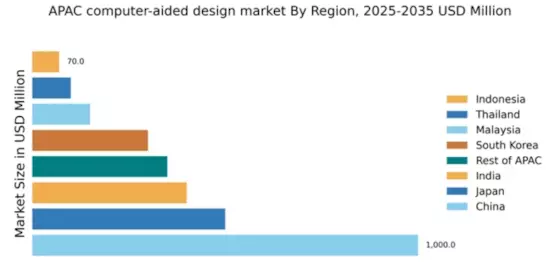
China holds a commanding 40% market share in the APAC CAD market, valued at $1000.0 million. Key growth drivers include rapid industrialization, increased investment in infrastructure, and a booming manufacturing sector. The demand for advanced design software is fueled by the government's push for smart manufacturing and digital transformation initiatives. Regulatory policies favoring technology adoption further enhance market potential, while significant infrastructure projects create a robust demand for CAD solutions.

India : Rapid Growth in Design Solutions

India accounts for an 8% market share, valued at $400.0 million in the CAD sector. The growth is driven by the expanding IT and engineering services industry, alongside increasing adoption of CAD tools in sectors like automotive and construction. Government initiatives like 'Make in India' promote local manufacturing, enhancing demand for CAD solutions. The rise of startups and tech hubs in cities like Bengaluru and Hyderabad further fuels consumption patterns.

Japan : Precision and Quality in Design

Japan holds a 10% market share, valued at $500.0 million, characterized by a strong emphasis on precision engineering and quality. The growth is driven by advancements in robotics and automation, with CAD tools being integral to these sectors. Government policies supporting R&D in technology and manufacturing bolster market demand. The aging population also drives innovation in healthcare design applications, creating new opportunities for CAD solutions.

South Korea : Tech-Driven Design Solutions

South Korea captures a 6% market share, valued at $300.0 million, with a focus on high-tech industries such as electronics and automotive. The growth is propelled by strong government support for technology innovation and smart city initiatives. Demand for CAD solutions is rising in urban development projects, with cities like Seoul leading the charge. Major players like Samsung and LG are significant users of CAD tools, enhancing the competitive landscape.

Malaysia : Strategic Location for Design Firms

Malaysia holds a 3% market share, valued at $150.0 million, with growth driven by the expanding manufacturing sector and government initiatives to attract foreign investment. The demand for CAD solutions is increasing in industries such as construction and electronics. The government's focus on developing the digital economy supports infrastructure improvements, enhancing the business environment for CAD providers. Key markets include Kuala Lumpur and Penang, which are tech hubs.

Thailand : Manufacturing and Design Synergy

Thailand accounts for a 2% market share, valued at $100.0 million, with growth driven by the automotive and electronics sectors. The government’s 'Thailand 4.0' initiative promotes innovation and technology adoption, boosting demand for CAD solutions. Key cities like Bangkok and Chonburi are central to this growth, with a competitive landscape featuring both local and international players. The focus on smart manufacturing enhances the local business environment.

Indonesia : Investment in Infrastructure Development

Indonesia holds a 1.4% market share, valued at $70.0 million, with growth driven by significant investments in infrastructure and urban development. The demand for CAD solutions is increasing in construction and manufacturing sectors, supported by government initiatives to improve connectivity and industrial capabilities. Key markets include Jakarta and Surabaya, where local players are emerging alongside international firms, creating a competitive landscape.

Rest of APAC : Varied Growth Across Sub-regions

The Rest of APAC accounts for a 7% market share, valued at $350.0 million, with diverse growth driven by varying industrial needs. Countries like Vietnam and the Philippines are witnessing increased CAD adoption in manufacturing and construction. Government policies promoting technology and infrastructure development enhance market potential. The competitive landscape features both local and international players, catering to sector-specific applications across the region.

APAC Computer Aided Design Market Regional Image

Key Players and Competitive Insights

The computer aided-design market is currently characterized by a dynamic competitive landscape, driven by rapid technological advancements and increasing demand for efficient design solutions across various industries. Key players such as Autodesk (US), Dassault Systemes (FR), and Siemens (DE) are at the forefront, each adopting distinct strategies to enhance their market positioning. Autodesk (US) focuses on innovation through cloud-based solutions, enabling collaborative design processes, while Dassault Systemes (FR) emphasizes digital transformation and sustainability in its offerings. Siemens (DE) is leveraging its expertise in automation and digitalization to integrate CAD with broader manufacturing processes, thereby enhancing operational efficiency. Collectively, these strategies contribute to a competitive environment that is increasingly centered around technological integration and customer-centric solutions.

In terms of business tactics, companies are increasingly localizing manufacturing and optimizing supply chains to respond to regional demands effectively. The market structure appears moderately fragmented, with several players vying for market share, yet the influence of major companies remains substantial. This competitive structure fosters innovation and encourages smaller firms to differentiate themselves through niche offerings, thereby enriching the overall market landscape.

In October 2025, Autodesk (US) announced a strategic partnership with a leading AI firm to enhance its design software capabilities. This collaboration aims to integrate advanced AI algorithms into Autodesk's platforms, potentially revolutionizing the design process by automating routine tasks and providing predictive analytics. Such a move underscores Autodesk's commitment to maintaining its competitive edge through technological innovation and aligns with broader industry trends towards AI integration.

In September 2025, Dassault Systemes (FR) launched a new sustainability initiative aimed at reducing the carbon footprint of its design processes. This initiative includes the development of tools that allow users to simulate the environmental impact of their designs in real-time. The strategic importance of this move lies in its alignment with global sustainability goals, positioning Dassault Systemes as a leader in environmentally conscious design solutions, which is increasingly becoming a critical factor for clients.

In August 2025, Siemens (DE) expanded its digital twin technology offerings, enhancing its CAD solutions to include more robust simulation capabilities. This expansion is significant as it allows clients to visualize and optimize their designs in a virtual environment before physical production, thereby reducing costs and time-to-market. Siemens' focus on integrating CAD with IoT and automation technologies reflects a broader trend towards digitalization in manufacturing, further solidifying its competitive position.

As of November 2025, the competitive trends in the computer aided-design market are heavily influenced by digitalization, sustainability, and AI integration. Strategic alliances are increasingly shaping the landscape, as companies recognize the need for collaborative innovation to meet evolving customer demands. Looking ahead, competitive differentiation is likely to shift from traditional price-based competition to a focus on innovation, technological advancement, and supply chain reliability. This evolution suggests that companies that prioritize these aspects will be better positioned to thrive in an increasingly complex market.

Key Companies in the APAC Computer Aided Design Market market include

Industry Developments

The APAC Computer Aided Design Market has been experiencing significant developments recently, with notable growth attributed to increasing demand for advanced design solutions across various industries. Companies like Altium and Autodesk have reported substantial gains in market valuation, driven by the integration of cloud-based solutions and enhanced functionalities in their platforms.

In September 2023, PTC expanded its capabilities by acquiring several assets that focus on IoT, strengthening its position in the APAC region. Additionally, in August 2023, Siemens announced a collaboration with Schneider Electric aimed at enhancing digital twin technology in infrastructure projects throughout Asia-Pacific.

Amidst this growth, Hexagon focused on local partnerships to cater to region-specific design requirements, while Bentley Systems is investing in the development of sustainability features in its offerings.

The market has seen strong adoption of CAD solutions, with ZWCAD reporting a year-over-year increase in user base, especially in emerging economies. Overall, the APAC Computer Aided Design Market continues to evolve, benefiting from technological advancements and shifting market demands, reflected in ongoing investments and partnerships by key players in the sector.

Future Outlook

APAC Computer Aided Design Market Future Outlook

The computer aided-design market is projected to grow at a 6.85% CAGR from 2024 to 2035, driven by technological advancements and increasing demand for automation.

New opportunities lie in:

  • Development of AI-driven design tools for enhanced efficiency.
  • Expansion of cloud-based CAD solutions for remote collaboration.
  • Integration of AR/VR technologies in design processes for immersive experiences.

By 2035, the market is expected to achieve substantial growth, reflecting evolving industry needs.

Market Segmentation

APAC Computer Aided Design Market Component Outlook

  • Software
  • Service

APAC Computer Aided Design Market Technology Outlook

  • 2D
  • 3D

APAC Computer Aided Design Market Application Outlook

  • 3D Printing
  • Surface Modelling
  • Reverse Engineering
  • Drafting Detailing
  • Assembly
  • Others

APAC Computer Aided Design Market End Use Vertical Outlook

  • Electrical And Electronics
  • Automotive
  • Civil And Construction
  • Energy And Materials
  • Industrial Equipment
  • Media And Entertainment
  • Others

APAC Computer Aided Design Market Development Model Outlook

  • Cloud
  • On-Premises

Report Scope

MARKET SIZE 2024 2470.0(USD Million)
MARKET SIZE 2025 2639.2(USD Million)
MARKET SIZE 2035 5120.0(USD Million)
COMPOUND ANNUAL GROWTH RATE (CAGR) 6.85% (2024 - 2035)
REPORT COVERAGE Revenue Forecast, Competitive Landscape, Growth Factors, and Trends
BASE YEAR 2024
Market Forecast Period 2025 - 2035
Historical Data 2019 - 2024
Market Forecast Units USD Million
Key Companies Profiled ["Autodesk (US)", "Dassault Systemes (FR)", "Siemens (DE)", "PTC (US)", "Bentley Systems (US)", "Hexagon (SE)", "ANSYS (US)", "ZWSOFT (CN)", "Bricsys (BE)"]
Segments Covered Technology, Component, Development Model, Application, End Use Vertical
Key Market Opportunities Integration of artificial intelligence in the computer aided-design market enhances design efficiency and innovation.
Key Market Dynamics Rising demand for advanced computer aided-design tools drives innovation and competition in the APAC market.
Countries Covered China, India, Japan, South Korea, Malaysia, Thailand, Indonesia, Rest of APAC

Leave a Comment

FAQs

What is the projected market size of the APAC Computer Aided Design Market by 2024?

The APAC Computer Aided Design Market is expected to be valued at 2.77 USD Billion by 2024.

What is the expected CAGR for the APAC Computer Aided Design Market from 2025 to 2035?

The expected CAGR for the APAC Computer Aided Design Market from 2025 to 2035 is 6.009%.

Which region is expected to have the highest market value in the APAC Computer Aided Design Market by 2035?

By 2035, China is projected to have the highest market value at 1.85 USD Billion.

What will be the market value for 2D technology in the APAC Computer Aided Design Market by 2035?

The market value for 2D technology is expected to reach 2.45 USD Billion by 2035.

Which key players are significant in the APAC Computer Aided Design Market?

Major players in the market include Autodesk, PTC, Siemens, and Bentley Systems.

What will be the market value for 3D technology in the APAC Computer Aided Design Market by 2035?

The market for 3D technology is anticipated to grow to 2.81 USD Billion by 2035.

How much is the APAC Computer Aided Design Market valued in India for the year 2024?

The APAC Computer Aided Design Market in India is valued at 0.73 USD Billion for the year 2024.

What will be the projected market growth in Japan from 2024 to 2035?

Japan's market is expected to grow from 0.51 USD Billion in 2024 to 1.06 USD Billion by 2035.

What challenges are currently impacting the APAC Computer Aided Design Market?

The market faces challenges including rapid technological advancements and evolving customer demands.

What are the key applications driving the growth of the APAC Computer Aided Design Market?

Key applications driving growth include architecture, engineering, and product design.

Download Free Sample

Kindly complete the form below to receive a free sample of this Report

Compare Licence

×
Features License Type
Single User Multiuser License Enterprise User
Price $4,950 $5,950 $7,250
Maximum User Access Limit 1 User Upto 10 Users Unrestricted Access Throughout the Organization
Free Customization
Direct Access to Analyst
Deliverable Format
Platform Access
Discount on Next Purchase 10% 15% 15%
Printable Versions