×
Request Free Sample ×

Kindly complete the form below to receive a free sample of this Report

* Please use a valid business email

Leading companies partner with us for data-driven Insights

clients tt-cursor
Hero Background

Electrical Electronic Computer Aided Design Market

ID: MRFR/ICT/8828-CR
141 Pages
Aarti Dhapte
November 2020

Electrical and Electronic Computer-Aided Design Market Research Report Information By Component (Software and Services), Industry Type (Process Industry and Discrete Industry), Application (Industrial Machine Controls, Plant Design, Mining Equipment Control, Rail Signaling, Switchgear Design, Water Treatment and Distribution System Control and Others), Vertical (Automotive, Plant Design, Aerospace, Defense, Construction, Railway, Power Generation Equipment and Machinery, Oil & Gas, Food & Beverage, Energy) - Forecast till 2035

Share:
Download PDF ×

We do not share your information with anyone. However, we may send you emails based on your report interest from time to time. You may contact us at any time to opt-out.

Electrical Electronic Computer Aided Design Market Infographic
Purchase Options

Electrical Electronic Computer Aided Design Market Summary

As per MRFR analysis, the Electrical Electronic Computer Aided Design Market Size was estimated at 3240.0 USD Million in 2024. The Electrical Electronic Computer Aided Design industry is projected to grow from 3460.0 in 2025 to 7400.0 by 2035, exhibiting a compound annual growth rate (CAGR) of 7.88 during the forecast period 2025 - 2035.

Key Market Trends & Highlights

The Electrical Electronic Computer Aided Design Market is poised for substantial growth driven by technological advancements and evolving industry needs.

  • The integration of AI in design processes is transforming workflows across various sectors, enhancing efficiency and creativity.
  • Sustainability remains a focal point, with companies increasingly prioritizing eco-friendly practices in their design methodologies.
  • Collaboration and interoperability are becoming essential, particularly in the North American market, to streamline project execution and improve outcomes.
  • The rising demand for advanced design tools and the increased adoption of IoT and smart devices are key drivers propelling growth in the automotive and consumer electronics segments.

Market Size & Forecast

2024 Market Size 3240.0 (USD Million)
2035 Market Size 7400.0 (USD Million)
CAGR (2025 - 2035) 7.88%

Major Players

Autodesk (US), Siemens (DE), Dassault Systemes (FR), PTC (US), ANSYS (US), Altium (AU), Mentor Graphics (US), Cadence Design Systems (US), Zuken (JP)

Electrical Electronic Computer Aided Design Market Trends

The Electrical Electronic Computer Aided Design Market is currently experiencing a transformative phase, driven by advancements in technology and increasing demand for efficient design solutions. As industries evolve, the need for sophisticated design tools that enhance productivity and accuracy becomes paramount. This market encompasses a wide range of applications, including circuit design, PCB layout, and system modeling, which are essential for various sectors such as automotive, aerospace, and consumer electronics. The integration of artificial intelligence and machine learning into design processes is reshaping how engineers and designers approach their work, potentially leading to faster development cycles and improved product quality. Moreover, the growing emphasis on sustainability and energy efficiency is influencing the direction of the Electrical Electronic Computer Aided Design Market. Companies are increasingly seeking solutions that not only meet performance standards but also adhere to environmental regulations. This shift is prompting the development of innovative tools that facilitate eco-friendly design practices. As the market continues to expand, collaboration among software developers, hardware manufacturers, and end-users is likely to foster a more interconnected ecosystem, enhancing the overall effectiveness of design processes across various industries.

Integration of AI in Design Processes

The incorporation of artificial intelligence into design workflows is becoming more prevalent. This trend suggests that AI can optimize design tasks, automate repetitive processes, and provide predictive analytics, thereby enhancing overall efficiency.

Focus on Sustainability

There is a noticeable shift towards sustainable design practices within the Electrical Electronic Computer Aided Design Market. Companies are increasingly prioritizing eco-friendly solutions, which may lead to the development of tools that support energy-efficient designs.

Collaboration and Interoperability

The trend towards enhanced collaboration among different stakeholders in the design process is emerging. Improved interoperability between various software platforms could facilitate seamless communication and data sharing, ultimately streamlining workflows.

Electrical Electronic Computer Aided Design Market Drivers

Emergence of 5G Technology

The emergence of 5G technology is poised to reshape the Global Electrical and Electronic Computer-Aided Design Market Industry. With its promise of faster data transmission and enhanced connectivity, 5G is driving the development of next-generation electronic devices that require advanced design capabilities. CAD tools are essential for engineers to create designs that can leverage the benefits of 5G, such as improved performance and reduced latency. As industries adopt 5G solutions, the demand for sophisticated CAD applications is likely to increase, further propelling market growth in the coming years.

Growing Focus on Sustainability

Sustainability has become a critical driver in the Global Electrical and Electronic Computer-Aided Design Market Industry. As environmental concerns rise, companies are increasingly prioritizing eco-friendly design practices. CAD tools that facilitate sustainable design, such as energy-efficient simulations and material optimization, are gaining traction. This shift is evident as organizations aim to reduce their carbon footprint and comply with stringent regulations. The market's evolution towards sustainability is likely to influence product development and design methodologies, ensuring that future electronic products are not only innovative but also environmentally responsible.

Expansion of the Automotive Sector

The automotive sector's expansion significantly impacts the Global Electrical and Electronic Computer-Aided Design Market Industry. With the rise of electric vehicles and autonomous driving technologies, there is an increasing demand for advanced design tools that can accommodate complex electronic systems. CAD solutions are essential for developing innovative automotive designs, ensuring safety, and enhancing performance. As the automotive industry continues to evolve, the need for specialized CAD applications tailored to automotive electronics is expected to grow, further driving market expansion. This trend underscores the importance of CAD in meeting the unique challenges posed by modern automotive engineering.

Integration of AI and Machine Learning

The integration of artificial intelligence and machine learning into the Global Electrical and Electronic Computer-Aided Design Market Industry is transforming design processes. These technologies enable designers to automate repetitive tasks, optimize designs, and predict potential issues before they arise. As a result, companies can achieve higher levels of efficiency and innovation. The adoption of AI-driven CAD tools is anticipated to accelerate, as organizations seek to leverage data analytics for better decision-making. This trend not only enhances productivity but also aligns with the industry's growth trajectory, with a projected CAGR of 7.16% from 2025 to 2035.

Rising Demand for Advanced Electronic Products

The Global Electrical and Electronic Computer-Aided Design Market Industry experiences a surge in demand for advanced electronic products, driven by the proliferation of smart devices and IoT applications. As industries increasingly adopt automation and smart technologies, the need for sophisticated design tools becomes paramount. In 2024, the market is projected to reach 3.21 USD Billion, reflecting the industry's response to these technological advancements. Companies are investing in CAD solutions that enhance design efficiency, reduce time-to-market, and improve product quality. This trend is likely to continue, as the market is expected to grow significantly, reaching 6.87 USD Billion by 2035.

Market Segment Insights

By Application: Product Design (Largest) vs. Testing (Fastest-Growing)

In the Electrical Electronic Computer Aided Design Market, the application segment is predominantly driven by product design, which holds the largest share in terms of market value. Product design is essential for creating innovative and competitive electronic products, leading to significant investment and demand. Following closely is testing, which has emerged as the fastest-growing value in this segment, attributed to the increasing need for quality assurance and compliance in electronic design processes. Growth trends in the application segment are influenced by various factors, including advancements in technology and the increasing complexity of electronic systems. The rising importance of simulation tools also complements product design, as they allow engineers to visualize and evaluate designs before physical production. Consequently, testing is witnessing a surge as a vital phase in the design process, ensuring reliability and compliance with industry standards.

Product Design: Dominant vs. Testing: Emerging

Product design in the Electrical Electronic Computer Aided Design Market is characterized by its critical role in the innovation cycle of electronic components. This segment focuses on the development of cutting-edge designs that meet rapidly changing consumer and industry demands. It drives significant investments in research and development, capturing major market share. In contrast, testing has become an emerging application, reflecting a shift towards rigorous quality control and validation protocols. As electronic devices evolve, the complexity of design necessitates comprehensive testing to ensure functionality and safety. This segment is gaining traction as manufacturers invest in advanced testing methodologies to prevent failures, indicating a robust and growing trend that underpins the entire design process.

By End Use Industry: Automotive (Largest) vs. Consumer Electronics (Fastest-Growing)

In the Electrical Electronic Computer Aided Design (ECAD) market, the automotive industry holds the largest share, driven by a surge in demand for advanced vehicle technologies and electronic systems. As vehicles incorporate more sophisticated electronics, the need for advanced design tools has grown, securing a significant portion of the market for automotive applications. In contrast, the consumer electronics sector is rapidly emerging with impressive growth, fueled by ongoing innovations in devices and the increasing adoption of smart technologies.

Automotive: Dominant vs. Consumer Electronics: Emerging

The automotive sector in the ECAD market is characterized by its adoption of cutting-edge design tools needed for developing electronic components in modern vehicles, including EVs and hybrid models. This industry leverages ECAD solutions to enhance productivity and accuracy in designing intricate electronic systems. On the other hand, the consumer electronics segment is witnessing rapid expansion, driven by the explosive demand for smart devices and IoT applications. This segment is focused on agile design workflows, allowing for quick iteration and adaptation to new technological trends, making it a vibrant area for emerging technologies and innovative designs.

By Deployment Type: Cloud-Based (Largest) vs. On-Premises (Fastest-Growing)

The deployment type segment in the Electrical Electronic Computer Aided Design Market reflects a dynamic distribution of market share. The cloud-based solution currently dominates the market, driven by its scalability, flexibility, and cost-effectiveness. Companies are increasingly moving towards cloud-based systems to take advantage of the reduced infrastructure costs and enhanced collaboration capabilities they offer. This segment has attracted significant user adoption, particularly among small to medium-sized enterprises looking for accessible design solutions. In contrast, on-premises deployment is experiencing a resurgence, being labeled the fastest-growing segment in this sector. Despite the initial investment required, many organizations are returning to on-premises solutions due to the perceived control and security benefits. As data privacy concerns rise, the demand for on-premises deployment solutions is expected to grow steadily, complementing the cloud-based paradigm.

Cloud-Based (Dominant) vs. On-Premises (Emerging)

Cloud-based deployment in the Electrical Electronic Computer Aided Design Market has firmly established itself as the dominant solution, favored for its operational efficiency and remote access capabilities. It allows users to collaborate seamlessly across geographies, essential in today’s globalized work environment. Meanwhile, on-premises deployment is emerging as a valid alternative, particularly among industries that prioritize data security and compliance. Firms implementing on-premises solutions often invest in robust infrastructure to manage their design processes internally, ensuring data integrity and control. This comparative analysis highlights the shifting dynamics of deployment preferences, where organizations balance the need for efficiency with compliance and control.

By Software Type: 3D CAD Software (Largest) vs. 2D CAD Software (Fastest-Growing)

In the Electrical Electronic Computer Aided Design Market, the market share distribution among software types showcases a significant preference for 3D CAD Software, which leads the sector due to its advanced capabilities and integration potential. Following closely is 2D CAD Software, which remains popular for simpler tasks, yet it is increasingly praised for its cost-effectiveness and ease of use. Electrical and Mechanical CAD Software also play critical roles but command a smaller share compared to the dynamic 3D segment.

Software Type: 3D CAD (Dominant) vs. 2D CAD (Emerging)

3D CAD Software is the dominant force in the Electrical Electronic Computer Aided Design Market, leveraging its sophisticated modeling capabilities to serve industries ranging from automotive to architecture. Its integration with emerging technologies like augmented reality enhances design precision and collaboration. In contrast, 2D CAD Software is emerging, favored for its simplicity and lower costs, appealing to startups and smaller enterprises. While it lacks the advanced features of 3D counterparts, its quick adoption in user-friendly interfaces and basic design tasks marks its growing relevance in a competitive landscape.

By User Type: Small and Medium Enterprises (Largest) vs. Large Enterprises (Fastest-Growing)

The user type segment in the Electrical Electronic Computer Aided Design Market showcases a diverse distribution of market share among Individual Users, Small and Medium Enterprises (SMEs), and Large Enterprises. SMEs represent the largest share of the market, driven by the increasing affordability and accessibility of CAD software solutions. Individual Users also hold a significant portion, catering to freelance designers and hobbyists, while the Large Enterprises segment, though smaller in share, is rapidly gaining traction due to high-end software requirements in complex projects. Growth trends in this segment are influenced by several factors, including the proliferation of cloud-based CAD solutions, which are particularly appealing to SMEs looking for cost-effective options. Large Enterprises are focusing on upgrading their systems with advanced features like AI integration, enhancing productivity. Meanwhile, Individual Users are increasingly adopting user-friendly CAD tools, driven by an upsurge in remote work and personal projects, contributing to a dynamic market landscape.

Small and Medium Enterprises (Dominant) vs. Large Enterprises (Emerging)

Small and Medium Enterprises currently dominate the Electrical Electronic Computer Aided Design Market, characterized by their adaptability and cost-effective strategies. These businesses leverage flexible pricing models and tailored software packages, ensuring a fit for a range of project sizes and industries. Furthermore, SMEs greatly benefit from advancements in cloud technologies, allowing for collaborative efforts and real-time project updates that enhance productivity. Conversely, Large Enterprises, although emerging in this sector, are increasingly focusing on robust, integrated CAD solutions to handle complex designs. They invest significantly in technology to ensure compliance, efficiency, and innovation, making them a formidable player in the market as they seek to optimize their vast resources in design processes.

Get more detailed insights about Electrical Electronic Computer Aided Design Market

Regional Insights

North America : Leading Innovation and Growth

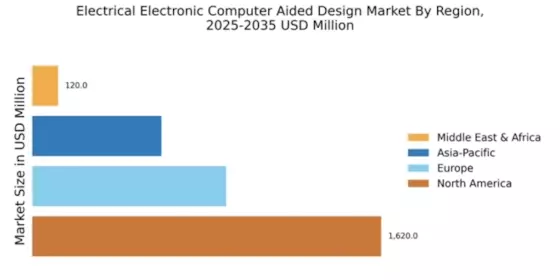
North America continues to lead the Electrical Electronic Computer Aided Design (EE CAD) market, holding a significant share of 1620.0 million. The region's growth is driven by rapid technological advancements, increasing demand for automation, and a strong focus on R&D. Regulatory support for innovation and sustainability further catalyzes market expansion, making it a hub for cutting-edge design solutions. The competitive landscape is robust, with key players like Autodesk, Siemens, and ANSYS dominating the market. The U.S. stands out as a leader, supported by a strong infrastructure and a skilled workforce. The presence of major companies fosters a collaborative environment, enhancing innovation and driving market growth. As the demand for advanced design tools rises, North America is poised to maintain its leadership position in the EE CAD market.

Europe : Emerging Market with Potential

Europe's Electrical Electronic Computer Aided Design market is valued at 900.0 million, reflecting a growing trend towards digital transformation across industries. The region is witnessing increased investments in technology and innovation, driven by regulatory frameworks that promote sustainability and efficiency. The demand for advanced design tools is on the rise, particularly in sectors like automotive and aerospace, which are pivotal to the European economy. Leading countries such as Germany, France, and the UK are at the forefront of this growth, with a strong presence of key players like Siemens and Dassault Systemes. The competitive landscape is characterized by a mix of established firms and emerging startups, fostering innovation. As Europe continues to embrace digital solutions, the EE CAD market is expected to expand significantly, supported by favorable regulations and a skilled workforce.

Asia-Pacific : Rapidly Growing Market

The Asia-Pacific region, valued at 600.0 million, is experiencing rapid growth in the Electrical Electronic Computer Aided Design market. This surge is driven by increasing industrialization, urbanization, and a growing emphasis on technological innovation. Countries in this region are investing heavily in infrastructure and manufacturing, which is propelling the demand for advanced design tools and solutions. Regulatory initiatives aimed at enhancing productivity and efficiency further support this growth trajectory. China, Japan, and India are leading the charge in this market, with significant contributions from local and international players. Companies like Zuken and Altium are making strides in the region, enhancing competition and innovation. As the demand for sophisticated design solutions continues to rise, the Asia-Pacific market is set to become a key player in the global EE CAD landscape, driven by a dynamic and evolving industrial base.

Middle East and Africa : Emerging Opportunities Ahead

The Middle East and Africa region, with a market size of 120.0 million, presents emerging opportunities in the Electrical Electronic Computer Aided Design sector. The growth is primarily driven by increasing investments in infrastructure and technology, alongside a rising demand for automation in various industries. Regulatory frameworks are gradually evolving to support technological advancements, which is crucial for market expansion in this region. Countries like South Africa and the UAE are leading the way, with a growing number of local and international players entering the market. The competitive landscape is still developing, but the presence of key players is beginning to shape the industry. As the region continues to invest in technology and innovation, the EE CAD market is expected to grow, driven by both local demand and international partnerships.

Key Players and Competitive Insights

The Electrical Electronic Computer Aided Design Market is characterized by a dynamic competitive landscape, driven by rapid technological advancements and increasing demand for efficient design solutions. Key players such as Autodesk (US), Siemens (DE), and Dassault Systemes (FR) are at the forefront, each adopting distinct strategies to enhance their market positioning. Autodesk (US) focuses on innovation through cloud-based solutions, enabling collaborative design processes, while Siemens (DE) emphasizes digital transformation and integration of IoT technologies into its offerings. Dassault Systemes (FR) leverages its strong portfolio in 3D modeling and simulation to cater to diverse industries, thereby shaping a competitive environment that prioritizes technological sophistication and user-centric solutions.

The market structure appears moderately fragmented, with a blend of established players and emerging companies vying for market share. Key business tactics include localizing manufacturing to reduce costs and optimize supply chains, which is crucial in maintaining competitive pricing. The collective influence of these major players fosters a competitive atmosphere where innovation and operational efficiency are paramount, allowing them to respond adeptly to market demands.

In November 2025, Autodesk (US) announced a strategic partnership with a leading AI firm to enhance its design software capabilities. This collaboration aims to integrate advanced AI algorithms into Autodesk's platforms, potentially revolutionizing the design process by automating routine tasks and providing predictive analytics. Such a move underscores Autodesk's commitment to remaining at the cutting edge of technology and meeting the evolving needs of its users.

In October 2025, Siemens (DE) unveiled a new suite of digital twin solutions aimed at optimizing product lifecycle management. This initiative is significant as it aligns with the growing trend of digitalization in engineering, allowing companies to simulate and analyze product performance in real-time. By enhancing its digital offerings, Siemens positions itself as a leader in the integration of digital technologies within the design process.

In September 2025, Dassault Systemes (FR) expanded its cloud-based platform to include enhanced collaboration tools for remote teams. This strategic enhancement is particularly relevant in the current market, where remote work has become increasingly prevalent. By facilitating seamless collaboration, Dassault Systemes strengthens its value proposition, catering to the needs of modern design teams.

As of December 2025, the competitive trends in the Electrical Electronic Computer Aided Design Market are increasingly defined by digitalization, sustainability, and AI integration. Strategic alliances among key players are shaping the landscape, fostering innovation and enhancing product offerings. The shift from price-based competition to a focus on technological advancement and supply chain reliability is evident, suggesting that future competitive differentiation will hinge on the ability to innovate and adapt to changing market dynamics.

Key Companies in the Electrical Electronic Computer Aided Design Market market include

Industry Developments

The product lifestyle management suite has been developed recently which comes along the help guidelines to assist the engineers and bring out the suitable designs for their equipment.

The cutting-edge technology and cloud-based technology have increased the value of the existing ECAD tools. Also, the 3D printers being used for the construction department helps the builders to construct the apartment blocks before investing. Such trends have been helping in building residential units in highly populated areas.

Future Outlook

Electrical Electronic Computer Aided Design Market Future Outlook

The Electrical Electronic Computer Aided Design Market is projected to grow at a 7.88% CAGR from 2024 to 2035, driven by technological advancements and increasing demand for automation.

New opportunities lie in:

  • Integration of AI-driven design tools for enhanced efficiency.
  • Development of cloud-based CAD solutions for remote collaboration.
  • Expansion into emerging markets with tailored software solutions.

By 2035, the market is expected to achieve robust growth, solidifying its position as a leader in design technology.

Market Segmentation

Electrical Electronic Computer Aided Design Market User Type Outlook

  • Individual Users
  • Small and Medium Enterprises
  • Large Enterprises

Electrical Electronic Computer Aided Design Market Application Outlook

  • Product Design
  • Simulation
  • Testing
  • Manufacturing
  • Maintenance

Electrical Electronic Computer Aided Design Market Software Type Outlook

  • 2D CAD Software
  • 3D CAD Software
  • Electrical CAD Software
  • Mechanical CAD Software

Electrical Electronic Computer Aided Design Market Deployment Type Outlook

  • On-Premises
  • Cloud-Based
  • Hybrid

Electrical Electronic Computer Aided Design Market End Use Industry Outlook

  • Automotive
  • Aerospace
  • Consumer Electronics
  • Telecommunications
  • Industrial Equipment

Report Scope

MARKET SIZE 20243240.0(USD Million)
MARKET SIZE 20253460.0(USD Million)
MARKET SIZE 20357400.0(USD Million)
COMPOUND ANNUAL GROWTH RATE (CAGR)7.88% (2024 - 2035)
REPORT COVERAGERevenue Forecast, Competitive Landscape, Growth Factors, and Trends
BASE YEAR2024
Market Forecast Period2025 - 2035
Historical Data2019 - 2024
Market Forecast UnitsUSD Million
Key Companies ProfiledAutodesk (US), Siemens (DE), Dassault Systemes (FR), PTC (US), ANSYS (US), Altium (AU), Mentor Graphics (US), Cadence Design Systems (US), Zuken (JP)
Segments CoveredApplication, End Use Industry, Deployment Type, Software Type, User Type
Key Market OpportunitiesIntegration of artificial intelligence in Electrical Electronic Computer Aided Design Market enhances design efficiency and innovation.
Key Market DynamicsTechnological advancements drive innovation in Electrical Electronic Computer Aided Design, enhancing efficiency and competitive positioning.
Countries CoveredNorth America, Europe, APAC, South America, MEA

Market Highlights

Author
Aarti Dhapte
Team Lead - Research

She holds an experience of about 6+ years in Market Research and Business Consulting, working under the spectrum of Information Communication Technology, Telecommunications and Semiconductor domains. Aarti conceptualizes and implements a scalable business strategy and provides strategic leadership to the clients. Her expertise lies in market estimation, competitive intelligence, pipeline analysis, customer assessment, etc.

Leave a Comment

FAQs

What is the major driver of the ECAD design market?

Creation of electrical schematic designs and automated filling of lists and bill of materials is the major driver of the ECAD design market.

What opportunities can be capitalized by players to expand their reach in the global ECAD design market?

Smart metering and establishment of smart grids are opportunities for players to expand their reach in the market.

What is the growth rate predicted for the global ECAD design market?

The global ECAD design market is predicted to expand at 7.90% CAGR from 2024 to 2032.

Which application can gain the lead in the market?

Industrial machine controls can gain the lead in the market.

Which region can lead in the global ECAD design market?

North America can lead in the global ECAD design market.

Who are the major vendors of the market?

TRIMBLE INC., IGE+XAO Group, Siemens AG, Sienna Ecad Technologies, Autodesk Inc., Hexagon AB, MENTOR GRAPHICS, Bentley Systems, Inc., WSCAD, Cadence Design System Inc., Aucotec AG, Eplan Software & Service Gmbh & Co. KG, ALPI International Software SA, Dassault Systèmes SE, and Zuken are the vendors of the market.

Download Free Sample

Kindly complete the form below to receive a free sample of this Report

Compare Licence

×
Features License Type
Single User Multiuser License Enterprise User
Price $4,950 $5,950 $7,250
Maximum User Access Limit 1 User Upto 10 Users Unrestricted Access Throughout the Organization
Free Customization
Direct Access to Analyst
Deliverable Format
Platform Access
Discount on Next Purchase 10% 15% 15%
Printable Versions