×
Request Free Sample ×

Kindly complete the form below to receive a free sample of this Report

* Please use a valid business email

Leading companies partner with us for data-driven Insights

clients tt-cursor
Hero Background

APAC Monosodium Glutamate Market

ID: MRFR/CnM/45688-HCR
111 Pages
Chitranshi Jaiswal
October 2025

APAC Monosodium Glutamate Market Research Report: By Application (Additives, Acidity Regulators, Preservatives, Others), By End User (Food Processing, Pharmaceuticals, Cosmetics, Animal Feed, Others) and By Regional (China, India, Japan, South Korea, Malaysia, Thailand, Indonesia, Rest of APAC)- Forecast to 2035

Share:
Download PDF ×

We do not share your information with anyone. However, we may send you emails based on your report interest from time to time. You may contact us at any time to opt-out.

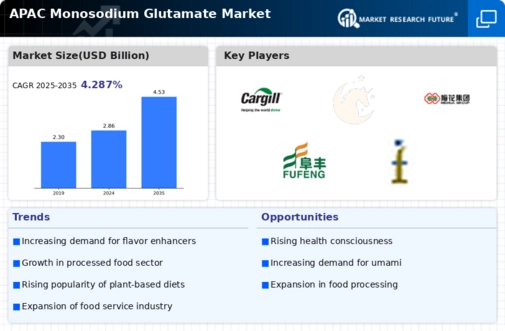
APAC Monosodium Glutamate Market Infographic
Purchase Options

APAC Monosodium Glutamate Market Summary

As per MRFR analysis, the APAC monosodium glutamate market Size was estimated at 2856.0 USD Million in 2024. The APAC monosodium glutamate market is projected to grow from 2977.38 USD Million in 2025 to 4512.0 USD Million by 2035, exhibiting a compound annual growth rate (CAGR) of 4.25% during the forecast period 2025 - 2035.

Key Market Trends & Highlights

The APAC monosodium glutamate market is experiencing robust growth driven by evolving consumer preferences and industry dynamics.

  • The demand for umami flavor continues to rise, particularly in China, the largest market for monosodium glutamate.
  • The processed food sector is expanding rapidly, with India emerging as the fastest-growing region in this domain.
  • Health and wellness trends are influencing consumer choices, leading to increased scrutiny of food additives like monosodium glutamate.
  • Key market drivers include the expansion of the food processing industry and the rising popularity of Asian cuisine, which significantly boosts demand.

Market Size & Forecast

2024 Market Size 2856.0 (USD Million)
2035 Market Size 4512.0 (USD Million)
CAGR (2025 - 2035) 4.25%

Major Players

Ajinomoto Co Inc (JP), MSG Co Ltd (CN), Fufeng Group Ltd (CN), Meihua Group (CN), Sambavanam (IN), Ningxia Eppen Biotech Co Ltd (CN), Shandong Qilu Biotechnology Co Ltd (CN), Shandong Shenghua Biotech Co Ltd (CN)

APAC Monosodium Glutamate Market Trends

The monosodium glutamate market is currently experiencing notable growth, driven by increasing consumer demand for flavor enhancers in various food products. This trend is particularly evident in the Asia-Pacific region, where culinary traditions often incorporate umami flavors. The rising popularity of processed and convenience foods has further propelled the use of monosodium glutamate, as manufacturers seek to enhance taste while maintaining cost-effectiveness. Additionally, the growing awareness of food safety and quality standards has led to a more regulated environment, influencing production practices and ingredient sourcing. Moreover, the market appears to be influenced by shifting dietary preferences, with a noticeable rise in vegetarian and vegan products. This shift may lead to an increased reliance on monosodium glutamate as a flavor enhancer in plant-based alternatives. As consumers become more health-conscious, there is a potential for innovation in product formulations, focusing on natural sources of umami. Overall, the monosodium glutamate market is poised for continued expansion, reflecting broader trends in food consumption and culinary innovation.

Rising Demand for Umami Flavor

The increasing consumer preference for umami flavor in various cuisines is driving the growth of the monosodium glutamate market. As culinary trends evolve, more food manufacturers are incorporating this flavor enhancer into their products to meet consumer expectations.

Growth in Processed Food Sector

The expansion of the processed food sector in the Asia-Pacific region is significantly impacting the monosodium glutamate market. As more consumers opt for convenience foods, the demand for flavor enhancers like monosodium glutamate is likely to rise.

Focus on Health and Wellness

There is a growing emphasis on health and wellness among consumers, which may influence the monosodium glutamate market. As individuals seek healthier food options, manufacturers are exploring innovative ways to use monosodium glutamate in formulations that align with these preferences.

APAC Monosodium Glutamate Market Drivers

Rising Popularity of Asian Cuisine

The increasing popularity of Asian cuisine in APAC is significantly influencing the monosodium glutamate market. As culinary diversity expands, more consumers are seeking authentic flavors found in traditional Asian dishes, which often utilize monosodium glutamate as a flavor enhancer. This trend is particularly evident in urban areas where multicultural dining experiences are prevalent. Market data suggests that the demand for Asian food products is expected to rise by 8% annually, further driving the need for monosodium glutamate. As restaurants and food manufacturers aim to replicate authentic flavors, the incorporation of monosodium glutamate becomes essential, thereby bolstering its market presence.

Growth of E-commerce in Food Sector

The rapid growth of e-commerce platforms in the food sector is emerging as a significant driver for the monosodium glutamate market. With the increasing adoption of online shopping, consumers are more inclined to purchase food products, including those containing monosodium glutamate, through digital channels. In 2025, e-commerce sales in the food sector in APAC are projected to reach $200 billion, reflecting a CAGR of 15%. This shift not only enhances accessibility for consumers but also encourages food manufacturers to innovate and offer products that cater to online shoppers. As a result, the monosodium glutamate market is likely to see increased demand as more products are marketed through e-commerce platforms.

Expansion of Food Processing Industry

The food processing industry in APAC is experiencing notable expansion, which appears to be a key driver for the monosodium glutamate market. As consumer preferences shift towards convenience foods, the demand for processed products is likely to increase. In 2025, the food processing sector in APAC is projected to grow at a CAGR of approximately 6.5%, leading to a heightened need for flavor enhancers like monosodium glutamate. This growth is driven by urbanization and changing lifestyles, which necessitate quick meal solutions. Consequently, the monosodium glutamate market is poised to benefit from this trend, as manufacturers seek to enhance the taste of their products to meet consumer expectations.

Rising Awareness of Flavor Enhancement

There is a growing awareness among consumers regarding the role of flavor enhancement in food products, which is positively impacting the monosodium glutamate market. As culinary knowledge expands, consumers are becoming more discerning about the flavors in their food. This trend is particularly pronounced in APAC, where traditional cooking methods are being blended with modern techniques. Market Research Future indicates that approximately 70% of consumers in APAC are actively seeking products that enhance flavor without compromising quality. This shift in consumer behavior is likely to drive the demand for monosodium glutamate, as it is recognized for its ability to enhance taste profiles in various food applications.

Increased Investment in Food Innovation

The monosodium glutamate market is benefiting from increased investment in food innovation across APAC. Companies are focusing on developing new products that cater to evolving consumer tastes and preferences. This trend is supported by a surge in research and development activities aimed at creating innovative food solutions. In 2025, it is estimated that investment in food innovation in APAC will exceed $10 billion, fostering an environment conducive to the growth of flavor enhancers like monosodium glutamate. As manufacturers strive to differentiate their offerings, the demand for effective flavor enhancers is likely to rise, further propelling the monosodium glutamate market.

Market Segment Insights

By Application: Additives (Largest) vs. Acidity Regulators (Fastest-Growing)

In the APAC monosodium glutamate market, the application segment is predominantly driven by additives, which hold the largest share. This segment's strength is attributed to a rising demand for flavor enhancement in food products across various industries including processed foods, snacks, and sauces. Acidity regulators, though smaller in comparison, are rapidly gaining traction, particularly in the food processing sector, as manufacturers seek to improve product stability and shelf life. Growth trends within the application segment indicate a shift towards healthier and more natural food options, propelling demand for monosodium glutamate as a safe flavor enhancer. Additionally, the increasing urbanization and changing consumer preferences towards flavorful, ready-to-eat meals are expected to further fuel the market. As consumers become more aware of food quality, the need for effective and safe additives will likely continue to grow.

Additives (Dominant) vs. Acidity Regulators (Emerging)

Additives lead the application segment in the APAC monosodium glutamate market due to their widespread use in enhancing the flavor profile of various food products. The demand for flavorful snacks, sauces, and processed foods significantly drives this segment. In contrast, acidity regulators are emerging as a crucial component, especially as food manufacturers look for ways to maintain product quality and safety. This segment is gaining attention for its role in preserving the taste and extending shelf life in processed foods. Both segments reflect evolving consumer preferences with an increasing focus on quality and flavor, showcasing a dynamic shift in how monosodium glutamate is incorporated into food production.

By End-User: Food Processing (Largest) vs. Animal Feed (Fastest-Growing)

In the APAC monosodium glutamate market, the Food Processing segment commands the largest share, driven by the widespread use of MSG as a flavor enhancer in various processed foods. The Pharmaceuticals segment also holds a significant portion, attributed to its applications in drug formulation. Other notable segments include Cosmetics and Animal Feed, each contributing to the market with unique applications that cater to diverse consumer needs. Growth trends indicate a steady increase in demand for monosodium glutamate, primarily in the Food Processing and Animal Feed segments. The latter is emerging as a rapid growth area, propelled by the rising livestock industry and increased animal welfare awareness. Additionally, the unique flavor-enhancing properties of MSG in food processing support its enduring popularity, while regulatory approvals in pharmaceuticals further aid in market expansion.

Food Processing: Dominant vs. Animal Feed: Emerging

The Food Processing segment is a dominant force in the APAC monosodium glutamate market, providing essential flavor enhancement to a variety of processed foods such as snacks, seasonings, and ready-to-eat meals. Its widespread application appeals to both manufacturers and consumers seeking improved taste without additional calories. In contrast, the Animal Feed segment is emerging rapidly, fueled by an increase in livestock production and the need for quality feed supplements. This segment thrives on the growing demand for high-quality protein sources and the focus on animal health, positioning it as a key player in the market's future.

Get more detailed insights about APAC Monosodium Glutamate Market

Regional Insights

China : Unmatched Production and Consumption

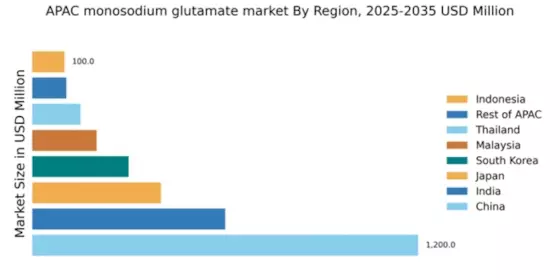
China holds a staggering 60% market share in the APAC monosodium glutamate market, valued at $1200.0 million. Key growth drivers include rising consumer demand for flavor enhancers in food products, coupled with increasing urbanization and disposable income. Regulatory support for food safety and quality standards has bolstered production capabilities. Infrastructure improvements in logistics and manufacturing have further facilitated market growth, making China a powerhouse in MSG production.

India : Emerging Market with High Demand

India accounts for 15% of the APAC monosodium glutamate market, valued at $600.0 million. The growth is driven by increasing consumption in processed foods and snacks, alongside a growing restaurant industry. Government initiatives promoting food processing and safety standards are enhancing market dynamics. The rise of e-commerce platforms is also facilitating wider distribution of MSG products across urban and rural areas.

Japan : Culinary Tradition Meets Innovation

Japan holds a 10% share of the APAC monosodium glutamate market, valued at $400.0 million. The market is driven by a strong culinary culture that values umami flavors, leading to consistent demand for MSG in various food applications. Regulatory frameworks ensure high safety standards, fostering consumer trust. The country's advanced food technology sector is also innovating MSG applications, enhancing its market presence.

South Korea : A Hub for Flavor Innovation

South Korea represents 7.5% of the APAC monosodium glutamate market, valued at $300.0 million. The growth is fueled by a booming food service industry and increasing consumer interest in flavor-enhancing products. Government regulations support food safety and quality, while local companies are investing in R&D for innovative MSG applications. The competitive landscape includes major players like Ajinomoto, which has a significant market presence.

Malaysia : Strategic Location for Distribution

Malaysia captures 5% of the APAC monosodium glutamate market, valued at $200.0 million. The market is driven by rising demand in the food processing sector and a growing population. Government initiatives to boost the food industry and improve infrastructure are key growth factors. The competitive landscape features local and international players, with Kuala Lumpur being a central hub for distribution and logistics.

Thailand : A Flavorful Market Landscape

Thailand holds a 3.75% share of the APAC monosodium glutamate market, valued at $150.0 million. The growth is attributed to the country's rich culinary heritage, which emphasizes flavor enhancement in traditional dishes. Regulatory policies support food safety, while local manufacturers are expanding their product lines. Bangkok serves as a key market, with a competitive landscape featuring both local and international brands.

Indonesia : Rising Demand for Flavor Enhancers

Indonesia accounts for 2.5% of the APAC monosodium glutamate market, valued at $100.0 million. The market is driven by increasing urbanization and a growing middle class, leading to higher consumption of processed foods. Government initiatives to improve food safety and quality standards are fostering market growth. Key cities like Jakarta are pivotal for market dynamics, with local players gaining traction in the competitive landscape.

Rest of APAC : Varied Demand Across Regions

The Rest of APAC holds a 2.65% share of the monosodium glutamate market, valued at $106.0 million. This sub-region showcases diverse consumption patterns influenced by local cuisines and food preferences. Regulatory frameworks vary, impacting market dynamics differently across countries. The competitive landscape includes both local and international players, with opportunities for growth in niche markets and specialty applications.


APAC Monosodium Glutamate Market Regional Image

Key Players and Competitive Insights

The monosodium glutamate market exhibits a dynamic competitive landscape, characterized by a blend of established players and emerging companies. Key growth drivers include increasing consumer demand for umami flavors, the expansion of the food processing industry, and rising awareness of MSG's safety and culinary benefits. Major companies such as Ajinomoto Co Inc (Japan), MSG Co Ltd (China), and Fufeng Group Ltd (China) are strategically positioned to leverage these trends. Ajinomoto Co Inc (Japan) focuses on innovation and product diversification, while MSG Co Ltd (China) emphasizes regional expansion and supply chain optimization. Fufeng Group Ltd (China) is actively pursuing partnerships to enhance its market reach, collectively shaping a competitive environment that is both collaborative and competitive.

The market structure appears moderately fragmented, with several key players influencing overall dynamics. Business tactics such as localizing manufacturing and optimizing supply chains are prevalent among these companies, allowing them to respond swiftly to regional demands. The collective influence of these players fosters a competitive atmosphere where agility and responsiveness are paramount, enabling them to capture market share effectively.

In October 2025, Ajinomoto Co Inc (Japan) announced a strategic partnership with a leading food technology firm to develop new MSG-based flavor enhancers. This collaboration is expected to enhance product offerings and cater to the growing demand for innovative food solutions. The strategic importance of this move lies in Ajinomoto's commitment to maintaining its leadership position through continuous innovation and adaptation to consumer preferences.

In September 2025, Fufeng Group Ltd (China) expanded its production capacity by 20% at its facility in Inner Mongolia. This expansion is significant as it not only increases output but also positions the company to meet the rising demand for MSG in both domestic and international markets. The move reflects Fufeng's proactive approach to scaling operations in response to market trends, thereby strengthening its competitive edge.

In August 2025, MSG Co Ltd (China) launched a new line of organic MSG products aimed at health-conscious consumers. This strategic initiative is indicative of the company's efforts to diversify its product portfolio and cater to evolving consumer preferences. By tapping into the organic segment, MSG Co Ltd (China) is likely to attract a broader customer base, enhancing its market presence.

As of November 2025, current competitive trends in the monosodium glutamate market are increasingly defined by digitalization, sustainability, and the integration of AI technologies. Strategic alliances among key players are shaping the landscape, fostering innovation and enhancing operational efficiencies. Looking ahead, competitive differentiation is expected to evolve, with a notable shift from price-based competition to a focus on innovation, technology, and supply chain reliability. Companies that can effectively leverage these trends are likely to secure a competitive advantage in the marketplace.

Key Companies in the APAC Monosodium Glutamate Market market include

Industry Developments

APAC's Monosodium Glutamate (MSG) market has recently seen significant developments, particularly from major players such as Ajinomoto and Fufeng Group. In March 2023, Ajinomoto announced expanded production capabilities in Indonesia to meet rising global demand, leveraging advancements in sustainable practices.

Concurrently, Cargill has increased its investment in plant-based MSG alternatives, reflecting a shift in consumer preferences toward natural flavor enhancers. Sokhsa Group made headlines in June 2023 by acquiring Changzhou Tiansheng Technology, enhancing its market share and innovation potential in MSG production.

Recent growth in market valuation for companies like Meihua Group has been driven by surging demand in the food service sector, resulting in a valuation increase of over 15% year-on-year. Additionally, a report from the Ministry of Commerce in China indicated an annual growth forecast exceeding 8% for MSG consumption, underscoring the market's robust expansion.

Noteworthy is the collaboration between Sichuan HAID Group and James Finley in September 2022 aimed at optimizing MSG production processes, significantly impacting overall production efficiency in the region. These developments collectively emphasize the dynamism and competitive landscape of the APAC MSG market as it evolves to meet consumer trends and preferences.

APAC Monosodium Glutamate Market Market Segmentation Insights

Monosodium Glutamate Market Application Outlook

    • Additives
    • Acidity Regulators
    • Preservatives
    • Others

Monosodium Glutamate Market End User Outlook

    • Food Processing
    • Pharmaceuticals
    • Cosmetics
    • Animal Feed
    • Others

Monosodium Glutamate Market Regional Outlook

    • China
    • India
    • Japan
    • South Korea
    • Malaysia
    • Thailand
    • Indonesia
    • Rest of APAC

Future Outlook

APAC Monosodium Glutamate Market Future Outlook

The monosodium glutamate market is projected to grow at a 4.25% CAGR from 2024 to 2035, driven by increasing demand in food processing and culinary applications.

New opportunities lie in:

  • Expansion into plant-based food products
  • Development of premium MSG variants for gourmet markets
  • Strategic partnerships with food service providers for bulk supply

By 2035, the market is expected to achieve robust growth, driven by diverse applications and strategic innovations.

Market Segmentation

APAC Monosodium Glutamate Market End-User Outlook

  • Food Processing
  • Pharmaceuticals
  • Cosmetics
  • Animal Feed
  • Others

APAC Monosodium Glutamate Market Application Outlook

  • Additives
  • Acidity Regulators
  • Preservatives
  • Others

Report Scope

MARKET SIZE 20242856.0(USD Million)
MARKET SIZE 20252977.38(USD Million)
MARKET SIZE 20354512.0(USD Million)
COMPOUND ANNUAL GROWTH RATE (CAGR)4.25% (2024 - 2035)
REPORT COVERAGERevenue Forecast, Competitive Landscape, Growth Factors, and Trends
BASE YEAR2024
Market Forecast Period2025 - 2035
Historical Data2019 - 2024
Market Forecast UnitsUSD Million
Key Companies Profiled["Ajinomoto Co Inc (JP)", "MSG Co Ltd (CN)", "Fufeng Group Ltd (CN)", "Meihua Group (CN)", "Sambavanam (IN)", "Ningxia Eppen Biotech Co Ltd (CN)", "Shandong Qilu Biotechnology Co Ltd (CN)", "Shandong Shenghua Biotech Co Ltd (CN)"]
Segments CoveredApplication, End-User
Key Market OpportunitiesGrowing demand for natural flavor enhancers presents opportunities in the monosodium glutamate market.
Key Market DynamicsRising consumer demand for natural flavor enhancers drives innovation in the monosodium glutamate market.
Countries CoveredChina, India, Japan, South Korea, Malaysia, Thailand, Indonesia, Rest of APAC

Leave a Comment

FAQs

What is the expected market size of the APAC Monosodium Glutamate Market in 2024?

The APAC Monosodium Glutamate Market is expected to be valued at 2.86 USD Billion in 2024.

What is the projected market size for the APAC Monosodium Glutamate Market by 2035?

By 2035, the APAC Monosodium Glutamate Market is projected to be valued at 4.53 USD Billion.

What is the expected CAGR for the APAC Monosodium Glutamate Market from 2025 to 2035?

The expected compound annual growth rate for the APAC Monosodium Glutamate Market from 2025 to 2035 is 4.287%.

Which country is expected to dominate the APAC Monosodium Glutamate Market by 2035?

China is expected to dominate the APAC Monosodium Glutamate Market with a valuation of 1.83 USD Billion by 2035.

What is the estimated market size for Monosodium Glutamate additives in 2024?

The market size for Monosodium Glutamate additives is expected to be 1.14 USD Billion in 2024.

Which key players are significant in the APAC Monosodium Glutamate Market?

Major players in the market include Ajinomoto, Wuhan Wuhuadong, and Cargill, among others.

How much is the Monosodium Glutamate market valued in India for 2024?

The Monosodium Glutamate market in India is valued at 0.63 USD Billion in 2024.

What is the market size for preservatives in the APAC Monosodium Glutamate Market by 2035?

The market size for preservatives in the APAC Monosodium Glutamate Market is projected to be 0.90 USD Billion by 2035.

What is the anticipated market growth rate for Japan’s Monosodium Glutamate segment from 2025 to 2035?

Japan’s Monosodium Glutamate segment is anticipated to grow, reaching a market size of 0.82 USD Billion by 2035.

What is the expected market value for acidity regulators in 2035?

The expected market value for acidity regulators in the APAC Monosodium Glutamate Market is 1.32 USD Billion in 2035.

Download Free Sample

Kindly complete the form below to receive a free sample of this Report

Compare Licence

×
Features License Type
Single User Multiuser License Enterprise User
Price $4,950 $5,950 $7,250
Maximum User Access Limit 1 User Upto 10 Users Unrestricted Access Throughout the Organization
Free Customization
Direct Access to Analyst
Deliverable Format
Platform Access
Discount on Next Purchase 10% 15% 15%
Printable Versions