×
Request Free Sample ×

Kindly complete the form below to receive a free sample of this Report

* Please use a valid business email

Leading companies partner with us for data-driven Insights

clients tt-cursor
Hero Background

APAC Traffic Signal Controller Market

ID: MRFR/AT/54961-HCR
200 Pages
Garvit Vyas
October 2025

APAC Traffic Signal Controller Market Research Report By Product Type (Standard Controller, Smart Controller), By Application (Urban, Suburbs) and By Regional (China, India, Japan, South Korea, Malaysia, Thailand, Indonesia, Rest of APAC) - Forecast to 2035

Share:
Download PDF ×

We do not share your information with anyone. However, we may send you emails based on your report interest from time to time. You may contact us at any time to opt-out.

APAC Traffic Signal Controller Market Infographic
Purchase Options

APAC Traffic Signal Controller Market Summary

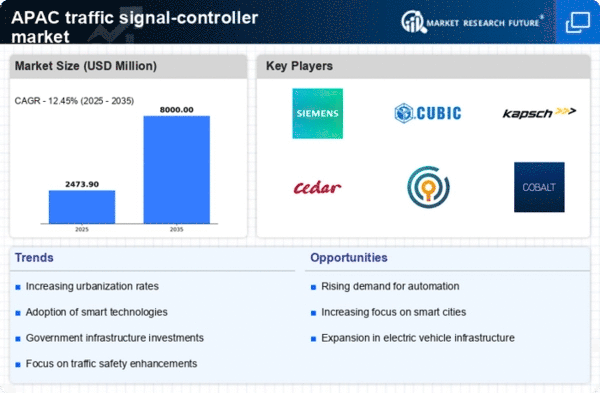
As per MRFR analysis, the APAC traffic signal-controller market size was estimated at 2200.0 USD Million in 2024. The APAC traffic signal-controller market is projected to grow from 2473.9 USD Million in 2025 to 8000.0 USD Million by 2035, exhibiting a compound annual growth rate (CAGR) of 12.45% during the forecast period 2025 - 2035.

Key Market Trends & Highlights

The APAC traffic signal-controller market is experiencing a transformative shift towards smart and sustainable solutions.

  • The adoption of smart technologies is reshaping traffic management systems across the region.
  • China remains the largest market, while India is recognized as the fastest-growing region in the APAC traffic signal-controller landscape.
  • Integration of IoT solutions is becoming increasingly prevalent, enhancing real-time traffic monitoring and control.
  • Urbanization and government initiatives are driving the demand for advanced traffic signal systems, emphasizing road safety and efficiency.

Market Size & Forecast

2024 Market Size 2200.0 (USD Million)
2035 Market Size 8000.0 (USD Million)
CAGR (2025 - 2035) 12.45%

Major Players

Siemens (DE), Cubic Corporation (US), Kapsch TrafficCom AG (AT), Cedar Communications (US), Civis Analytics (US), Cobalt Robotics (US), Cypress Semiconductor (US), Cavotec (SE), Cedar Communications (US)

APAC Traffic Signal Controller Market Trends

The traffic signal-controller market in the APAC region is currently experiencing a notable transformation, driven by advancements in technology and increasing urbanization. As cities expand and traffic congestion becomes a pressing issue, the demand for efficient traffic management solutions is on the rise. Smart traffic signal systems, which utilize real-time data and adaptive algorithms, are gaining traction among municipalities aiming to enhance road safety and optimize traffic flow. Furthermore, government initiatives promoting sustainable transportation are likely to bolster the adoption of innovative traffic signal technologies, aligning with broader environmental goals. In addition, the integration of Internet of Things (IoT) capabilities into traffic signal systems appears to be a significant trend. This integration facilitates better communication between vehicles and infrastructure, potentially reducing delays and improving overall traffic efficiency. The emphasis on data-driven decision-making in urban planning suggests that the traffic signal-controller market will continue to evolve, with stakeholders increasingly prioritizing solutions that offer real-time insights and analytics. As the region progresses towards smarter cities, the traffic signal-controller market is poised for substantial growth, reflecting the changing dynamics of urban mobility and infrastructure development.

Adoption of Smart Technologies

The traffic signal-controller market is witnessing a shift towards smart technologies that enhance traffic management. These systems utilize real-time data and adaptive algorithms to optimize signal timings, thereby improving traffic flow and reducing congestion. Municipalities are increasingly investing in these solutions to address urban mobility challenges.

Integration of IoT Solutions

The integration of Internet of Things (IoT) solutions into traffic signal systems is becoming more prevalent. This trend allows for better communication between vehicles and infrastructure, which may lead to improved traffic efficiency. The use of IoT data can facilitate informed decision-making in urban planning.

Focus on Sustainability

There is a growing emphasis on sustainability within the traffic signal-controller market. Governments are promoting eco-friendly transportation solutions, which may drive the adoption of energy-efficient traffic signal technologies. This focus aligns with broader environmental initiatives aimed at reducing carbon footprints in urban areas.

APAC Traffic Signal Controller Market Drivers

Rising Vehicle Ownership

The rising vehicle ownership in APAC is a significant driver for the traffic signal-controller market. As disposable incomes increase and urban populations grow, more individuals are purchasing vehicles, leading to heightened traffic congestion. In 2025, vehicle ownership in APAC is projected to surpass 800 million units, creating an urgent need for efficient traffic management solutions. The traffic signal-controller market is responding to this trend by developing systems that can handle increased traffic volumes and improve overall road safety. Enhanced traffic signal systems are essential for managing the flow of vehicles and pedestrians, thereby reducing the likelihood of accidents. This growing demand for effective traffic control solutions is likely to stimulate further innovation within the industry.

Government Initiatives and Funding

Government initiatives and funding play a crucial role in the development of the traffic signal-controller market in APAC. Various governments are investing in infrastructure improvements to enhance road safety and traffic management. For instance, initiatives aimed at modernizing traffic control systems are being implemented across several APAC nations. In 2025, it is estimated that government spending on traffic management systems will exceed $10 billion in the region. This financial support is likely to facilitate the adoption of advanced traffic signal technologies, which can improve traffic efficiency and reduce accidents. The traffic signal-controller market is thus positioned to benefit from these investments, as they enable the deployment of state-of-the-art systems that can adapt to real-time traffic conditions.

Urbanization and Population Growth

The rapid urbanization and population growth in APAC countries are driving the traffic signal-controller market. As cities expand, the need for efficient traffic management systems becomes paramount. Urban areas are experiencing an influx of residents, leading to increased vehicular traffic. According to recent data, urban populations in APAC are projected to reach 1.2 billion by 2030, necessitating advanced traffic signal systems to manage congestion. The traffic signal-controller market is responding to this demand by developing innovative solutions that enhance traffic flow and reduce delays. Furthermore, the integration of smart technologies in urban planning is likely to further propel the adoption of advanced traffic signal systems, ensuring that they can accommodate the growing number of vehicles and pedestrians in densely populated areas.

Focus on Road Safety and Efficiency

The focus on road safety and efficiency is increasingly shaping the traffic signal-controller market in APAC. Governments and municipalities are prioritizing the implementation of traffic management systems that enhance safety for all road users. Recent studies indicate that effective traffic signal control can reduce accidents by up to 30%. This emphasis on safety is driving investments in advanced traffic signal technologies that can adapt to varying traffic conditions. The traffic signal-controller market is likely to see a surge in demand for systems that not only improve traffic flow but also prioritize pedestrian safety. As public awareness of road safety issues grows, the industry is expected to innovate and provide solutions that align with these safety objectives.

Technological Advancements in Traffic Management

Technological advancements are significantly influencing the traffic signal-controller market in APAC. Innovations such as adaptive traffic signal control systems, which adjust signal timings based on real-time traffic conditions, are gaining traction. These systems utilize data analytics and machine learning algorithms to optimize traffic flow, thereby reducing congestion and improving travel times. The traffic signal-controller market is witnessing a shift towards these intelligent systems, which are expected to account for over 40% of the market share by 2027. Additionally, the integration of artificial intelligence in traffic management is likely to enhance decision-making processes, making traffic signal systems more responsive to changing conditions. This trend indicates a promising future for the industry as cities seek to implement smarter traffic solutions.

Market Segment Insights

By Type: Smart Controller (Largest) vs. Standard Controller (Fastest-Growing)

In the APAC traffic signal-controller market, Smart Controllers hold the largest market share, signaling a shift towards advanced traffic management solutions that enhance efficiency and reduce congestion. Meanwhile, Standard Controllers, while historically popular, are experiencing a decline in market share as newer technologies gain traction. The growth trend for Smart Controllers is driven by increased investments in smart city initiatives and the integration of AI and IoT technologies in urban infrastructure. Standard Controllers are projected to experience rapid growth as municipalities seek cost-effective solutions for upgrading existing traffic systems. The demand for both types is influenced by urbanization and the need for enhanced traffic flow management.

Controllers: Smart (Dominant) vs. Standard (Emerging)

Smart Controllers are characterized by advanced features such as real-time data analytics, adaptive traffic signal timing, and connectivity to various traffic management systems, making them the dominant choice among urban planners looking to optimize traffic flow. These controllers are increasingly preferred due to their ability to respond to real-time traffic conditions and improve safety for road users. On the other hand, Standard Controllers, while considered an older technology, are emerging as a cost-effective solution for cities aiming to modernize their traffic management with limited budgets. These controllers provide basic traffic signal functions and can be easily integrated into existing infrastructures, appealing to municipalities focused on gradual upgrades.

By Application: Urban (Largest) vs. Suburbs (Fastest-Growing)

The APAC traffic signal-controller market is characterized by varied application segments with Urban traffic signal controllers commanding the largest share. Urban areas typically have a denser population and higher traffic volumes, necessitating advanced signal control technologies. This segment is well-established and continuously evolving to meet the demands of increasing vehicular congestion, making it a focal point for traffic management initiatives. In contrast, the Suburbs segment is observed as the fastest-growing sector. As populations expand beyond urban centers, the need for efficient traffic signal systems in suburban areas becomes more critical. Factors driving this growth include urban sprawl, infrastructure development, and the need for improved traffic flow, presenting a significant opportunity for new technologies and innovations to emerge in this area.

Urban (Dominant) vs. Suburbs (Emerging)

Urban traffic signal controllers are characterized by their robust infrastructure designed to manage high traffic volumes efficiently. They utilize advanced technologies such as adaptive signal control, which adjusts signal timing based on real-time traffic data, consequently enhancing traffic flow and reducing delays. This segment is well-integrated into existing urban planning frameworks, ensuring optimal performance in complex traffic scenarios. On the other hand, Suburbs are emerging as a vital segment, focused on integrating smart solutions to cater to growing populations and commuting patterns unique to less dense areas. As suburban areas expand, there is increasing investment in traffic management systems that utilize data-driven approaches to optimize signal control, thus improving mobility and safety for residents.

Get more detailed insights about APAC Traffic Signal Controller Market

Regional Insights

China : Leading in Innovation and Demand

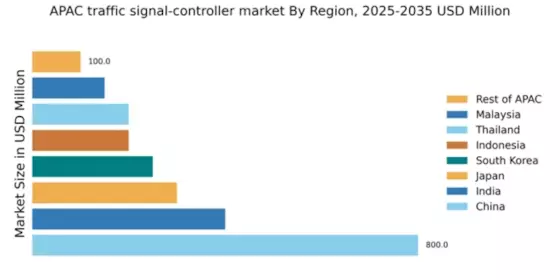
China holds a commanding market share of 40% in the APAC traffic signal-controller market, valued at $800.0 million. Key growth drivers include rapid urbanization, increasing vehicle ownership, and government initiatives aimed at smart city development. The demand for advanced traffic management systems is rising, supported by regulatory policies promoting intelligent transportation solutions. Infrastructure investments in major cities are also enhancing the market landscape.

India : Expanding Infrastructure and Demand

India's traffic signal-controller market is valued at $400.0 million, accounting for 20% of the APAC market. The growth is driven by urban expansion, increasing traffic congestion, and government initiatives like the Smart Cities Mission. Demand for efficient traffic management solutions is surging, with a focus on integrating technology into existing infrastructure. Regulatory support is fostering innovation in traffic control systems.

Japan : Focus on Smart Traffic Systems

Japan's market for traffic signal controllers is valued at $300.0 million, representing 15% of the APAC market. The growth is fueled by the country's commitment to advanced technology and smart city initiatives. Demand for energy-efficient and automated traffic systems is rising, supported by government policies promoting sustainability. Infrastructure upgrades in urban areas are also contributing to market expansion.

South Korea : Strong Government Support and Investment

South Korea's traffic signal-controller market is valued at $250.0 million, making up 12.5% of the APAC market. Key growth drivers include government investments in smart transportation and urban infrastructure. The demand for integrated traffic management systems is increasing, with a focus on reducing congestion and enhancing safety. Regulatory frameworks are encouraging the adoption of innovative technologies in traffic control.

Malaysia : Growing Demand for Smart Solutions

Malaysia's traffic signal-controller market is valued at $150.0 million, accounting for 7.5% of the APAC market. The growth is driven by urbanization and increasing vehicle usage, alongside government initiatives to improve traffic management. Demand for smart traffic solutions is on the rise, supported by regulatory policies promoting technology integration. Infrastructure development in key cities is enhancing market prospects.

Thailand : Focus on Infrastructure Development

Thailand's market for traffic signal controllers is valued at $200.0 million, representing 10% of the APAC market. The growth is driven by urban expansion and government initiatives aimed at improving traffic flow. Demand for advanced traffic management systems is increasing, supported by regulatory frameworks promoting smart city projects. Infrastructure investments in Bangkok and other urban centers are key to market growth.

Indonesia : Investment in Traffic Solutions

Indonesia's traffic signal-controller market is valued at $200.0 million, accounting for 10% of the APAC market. The growth is driven by rapid urbanization and increasing traffic congestion in major cities. Government initiatives to enhance transportation infrastructure are fostering demand for advanced traffic management systems. Regulatory support is encouraging the adoption of smart traffic solutions to address urban mobility challenges.

Rest of APAC : Varied Demand Across Regions

The Rest of APAC traffic signal-controller market is valued at $100.0 million, representing 5% of the overall market. Growth is driven by varying urbanization rates and infrastructure development across different countries. Demand for traffic management solutions is influenced by local government initiatives and regulatory frameworks. The market is characterized by diverse applications in urban and rural settings, catering to specific regional needs.


APAC Traffic Signal Controller Market Regional Image

Key Players and Competitive Insights

The traffic signal-controller market is currently characterized by a dynamic competitive landscape, driven by technological advancements and increasing urbanization across the APAC region. Key players are actively pursuing strategies that emphasize innovation, regional expansion, and partnerships to enhance their market positioning. For instance, Siemens (DE) has been focusing on integrating smart technologies into its traffic management solutions, which aligns with the growing demand for intelligent transportation systems. Similarly, Kapsch TrafficCom AG (AT) is leveraging its expertise in data analytics to optimize traffic flow, thereby enhancing operational efficiency. These strategic initiatives collectively contribute to a competitive environment that is increasingly centered around technological differentiation and customer-centric solutions.

In terms of business tactics, companies are localizing manufacturing and optimizing supply chains to better serve regional markets. The competitive structure of the market appears moderately fragmented, with several players vying for market share. This fragmentation is indicative of a landscape where innovation and localized solutions are paramount, allowing companies to cater to specific regional needs while maintaining competitive pricing.

In October 2025, Cubic Corporation (US) announced a strategic partnership with a leading smart city initiative in Singapore, aimed at deploying advanced traffic signal systems that utilize real-time data analytics. This collaboration is expected to enhance traffic management capabilities and reduce congestion, reflecting Cubic's commitment to integrating cutting-edge technology into urban infrastructure. The strategic importance of this partnership lies in its potential to position Cubic as a leader in smart city solutions within the APAC region.

In September 2025, Kapsch TrafficCom AG (AT) launched a new suite of traffic signal controllers designed to improve energy efficiency and reduce emissions. This product line is particularly relevant in light of increasing regulatory pressures for sustainable urban development. The introduction of these controllers not only aligns with global sustainability trends but also enhances Kapsch's competitive edge by appealing to environmentally conscious municipalities.

In August 2025, Cedar Communications (US) expanded its operations in Australia by establishing a new manufacturing facility dedicated to traffic signal controllers. This move is indicative of Cedar's strategy to localize production and reduce lead times, thereby enhancing its responsiveness to market demands. The establishment of this facility is likely to strengthen Cedar's market presence and improve its supply chain efficiency in the region.

As of November 2025, the competitive trends in the traffic signal-controller market are increasingly defined by digitalization, sustainability, and the integration of artificial intelligence. Strategic alliances are playing a crucial role in shaping the current landscape, enabling companies to pool resources and expertise to drive innovation. Looking ahead, it is anticipated that competitive differentiation will evolve, with a shift from price-based competition to a focus on technological innovation, reliability in supply chains, and sustainable practices. This evolution underscores the importance of adaptability and forward-thinking strategies in maintaining a competitive edge in the market.

Key Companies in the APAC Traffic Signal Controller Market market include

Industry Developments

Recent developments in the APAC Traffic Signal Controller Market have showcased significant advancements and strategic maneuvers by leading companies. For instance, in September 2023, Siemens launched an upgraded traffic signal system in partnership with local authorities focused on enhancing traffic flow efficiency in urban areas. This system aims to integrate AI-driven analytics for improved real-time decision-making. Furthermore, in July 2023, Xerox entered into a collaboration with Traffic Technologies to develop smart traffic management systems that utilize real-time data to adapt traffic signals dynamically.

Notably, in August 2023, Thales Group announced its acquisition of a regional traffic management software company, intending to bolster its portfolio in smart city solutions across the APAC region. Additionally, the APAC Traffic Signal Controller Market has experienced robust growth, with a reported market valuation increase fueled by escalating urbanization and the demand for intelligent transport systems. Companies such as Hitachi and Mitsubishi Electric are actively investing in Research and Development to enhance their product offerings, aligning with government initiatives aimed at improving urban mobility and environmental sustainability in cities across Asia-Pacific.

Future Outlook

APAC Traffic Signal Controller Market Future Outlook

The Traffic Signal Controller Market is projected to grow at 12.45% CAGR from 2024 to 2035, driven by urbanization, smart city initiatives, and technological advancements.

New opportunities lie in:

  • Integration of AI-driven traffic management systems
  • Development of adaptive signal control technologies
  • Expansion into emerging markets with infrastructure investments

By 2035, the market is expected to achieve substantial growth, driven by innovation and increased demand.

Market Segmentation

APAC Traffic Signal Controller Market Type Outlook

  • Standard Controller
  • Smart Controller

APAC Traffic Signal Controller Market Application Outlook

  • Urban
  • Suburbs

Report Scope

MARKET SIZE 20242200.0(USD Million)
MARKET SIZE 20252473.9(USD Million)
MARKET SIZE 20358000.0(USD Million)
COMPOUND ANNUAL GROWTH RATE (CAGR)12.45% (2024 - 2035)
REPORT COVERAGERevenue Forecast, Competitive Landscape, Growth Factors, and Trends
BASE YEAR2024
Market Forecast Period2025 - 2035
Historical Data2019 - 2024
Market Forecast UnitsUSD Million
Key Companies Profiled["Siemens (DE)", "Cubic Corporation (US)", "Kapsch TrafficCom AG (AT)", "Cedar Communications (US)", "Civis Analytics (US)", "Cobalt Robotics (US)", "Cypress Semiconductor (US)", "Cavotec (SE)", "Cedar Communications (US)"]
Segments CoveredType, Application
Key Market OpportunitiesIntegration of smart technologies enhances efficiency in the traffic signal-controller market.
Key Market DynamicsTechnological advancements and regulatory changes drive innovation in the traffic signal-controller market across APAC.
Countries CoveredChina, India, Japan, South Korea, Malaysia, Thailand, Indonesia, Rest of APAC

Leave a Comment

FAQs

What is the expected market size of the APAC Traffic Signal Controller Market in 2024?

The APAC Traffic Signal Controller Market is expected to be valued at 2.1 USD Billion in 2024.

What is the anticipated market size of the APAC Traffic Signal Controller Market by 2035?

By 2035, the APAC Traffic Signal Controller Market is expected to reach a valuation of 7.25 USD Billion.

What is the compound annual growth rate (CAGR) of the APAC Traffic Signal Controller Market from 2025 to 2035?

The market is anticipated to grow at a CAGR of 11.899% between 2025 and 2035.

Which region holds the largest share of the APAC Traffic Signal Controller Market in 2024?

In 2024, China holds the largest share of the APAC Traffic Signal Controller Market, valued at 0.9 USD Billion.

What is the projected market size for China in the APAC Traffic Signal Controller Market by 2035?

The market size for China is projected to be 3.2 USD Billion by 2035.

Which company is a major player in the APAC Traffic Signal Controller Market?

Major players in the market include Siemens and Xerox, among others.

What is the expected market size for the Smart Controller segment in 2035?

The Smart Controller segment is expected to be valued at 3.05 USD Billion in 2035.

How does the market for Standard Controllers compare in 2024 and 2035?

The Standard Controller segment is valued at 1.2 USD Billion in 2024 and is expected to reach 4.2 USD Billion by 2035.

What is the estimated market growth for India by 2035 in the APAC Traffic Signal Controller Market?

India's market size is projected to grow to 1.8 USD Billion by 2035.

What are some key trends driving growth in the APAC Traffic Signal Controller Market?

The growing need for traffic management solutions and smart city initiatives are key trends driving market growth.

Download Free Sample

Kindly complete the form below to receive a free sample of this Report

Compare Licence

×
Features License Type
Single User Multiuser License Enterprise User
Price $4,950 $5,950 $7,250
Maximum User Access Limit 1 User Upto 10 Users Unrestricted Access Throughout the Organization
Free Customization
Direct Access to Analyst
Deliverable Format
Platform Access
Discount on Next Purchase 10% 15% 15%
Printable Versions