×
Request Free Sample ×

Kindly complete the form below to receive a free sample of this Report

* Please use a valid business email

Leading companies partner with us for data-driven Insights

clients tt-cursor
Hero Background

Europe Traffic Signal Controller Market

ID: MRFR/AT/54959-HCR
200 Pages
Garvit Vyas
October 2025

Europe Traffic Signal Controller Market Research Report By Product Type (Standard Controller, Smart Controller), By Application (Urban, Suburbs) and By Regional (Germany, UK, France, Russia, Italy, Spain, Rest of Europe) - Forecast to 2035

Share:
Download PDF ×

We do not share your information with anyone. However, we may send you emails based on your report interest from time to time. You may contact us at any time to opt-out.

Europe Traffic Signal Controller Market Infographic
Purchase Options

Europe Traffic Signal Controller Market Summary

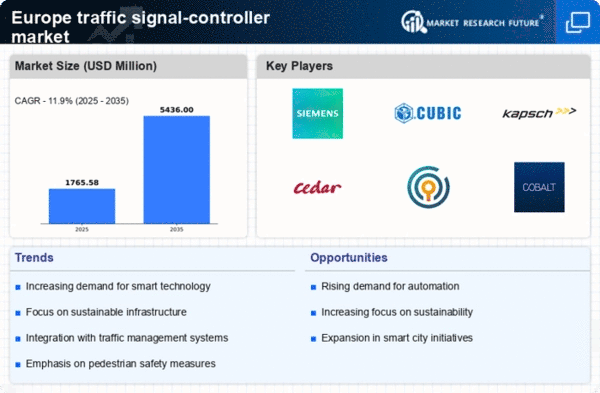
As per MRFR analysis, the traffic signal-controller market size was estimated at 1577.82 USD Million in 2024. The traffic signal-controller market is projected to grow from 1765.58 USD Million in 2025 to 5436.0 USD Million by 2035, exhibiting a compound annual growth rate (CAGR) of 11.9% during the forecast period 2025 - 2035.

Key Market Trends & Highlights

The Europe traffic signal-controller market is experiencing a transformative shift towards smart and sustainable solutions.

  • Smart technologies are reshaping traffic signal systems across Europe. This is particularly evident in Germany.
  • A growing focus on sustainability is driving the adoption of eco-friendly traffic management solutions in the UK.
  • Regulatory support for modernization is facilitating advancements in traffic management systems throughout the region.
  • Key market drivers include increased investment in urban infrastructure and a growing emphasis on road safety, which are propelling market growth.

Market Size & Forecast

2024 Market Size 1577.82 (USD Million)
2035 Market Size 5436.0 (USD Million)
CAGR (2025 - 2035) 11.9%

Major Players

Siemens (DE), Cubic Corporation (US), Kapsch TrafficCom (AT), Cedar Communications (US), Civis Analytics (US), Cobalt Robotics (US), Cypress Semiconductor (US), Cedar Communications (US)

Europe Traffic Signal Controller Market Trends

The The traffic signal-controller market is undergoing a transformative phase., driven by advancements in technology and increasing urbanization across Europe. The integration of smart technologies into traffic management systems appears to enhance efficiency and safety on the roads. As cities expand and traffic congestion becomes a pressing issue, the demand for innovative solutions that optimize traffic flow is likely to rise. Moreover, the emphasis on sustainability and reducing carbon emissions may further propel the adoption of intelligent traffic signal systems, which can adapt to real-time traffic conditions and minimize idle times for vehicles. In addition, regulatory frameworks across various European nations are evolving to support the implementation of modern traffic management solutions. Governments are investing in infrastructure upgrades, which may include the installation of advanced traffic signal controllers that utilize data analytics and machine learning. This shift not only aims to improve traffic efficiency but also to enhance pedestrian safety and reduce accidents. As the market continues to evolve, collaboration between public and private sectors could play a crucial role in fostering innovation and ensuring the successful deployment of these systems.

Integration of Smart Technologies

The traffic signal-controller market is witnessing a notable trend towards the integration of smart technologies. This includes the use of sensors, cameras, and data analytics to optimize traffic management. Such advancements enable real-time monitoring and adjustments, which may lead to improved traffic flow and reduced congestion.

Focus on Sustainability

There is a growing emphasis on sustainability within the traffic signal-controller market. As cities strive to reduce their carbon footprints, the adoption of energy-efficient systems and solutions that minimize vehicle idling times is becoming increasingly important. This trend aligns with broader environmental goals across Europe.

Regulatory Support for Modernization

Regulatory frameworks are evolving to support the modernization of traffic management systems. Governments are likely to invest in upgrading infrastructure, which may include the deployment of advanced traffic signal controllers. This trend indicates a commitment to enhancing road safety and efficiency.

Europe Traffic Signal Controller Market Drivers

Growing Emphasis on Road Safety

The traffic signal-controller market in Europe is significantly influenced by the growing emphasis on road safety. With increasing awareness of traffic-related fatalities and injuries, there is a concerted effort to enhance safety measures at intersections. In 2025, it is projected that road safety initiatives will lead to a 20% increase in the adoption of advanced traffic signal controllers equipped with features such as pedestrian detection and emergency vehicle prioritization. This focus on safety not only aligns with governmental policies but also resonates with public sentiment, driving demand for more sophisticated traffic management solutions. Consequently, manufacturers are likely to innovate and develop products that meet these safety standards, thereby expanding their market presence.

Integration of Sustainable Practices

Sustainable practices are becoming a crucial driver for the traffic signal-controller market in Europe. As cities aim to reduce their carbon footprints, there is a growing demand for energy-efficient traffic signal systems. In 2025, it is anticipated that the market for eco-friendly traffic signal controllers will grow by 25%, reflecting a shift towards sustainability. These systems often utilize LED technology and renewable energy sources, contributing to lower operational costs and reduced environmental impact. Furthermore, the adoption of sustainable practices aligns with broader European Union goals for climate action, encouraging municipalities to invest in greener traffic solutions. This trend not only enhances the appeal of traffic signal controllers but also positions them as essential components of modern urban infrastructure.

Advancements in Traffic Management Systems

The traffic signal-controller market in Europe is shifting significantly because of advancements in traffic management systems. These systems leverage real-time data analytics and artificial intelligence to optimize traffic flow, thereby reducing congestion. As urban areas become increasingly populated, the demand for efficient traffic management solutions is likely to rise. In 2025, the market is projected to grow by approximately 15%, driven by the need for smarter infrastructure. The integration of advanced algorithms in traffic signal controllers enhances their ability to adapt to changing traffic conditions, which is crucial for urban mobility. This trend indicates a significant transformation in how cities manage their traffic, ultimately improving safety and reducing travel times.

Increased Investment in Urban Infrastructure

Investment in urban infrastructure is a critical driver for the traffic signal-controller market in Europe. Governments and municipalities are allocating substantial budgets to upgrade existing traffic systems and implement new technologies. In 2025, it is estimated that public spending on transportation infrastructure will exceed €100 billion across Europe. This influx of capital is likely to facilitate the adoption of modern traffic signal controllers that can integrate with smart city initiatives. Enhanced funding for infrastructure projects not only supports the deployment of advanced traffic management solutions but also encourages public-private partnerships, fostering innovation in the traffic signal-controller market. As cities strive to improve mobility and reduce emissions, this investment trend is expected to play a pivotal role in shaping the future of urban transportation.

Technological Innovations in Communication Systems

Technological innovations in communication systems are playing a crucial role in shaping the traffic signal-controller market in Europe. The rise of vehicle-to-infrastructure (V2I) communication technologies is enabling traffic signal controllers to interact seamlessly with connected vehicles. This interaction is expected to enhance traffic flow and reduce delays, as vehicles can receive real-time updates on signal changes. By 2025, it is projected that the implementation of V2I technologies will lead to a 30% improvement in traffic efficiency at intersections. This advancement not only benefits drivers but also supports the broader goals of smart city initiatives. As cities continue to embrace digital transformation, the integration of advanced communication systems into traffic signal controllers is likely to become a standard practice.


Market Segment Insights

By Type: Smart Controller (Largest) vs. Standard Controller (Fastest-Growing)

In the traffic signal-controller market, Smart Controllers hold a significant market share as they are increasingly adopted due to their advanced features, allowing for real-time data integration and better traffic management. Standard Controllers, while historically popular, are seeing a relatively poorer share as cities move towards more innovative solutions that harness technology for enhanced performance. The growth trends indicate a robust shift towards Smart Controllers, driven by the need for more efficient traffic systems in urban areas. Advancements in IoT and AI technologies contribute to the rising demand for Smart Controllers, while Standard Controllers are undergoing improvements to retain relevance. Sustainability goals and smart city initiatives further influence this dynamic between the segments.

Controller Type: Smart (Dominant) vs. Standard (Emerging)

Smart Controllers exhibit advanced functionalities such as adaptive traffic management and integration with smart city infrastructure, making them the dominant choice for city planners aiming to enhance traffic flow and safety. Their ability to analyze real-time data and optimize signal timings positions them favorably in an increasingly urbanized landscape. In contrast, Standard Controllers are positioned as emerging but are increasingly being upgraded with new capabilities to remain competitive. However, they lack the sophisticated technology found in Smart Controllers, which limits their adaptability in rapidly changing environments. The push for modernizing traffic systems pushes Standard Controllers to innovate while still catering to cost-sensitive markets that prioritize basic functionality.

By Application: Urban (Largest) vs. Suburbs (Fastest-Growing)

The application segment in the traffic signal-controller market is primarily dominated by Urban implementations, which cater to the dense and complex traffic scenarios prevalent in city centers. This segment captures a substantial market share due to the increasing population and vehicular congestion in urban areas, necessitating advanced traffic management solutions. On the other hand, the Suburbs segment is experiencing rapid growth, driven by the expansion of suburban areas and the need for efficient traffic control systems to manage the rising number of vehicles in less densely populated regions. The growth trends within the Urban segment are fueled by technological advancements and governmental initiatives focusing on smart city developments. Meanwhile, the Suburbs segment is benefiting from infrastructure improvements and increased investment in transportation projects, making it attractive for manufacturers. As these trends continue, both segments are likely to witness increased demand for innovative and efficient traffic signal controllers, aligning with sustainable urban mobility goals.

Application: Urban (Dominant) vs. Suburbs (Emerging)

Urban applications of traffic signal controllers are characterized by sophisticated technology integration, addressing the intricate demands of high-density traffic areas. These systems often include adaptive signal control technology, allowing real-time adjustments based on traffic flow, thereby improving efficiency. The potential for smart city integration further solidifies Urban as a dominant force in this market. Conversely, the Suburbs segment, while emerging, shows a unique appeal due to its emphasis on expanding infrastructure. These installations often prioritize budget-friendly and scalable solutions to accommodate growth without compromising on efficiency. As suburban areas evolve, they increasingly require modern traffic management systems capable of improving safety and reducing congestion as more residents move to these regions.

Get more detailed insights about Europe Traffic Signal Controller Market

Regional Insights

Germany : Innovative Infrastructure and Technology

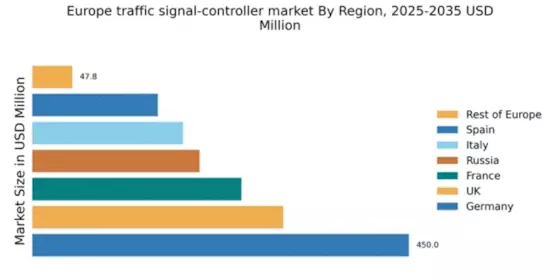
Germany holds a dominant position in the European traffic signal-controller market, accounting for 450.0 million, representing approximately 40% of the total market share. Key growth drivers include the country's commitment to smart city initiatives, which promote the integration of advanced traffic management systems. Demand is bolstered by increasing urbanization and government policies aimed at reducing traffic congestion and emissions. Significant investments in infrastructure development further enhance market potential, with a focus on sustainable transport solutions.

UK : Smart Solutions for Urban Mobility

The UK traffic signal-controller market is valued at 300.0 million, capturing about 27% of the European market. Growth is driven by urban expansion and the need for efficient traffic management systems. Government initiatives, such as the Road Investment Strategy, aim to enhance road safety and reduce congestion. The increasing adoption of intelligent transport systems (ITS) is also shaping demand, with a focus on real-time data analytics and traffic flow optimization.

France : Focus on Sustainable Urban Development

France's market for traffic signal controllers is valued at 250.0 million, representing 23% of the European market. The growth is fueled by government policies promoting sustainable urban mobility and smart city projects. Demand trends indicate a shift towards integrated traffic management solutions, driven by the need for improved road safety and reduced emissions. The French government is actively investing in infrastructure upgrades to support these initiatives, enhancing the overall market landscape.

Russia : Infrastructure Development and Modernization

Russia's traffic signal-controller market is valued at 200.0 million, accounting for 18% of the European market. Key growth drivers include ongoing infrastructure modernization and urbanization efforts in major cities like Moscow and St. Petersburg. Government initiatives focus on enhancing road safety and traffic efficiency, although regulatory challenges persist. The competitive landscape features both local and international players, with a growing emphasis on smart traffic solutions to address urban mobility issues.

Italy : Balancing Tradition and Innovation

Italy's traffic signal-controller market is valued at 180.0 million, representing 16% of the European market. Growth is driven by regional investments in smart city projects and the need for improved traffic management in urban areas. Demand trends reflect a focus on integrating technology with traditional traffic systems. Key cities like Milan and Rome are leading the charge, supported by government initiatives aimed at enhancing public transport and reducing congestion.

Spain : Investments in Smart Infrastructure

Spain's traffic signal-controller market is valued at 150.0 million, capturing about 14% of the European market. The growth is driven by urbanization and government investments in smart infrastructure. Demand for advanced traffic management systems is increasing, particularly in cities like Madrid and Barcelona, where congestion is a significant issue. The competitive landscape includes both local and international players, focusing on innovative solutions to enhance traffic flow and safety.

Rest of Europe : Tailored Solutions for Diverse Regions

The Rest of Europe traffic signal-controller market is valued at 47.82 million, representing a smaller segment of the overall market. Growth is driven by localized needs and varying regulatory environments across different countries. Demand trends indicate a focus on customized solutions that cater to specific regional challenges. The competitive landscape is characterized by smaller players and niche solutions, with an emphasis on adapting to local infrastructure and traffic conditions.

Europe Traffic Signal Controller Market Regional Image

Key Players and Competitive Insights

The traffic signal-controller market is currently characterized by a dynamic competitive landscape, driven by technological advancements and increasing urbanization across Europe. Key players are actively pursuing strategies that emphasize innovation, partnerships, and regional expansion to enhance their market presence. Siemens (DE) stands out with its focus on smart city solutions, integrating advanced traffic management systems that leverage AI and IoT technologies. Meanwhile, Kapsch TrafficCom (AT) is concentrating on digital transformation initiatives, aiming to optimize traffic flow and reduce congestion through data-driven insights. These strategic orientations collectively shape a competitive environment that is increasingly focused on technological integration and sustainability.

In terms of business tactics, companies are localizing manufacturing and optimizing supply chains to enhance operational efficiency. The market appears moderately fragmented, with several key players exerting influence over specific segments. This fragmentation allows for niche players to thrive, while larger corporations leverage their resources to establish a more significant foothold. The collective influence of these key players fosters a competitive structure that encourages innovation and responsiveness to market demands.

In October 2025, Siemens (DE) announced a partnership with a leading European city to implement a new traffic signal system that utilizes real-time data analytics. This strategic move is likely to enhance traffic management capabilities and improve urban mobility, positioning Siemens as a frontrunner in smart city initiatives. The collaboration underscores the importance of data-driven solutions in addressing contemporary urban challenges.

In September 2025, Kapsch TrafficCom (AT) launched a new cloud-based traffic management platform designed to facilitate seamless communication between vehicles and traffic signals. This initiative reflects a growing trend towards digitalization in the traffic signal-controller market, suggesting that Kapsch is keen on capitalizing on the increasing demand for integrated transportation solutions. The platform's capabilities may significantly enhance traffic efficiency and safety, aligning with broader sustainability goals.

In August 2025, Cubic Corporation (US) expanded its operations in Europe by acquiring a local technology firm specializing in traffic signal control systems. This acquisition is indicative of Cubic's strategy to bolster its technological capabilities and expand its product offerings in the European market. By integrating local expertise, Cubic may enhance its competitive edge and better address the unique needs of European cities.

As of November 2025, the competitive trends in the traffic signal-controller market are increasingly defined by digitalization, sustainability, and AI integration. Strategic alliances are becoming more prevalent, as companies recognize the value of collaboration in driving innovation. The shift from price-based competition to a focus on technological advancement and supply chain reliability is evident. Moving forward, competitive differentiation is likely to hinge on the ability to deliver innovative solutions that address the evolving demands of urban mobility.

Key Companies in the Europe Traffic Signal Controller Market market include

Industry Developments

Recent developments in the Europe Traffic Signal Controller Market demonstrate a notable increase in technological advancements, with companies like Siemens and Schneider Electric leading the charge in implementing smart traffic management systems. In July 2023, Siemens Mobility announced a strategic initiative aimed at enhancing urban mobility solutions across European cities, indicating a shift toward more integrated transport systems. A significant merger was recorded in May 2023 when Kapsch TrafficCom acquired a local startup specializing in traffic monitoring technology, further diversifying its product offerings.

Meanwhile, Trafikverket is pushing for greener solutions, as it recently initiated projects to incorporate sustainable practices into traffic signal technologies.

The market valuation reflects a steady growth attributed to rising urbanization and the demand for efficient traffic management, with the European traffic signal controller market expected to approach a valuation of 1.7 billion Euros by 2025. In recent years, companies such as Imtech have also been pioneering Research and Development in adaptive traffic signal control, which has seen increased adoption across many European cities since 2022. Major investments in automated sensor technologies are shaping the future landscape of traffic management in Europe.

Future Outlook

Europe Traffic Signal Controller Market Future Outlook

The Traffic Signal Controller Market is projected to grow at a CAGR of 11.9% from 2024 to 2035, fueled by urbanization and smart city initiatives.

New opportunities lie in:

  • Integration of AI-driven traffic management systems
  • Development of adaptive signal control technologies
  • Expansion into emerging markets with tailored solutions

By 2035, the market is expected to achieve substantial growth and innovation.

Market Segmentation

Europe Traffic Signal Controller Market Type Outlook

  • Standard Controller
  • Smart Controller

Europe Traffic Signal Controller Market Application Outlook

  • Urban
  • Suburbs

Report Scope

MARKET SIZE 20241577.82(USD Million)
MARKET SIZE 20251765.58(USD Million)
MARKET SIZE 20355436.0(USD Million)
COMPOUND ANNUAL GROWTH RATE (CAGR)11.9% (2024 - 2035)
REPORT COVERAGERevenue Forecast, Competitive Landscape, Growth Factors, and Trends
BASE YEAR2024
Market Forecast Period2025 - 2035
Historical Data2019 - 2024
Market Forecast UnitsUSD Million
Key Companies Profiled["Siemens (DE)", "Cubic Corporation (US)", "Kapsch TrafficCom (AT)", "Cedar Communications (US)", "Civis Analytics (US)", "Cobalt Robotics (US)", "Cypress Semiconductor (US)", "Cedar Communications (US)"]
Segments CoveredType, Application
Key Market OpportunitiesIntegration of smart technologies enhances efficiency in the traffic signal-controller market.
Key Market DynamicsTechnological advancements and regulatory changes drive innovation in the traffic signal-controller market across Europe.
Countries CoveredGermany, UK, France, Russia, Italy, Spain, Rest of Europe

Leave a Comment

FAQs

What is the projected market size of the Europe Traffic Signal Controller Market by 2035?

The Europe Traffic Signal Controller Market is expected to be valued at 5.43 USD Billion by the year 2035.

What was the market value of the Europe Traffic Signal Controller Market in 2024?

In 2024, the Europe Traffic Signal Controller Market is valued at 1.58 USD Billion.

What is the expected CAGR for the Europe Traffic Signal Controller Market from 2025 to 2035?

The expected CAGR for the Europe Traffic Signal Controller Market is 11.899% for the period from 2025 to 2035.

Which region holds the largest market share in the Europe Traffic Signal Controller Market by 2035?

By 2035, Germany is expected to hold the largest market share, valued at 2.48 USD Billion.

What are the estimated market values of the Standard Controller and Smart Controller by 2035?

The Standard Controller is projected to be valued at 2.46 USD Billion, while the Smart Controller is expected to reach 2.97 USD Billion by 2035.

What is the estimated value of the UK market for Traffic Signal Controllers by 2035?

The UK market for Traffic Signal Controllers is projected to be valued at 1.42 USD Billion by 2035.

What key players are dominating the Europe Traffic Signal Controller Market?

Some major players in the market include Siemens, Trafikverket, Imtech, and Kapsch TrafficCom.

What was the market size for Traffic Signal Controllers in France in 2024?

In 2024, the market size for Traffic Signal Controllers in France was valued at 0.3 USD Billion.

How does the Russia market for Traffic Signal Controllers compare from 2024 to 2035?

The Russia market is expected to grow from 0.08 USD Billion in 2024 to 0.28 USD Billion by 2035.

What opportunities exist in the Europe Traffic Signal Controller Market?

Emerging trends in smart traffic management systems present significant growth opportunities in the Europe Traffic Signal Controller Market.

Download Free Sample

Kindly complete the form below to receive a free sample of this Report

Compare Licence

×
Features License Type
Single User Multiuser License Enterprise User
Price $4,950 $5,950 $7,250
Maximum User Access Limit 1 User Upto 10 Users Unrestricted Access Throughout the Organization
Free Customization
Direct Access to Analyst
Deliverable Format
Platform Access
Discount on Next Purchase 10% 15% 15%
Printable Versions