API Management Market (2025 - 2035)

API Management Market Size, Share and Research Report By Deployment Model (Cloud, On-Premise, Hybrid), By Offering (Platform (API Lifecycle Management, Analytics & Monitoring, Gateway, Security, and More), Services), By End-User Industry (BFSI, IT and Telecommunications, Healthcare, Other Industries), By Enterprise Size (Large Enterprises, Small and Medium-Sized Enterprises) and By Regional (North America, Europe, South America, Asia Pacific, Middle East and Africa) - Industry Forecast to 2035.
ID: MRFR/ICT/1796-HCR
100 Pages
Apoorva Priyadarshi, Shubham Munde
Last Updated: July 08, 2026
API Management Market
Market Size
Forecast Period2025-2035
CAGR (2025-2035)15.2%
2025 Market SizeUSD 9.50 Billion
2035 Market SizeUSD 39.10 Billion
Key Players
Google
Microsoft
Amazon Web Services
Salesforce
IBM
Kong Inc.
Opportunities
  • AI-Native API Governance Platforms
  • Embedded Finance and Banking-as-a-Service
  • Government Digital Public Infrastructure in Emerging Markets

API Management Market Summary

The API Management Market was valued at USD 9.50 Billion in 2025 and is projected to grow from USD 10.94 Billion in 2026 to USD 39.10 Billion by 2035, registering a CAGR of 15.2% during the forecast period (2026–2035). This expansion tracks directly to the enterprise-wide pivot toward API-first architectures, where every digital interface is designed, governed, and monetized as a standalone product rather than a backend utility. Regulatory pressure is compounding this shift — the EU's PSD3 directive and the U.S. Consumer Financial Protection Bureau's open-banking rulemaking both mandate standardized API access, forcing financial institutions to invest in compliant management platforms [1][2].

The technology transformation reshaping this space is structural. Monolithic middleware stacks that once handled integration tasks are giving way to distributed gateways, service meshes, and event-driven brokers that can scale across containerized and serverless environments. Cloud-native spending on application infrastructure crossed USD 68 Billion globally in 2024 according to estimates, and a meaningful share of that budget flows into the API Management Market as organizations operationalize microservices at scale [3].

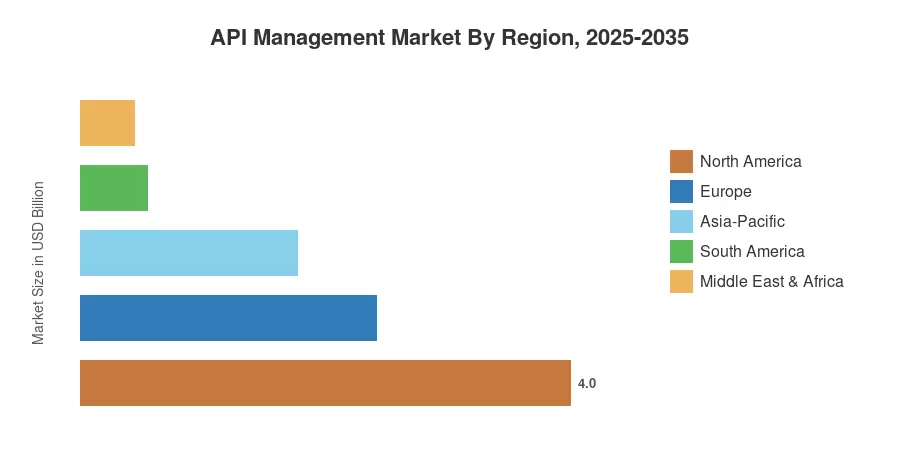
North America held approximately 42.1% of global revenue in 2025, anchored by hyperscaler ecosystems and a mature SaaS economy that generates massive API traffic volumes. Asia-Pacific is the fastest-growing region with a projected CAGR of 18.6% through 2035, propelled by 5G infrastructure rollouts, government digitization mandates in India and Indonesia, and the GSMA Open Gateway framework accelerating telecom API commercialization. Europe accounted for the second-largest share at roughly 25.5%, driven by open-finance regulation and the Digital Markets Act's interoperability requirements. The API Management Market is poised for a decade of compounding investment as generative AI workloads, embedded finance, and cross-industry data exchanges raise the governance stakes for every exposed endpoint.


Key Report Takeaways

• By Deployment Model

  • Cloud deployments captured approximately 74.0% of the API Management Market in 2025, reflecting the migration of enterprise workloads to public and multi-cloud environments.
  • Hybrid architectures are forecast to register a 19.4% CAGR through 2035 as regulated industries balance cloud economics with on-premise compliance requirements.

• By Offering

  • Platform solutions accounted for roughly 65.6% of the API Management Market revenue in 2025, consolidating gateway, analytics, and policy-enforcement capabilities into unified suites.
  • Services are projected to expand at a 24.6% CAGR to 2035, driven by demand for managed API operations and migration consulting.

• By End-User Industry

  • Banking, financial services, and insurance led all verticals with a 29.3% revenue share in 2025, underpinned by open-banking mandates and real-time payment APIs.
  • Healthcare is set to grow fastest at a 17.3% CAGR through 2035, fueled by FHIR-based interoperability standards and telehealth platform expansion.

• By Enterprise Size

  • Large enterprises held 53.8% of the API Management Market in 2025.
  • SMEs are advancing at a 23.5% CAGR through 2035, enabled by self-service developer portals and usage-based pricing tiers.

• By Region

  • North America dominated with a 42.1% share in 2025.
  • Asia-Pacific is forecast to register an 18.6% CAGR through 2035.


API Management Market Size and Forecast (2021–2035)

Market sizing draws on a triangulated methodology combining vendor revenue disclosures, enterprise IT budget surveys, and bottom-up demand modeling across deployment, offering, vertical, and enterprise-size dimensions. Historical figures (2021–2024) reflect audited vendor filings and verified industry datasets; forecast values (2026–2035) apply a calibrated CAGR anchored to macro indicators including cloud infrastructure spend, regulatory API mandates, and digital transformation budgets tracked by the World Bank [3][4].
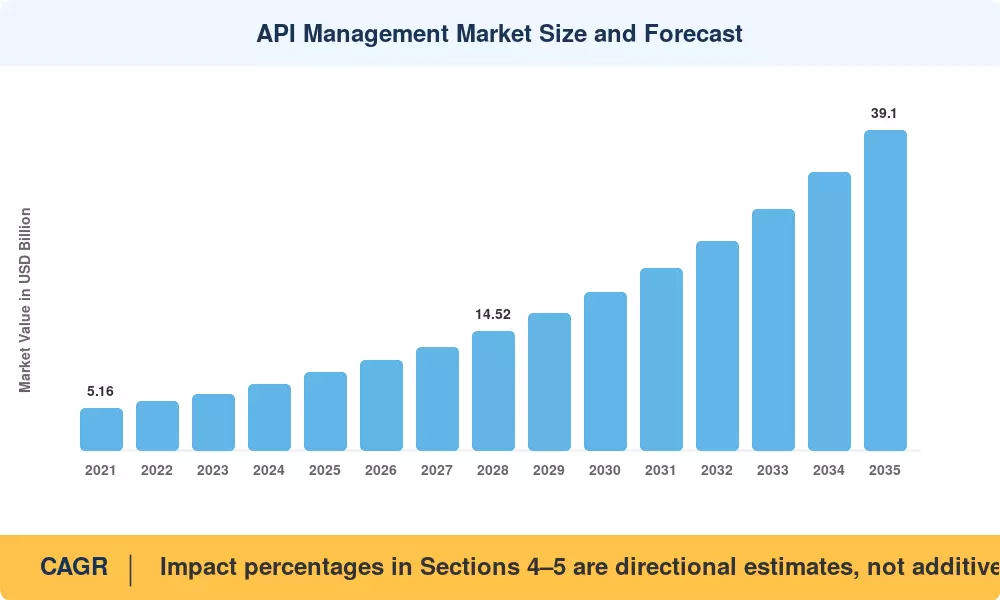
API Management Market Size and Forecast
Our Impact
Enabled $4.3B Revenue Impact for Fortune 500 and Leading Multinationals
Partnering with 2000+ Global Organizations Each Year
30K+ Citations by Top-Tier Firms in the Industry

Driver Impact Analysis

Driver ~% Impact on CAGR Geographic Relevance Impact Timeline
Open-banking and open-finance regulation ~18% North America, Europe Short-term (≤2 yr)
Cloud-native and microservices adoption ~22% Global Medium-term (2–4 yr)
Generative AI integration into gateways ~15% North America, Europe Short-term (≤2 yr)
5G-driven telecom API commercialization ~14% Asia-Pacific, MEA Medium-term (2–4 yr)
Healthcare interoperability mandates ~10% North America, Europe Medium-term (2–4 yr)
Government digital public infrastructure ~12% Asia-Pacific, South America Long-term (≥4 yr)
Embedded finance and BaaS proliferation ~9% Global Long-term (≥4 yr)


Open-Banking and Open-Finance Regulation

The regulatory push toward mandated API access in financial services is one of the most immediate growth catalysts for the API Management Market. The EU's revised Payment Services Directive (PSD3), finalized in 2024, extends open-data obligations beyond payments to insurance and investment products, requiring every regulated institution to expose standardized interfaces. In the United States, the CFPB's Personal Financial Data Rights rule under Section 1033 of the Dodd-Frank Act imposes similar obligations on banks and fintechs holding consumer accounts. Collectively, these mandates are projected to generate over USD 3.5 Billion in incremental API infrastructure spend by 2028, according to Celent estimates [1][2].

Cloud-Native and Microservices Adoption

Enterprise IT architectures have moved decisively beyond lift-and-shift cloud migrations into container-orchestrated, serverless environments where hundreds of discrete services communicate exclusively through APIs. Projects show that 75% of new enterprise applications will be built on microservices architectures by 2027, creating exponential growth in the number of API endpoints requiring lifecycle governance. Each decomposed service needs rate limiting, versioning, authentication, and traffic shaping — functions that sit squarely within the API Management Market value chain [3][4].

Generative AI Integration into Gateways

Large-language-model deployments have introduced a new class of gateway requirements: semantic caching to reduce redundant inference calls, token-budget enforcement per consumer, and policy layers that screen prompts for sensitive data before they reach model endpoints. Vendors including Google, Microsoft, and Kong shipped AI-specific gateway features in 2024, and estimates that 40% of enterprise API gateway procurement decisions in 2025 explicitly required AI-traffic management capabilities [6].

5G-Driven Telecom API Commercialization

Telecom operators are transforming from connectivity providers into API-first platforms through initiatives such as the GSMA Open Gateway, which standardizes network-capability APIs — device location, number verification, quality-on-demand — for third-party consumption. Over 60 mobile operators across 35 countries had committed to the framework by mid-2025, creating a federated API marketplace expected to unlock USD 6 Billion in incremental developer-economy revenue by 2030 [7][10].


Restraints Impact Analysis

Restraint ~% Drag on CAGR Geographic Relevance Impact Timeline
Data-sovereignty and cross-border compliance complexity ~−6% Europe, Asia-Pacific Medium-term (2–4 yr)
Integration complexity in legacy-heavy enterprises ~−5% Global Short-term (≤2 yr)
Vendor lock-in and portability concerns ~−4% North America, Europe Long-term (≥4 yr)
Cybersecurity attack surface expansion ~−4% Global Medium-term (2–4 yr)
Skills shortage in API architecture roles ~−3% Asia-Pacific, South America Short-term (≤2 yr)


Data-Sovereignty and Cross-Border Compliance

Enterprises operating across jurisdictions face a patchwork of data-residency regulations — from GDPR's restrictions on transatlantic data flows to India's Digital Personal Data Protection Act and China's cross-border data-transfer assessments. Each layer of compliance forces API traffic through region-specific gateways, inflating deployment costs and slowing multi-region rollouts. A survey found that 38% of enterprises cited cross-border data rules as the single largest impediment to API-first transformation timelines [11].

Integration Complexity in Legacy Environments

Large banks, insurers, and government agencies still run critical workloads on COBOL mainframes and proprietary middleware where API exposure requires custom adapters, protocol translation, and extensive regression testing. estimates that legacy-integration overhead adds 30–45% to API program budgets in organizations with technology estates older than 15 years, throttling the pace at which these institutions can modernize [12].

Vendor Lock-In and Portability

Proprietary policy languages, gateway-specific extensions, and bundled analytics create switching costs that discourage multi-vendor strategies. The Cloud Native Computing Foundation's Gateway API specification aims to address portability, but enterprise adoption remains below 20% as of 2025, leaving many buyers locked into single-vendor stacks [13].


API Management Market Opportunities

AI-Native API Governance Platforms

The proliferation of LLM-powered applications is creating demand for governance layers purpose-built around inference workloads — token metering, model-routing policies, prompt-safety filters, and cost-attribution dashboards. Vendors that embed these capabilities natively into their platforms, rather than bolting them onto legacy gateways, stand to capture a disproportionate share of new enterprise budgets through 2030.

Embedded Finance and Banking-as-a-Service

Non-financial companies — retailers, ride-hailing platforms, payroll providers — increasingly embed lending, payments, and insurance products directly into their interfaces via APIs. The embedded-finance sector is projected to exceed USD 230 Billion in transaction value by 2030, and every integration requires governed API infrastructure, expanding the API Management Market beyond its traditional IT buyer base[9].

Government Digital Public Infrastructure in Emerging Markets

India's Unified Payments Interface processed over 14 Billion transactions in a single month in 2024, demonstrating how government-backed API ecosystems can reach population scale. Brazil's Pix, Indonesia's QRIS, and Nigeria's NIP are following the same playbook. Each of these programs demands enterprise-grade management platforms to handle authentication, throttling, and audit trails — opening a fast-growing addressable market for the API Management Market across South America, Southeast Asia, and Africa[10].

API Monetization as a Revenue Channel

Organizations are moving beyond internal-use APIs toward externally published, revenue-generating product APIs. Stripe, Twilio, and Plaid have demonstrated that API-as-product models can scale to multi-billion-dollar businesses. The shift elevates the strategic importance of usage analytics, tiered pricing engines, and developer-engagement portals, all of which sit within the management platform stack.

Edge-Native API Management

The rollout of 5G networks and multi-access edge computing is pushing API processing closer to end-user devices. Autonomous vehicles, industrial IoT, and augmented-reality applications need sub-10-millisecond API response times that centralized cloud gateways cannot reliably deliver. Edge-distributed management solutions represent a greenfield segment within the API Management Market, with early entrants already attracting venture capital[7].


API Management Market Future Outlook

AI-Autonomous API Operations

By 2030, leading management platforms will shift from policy-enforcement tools to autonomous orchestration engines that use reinforcement learning to self-tune rate limits, auto-generate API documentation from traffic patterns, and detect anomalous consumption before human operators intervene. Projects that 30% of enterprise API decisions will be fully automated by 2028, reducing operational overhead by up to 40% for large-scale API programs [6].

Platform Economics and API Marketplaces

The API Management Market is converging with marketplace economics, where aggregators curate third-party APIs alongside proprietary services under unified governance. Telecom-led marketplaces such as CAMARA (GSMA) and hyperscaler API hubs are turning management platforms into transaction brokers that meter usage, settle payments, and enforce SLAs across multi-party ecosystems. This evolution repositions API management from a cost center into a revenue-enablement function [7][9].

Zero-Trust API Security Architecture

The expanding attack surface created by cross-organizational API traffic is driving adoption of zero-trust architectures where every API call is authenticated, authorized, and encrypted regardless of network origin. The U.S. Executive Order 14028 on Improving the Nation's Cybersecurity explicitly cites API security as a federal priority, and NIST's updated Zero Trust Architecture guidelines (SP 800-207A) include API-specific controls. Spending on zero-trust API controls is expected to grow at 22% annually through 2030, outpacing the broader API Management Market average [14][16].

Sustainability and ESG Data Exchange

Regulatory disclosure requirements — the EU's Corporate Sustainability Reporting Directive, the SEC's climate-risk rules, and the ISSB standards — are creating a new class of ESG data APIs that enable automated scope-3 emissions reporting across supply chains. API management platforms capable of certifying data provenance, enforcing consent-based sharing, and auditing access logs will become critical infrastructure for sustainability compliance by the early 2030s [17].


API Management Market Segmentation

By Deployment Model

Segment Key Metric Primary Demand Driver
Cloud 74.0% share (2025) Multi-cloud and SaaS workload proliferation
On-Premise USD 1.43 Billion (2025) Regulatory data-residency constraints in banking and defense
Hybrid 19.4% CAGR (2026–2035) Regulated industries balancing cloud economics with compliance


Cloud deployments dominate the API Management Market because they eliminate the infrastructure provisioning bottleneck that historically slowed API program rollouts. Managed cloud gateways offered by hyperscalers — Google Apigee, AWS API Gateway, Azure API Management — allow teams to go from design to production in hours rather than weeks. Hybrid models are gaining traction in banking, healthcare, and government, where sensitive workloads must remain on-premise while less-regulated traffic routes through public-cloud gateways.

On-premise deployments retain a resilient base among defense contractors and intelligence agencies subject to FedRAMP High and IL5 classification requirements, where data cannot leave sovereign infrastructure under any circumstance [11][16].

By Offering

Segment Key Metric Primary Demand Driver
Platform (API Lifecycle Management, Analytics, Gateway, Security, and More) 65.6% share (2025) Consolidation of point tools into integrated suites
Services 24.6% CAGR (2026–2035) Managed operations, migration consulting, and training


Platform revenue reflects a market-wide consolidation trend: buyers increasingly prefer a single vendor that handles gateway routing, usage analytics, developer onboarding, and policy enforcement in one control plane. This bundle logic benefits full-stack incumbents like Google, Microsoft, and Salesforce/MuleSoft, which can cross-sell management capabilities alongside broader cloud or CRM contracts.

Services are the faster-growing segment because enterprises migrating from legacy middleware to cloud-native architectures require specialized consulting for API discovery, contract testing, and organizational change management. Managed-service contracts — where the vendor operates the gateway and analytics layer on behalf of the customer — are particularly attractive to mid-market firms lacking in-house platform engineering teams [12].

By End-User Industry

Segment Key Metric Primary Demand Driver
BFSI 29.3% share (2025) Open-banking mandates and real-time payment APIs
IT and Telecommunications USD 2.05 Billion (2025) 5G Open Gateway and developer-platform strategies
Healthcare 17.3% CAGR (2026–2035) FHIR interoperability and telehealth integration
Other Industries USD 1.85 Billion (2025) Manufacturing IoT, retail commerce APIs, government DPI


BFSI remains the largest vertical buyer in the API Management Market because every open-banking regulation translates directly into API infrastructure procurement. Banks must expose account-information and payment-initiation APIs to licensed third parties, monitor consumption against regulatory SLAs, and generate audit trails — requirements that map one-to-one to management-platform capabilities.

Healthcare is accelerating fastest thanks to the U.S. CMS Interoperability and Patient Access Final Rule, which requires payers and providers to implement FHIR-based APIs for patient data exchange. Similar mandates are emerging in the EU, Australia, and India, transforming healthcare from an API-laggard vertical into one of the API Management Market's highest-growth segments [8].

By Enterprise Size

Segment Key Metric Primary Demand Driver
Large Enterprises 53.8% share (2025) Complex multi-cloud estates requiring centralized governance
Small and Medium-Sized Enterprises 23.5% CAGR (2026–2035) Self-service platforms, pay-as-you-go pricing, low-code portals


Large enterprises generate the majority of current API Management Market revenue, but SMEs represent the structural growth story. Cloud-native startups and mid-market SaaS companies often build API-first from inception, bypassing the legacy-integration challenges that inflate large-enterprise project timelines. Vendor pricing models are adapting accordingly — usage-based billing, freemium developer tiers, and bundled management within broader PaaS offerings lower the entry barrier for organizations managing fewer than 100 API endpoints.


Regional Market Share Analysis

Region Key Metric Primary Investment Themes
North America 42.1% share (2025) Hyperscaler ecosystems, open-banking compliance, AI-gateway integration
Europe 25.5% share (2025) PSD3 open-finance, Digital Markets Act interoperability, sovereign cloud
Asia-Pacific 18.6% CAGR (2026–2035) 5G API commercialization, government DPI, fintech proliferation
South America USD 0.55 Billion (2025) Pix ecosystem expansion, digital banking regulation
Middle East & Africa USD 0.44 Billion (2025) Smart-city programs, telecom API monetization
Total USD 9.50 Billion (2025)

The API Management Market exhibits pronounced regional asymmetry, with mature digital economies driving current revenue while high-growth regions reshape the competitive map. The table below summarizes regional positioning as of the 2025 base year.


North America

Country Key Metric Key Driver
United States 78.5% of regional share Hyperscaler platform dominance; CFPB Section 1033 mandate
Canada 12.3% of regional share Open-banking framework rollout; federal digital strategy
Mexico 9.2% of regional share Fintech regulation (Ley Fintech); banking API standardization


The United States generates the bulk of North American demand thanks to the concentration of API-first SaaS companies, hyperscaler gateway revenue, and a regulatory environment that is now codifying open-data access in financial services. Canada's 2024 Consumer-Driven Banking framework is accelerating API adoption among the Big Five banks, while Mexico's Ley Fintech continues to formalize data-sharing obligations for licensed fintech operators [1][2].

Europe

Country Key Metric Key Driver
Germany 14.5% CAGR (2026–2035) Industry 4.0 industrial API integration
United Kingdom USD 0.62 Billion (2025) FCA open-banking leadership; fintech density
France 13.8% CAGR (2026–2035) Digital sovereignty initiatives; public-sector APIs
Italy USD 0.22 Billion (2025) Banking digitization under PNRR stimulus
Spain 13.2% CAGR (2026–2035) Telecom API partnerships; tourism-tech growth
Nordic Countries USD 0.31 Billion (2025) Advanced digital maturity; real-time payments
Russia USD 0.10 Billion (2025) Domestic platform development
Rest of Europe USD 0.38 Billion (2025) EU Digital Markets Act compliance spend


PSD3 implementation is the single largest regional catalyst, extending mandatory API access from payments into insurance and investment verticals. The UK, operating under its own post-Brexit Smart Data framework, remains Europe's largest single-country market for API governance solutions, with London's fintech corridor accounting for a significant portion of platform procurement [1][11].

Asia-Pacific

Country Key Metric Key Driver
China 28.5% of regional share Super-app ecosystems; government data-exchange mandates
India 20.2% CAGR (2026–2035) UPI ecosystem; Digital India Stack; Account Aggregator
Japan USD 0.38 Billion (2025) Banking consortium APIs; fintech sandbox
South Korea 17.8% CAGR (2026–2035) MyData initiative; telecom Open Gateway adoption
ASEAN USD 0.29 Billion (2025) Regional fintech regulation; e-government APIs
Rest of Asia-Pacific 16.5% CAGR (2026–2035) Telecommunications-led digital transformation


India is the regional standout, combining a government-backed API infrastructure (UPI, Account Aggregator, DigiLocker) with one of the world's fastest-growing fintech ecosystems. The GSMA Open Gateway initiative has gained rapid traction with operators like Airtel, Reliance Jio, and Singtel, transforming telecom networks into programmable API platforms [7][10].

South America

Country Key Metric Key Driver
Brazil 62.0% of regional share Pix instant-payments ecosystem; Open Finance regulation
Argentina 18.5% of regional share Fintech-led digital banking expansion
Rest of South America 19.5% of regional share Government digitization and e-invoicing APIs


Brazil's central bank has mandated phased Open Finance implementation covering banking, insurance, and investment APIs, making it the API Management Market growth engine for the region. The Pix ecosystem alone processed over USD 4.3 Trillion in transaction volume in 2024, requiring robust API governance across hundreds of participating institutions [10].

Middle East & Africa

Country Key Metric Key Driver
Saudi Arabia 31.0% of regional share Vision 2030 smart-city and fintech programs
UAE 27.5% of regional share DIFC/ADGM open-finance frameworks
South Africa 18.0% of regional share Financial-sector API standards development
Egypt 12.8% CAGR (2026–2035) Central bank digital transformation agenda
Rest of MEA 14.2% of regional share Telecom-led API marketplace expansion


Saudi Arabia's SAMA open-banking framework, launched in phases since 2023, is compelling domestic banks to build compliant API layers — a mandate that directly benefits platform vendors with pre-certified regulatory templates. The UAE's dual regulatory sandbox structure (DIFC and ADGM) attracts fintech entrants that rely on third-party management platforms from day one [10].


API Management Market By Region, 2025-2035

Competitive Benchmarking

The API Management Market exhibits medium concentration, with the top five vendors — Google (Apigee), Microsoft, AWS, Salesforce (MuleSoft), and IBM — collectively holding an estimated 48–55% revenue share. The remaining market is fragmented across specialized gateway vendors, open-source entrants, and regional integrators. Competitive differentiation increasingly hinges on AI-native capabilities, multi-cloud portability, and vertical-specific compliance templates. The estimated Herfindahl-Hirschman Index (HHI) for the sector falls in the 900–1,200 range, indicating a moderately competitive structure[6].

Company Est. Revenue Share Range Key Offerings for API Management Market Strategic Positioning
Google (Apigee) ~10–14% Full-lifecycle platform, AI-powered analytics, Anthos hybrid support Hyperscaler integration; strong in multi-cloud governance
Microsoft (Azure API Management) ~9–13% Cloud-native gateway, developer portal, Azure integration Enterprise cross-sell via Azure and Dynamics ecosystem
Amazon Web Services ~8–12% API Gateway, AppSync (GraphQL), Lambda-native integration Serverless-first; dominant in born-in-cloud startups
Salesforce (MuleSoft) ~7–11% Anypoint Platform, API-led connectivity, Composer low-code CRM-adjacent positioning; strong in B2B integration
IBM (API Connect) ~5–8% Hybrid gateway, DataPower security, mainframe API exposure Legacy-modernization specialist for banking and government
Kong Inc. ~4–6% Open-source gateway (Kong Gateway), Konnect SaaS platform Developer-community-led adoption; strong in cloud-native
Axway ~3–5% Amplify Platform, B2B integration, managed file transfer Hybrid B2B and API management convergence
Software AG (webMethods) ~3–5% webMethods API Gateway, Integration Server, IoT analytics Integration-suite approach; strong in European manufacturing
Broadcom (Layer7) ~2–4% Layer7 API Gateway, OAuth Toolkit, policy enforcement Security-first positioning; federal and defense focus
Akamai Technologies ~2–4% Edge-native API gateway, bot management, CDN integration Edge-performance optimization; low-latency use cases


Recent News & Developments


  • May 2025: In order to improve API analytics and monetization capabilities, WSO2 acquired Moesif in May 2025.
  • May 2025: In order to facilitate Kubernetes-native deployments, Google Cloud announced in May 2025 that APIM Operator for Apigee is now generally available.
  • November 2024: To speed up the growth of AI-powered platforms, Kong secured USD 175 million in Series E funding at a USD 2 billion valuation.
  • November 2024: Nokia purchased Rapid in November 2024 to expand its API marketplace capabilities.


API Management Market Report Scope

Parameter Detail
Market Scope Global API Management Market covering platforms, services, and managed offerings
Study Period 2021–2035
Historical Period 2021–2024
Base Year 2025
Forecast Period 2026–2035
CAGR (2026–2035) 15.2%
Market Size (2025) USD 9.50 Billion
Market Size (2035) USD 39.10 Billion
Fastest Growing Segment Healthcare (by end-user); Hybrid (by deployment); Services (by offering)
Companies Profiled Google, Microsoft, AWS, Salesforce (MuleSoft), IBM, Kong, Axway, Software AG, Broadcom, Akamai
Valuation Currency USD Billion
CAGR Driver Disclaimer Impact percentages in Sections 4–5 are directional estimates, not additive components of headline CAGR


FAQs

How does API versioning strategy affect total cost of ownership for enterprise buyers?
Maintaining multiple live API versions increases gateway resource consumption and support overhead linearly. Enterprises enforcing a sunset-by-default policy — retiring versions within 12 months — can reduce management costs by 25–30% compared to indefinite version support [12].
What distinguishes a full-lifecycle platform from a standalone gateway in procurement decisions?
A full-lifecycle platform bundles design, testing, deployment, monitoring, and retirement into one control plane. Standalone gateways handle traffic routing only, requiring separate tools for analytics, security, and developer onboarding — increasing integration risk [6].
How are enterprises mitigating API sprawl across multi-cloud environments?
Centralized API catalogs with automated discovery agents scan cloud accounts to inventory undocumented endpoints. Organizations deploying these tools report 40–60% reductions in shadow API exposure within the first year of adoption [14].
What role do GraphQL and event-driven architectures play in shaping the API Management Market?
GraphQL reduces over-fetching by letting consumers request only needed fields, lowering bandwidth costs. Event-driven patterns using AsyncAPI complement REST-based governance, and management platforms now support both paradigms natively [13].
How should regulated industries evaluate vendor compliance certifications for the API Management Market?
Buyers should require SOC 2 Type II, ISO 27001, and industry-specific certifications such as PCI-DSS or HITRUST. Pre-certified policy templates accelerate regulatory audits and reduce custom-configuration overhead [16].
What pricing models dominate the API Management Market, and how do they affect SME adoption?
Usage-based pricing tied to API call volume has become the dominant model, replacing per-seat licensing. This structure lowers SME entry costs by aligning expenses with actual consumption rather than projected capacity [5].
How will edge computing reshape deployment architecture for the API Management Market by 2030?
Distributed gateways deployed at edge nodes will process latency-sensitive traffic locally while synchronizing policies with a central control plane. Autonomous vehicles and industrial IoT are the primary use cases driving this architectural shift [7].    
Author
Author
Author Profile
Apoorva Priyadarshi LinkedIn
Research Analyst
With 4+ years of experience in Market Intelligence and Strategic Research, Apoorv specializes in ICT, Semiconductor, and BFSI markets. Combining strong analytical capabilities with a deep understanding of technology-driven industries, he focuses on delivering data-driven insights that support strategic decision-making. With a background in technology and business research, Apoorv has contributed to numerous global market studies, competitive landscape analyses, and opportunity assessments across sectors such as semiconductors, digital banking, cybersecurity, and telecommunications.
Co-Author
Co-Author Profile
Shubham Munde LinkedIn
Team Lead - Research
Shubham brings over 7 years of expertise in Market Intelligence and Strategic Consulting, with a strong focus on the Automotive, Aerospace, and Defense sectors. Backed by a solid foundation in semiconductors, electronics, and software, he has successfully delivered high-impact syndicated and custom research on a global scale. His core strengths include market sizing, forecasting, competitive intelligence, consumer insights, and supply chain mapping. Widely recognized for developing scalable growth strategies, Shubham empowers clients to navigate complex markets and achieve a lasting competitive edge. Trusted by start-ups and Fortune 500 companies alike, he consistently converts challenges into strategic opportunities that drive sustainable growth.

Research Approach

Research Methodology on API Management Market

This research report is prepared with the help of extensive primary and secondary research. The primary research involves the interviews of API Management solution providers, industry experts, and stakeholders. In the same manner, different research sources such as verified data sources, industry databases, white papers, and technology magazines are used for the report.

The primary research provides insights about the industry and market trends, followed by comprehensive secondary research, covering trustworthy paid and unpaid sources, trade and local journals, economic and business reports, market reviews, surveys and reliable press releases.

Market Research Future (MRFR), performed a data triangulation method to determine the exact market size. It is a combination of top-down and bottom-up approaches. First of all, the top-to-bottom approach is employed to estimate the size of the overall parent category, and then the bottom-to-top approach is used to calculate the individual segments. Additionally, a market breakdown and an analysis of the value chain are also involved in the report.

Secondary Research

This research report includes secondary sources to include robust information regarding API Management solutions and services. Sources that are used to collect data and information are articles published in business magazines, industry whitepapers and surveys, reports by industry trade organizations, and published research papers by reputed authors and journals.

Primary Research

The primary research of the study involves surveys and interviews of experienced professionals and knowledgeable individuals in the API Management market. The informants provide information about the market size, growth rates, drivers, constraints, trends, and their impact on the market during the forecast period. Based on their inputs, MRFR creates a market model and establishes its reliability based on the triangulation method.

Data Collection

For this report, market data is collated from the relevant primary and secondary sources and analyzed using various methodological techniques. The objective of the study is to collect and verify the data collected to provide accurate and up-to-date data. For this purpose, sources such as current news and developments, industry journals and magazines, as well as other relevant sources are used.

Data Validation

To validate the accuracy of this report, several methods are used such as analyzing the collected data twice, conducting expert interviews, performing direct observations, and carrying out secondary research. Moreover, the data are tabulated, analyzed, and verified using various statistical methods to ensure it is accurate and reliable.

Approach Used in the Report

This research report includes primary and secondary research methodologies. The primary research includes interviews and surveys of stakeholders such as API Management solution providers, industry experts, and professional organizations. The secondary research includes the review of secondary sources such as industry journals, published research papers, reports, market newsletters and magazines, and market reviews.

Market Modelling

Market forecasting is done based on the input variables collected from the primary research. The forecast model is based on the stakeholder's current and projected trends as well as a series of parameters that include pricing trends, production capacities, market shares, revenue, profit margins, and geographical expansion.

Analytical Model

To carry out an analysis of the data collected on the Api Management market, several analytical techniques are used. These include forecasting, scenario analysis, trend analysis, market share analysis, and breakeven analysis. The data is further analyzed using various one-way and n-way analysis spreadsheets to provide appropriate insights into the market's trends and statistics. The research also involves a mapping of the key players in the market and their core competencies. The report also contains highlights of the emerging opportunities.

Download Free Sample

Kindly complete the form below to receive a free sample of this Report

Download PDF ×

We do not share your information with anyone. However, we may send you emails based on your report interest from time to time. You may contact us at any time to opt-out.
















