Application Security Market (2025 - 2035)

Application Security Market Size, Share and Research Report: By Application Type (Web Application, Mobile Application, API Security, Cloud Application), By Deployment Type (On-Premises, Cloud-Based, Hybrid), By Security Type (Static Application Security Testing, Dynamic Application Security Testing, Interactive Application Security Testing, Runtime Application Self-Protection), By End Use (Banking Financial Services and Insurance, Retail, Healthcare, Government) and By Regional (North America, Europe, South America, Asia Pacific, Middle East and Africa) - Industry Forecast to 2035
ID: MRFR/ICT/2435-CR
200 Pages
Apoorva Priyadarshi, Shubham Munde
Last Updated: July 13, 2026
Application Security Market
Market Size
Forecast Period2025-2035
CAGR (2025-2035)14.7%
2025 Market SizeUSD 14.56 Billion
2035 Market SizeUSD 54.56 Billion
Key Players
Synopsys
Checkmarx
Veracode
OpenText
HCL Technologies
IBM
Opportunities
  • AI-Driven Autonomous Remediation
  • Managed Application Security for SMEs
  • API Monetization and Security-as-a-Revenue

Application Security Market Summary

The Application Security Market was valued at USD 14.56 billion in 2025 and is projected to grow from USD 15.87 Billion in 2026 to USD 54.56 billion by 2035, registering a CAGR of 14.7% during the forecast period (2026–2035). The PCI-DSS 4.0 compliance deadline in March 2025 compressed procurement timelines across financial institutions, triggering a wave of spending on code-scanning and runtime-protection tools [1]. Simultaneously, the White House Executive Order on Improving the Nation's Cybersecurity pushed federal agencies toward mandatory software bill-of-materials requirements, creating procurement mandates that rippled into private-sector supply chains [2].

The application security market is going through a major technological transition. Integrated DevSecOps solutions that incorporate scanning at every stage of the CI/CD pipeline are gradually displacing legacy standalone static analyzers. Businesses set aside a projected USD 4.3 billion in 2024 to update their application testing stacks, substituting unified platforms with API-aware, container-native, and supply-chain vulnerability detection capabilities for isolated tools [3]. Automated scans are now triggered by continuous integration pipelines at each code commit, increasing tool consumption in the development, staging, and production levels.

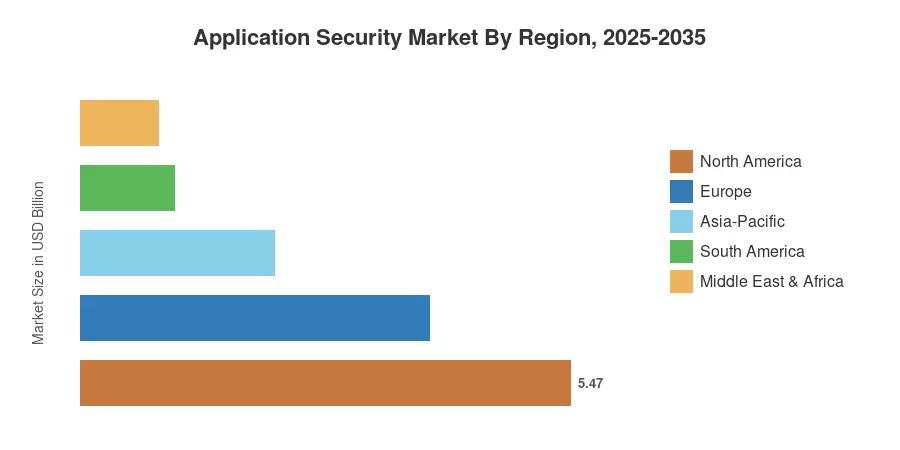
With 37.6% of 2025 revenue, North America leads the application security market due to strict regulations and a well-established DevOps culture. With a predicted CAGR of 14.9%, Asia-Pacific is the fastest-growing area, driven by the quick adoption of cloud computing in Southeast Asia, Japan, and India. With 26.8% of worldwide investment, Europe is in second place as businesses are forced to strengthen their software supply chains due to GDPR enforcement measures and the EU Cyber Resilience Act. This market is expected to develop steadily in double digits through 2035 as threat surfaces increase and regulatory demands become more intense.


Key Report Takeaways

• By Component

  • Solutions captured 56.8% of the Application Security Market revenue in 2025, reflecting enterprise preference for integrated scanning platforms over point services.
  • The services segment is expanding at a 14.8% CAGR through 2035, as managed security testing and consulting engagements gain traction among mid-market buyers.

• By Security Testing Type

  • Static application security testing held a 33.5% revenue share in 2025, maintaining its position as the most widely deployed testing methodology in the Application Security Market.
  • Interactive application security testing is projected to grow at a 14.8% CAGR, driven by its ability to detect business-logic flaws during live execution.

• By Region

  • North America accounted for 37.6% of the Application Security Market in 2025, anchored by U.S. federal cybersecurity mandates.
  • Asia-Pacific is registering the highest regional CAGR at 14.9%, with India and Japan leading adoption.
  • Europe contributed 26.8% of global revenue, propelled by GDPR enforcement and the Cyber Resilience Act.


Market Size and Forecast (2021–2035)

Market Research Future's estimates draw on vendor financial disclosures, regulatory filings, CISO budget surveys, and proprietary demand-side modeling calibrated to 2025 actuals.
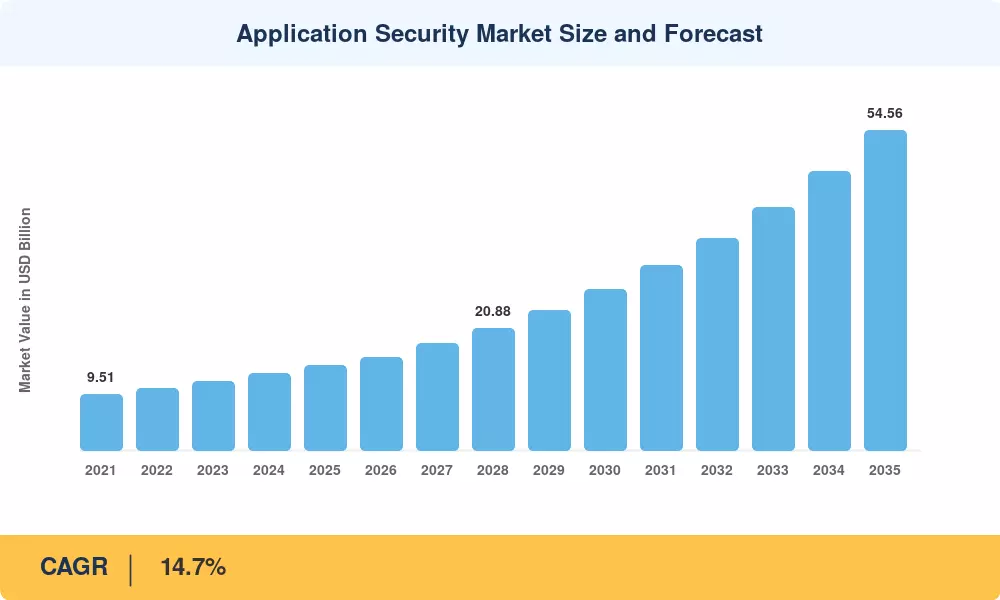
Application Security Market Size and Forecast
Our Impact
Enabled $4.3B Revenue Impact for Fortune 500 and Leading Multinationals
Partnering with 2000+ Global Organizations Each Year
30K+ Citations by Top-Tier Firms in the Industry

Driver Impact Analysis

Driver ~% Impact on CAGR Geographic Relevance Impact Timeline
CI/CD-embedded security scanning ~22% Global Short-term (≤2 yr)
API-security regulatory mandates ~18% North America, Europe Medium-term (2–4 yr)
PCI-DSS 4.0 and financial compliance ~15% Global Short-term (≤2 yr)
Cloud-native workload expansion ~14% Asia-Pacific, North America Long-term (≥4 yr)
Software supply-chain transparency laws ~12% Europe, North America Medium-term (2–4 yr)
AI-powered vulnerability prioritization ~11% Global Medium-term (2–4 yr)
Managed security service outsourcing ~8% Emerging markets Long-term (≥4 yr)


CI/CD-Embedded Security Scanning

Modern development teams push code frequently, triggering automated vulnerability scans. According to official documentation, tools like GitHub Advanced Security integrate capabilities that embed protection directly into the software development life cycle. This shift transforms application security from a periodic audit exercise into a continuous consumption model, directly expanding per-seat license revenue for platform vendors in the Application Security Market.

API-Security Regulatory Mandates

Insecure API interfaces represent a primary initial access vector for web-related security breaches. To counter this, the Cybersecurity and Infrastructure Security Agency issued its latest Binding Operational Directives, establishing a strict, risk-informed framework for vulnerability management. This directive is catalyzing demand for API-aware testing tools capable of mapping shadow APIs, validating authentication flows, and detecting data-exposure risks across microservices architectures in the Application Security Market.

Software Supply-Chain Transparency Laws

The EU Cyber Resilience Act, officially published as Regulation (EU) 2024/2847, mandates that vendors shipping digital products into European markets maintain software bills of materials in a commonly used, machine-readable format. This regulation is expanding the addressable market for software composition analysis tools, which identify vulnerable open-source dependencies embedded deep in application stacks.


Restraints Impact Analysis

Restraint impact percentages are directional and represent estimated drag on market expansion rates.

Restraint ~% Impact on CAGR Geographic Relevance Impact Timeline
Alert fatigue and false-positive overload ~−18% Global Short-term (≤2 yr)
Cybersecurity talent shortage ~−16% Global Long-term (≥4 yr)
Integration complexity with legacy stacks ~−14% Europe, South America Medium-term (2–4 yr)
Budget constraints among SMEs ~−12% Emerging markets Long-term (≥4 yr)
Data sovereignty and scanning restrictions ~−10% Asia-Pacific, MEA Medium-term (2–4 yr)


Alert Fatigue and False-Positive Overload

Security teams encounter an overwhelming volume of daily alerts from web and system testing tools, with high false-positive rates frequently exceeding average capacity. This continuous noise erodes developer trust in automated scanning outputs, delaying critical remediation efforts and reducing the perceived return on investment for platform solutions. Vendors failing to improve triage efficiency risk losing contract renewals to competitors offering prioritized vulnerability tracking.

Cybersecurity Talent Shortage

The global cybersecurity workforce gap remains substantial, with specialized application security engineers listed among the most difficult operational roles to fill. Organizations lacking dedicated internal expertise struggle to deploy and manage modern testing tools, often resulting in underutilized software licenses. This skills deficit limits overall adoption rates across emerging markets, constraining regional expansion within the broader security software sectors.


Application Security Market Opportunities

AI-Driven Autonomous Remediation

Generative AI models trained on vulnerability-fix repositories offer software development teams the ability to suggest code-level patches for common security flaws automatically. Platforms that integrate these automated remediation capabilities directly into developer environments can shift their offerings from passive detection tools to active co-development solutions. This transition allows platform providers to justify premium pricing models and capture higher software revenues.

Managed Application Security for SMEs

According to reporting from the United Nations, small and medium enterprises constitute the vast majority of global businesses and act as primary drivers for economic growth. However, these smaller organizations frequently lack the internal infrastructure required to deploy standalone vulnerability testing software. Managed security service providers that package application scanning into an accessible subscription model can unlock this underserved segment across developing regions.


API Monetization and Security-as-a-Revenue

Organizations increasingly commercialize their data interfaces as standalone digital products across sectors like digital banking, logistics, and healthcare. Before onboarding external enterprise partners, these organizations must formally certify their integration security posture. This structural requirement transforms application security compliance tools into a vital business enabler, turning a traditional operational cost center into a clear revenue-generating value add.


Regulatory-Driven Growth in Emerging Markets

India's CERT-In directives and Brazil's LGPD enforcement are creating compliance-driven demand in regions where application security adoption has historically lagged. Vendors localizing their platforms for these markets — with vernacular interfaces, local data residency, and tiered pricing — stand to capture first-mover advantage.


Application Security Market Future Outlook

AI-Augmented Security Testing (2026–2028)

Large language models are being fine-tuned on vulnerability databases to assist development teams with generating initial test cases and suggesting potential code-level patches. Moving forward, application security workflows will increasingly adopt assisted triage mechanisms to decrease basic manual screening requirements. Early moving platform providers embedding these automated capabilities into their scanning engines aim to command higher system retention rates.


Regulatory Harmonization Across Jurisdictions (2029–2033)

Divergent national regulations currently force multinational enterprises to maintain multiple compliance frameworks. Efforts by ENISA, NIST, and ISO to harmonize application security standards will simplify cross-border procurement and expand the addressable Application Security Market by reducing compliance overhead for global organizations [10].

Shift-Everywhere Security Architecture (2032–2035)

The industry is moving beyond "shift-left" toward a shift-everywhere model where security testing runs continuously — from IDE to production runtime. Autonomous security orchestration platforms that correlate findings across the entire software lifecycle will define the next phase of the Application Security Market, with runtime application self-protection converging with pre-deployment scanning into unified feedback loops [23].


Application Security Market Segmentation

By Component

Segment Key Metric Primary Demand Driver
Solutions 56.8% share (2025) Platform licensing and subscription models
Services 14.8% CAGR (2026–2035) Managed testing and consulting demand


Solutions dominate the Application Security Market because enterprises increasingly prefer integrated platforms that bundle scanning, analytics, and remediation guidance under a single license. The services segment is accelerating as mid-market organizations with limited in-house expertise outsource penetration testing, code review, and compliance audits to specialized providers.

By Deployment Mode

Segment Key Metric Primary Demand Driver
Cloud 14.9% CAGR (2026–2035) Scalability and CI/CD integration
On-Premises 46.2% share (2025) Data-sovereignty and air-gapped requirements


Cloud deployment is the growth engine of the Application Security Market, driven by organizations migrating workloads to AWS, Azure, and GCP and demanding native integrations with cloud CI/CD pipelines. On-premises deployments retain a significant base among defense contractors, government agencies, and regulated financial institutions that cannot route source code through external scanning infrastructure.

By Organization Size

Segment Key Metric Primary Demand Driver
Large Enterprises USD 8.83 Billion (2025) Complex multi-application portfolios
SMEs 14.9% CAGR (2026–2035) SaaS-based, affordable testing tools


Large enterprises anchor the Application Security Market with sprawling application estates that demand enterprise-grade scanning. SMEs are the fastest-growing segment, enabled by pay-as-you-scan pricing models and lightweight SaaS platforms that eliminate the need for dedicated security teams.

By Security Testing Type

Segment Key Metric Primary Demand Driver
SAST 33.5% share (2025) Early-stage code-quality requirements
DAST USD 3.62 Billion (2025) Runtime vulnerability detection
IAST 14.8% CAGR (2026–2035) Business logic flaw identification


SAST remains the most deployed methodology in the Application Security Market, embedded into developer IDEs and pull-request workflows. However, IAST is gaining ground rapidly because it combines instrumentation with runtime observation to detect vulnerabilities that static or dynamic tools alone would miss — particularly authentication bypass and privilege-escalation flaws.

By End-User Industry

Segment Key Metric Primary Demand Driver
BFSI 22.8% share (2025) PCI-DSS, open-banking mandates
Healthcare 14.9% CAGR (2026–2035) HIPAA, connected-device proliferation
Retail & E-Commerce USD 1.76 Billion (2025) Payment gateway and API protection


BFSI leads the Application Security Market because financial institutions face the most prescriptive compliance regimes and the highest per-breach costs — averaging USD 5.9 million per incident in 2024 according to IBM [24]. Healthcare is the fastest-growing vertical as telehealth platforms, electronic health records, and IoMT devices dramatically expand the attack surface.


Regional Market Share Analysis

Region Key Metric Primary Investment Themes
North America 37.6% share (2025) Federal mandates, DevSecOps maturity
Europe 26.8% share (2025) GDPR, Cyber Resilience Act compliance
Asia-Pacific 14.9% CAGR (2026–2035) Cloud migration, digital transformation
South America USD 1.05 Billion (2025) LGPD enforcement, fintech growth
Middle East & Africa USD 0.87 Billion (2025) Smart-city programs, banking modernization
Total USD 14.56 Billion (2025)

The Application Security Market exhibits distinct regional dynamics shaped by regulatory maturity, cloud adoption rates, and cybersecurity talent availability.


North America

Country Key Metric Key Driver
US 78.4% of regional share CISA mandates a large tech ecosystem
Canada 13.8% CAGR Federal cloud-first policy
Mexico USD 0.21 Billion (2025) Nearshoring-driven IT modernization


U.S. federal agencies are required to implement zero-trust architectures by fiscal year 2027, generating sustained procurement of application testing tools across the civilian and defense sectors [2]. Canada's Digital Operations Strategic Plan allocates CAD 1.2 billion to cybersecurity modernization, with application-layer controls a stated priority [17]. Mexico's growing role as a nearshoring hub for North American software development is pulling Application Security Market demand into the country's expanding tech corridor.

Europe

Country Key Metric Key Driver
Germany 23.5% of regional share Industrial IoT and automotive software
UK 14.6% CAGR Financial services regulation
France USD 0.52 Billion (2025) Sovereignty-driven cloud adoption
Italy 13.9% CAGR Digital public administration push
Spain USD 0.29 Billion (2025) EU recovery fund tech investments
Nordic Countries 14.2% CAGR Advanced DevOps culture
Russia USD 0.18 Billion (2025) Import-substitution for security tools
Rest of Europe 12.8% CAGR Varied regulatory adoption


The EU Cyber Resilience Act introduces mandatory vulnerability-handling obligations for all digital products sold in the single market, creating a compliance-driven baseline demand for the Application Security Market across all 27 member states [10]. Germany's automotive sector is embedding application security into vehicle software development lifecycles as connected-car platforms scale.

Asia-Pacific

Country Key Metric Key Driver
China 31.2% of regional share Government cloud-security standards
India 15.8% CAGR Digital India, CERT-In mandates
Japan USD 0.58 Billion (2025) Financial-sector modernization
South Korea 15.1% CAGR K-cloud initiative
ASEAN USD 0.34 Billion (2025) Cross-border e-commerce growth
Rest of Asia-Pacific 14.4% CAGR Emerging digital economies


Asia-Pacific is the fastest-growing region in the Application Security Market. India's CERT-In mandatory six-hour incident reporting rule has forced enterprises to adopt proactive vulnerability detection rather than reactive breach response [18]. Japan's Financial Services Agency updated its cybersecurity guidelines in 2024 to require continuous application testing for all tier-one banking platforms [19].

South America

Country Key Metric Key Driver
Brazil 58.3% of regional share LGPD enforcement, fintech boom
Argentina 14.1% CAGR Banking digitalization
Rest of South America USD 0.19 Billion (2025) Gradual regulatory adoption


Brazil's central bank mandated open-banking API security standards in 2024, directly driving adoption of API-aware testing tools across the country's 800+ regulated financial institutions [20]. The Application Security Market in South America benefits from a rapidly digitalizing financial sector that is leapfrogging legacy infrastructure.

Middle East & Africa

Country Key Metric Key Driver
Saudi Arabia 34.8% of regional share Vision 2030 digital programs
UAE 14.5% CAGR Smart-city and fintech expansion
South Africa USD 0.11 Billion (2025) POPIA compliance requirements
Egypt 15.0% CAGR Government digitalization initiatives
Rest of MEA USD 0.14 Billion (2025) Early-stage adoption


Saudi Arabia's National Cybersecurity Authority requires all government-linked entities to conduct annual application penetration testing, creating a steady procurement floor for the Application Security Market in the Gulf region [21].


Application Security Market By Region, 2025-2035

Competitive Benchmarking

The Application Security Market exhibits medium concentration, with the top five vendors accounting for an estimated 38–44% of global revenue. The Herfindahl-Hirschman Index sits in the 800–1,100 range, indicating a moderately competitive environment. Mergers and acquisitions — particularly platform vendors acquiring niche API, container, and supply-chain specialists — are reshaping competitive dynamics and expanding bundled DevSecOps offerings.

Company Est. Revenue Share Range Key Offerings Strategic Positioning
Synopsys ~7–10% Coverity, Black Duck, Seeker Full-spectrum code-to-cloud platform
Checkmarx ~6–9% SAST, SCA, API Security Developer-first cloud-native platform
Veracode ~5–8% SAST, DAST, SCA, Container Security SaaS-delivered continuous testing
OpenText (Micro Focus) ~4–7% Fortify SAST/DAST Enterprise-grade legacy modernization
HCL Technologies ~4–6% HCL AppScan Hybrid cloud application testing
IBM ~3–6% IBM Security AppScan AI-integrated enterprise security
Rapid7 ~3–5% InsightAppSec, tCell Cloud-first dynamic testing
Qualys ~3–5% Web Application Scanning Unified IT security and compliance
Fortinet ~2–4% FortiWeb, FortiDevSec Network-to-application security convergence
Imperva (Thales) ~2–4% WAF, API Security, RASP Data-centric application protection


Recent News & Developments

  • ThreatModeler- (June, 2026)--Acquired top competitor IriusRisk to form a unified, global AI-driven threat modeling platform, significantly accelerating DevSecOps automated design capabilities.
  • Invicti Security- (June, 2026)--Launched "AppSec Core," a unified platform combining DAST, SAST, and SCA to help lean enterprise teams rapidly eliminate exploitable runtime risks.
  • Cisco- (May 2026) -Announced intent to acquire Israeli startup Astrix Security for $400 million to expand its zero-trust architecture into non-human, autonomous agentic identities.

Application Security Market Report Scope

Parameter Detail
Market Scope Global Application Security Market — solutions, services, deployment, organization size, testing type, end-user, geography
Study Period 2021–2035
CAGR (2026–2035) 14.7%
Base Year Market Size USD 14.56 Billion (2025)
Forecast Endpoint USD 54.56 Billion (2035)
Fastest Growing Segment Interactive Application Security Testing (14.8% CAGR)
Companies Profiled 10+ (Synopsys, Checkmarx, Veracode, OpenText, HCL Technologies, IBM, Rapid7, Qualys, Fortinet, Imperva)
Valuation Currency USD Billion


FAQs

How do SAST and DAST for application vulnerability testing differ in deployment complexity?
SAST integrates into IDEs and build pipelines with minimal infrastructure, while DAST requires a running application environment and traffic-generation setup. Most enterprises deploy both in tandem to cover pre- and post-build vulnerability detection.
What pricing models dominate the Application Security Market for mid-market buyers?
Per-application and per-developer subscription tiers are the most common models. Usage-based scan pricing is gaining traction as it aligns cost with actual consumption.
How are container-security acquisitions reshaping vendor portfolios?
Platform vendors are buying container-scanning specialists to extend pipeline coverage from code commit through runtime. These acquisitions reduce integration friction for DevOps teams managing Kubernetes-native deployments [22].
What role does open-source tooling play alongside commercial Application Security Market solutions?
Open-source scanners like OWASP ZAP serve as entry points, but enterprises graduate to commercial platforms for policy enforcement, compliance reporting, and SLA-backed support [23].
How should procurement teams evaluate Application Security Market vendors for API coverage?
Prioritize vendors demonstrating automated API discovery, schema validation, and authentication-flow testing. Request proof-of-concept results against your own API inventory before contract commitment [8].
What compliance certifications should buyers verify before selecting an Application Security Market platform?
Look for SOC 2 Type II, ISO 27001, and FedRAMP authorization where applicable. These certifications indicate the vendor's own security posture meets auditable standards [1].
How is AI changing false-positive rates in the Application Security Market?
Machine-learning triage models reduce false positives by 35–50% compared to rule-based engines, enabling developers to focus on confirmed vulnerabilities [7].    
Author
Author
Author Profile
Apoorva Priyadarshi LinkedIn
Research Analyst
With 4+ years of experience in Market Intelligence and Strategic Research, Apoorv specializes in ICT, Semiconductor, and BFSI markets. Combining strong analytical capabilities with a deep understanding of technology-driven industries, he focuses on delivering data-driven insights that support strategic decision-making. With a background in technology and business research, Apoorv has contributed to numerous global market studies, competitive landscape analyses, and opportunity assessments across sectors such as semiconductors, digital banking, cybersecurity, and telecommunications.
Co-Author
Co-Author Profile
Shubham Munde LinkedIn
Team Lead - Research
Shubham brings over 7 years of expertise in Market Intelligence and Strategic Consulting, with a strong focus on the Automotive, Aerospace, and Defense sectors. Backed by a solid foundation in semiconductors, electronics, and software, he has successfully delivered high-impact syndicated and custom research on a global scale. His core strengths include market sizing, forecasting, competitive intelligence, consumer insights, and supply chain mapping. Widely recognized for developing scalable growth strategies, Shubham empowers clients to navigate complex markets and achieve a lasting competitive edge. Trusted by start-ups and Fortune 500 companies alike, he consistently converts challenges into strategic opportunities that drive sustainable growth.

Research Approach


Secondary Research

The secondary research process involved comprehensive analysis of cybersecurity frameworks, threat intelligence databases, peer-reviewed computer science journals, technical standards publications, and authoritative information security organizations. Key sources included the National Institute of Standards and Technology (NIST) Cybersecurity Framework, Cybersecurity and Infrastructure Security Agency (CISA) Advisories, European Union Agency for Cybersecurity (ENISA) Threat Landscape Reports, International Organization for Standardization (ISO/IEC 27034) Application Security Standards, Open Web Application Security Project (OWASP) Foundation, MITRE Corporation (CVE Database and ATT&CK Framework), SANS Institute, Information Systems Security Association (ISSA), ISACA (Information Systems Audit and Control Association), (ISC)² Cybersecurity Workforce Studies, Cloud Security Alliance (CSA), Payment Card Industry Security Standards Council (PCI SSC), Health Information Trust Alliance (HITRUST), IEEE Computer Society Digital Library, ACM Digital Library, National Vulnerability Database (NVD), Statista Cybersecurity Statistics, OECD Digital Economy Outlook, and national cybersecurity agency reports from key markets including Singapore CSA, UK NCSC, Australian ACSC, and Japan NISC. These sources were used to collect vulnerability statistics, compliance regulatory data, threat landscape analysis, framework adoption trends, and market landscape analysis for static application security testing (SAST), dynamic application security testing (DAST), interactive application security testing (IAST), runtime application self-protection (RASP), and secure DevOps (DevSecOps) practices.


Primary Research

Qualitative and quantitative insights were obtained by interviewing supply-side and demand-side stakeholders during the primary research process. The supply-side sources consisted of CEOs, CTOs, VPs of Product Development, Chief Information Security Officers (CISOs), and Heads of Engineering from application security vendors, code analysis tool providers, and cloud security platforms. Demand-side sources included Chief Information Security Officers (CISOs), Chief Technology Officers (CTOs), Security Architects, DevOps/DevSecOps Leaders, Compliance Officers, and Application Development Managers from the Banking Financial Services and Insurance (BFSI), Healthcare, Retail, and Government sectors. Primary research has affirmed product innovation roadmaps, validated market segmentation across deployment types (cloud-based, on-premises, hybrid), and gathered insights on DevSecOps adoption patterns, API security investment priorities, and compliance-driven procurement dynamics.

Primary Respondent Breakdown:

By Designation: C-level Primaries (32%), Director Level (30%), Others (38%)

By Region: North America (38%), Europe (25%), Asia-Pacific (28%), Rest of World (9%)


Market Size Estimation

Global market valuation was derived through revenue mapping and enterprise adoption analysis. The methodology included:

Identification of 45+ key vendors across North America, Europe, Asia-Pacific, Latin America, and Middle East & Africa

Solution mapping across static application security testing (SAST), dynamic application security testing (DAST), interactive application security testing (IAST), runtime application self-protection (RASP), web application firewalls (WAF), and API security platforms

Analysis of reported and modeled annual revenues specific to application security portfolios, including subscription-based SaaS models and perpetual licensing frameworks

Coverage of vendors representing 70-75% of global market share in 2024

Extrapolation using bottom-up (enterprise deployment volumes × ASP by organization size and sector) and top-down (vendor revenue validation and security spending budget analysis) approaches to derive segment-specific valuations across BFSI, healthcare, retail, and government verticals

Download Free Sample

Kindly complete the form below to receive a free sample of this Report

Download PDF ×

We do not share your information with anyone. However, we may send you emails based on your report interest from time to time. You may contact us at any time to opt-out.
















