×
Request Free Sample ×

Kindly complete the form below to receive a free sample of this Report

* Please use a valid business email

Leading companies partner with us for data-driven Insights

clients tt-cursor
Hero Background

Architectural Paints Coating Market

ID: MRFR/CnM/40042-HCR
111 Pages
Chitranshi Jaiswal
October 2025

Global Architectural Paints and Coatings Market Research Report: By Application (Residential, Commercial, Industrial, Infrastructure), By Type (Interior Paints, Exterior Paints, Primers, Sealers), By Substrate (Concrete, Wood, Metal, Plaster), By Formulation (Water-based, Solvent-based, Powder Coatings, Acrylic) and By Regional (North America, Europe, South America, Asia Pacific, Middle East and Africa) - Forecast to 2035

Share:
Download PDF ×

We do not share your information with anyone. However, we may send you emails based on your report interest from time to time. You may contact us at any time to opt-out.

Architectural Paints Coating Market Infographic
Purchase Options

Architectural Paints Coating Market Summary

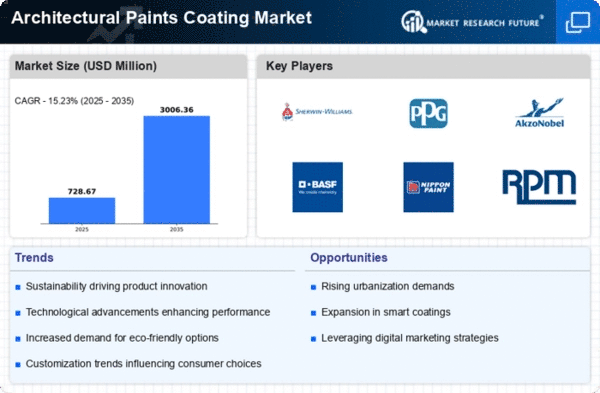
As per MRFR analysis, the Architectural Paints Coating Market Size was estimated at 632.36 USD Million in 2024. The Architectural Paints Coating industry is projected to grow from 728.65 USD Million in 2025 to 3006.36 USD Million by 2035, exhibiting a compound annual growth rate (CAGR) of 15.23 during the forecast period 2025 - 2035.

Key Market Trends & Highlights

The Architectural Paints Coating Market is experiencing a dynamic shift towards sustainability and technological innovation.

  • North America remains the largest market for architectural paints, driven by robust construction activities and consumer demand.
  • The Asia-Pacific region is identified as the fastest-growing market, fueled by rapid urbanization and increasing disposable incomes.
  • The residential segment continues to dominate the market, while the commercial segment is witnessing the fastest growth due to rising infrastructure projects.
  • Sustainability initiatives and technological advancements are key drivers propelling the market forward, particularly in water-based paints.

Market Size & Forecast

2024 Market Size 632.36 (USD Million)
2035 Market Size 3006.36 (USD Million)
CAGR (2025 - 2035) 15.23%

Major Players

Sherwin-Williams (US), PPG Industries (US), AkzoNobel (NL), BASF (DE), Nippon Paint (JP), RPM International (US), Benjamin Moore (US), DuluxGroup (AU), Asian Paints (IN)

Architectural Paints Coating Market Trends

The Architectural Paints Coating Market is currently experiencing a dynamic evolution, driven by various factors that influence consumer preferences and industry standards. The increasing emphasis on sustainability and eco-friendly products appears to be reshaping the landscape, as manufacturers strive to develop paints that minimize environmental impact. This shift is likely to enhance the demand for low-VOC and water-based coatings, which are perceived as safer alternatives. Furthermore, the growing trend of urbanization and infrastructure development seems to be propelling the market forward, as more residential and commercial projects require high-quality finishes that meet aesthetic and functional needs. In addition to sustainability, technological advancements in paint formulations are playing a crucial role in the market's growth. Innovations such as self-cleaning and anti-microbial coatings may provide added value to consumers, enhancing the durability and performance of architectural paints. Moreover, the rise of online retail channels is transforming how products are marketed and sold, allowing consumers to access a wider range of options. As the Architectural Paints Coating Market continues to evolve, it is essential for stakeholders to remain attuned to these trends to capitalize on emerging opportunities and address potential challenges.

Sustainability Focus

The Architectural Paints Coating Market is witnessing a pronounced shift towards sustainable practices. Manufacturers are increasingly prioritizing eco-friendly formulations, which include low-VOC and water-based options. This trend reflects a growing consumer preference for products that are less harmful to the environment, suggesting that sustainability will remain a key driver in product development.

Technological Innovations

Advancements in technology are significantly influencing the Architectural Paints Coating Market. Innovations such as self-cleaning and anti-microbial coatings are gaining traction, as they offer enhanced performance and durability. These developments indicate a potential shift in consumer expectations, as buyers seek products that provide added functionality alongside aesthetic appeal.

E-commerce Growth

The rise of e-commerce is reshaping the distribution landscape of the Architectural Paints Coating Market. Online platforms are becoming increasingly popular for purchasing paints, allowing consumers to explore a broader range of products. This trend suggests that digital channels will play a vital role in how manufacturers engage with customers and promote their offerings.

Market Segment Insights

By Application: Residential (Largest) vs. Commercial (Fastest-Growing)

The Architectural Paints Coating Market showcases a dynamic distribution of market share across four distinct applications: residential, commercial, industrial, and institutional. The residential segment stands out as the largest contributor, accounting for a significant portion of the overall market. Its popularity is driven by the increasing consumer interest in home improvement and aesthetic enhancements. Conversely, the commercial segment is emerging rapidly, fueled by urban development and infrastructure projects, particularly in emerging economies. Growth trends for the application segment reveal a promising trajectory for both residential and commercial applications. Factors such as heightened renovation activities in residential areas are bolstering the demand for decorative coatings. Additionally, the commercial segment is witnessing a surge in demand due to new construction projects, office spaces, and an emphasis on sustainable building practices, which are further propelling market growth in this area.

Residential (Dominant) vs. Commercial (Emerging)

In the context of the Architectural Paints Coating Market, the residential segment is characterized by its dominant market position, largely attributable to ongoing trends in home renovation and increased investments in interior decoration. Consumers are increasingly seeking high-quality and environmentally friendly paint options, thus shaping the demand landscape. This dominance is reflected in the variety of products available that cater specifically to aesthetic preferences and durability requirements for homes. On the other hand, the commercial segment is emerging as a crucial player in the market. The rapid expansion of urban infrastructure, along with stringent regulations for environmental compliance, has prompted a shift toward innovative coating solutions in commercial applications. This segment is particularly focused on performance, with a growing emphasis on coatings that provide greater resistance to wear and tear, enhancing the longevity of commercial properties.

By Product Type: Water-Based Paints (Largest) vs. Solvent-Based Paints (Fastest-Growing)

In the Architectural Paints Coating Market, Water-Based Paints commands a substantial share, primarily due to their eco-friendliness and ease of application, making them a preferred choice for both residential and commercial applications. Conversely, Solvent-Based Paints, while holding a smaller market share, are gaining traction thanks to their durability and exceptional finish, appealing to specific sectors looking for high-performance coatings. Specialty Coatings and Primers, although niche segments, contribute significantly to the broader market dynamics.

Water-Based Paints (Dominant) vs. Solvent-Based Paints (Emerging)

Water-Based Paints are characterized by their low VOC emissions, making them a top choice for environmentally conscious consumers. Their versatility allows them to be used on various surfaces, offering a broad range of colors and finishes. In contrast, Solvent-Based Paints exhibit superior adhesion and resistance to physical wear, making them ideal for heavy-duty applications like industrial and commercial settings. These emerging paints are experiencing robust growth, supported by rising demand in sectors that require long-lasting finishes. Together, these segments illustrate the diverse preferences in the market, catering to both eco-responsible and performance-focused consumers.

By End Use: New Construction (Largest) vs. Renovation (Fastest-Growing)

In the Architectural Paints Coating Market, the end-use segmentation showcases distinct patterns in both market share and growth dynamics. New Construction holds the largest share, making it a pivotal segment for manufacturers and providers. Meanwhile, Renovation, driven by increasing urbanization and the need for aesthetic upgrades in existing structures, is rapidly gaining traction as a significant player in the market. Maintenance activities also continue to contribute to overall market stability, ensuring a steady demand across various applications. Analyzing growth trends, it's clear that Renovation is emerging as the fastest-growing segment. This surge can be attributed to factors like rising disposable incomes, which encourage home improvement projects, and a growing awareness of environmental sustainability leading to higher demand for eco-friendly paints. In addition, the revitalization of urban areas attracts investments, further boosting the renovation sector's expansion. Meanwhile, New Construction remains strong due to ongoing infrastructure developments across various regions.

New Construction (Dominant) vs. Renovation (Emerging)

New Construction is characterized by substantial demand stemming from large-scale infrastructure projects and housing developments, positioning it as a dominant player in the Architectural Paints Coating Market. Its prominence is driven by the consistent need for quality finishes in newly built residential and commercial spaces. In contrast, the Renovation segment is emerging, fueled by a growing preference for home renovation and the increasing tendency to improve the aesthetics of older properties. Consumers are increasingly investing in renovations driven by changing lifestyle trends and the desire for modernized living spaces. Both segments reflect a robust market, with New Construction leveraging significant investment in infrastructural growth and Renovation capturing the essence of evolving consumer tastes.

By Formulation Type: Acrylic (Largest) vs. Epoxy (Fastest-Growing)

In the Architectural Paints Coating Market, Acrylic paints dominate the formulation type segment, attributed to their versatility and favorable properties such as quick drying time and high durability. Alkyd paints hold a significant share as well, known for their excellent gloss retention and smooth finish, making them popular choices for both residential and commercial applications. Polyurethane paints, while less prevalent, offer high performance in specific use cases, particularly in environments requiring resilience against chemicals and abrasion. Epoxy formulations, though smaller in market share, are rapidly gaining traction due to their exceptional bonding strength and durability, especially in high-traffic and high-moisture environments.

Acrylic (Dominant) vs. Polyurethane (Emerging)

Acrylic paints, recognized for their ease of use and water-based formulation, are the dominant player in the Architectural Paints Coating Market, mainly because of their eco-friendliness and broad applicability. They are ideal for residential and commercial projects alike, providing a versatile option for a variety of surfaces. On the other hand, Polyurethane paints are emerging, known for their superior chemical resistance and flexibility. They are increasingly favored for specialized applications where high performance and durability are essential, such as in flooring and industrial uses. As construction standards evolve toward high-quality finishes, Polyurethane coatings are expected to gain higher market acceptance and growth.

By Finish Type: Gloss (Largest) vs. Matte (Fastest-Growing)

In the Architectural Paints Coating Market, the finish type segment reveals a diverse distribution of preferences among consumers. Gloss finishes currently command the largest share, favored for their high reflectivity and durability, making them ideal for high-traffic areas. Meanwhile, matte finishes, valued for their subtlety and modern aesthetic, are gaining traction among consumers looking for a fresh finish in residential and commercial applications, indicating a shift in user preferences towards more understated looks. Growth trends in the finish type segment are being influenced by evolving consumer tastes and a growing demand for eco-friendly paint options. Matte finishes, trending as the fastest-growing type, appeal to environmentally conscious buyers due to their low VOC emissions. Additionally, the increasing popularity of minimalist design in interiors significantly promotes the matte finish's market share as more consumers seek softer and less shiny appearances in their spaces.

Gloss (Dominant) vs. Semi-Gloss (Emerging)

Gloss finishes are recognized as the dominant choice in the Architectural Paints Coating Market due to their exceptional durability and ease of cleaning, making them ideal for surfaces that require regular maintenance like kitchens and bathrooms. On the other hand, semi-gloss finishes are emerging as a popular alternative due to their balanced sheen levels, offering a combination of elegance and practicality. Semi-gloss is particularly valued for its versatility, being suitable for a wide range of applications from walls to trim, thus appealing to consumers who want visual appeal without compromising functionality. The ongoing trend towards dual-finish applications in residential projects is enhancing semi-gloss's position in the market as it complements other finishes effectively.

Get more detailed insights about Architectural Paints Coating Market

Regional Insights

North America : Market Leader in Coatings

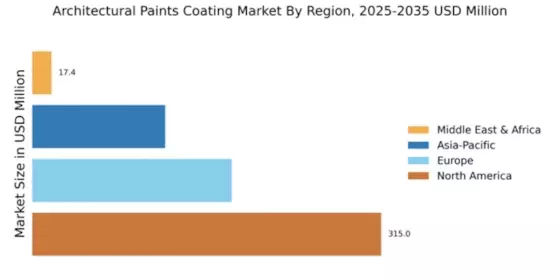
North America continues to lead the architectural paints coating market, holding a significant share of 315.0 million. The growth is driven by robust construction activities, increasing renovation projects, and a rising demand for eco-friendly products. Regulatory support for sustainable practices further enhances market dynamics, with initiatives promoting low-VOC and non-toxic formulations. The region's focus on innovation and quality standards is pivotal in maintaining its market leadership. The competitive landscape is characterized by major players such as Sherwin-Williams, PPG Industries, and Benjamin Moore, which dominate the market with their extensive product portfolios. The U.S. remains the largest contributor, supported by a strong distribution network and consumer preference for premium products. The presence of established brands fosters a competitive environment, driving continuous improvements in product offerings and customer service.

Europe : Sustainable Growth Focus

Europe's architectural paints coating market is valued at 210.0 million, driven by increasing environmental regulations and a shift towards sustainable building practices. The demand for low-emission and eco-friendly coatings is rising, supported by EU directives aimed at reducing carbon footprints. This regulatory landscape encourages innovation in product development, aligning with consumer preferences for sustainable solutions. The market is expected to grow as construction activities rebound post-pandemic, emphasizing energy-efficient buildings. Leading countries such as Germany, France, and the UK are at the forefront of this market, with key players like AkzoNobel and BASF driving advancements in technology and sustainability. The competitive landscape is marked by a mix of local and international brands, fostering innovation and quality. The presence of established companies ensures a diverse range of products, catering to various consumer needs and preferences.

Asia-Pacific : Rapid Growth Region

The Asia-Pacific architectural paints coating market, valued at 90.0 million, is experiencing rapid growth driven by urbanization, rising disposable incomes, and increased construction activities. Countries like China and India are leading this growth, with significant investments in infrastructure and housing projects. The demand for decorative and protective coatings is on the rise, supported by a growing middle class and changing consumer preferences towards quality and aesthetics. Regulatory frameworks promoting sustainable practices are also emerging, further boosting market potential. China stands out as the largest market, with local players like Nippon Paint and Asian Paints gaining traction. The competitive landscape is evolving, with both domestic and international brands vying for market share. The presence of key players fosters innovation, leading to the introduction of advanced products that meet the diverse needs of consumers in this dynamic region.

Middle East and Africa : Emerging Market Potential

The Middle East and Africa architectural paints coating market, valued at 17.36 million, is gradually expanding, driven by increasing urbanization and infrastructure development. The region is witnessing a surge in construction projects, particularly in the Gulf Cooperation Council (GCC) countries, where investments in real estate and commercial spaces are on the rise. Regulatory initiatives aimed at promoting sustainable building practices are also gaining traction, encouraging the adoption of eco-friendly coatings. This evolving landscape presents significant growth opportunities for market players. Countries like the UAE and South Africa are leading the market, with a mix of local and international brands competing for dominance. The presence of key players, including regional distributors and global companies, enhances competition and drives innovation. As the market matures, the focus on quality and sustainability will shape the future of architectural paints in this region.

Key Players and Competitive Insights

The Architectural Paints Coating Market is currently characterized by a dynamic competitive landscape, driven by innovation, sustainability, and regional expansion. Major players such as Sherwin-Williams (US), PPG Industries (US), and AkzoNobel (NL) are actively shaping the market through strategic initiatives. Sherwin-Williams (US) has positioned itself as a leader in product innovation, focusing on eco-friendly formulations and advanced coatings technology. PPG Industries (US) emphasizes its commitment to sustainability, integrating environmentally responsible practices into its operations. Meanwhile, AkzoNobel (NL) is pursuing aggressive regional expansion, particularly in emerging markets, to capitalize on growing demand for architectural coatings. Collectively, these strategies contribute to a competitive environment that is increasingly focused on differentiation through innovation and sustainability.

In terms of business tactics, companies are localizing manufacturing to enhance supply chain efficiency and reduce costs. This approach is particularly evident in the moderately fragmented market structure, where key players leverage their operational strengths to gain competitive advantages. The collective influence of these companies fosters a landscape where agility and responsiveness to market demands are paramount.

In November 2025, Sherwin-Williams (US) announced the launch of a new line of low-VOC paints aimed at the residential market, reflecting a growing consumer preference for sustainable products. This strategic move not only aligns with current environmental trends but also positions the company to capture a larger share of the eco-conscious consumer segment. The introduction of these products is likely to enhance brand loyalty and attract new customers seeking environmentally friendly options.

In October 2025, PPG Industries (US) unveiled a partnership with a leading technology firm to develop AI-driven color matching solutions for its customers. This initiative is indicative of the company's commitment to digital transformation, enhancing customer experience through innovative technology. By integrating AI into its service offerings, PPG Industries (US) aims to streamline the purchasing process and improve customer satisfaction, potentially leading to increased market share.

In September 2025, AkzoNobel (NL) completed the acquisition of a regional paint manufacturer in Southeast Asia, significantly expanding its footprint in a high-growth market. This strategic acquisition is expected to bolster AkzoNobel's production capabilities and distribution network, allowing the company to better serve local customers and respond to regional demand fluctuations. Such moves are crucial for maintaining competitive advantage in a rapidly evolving market.

As of December 2025, the Architectural Paints Coating Market is witnessing trends that emphasize digitalization, sustainability, and technological integration. Strategic alliances are increasingly shaping the competitive landscape, enabling companies to pool resources and expertise. The shift from price-based competition to a focus on innovation and supply chain reliability is evident, suggesting that future competitive differentiation will hinge on the ability to deliver high-quality, sustainable products while leveraging advanced technologies.

Key Companies in the Architectural Paints Coating Market market include

Industry Developments

Recent developments in the Global Architectural Paints and Coatings Market reflect various trends and shifts among prominent players such as Hempel, RPM International, Kansai Paint, Asian Paints, Nippon Paint, Sika, DuluxGroup, BASF, PPG Industries, Valspar, Royal Paints, Beckers Group, AkzoNobel, Sherwin-Williams, and Benjamin Moore. There has been notable growth in market valuation attributed to increased construction activities and rising demand for eco-friendly and innovative coatings. Companies are embracing sustainability practices, focusing on low-VOC and water-based formulations to cater to consumer preferences. Recent acquisition activities point towards consolidation in the sector, with strategic mergers aimed at enhancing market presence and expanding product offerings. For example, Sherwin-Williams has been active in acquiring regional competitors to strengthen its distribution and product lines. Additionally, Nippon Paint is pursuing partnerships to enhance its technological capabilities in coatings. Overall, the competitive landscape is evolving, characterized by innovation, sustainability, and strategic alliances among key market players set against a backdrop of varying economic conditions globally.

Future Outlook

Architectural Paints Coating Market Future Outlook

The Architectural Paints Coating Market is projected to grow at a 15.23% CAGR from 2024 to 2035, driven by urbanization, sustainability trends, and technological advancements.

New opportunities lie in:

  • Development of eco-friendly paint formulations
  • Expansion into emerging markets with tailored products
  • Integration of smart technology in paint applications

By 2035, the market is expected to achieve robust growth, reflecting evolving consumer preferences and innovation.

Market Segmentation

Architectural Paints Coating Market End Use Outlook

  • New Construction
  • Renovation
  • Maintenance

Architectural Paints Coating Market Application Outlook

  • Residential
  • Commercial
  • Industrial
  • Institutional

Architectural Paints Coating Market Finish Type Outlook

  • Matte
  • Satin
  • Gloss
  • Semi-Gloss

Architectural Paints Coating Market Product Type Outlook

  • Water-Based Paints
  • Solvent-Based Paints
  • Specialty Coatings
  • Primers

Architectural Paints Coating Market Formulation Type Outlook

  • Acrylic
  • Alkyd
  • Polyurethane
  • Epoxy

Report Scope

MARKET SIZE 2024632.36(USD Million)
MARKET SIZE 2025728.65(USD Million)
MARKET SIZE 20353006.36(USD Million)
COMPOUND ANNUAL GROWTH RATE (CAGR)15.23% (2024 - 2035)
REPORT COVERAGERevenue Forecast, Competitive Landscape, Growth Factors, and Trends
BASE YEAR2024
Market Forecast Period2025 - 2035
Historical Data2019 - 2024
Market Forecast UnitsUSD Million
Key Companies ProfiledSherwin-Williams (US), PPG Industries (US), AkzoNobel (NL), BASF (DE), Nippon Paint (JP), RPM International (US), Benjamin Moore (US), DuluxGroup (AU), Asian Paints (IN)
Segments CoveredApplication, Product Type, End Use, Formulation Type, Finish Type
Key Market OpportunitiesGrowing demand for eco-friendly coatings drives innovation in the Architectural Paints Coating Market.
Key Market DynamicsRising demand for eco-friendly coatings drives innovation and competition in the architectural paints coating market.
Countries CoveredNorth America, Europe, APAC, South America, MEA

Leave a Comment

FAQs

What is the expected market size of the Global Architectural Paints and Coatings Market in 2024?

The Global Architectural Paints and Coatings Market is expected to be valued at 198.06 USD Billion in 2024.

What is the projected CAGR for the Global Architectural Paints and Coatings Market from 2025 to 2035?

The market is projected to have a CAGR of 3.52% from 2025 to 2035.

Which application segment is anticipated to have the highest market value in 2024?

The Residential segment is anticipated to be valued at 70.0 USD Billion in 2024.

What will be the market size for the Commercial application segment in 2035?

The Commercial application segment is expected to be valued at 75.0 USD Billion in 2035.

Which region will dominate the Global Architectural Paints and Coatings Market in 2024?

North America is expected to dominate the market with a value of 60.0 USD Billion in 2024.

What is the expected market size for the APAC region in 2035?

The APAC region is projected to reach a market size of 90.0 USD Billion by 2035.

Who are some of the key players in the Global Architectural Paints and Coatings Market?

Key players include Hempel, RPM International, Kansai Paint, and Asian Paints among others.

What is the expected market value for the Industrial application segment in 2024?

The Industrial application segment is expected to be valued at 40.0 USD Billion in 2024.

What challenges are the Global Architectural Paints and Coatings Market expected to face?

The market may face challenges such as fluctuating raw material prices and environmental regulations.

What is the projected market size for the Infrastructure application segment in 2035?

The Infrastructure application segment is projected to reach a market size of 55.0 USD Billion by 2035.

Download Free Sample

Kindly complete the form below to receive a free sample of this Report

Compare Licence

×
Features License Type
Single User Multiuser License Enterprise User
Price $4,950 $5,950 $7,250
Maximum User Access Limit 1 User Upto 10 Users Unrestricted Access Throughout the Organization
Free Customization
Direct Access to Analyst
Deliverable Format
Platform Access
Discount on Next Purchase 10% 15% 15%
Printable Versions