Download Free Sample
Kindly complete the form below to receive a free sample of this Report
Argentina Blockchain Fintech Market Size, Share and Research Report By Application (Payments, Clearing, Settlement, Exchange, Remittance, Smart Contracts, Identity Management, Compliance Management, Know Your Customer, Content Storage Management), By Provider (Application and Solution Providers, Middleware Providers, Infrastructure and Protocols Providers), By Organization Size (Small-Medium Size Enterprises, Large Enterprises) and By Industry Vertical (Banking, Non-banking, Financial Services, Insurance)-Forecast to 2035
As per Market Research Future analysis, the Argentina Blockchain Fintech Market size was estimated at 39.05 USD Million in 2024. The Argentina blockchain fintech market is projected to grow from 45.64 USD Million in 2025 to 217.17 USD Million by 2035, exhibiting a compound annual growth rate (CAGR) of 16.8% during the forecast period 2025 - 2035
The Argentina blockchain fintech market is experiencing robust growth driven by technological advancements and increasing regulatory clarity.
| 2024 Market Size | 39.05 (USD Million) |
| 2035 Market Size | 217.17 (USD Million) |
| CAGR (2025 - 2035) | 16.88% |
Binance (MT), Coinbase (US), Ripple (US), Bitfinex (HK), Kraken (US), Gemini (US), Bitstamp (LU), eToro (IL), Blockchain.com (GB)
Our Impact
Enabled $4.3B Revenue Impact for Fortune 500 and Leading Multinationals
Partnering with 2000+ Global Organizations Each Year
30K+ Citations by Top-Tier Firms in the Industry
The blockchain fintech market in Argentina is currently experiencing a notable evolution, driven by a combination of technological advancements and regulatory developments. The government has shown a growing interest in fostering innovation within the financial sector, which has led to the emergence of various startups and established companies exploring blockchain solutions. This environment appears conducive to the adoption of decentralized finance (DeFi) applications, which may enhance financial inclusion and provide alternative financial services to underserved populations. Furthermore, the increasing awareness of cryptocurrencies among the Argentine populace suggests a shift in consumer behavior, as individuals seek to leverage digital assets for investment and transactional purposes. In addition, the regulatory landscape is gradually adapting to accommodate the unique characteristics of blockchain technology. Authorities are likely to implement frameworks that promote transparency and security while encouraging responsible innovation. This regulatory support could potentially attract foreign investment and partnerships, further stimulating growth in the blockchain fintech market. As the ecosystem matures, collaboration between traditional financial institutions and blockchain-based entities may become more prevalent, leading to the development of hybrid solutions that combine the strengths of both sectors. Overall, the outlook for the blockchain fintech market in Argentina appears promising, with numerous opportunities for growth and innovation on the horizon.
The blockchain fintech market is witnessing a surge in decentralized finance applications, which aim to provide financial services without intermediaries. This trend is likely to empower users by offering greater control over their assets and reducing transaction costs. As awareness of DeFi grows, more individuals and businesses may explore these innovative solutions.
Regulatory bodies in Argentina are progressively establishing guidelines for blockchain technology and cryptocurrencies. This increased clarity may foster a safer environment for businesses and consumers alike, encouraging investment and innovation within the blockchain Argentina Blockchain Fintech Market. A well-defined regulatory framework could also enhance trust among users.
There appears to be a growing trend of collaboration between traditional financial institutions and blockchain-based companies. This integration may lead to the development of hybrid financial products that leverage the advantages of both sectors. Such partnerships could enhance service offerings and improve customer experiences in the blockchain fintech market.
In Argentina, the blockchain fintech market is witnessing a significant rise in cryptocurrency adoption. With inflation rates soaring above 40% annually, many citizens are turning to cryptocurrencies as a hedge against currency devaluation. Reports indicate that approximately 10% of the population has engaged in cryptocurrency transactions, reflecting a growing acceptance of digital assets. This trend is further fueled by the increasing availability of cryptocurrency exchanges and wallets, which facilitate easier access to these assets. As more individuals and businesses recognize the benefits of cryptocurrencies, the blockchain fintech market is likely to expand, offering innovative solutions that cater to this burgeoning demand. The integration of cryptocurrencies into everyday transactions may reshape the financial landscape in Argentina.
The Argentine government is increasingly recognizing the potential of blockchain technology, leading to supportive initiatives that bolster the blockchain fintech market. Recent policy frameworks aim to promote innovation and attract investment in the fintech sector. For instance, the government has launched programs to encourage the development of blockchain-based solutions for public services, such as land registries and voting systems. These initiatives not only enhance transparency and efficiency but also stimulate interest from private sector players. As the government continues to foster a conducive environment for blockchain innovation, the blockchain fintech market is expected to thrive, attracting both local and international players seeking to capitalize on emerging opportunities.
The blockchain fintech market in Argentina is experiencing a notable surge in demand for financial inclusion. A significant portion of the population remains unbanked or underbanked, with estimates suggesting that around 30% of adults lack access to traditional banking services. Blockchain technology offers innovative solutions that can bridge this gap, enabling individuals to access financial services through decentralized platforms. This trend is particularly relevant in rural areas, where traditional banking infrastructure is limited. By leveraging blockchain, financial institutions can provide affordable and accessible services, thereby enhancing economic participation. The potential for increased user adoption in the blockchain fintech market is substantial, as more Argentinians seek alternatives to conventional banking systems that often exclude them.
Security concerns and the need for fraud prevention are driving growth in the blockchain fintech market in Argentina. As digital transactions become more prevalent, the risk of cyber threats and fraud has escalated. Blockchain technology offers enhanced security features, such as immutability and encryption, which can significantly reduce the likelihood of fraudulent activities. Financial institutions are increasingly adopting blockchain solutions to safeguard their operations and build trust with customers. Reports indicate that around 60% of financial organizations in Argentina are exploring blockchain technology to enhance their security protocols. This focus on security is likely to propel the blockchain fintech market forward, as businesses seek reliable solutions to protect their assets and customer data.
Technological advancements are playing a crucial role in shaping the blockchain fintech market in Argentina. Innovations such as smart contracts, decentralized applications, and improved consensus algorithms are enhancing the efficiency and security of blockchain solutions. These advancements are attracting both startups and established financial institutions to explore blockchain technology for various applications, including remittances, payments, and identity verification. The market is projected to grow at a compound annual growth rate (CAGR) of around 25% over the next five years, driven by these technological improvements. As the ecosystem matures, the blockchain fintech market is likely to witness increased investment and collaboration among stakeholders, fostering a more robust and competitive environment.
The Argentina blockchain fintech market showcases a diverse application landscape, with the Payments segment leading in market share. This segment benefits from the increasing adoption of digital currencies and the rising preference for contactless transactions among consumers. Following Payments are Exchanges and Remittances, which also hold significant share, catering to the growing demand for cross-border transactions and remittances in a global economy. However, segments like Smart Contracts and Identity Management are rapidly gaining attention, reflecting the market's shifting dynamics. Growth in the Argentina blockchain fintech market is propelled by several key trends, including the rising need for secure and efficient financial solutions amidst regulatory changes. The demand for Compliance Management and KYC solutions is also on the rise, driven by evolving regulatory frameworks. Furthermore, the pandemic accelerated digital transformation, leading to a surge in the adoption of blockchain-based solutions across various sectors, indicating a robust growth trajectory for emerging applications such as Smart Contracts and Compliance Management.
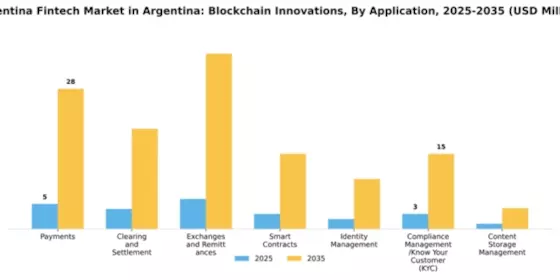
Payments (Dominant) vs. Smart Contracts (Emerging)
The Payments segment stands out as the dominant force in the Argentina blockchain fintech market, capitalizing on the shift towards digital transactions and the growing acceptance of cryptocurrencies. This segment caters to individuals and businesses seeking efficient, secure, and instantaneous payment methods. In contrast, Smart Contracts emerge as a promising and innovative application, facilitating automated, trustless agreements without intermediaries. This emerging segment harnesses the power of blockchain to streamline processes across various industries, enhancing operational efficiency and reducing costs. Together, these segments highlight the dual nature of the Argentina blockchain fintech market, balancing established solutions with groundbreaking technological advancements.
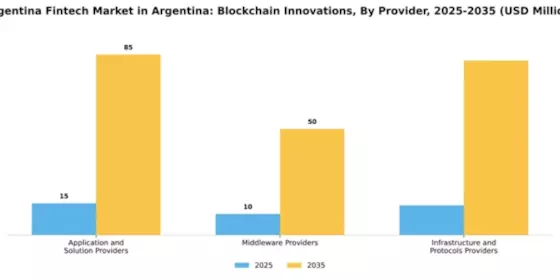
In the Argentina blockchain fintech market, Application and Solution Providers dominate the space, accounting for the largest share of the provider segment. Middleware Providers are emerging as a notable force, capturing a growing segment of the market as organizations seek seamless integration between blockchain technology and existing infrastructures, making them increasingly relevant. The balance of power is leaning towards Application and Solution Providers while Middleware is rapidly growing in importance. The growth trends within this segment are primarily driven by the increasing demand for efficient transaction processes and secure platforms. As the digital economy expands, businesses are leaning towards innovative solutions offered by Application and Solution Providers. Meanwhile, Middleware Providers are witnessing growth due to the accelerating need for interoperability in blockchain deployments, allowing businesses to leverage existing systems alongside new technologies.
Application and Solution Providers (Dominant) vs. Middleware Providers (Emerging)
Application and Solution Providers in the Argentina blockchain fintech market are characterized by their comprehensive offerings that include a variety of solutions such as payment processing, smart contracts, and digital wallets. They cater to both individual consumers and businesses, making significant strides in enhancing transaction efficiency and security. Conversely, Middleware Providers are emerging as critical players who facilitate the interaction between blockchain networks and existing IT frameworks. Their solutions enable organizations to adopt blockchain technologies without overhauling their current systems, thereby presenting an attractive proposition in a market where adaptability is key.
In the Argentina blockchain fintech market, the distribution of market share between Small and Medium-Sized Enterprises (SMEs) and Large Enterprises showcases a distinctive landscape. SMEs hold a significant proportion of the market due to their agility and innovation capabilities, contributing substantially to the overall market dynamics. In contrast, Large Enterprises, while having a smaller share, are increasingly adapting blockchain technologies to enhance their operations and improve service delivery, carving out a growing niche in this sector. The growth trends for these segments reveal a robust inclination towards the adoption of blockchain solutions, particularly among SMEs that leverage these technologies for competitive advantage. Large Enterprises, energized by the demand for transparency and efficiency, are responding rapidly to the fintech revolution, making them the fastest-growing segment. This duality not only reflects the evolving market landscape but also indicates a thriving ecosystem where both SMEs and Large Enterprises play crucial roles in shaping the future of financial services.
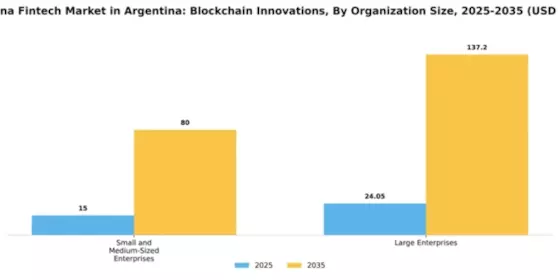
Small and Medium-Sized Enterprises: Dominant vs. Large Enterprises: Emerging
Small and Medium-Sized Enterprises (SMEs) are the dominant force in the Argentina blockchain fintech market, characterized by their quick adaptability and innovative approaches to technology. Their capacity to implement blockchain solutions efficiently allows them to stay competitive, often leading to tailored products and services that meet local demands. On the other hand, Large Enterprises are emerging with a focus on integrating blockchain technologies for improved operational efficiency and enhanced customer experiences. They leverage their substantial resources to explore new blockchain applications, which, although not as prevalent as SMEs, signifies a strong potential for growth. As the market evolves, the synergy between these two segments will likely drive innovation and expansion in the blockchain fintech space.
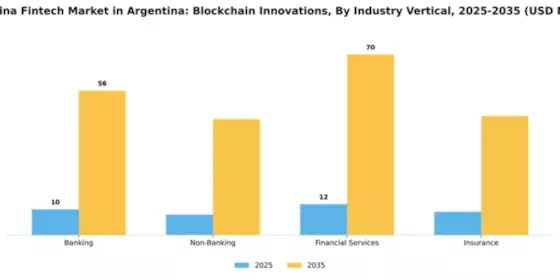
In the Argentina blockchain fintech market, the market share distribution reveals that Banking holds a significant position, capitalizing on traditional financial infrastructures while integrating blockchain technology for improved transparency and efficiency. Non-Banking and Financial Services, while present, comprise lesser shares, catering to niche demands. Insurance emerges as a notable emerging segment within the market, gradually capturing interest through innovative use cases in claims processing and fraud detection. Growth trends indicate that Banking continues to dominate due to established consumer trust and regulatory acceptance of blockchain solutions. However, Insurance is showcasing rapid expansion as it addresses specific pain points in customer service and risk management. Moreover, the adoption of smart contracts and automated processes in Insurance reflects the industry's shift towards leveraging digital transformation effectively.
Banking: Dominant vs. Insurance: Emerging
Banking, as the dominant segment in the Argentina blockchain fintech market, benefits from its long-standing infrastructure and customer base, allowing for easier adaptation of blockchain technologies. This segment focuses heavily on enhancing security, reducing transaction times, and lowering operational costs through decentralized finance (DeFi) solutions. Conversely, Insurance is gradually positioning itself as an emerging player, utilizing blockchain to streamline operations and enhance customer experiences. The advent of automated claims processing and the ability to maintain transparent records are key drivers for this growth in the Insurance sector, reflecting a strong shift toward modernization and efficiency in service delivery.
Get more detailed insights about Argentina Blockchain Fintech Market Request Free Sample
The blockchain fintech market in Argentina is characterized by a rapidly evolving competitive landscape, driven by technological advancements and increasing consumer adoption. Major players such as Binance (MT), Coinbase (US), and Ripple (US) are actively shaping the market through strategic initiatives aimed at enhancing their service offerings and expanding their user base. Binance (MT) has positioned itself as a leader by focusing on innovation and user experience, while Coinbase (US) emphasizes regulatory compliance and security, appealing to a more risk-averse clientele. Ripple (US), on the other hand, is leveraging its partnerships with financial institutions to facilitate cross-border transactions, thereby enhancing its competitive edge in the remittance sector. Collectively, these strategies contribute to a dynamic environment where competition is not solely based on pricing but also on technological capabilities and service reliability. In terms of business tactics, companies are increasingly localizing their operations to better cater to the Argentine market. This includes optimizing supply chains and enhancing customer support services to meet local demands. The market appears moderately fragmented, with several key players vying for market share. However, the influence of major companies like Binance (MT) and Coinbase (US) is substantial, as they set industry standards and drive innovation, thereby shaping the overall market structure. In October 2025, Binance (MT) announced the launch of a new educational initiative aimed at increasing blockchain literacy among Argentine users. This move is strategically significant as it not only positions Binance (MT) as a thought leader in the space but also fosters a more informed user base, potentially leading to increased adoption of their services. By investing in education, Binance (MT) is likely to enhance customer loyalty and trust, which are critical in a market that is still maturing. In September 2025, Coinbase (US) expanded its operations in Argentina by introducing a localized version of its platform, tailored to meet the specific needs of Argentine consumers. This strategic localization is crucial as it allows Coinbase (US) to better engage with local users, offering them a more relevant and user-friendly experience. Such adaptations may lead to increased market penetration and customer retention, as users are more likely to engage with platforms that understand their unique needs. In November 2025, Ripple (US) secured a partnership with a major Argentine bank to facilitate real-time cross-border payments. This collaboration is indicative of Ripple's strategy to integrate its technology within traditional financial systems, thereby enhancing its credibility and reach. By aligning with established financial institutions, Ripple (US) not only expands its operational footprint but also reinforces its position as a key player in the remittance market, which is particularly vital in a country with a high volume of cross-border transactions. As of November 2025, the competitive trends in the blockchain fintech market are increasingly defined by digitalization, sustainability, and the integration of artificial intelligence. Strategic alliances are becoming more prevalent, as companies recognize the value of collaboration in enhancing their technological capabilities and market reach. Looking ahead, it is likely that competitive differentiation will evolve, with a shift from price-based competition to a focus on innovation, technology, and supply chain reliability. This transition suggests that companies that prioritize these aspects will be better positioned to thrive in an increasingly competitive landscape.


In recent months, the Argentina Blockchain Fintech Market has experienced significant developments, notably with companies such as Mercado Libre and Ripio enhancing their cryptocurrency offerings. Pagadito announced an innovative partnership with local banks to facilitate crypto transactions, further mainstreaming digital currencies.
Uphold and SatoshiTango have also made strides by increasing their user engagement through enhanced services. In terms of market valuation, Bitcoin adoption in Argentina has risen, increasing by over 60% year-on-year as consumers opt for cryptocurrencies in response to inflation, which has been a major economic concern since 2021.
Notably, Bitso secured partnerships with major payment networks to expand its operations in Argentina, showcasing the increasing importance of this sector.
Overall, the market is witnessing a robust evolution as regulatory frameworks are beginning to adapt, with the government placing emphasis on blockchain technology to boost financial inclusion. These advancements reflect a vibrant and rapidly changing landscape in Argentinablockchain fintech market, driven largely by both innovation and necessity amidst economic challenges.
The blockchain fintech market in Argentina is projected to grow at a 16.88% CAGR from 2025 to 2035, driven by technological advancements, regulatory support, and increasing digital transactions.
New opportunities lie in:
By 2035, the blockchain fintech market is expected to be a cornerstone of Argentina's financial ecosystem.
| MARKET SIZE 2024 | 39.05(USD Million) |
| MARKET SIZE 2025 | 45.64(USD Million) |
| MARKET SIZE 2035 | 217.17(USD Million) |
| COMPOUND ANNUAL GROWTH RATE (CAGR) | 16.88% (2025 - 2035) |
| REPORT COVERAGE | Revenue Forecast, Competitive Landscape, Growth Factors, and Trends |
| BASE YEAR | 2024 |
| Market Forecast Period | 2025 - 2035 |
| Historical Data | 2019 - 2024 |
| Market Forecast Units | USD Million |
| Key Companies Profiled | Binance (MT), Coinbase (US), Ripple (US), Bitfinex (HK), Kraken (US), Gemini (US), Bitstamp (LU), eToro (IL), Blockchain.com (GB) |
| Segments Covered | Application, Provider, Organization Size, Industry Vertical |
| Key Market Opportunities | Integration of decentralized finance solutions to enhance financial inclusion and accessibility in emerging markets. |
| Key Market Dynamics | Regulatory shifts and technological advancements drive innovation in Argentina's blockchain fintech market. |
| Countries Covered | Argentina |
The overall market valuation was $39.05 Million in 2024.
The projected valuation for 2035 is $217.17 Million.
The expected CAGR during the forecast period 2025 - 2035 is 16.88%.
The Exchanges and Remittances segment had the highest valuation at $35.0 Million in 2024.
Key players include Binance (MT), Coinbase (US), Ripple (US), and Kraken (US), among others.
The Payments segment recorded a valuation of $28.0 Million in 2024.
The Smart Contracts segment is expected to grow to $15.0 Million by 2035.
The Compliance Management/KYC segment had a valuation of $15.0 Million in 2024.
Small and Medium-Sized Enterprises had a valuation of $80.0 Million, while Large Enterprises reached $137.17 Million in 2024.
The Infrastructure and Protocols Providers segment is projected to reach $82.17 Million by 2035.


Kindly complete the form below to receive a free sample of this Report

“This is really good guys. Excellent work on a tight deadline. I will continue to use you going forward and recommend you to others. Nice job”


“Thanks. It’s been a pleasure working with you, please use me as reference with any other Intel employees.”


“Thanks for sending the report it gives us a good global view of the Betaïne market.”


“Thank you, this will be very helpful for OQS.”


“We found the report very insightful! we found your research firm very helpful. I'm sending this email to secure our future business.”


“I am very pleased with how market segments have been defined in a relevant way for my purposes (such as "Portable Freezers & refrigerators" and "last-mile"). In general the report is well structured. Thanks very much for your efforts.”


“I have been reading the first document or the study, ,the Global HVAC and FP market report 2021 till 2026. Must say, good info! I have not gone in depth at all parts, but got a good indication of the data inside!”


“We got the report in time, we really thank you for your support in this process. I also thank to all of your team as they did a great job.”


“The Automotive 48V ECU Components Procurement Intelligence Study” was a complex project, but the Market Research Future (MRFR) team handled it with quality, agility, and customer-centricity. They delivered all requested data on time and within the agreed scope. The team, including Shubhendra Anand and Rahul Gotadki, was always readily available to clarify questions and swiftly implement necessary adjustments, driving the project to a successful conclusion within a very demanding timeframe.
I would also like to specifically commend Akshay Agarwal for his responsiveness and support at every stage—from our initial inquiry on May 6th through to final delivery on June 18th. His dedication made the entire process seamless.”



