×
Request Free Sample ×

Kindly complete the form below to receive a free sample of this Report

* Please use a valid business email

Leading companies partner with us for data-driven Insights

clients tt-cursor
Hero Background

Aromatic Ketone Polymer Market

ID: MRFR/CnM/4316-HCR
140 Pages
Priya Nagrale
October 2025

Aromatic Ketone Polymer Market by Type (Poly Ether Ether Ketone, Poly Ether Ketone Ketone, Poly Ether Ketone), Application (Electronic, Automotive, Aerospace, Medical and Others), By Region - Forcast to 2030

Share:
Download PDF ×

We do not share your information with anyone. However, we may send you emails based on your report interest from time to time. You may contact us at any time to opt-out.

Aromatic Ketone Polymer Market Infographic
Purchase Options

Aromatic Ketone Polymer Market Summary

As per MRFR analysis, the Aromatic Ketone Polymer Market Size was estimated at 4.24 USD Million in 2024. The Aromatic Ketone Polymer industry is projected to grow from 4.51 in 2025 to 8.38 by 2035, exhibiting a compound annual growth rate (CAGR) of 6.39 during the forecast period 2025 - 2035.

Key Market Trends & Highlights

The Aromatic Ketone Polymer Market is poised for robust growth driven by sustainability and technological advancements.

  • North America remains the largest market for aromatic ketone polymers, driven by strong demand in the automotive sector.
  • Asia-Pacific is recognized as the fastest-growing region, with increasing investments in infrastructure and construction.
  • The adhesives segment holds the largest share, while the coatings segment is experiencing rapid growth due to diverse application needs.
  • Key market drivers include rising demand in the automotive sector and a growing focus on sustainable materials.

Market Size & Forecast

2024 Market Size 4.24 (USD Million)
2035 Market Size 8.38 (USD Million)
CAGR (2025 - 2035) 6.39%

Major Players

BASF SE (DE), Mitsubishi Chemical Corporation (JP), Covestro AG (DE), SABIC (SA), LG Chem Ltd. (KR), Eastman Chemical Company (US), Huntsman Corporation (US), Solvay SA (BE), DIC Corporation (JP)

Aromatic Ketone Polymer Market Trends

The Aromatic Ketone Polymer Market is currently experiencing a notable evolution, driven by various factors that influence its growth trajectory. This sector appears to be gaining traction due to the increasing demand for high-performance materials across diverse industries, including automotive, aerospace, and electronics. The unique properties of aromatic ketone polymers, such as their thermal stability and chemical resistance, make them particularly appealing for applications requiring durability and reliability. Furthermore, the ongoing advancements in polymer technology suggest a potential for enhanced performance characteristics, which could further stimulate market interest. In addition to technological innovations, sustainability considerations are becoming increasingly relevant within the Aromatic Ketone Polymer Market. Manufacturers are exploring eco-friendly production methods and materials, aligning with global trends towards greener practices. This shift not only addresses environmental concerns but also meets the evolving preferences of consumers and businesses alike. As the market continues to adapt to these dynamics, it is likely that new opportunities will emerge, fostering a competitive landscape that encourages innovation and collaboration among key players.

Sustainability Initiatives

The Aromatic Ketone Polymer Market is witnessing a growing emphasis on sustainability. Companies are increasingly adopting eco-friendly practices in production, focusing on reducing waste and energy consumption. This trend aligns with global environmental goals and consumer preferences for greener products.

Technological Advancements

Innovations in polymer technology are shaping the Aromatic Ketone Polymer Market. Enhanced processing techniques and material formulations are leading to improved performance characteristics. These advancements are likely to attract new applications and expand market reach.

Diverse Application Growth

The demand for aromatic ketone polymers is expanding across various sectors, including automotive and electronics. This diversification indicates a robust market potential, as industries seek materials that offer superior performance and reliability.

Aromatic Ketone Polymer Market Drivers

Market Growth Projections

The Global Aromatic Ketone Polymer Market Industry is poised for substantial growth, with projections indicating a market value of 2500 USD Million in 2024 and an anticipated increase to 4000 USD Million by 2035. This growth trajectory suggests a compound annual growth rate (CAGR) of 4.37% from 2025 to 2035. Such figures reflect the increasing adoption of aromatic ketone polymers across various industries, driven by their unique properties and performance advantages. The market's expansion is indicative of a broader trend towards innovative materials that meet the evolving needs of manufacturers and consumers alike.

Advancements in Material Science

Innovations in material science are propelling the Global Aromatic Ketone Polymer Market Industry forward. Researchers are continuously developing new formulations that enhance the properties of aromatic ketone polymers, making them more versatile for various applications. These advancements may lead to improved performance characteristics, such as increased durability and resistance to environmental factors. As industries seek materials that can withstand harsh conditions while maintaining functionality, the demand for these advanced polymers is likely to rise. This trend aligns with the projected CAGR of 4.37% from 2025 to 2035, indicating a robust future for the market.

Rising Demand in Automotive Sector

The Global Aromatic Ketone Polymer Market Industry experiences a notable surge in demand driven by the automotive sector. As manufacturers increasingly prioritize lightweight materials for fuel efficiency, aromatic ketone polymers are becoming essential in vehicle production. These polymers offer superior strength-to-weight ratios, which enhance performance while reducing emissions. In 2024, the market is projected to reach 2500 USD Million, reflecting the automotive industry's shift towards sustainable practices. This trend is likely to continue, as the sector aims for a greener future, potentially propelling the market further as it aligns with global environmental regulations.

Diverse Applications Across Industries

The Global Aromatic Ketone Polymer Market Industry is characterized by its diverse applications across various sectors, including automotive, electronics, and construction. This versatility allows for a broad customer base, which is crucial for market stability and growth. As industries continue to explore the benefits of aromatic ketone polymers, their adoption is expected to increase. The ability to tailor these polymers for specific applications enhances their appeal, making them a preferred choice for manufacturers. This diversity in application is likely to contribute to the market's resilience and growth trajectory in the coming years.

Regulatory Support for Sustainable Materials

The Global Aromatic Ketone Polymer Market Industry benefits from increasing regulatory support for sustainable materials. Governments worldwide are implementing policies that encourage the use of eco-friendly materials in manufacturing processes. This regulatory landscape is fostering innovation and investment in aromatic ketone polymers, as industries strive to comply with environmental standards. The emphasis on sustainability is likely to drive demand, as companies seek to enhance their green credentials. This shift not only supports market growth but also aligns with global efforts to reduce carbon footprints, potentially leading to a more sustainable future for the industry.

Growth in Electronics and Electrical Applications

The Global Aromatic Ketone Polymer Market Industry is significantly influenced by the expanding electronics and electrical applications. These polymers are utilized in manufacturing components such as insulators, connectors, and circuit boards due to their excellent thermal stability and electrical insulating properties. As the demand for advanced electronic devices rises, particularly in consumer electronics, the market is expected to flourish. The anticipated growth in this sector could contribute to the market's expansion, with projections indicating a rise to 4000 USD Million by 2035. This growth underscores the polymers' critical role in the evolving landscape of technology.
Market Segment Insights

By Application: Adhesives (Largest) vs. Coatings (Fastest-Growing)

In the Aromatic Ketone Polymer market, the application segment is broadly distributed across various value categories, including Adhesives, Coatings, Sealants, Composites, and Plastics. Among these, Adhesives occupy the largest market share, driven by their extensive use in construction, automotive, and packaging industries. Coatings, however, are emerging as a crucial segment due to increased demand for protective and aesthetic finishes in various sectors, making them a significant player in the market.

Adhesives (Dominant) vs. Coatings (Emerging)

Adhesives have solidified their position as the dominant application in the Aromatic Ketone Polymer market due to their versatility and effectiveness in bonding materials across industries. These products provide strong adhesion, thermal stability, and resistance to environmental factors, making them essential in applications ranging from automotive assembly to consumer goods. On the other hand, Coatings are becoming an emerging segment, driven by advances in technology and a push for higher-quality surface finishes. This segment's growth is motivated by a growing emphasis on aesthetics and durability in products, leading to the development of innovative coating solutions that enhance performance and visual appeal.

By End Use Industry: Automotive (Largest) vs. Aerospace (Fastest-Growing)

The 'End Use Industry' segment within the Aromatic Ketone Polymer Market displays a diverse range of applications with varying market shares. The automotive industry holds the largest share, driven by the increasing demand for lightweight, durable materials that enhance fuel efficiency. In contrast, the aerospace sector, while smaller in share currently, shows the fastest growth due to rising aviation demand and advancements in aerospace technology that require high-performance materials.

Automotive: Dominant vs. Aerospace: Emerging

The automotive segment is a dominant player in the Aromatic Ketone Polymer Market, benefiting from a focus on sustainability and the need for lightweight components to improve overall vehicle efficiency. High-performance thermal and mechanical properties make aromatic ketone polymers attractive for various automotive applications, including interiors, exteriors, and under-the-hood components. Conversely, the aerospace sector represents an emerging segment, with its rapid growth fueled by an uptick in air travel and aircraft manufacturing. Aerospace applications leverage the unique properties of aromatic ketone polymers for parts subjected to extreme conditions, ensuring safety and performance in flight.

By Formulation Type: Solvent-Based (Largest) vs. Water-Based (Fastest-Growing)

In the Aromatic Ketone Polymer Market, the formulation type segment reveals a diverse distribution among its values, with solvent-based formulations holding the largest market share due to their superior performance and wide applicability across various manufacturing processes. Water-based formulations, on the other hand, are rapidly gaining traction, driven by increasing environmental regulations that promote sustainable practices. As manufacturers seek eco-friendly alternatives, the market share of water-based polymers is on the rise, quickly becoming a strong contender in the segment.

Solvent-Based (Dominant) vs. Emulsion-Based (Emerging)

Solvent-based formulations remain the dominant player in the Aromatic Ketone Polymer Market due to their robust properties, including enhanced adhesion, durability, and versatility in application. They are widely utilized in the automotive, construction, and consumer goods industries, making them crucial for high-performance requirements. Conversely, emulsion-based formulations are emerging as a strong alternative, particularly appealing to manufacturers focused on sustainability. These formulations offer reduced volatile organic compound (VOC) emissions and are increasingly favored in water-sensitive applications. The growth of emulsion-based products reflects a shift towards environmentally friendly solutions, positioning them as a noteworthy segment in the current market landscape.

By Polymer Type: Thermoplastic (Largest) vs. Elastomer (Fastest-Growing)

The Aromatic Ketone Polymer Market displays a diverse distribution of polymer types, with thermoplastics capturing a significant share due to their versatility and wide range of applications. This segment benefits from high demand across industries such as automotive, electronics, and consumer goods. On the other hand, thermosetting polymers are also prevalent, particularly where heat resistance and structural integrity are crucial. Meanwhile, elastomers, though currently a smaller segment, are rapidly gaining traction as they are increasingly utilized in various innovative applications.

Polymer Type: Thermoplastic (Dominant) vs. Elastomer (Emerging)

Thermoplastics are regarded as the dominant polymer type in the Aromatic Ketone Polymer Market, owing to their impressive processing capabilities and reusability. Their ability to melt and remold makes them an ideal choice for high-volume production runs, particularly in sectors demanding lightweight and durable materials. Conversely, elastomers are emerging as a significant market force, driven by their unique elasticity and resilience. These materials are becoming increasingly popular in applications requiring flexibility, such as seals, gaskets, and protective items. The rising innovation in elastomer formulations is expected to propel their growth, making them a preferred choice for modern industrial applications.

By Processing Method: Injection Molding (Largest) vs. Extrusion (Fastest-Growing)

The Aromatic Ketone Polymer Market demonstrates diverse share distribution among various processing methods. Injection Molding stands as the largest segment, primarily due to its versatility and efficiency in producing high-quality parts at scale. Meanwhile, Extrusion is capturing attention as the fastest-growing processing method, driven by increasing demand for continuous shapes and profiles in applications such as packaging and construction.

Injection Molding (Dominant) vs. Blow Molding (Emerging)

Injection Molding maintains dominant market status due to its ability to create intricate designs and reliable prototypes, making it ideal for high-volume production in the aromatic ketone polymers sector. In contrast, Blow Molding is emerging as a relevant process for manufacturing hollow parts and containers, presenting features such as lightweight designs and efficient material usage. The transition towards more sustainable practices and the need for innovative packaging solutions are driving interest in Blow Molding as industries look for alternatives to traditional methods. As both methods evolve, they reveal distinct advantages across varying applications.

Get more detailed insights about Aromatic Ketone Polymer Market

Regional Insights

North America : Market Leader in Innovation

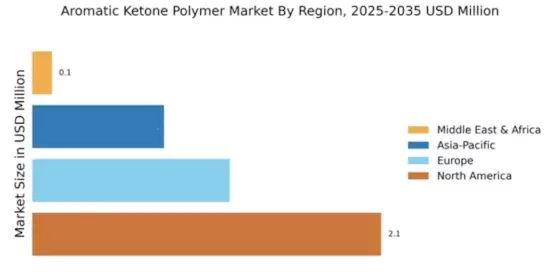
North America is poised to maintain its leadership in the Aromatic Ketone Polymer market, holding a significant market share of 2.12 in 2024. The region's growth is driven by robust demand from industries such as automotive, electronics, and construction, alongside favorable regulatory frameworks that promote innovation. The increasing focus on sustainable materials and advanced manufacturing processes further catalyzes market expansion. The United States stands out as the leading country in this sector, with major players like BASF SE, Eastman Chemical Company, and Huntsman Corporation driving competition. The presence of established companies fosters a dynamic market environment, encouraging technological advancements and strategic partnerships. As the market evolves, North America is expected to leverage its innovation capabilities to sustain its competitive edge.

Europe : Sustainable Growth Initiatives

Europe's Aromatic Ketone Polymer market is projected to grow significantly, with a market size of 1.2 in 2024. The region is characterized by stringent environmental regulations and a strong push towards sustainability, which are key drivers of demand. The European Union's commitment to reducing carbon emissions and promoting circular economy practices is expected to further enhance market opportunities for aromatic ketone polymers. Germany and France are leading countries in this market, with companies like Covestro AG and SABIC playing pivotal roles. The competitive landscape is marked by innovation and collaboration among key players, focusing on developing eco-friendly products. As Europe continues to prioritize sustainability, the aromatic ketone polymer market is likely to see increased investments and advancements in technology.

Asia-Pacific : Rapid Industrialization and Growth

The Asia-Pacific region is witnessing rapid growth in the Aromatic Ketone Polymer market, with a market size of 0.84 in 2024. This growth is fueled by industrialization, urbanization, and increasing demand from sectors such as packaging, automotive, and electronics. Governments in the region are implementing supportive policies to enhance manufacturing capabilities, which is expected to drive further demand for aromatic ketone polymers. Japan and South Korea are at the forefront of this market, with key players like Mitsubishi Chemical Corporation and LG Chem Ltd. leading the charge. The competitive landscape is evolving, with a focus on innovation and product development. As the region continues to expand its industrial base, the aromatic ketone polymer market is set to benefit from increased investments and technological advancements.

Middle East and Africa : Emerging Market Potential

The Middle East and Africa region is in the nascent stages of developing its Aromatic Ketone Polymer market, with a market size of 0.08 in 2024. The growth potential is significant, driven by increasing industrial activities and a growing demand for advanced materials in construction and automotive sectors. Governments are beginning to recognize the importance of diversifying economies, which is expected to catalyze market development in this region. Countries like South Africa and Saudi Arabia are emerging as key players, with investments in manufacturing and infrastructure. The competitive landscape is still developing, but the presence of global companies like SABIC indicates a promising future. As the region continues to invest in industrial growth, the aromatic ketone polymer market is likely to see substantial opportunities for expansion.

Key Players and Competitive Insights

The Aromatic Ketone Polymer Market is currently characterized by a dynamic competitive landscape, driven by innovation, sustainability, and strategic partnerships. Key players such as BASF SE (DE), Mitsubishi Chemical Corporation (JP), and Covestro AG (DE) are actively shaping the market through their distinct operational focuses. BASF SE (DE) emphasizes innovation in product development, particularly in sustainable solutions, while Mitsubishi Chemical Corporation (JP) is enhancing its regional presence through strategic collaborations. Covestro AG (DE) is focusing on digital transformation to optimize its manufacturing processes, which collectively influences the competitive environment by fostering a culture of continuous improvement and responsiveness to market demands.

The market structure appears moderately fragmented, with several key players exerting influence over various segments. Companies are increasingly localizing manufacturing to reduce lead times and enhance supply chain efficiency. This tactic not only mitigates risks associated with The Aromatic Ketone Polymer needs. The collective influence of these major players is significant, as they drive trends that shape the overall market dynamics.

In November 2025, BASF SE (DE) announced a partnership with a leading technology firm to develop advanced recycling technologies for aromatic ketone polymers. This strategic move is likely to enhance BASF's sustainability profile and position it as a leader in eco-friendly solutions, responding to the growing demand for sustainable materials in various industries. The collaboration underscores the importance of innovation in maintaining competitive advantage in a rapidly evolving market.

In October 2025, Mitsubishi Chemical Corporation (JP) expanded its production capacity for aromatic ketone polymers in Asia, aiming to meet the increasing demand from the automotive and electronics sectors. This expansion not only strengthens Mitsubishi's market position but also reflects a broader trend of regional manufacturing optimization, which is crucial for responding to local market dynamics and customer needs. The strategic importance of this move lies in its potential to enhance supply chain resilience and operational efficiency.

In September 2025, Covestro AG (DE) launched a new line of high-performance aromatic ketone polymers designed for use in high-temperature applications. This product introduction is indicative of Covestro's commitment to innovation and its ability to cater to niche markets. By focusing on high-performance materials, Covestro is likely to differentiate itself from competitors, thereby enhancing its market share and reinforcing its reputation as a leader in advanced materials.

As of December 2025, the competitive trends in the Aromatic Ketone Polymer Market are increasingly defined by digitalization, sustainability, and the integration of AI technologies. Strategic alliances are becoming more prevalent, as companies recognize the need to collaborate to enhance their technological capabilities and market reach. The shift from price-based competition to a focus on innovation, technology, and supply chain reliability is evident, suggesting that future competitive differentiation will hinge on the ability to deliver sustainable and technologically advanced solutions.

Key Companies in the Aromatic Ketone Polymer Market market include

Future Outlook

Aromatic Ketone Polymer Market Future Outlook

The Aromatic Ketone Polymer Market is projected to grow at a 6.39% CAGR from 2024 to 2035, driven by increasing demand in automotive and electronics sectors.

New opportunities lie in:

  • Development of high-performance coatings for automotive applications.
  • Expansion into biodegradable aromatic ketone polymers for sustainable packaging.
  • Investment in R&D for advanced polymer composites in electronics.

By 2035, the market is expected to achieve robust growth, positioning itself as a leader in polymer innovation.

Market Segmentation

Aromatic Ketone Polymer Market Application Outlook

  • Adhesives
  • Coatings
  • Sealants
  • Composites
  • Plastics

Aromatic Ketone Polymer Market Polymer Type Outlook

  • Thermoplastic
  • Thermosetting
  • Elastomer

Aromatic Ketone Polymer Market End Use Industry Outlook

  • Automotive
  • Aerospace
  • Construction
  • Electronics
  • Consumer Goods

Aromatic Ketone Polymer Market Formulation Type Outlook

  • Solvent-Based
  • Water-Based
  • Powder-Based
  • Emulsion-Based

Aromatic Ketone Polymer Market Processing Method Outlook

  • Injection Molding
  • Extrusion
  • Blow Molding
  • Thermoforming

Report Scope

MARKET SIZE 20244.24(USD Million)
MARKET SIZE 20254.51(USD Million)
MARKET SIZE 20358.38(USD Million)
COMPOUND ANNUAL GROWTH RATE (CAGR)6.39% (2024 - 2035)
REPORT COVERAGERevenue Forecast, Competitive Landscape, Growth Factors, and Trends
BASE YEAR2024
Market Forecast Period2025 - 2035
Historical Data2019 - 2024
Market Forecast UnitsUSD Million
Key Companies ProfiledBASF SE (DE), Mitsubishi Chemical Corporation (JP), Covestro AG (DE), SABIC (SA), LG Chem Ltd. (KR), Eastman Chemical Company (US), Huntsman Corporation (US), Solvay SA (BE), DIC Corporation (JP)
Segments CoveredApplication, End Use Industry, Formulation Type, Polymer Type, Processing Method
Key Market OpportunitiesGrowing demand for sustainable materials drives innovation in the Aromatic Ketone Polymer Market.
Key Market DynamicsRising demand for lightweight materials drives innovation and competition in the aromatic ketone polymer sector.
Countries CoveredNorth America, Europe, APAC, South America, MEA

Market Highlights

Author
Priya Nagrale
Senior Research Analyst

With an experience of over five years in market research industry (Chemicals & Materials domain), I gather and analyze market data from diverse sources to produce results, which are then presented back to a client. Also, provide recommendations based on the findings. As a Senior Research Analyst, I perform quality checks (QC) for market estimations, QC for reports, and handle queries and work extensively on client customizations. Also, handle the responsibilities of client proposals, report planning, report finalization, and execution

Leave a Comment

FAQs

What are the major product types in the aromatic ketone polymer market?

Major product types in the market include PEEK, PEKK, and PEK.

What are the major end use industries?

Major end use industries for aromatic ketone polymer include electronics, automotive, aerospace, and medical.

What is the major driver for the market?

Growing demand from the electronics industry is the major driver for the aromatic ketone polymer market.

Which is the leading regional market?

North America holds the largest share in the global market.

What are the key players in the market?

Leading players in the market include DSM, Solvay, and Victrex, among others.

Download Free Sample

Kindly complete the form below to receive a free sample of this Report

Compare Licence

×
Features License Type
Single User Multiuser License Enterprise User
Price $4,950 $5,950 $7,250
Maximum User Access Limit 1 User Upto 10 Users Unrestricted Access Throughout the Organization
Free Customization
Direct Access to Analyst
Deliverable Format
Platform Access
Discount on Next Purchase 10% 15% 15%
Printable Versions