×
Request Free Sample ×

Kindly complete the form below to receive a free sample of this Report

* Please use a valid business email

Leading companies partner with us for data-driven Insights

clients tt-cursor
Hero Background

Artificial insemination Market

ID: MRFR/MED/0711-CR
90 Pages
Rahul Gotadki
February 2021

Artificial Insemination Market Size, Growth Research Report By Type (Intrauterine, Intracervical and Intratubal), End User (Hospitals & Clinics, Fertility Centre and Home-Based) and Region (Americas, Europe, Asia-Pacific and Rest of the World) - Competitor Industry Analysis and Trends Forecast Till 2035

Share:
Download PDF ×

We do not share your information with anyone. However, we may send you emails based on your report interest from time to time. You may contact us at any time to opt-out.

Artificial insemination Market Infographic
Purchase Options

Artificial insemination Market Summary

As per MRFR analysis, the Artificial insemination Market Size was estimated at 2397.98 USD Million in 2024. The Artificial insemination industry is projected to grow from 2632.16 USD Million in 2025 to 5979.93 USD Million by 2035, exhibiting a compound annual growth rate (CAGR) of 8.62 during the forecast period 2025 - 2035.

Key Market Trends & Highlights

The Artificial Insemination Market is experiencing robust growth driven by technological advancements and changing societal norms.

  • Technological advancements are enhancing the efficiency and success rates of artificial insemination procedures.
  • Cultural acceptance of artificial insemination is increasing, particularly in North America, leading to wider adoption.
  • The artificial insemination in cattle segment remains the largest, while the swine segment is witnessing the fastest growth.
  • Rising demand for fertility treatments and increased awareness are key drivers propelling market expansion.

Market Size & Forecast

2024 Market Size 2397.98 (USD Million)
2035 Market Size 5979.93 (USD Million)
CAGR (2025 - 2035) 8.62%

Major Players

Genus PLC (GB), Zoetis Inc. (US), Merck Animal Health (US), Hendrix Genetics (NL), Select Sires Inc. (US), Gencor (US), CRV Holding (NL), Harrisvaccines Inc. (US), Neogen Corporation (US)

Artificial insemination Market Trends

The Artificial insemination Market is currently experiencing a notable evolution, driven by advancements in reproductive technologies and increasing awareness regarding fertility issues. As more individuals and couples seek assistance in conception, the demand for artificial insemination services appears to be on the rise. This trend is further supported by a growing acceptance of assisted reproductive techniques across various cultures, which may contribute to a broader market reach. Additionally, the integration of innovative technologies, such as artificial intelligence and genetic screening, seems to enhance the effectiveness and safety of procedures, thereby attracting more clients to these services. Moreover, the Artificial insemination Market is likely to benefit from the expansion of healthcare infrastructure and improved access to fertility clinics. As more facilities emerge, competition may intensify, leading to enhanced service offerings and potentially lower costs for consumers. Furthermore, the increasing focus on personalized medicine suggests that tailored treatment plans could become more prevalent, addressing the unique needs of individuals seeking assistance. Overall, the market appears poised for growth, with various factors converging to create a favorable environment for artificial insemination services.

Technological Advancements

The integration of cutting-edge technologies in the Artificial insemination Market is transforming traditional practices. Innovations such as artificial intelligence and advanced genetic screening are enhancing the precision and success rates of procedures, making them more appealing to prospective clients.

Cultural Acceptance

There is a noticeable shift in societal attitudes towards assisted reproductive technologies. As more individuals and couples openly discuss fertility challenges, the stigma surrounding artificial insemination diminishes, potentially leading to increased utilization of these services.

Healthcare Accessibility

The expansion of healthcare facilities specializing in reproductive health is likely to improve access to artificial insemination services. As more clinics emerge, competition may foster better service quality and affordability, making these options more attainable for a wider audience.

Artificial insemination Market Drivers

Increasing Demand for Livestock Production

The Global Artificial Insemination Market Industry experiences a notable surge in demand due to the increasing need for livestock production. As global populations rise, the demand for meat and dairy products escalates, prompting farmers to enhance productivity. Artificial insemination Market allows for the rapid genetic improvement of livestock, leading to healthier and more productive animals. This method is particularly advantageous in regions where traditional breeding practices are insufficient. By 2024, the market is projected to reach 4.3 USD Billion, reflecting the growing reliance on advanced reproductive technologies to meet food security challenges.

Market Segment Insights

By Application: Artificial Insemination in Cattle (Largest) vs. Artificial Insemination in Swine (Fastest-Growing)

The artificial insemination market is predominantly led by the application in cattle, which holds the largest market share due to the strong demand for high-quality meat and dairy products. Cattle insemination's popularity stems from its effectiveness in improving herd genetics and productivity, making it a preferred choice among farmers and livestock breeders. In contrast, artificial insemination in swine is emerging rapidly, driven by the increasing global pork consumption and advancements in reproductive technologies that enhance breeding outcomes for swine herds.

Artificial Insemination: Cattle (Dominant) vs. Swine (Emerging)

Artificial insemination in cattle remains the dominant application in the market owing to its significant role in enhancing milk and meat production, improving herd management, and ensuring genetic diversity. Cattle breeders utilize this technique to select superior genetics for their herds, leading to increased productivity. On the other hand, artificial insemination in swine is gaining traction as an emerging application, fueled by innovations in breeding techniques and a growing need to meet the rising pork demand. The efficiency and improved genetic outcomes of swine insemination position it as a competitive option in the livestock sector, signaling a shift in breeding practices.

By End Use: Farms (Largest) vs. Breeding Centers (Fastest-Growing)

The artificial insemination market is significantly segmented by end use, with Farms exhibiting the largest market share owing to their high demand for improved genetic quality in livestock. Veterinary Clinics follow closely, focusing on providing essential reproductive services. Breeding Centers, while currently smaller in market share, are booming as they cater to specialized breeding needs, highlighting the diversity within this market sector. Research Institutions contribute to advancements but hold a more niche market role.

Farms: Dominant vs. Breeding Centers: Emerging

Farms play a dominant role in the artificial insemination market as they are at the forefront of livestock reproduction trends, seeking genetic improvements to enhance productivity and health. Their substantial integration of artificial insemination practices is driven by evolving breeding technologies and the need for effective herd management. In contrast, Breeding Centers are emerging as a fast-growing segment, attracting attention for their specialized services that focus on high-quality genetic material. These centers are expanding rapidly due to increasing interest in advanced breeding techniques and customized solutions that not only meet farm demands but also align with sustainable agricultural practices.

By Technology: Semen Freezing (Largest) vs. Semen Processing (Fastest-Growing)

In the Artificial Insemination Market, the 'By Technology' segment showcases a diverse distribution among its values. Semen Freezing stands out as the largest segment, capturing a significant share due to its crucial role in preserving viability during storage and transport. Meanwhile, Semen Processing has emerged as a rapidly growing sector driven by advancements in fertility practices and increasing awareness of successful artificial insemination techniques. The growth trends within this segment are propelled by technological innovations such as advanced cryopreservation methods and the rising acceptance of artificial insemination in both livestock and human fertility treatments. The demand for these technologies is further stimulated by ongoing research and development aimed at improving efficiency and outcomes in artificial insemination practices. As a result, the market anticipates substantial shifts in preferences towards these high-tech solutions over the forecast period.

Technology: Semen Freezing (Dominant) vs. Semen Thawing (Emerging)

Semen Freezing remains the dominant technology in the artificial insemination landscape, recognized for its critical role in increasing the shelf life of viable sperm and enabling global distribution. This method’s established techniques ensure that reproductive materials are preserved effectively, making it a cornerstone of artificial insemination practices. Conversely, Semen Thawing has emerged as a focal point of interest due to recent innovations aimed at enhancing recovery rates and minimizing damage to sperm during the thawing process. As demand for efficient thawing protocols grows, combined with the push for more successful insemination rates, this sector is increasingly being viewed as a vital element of the overall artificial insemination technology spectrum.

By Type: Frozen Semen (Largest) vs. Chilled Semen (Fastest-Growing)

The Artificial Insemination Market is primarily segmented into three main types of semen: Fresh Semen, Frozen Semen, and Chilled Semen. Among these, Frozen Semen currently holds the largest market share due to its convenience and long shelf life, which make it a preferred choice for breeders across various species. Fresh Semen, while crucial for immediate use, has a smaller market share as it requires timely application and is not as versatile as its frozen counterpart. Chilled Semen is gaining traction, especially in assisted reproduction technologies, contributing significantly to the diversification of the market.

Semen Types: Fresh Semen (Dominant) vs. Chilled Semen (Emerging)

Frozen Semen remains the dominant type in the Artificial Insemination Market, owing to its advantages in ease of handling and storage capabilities. Meanwhile, Chilled Semen is emerging as a notable player, capturing the attention of many breeders looking for fresh alternatives while retaining some benefits of the frozen process. Fresh Semen, although pivotal for immediate insemination purposes, lacks the durability of Frozen and Chilled Semen. As the market evolves, Chilled Semen is experiencing accelerated growth due to increased adoption in breeding programs that prioritize genetic diversity and health. This segment could redefine breeding practices by expanding the options for insemination without sacrificing quality.

By Service Type: Consultation Services (Largest) vs. Semen Supply Services (Fastest-Growing)

In the Artificial Insemination Market, service type segmentation reveals that Consultation Services holds the largest market share, primarily driven by the increasing demand for expert advice and tailored practices in artificial insemination. This segment includes services such as fertility evaluations and personalized consultations, making it a critical component for both consumers and providers in the industry. Semen Supply Services, while smaller in share, have been rapidly gaining traction due to advancements in cryopreservation techniques and the expanding availability of genetic material, particularly from high-quality animals, enhancing breeding outcomes significantly. Growth trends within the service type segment are being greatly influenced by rising consumer awareness and regulatory support for artificial insemination. Moreover, the increasing focus on enhancing livestock genetics and improving reproductive efficiency is stimulating demand for specialized services. Training Services are also seeing steady growth as stakeholders prioritize equipping personnel with essential skills in artificial insemination techniques, thus fostering a more educated workforce capable of meeting the evolving needs of the market.

Consultation Services (Dominant) vs. Training Services (Emerging)

Consultation Services are recognized as the dominant segment in the Artificial Insemination Market, providing essential expertise and personalized support throughout the insemination process. They focus on offering customized solutions to clients, ensuring optimal reproductive outcomes based on individual circumstances and requirements. By contrast, Training Services are emerging as a crucial segment, geared towards enhancing the skill set of professionals involved in the artificial insemination process. These services aim to improve knowledge regarding best practices, animal health, and technology use, fostering greater efficiency and effectiveness in implementation. The growth of Training Services is vital as it helps nurture a skilled labor force that can adapt to new advancements in artificial insemination, thus contributing to the overall success of the market.

Get more detailed insights about Artificial insemination Market

Regional Insights

North America : Market Leader in Innovation

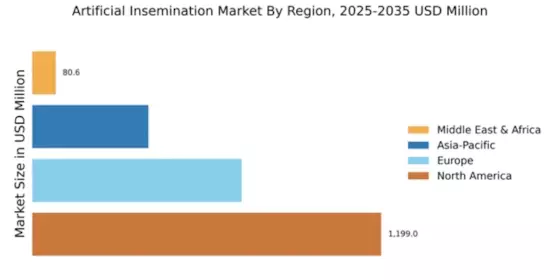
North America holds the largest market share in the artificial insemination sector, valued at $1198.99M in 2024. The region's growth is driven by advanced agricultural practices, increasing livestock productivity, and a strong focus on genetic improvement. Regulatory support from agencies like the USDA enhances the adoption of artificial insemination technologies, ensuring compliance with health and safety standards. The competitive landscape is robust, with key players such as Zoetis Inc., Merck Animal Health, and Genus PLC leading the market. The U.S. and Canada are the primary contributors, leveraging technological advancements and research initiatives. The presence of established companies fosters innovation, while collaborations with research institutions further enhance market dynamics.

Europe : Emerging Market with Growth Potential

Europe's artificial insemination market is valued at $719.39M, reflecting a growing demand for genetic improvement in livestock. The region benefits from stringent regulations that promote animal welfare and food safety, driving the adoption of artificial insemination techniques. Countries like Germany and France are at the forefront, supported by EU policies that encourage sustainable agricultural practices. The competitive landscape features key players such as Hendrix Genetics and CRV Holding, which are expanding their market presence through innovative solutions. The European market is characterized by a mix of established companies and emerging startups, fostering a dynamic environment for growth. The focus on research and development is crucial for maintaining competitiveness in this evolving market.

Asia-Pacific : Rapidly Growing Market

The Asia-Pacific artificial insemination market, valued at $398.99M, is witnessing rapid growth driven by increasing livestock production and a rising demand for high-quality meat and dairy products. Countries like China and India are leading this growth, supported by government initiatives aimed at improving livestock genetics and productivity. The region's diverse agricultural landscape presents unique opportunities for artificial insemination technologies. The competitive landscape is evolving, with both local and international players vying for market share. Companies like Neogen Corporation and Gencor are expanding their operations in the region, capitalizing on the growing awareness of artificial insemination benefits. The focus on enhancing livestock health and productivity is expected to drive further adoption of these technologies in the coming years.

Middle East and Africa : Untapped Market Potential

The Middle East and Africa artificial insemination market is valued at $80.61M, representing significant untapped potential. The region's agricultural sector is gradually adopting advanced technologies to improve livestock quality and productivity. Factors such as increasing population and demand for protein-rich food are driving the need for effective breeding solutions. Government initiatives aimed at enhancing food security are also contributing to market growth. Countries like South Africa and Kenya are emerging as key players in the artificial insemination landscape. The presence of local and international companies is fostering competition, with a focus on education and training for farmers to adopt these technologies. As awareness grows, the market is expected to expand, presenting opportunities for investment and innovation.
Key Players and Competitive Insights

The Artificial insemination Market is characterized by a dynamic competitive landscape, driven by technological advancements, increasing demand for livestock productivity, and a growing focus on genetic improvement. Key players such as Genus PLC (GB), Zoetis Inc. (US), and Merck Animal Health (US) are at the forefront, each adopting distinct strategies to enhance their market positioning. Genus PLC (GB) emphasizes innovation through its proprietary breeding technologies, while Zoetis Inc. (US) focuses on expanding its product portfolio and enhancing customer engagement through digital platforms. Merck Animal Health (US) is actively pursuing strategic partnerships to bolster its research capabilities, thereby shaping a competitive environment that is increasingly reliant on technological integration and collaborative efforts.

In terms of business tactics, companies are localizing manufacturing to reduce costs and optimize supply chains, which is particularly crucial in a moderately fragmented market. The collective influence of these key players fosters a competitive structure that encourages innovation and responsiveness to market demands. This localized approach not only enhances operational efficiency but also allows for quicker adaptation to regional market needs, thereby strengthening their competitive edge.

In November 2025, Genus PLC (GB) announced a strategic partnership with a leading agricultural technology firm to develop advanced genomic solutions aimed at improving livestock health and productivity. This collaboration is expected to enhance Genus's capabilities in precision breeding, positioning the company to better meet the evolving demands of the market. The strategic importance of this partnership lies in its potential to leverage cutting-edge technology, thereby reinforcing Genus's leadership in the sector.

Similarly, in October 2025, Zoetis Inc. (US) launched a new digital platform designed to provide farmers with real-time data analytics on reproductive performance. This initiative not only enhances customer engagement but also empowers farmers to make informed decisions, ultimately driving productivity. The strategic significance of this move is underscored by the increasing reliance on data-driven solutions in agriculture, which could redefine operational efficiencies in the Artificial insemination Market.

In September 2025, Merck Animal Health (US) expanded its product line by introducing a novel artificial insemination technology that incorporates AI-driven analytics. This innovation is poised to revolutionize breeding practices by offering enhanced accuracy and efficiency. The strategic relevance of this development is profound, as it aligns with the broader trend of integrating AI into agricultural practices, thereby setting a new standard for operational excellence in the industry.

As of December 2025, the competitive trends in the Artificial insemination Market are increasingly defined by digitalization, sustainability, and the integration of AI technologies. Strategic alliances are becoming pivotal, as companies recognize the need for collaborative innovation to stay ahead. Looking forward, competitive differentiation is likely to evolve from traditional price-based competition to a focus on innovation, technological advancements, and supply chain reliability. This shift suggests that companies that prioritize these elements will be better positioned to thrive in an increasingly complex market.

Key Companies in the Artificial insemination Market market include

Industry Developments

  • Q2 2024: CooperSurgical Launches New ARTlab™ Laboratory Management Platform for Fertility Clinics CooperSurgical announced the launch of ARTlab™, a new laboratory management platform designed to streamline workflows and improve data management in fertility clinics, supporting artificial insemination and other assisted reproductive technologies.
  • Q2 2024: Hamilton Thorne Announces Acquisition of IVFtech ApS Hamilton Thorne, a leading provider of precision instruments for fertility clinics, announced the acquisition of IVFtech ApS, a Danish manufacturer of laminar flow workstations and related products for artificial insemination and IVF laboratories.
  • Q2 2024: Fujifilm Irvine Scientific Opens New Manufacturing Facility in Tilburg, Netherlands Fujifilm Irvine Scientific opened a new manufacturing facility in the Netherlands to expand production of cell culture media used in artificial insemination and other assisted reproductive technologies, aiming to meet growing European demand.
  • Q3 2024: Vitrolife Appoints New CEO to Drive Growth in Fertility Solutions Vitrolife, a global leader in fertility treatment products including artificial insemination media, announced the appointment of a new CEO to accelerate its international expansion and product innovation.

  • Q3 2024: Cook Medical Launches Next-Generation Insemination Catheter Cook Medical introduced a next-generation insemination catheter designed to improve patient comfort and clinical outcomes in artificial insemination procedures.
  • Q4 2024: Genus plc Announces Strategic Partnership with CRV for Bovine Artificial Insemination Genus plc, a leader in animal genetics, announced a strategic partnership with CRV to jointly develop and distribute advanced bovine artificial insemination solutions in Europe.
  • Q4 2024: Pride Angel Launches Online Platform for Home Artificial Insemination Kits Pride Angel launched a new online platform offering home artificial insemination kits, aiming to increase accessibility and privacy for individuals and couples seeking fertility solutions.
  • Q1 2025: Medtronic Receives CE Mark for Automated Artificial Insemination Device Medtronic announced it has received CE Mark approval for its new automated artificial insemination device, enabling commercial launch in the European Union.
  • Q1 2025: Bayer AG Invests in Fertility Tech Startup Focused on AI-Driven Insemination Bayer AG announced a strategic investment in a fertility technology startup developing AI-driven solutions for optimizing artificial insemination outcomes.
  • Q2 2025: JLG Enterprises, Inc. Expands Manufacturing Capacity for Artificial Insemination Equipment JLG Enterprises, Inc. announced the expansion of its manufacturing facility to increase production of artificial insemination equipment, citing rising demand from fertility clinics and animal breeding centers.
  • Q2 2025: Hi-Tech Solutions Secures Series B Funding to Scale Artificial Insemination Technologies Hi-Tech Solutions, a provider of reproductive health technologies, secured Series B funding to accelerate the development and commercialization of its artificial insemination products.
  • Q2 2025: Cook Medical Receives FDA Clearance for New Artificial Insemination Syringe Cook Medical received FDA clearance for its new artificial insemination syringe, allowing for immediate commercialization in the United States.

Artificial Insemination Market Trends

Rising infertility rates and increased awareness among individuals about alternative reproductive treatments are two major factors influencing the market. Furthermore, governments in many countries have legalized same-sex marriage and provided insurance coverage to civil unions for artificial insemination procedures, fueling the market growth. Aside from that, the growing  population and increasing demand for animal-based protein drive the demand for artificial insemination in domestic livestock animals. Improving veterinary services and rising animal healthcare expenditure drive market growth. Furthermore, the leading players are forming strategic alliances to expand their portfolio of animal genetics and strengthen their position in various markets.

 Market Drivers

  •   Rising infertility issues in people to aid the  market growth

Infertility is one of the most serious and widespread issues affecting today's youth worldwide. The female preference for pregnancy and the gradual increase in the number of infertile couples who require pregnancy assistance can be attributed to market growth. The age of women, the quality of their eggs, and women in their late 30s are expected to increase demand for artificial insemination. Furthermore, infertility affects over 20 million women, according to the National Women's Health Resource Center.

Total fertility is expected to fall from 2.43 to 2.39 children per woman between 2020 and 2030, according to the 2017 United Nations World Population Prospects report. The rising prevalence of infertility among the  population drives the  market forward.

Market Restraints:

  • Most countries have strict regulations in place regarding who is eligible to receive fertility treatments, which is stifling market growth

Most countries' stringent regulations governing who is eligible to receive fertility treatments are impeding the growth of the  market. Italy and France, for example, prohibit lesbian couples and single women from using artificial insemination. Italy and Austria are among the countries that have banned all sperm and egg donations for IVF. Norway and Germany prohibit egg donation but permit sperm donation.

Market Opportunities:

  • Insurance companies covering artificial insemination treatment under medical coverage

Many insurance companies now cover artificial insemination as a medical procedure. These initiatives assist patients in fighting infertility and creating opportunities in the insurance industry. Moreover, Governments and international organizations develop policies and establish new institutions to improve medical connectivity, such as the Assisted Reproductive Technology (ART) Regulation Bill, the Nation Public Action Plan, the National Family Policy, and other initiatives. According to the UN Security Council, 84% of the country supports the policy that directly and indirectly affects the country's infertility.

Artificial Insemination Market Segment Insights

Artificial Insemination Type Insights

The market segments of artificial insemination, based on type, is intrauterine, intracervical, and intratubal. The intrauterine segment is expected exhibit a rapid CAGR and hold the largest market share in the artificial insemination market growth in 2021. This insemination method is the most used to treat infertility because it produces the highest pregnancy rate. It is also a non-invasive procedure. During the washing process, prostaglandins, pathogenic agents, antigenic proteins, nonmotile spermatozoa, immature germ cells, and other contaminants are removed, resulting in high-quality sperm.

These are the primary benefits that will drive the intrauterine segment's growth in the  market during the forecast period. The intravaginal portion is expected to be the second largest (IVI). IVI can be performed in a fertility clinic or home, which is especially beneficial for surrogacy and donor insemination.

Artificial Insemination End-User Insights

Future Outlook

Artificial insemination Market Future Outlook

The Artificial Insemination Market is projected to grow at an 8.62% CAGR from 2024 to 2035, driven by technological advancements, increasing livestock production, and rising consumer demand for genetic quality.

New opportunities lie in:

  • Development of mobile artificial insemination units for remote areas.
  • Integration of AI-driven analytics for breeding optimization.
  • Expansion of genetic material storage facilities to enhance supply chain efficiency.

By 2035, the market is expected to solidify its position as a leader in reproductive technologies.

Market Segmentation

Artificial insemination Market Type Outlook

  • Fresh Semen
  • Frozen Semen
  • Chilled Semen

Artificial insemination Market End Use Outlook

  • Farms
  • Veterinary Clinics
  • Research Institutions
  • Breeding Centers

Artificial insemination Market Technology Outlook

  • Semen Freezing
  • Semen Processing
  • Semen Storage
  • Semen Thawing

Artificial insemination Market Application Outlook

  • Artificial Insemination in Cattle
  • Artificial Insemination in Swine
  • Artificial Insemination in Sheep
  • Artificial Insemination in Goats

Artificial insemination Market Service Type Outlook

  • Consultation Services
  • Training Services
  • Semen Supply Services

Report Scope

MARKET SIZE 2024 2397.98(USD Million)
MARKET SIZE 2025 2632.16(USD Million)
MARKET SIZE 2035 5979.93(USD Million)
COMPOUND ANNUAL GROWTH RATE (CAGR) 8.62% (2024 - 2035)
REPORT COVERAGE Revenue Forecast, Competitive Landscape, Growth Factors, and Trends
BASE YEAR 2024
Market Forecast Period 2025 - 2035
Historical Data 2019 - 2024
Market Forecast Units USD Million
Key Companies Profiled Genus PLC (GB), Zoetis Inc. (US), Merck Animal Health (US), Hendrix Genetics (NL), Select Sires Inc. (US), Gencor (US), CRV Holding (NL), Harrisvaccines Inc. (US), Neogen Corporation (US)
Segments Covered Application, End Use, Technology, Type, Service Type
Key Market Opportunities Advancements in reproductive technologies enhance efficiency in the Artificial insemination Market.
Key Market Dynamics Technological advancements and regulatory changes are reshaping the competitive landscape of the artificial insemination market.
Countries Covered North America, Europe, APAC, South America, MEA

Market Highlights

Author
Rahul Gotadki
Assistant Manager

He holds an experience of about 7+ years in Market Research and Business Consulting, working under the spectrum of Life Sciences and Healthcare domains. Rahul conceptualizes and implements a scalable business strategy and provides strategic leadership to the clients. His expertise lies in market estimation, competitive intelligence, pipeline analysis, customer assessment, etc. In addition to the above, his other responsibility includes strategic tracking of high growth markets & advising clients on the potential areas of focus they could direct their business initiatives

Leave a Comment

FAQs

What is the study period of the artificial insemination market report?

The artificial insemination market forecast period is 2025 - 2035

What is the artificial insemination Market Growth rate?

The market is expected to register a CAGR of 9.68% over the next 10 years, according to artificial insemination market research.

Which region has the highest market growth rate?

Asia-Pacific is expected to register the highest CAGR during 2024 - 2035

Which region has the largest share of the market?

Europe held the largest share in 2021

What is the expected artificial insemination market size by 2032?

The market size is expected to be USD 9.2 billion by 2032.

Who are the key players in the market?

Vitrolife AB, Genea Limited, Rinovum Women's Health, Pride Angel, Hi-tech Solutions, Kitazato Corporation, Fujifilm Irvine Scientific, and Rocket Medical are the major companies operating in the market.

Download Free Sample

Kindly complete the form below to receive a free sample of this Report

Compare Licence

×
Features License Type
Single User Multiuser License Enterprise User
Price $4,950 $5,950 $7,250
Maximum User Access Limit 1 User Upto 10 Users Unrestricted Access Throughout the Organization
Free Customization
Direct Access to Analyst
Deliverable Format
Platform Access
Discount on Next Purchase 10% 15% 15%
Printable Versions