Artificial Intelligence Market (2026 - 2035)

Artificial Intelligence Market Size, Share and Research Report By Component (Hardware, Software, and Services), By Deployment Mode (Public Cloud, On-Premise, and Hybrid), By Technology (Machine Learning, Deep Learning, Natural Language Processing, Computer Vision, Generative AI, Context-Aware Computing & Others), By End-User Industry (BFSI, IT & Telecommunications, Healthcare & Life Sciences, Manufacturing, and Others Including Retail, Energy, Education, and Government), And By Region (North America, Europe, Asia-Pacific, And Rest Of The World) – Industry Forecast Till 2035
ID: MRFR/ICT/0633-HCR
200 Pages
Aarti Dhapte
Last Updated: August 24, 2026
Artificial Intelligence Market
Market Size
Forecast Period2026-2035
CAGR (2026-2035)38.50%
2025 Market SizeUSD 327.50 Billion
2035 Market SizeUSD 8,716.00 Billion
Key Players
Microsoft
Alphabet
Amazon Web Services
NVIDIA
IBM
Meta Platforms
Opportunities
  • Edge AI Deployment in Industrial Settings
  • AI-Native Healthcare Platforms
  • Emerging-Market Digitization

Artificial Intelligence Market Summary

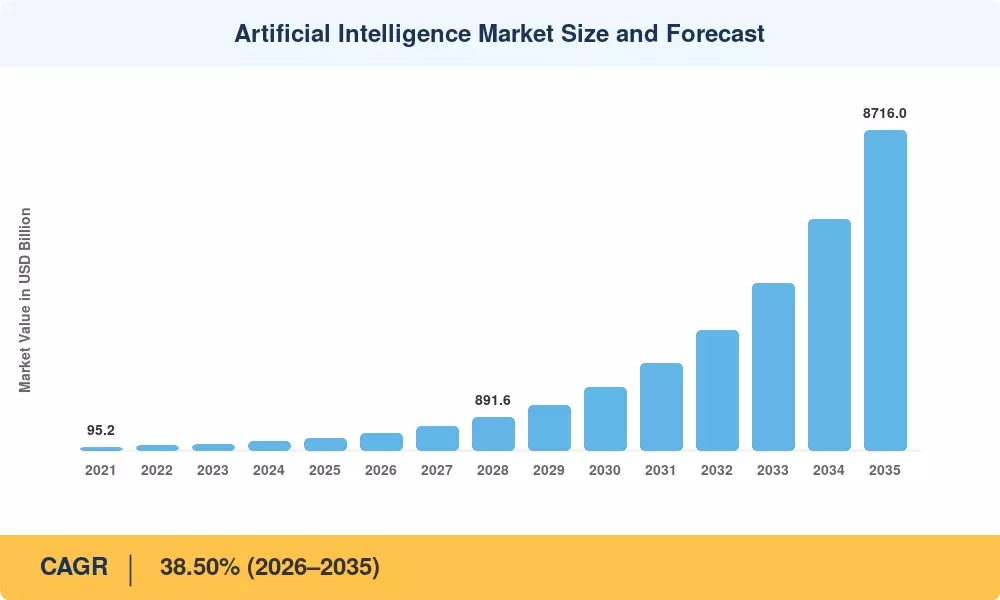
The Artificial Intelligence Market reached an estimated USD 327.50 Billion in 2025, entering the forecast window at USD 464.80 Billion in 2026 and tracking toward USD 8,716.00 Billion by 2035 at a compound annual growth rate of 38.50%. Sovereign AI initiatives — including the U.S. National AI Initiative Act reauthorization, the EU AI Act enforcement timeline, and China's "New Generation AI Development Plan" refresh — have shifted enterprise spending from exploratory pilots into production-grade deployments [1][5]. Corporate capital expenditure on AI infrastructure exceeded USD 150 Billion globally in 2024 alone, a figure that underscores how rapidly boardroom budgets have realigned around this technology [2].

Underneath the headline spending, a structural technology transition is underway. Legacy rule-based automation platforms and conventional analytics stacks are giving way to foundation-model architectures, retrieval-augmented generation pipelines, and multimodal reasoning engines. GPU compute density has doubled roughly every eighteen months since 2021, while energy-efficient accelerator designs from multiple chipmakers have compressed inference costs by more than 60% over the same period [7][8]. These hardware gains, paired with open-weight model ecosystems, are pulling AI adoption in enterprise applications down-market into mid-size firms that previously lacked the engineering depth to deploy at scale.

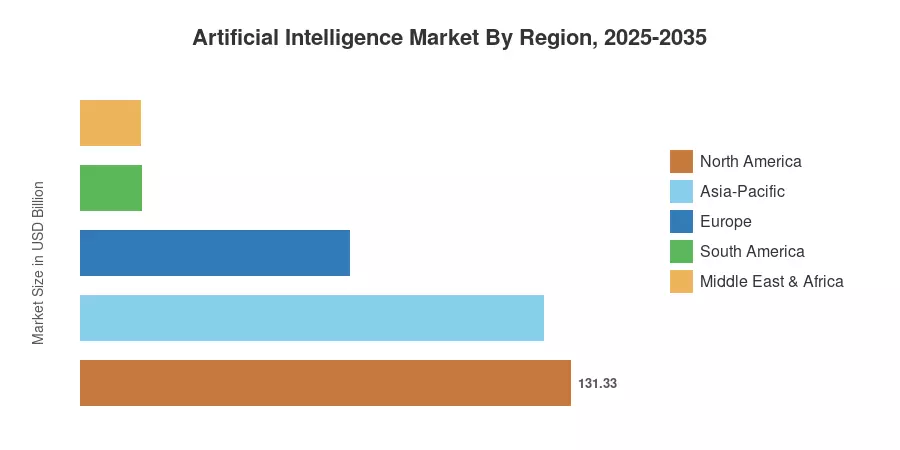
North America commanded approximately 40.10% of the Artificial Intelligence Market in 2025, anchored by hyperscaler R&D clusters and a mature venture-capital ecosystem. Asia-Pacific is the fastest-growing region, projected to register a 37.90% CAGR through 2035, driven by national digitization mandates across China, India, Japan, and South Korea. Europe held the second-largest share at roughly 22.00%, with regulatory clarity under the AI Act increasingly attracting compliance-ready platform investment. The decade ahead will be shaped by how quickly sovereign compute capacity scales and whether open-model ecosystems can sustain their current momentum against proprietary incumbents.

Key Report Takeaways

• By Component

  • Software dominated the Artificial Intelligence Market with a 65.50% revenue share in 2025, reflecting enterprise demand for inference platforms, MLOps tooling, and pre-trained model APIs.
  • Services is forecast to record the fastest segment CAGR of 37.95% through 2035, propelled by consulting-led deployment and managed-AI offerings.

• By Technology

  • Machine Learning held a 38.25% share of the Artificial Intelligence Market in 2025, supported by widespread adoption of supervised and reinforcement learning frameworks.
  • Generative AI is anticipated to post a 49.50% CAGR to 2035, the highest among technology segments, fuelled by large language model and multimodal content-generation use cases.

• By Region

  • North America led the Artificial Intelligence Market with a 40.10% share in 2025, buoyed by hyperscaler infrastructure and federal R&D commitments.
  • Asia-Pacific is projected to grow at a 37.90% CAGR, making it the fastest-expanding regional market through 2035.

Artificial Intelligence Market Size and Forecast (2021–2035)

Market sizing draws on a triangulated methodology combining top-down revenue modelling from vendor financial disclosures, bottom-up demand estimation across end-user verticals, and cross-validation against third-party technology spending trackers [2][4][9]. Historical figures (2021–2024) are actuals reconciled to reported fiscal-year data; 2025 is an estimated base year; 2026–2035 values are projected using the calibrated 38.50% CAGR with adjustments for anticipated demand cycles.
Artificial Intelligence Market Size and Forecast
Our Impact
Enabled $4.3B Revenue Impact for Fortune 500 and Leading Multinationals
Partnering with 2000+ Global Organizations Each Year
30K+ Citations by Top-Tier Firms in the Industry

Driver Impact Analysis

Driver ~% Impact on CAGR Geographic Relevance Impact Timeline
Sovereign AI Infrastructure Programs 18–22% Global Short-term (≤2 yr)
Enterprise Cost-Optimization Mandates 15–18% North America, Europe Medium-term (2–4 yr)
GPU & Accelerator Innovation Cycles 12–15% Global Short-term (≤2 yr)
Generative AI Commercialization 14–17% North America, Asia-Pacific Medium-term (2–4 yr)
Healthcare & Life Sciences Digitization 8–11% Global Long-term (≥4 yr)
Autonomous Systems & Robotics Demand 7–10% Asia-Pacific, Europe Long-term (≥4 yr)
Open-Model Ecosystem Proliferation 6–9% Global Medium-term (2–4 yr)


Sovereign AI Infrastructure Programs

Similar to energy grids, governments are viewing AI compute capacity as strategic infrastructure. While the EU's Horizon Europe framework set aside EUR 1 billion expressly for reliable AI development, the U.S. National AI Initiative Act granted more than USD 2.6 billion in government AI R&D funding till 2025 [1][5]. By subsidizing GPU cluster buildouts and encouraging domestic chip manufacturing, these initiatives directly increase demand in the artificial intelligence market.

Enterprise Cost-Optimization Mandates

According to a 2024 poll, 79% of businesses using AI in production reported quantifiable cost benefits within the first year, with median savings in back-office activities reaching 23% [9]. AI-driven efficiency measures are increasingly being used by chief financial officers to inform capital allocation choices, turning what was once a line item in the innovation budget into a crucial operational expense. The Artificial Intelligence Market's procurement cycles are being accelerated by this feedback loop.

GPU and Accelerator Innovation Cycles

NVIDIA's data-centre revenue surpassed USD 47 Billion in fiscal year 2025, more than doubling year over year, as training and inference workloads scaled [7]. Competing architectures from AMD, Intel, and custom silicon programs at Google and Amazon are compressing price-performance ratios, which lowers the barrier to entry for the Artificial Intelligence Market and broadens the addressable customer base.

Generative AI Commercialization

The generative AI market alone is USD 67 Billion in 2024, with projections exceeding USD 1.3 Trillion by the early 2030s [8]. Enterprise adoption of large language models for customer service automation, code generation, and content workflows is converting experimental budgets into recurring software subscriptions, directly expanding the Artificial Intelligence Market revenue base.

Restraints Impact Analysis

The restraint estimates below represent directional headwinds that moderate growth velocity. They are not subtractive from the headline CAGR in a linear sense but capture friction points identified through supply-chain audits, regulatory reviews, and enterprise buyer surveys [5][10].

Restraint ~% Negative Impact on CAGR Geographic Relevance Impact Timeline
Regulatory Fragmentation & Compliance Costs –4 to –6% Europe, Global Medium-term
Data Privacy & Sovereignty Constraints –3 to –5% Global Long-term
Talent Shortage in AI Engineering –3 to –4% Global Short-term
Energy Consumption & Sustainability Pressure –2 to –4% North America, Europe Medium-term
Intellectual Property & Liability Uncertainty –2 to –3% North America, Europe Long-term


Regulatory Fragmentation and Compliance Costs

Product launch timescales may be extended by 12 to 18 months due to the EU AI Act's strict conformity-assessment criteria for high-risk AI systems, which went into phased enforcement in 2025 [5]. Different national frameworks, such as Canada's AIDA, India's advisory approach, and Brazil's draft AI bill, result in compliance requirements that increase operating costs for international suppliers involved in the AI market.

Energy Consumption and Sustainability Pressure

AI training workloads accounted for a steadily increasing portion of the world's data-center electricity consumption, which reached almost 460 TWh in 2024, according to the International Energy Agency [13]. ESG-conscious investors and local planners are concerned about large-scale model training runs since they can use the energy of hundreds of households over several weeks. Timelines for facility permits in the artificial intelligence market are starting to be constrained by this environmental calculation.

Artificial Intelligence Market Opportunities

Edge AI Deployment in Industrial Settings

As inference costs decline and edge-optimized chipsets mature, manufacturers are embedding AI directly into production lines, quality-inspection stations, and predictive-maintenance systems. The industrial edge AI segment is expected to represent a significant new revenue stream within the Artificial Intelligence Market by 2030, particularly in Asia-Pacific where factory digitization subsidies are accelerating adoption [11].

AI-Native Healthcare Platforms

Regulatory green lights for AI-assisted diagnostics — including FDA clearances for radiology and pathology algorithms — are opening a high-value vertical. Healthcare's projected growth trajectory within the Artificial Intelligence Market offers above-average margins because of long procurement cycles and sticky platform economics [12].

Emerging-Market Digitization

Countries across Southeast Asia, the Middle East, and sub-Saharan Africa are leapfrogging legacy IT stacks entirely, building cloud-first government services with embedded AI capabilities. Saudi Arabia's NEOM initiative and India's Digital India programme are catalysing greenfield deployments that bypass the retrofit costs burdening mature markets [14].

Data Monetization and AI-as-a-Service Models

Enterprises sitting on proprietary datasets are increasingly packaging domain-specific AI models as subscription services, creating recurring revenue streams. This business-model shift is expanding the Artificial Intelligence Market beyond traditional software licensing into outcome-based pricing and consumption models [9].

AI-Driven Cybersecurity

The global cost of cybercrime exceeded USD 8 Trillion in 2024, driving demand for real-time threat detection and autonomous response systems [10]. AI-powered security platforms that integrate behavioural analytics with automated remediation represent a fast-growing pocket within the Artificial Intelligence Market, particularly for financial services and critical infrastructure operators.

Artificial Intelligence Market Future Outlook

Autonomous Operations and Agentic AI

The next phase of the Artificial Intelligence Market will be defined by agentic AI systems capable of executing multi-step workflows with minimal human oversight. By 2030, projects that 30% of enterprise software interactions will be mediated by autonomous agents, reshaping IT service management, supply-chain orchestration, and customer-engagement architectures [4].

Platform Economics and Foundation-Model Consolidation

Foundation-model development costs — currently exceeding USD 100 Million per frontier training run — are concentrating capability among a handful of well-capitalised platform providers. This dynamic is creating platform-layer lock-in effects reminiscent of cloud infrastructure a decade ago, with downstream implications for pricing power and market structure across the Artificial Intelligence Market [8][16].

AI-Accelerated Scientific Discovery

Drug discovery, materials science, and climate modelling are increasingly relying on AI-driven simulation and hypothesis generation. The Artificial Intelligence Market stands to capture significant incremental revenue as pharmaceutical companies, national laboratories, and energy firms embed predictive models into core R&D pipelines [12][13].

Sustainability and Green-AI Architectures

Energy efficiency is transitioning from a corporate-responsibility talking point into a competitive differentiator. Techniques such as model distillation, sparse-mixture-of-experts architectures, and carbon-aware scheduling are reducing inference energy consumption by 40–70% compared to brute-force scaling approaches [13]. The Artificial Intelligence Market will increasingly reward vendors that deliver performance-per-watt gains alongside raw capability.

Artificial Intelligence Market Segmentation

By Component

Segment Key Metric Primary Demand Driver
Hardware USD 78.60 Billion (2025) GPU/accelerator demand for training
Software 65.50% share (2025) Inference platforms, MLOps, pre-trained APIs
Services 37.95% CAGR (2026–2035) Consulting, managed AI, implementation


Software remains the largest component of the Artificial Intelligence Market, driven by enterprise procurement of inference-serving platforms, model-management toolkits, and vertical-specific AI applications. Cloud-native software delivery models have compressed sales cycles and lowered adoption thresholds, enabling mid-market buyers to access capabilities that were previously confined to Fortune 500 technology budgets.

Services is the fastest-growing component, reflecting a structural gap between available AI talent and enterprise deployment ambitions. System integrators and specialist consultancies are building dedicated AI practices, offering everything from data-readiness assessments to end-to-end model lifecycle management, which expands the addressable revenue pool beyond pure software licensing.

By Deployment Mode

Segment Key Metric Primary Demand Driver
Public Cloud 46.80% share (2025) Elastic compute, rapid prototyping
On-Premise USD 87.20 Billion (2025) Data governance, latency-sensitive workloads
Hybrid 42.35% CAGR (2026–2035) Balanced control and scalability


Public Cloud retains the largest share of the Artificial Intelligence Market by deployment mode, as hyperscalers offer pre-configured AI stacks that dramatically reduce time to first inference. Hybrid deployment is accelerating fastest, driven by regulated industries — banking, healthcare, defence — that require on-premise data residency but benefit from cloud-based model training and burst compute.

By Technology

Segment Key Metric Primary Demand Driver
Machine Learning 38.25% share (2025) Predictive analytics, recommendation engines
Deep Learning USD 52.40 Billion (2025) Image recognition, autonomous systems
Natural Language Processing 14.80% share (2025) Chatbots, document understanding
Computer Vision USD 36.70 Billion (2025) Quality inspection, security, retail analytics
Generative AI 49.50% CAGR (2026–2035) Content creation, code generation, synthesis
Context-Aware Computing & Others 5.10% share (2025) IoT integration, ambient intelligence


Machine Learning underpins the broadest range of production use cases across the Artificial Intelligence Market, from demand forecasting in retail to fraud scoring in financial services. Its maturity and interpretability make it the default choice for risk-sensitive applications where regulatory explainability requirements are stringent.

Generative AI is rewriting the growth calculus. Large language models and diffusion-based image generators have moved from research curiosities to enterprise-grade products in under three years, creating entirely new software categories — AI-assisted coding tools, synthetic data generators, and multimodal content engines — that are expanding the total addressable market.

By End-User Industry

Segment Key Metric Primary Demand Driver
BFSI USD 68.30 Billion (2025) Fraud detection, algorithmic trading, risk modelling
IT & Telecommunications 28.90% share (2025) Network optimization, AIOps, customer experience
Healthcare & Life Sciences 35.65% CAGR (2026–2035) Clinical decision support, drug discovery
Manufacturing USD 38.50 Billion (2025) Predictive maintenance, supply-chain AI
Others (Retail, Energy, Education, Gov) 18.40% share (2025) Varied vertical-specific applications


IT & Telecommunications holds the largest end-user share in the Artificial Intelligence Market, as telcos and IT service providers embed AI into network management, cybersecurity operations, and customer-lifecycle automation. Healthcare & Life Sciences is the fastest-growing vertical, propelled by regulatory pathways for AI-assisted diagnostics and pharmaceutical companies investing heavily in AI-driven drug-candidate screening [12].

Regional Market Share Analysis

Region Key Metric Primary Investment Themes
North America 40.10% share (2025) Hyperscaler R&D, federal AI mandates, venture capital
Europe 22.00% share (2025) AI Act compliance platforms, sovereign cloud
Asia-Pacific 37.90% CAGR (2026–2035) National digitization, semiconductor self-sufficiency
South America USD 16.40 Billion (2025) Fintech AI, agritech automation
Middle East & Africa USD 16.05 Billion (2025) Smart-city programs, energy-sector AI
Total USD 327.50 Billion (2025)

The Artificial Intelligence Market exhibits a concentrated regional structure, with North America and Asia-Pacific collectively accounting for more than two-thirds of global revenue. Regional dynamics are shaped by compute infrastructure density, regulatory posture, talent availability, and government investment priorities.

North America

Country Key Metric Key Driver
US 78.50% of regional share Cloud hyperscaler headquarters, CHIPS Act funding
Canada 12.20% of regional share Federal AI strategy, Montréal AI hub
Mexico 9.30% of regional share Nearshoring-driven IT modernization


The United States remains the gravitational centre of the Artificial Intelligence Market, hosting the headquarters of the five largest AI platform companies and channelling more than USD 67 Billion in private AI investment in 2024 alone [2]. Canada's strength in foundational research — anchored by the Vector Institute and Mila — translates into a robust start-up pipeline, while Mexico's expanding software-services sector is absorbing AI tooling at an accelerating pace as nearshoring reshapes North American supply chains.

Europe

Country Key Metric Key Driver
Germany 24.30% of regional share Industrie 4.0, automotive AI R&D
UK 21.70% of regional share London fintech, DeepMind ecosystem
France 16.80% of regional share National AI strategy "France 2030"
Italy 9.50% of regional share Manufacturing digitization incentives
Spain 7.20% of regional share Tourism-tech, public-sector AI pilots
Nordic Countries 8.80% of regional share Green-tech AI, healthcare digitization
Russia 5.40% of regional share Domestic platform development
Rest of Europe 6.30% of regional share Varied national programs


European spending on the Artificial Intelligence Market is increasingly shaped by AI Act readiness. Germany and the UK together represent nearly half of regional revenue, with automotive OEMs and financial institutions leading enterprise-scale adoption. France's EUR 2.2 billion "France 2030" AI investment package is seeding a competitive start-up ecosystem, while Nordic countries punch above their weight in ethical-AI frameworks and public-sector deployments [5][14].

Asia-Pacific

Country Key Metric Key Driver
China 42.50% CAGR (2026–2035) Baidu, Alibaba, government AI mandates
India 44.10% CAGR (2026–2035) Digital India, IT services sector
Japan USD 18.90 Billion (2025) Robotics, ageing-society automation
South Korea USD 11.40 Billion (2025) Semiconductor ecosystem, 5G-AI convergence
ASEAN 39.80% CAGR (2026–2035) Smart-city initiatives, fintech
Rest of Asia-Pacific USD 5.60 Billion (2025) Emerging adoption


Asia-Pacific is the fastest-growing region in the Artificial Intelligence Market. China's state-backed AI investment exceeded USD 15 Billion in 2024, targeting semiconductor self-sufficiency and large-model development. India's IT services giants — TCS, Infosys, Wipro — are embedding AI into outsourcing delivery, creating a multiplier effect across global enterprise budgets. Japan's focus on robotics and labour-augmentation AI directly addresses demographic headwinds, while South Korea's chipmaker ecosystem ensures tight hardware-software integration [3][7].

South America

Country Key Metric Key Driver
Brazil 62.80% of regional share Banking-sector AI, agribusiness analytics
Argentina 18.50% of regional share Tech-talent exports, start-up ecosystem
Rest of South America 18.70% of regional share Government digital services


Brazil dominates the South American Artificial Intelligence Market, led by large private banks deploying conversational AI at scale and agribusiness conglomerates integrating satellite-image analytics into crop management [12]. Argentina's developer community punches above its weight in AI start-up formation, and regional cloud data-centre expansions by AWS, Azure, and Google Cloud are reducing latency barriers that previously slowed adoption.

Middle East & Africa

Country Key Metric Key Driver
Saudi Arabia 28.40% of regional share Vision 2030, NEOM smart-city
UAE 25.60% of regional share National AI Strategy 2031
South Africa 17.30% of regional share Financial services, mining automation
Egypt 12.10% of regional share Government digitization, telecom AI
Rest of MEA 16.60% of regional share Early-stage programs


The Middle East & Africa region, while smaller in absolute terms, is registering outsized growth ambition in the Artificial Intelligence Market. The UAE appointed a dedicated Minister of State for Artificial Intelligence in 2017 — a global first — and has since funnelled investment into sovereign LLM development and smart-city infrastructure. Saudi Arabia's Public Investment Fund has allocated billions toward AI-centric ventures under Vision 2030, positioning the Kingdom as a regional hub [14].


Artificial Intelligence Market By Region, 2025-2035

Competitive Benchmarking

The Artificial Intelligence Market exhibits high concentration at the platform layer, where the top five vendors collectively control an estimated 45–55% of global software revenue. Below this platform tier, the market fragments rapidly into hundreds of vertical-specialist and open-source ecosystem players, producing a barbell-shaped competitive structure [16][17].

Company Est. Revenue Share Range Key Offerings for Artificial Intelligence Market Strategic Positioning
Microsoft ~12–16% Azure AI, Copilot suite, OpenAI partnership Full-stack enterprise AI platform leader
Alphabet (Google) ~10–14% Google Cloud AI, Gemini models, DeepMind Research-to-product pipeline, cloud-AI convergence
Amazon Web Services ~8–12% SageMaker, Bedrock, Trainium chips Cloud-infrastructure AI gateway
NVIDIA ~7–11% CUDA ecosystem, DGX systems, Omniverse Hardware-software AI compute standard-setter
IBM ~4–6% watsonx, Red Hat OpenShift AI Hybrid-cloud AI for regulated industries
Meta Platforms ~3–5% LLaMA open models, PyTorch framework Open-ecosystem AI research leader
Salesforce ~2–4% Einstein AI, Agentforce CRM-embedded AI automation
SAP ~2–3% Joule AI Copilot, Business AI ERP-integrated AI for enterprise workflows
Oracle ~2–3% OCI AI Services, autonomous database Database-native AI and cloud modernization
Baidu ~2–3% ERNIE models, Apollo autonomous driving Chinese-market AI platform leader


Recent News & Developments

  • Microsoft (March 2025): Announced a USD 80 Billion capital expenditure plan for AI data-centre infrastructure in fiscal 2025, signalling sustained capacity expansion across the Artificial Intelligence Market [16].
  • European Commission (February 2025): Began enforcement of the EU AI Act's prohibited-practices provisions, establishing the first binding regulatory framework for high-risk AI systems globally [5].
  • NVIDIA (January 2025): Launched the Blackwell Ultra B300 GPU architecture at CES, delivering a 4× inference throughput improvement over the prior Hopper generation [7].
  • Google DeepMind (December 2024): Released Gemini 2.0, a natively multimodal model integrating text, image, audio, and code understanding, expanding the Artificial Intelligence Market's product frontier [17].
  • Amazon Web Services (November 2024): Introduced Amazon Nova foundation models and the Trainium2 chip at re: Invent, intensifying cloud-AI platform competition [18].
  • OpenAI (September 2024): Closed a USD 6.6 Billion funding round at a USD 157 Billion valuation, the largest private capital raise in AI history, underscoring investor confidence in the Artificial Intelligence Market [8].
  • IBM (June 2024): Launched watsonx. governance, an AI lifecycle governance toolkit designed for regulated-industry compliance with the EU AI Act and emerging global standards [10].
  • Saudi Arabia (May 2024): Established the Saudi Authority for Data and Artificial Intelligence (SDAIA) international AI centre, committing USD 1.2 Billion to regional AI research infrastructure [14].


Artificial Intelligence Market Report Scope

Parameter Detail
Market Scope Global Artificial Intelligence Market across component, deployment, technology, end-user, and geography
Study Period 2021–2035
CAGR (Forecast) 38.50% (2026–2035)
Market Size (2025) USD 327.50 Billion
Market Size (2035) USD 8,716.00 Billion
Fastest Growing Segment Generative AI (by technology); Services (by component)
Companies Profiled 10 (Microsoft, Alphabet, AWS, NVIDIA, IBM, Meta, Salesforce, SAP, Oracle, Baidu)
Valuation Currency USD Billion

FAQs

What is the projected size of the Artificial Intelligence Market by 2035?
The Artificial Intelligence Market is projected to reach USD 8,716.00 Billion by 2035, growing at a 38.50% CAGR from a 2026 base of USD 464.80 Billion.
Which technology segment shows the highest growth potential in the Artificial Intelligence Market?
Generative AI is forecast to grow at a 49.50% CAGR through 2035, driven by enterprise adoption of large language models and multimodal content-generation platforms.
How does the EU AI Act affect vendor strategy in the Artificial Intelligence Market?
The Act requires conformity assessments for high-risk systems, increasing compliance costs but rewarding vendors that embed governance tooling into their platforms natively.
What distinguishes hybrid deployment demand in the Artificial Intelligence Market?
Regulated industries need on-premise data residency combined with cloud-based training elasticity, making hybrid the fastest-growing deployment mode at a 42.35% CAGR.
Which region is expected to grow fastest in the Artificial Intelligence Market through 2035?
Asia-Pacific leads with a projected 37.90% CAGR, propelled by sovereign digitization mandates in China, India, and ASEAN economies.
How are edge-computing advances reshaping the Artificial Intelligence Market?
Declining inference costs and optimized chipsets allow manufacturers to embed AI at the production line, opening industrial verticals previously dependent on cloud connectivity.
What role does open-source model development play in the Artificial Intelligence Market?
Open-weight models lower entry barriers for mid-market adopters and accelerate ecosystem innovation, though they intensify competitive pressure on proprietary platform margins.    
Author
Author
Author Profile
Aarti Dhapte LinkedIn
AVP - Research
A consulting professional focused on helping businesses navigate complex markets through structured research and strategic insights. I partner with clients to solve high-impact business problems across market entry strategy, competitive intelligence, and opportunity assessment. Over the course of my experience, I have led and contributed to 100+ market research and consulting engagements, delivering insights across multiple industries and geographies, and supporting strategic decisions linked to $500M+ market opportunities. My core expertise lies in building robust market sizing, forecasting, and commercial models (top-down and bottom-up), alongside deep-dive competitive and industry analysis. I have played a key role in shaping go-to-market strategies, investment cases, and growth roadmaps, enabling clients to make confident, data-backed decisions in dynamic markets.

Research Approach


Secondary Research

The secondary research process involved comprehensive analysis of technology regulatory frameworks, peer-reviewed computer science journals, AI research publications, and authoritative technology policy organizations. Key sources included the US National Institute of Standards and Technology (NIST) AI Risk Management Framework, National Science Foundation (NSF) AI Research Institutes, European Commission AI Act & Digital Strategy, DARPA (Defense Advanced Research Projects Agency) AI Programs, China's Cyberspace Administration (CAC) AI Governance, UK Office for Artificial Intelligence, IEEE Standards Association (IEEE-SA), Association for Computing Machinery (ACM) Digital Library, arXiv.org Computer Science Repository, NeurIPS/ICML/AAAI Conference Proceedings, Gartner AI Market Guides, IDC Worldwide Artificial Intelligence Spending Guide, OECD AI Policy Observatory, Partnership on AI, AI Now Institute, Stanford HAI (Institute for Human-Centered AI), MIT Computer Science and Artificial Intelligence Laboratory (CSAIL), and national digital transformation reports from key markets (China's Ministry of Science and Technology, Japan's Ministry of Economy Trade and Industry, India's NITI Aayog). These sources were used to collect AI adoption statistics, regulatory framework developments, research publication trends, patent landscapes, compute infrastructure data, and market ecosystem analysis for machine learning platforms, natural language processing tools, computer vision systems, robotics automation, and expert system technologies.


Primary Research

Qualitative and quantitative insights were obtained by interviewing supply-side and demand-side stakeholders during the primary research process. In addition to regulatory compliance leads from AI technology providers such as cloud hyperscalers, semiconductor manufacturers, and enterprise AI software vendors, supply-side sources included CTOs, Chief AI Officers, VPs of Machine Learning Engineering, leaders of AI Product Development, and the like. Demand-side sources included Chief Information Officers (CIOs), Chief Digital Officers, heads of AI/ML Centers of Excellence, data science directors, and procurement leads from large enterprises and SMEs spanning healthcare systems, financial institutions, retail conglomerates, automotive OEMs, and manufacturing facilities that were implementing AI solutions. The primary research validated market segmentation across technology types and industry verticals, confirmed AI model pipeline roadmaps, and garnered insights on enterprise adoption patterns, cloud vs. on-premises deployment preferences, pricing models, and regulatory compliance strategies.

Primary Respondent Breakdown:

By Designation: C-level Primaries (40%), Director Level (32%), Others (28%)

By Region: North America (40%), Europe (25%), Asia-Pacific (28%), Rest of World (7%)


Market Size Estimation

Revenue mapping and AI adoption analytics were employed to determine the global market valuation. The methodology comprised the following:

Identification of 55+ key AI technology providers in North America, Europe, Asia-Pacific, and Latin America, including cloud AI services, AI software platforms, AI semiconductor hardware, and specialized robotics vendors

Technological mappings of Expert Systems/Knowledge graphs, Natural Language Processing solutions, Computer Vision systems, Robotics & automation, and Machine Learning platforms An examination of the annual revenues that have been reported and modeled for AI product portfolios, which include cloud AI services, enterprise AI software licenses, AIaaS (AI as a Service), and AI chipsets.

In 2024, the coverage of technology providers will account for 75-80% of the global AI market share.

Derive segment-specific valuations for healthcare AI, financial services AI, retail AI, automotive AI, and manufacturing AI applications through extrapolation using bottom-up (enterprise adoption volume × ASP by deployment model and industry vertical) and top-down (technology provider revenue validation against cloud infrastructure spending) approaches.

Download Free Sample

Kindly complete the form below to receive a free sample of this Report

* Please use a valid business email

Download PDF ×

We do not share your information with anyone. However, we may send you emails based on your report interest from time to time. You may contact us at any time to opt-out.