×
Hero Background
English
Chinese
French
Japanese
Korean
German
Spanish

ASEAN energy transition market Share

ID: MRFR/EnP/14672-HCR
128 Pages
Garvit Vyas
October 2025

ASEAN Energy Transition Market Research Report Information By Type (Renewable Energy, Energy Efficient, Electrification, Hydrogen, and Other), By Application (Residential, Commercial, and Utility-Scale)–and ASEAN Market Forecast Till 2035

Share:
Download PDF ×

We do not share your information with anyone. However, we may send you emails based on your report interest from time to time. You may contact us at any time to opt-out.

ASEAN energy transition market Infographic
Purchase Options

Market Share

ASEAN energy transition market Share Analysis

To succeed in this rapidly changing environment of the ASEAN energy transition market, businesses need to have appropriate positioning strategies for their respective share markets that can help them survive and compensate with innovative trends within the sector while leaving behind rival companies. Such companies have designed Technology Innovation as one of the imperative strategies, and they invest in modern REN solutions, smart grid technologies, and energy storage systems. Companies that are implementing innovations including solar photovoltaic arrays, wind turbines and grid optimization technologies become the forerunners in offering sustainable solutions with superior efficiency to storage of energy leading to significant share capture and retention. The strategic collaborations and partnerships are also instrumental in creating a market share positioning within the ASEAN energy transition market. Companies aligning with government bodies, utilities or technology providers allows them to pool together resources and knowledge. Such partnerships improve implementation of the project, guarantee favourable regulatory support, and enable companies to become key players in regional energy transition providing opting market share within certain field. Compliance with strict environmental and regulatory criteria is an important strategic platform in the energy transition market of ASEAN. Firms that place emphasis on sustainability initiatives, undertake direct investments in low-carbon technologies and emphasize commitment to emission reduction targets stand favorably. Following regulations not only makes the marketplace relevant but also commands trust among various stakeholders, including investors and consumers whose choices are made based on specific regulation compliance which finally positively affect modern companies’ share of markets. Companies operating in the ASEAN energy transition market focus on diversification and optimization of their portfolios to attain superior market share positioning. By supplying a broad array of renewable energy options consisting of solar, wind hydropower, and bioenergy companies are able to address the various ways in which people utilize the vast amountsof powerin this area. Furthermore, the greater efficiency of energy storage and distribution systems brings to grid stability competitiveness optimizing whole market share. Strategic pricing is a crucial factor in market share positioning of the ASEAN energy transition market. Companies main showroom to strike an effective balance between competitive pricing, attractive government incentives and operational costs that will attract investment partners and customers. Enterprises that develop or provide competitive pricing structures, new financing models and bundled energy services thus acquire a market advantage by securing larger shares in the market. Other strategic pricing strategies may include long-term power purchase agreement and community focused price initiatives to advance the regional energy transition mission. Expansion geography and the deployment of projects in some important ASEAN countries is an opportunity that can gain a competitive market share as part of their strategies manipulation energy transition industry. When increasingly quickly Southeast Asian nations move to cleaner energy resources, companies that plan rationally increase their deal in rising markets or regions with vigorous renewable power targets could have new opportunities and a greater market share. Developing projects to suit different energy needs and legislative frameworks is an essential prerequisite for expanding into markets with varying demand in the ASEAN region. Investment in R&D plays a significant role under market share positioning strategies of the ASEAN energy transformation industry. The innovations in energy storage technology, grid integration solutions and hybrid renewable systems help corporations keep up with the trends of industry change and technological advancement. Being the market leaders in sustainable energy solutions creates companies as very significant actors in ASEAN’s energy transition, helping to allay investors’ concerns and increase their positive corporate image. The CRM and stakeholders’ engagement are strategic means to take a competitive market share in the ASEAN energy transition arena. Such collaboration and support necessitate developing effective working relationships with government bodies, local communities, project investors. Positive relationships with stakeholders are necessary for managing association fields, acquiring social license and attracting the investment sources that influence market share. Strategic acquisitions and mergers also determine how market players position themselves on the ASEAN energy transition market. When firms merge with related organizations, they enjoy emerging technologies and extended project assets as well because of broadening markets. These growth activities are aimed at empowering companies to fortify market presence, tighten available resources and establish their dominance in terms of influence on ASEAN’s energy transition for overall market share.


Author
Garvit Vyas
Analyst

Explore the profile of Garvit Vyas, one of our esteemed authors at Market Research Future, and access their expert research contributions in the field of market research and industry analysis

Leave a Comment

FAQs

What is the projected market valuation of the ASEAN Energy Transition Market by 2035?

The projected market valuation for the ASEAN Energy Transition Market is 1789.5 USD Billion by 2035.

What was the overall market valuation of the ASEAN Energy Transition Market in 2024?

The overall market valuation of the ASEAN Energy Transition Market was 707.64 USD Billion in 2025.

What is the expected CAGR for the ASEAN Energy Transition Market during the forecast period 2025 - 2035?

The expected CAGR for the ASEAN Energy Transition Market during the forecast period 2025 - 2035 is 8.8%.

Which segments are included in the ASEAN Energy Transition Market, and what are their valuations?

The segments include Renewable Energy valued at 300.0 to 800.0 USD Billion, Energy Efficiency at 150.0 to 400.0 USD Billion, Electrification at 200.0 to 500.0 USD Billion, and Hydrogen at 57.64 to 89.5 USD Billion.

What are the application segments of the ASEAN Energy Transition Market and their respective valuations?

The application segments are Residential valued at 141.53 to 367.87 USD Billion, Commercial at 141.53 to 367.87 USD Billion, and Utility-Scale at 424.58 to 1053.76 USD Billion.

Market Summary

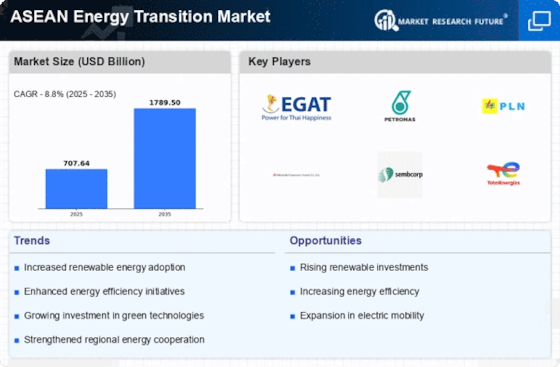
As per MRFR analysis, the ASEAN Energy Transition Market Size was estimated at 707.64 USD Billion in 2024. The ASEAN Energy Transition industry is projected to grow from 769.91 USD Billion in 2025 to 1789.5 USD Billion by 2035, exhibiting a compound annual growth rate (CAGR) of 8.8 during the forecast period 2025 - 2035.

Key Market Trends & Highlights

The ASEAN Energy Transition Market is poised for substantial growth driven by renewable energy investments and technological advancements.

  • Investment in renewable energy continues to surge, reflecting a broader global trend observed in North America. Regional collaboration on energy policies is enhancing the effectiveness of energy transition strategies across ASEAN nations. The adoption of smart energy technologies is gaining momentum, particularly in the residential segment, which remains the largest market. Government policies and incentives, alongside rising energy demand and urbanization, are key drivers propelling the growth of both renewable energy and hydrogen sectors.

Market Size & Forecast

2024 Market Size 707.64 (USD Billion)
2035 Market Size 1789.5 (USD Billion)
CAGR (2025 - 2035) 8.8%
Largest Regional Market Share in 2024 Asia Pacific

Major Players

<p><a href="https://www.enlit-asia.com/interview-series/egats-roadmap-drive-energy-transition-thailand">Electricity Generating Authority of Thailand</a> (TH), Petronas (MY), Singapore Power (SG), PT Perusahaan Listrik Negara (ID), Mitsubishi Corporation (JP), Sembcorp Industries (SG), TotalEnergies (FR), <a href="https://www.enel.com/learning-hub/energy-transition">Enel Green Power</a> (IT), First Gen Corporation (PH)</p>

Market Trends

The ASEAN Energy Transition Market is currently undergoing a transformative phase characterized by a shift towards sustainable energy sources. This transition is driven by a combination of governmental policies, technological advancements, and increasing public awareness regarding climate change. Countries within the ASEAN region are actively pursuing renewable energy projects, such as solar, wind, and hydropower, to reduce their reliance on fossil fuels. This movement not only aims to enhance energy security but also to foster economic growth through green jobs and innovation. Furthermore, regional cooperation among ASEAN nations appears to be strengthening, as they collaborate on energy efficiency initiatives and share best practices in renewable technologies. In addition to governmental efforts, private sector investment in the ASEAN Energy Transition Market is gaining momentum. Corporations are increasingly recognizing the potential of clean energy solutions, leading to a surge in partnerships and joint ventures focused on renewable energy development. This trend suggests a growing alignment between corporate sustainability goals and national energy policies. As the market evolves, it is likely that the integration of smart technologies and digital solutions will play a crucial role in optimizing energy consumption and distribution, thereby enhancing the overall efficiency of the energy system in the region.

Increased Investment in Renewable Energy

There is a noticeable rise in investments directed towards renewable energy projects across the ASEAN region. This trend indicates a collective commitment to transitioning from traditional energy sources to more sustainable alternatives, driven by both public and private sectors.

Regional Collaboration on Energy Policies

ASEAN nations are increasingly engaging in collaborative efforts to harmonize energy policies and regulations. This cooperation aims to facilitate the sharing of resources and knowledge, ultimately enhancing the effectiveness of energy transition strategies across member states.

Adoption of Smart Energy Technologies

The integration of smart technologies into the energy sector is becoming more prevalent. This trend suggests that digital solutions, such as smart grids and energy management systems, are likely to optimize energy efficiency and improve the reliability of energy supply in the ASEAN Energy Transition Market.

ASEAN energy transition market Market Drivers

Government Policies and Incentives

The ASEAN Energy Transition Market is significantly influenced by government policies and incentives aimed at promoting renewable energy adoption. Various ASEAN nations have implemented feed-in tariffs, tax breaks, and subsidies to encourage investments in clean energy technologies. For instance, countries like Indonesia and Vietnam have established ambitious renewable energy targets, aiming for 23% and 20% of their energy mix from renewables by 2025, respectively. These policies not only stimulate local investments but also attract foreign direct investment, thereby enhancing the overall market landscape. The commitment of governments to reduce carbon emissions and transition towards sustainable energy sources is likely to drive growth in the ASEAN Energy Transition Market.

Rising Energy Demand and Urbanization

The rapid urbanization and rising energy demand in ASEAN countries are driving the need for a transition to sustainable energy solutions. As urban populations grow, the demand for electricity is expected to increase significantly, with projections indicating a rise of 6% annually in energy consumption across the region. This surge in demand necessitates a shift from traditional fossil fuels to renewable energy sources to ensure energy security and sustainability. The ASEAN Energy Transition Market is likely to benefit from this trend, as governments and private sectors seek to develop infrastructure that supports renewable energy generation and distribution. The interplay between urbanization and energy demand presents both challenges and opportunities for the ASEAN Energy Transition Market.

Investment in Infrastructure Development

Investment in infrastructure development is a pivotal driver for the ASEAN Energy Transition Market. The region is experiencing a wave of infrastructure projects aimed at enhancing energy generation and distribution capabilities. Governments are prioritizing investments in renewable energy facilities, smart grids, and transmission networks to accommodate the growing share of renewables in their energy mix. For example, the Asian Development Bank has committed substantial funding to support renewable energy projects across ASEAN nations. This influx of capital is expected to facilitate the construction of new energy facilities and the modernization of existing infrastructure, thereby bolstering the ASEAN Energy Transition Market. The focus on infrastructure development is likely to create a more resilient and efficient energy system in the region.

Technological Advancements in Energy Storage

Technological advancements in energy storage solutions are poised to play a crucial role in the ASEAN Energy Transition Market. Innovations in battery technologies, such as lithium-ion and solid-state batteries, are enhancing the efficiency and reliability of renewable energy systems. The region is witnessing a surge in energy storage projects, with countries like Thailand and Malaysia investing in large-scale battery storage systems to stabilize their grids. According to recent data, the energy storage market in ASEAN is projected to grow at a compound annual growth rate of over 20% in the coming years. This growth indicates a strong potential for energy storage technologies to support the integration of renewable energy sources, thereby facilitating a smoother transition in the ASEAN Energy Transition Market.

Public Awareness and Consumer Demand for Sustainability

Public awareness regarding climate change and the demand for sustainable energy solutions are increasingly shaping the ASEAN Energy Transition Market. As consumers become more environmentally conscious, there is a growing preference for renewable energy sources. Surveys indicate that a significant percentage of the population in ASEAN countries is willing to pay a premium for green energy options. This shift in consumer behavior is prompting energy providers to diversify their offerings and invest in renewable energy projects. The rise in demand for sustainable energy solutions is likely to encourage innovation and competition within the ASEAN Energy Transition Market, ultimately leading to a more sustainable energy landscape.

Market Segment Insights

By Type: Renewable Energy (Largest) vs. Hydrogen (Fastest-Growing)

<p>In the ASEAN Energy Transition Market, Renewable Energy holds the largest share, being the cornerstone of the region's energy strategy. This segment has seen consistent investments, driven by both governmental policies and increasing public demand for sustainable energy sources. Meanwhile, Hydrogen is rapidly emerging, positioned as a solution to decarbonize hard-to-abate sectors, with increasing interest from both public and private sectors aiming to leverage its potential.</p>

<p>Energy Efficiency (Dominant) vs. Electrification (Emerging)</p>

<p>Energy Efficiency has established itself as a dominant force within the ASEAN Energy Transition Market, characterized by significant advancements in technology and widespread governmental support. Technologies such as smart grids and energy-efficient systems have led to a substantial reduction in energy consumption across various sectors. Conversely, Electrification is gaining prominence as an emerging trend, driven by the shift towards electric vehicles and broad electrification policies. This segment is rapidly evolving, with increasing infrastructure development and investments aimed at transitioning towards a more electrified future, which aligns with the region's goals of sustainability and carbon neutrality.</p>

By Application: Residential (Largest) vs. Commercial (Fastest-Growing)

<p>In the ASEAN Energy Transition Market, the application segment is witnessing a dynamic distribution of market share, with the residential sector emerging as the largest contributor. The increasing focus on energy efficiency and renewable sources within households is driving significant investments and technologies tailored to meet evolving consumer expectations. On the other hand, the commercial sector is quickly catching up, reflecting a robust interest in implementing sustainable practices, which is reshaping business operations across various industries.</p>

<p>Residential (Dominant) vs. Utility-Scale (Emerging)</p>

<p>The residential application segment holds a dominant position in the ASEAN Energy Transition Market, characterized by a growing emphasis on energy efficiency, renewable energy adoption, and innovative energy management solutions tailored for homes. This segment caters to consumers who prioritize sustainable living, driving demand for solar power installations, energy storage systems, and smart home technologies. In juxtaposition, the utility-scale application is emerging with significant potential due to the scale and impact of large-scale energy projects. This segment benefits from government incentives and an increased focus on grid stability and renewable integration, appealing to large energy producers aiming to contribute to the region's energy transition.</p>

Get more detailed insights about ASEAN Energy Transition Market Research Report – Forecast till 2035

Regional Insights

Key Players and Competitive Insights

Leading market players are investing heavily in research and development to expand their product lines, which will help the energy transition market grow even more. Market participants are also undertaking various strategic activities to expand their footprint, with important market developments including new product launches, contractual agreements, mergers and acquisitions, higher investments, and collaboration with other organizations. To expand and survive in a more competitive and rising market climate, the energy transition industry must offer cost-effective items.

Major players in the energy transition market are attempting to increase market demand by investing in research and development operations, including Exelon Corporation, Duke Energy Corporation, Pacific Gas and Electric Company, Southern Company, American Electric Power, Inc., Edison International, Repsol, Brookfield Renewable Partners, Ørsted A/S, and NextEra Energy, Inc.

Key Companies in the ASEAN energy transition market market include

Industry Developments

  • Q2 2025: What happened at the Energy Transition Meeting in ASEAN On May 26, 2025, the World Economic Forum and Malaysia Centre for the Fourth Industrial Revolution co-hosted the ASEAN Energy Transition Meeting, bringing together 200 high-level leaders to discuss actionable solutions for accelerating the region’s energy transition, including industrial decarbonization, innovative financing, and regional integration.
  • Q2 2025: New Tool Tracks ASEAN Countries' Ambitions on Energy ... At ACES 2024, Singapore’s Minister for Manpower and Second Minister for Trade and Industry, Dr. Tan See Leng, announced the launch of DigiLeap, a digital platform developed by SEAS to foster knowledge-sharing, networking, and innovation in Southeast Asia’s clean energy ecosystem.

Future Outlook

ASEAN energy transition market Future Outlook

<p>The ASEAN Energy Transition Market is projected to grow at an 8.8% CAGR from 2024 to 2035, driven by renewable energy adoption, regulatory support, and technological advancements.</p>

New opportunities lie in:

  • <p>Investment in smart grid technologies for enhanced energy management.</p>
  • <p>Development of localized renewable energy projects to meet regional demands.</p>
  • <p>Expansion of electric vehicle infrastructure to support growing market needs.</p>

<p>By 2035, the ASEAN Energy Transition Market is expected to be robust and dynamic.</p>

Market Segmentation

ASEAN energy transition market Type Outlook

  • Renewable Energy
  • Energy Efficiency
  • Electrification
  • Hydrogen

ASEAN energy transition market Application Outlook

  • Residential
  • Commercial
  • Utility-Scale

Report Scope

MARKET SIZE 2024 707.64(USD Billion)
MARKET SIZE 2025 769.91(USD Billion)
MARKET SIZE 2035 1789.5(USD Billion)
COMPOUND ANNUAL GROWTH RATE (CAGR) 8.8% (2024 - 2035)
REPORT COVERAGE Revenue Forecast, Competitive Landscape, Growth Factors, and Trends
BASE YEAR 2024
Market Forecast Period 2025 - 2035
Historical Data 2019 - 2024
Market Forecast Units USD Billion
Key Companies Profiled Market analysis in progress
Segments Covered Market segmentation analysis in progress
Key Market Opportunities Integration of renewable energy sources into national grids enhances energy security in the ASEAN Energy Transition Market.
Key Market Dynamics Accelerating investments in renewable energy technologies drive competitive dynamics within the ASEAN Energy Transition Market.
Countries Covered North America, Europe, APAC, South America, MEA

FAQs

What is the projected market valuation of the ASEAN Energy Transition Market by 2035?

The projected market valuation for the ASEAN Energy Transition Market is 1789.5 USD Billion by 2035.

What was the overall market valuation of the ASEAN Energy Transition Market in 2024?

The overall market valuation of the ASEAN Energy Transition Market was 707.64 USD Billion in 2025.

What is the expected CAGR for the ASEAN Energy Transition Market during the forecast period 2025 - 2035?

The expected CAGR for the ASEAN Energy Transition Market during the forecast period 2025 - 2035 is 8.8%.

Which segments are included in the ASEAN Energy Transition Market, and what are their valuations?

The segments include Renewable Energy valued at 300.0 to 800.0 USD Billion, Energy Efficiency at 150.0 to 400.0 USD Billion, Electrification at 200.0 to 500.0 USD Billion, and Hydrogen at 57.64 to 89.5 USD Billion.

What are the application segments of the ASEAN Energy Transition Market and their respective valuations?

The application segments are Residential valued at 141.53 to 367.87 USD Billion, Commercial at 141.53 to 367.87 USD Billion, and Utility-Scale at 424.58 to 1053.76 USD Billion.

  1. SECTION I: EXECUTIVE SUMMARY AND KEY HIGHLIGHTS
    1. EXECUTIVE SUMMARY
      1. Market Overview
      2. Key Findings
      3. Market Segmentation
      4. Competitive Landscape
      5. Challenges and Opportunities
      6. Future Outlook 2
  2. SECTION II: SCOPING, METHODOLOGY AND MARKET STRUCTURE
    1. MARKET INTRODUCTION
      1. Definition
      2. Scope of the study
    2. RESEARCH METHODOLOGY
      1. Overview
      2. Data Mining
      3. Secondary Research
      4. Primary Research
      5. Forecasting Model
      6. Market Size Estimation
      7. Data Triangulation
      8. Validation 3
  3. SECTION III: QUALITATIVE ANALYSIS
    1. MARKET DYNAMICS
      1. Overview
      2. Drivers
      3. Restraints
      4. Opportunities
    2. MARKET FACTOR ANALYSIS
      1. Value chain Analysis
      2. Porter's Five Forces Analysis
      3. COVID-19 Impact Analysis
  4. SECTION IV: QUANTITATIVE ANALYSIS
    1. Energy & Power, BY Type (USD Billion)
      1. Renewable Energy
      2. Energy Efficiency
      3. Electrification
      4. Hydrogen
    2. Energy & Power, BY Application (USD Billion)
      1. Residential
      2. Commercial
      3. Utility-Scale
    3. Energy & Power, BY Region (USD Billion)
      1. North America
      2. Europe
      3. APAC
      4. South America
      5. MEA
  5. SECTION V: COMPETITIVE ANALYSIS
    1. Competitive Landscape
      1. Overview
      2. Competitive Analysis
      3. Market share Analysis
      4. Major Growth Strategy in the Energy & Power
      5. Competitive Benchmarking
      6. Leading Players in Terms of Number of Developments in the Energy & Power
      7. Key developments and growth strategies
      8. Major Players Financial Matrix
    2. Company Profiles
      1. Electricity Generating Authority of Thailand (TH)
      2. Petronas (MY)
      3. Singapore Power (SG)
      4. PT Perusahaan Listrik Negara (ID)
      5. Mitsubishi Corporation (JP)
      6. Sembcorp Industries (SG)
      7. TotalEnergies (FR)
      8. Enel Green Power (IT)
      9. First Gen Corporation (PH)
    3. Appendix
      1. References
      2. Related Reports 6 LIST OF FIGURES
    4. MARKET SYNOPSIS
    5. NORTH AMERICA MARKET ANALYSIS
    6. US MARKET ANALYSIS BY TYPE
    7. US MARKET ANALYSIS BY APPLICATION
    8. CANADA MARKET ANALYSIS BY TYPE
    9. CANADA MARKET ANALYSIS BY APPLICATION
    10. EUROPE MARKET ANALYSIS
    11. GERMANY MARKET ANALYSIS BY TYPE
    12. GERMANY MARKET ANALYSIS BY APPLICATION
    13. UK MARKET ANALYSIS BY TYPE
    14. UK MARKET ANALYSIS BY APPLICATION
    15. FRANCE MARKET ANALYSIS BY TYPE
    16. FRANCE MARKET ANALYSIS BY APPLICATION
    17. RUSSIA MARKET ANALYSIS BY TYPE
    18. RUSSIA MARKET ANALYSIS BY APPLICATION
    19. ITALY MARKET ANALYSIS BY TYPE
    20. ITALY MARKET ANALYSIS BY APPLICATION
    21. SPAIN MARKET ANALYSIS BY TYPE
    22. SPAIN MARKET ANALYSIS BY APPLICATION
    23. REST OF EUROPE MARKET ANALYSIS BY TYPE
    24. REST OF EUROPE MARKET ANALYSIS BY APPLICATION
    25. APAC MARKET ANALYSIS
    26. CHINA MARKET ANALYSIS BY TYPE
    27. CHINA MARKET ANALYSIS BY APPLICATION
    28. INDIA MARKET ANALYSIS BY TYPE
    29. INDIA MARKET ANALYSIS BY APPLICATION
    30. JAPAN MARKET ANALYSIS BY TYPE
    31. JAPAN MARKET ANALYSIS BY APPLICATION
    32. SOUTH KOREA MARKET ANALYSIS BY TYPE
    33. SOUTH KOREA MARKET ANALYSIS BY APPLICATION
    34. MALAYSIA MARKET ANALYSIS BY TYPE
    35. MALAYSIA MARKET ANALYSIS BY APPLICATION
    36. THAILAND MARKET ANALYSIS BY TYPE
    37. THAILAND MARKET ANALYSIS BY APPLICATION
    38. INDONESIA MARKET ANALYSIS BY TYPE
    39. INDONESIA MARKET ANALYSIS BY APPLICATION
    40. REST OF APAC MARKET ANALYSIS BY TYPE
    41. REST OF APAC MARKET ANALYSIS BY APPLICATION
    42. SOUTH AMERICA MARKET ANALYSIS
    43. BRAZIL MARKET ANALYSIS BY TYPE
    44. BRAZIL MARKET ANALYSIS BY APPLICATION
    45. MEXICO MARKET ANALYSIS BY TYPE
    46. MEXICO MARKET ANALYSIS BY APPLICATION
    47. ARGENTINA MARKET ANALYSIS BY TYPE
    48. ARGENTINA MARKET ANALYSIS BY APPLICATION
    49. REST OF SOUTH AMERICA MARKET ANALYSIS BY TYPE
    50. REST OF SOUTH AMERICA MARKET ANALYSIS BY APPLICATION
    51. MEA MARKET ANALYSIS
    52. GCC COUNTRIES MARKET ANALYSIS BY TYPE
    53. GCC COUNTRIES MARKET ANALYSIS BY APPLICATION
    54. SOUTH AFRICA MARKET ANALYSIS BY TYPE
    55. SOUTH AFRICA MARKET ANALYSIS BY APPLICATION
    56. REST OF MEA MARKET ANALYSIS BY TYPE
    57. REST OF MEA MARKET ANALYSIS BY APPLICATION
    58. KEY BUYING CRITERIA OF ENERGY & POWER
    59. RESEARCH PROCESS OF MRFR
    60. DRO ANALYSIS OF ENERGY & POWER
    61. DRIVERS IMPACT ANALYSIS: ENERGY & POWER
    62. RESTRAINTS IMPACT ANALYSIS: ENERGY & POWER
    63. SUPPLY / VALUE CHAIN: ENERGY & POWER
    64. ENERGY & POWER, BY TYPE, 2024 (% SHARE)
    65. ENERGY & POWER, BY TYPE, 2024 TO 2035 (USD Billion)
    66. ENERGY & POWER, BY APPLICATION, 2024 (% SHARE)
    67. ENERGY & POWER, BY APPLICATION, 2024 TO 2035 (USD Billion)
    68. BENCHMARKING OF MAJOR COMPETITORS 7 LIST OF TABLES
    69. LIST OF ASSUMPTIONS
    70. North America MARKET SIZE ESTIMATES; FORECAST
      1. BY TYPE, 2025-2035 (USD Billion)
      2. BY APPLICATION, 2025-2035 (USD Billion)
    71. US MARKET SIZE ESTIMATES; FORECAST
      1. BY TYPE, 2025-2035 (USD Billion)
      2. BY APPLICATION, 2025-2035 (USD Billion)
    72. Canada MARKET SIZE ESTIMATES; FORECAST
      1. BY TYPE, 2025-2035 (USD Billion)
      2. BY APPLICATION, 2025-2035 (USD Billion)
    73. Europe MARKET SIZE ESTIMATES; FORECAST
      1. BY TYPE, 2025-2035 (USD Billion)
      2. BY APPLICATION, 2025-2035 (USD Billion)
    74. Germany MARKET SIZE ESTIMATES; FORECAST
      1. BY TYPE, 2025-2035 (USD Billion)
      2. BY APPLICATION, 2025-2035 (USD Billion)
    75. UK MARKET SIZE ESTIMATES; FORECAST
      1. BY TYPE, 2025-2035 (USD Billion)
      2. BY APPLICATION, 2025-2035 (USD Billion)
    76. France MARKET SIZE ESTIMATES; FORECAST
      1. BY TYPE, 2025-2035 (USD Billion)
      2. BY APPLICATION, 2025-2035 (USD Billion)
    77. Russia MARKET SIZE ESTIMATES; FORECAST
      1. BY TYPE, 2025-2035 (USD Billion)
      2. BY APPLICATION, 2025-2035 (USD Billion)
    78. Italy MARKET SIZE ESTIMATES; FORECAST
      1. BY TYPE, 2025-2035 (USD Billion)
      2. BY APPLICATION, 2025-2035 (USD Billion)
    79. Spain MARKET SIZE ESTIMATES; FORECAST
      1. BY TYPE, 2025-2035 (USD Billion)
      2. BY APPLICATION, 2025-2035 (USD Billion)
    80. Rest of Europe MARKET SIZE ESTIMATES; FORECAST
      1. BY TYPE, 2025-2035 (USD Billion)
      2. BY APPLICATION, 2025-2035 (USD Billion)
    81. APAC MARKET SIZE ESTIMATES; FORECAST
      1. BY TYPE, 2025-2035 (USD Billion)
      2. BY APPLICATION, 2025-2035 (USD Billion)
    82. China MARKET SIZE ESTIMATES; FORECAST
      1. BY TYPE, 2025-2035 (USD Billion)
      2. BY APPLICATION, 2025-2035 (USD Billion)
    83. India MARKET SIZE ESTIMATES; FORECAST
      1. BY TYPE, 2025-2035 (USD Billion)
      2. BY APPLICATION, 2025-2035 (USD Billion)
    84. Japan MARKET SIZE ESTIMATES; FORECAST
      1. BY TYPE, 2025-2035 (USD Billion)
      2. BY APPLICATION, 2025-2035 (USD Billion)
    85. South Korea MARKET SIZE ESTIMATES; FORECAST
      1. BY TYPE, 2025-2035 (USD Billion)
      2. BY APPLICATION, 2025-2035 (USD Billion)
    86. Malaysia MARKET SIZE ESTIMATES; FORECAST
      1. BY TYPE, 2025-2035 (USD Billion)
      2. BY APPLICATION, 2025-2035 (USD Billion)
    87. Thailand MARKET SIZE ESTIMATES; FORECAST
      1. BY TYPE, 2025-2035 (USD Billion)
      2. BY APPLICATION, 2025-2035 (USD Billion)
    88. Indonesia MARKET SIZE ESTIMATES; FORECAST
      1. BY TYPE, 2025-2035 (USD Billion)
      2. BY APPLICATION, 2025-2035 (USD Billion)
    89. Rest of APAC MARKET SIZE ESTIMATES; FORECAST
      1. BY TYPE, 2025-2035 (USD Billion)
      2. BY APPLICATION, 2025-2035 (USD Billion)
    90. South America MARKET SIZE ESTIMATES; FORECAST
      1. BY TYPE, 2025-2035 (USD Billion)
      2. BY APPLICATION, 2025-2035 (USD Billion)
    91. Brazil MARKET SIZE ESTIMATES; FORECAST
      1. BY TYPE, 2025-2035 (USD Billion)
      2. BY APPLICATION, 2025-2035 (USD Billion)
    92. Mexico MARKET SIZE ESTIMATES; FORECAST
      1. BY TYPE, 2025-2035 (USD Billion)
      2. BY APPLICATION, 2025-2035 (USD Billion)
    93. Argentina MARKET SIZE ESTIMATES; FORECAST
      1. BY TYPE, 2025-2035 (USD Billion)
      2. BY APPLICATION, 2025-2035 (USD Billion)
    94. Rest of South America MARKET SIZE ESTIMATES; FORECAST
      1. BY TYPE, 2025-2035 (USD Billion)
      2. BY APPLICATION, 2025-2035 (USD Billion)
    95. MEA MARKET SIZE ESTIMATES; FORECAST
      1. BY TYPE, 2025-2035 (USD Billion)
      2. BY APPLICATION, 2025-2035 (USD Billion)
    96. GCC Countries MARKET SIZE ESTIMATES; FORECAST
      1. BY TYPE, 2025-2035 (USD Billion)
      2. BY APPLICATION, 2025-2035 (USD Billion)
    97. South Africa MARKET SIZE ESTIMATES; FORECAST
      1. BY TYPE, 2025-2035 (USD Billion)
      2. BY APPLICATION, 2025-2035 (USD Billion)
    98. Rest of MEA MARKET SIZE ESTIMATES; FORECAST
      1. BY TYPE, 2025-2035 (USD Billion)
      2. BY APPLICATION, 2025-2035 (USD Billion)
    99. PRODUCT LAUNCH/PRODUCT DEVELOPMENT/APPROVAL
    100. ACQUISITION/PARTNERSHIP

ASEAN Energy Transition Market Segmentation

Market Segmentation Overview

  • Detailed segmentation data will be available in the full report
  • Comprehensive analysis by multiple parameters
  • Regional and country-level breakdowns
  • Market size forecasts by segment
Infographic

Free Sample Request

Kindly complete the form below to receive a free sample of this Report

Get Free Sample

Customer Strories

Compare Licence

×
Features License Type
Single User Multiuser License Enterprise User
Price $4,950 $5,950 $7,250
Maximum User Access Limit 1 User Upto 10 Users Unrestricted Access Throughout the Organization
Free Customization
Direct Access to Analyst
Deliverable Format
Platform Access
Discount on Next Purchase 10% 15% 15%
Printable Versions