Asia Pacific Logistics Market (2025 - 2035)

ID: MRFR/PCM/19916-HCR
128 Pages
Snehal Singh
Last Updated: July 28, 2026
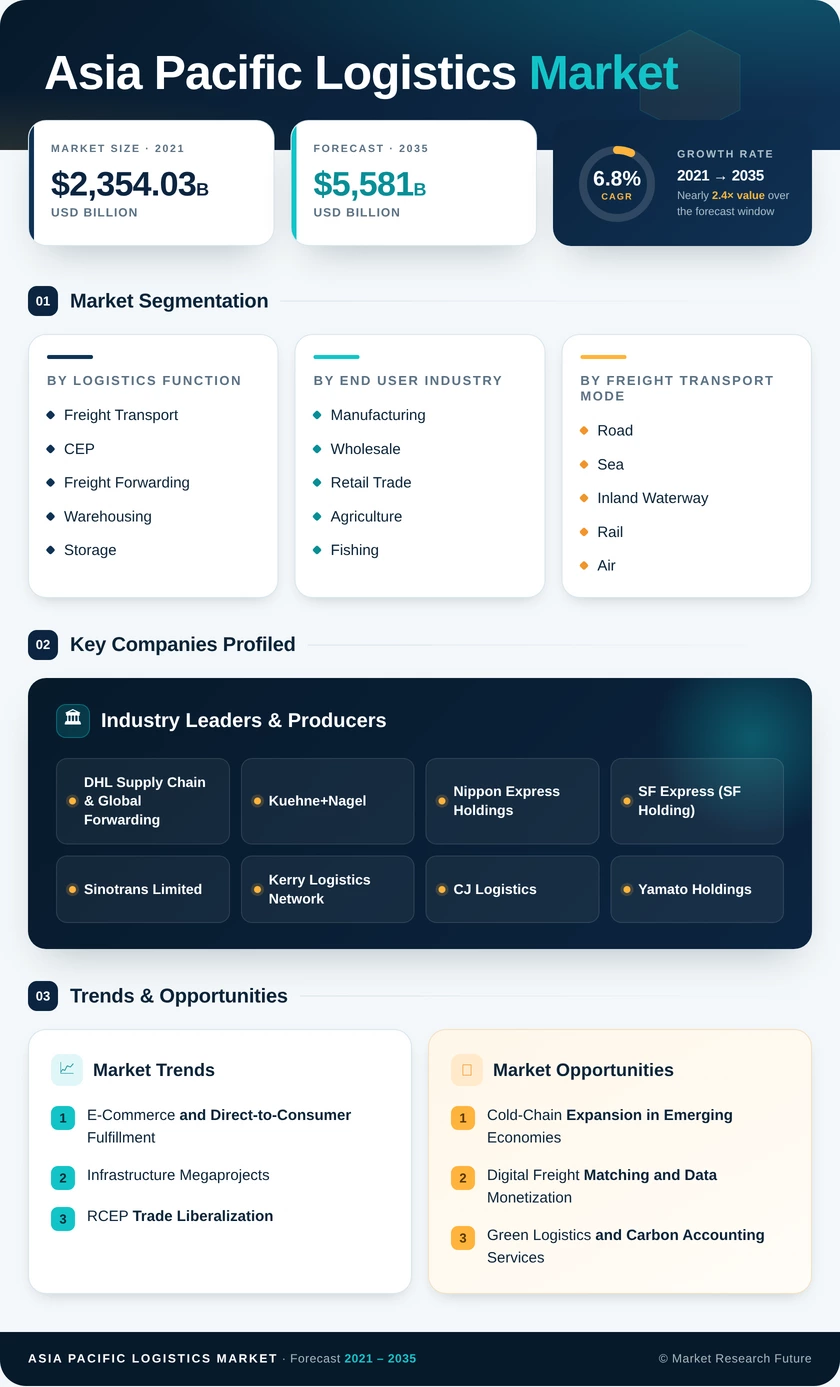
Asia Pacific Logistics Market Research Report Information By Logistics Function (Freight Transport, Courier, Express, and Parcel (CEP), Freight Forwarding, Warehousing and Storage, and Other Services), By End-User Industry (Manufacturing, Wholesale and Retail Trade, Agriculture, Fishing, and Forestry, Construction, and Other Industries), By Freight Transport Mode (Road Freight Transport, Sea and Inland Waterway, Rail Freight, Air Freight, and Pipeline), and By Freight Forwarding Mode (Sea and Inland Waterway Freight Forwarding, Air Freight Forwarding, and Land Freight Forwarding) – Forecast Till 2035
Asia Pacific Logistics Market
Market Size
Forecast Period2025-2035
CAGR (2025-2035)6.8%
2025 Market SizeUSD 2,889.16 Billion
2035 Market SizeUSD 5,581.00 Billion
Key Players
DHL Supply Chain & Global Forwarding
Kuehne+Nagel
Nippon Express Holdings
SF Express
Sinotrans Limited
Kerry Logistics Network
Opportunities
  • Cold-Chain Expansion in Emerging Economies
  • Digital Freight Matching and Data Monetization
  • Green Logistics and Carbon Accounting Services
  1. 1 Market Overview |
    1. 1.1 Study Assumptions & Market Definition |
    2. 1.2 Scope of the Study |
    3. 1.3 Research Methodology
  2. 2 Market Summary & Key Takeaways
  3. 3 Market Dynamics |
    1. 3.1 Market Drivers Analysis | |
      1. 3.1.1 E-Commerce and Direct-to-Consumer Fulfillment Expansion | |
      2. 3.1.2 Infrastructure Megaprojects (Ports, Expressways, Rail) | |
      3. 3.1.3 RCEP and Bilateral Trade Liberalization | |
      4. 3.1.4 Manufacturing Relocation into Southeast Asia | |
      5. 3.1.5 Digital Freight Platforms and Visibility Technology | |
      6. 3.1.6 Cold-Chain and Pharmaceutical Logistics Demand | |
      7. 3.1.7 Urbanization and Last-Mile Complexity |
    2. 3.2 Market Restraints Analysis | |
      1. 3.2.1 Fragmented Regulatory and Customs Regimes | |
      2. 3.2.2 Driver and Warehouse Labor Shortages | |
      3. 3.2.3 Fuel Price and Energy Cost Volatility | |
      4. 3.2.4 Geopolitical Tensions and Trade Policy Uncertainty | |
      5. 3.2.5 Climate-Related Disruption to Infrastructure |
    3. 3.3 Market Opportunity Analysis | |
      1. 3.3.1 Cold-Chain Expansion in Emerging Economies | |
      2. 3.3.2 Digital Freight Matching and Data Monetization | |
      3. 3.3.3 Green Logistics and Carbon Accounting Services | |
      4. 3.3.4 Cross-Border E-Commerce Fulfillment Hubs | |
      5. 3.3.5 Autonomous and Semi-Autonomous Fleet Deployment |
    4. 3.4 Industry Value Chain Analysis |
    5. 3.5 Porter's Five Forces Analysis
  4. 4 Asia Pacific Logistics Market Size & Forecast (2021–2035) |
    1. 4.1 Historical Market Size (2021–2025) |
    2. 4.2 Current & Forecast Market Size (2026–2035) |
    3. 4.3 Market Size by Revenue (USD Billion) |
    4. 4.4 Year-over-Year Growth Analysis
  5. 5 Segmentation Analysis |
    1. 5.1 By Logistics Function | |
      1. 5.1.1 Freight Transport | |
      2. 5.1.2 Courier, Express, and Parcel (CEP) | |
      3. 5.1.3 Freight Forwarding | |
      4. 5.1.4 Warehousing and Storage | |
      5. 5.1.5 Other Services |
    2. 5.2 By End User Industry | |
      1. 5.2.1 Manufacturing | |
      2. 5.2.2 Wholesale and Retail Trade | |
      3. 5.2.3 Agriculture, Fishing, and Forestry | |
      4. 5.2.4 Construction | |
      5. 5.2.5 Other Industries |
    3. 5.3 By Freight Transport Mode | |
      1. 5.3.1 Road Freight Transport | |
      2. 5.3.2 Sea and Inland Waterway | |
      3. 5.3.3 Rail Freight | |
      4. 5.3.4 Air Freight | |
      5. 5.3.5 Pipeline |
    4. 5.4 By Freight Forwarding Mode | |
      1. 5.4.1 Sea and Inland Waterway Freight Forwarding | |
      2. 5.4.2 Air Freight Forwarding | |
      3. 5.4.3 Land Freight Forwarding
  6. 6 Country-Level Analysis |
    1. 6.1 China |
    2. 6.2 India |
    3. 6.3 Japan |
    4. 6.4 ASEAN | |
      1. 6.4.1 Indonesia | |
      2. 6.4.2 Vietnam | |
      3. 6.4.3 Thailand | |
      4. 6.4.4 Malaysia | |
      5. 6.4.5 Philippines |
    5. 6.5 Rest of Asia-Pacific | |
      1. 6.5.1 South Korea | |
      2. 6.5.2 Australia | |
      3. 6.5.3 New Zealand
  7. 7 Competitive Landscape |
    1. 7.1 Market Share Analysis (2025) |
    2. 7.2 Competitive Benchmarking Matrix |
    3. 7.3 Company Profiles | |
      1. 7.3.1 DHL Supply Chain & Global Forwarding | |
      2. 7.3.2 Kuehne+Nagel | |
      3. 7.3.3 Nippon Express Holdings | |
      4. 7.3.4 SF Express (SF Holding) | |
      5. 7.3.5 Sinotrans Limited | |
      6. 7.3.6 Kerry Logistics Network | |
      7. 7.3.7 CJ Logistics | |
      8. 7.3.8 Yamato Holdings | |
      9. 7.3.9 DB Schenker | |
      10. 7.3.10 Delhivery
  8. 8 Future Outlook & Strategic Recommendations (2026–2035) |
    1. 8.1 AI-Driven Orchestration and Predictive Logistics |
    2. 8.2 Electrification and Alternative Fuels |
    3. 8.3 Platform Economics and Ecosystem Consolidation |
    4. 8.4 ESG Reporting and Sustainable Supply-Chain Mandates
  9. 9 Recent Developments & News
  10. 10 Frequently Asked Questions (FAQs)
  11. 11 Report Scope & Methodology |
    1. 11.1 Study Period & Base Year |
    2. 11.2 Data Sources & Citations |
    3. 11.3 Abbreviations
  12. 12 LIST OF TABLES |
  13. TABLE 1 Asia Pacific Logistics Market Size & Forecast, by Revenue (USD Billion), 2021–2035 |
  14. TABLE 2 Asia Pacific Logistics Market – Year-over-Year Growth Analysis, 2021–2035 |
  15. TABLE 3 Asia Pacific Logistics Market – Driver Impact Analysis |
  16. TABLE 4 Asia Pacific Logistics Market – Restraint Impact Analysis |
  17. TABLE 5 Asia Pacific Logistics Market Size, by Logistics Function, 2021–2035 (USD Billion) |
  18. TABLE 6 Asia Pacific Logistics Market Size, by End User Industry, 2021–2035 (USD Billion) |
  19. TABLE 7 Asia Pacific Logistics Market Size, by Freight Transport Mode, 2021–2035 (USD Billion) |
  20. TABLE 8 Asia Pacific Logistics Market Size, by Freight Forwarding Mode, 2021–2035 (USD Billion) |
  21. TABLE 9 Asia Pacific Logistics Market Size, by Country/Sub-Region, 2021–2035 (USD Billion) |
  22. TABLE 10 China Logistics Market Size, by Segment, 2021–2035 (USD Billion) |
  23. TABLE 11 India Logistics Market Size, by Segment, 2021–2035 (USD Billion) |
  24. TABLE 12 Japan Logistics Market Size, by Segment, 2021–2035 (USD Billion) |
  25. TABLE 13 ASEAN Logistics Market Size, by Country, 2021–2035 (USD Billion) |
  26. TABLE 14 Rest of Asia-Pacific Logistics Market Size, by Country, 2021–2035 (USD Billion) |
  27. TABLE 15 Competitive Benchmarking Matrix – Asia Pacific Logistics Market, 2025 |
  28. TABLE 16 Company Profiles – Key Players, Asia Pacific Logistics Market |
  29. TABLE 17 Recent Developments & Strategic Announcements, 2023–2025 |
  30. TABLE 18 Report Scope & Methodology Summary
  31. 13 LIST OF FIGURES |
  32. FIGURE 1 Asia Pacific Logistics Market Dynamics – Drivers, Restraints, and Opportunities |
  33. FIGURE 2 Industry Value Chain Analysis – Asia Pacific Logistics Market |
  34. FIGURE 3 Porter's Five Forces Analysis – Asia Pacific Logistics Market |
  35. FIGURE 4 Asia Pacific Logistics Market Size Trend (USD Billion), 2021–2035 |
  36. FIGURE 5 Asia Pacific Logistics Market Share, by Logistics Function (%), 2025 |
  37. FIGURE 6 Asia Pacific Logistics Market Share, by End User Industry (%), 2025 |
  38. FIGURE 7 Asia Pacific Logistics Market Share, by Freight Transport Mode (%), 2025 |
  39. FIGURE 8 Asia Pacific Logistics Market Share, by Freight Forwarding Mode (%), 2025 |
  40. FIGURE 9 Asia Pacific Logistics Market Share, by Country/Sub-Region (%), 2025 |
  41. FIGURE 10 China vs. India vs. Japan – Revenue Comparison (USD Billion), 2021–2035 |
  42. FIGURE 11 ASEAN Country-Level Revenue Distribution (%), 2025 |
  43. FIGURE 12 Competitive Landscape – Market Share Heatmap, 2025

Segmentation Quick Reference

DimensionSub-SegmentsDominant SegmentFastest Growing Segment
By Logistics FunctionFreight Transport, CEP, Freight Forwarding, Warehousing and Storage, Other ServicesFreight Transport (55.9% share, 2025)CEP (7.3% CAGR)
By End User IndustryManufacturing, Wholesale and Retail Trade, Agriculture, Fishing and Forestry, Construction, Other IndustriesManufacturing (33.6% share, 2025)Wholesale and Retail Trade (7.1% CAGR)
By Freight Transport ModeRoad, Sea and Inland Waterway, Rail, Air, PipelineRoad Freight Transport (59.0% share, 2025)Air Freight (7.4% CAGR)
By Freight Forwarding ModeSea and Inland Waterway, Air, LandSea and Inland Waterway (60.4% share, 2025)Air Freight Forwarding (7.0% CAGR)
By Country/Sub-RegionChina, India, Japan, ASEAN, Rest of Asia-PacificChina (~42% share, 2025)India (8.2% CAGR)


Market Segmentation Overview

By Logistics Function

Sub-SegmentKey Trend
Freight TransportRoad remains dominant; rail modal shift accelerating through dedicated corridor investments.
Courier, Express, and Parcel (CEP)Cross-border e-commerce volumes doubling every four years in Southeast Asia
Freight ForwardingDigital booking platforms enabling real-time rate comparison across ASEAN lanes
Warehousing and StorageMicro-fulfillment densification in urban cores; cold-chain capacity gaps closing
Other ServicesCustoms brokerage and value-added services gaining share through integrated platform offerings


The logistics function dimension captures how revenue flows through the core service layers that move, store, and manage goods across the region. Freight transport dominates in absolute scale, while CEP leads in growth trajectory as parcel-intensive commerce models reshape fulfillment expectations.

By End User Industry

Sub-SegmentKey Trend
ManufacturingExport-oriented factory relocations into Vietnam, Indonesia, and India generating new freight pairs.
Wholesale and Retail TradeOmnichannel and quick-commerce models compressing delivery windows to sub-60 minutes
Agriculture, Fishing, and ForestryPerishable cold-chain investment driven by rising consumer protein and fresh produce demand
ConstructionInfrastructure megaprojects across India, Indonesia, and China pulling heavy-haulage and project cargo volumes.
Other IndustriesPharma, oil & gas, and mining creating specialized handling and compliance requirements


End user segmentation reveals how industrial composition shapes logistics demand profiles. Manufacturing remains the heavyweight, but retail trade's growth trajectory signals a structural shift toward lighter, more frequent shipments with tighter service-level windows.

By Freight Transport Mode

Sub-SegmentKey Trend
Road Freight TransportAutonomous trucking pilots in China and Japan targeting 22% cost reduction on trunk routes
Sea and Inland WaterwayMega-vessel cascading and inland barge revival supporting bulk and container volumes.
Rail FreightDedicated freight corridors in India and China–Europe intermodal rail reshaping long-haul economics
Air FreightSemiconductor, pharma, and perishable shipments driving dedicated freighter capacity expansion
PipelineStable petrochemical flows with incremental LNG pipeline additions in Australia and Southeast Asia.


Modal segmentation highlights the infrastructure and technology investments that will shift freight share over the forecast period. Road retains scale advantage, but air and rail modes offer the strongest growth outlook driven by high-value goods and policy-driven modal rebalancing.

By Freight Forwarding Mode

Sub-SegmentKey Trend
Sea and Inland Waterway Freight ForwardingDigital forwarding platforms reducing booking-to-shipment lead times by 40%
Air Freight ForwardingE-commerce and pharma consignments driving dedicated freighter network build-out
Land Freight ForwardingCross-border trucking under ASEAN Framework Agreement gaining traction in GMS corridors.


Freight forwarding segmentation reflects intermediary value capture across transport modes. Sea forwarding maintains dominance through containerized trade volumes, while air forwarding's rapid growth underscores the premium placed on speed in high-value, time-critical supply chains.

By Country / Sub-Region

Sub-SegmentKey Trend
ChinaExpress network consolidation and port automation sustaining market leadership
IndiaNational Logistics Policy and Dedicated Freight Corridors unlocking transformational growth.
JapanLabor-saving automation and cold-chain sophistication offsetting demographic headwinds
ASEAN (Indonesia, Vietnam, Thailand, Malaysia, Philippines)FDI-led manufacturing logistics, cross-border e-commerce hub development
Rest of Asia-Pacific (South Korea, Australia, New Zealand)Semiconductor export logistics, mining supply chains, and intermodal rail investment


Geographic segmentation captures the divergent growth drivers across the region's economies. China's scale advantage coexists with India's rapid catch-up and ASEAN's emergence as a diversified manufacturing and fulfillment corridor.




Download PDF ×

We do not share your information with anyone. However, we may send you emails based on your report interest from time to time. You may contact us at any time to opt-out.