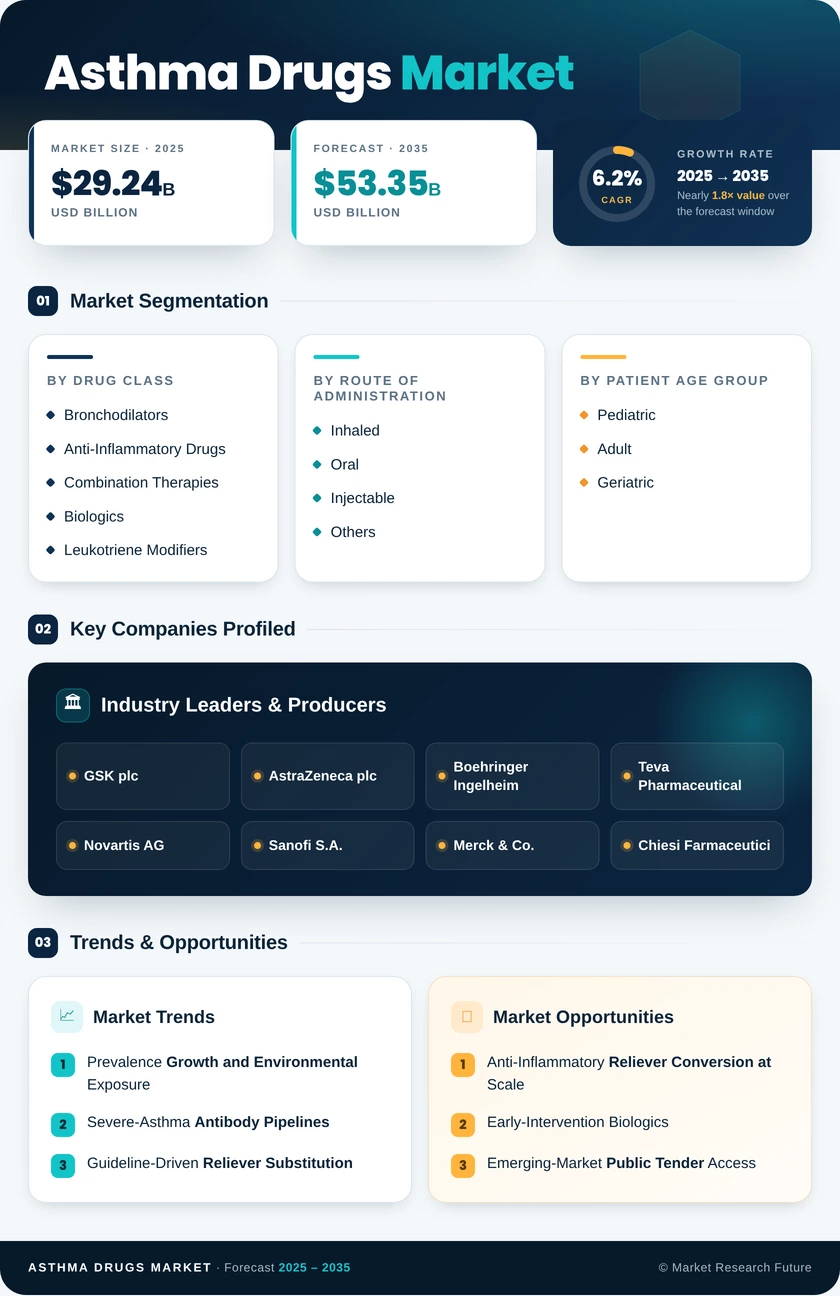
Asthma Drugs Market (2026 - 2035)

Asthma Drugs Market Research Report: Size, Share, Trend Analysis By Drug Class (Inhaled Corticosteroids, Long-Acting Beta Agonists, Leukotriene Receptor Antagonists, Short-Acting Beta Agonists, Monoclonal Antibodies), By Route of Administration (Inhalation, Oral, Injectable), By Disease Severity (Mild, Moderate, Severe), By Formulation Type (Dry Powder Inhalers, Metered Dose Inhalers, Nebulizers, Tablets, Injectables) andBy Regional (North America, Europe, South America, Asia Pacific, Middle East and Africa) - Growth Outlook & Industry Forecast 2025 To 2035

Forecast Period
2026-2035
CAGR
6.2%
2025 Market Size
USD 29.24 Billion
2035 Market Size
USD 53.35 Billion
Healthcare ● Updated August 2026 Report ID: MRFR/HC/41502-HCR | Pages: 200 | Author: Rahul Gotadki, Satyendra Maurya
  1. 1 Market Overview |
    1. 1.1 Study Assumptions & Market Definition |
    2. 1.2 Scope of the Study |
    3. 1.3 Research Methodology
  2. 2 Market Summary & Key Report Takeaways |
    1. 2.1 Key Takeaways by Drug Class |
    2. 2.2 Key Takeaways by Route and End User |
    3. 2.3 Key Takeaways by Geography
  3. 3 Market Size & Forecast (2021–2035) |
    1. 3.1 Historical Market Size (2021–2024) |
    2. 3.2 Base Year Assessment (2025) |
    3. 3.3 Forecast Market Size (2026–2035) |
    4. 3.4 Year-over-Year Growth Analysis
  4. 4 Driver Impact Analysis |
    1. 4.1 Prevalence Growth and Environmental Exposure |
    2. 4.2 Severe-Asthma Antibody Pipelines |
    3. 4.3 Guideline-Driven Reliever Substitution |
    4. 4.4 Reimbursement and Access Policy
  5. 5 Restraints Impact Analysis |
    1. 5.1 Generic and Biosimilar Erosion |
    2. 5.2 Diagnosis and Adherence Gaps |
    3. 5.3 Affordability of Advanced Therapy
  6. 6 Opportunity Analysis |
    1. 6.1 Anti-Inflammatory Reliever Conversion at Scale |
    2. 6.2 Early-Intervention Biologics |
    3. 6.3 Emerging-Market Public Tender Access |
    4. 6.4 Adherence Data as a Commercial Asset |
    5. 6.5 Sustainable Device Leadership |
    6. 6.6 Industry Value Chain Analysis |
    7. 6.7 Porter's Five Forces Analysis
  7. 7 Regional Market Share & Country-Level Analysis |
    1. 7.1 North America | |
      1. 7.1.1 US | |
      2. 7.1.2 Canada | |
      3. 7.1.3 Mexico |
    2. 7.2 Europe | |
      1. 7.2.1 Germany | |
      2. 7.2.2 UK | |
      3. 7.2.3 France | |
      4. 7.2.4 Italy | |
      5. 7.2.5 Spain | |
      6. 7.2.6 Nordic Countries | |
      7. 7.2.7 Russia | |
      8. 7.2.8 Rest of Europe |
    3. 7.3 Asia-Pacific | |
      1. 7.3.1 China | |
      2. 7.3.2 India | |
      3. 7.3.3 Japan | |
      4. 7.3.4 South Korea | |
      5. 7.3.5 ASEAN | |
      6. 7.3.6 Rest of Asia-Pacific |
    4. 7.4 South America | |
      1. 7.4.1 Brazil | |
      2. 7.4.2 Argentina | |
      3. 7.4.3 Rest of South America |
    5. 7.5 Middle East & Africa | |
      1. 7.5.1 Saudi Arabia | |
      2. 7.5.2 UAE | |
      3. 7.5.3 South Africa | |
      4. 7.5.4 Egypt | |
      5. 7.5.5 Rest of Middle East & Africa
  8. 8 Future Outlook (2026–2035) |
    1. 8.1 Precision Phenotyping |
    2. 8.2 Outcome-Linked Commercial Models |
    3. 8.3 Pediatric and Adolescent Expansion |
    4. 8.4 Decarbonized Inhalation
  9. 9 Market Segmentation Analysis |
    1. 9.1 By Drug Class | |
      1. 9.1.1 Bronchodilators | |
      2. 9.1.2 Anti-Inflammatory Drugs | |
      3. 9.1.3 Combination Therapies | |
      4. 9.1.4 Biologics | |
      5. 9.1.5 Leukotriene Modifiers | |
      6. 9.1.6 Others |
    2. 9.2 By Route of Administration | |
      1. 9.2.1 Inhaled | |
      2. 9.2.2 Oral | |
      3. 9.2.3 Injectable | |
      4. 9.2.4 Others |
    3. 9.3 By Patient Age Group | |
      1. 9.3.1 Pediatric | |
      2. 9.3.2 Adult | |
      3. 9.3.3 Geriatric |
    4. 9.4 By Distribution Channel | |
      1. 9.4.1 Hospital Pharmacies | |
      2. 9.4.2 Retail Pharmacies | |
      3. 9.4.3 Online Pharmacies | |
      4. 9.4.4 Others
  10. 10 Competitive Landscape |
    1. 10.1 Market Concentration Analysis (2026) |
    2. 10.2 Competitive Benchmarking Matrix |
    3. 10.3 Company Profiles | |
      1. 10.3.1 GSK plc | |
      2. 10.3.2 AstraZeneca plc | |
      3. 10.3.3 Boehringer Ingelheim | |
      4. 10.3.4 Teva Pharmaceutical Industries | |
      5. 10.3.5 Novartis AG | |
      6. 10.3.6 Sanofi S.A. | |
      7. 10.3.7 Merck & Co. | |
      8. 10.3.8 Chiesi Farmaceutici | |
      9. 10.3.9 Cipla Ltd. | |
      10. 10.3.10 Viatris Inc. | |
      11. 10.3.11 Sun Pharmaceutical Industries
  11. 11 Recent News & Developments
  12. 12 Report Scope & Methodology |
    1. 12.1 Study Period & Base Year |
    2. 12.2 Valuation Currency & Assumptions |
    3. 12.3 Abbreviations
  13. 13 Detailed Sources & Citations
  14. 14 Frequently Asked Questions (FAQs)
  15. 15 LIST OF TABLES
  16. 16 LIST OF FIGURES
Share::
Request Free Sample

Segmentation Quick Reference

DimensionSub-SegmentsDominant SegmentFastest Growing Segment
By Drug ClassBronchodilators; Anti-Inflammatory Drugs; Combination Therapies; Biologics; Leukotriene Modifiers; OthersBronchodilatorsBiologics
By Route of AdministrationInhaled; Oral; Injectable; OthersInhaledInjectable
By Patient Age GroupPediatric; Adult; GeriatricAdultGeriatric
By Distribution ChannelHospital Pharmacies; Retail Pharmacies; Online Pharmacies; OthersRetail PharmaciesOnline Pharmacies
By GeographyNorth America; Europe; Asia-Pacific; South America; Middle East & AfricaNorth AmericaAsia-Pacific


Market Segmentation Overview

By Drug Class

Sub-SegmentKey Trend
BronchodilatorsVolume base intact, but generic entry compresses branded pricing
Anti-Inflammatory DrugsGuideline reinforcement keeps corticosteroids at the core of every controller step
Combination TherapiesSingle-device fixed-dose regimens capture reliever substitution demand
BiologicsPhenotype-guided prescribing extends antibody use into earlier severity steps
Leukotriene ModifiersOral convenience sustains pediatric and comorbid rhinitis prescribing
OthersLegacy xanthines fade outside cost-constrained public systems


Class economics are diverging sharply. Volume leadership and value leadership no longer sit in the same segment, which forces manufacturers to run two commercial models simultaneously — a cost-efficient inhalation supply chain and a high-touch specialty franchise.

By Route of Administration

Sub-SegmentKey Trend
InhaledDevice engineering, dose counters, and low-carbon propellants drive differentiation
OralRetains pediatric and adherence-limited niches despite systemic exposure trade-offs
InjectablePrefilled autoinjectors shift antibody administration from clinic to home
OthersNebulization concentrated in acute, geriatric, and low-resource settings


Delivery format increasingly determines where revenue is booked. Home self-administration moves spend out of hospital budgets and into pharmacy benefit lines, changing which payer stakeholder has to be convinced.

By Patient Age Group

Sub-SegmentKey Trend
PediatricAge-down regulatory commitments open antibody access below age twelve
AdultLargest treated base; primary target for reliever-to-controller conversion
GeriatricAsthma-COPD overlap escalates patients to multi-agent, higher-value regimens


Age stratification is becoming a pricing variable rather than a clinical footnote, with several health technology assessment bodies now requesting age-specific cost-effectiveness evidence before granting unrestricted reimbursement.

By Distribution Channel

Sub-SegmentKey Trend
Hospital PharmaciesAnchor acute exacerbation care and infused biologic administration
Retail PharmaciesChronic refill convenience sustains the largest dispensed value pool
Online PharmaciesSubscription refill models and telehealth prescribing accelerate uptake
OthersPublic distribution schemes dominate access in Brazil, India and parts of Africa


Channel strategy now decides adherence outcomes as much as product design. Suppliers that link refill reminders, device telemetry and pharmacist intervention across retail and digital channels are capturing measurably better persistence than those competing on shelf price alone.




Share::
Request Free Sample
Download PDF ×

We do not share your information with anyone. However, we may send you emails based on your report interest from time to time. You may contact us at any time to opt-out.