Audio Equipment Market Summary
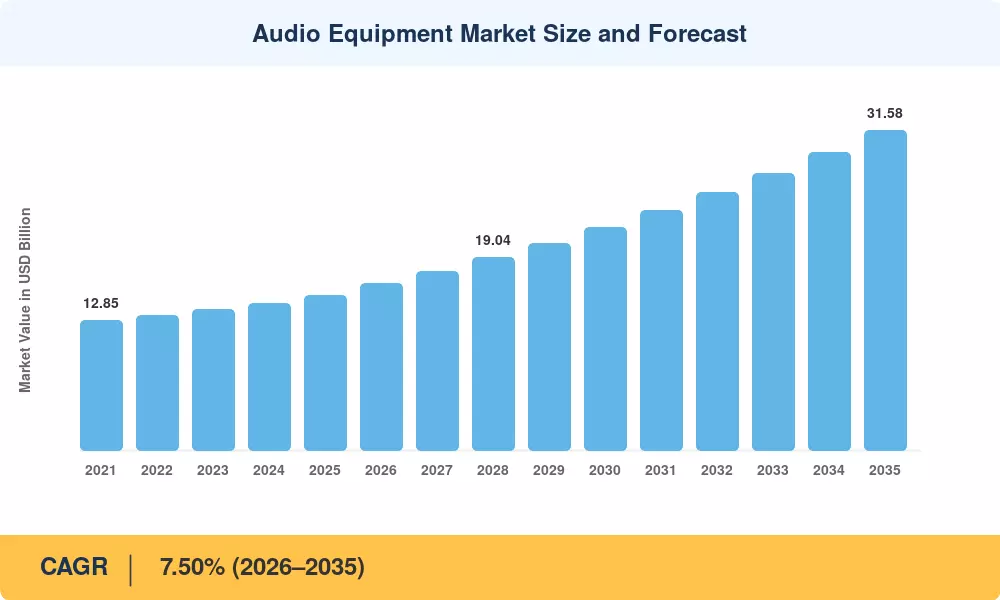
The global Audio Equipment Market reached USD 15.32 billion in 2025 and is projected to grow from USD 16.47 billion in 2026 to USD 31.58 billion by 2035, registering a CAGR of 7.50% during 2026–2035. Two catalysts are reshaping this trajectory: the global rollout of 5G networks — which unlocked sub-5 ms wireless audio latency by mid-2024 — and a wave of corporate return-to-office mandates that drove enterprise AV procurement budgets above USD 4.2 billion annually [1]. These policy and infrastructure shifts have turned audio equipment from a consumer discretionary category into a productivity-critical investment class.
A decisive technology transformation is underway across the Audio Equipment Market. Legacy analog mixers, passive loudspeakers, and wired monitoring chains are giving way to software-defined signal paths, AI-driven adaptive noise cancellation, and cloud-managed audio ecosystems. Harman International's 2024 annual report disclosed USD 1.1 billion in R&D spending, with more than 40% allocated to embedded AI processing for automotive and pro-audio platforms [2]. Meanwhile, the EU Ecodesign for Sustainable Products Regulation (ESPR), entering force in 2025, compels manufacturers to adopt recycled plastics and plant-fiber diaphragms — restructuring the bill of materials for headphones and portable speakers across the European market.
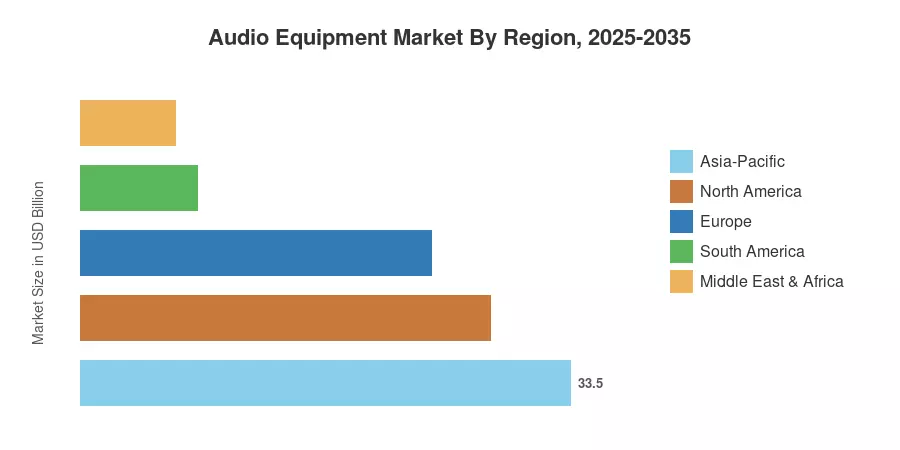
Asia-Pacific commands 33.5% of the Audio Equipment Market, anchored by manufacturing scale in China and aggressive 5G deployment across South Korea and India. North America holds a 28.0% share driven by content-production demand and premium adoption cycles, while Europe accounts for 24.0% as eco-design compliance reshapes product design. As spatial audio, automotive infotainment, and immersive enterprise collaboration converge, the Audio Equipment Market is entering a phase of sustained structural expansion through 2035.
Key Report Takeaways
• By Product Type
- Speakers and soundbars captured a 33.6% revenue share of the Audio Equipment Market in 2025, reflecting embedded smart-assistant adoption and home-theater upgrades.
- Headphones and earphones are projected to expand at a 10.9% CAGR through 2035, propelled by hybrid-work audio needs and active noise-cancellation premiums.
• By Connectivity
- Wireless-Bluetooth accounted for 57.2% of the Audio Equipment Market in 2025, underpinned by Bluetooth LE Audio and Auracast broadcast capabilities.
- Wi-Fi/AirPlay connectivity is advancing at a 10.6% CAGR through 2035 as multi-room and lossless streaming gain traction.
• By End User
- Home entertainment represented 44.8% of the Audio Equipment Market in 2025, sustained by streaming platform proliferation and Dolby Atmos adoption.
- Automotive OEM and aftermarket audio is projected to grow at a 10.8% CAGR between 2026–2035.
• By Region
- Asia-Pacific led the Audio Equipment Market with a 33.5% revenue share in 2025, followed by North America at 28.0%.
Audio Equipment Market Size and Forecast (2021–2035)
Market Research Future derives its sizing from a combination of bottom-up manufacturer revenue aggregation, import/export trade-flow analysis, and top-down consumer-expenditure modeling. Historical figures (2021–2024) reflect audited financial disclosures from publicly listed audio OEMs and verified distribution-channel sell-through data. The forecast (2026–2035) applies a compounded growth model calibrated against macroeconomic indicators including disposable-income growth, urbanization rates, and broadband penetration.