Auto Bodywork Repair Market (2026 - 2035)

Auto Bodywork Repairs Market Research Report Information By Service Type, By Vehicle Type, By Application, By End-User, By Service Provider, By Region - Industry Forecast 2035
ID: MRFR/AT/66588-CR
200 Pages
Garvit Vyas
Last Updated: July 08, 2026
Auto Bodywork Repair Market
Market Size
Forecast Period2026-2035
CAGR (2026-2035)4.10%
2025 Market SizeUSD 38.60 Billion
2035 Market SizeUSD 57.40 Billion
Key Players
Caliber Holdings LLC
Boyd Group Services Inc.
AutoNation Collision Centers
Crash Champions
Belron International
Maaco
Opportunities
  • Electric and Hybrid Vehicles Creating Specialized Repair Demand
  • Emerging Markets in Developing Regions
  • Online Service Booking Platforms Expanding Market Reach

Auto Bodywork Repairs Market Summary

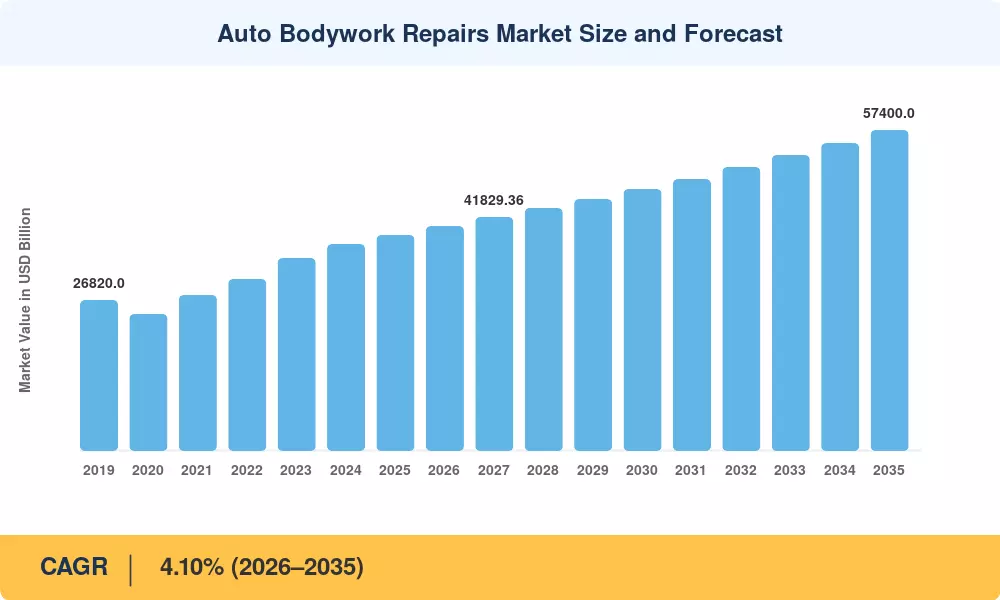
The global auto bodywork repairs market was valued at USD 38.63 billion in 2025 and is projected to reach USD 40.11 billion in 2026, growing to USD 57.40 billion by 2035 at a compound annual growth rate (CAGR) of 4.10% during the forecast period (2026–2035). This steady expansion is underpinned by a sustained increase in the global vehicle parc, which surpassed 1.47 billion units in 2024, directly elevating the frequency and volume of collision and cosmetic repair incidents [2]. Simultaneously, the rise of disposable incomes across both developed and emerging economies has encouraged vehicle owners to seek professional bodywork services rather than informal or deferred repairs, supporting higher average repair order values. Technological advancements in repair equipment—including AI-assisted damage estimation, computerized paint-matching systems, and advanced welding techniques- have further enhanced throughput and quality, drawing a larger share of repairs into the formal market [3].

With USD 11.04 billion in 2025, the collision repair market is the single largest service category, showing the ongoing incidence of traffic accidents worldwide. But with a 5.20% CAGR through 2035, paint repair and refinishing is the service type that is expanding the fastest due to consumer demand for aesthetic restoration and the widespread use of premium, multi-coat paint finishes on contemporary cars [4]. With AI-powered parts procurement producing quantifiable benefits in workflow performance and cycle-time reduction, the December 2025 rollout of Orderly by PartsTrader throughout Crash Champions' more than 650 repair centers is an example of how technology-led efficiency gains are transforming the industry [5]. As fleet operators place a greater emphasis on vehicle appearance and structural integrity for safety compliance and brand image, the commercial vehicles market is growing at a 5.30% CAGR on the vehicle-type axis, with buses and coaches leading the way with a 6.10% CAGR.

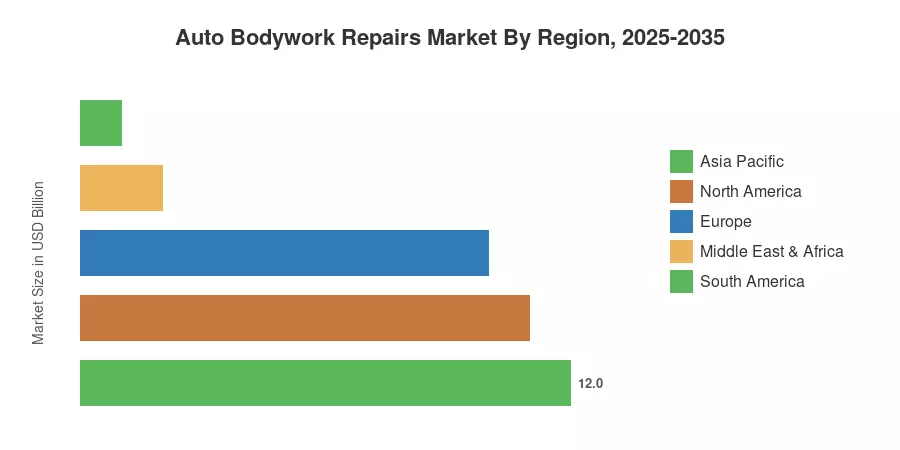
With a 2025 revenue base of USD 11.79 billion, North America continues to be the leading regional market. This is due to the region's high insurance penetration, well-established multi-shop operator (MSO) networks, and strict OEM-certified repair standards [6]. With an expected CAGR of 5.28%, Asia Pacific is the fastest-growing area, driven by China's enormous and developing auto aftermarket as well as the fast motorization of Indonesia (7.60% CAGR) and India (7.80% CAGR) [7]. With a projected value of USD 10.03 billion in 2025, Europe is the second-largest regional market. The adoption of electric vehicles and the governmental drive for environmentally friendly repair methods are driving this increase. Long-term, above-GDP growth is anticipated in all major regions through 2035 due to the convergence of EV-specific repair demand, digital service booking platforms, and MSO consolidation.


Key Report Takeaways

Segment Dimension Key Metric Notes
By Service Type — Dominant Collision Repair: USD 11,038.47 Mn (2025) The largest service category is driven by road traffic accident frequency
By Service Type — Fastest Growing Paint Repair and Refinishing: 5.20% CAGR Premium paint finishes and aesthetic restoration demand are rising
By Vehicle Type — Dominant Passenger Cars: USD 25,878.16 Mn (2025) SUVs contribute USD 10,935.25 Mn within this category
By Vehicle Type — Fastest Growing Commercial Vehicles: 5.30% CAGR The Buses and Coaches sub-segment at 6.10% CAGR leads the growth
By Application — Dominant ICE Vehicles: USD 31,942.95 Mn (2025) Still represents 82.7% of the total market revenue
By Application — Fastest Growing Electric Vehicles: 6.90% CAGR EV-specific bodywork repair demand is accelerating rapidly
By End-User — Dominant Insurance Companies: USD 15,763.54 Mn (2025) Insurance-funded claims account for 40.8% of the market value
By End-User — Fastest Growing Fleet Owners and Corporate Clients: 4.40% CAGR Corporate fleet management is driving outsourced repair volumes
By Service Provider — Dominant Independent Body Shops: USD 20,822.22 Mn (2025) Commands 53.9% market share by revenue
By Service Provider — Fastest Growing Multi Shop Operators (MSOs): 4.70% CAGR Consolidation through M&A continues to accelerate
By Region — Dominant North America: USD 11,792.00 Mn (2025) High insurance penetration and mature MSO ecosystem
By Region — Fastest Growing Asia Pacific: ~5.28% CAGR India and Indonesia each exceed 7.5% CAGR


Market Size and Forecast (2019–2035)

Market Research Future (MRFR) employs a triangulated forecasting methodology combining bottom-up revenue aggregation from company financials and industry associations, top-down macroeconomic modeling incorporating vehicle registration growth, accident frequency rates, and insurance claim trends, and demand-side analysis validated through primary interviews with body shop operators, insurers, and OEM parts distributors. The base year for this study is 2025, with historical data spanning 2019–2024 and forecast projections extending through 2035.
Auto Bodywork Repairs Market Size and Forecast
Our Impact
Enabled $4.3B Revenue Impact for Fortune 500 and Leading Multinationals
Partnering with 2000+ Global Organizations Each Year
30K+ Citations by Top-Tier Firms in the Industry

Driver Impact Analysis

Driver ~% Impact on CAGR Geographic Relevance Impact Timeline
Rising disposable incomes are enabling consumers to seek professional repair services ~30% Global, particularly APAC and Latin America Medium-term (2026–2030)
Increase in the number of vehicles on the road, leading to higher demand for repair services ~45% Global; strongest in China, India, and Southeast Asia Long-term (2026–2035)
Technological advancements in repair equipment and techniques are enhancing service efficiency ~25% North America and Europe (early adoption); APAC (lagged adoption) Short-to-medium-term (2026–2029)


Rising Disposable Incomes Enabling Professional Repair Demand

The upward trajectory of per-capita disposable income across both mature and developing economies has fundamentally shifted consumer behavior in the auto bodywork repairs market. In emerging markets such as India, Brazil, and Southeast Asia, the expanding middle class is increasingly opting for professional collision and cosmetic repair services over informal roadside workshops, driving a formalization of the repair ecosystem [2]. India's bodywork repairs market, growing at a 7.80% CAGR, illustrates this dynamic clearly: as household incomes rise, vehicle owners invest more in maintaining vehicle aesthetics and resale value.

In developed markets, higher incomes translate into a preference for premium repair finishes and OEM-certified repair facilities. The paint repair and refinishing segment's 5.20% CAGR reflects consumers' willingness to pay for multi-coat and color-matched finishes rather than accepting lower-quality alternatives. Insurance deductible thresholds have also become more manageable relative to income levels, reducing the share of unreported minor damage and expanding the addressable market for professional body shops [8].

Growing Vehicle Parc Driving Repair Volume

The global vehicle fleet continues to expand, with cumulative registrations exceeding 1.47 billion units by 2024 and projected to approach 1.7 billion by 2035 [3]. This fundamental demand driver operates through a straightforward mechanism: more vehicles on the road produce more collisions, fender-benders, parking incidents, and weather-related damage events. China's fleet alone surpassed 340 million vehicles in 2024, and the country's auto bodywork repairs market (USD 6.68 billion in 2025, 4.90% CAGR) directly reflects this scale [9].

In North America, while new-vehicle sales growth has moderated, the average vehicle age has risen to 12.6 years, meaning a larger proportion of the fleet requires cosmetic and structural repair to remain roadworthy [6]. The commercial vehicle segment (5.30% CAGR) is particularly sensitive to fleet expansion, as logistics, ride-hailing, and public transit operators add vehicles at rates exceeding the passenger car segment. The buses and coaches sub-segment (6.10% CAGR) reflects government investments in urban public transit infrastructure across the Asia Pacific and Latin America [10].

Technological Advancements Enhancing Service Efficiency

In order to increase productivity, accuracy, and profitability, modern body shop operations depend more and more on technology. By automating parts identification, pricing, and ordering, AI-powered damage estimating platforms—like PartsTrader's Orderly system, which was implemented throughout Crash Champions' 650+ repair facilities in December 2025—can save administrative cycle times by up to 30% [5]. The above-average growth rate of the paint repair and refinishing industry is directly supported by computerized paint-matching spectrophotometers, which currently achieve color accuracy rates above 99%, eliminating rework and material waste.

The spectrum of repairable damage has also been increased by advanced welding and adhesive bonding methods, especially for aluminum-intensive and mixed-material car bodywork that is increasingly common in both premium combustion and electric vehicles [11]. The frame straightening and structural repair industry (USD 1.97 billion, 3.40% CAGR) may now record fixes that would have previously resulted in total-loss declarations thanks to frame straightening devices with laser measuring, which provide sub-millimeter accuracy. Larger operators, such as MSOs and approved body shops, benefit from these technological investments because they can spread expenditures among high-volume repair networks, hastening market consolidation.

capital


Restraints Impact Analysis

Restraint ~% Drag on CAGR Geographic Relevance Impact Timeline
The high cost of advanced repair technologies is limiting market accessibility for small service providers ~40% Global; acute in developing regions Medium-term (2026–2030)
Fluctuations in the prices of raw materials affect overall repair costs ~30% Global; metals and petrochemical inputs Short-term (2026–2028)
The complexity of newer vehicle designs is making repairs more challenging and time-consuming ~30% North America and Europe (early); APAC (lagged) Long-term (2026–2035)


High Cost of Advanced Repair Technologies

Modern repair equipment, such as computerized measuring platforms, ADAS calibration systems, and aluminum welding rigs, requires capital investments ranging from USD 150,000 to USD 500,000 per facility. This presents a substantial obstacle for independent body shops, which account for 53.9% of the market by revenue [12]. This cost barrier hinders the formal market's ability to obtain repairs from unofficial channels. It delays the adoption of new technologies in underdeveloped nations, where independent operators are even more prevalent. As a result, the market is split, with OEM-approved shops and well-capitalized MSOs gaining a larger portion of complicated, expensive repairs. Smaller operators are limited to simple cosmetic procedures at the same time.


Raw Material Price Fluctuations

Bodywork repairs are intensive, consuming automotive-grade paints, primers, adhesives, steel panels, aluminum sheets, and plastic components whose prices are subject to commodity market volatility [13]. The cost of waterborne basecoat paints, which account for approximately 15–20% of a typical refinish job's material cost, has fluctuated significantly in response to petrochemical feedstock prices and environmental compliance surcharges. These price swings compress margins for body shops operating on fixed-rate insurance labor schedules, periodically discouraging investment and capacity expansion across the industry.

Complexity of Newer Vehicle Designs

Modern vehicles increasingly incorporate mixed-material construction—combining high-strength steel, aluminum, carbon fiber, and engineering plastics—alongside embedded ADAS sensors, cameras, and radar units that require post-repair recalibration [11]. A single front-end collision on an ADAS-equipped SUV can now require not only structural repair and paint refinishing but also recalibration of forward-facing cameras, radar modules, and ultrasonic sensors, adding 3–5 hours and USD 800–1,500 in additional labor and equipment costs. This complexity extends repair cycle times and increases the incidence of vehicles being declared total losses, effectively removing repair revenue from the addressable market.


Auto Bodywork Repairs Market Opportunities

Electric and Hybrid Vehicles Creating Specialized Repair Demand

The electric vehicles segment is the fastest-growing application category at a 6.90% CAGR, expanding from USD 3.02 billion in 2025 to an estimated USD 5.8–6.0 billion by 2035 [14]. EVs present unique bodywork repair requirements: high-voltage battery safety protocols, aluminum-intensive unibody structures, and integrated sensor arrays demand specialized training and equipment that differentiate certified EV repair facilities from conventional body shops. The hybrid segment (USD 3.67 billion, 4.50% CAGR) adds further demand for technicians trained in both combustion and electric powertrain proximity repairs. Early movers in EV-certified collision repair—including MSOs such as Caliber Holdings and Crash Champions—stand to capture premium pricing and insurer-preferred status as EV parc penetration accelerates beyond 20% in North America and Europe by 2030 [15].

Emerging Markets in Developing Regions

Asia Pacific's auto bodywork repairs market, valued at USD 12.89 billion in 2025 and growing at approximately 5.28% CAGR, contains the industry's most significant untapped growth potential [7]. India (7.80% CAGR) and Indonesia (7.60% CAGR) are experiencing rapid motorization alongside underdeveloped formal repair ecosystems, meaning a large share of bodywork repairs currently occurs outside the addressable market. As road infrastructure improves, insurance penetration rises, and regulatory standards for vehicle roadworthiness tighten, the formalization of repair services in these markets represents a multi-billion-dollar opportunity through 2035. Similarly, the Middle East and Africa region (USD 2.28 billion, ~2.54% CAGR) and South America (USD 1.64 billion, ~2.92% CAGR) offer growth potential as automotive aftermarket supply chains mature.

Online Service Booking Platforms Expanding Market Reach

Digital platforms for auto body repair scheduling, estimation, and insurer coordination are reshaping how consumers access bodywork services. Online booking reduces customer acquisition costs for body shops, extends geographic reach beyond walk-in traffic, and enables transparent price comparison that favors quality operators. Mobile auto body repair services, such as the Car Body Lab operation acquired by Caliber Holdings in September 2025, leverage digital scheduling to deliver dent removal, paint touch-up, and minor collision repair at the customer's location. This mobile, digitally enabled model has the potential to capture a meaningful share of the USD 10.08 billion dent removal and USD 8.19 billion paint repair segments by lowering the friction and time cost of seeking professional service.


Auto Bodywork Repairs Market Future Outlook

Technology and Service Evolution Trajectory

The auto bodywork repairs industry is entering a technology inflection point as AI-powered estimating, robotic paint application, and 3D-printed replacement parts transition from pilot programs to mainstream deployment [5][11]. By 2030, MRFR estimates that over 40% of MSO-operated repair centers in North America and Europe will use AI-assisted damage appraisal as their primary estimation workflow, reducing supplement rates and compressing cycle times below 7 days for moderate collision repairs. Additive manufacturing of cosmetic trim, brackets, and non-structural panels will further disrupt the traditional parts supply chain, with body shops increasingly printing components on-site or through regional additive manufacturing hubs by the early 2030s.

Competitive Dynamics and Market Structure Evolution

The auto bodywork repairs market is undergoing structural consolidation, with MSOs capturing an increasing share of total revenue (USD 11.99 billion, 4.70% CAGR) at the expense of independent operators [6]. Caliber Holdings' September 2025 acquisition of Car Body Lab and Crash Champions' multi-state expansion through 2025 illustrate the strategic playbook: acquire geographic density, invest in technology and OEM certifications, and leverage insurer relationships to secure preferred-provider status. By 2035, the top five MSOs could collectively command 40–45% of the North American market, up from an estimated 30–32% in 2025. In Europe and the Asia Pacific, analogous consolidation is beginning, albeit at earlier stages due to more fragmented market structures.

Electric Vehicle and Regulatory-Driven Shifts

The electric vehicle segment's 6.90% CAGR through 2035 will fundamentally reshape body shop economics and skill requirements [14][15]. EV bodywork repairs carry 25–35% higher average repair costs due to aluminum unibody structures, battery compartment integrity protocols, and mandatory ADAS sensor recalibration. Regulatory frameworks in the EU, California, and China are accelerating the transition toward zero-emission vehicles, ensuring that the EV share of the repair-eligible vehicle parc will grow from approximately 8% in 2025 to an estimated 22–28% by 2035. Body shops that fail to secure EV repair certifications risk exclusion from insurer direct repair programs, creating a natural selection mechanism that favors scale operators.

Long-Range Demand Scenario

Under MRFR's base-case scenario, the global auto bodywork repairs market reaches USD 57.40 billion by 2035 on the strength of vehicle parc expansion, rising repair complexity, and the formalization of repair ecosystems in developing markets. In an upside scenario, faster-than-expected EV adoption, accelerated ADAS mandates, and the expansion of mobile and digital repair models could push the market to USD 61–63 billion. In a downside scenario, prolonged macroeconomic weakness in key markets, rapid advances in autonomous driving reducing accident rates, and aggressive total-loss thresholds by insurers could limit growth to USD 52–54 billion. The balance of evidence supports the base case, with structural tailwinds from vehicle complexity and emerging-market motorization providing a durable growth floor through the forecast period.


Auto Bodywork Repairs Market Segmentation

Dimension Sub-Segments Dominant Segment (2025) Fastest Growing Segment
By Service Type Collision Repair; Dent Removal; Paint Repair and Refinishing; Frame Straightening and Structural Repair; Windshield and Glass; Rust Repair and Corrosion Treatment Collision Repair (USD 11,038.47 Mn) Paint Repair and Refinishing (5.20% CAGR)
By Vehicle Type Passenger Cars (Hatchback, Sedan, SUV, MUV/MPV, Others); Commercial Vehicles (LCVs, Trucks, Buses and Coaches) Passenger Cars (USD 25,878.16 Mn) Commercial Vehicles (5.30% CAGR)
By Application ICE Vehicles; Electric Vehicles; Hybrid ICE Vehicles (USD 31,942.95 Mn) Electric Vehicles (6.90% CAGR)
By End-User Retail/Individual Customers; Fleet Owners and Corporate Clients; Insurance Companies Insurance Companies (USD 15,763.54 Mn) Fleet Owners and Corporate Clients (4.40% CAGR)
By Service Provider Type Authorized/OEM Body Shops; Independent Body Shops; Multi Shop Operators (MSOs) Independent Body Shops (USD 20,822.22 Mn) Multi Shop Operators (4.70% CAGR)


By Service Type

Segment 2025 (USD Mn) CAGR (2026–2035) Primary Demand Driver
Collision Repair 11,038.47 2.80% Road traffic accident frequency and severity
Dent Removal 10,080.27 4.50% Hail damage, parking incidents, and cosmetic maintenance
Paint Repair and Refinishing 8,190.76 5.20% Premium multi-coat finishes; aesthetic restoration demand
Frame Straightening and Structural Repair 1,972.12 3.40% Severe collision recovery; structural integrity compliance
Windshield and Glass 5,749.94 4.40% ADAS-equipped windshields requiring calibrated replacement
Rust Repair and Corrosion Treatment 1,599.08 2.30% Aging fleet in northern climates; road salt exposure


Collision repair dominates the service type segmentation at USD 11.04 billion (28.6% of the total market), reflecting the persistent base of accident-driven demand globally. However, its relatively modest 2.80% CAGR indicates market maturity and the impact of improving vehicle safety systems on accident severity distribution. Paint repair and refinishing (5.20% CAGR) is the standout growth segment, fueled by the proliferation of complex paint systems, including pearlescent, matte, and tri-coat finishes on mass-market vehicles, alongside consumer preference for maintaining vehicle appearance [4]. Windshield and glass repair (4.40% CAGR) benefits from the growing installation of ADAS cameras and sensors behind windshields, which mandates OEM-grade glass and post-installation recalibration.

By Vehicle Type

Segment 2025 (USD Mn) CAGR (2026–2035) Primary Demand Driver
Passenger Cars 25,878.16 3.40% Dominant vehicle parc; SUV mix shift increasing repair values
— Hatchback 5,028.69 3.00% Economy segment; urban parking damage frequency
— Sedan 6,346.85 3.00% Stable fleet mix; moderate average repair costs
— SUV 10,935.25 4.00% Fastest-growing passenger car sub-segment; larger body panels
— MUV/MPV 2,171.15 2.50% Family and ride-sharing fleet applications
— Others 1,396.23 2.80% Sports cars, coupes, and specialty vehicles
Commercial Vehicles 12,752.48 5.30% Fleet expansion; regulatory compliance for safety and appearance
— LCVs 3,528.42 4.70% Last-mile delivery fleet growth
— Trucks 7,373.96 5.40% Long-haul fleet maintenance and refurbishment cycles
— Buses and Coaches 1,850.10 6.10% Public transit investment; tourism fleet expansion


Passenger cars account for 67.0% of market revenue, with the SUV sub-segment (USD 10.94 billion) driving above-average growth within the category due to larger body panel surface areas and higher average repair costs. Commercial vehicles (USD 12.75 billion, 5.30% CAGR) represent the faster-growing category, led by the trucks sub-segment (USD 7.37 billion, 5.40% CAGR), where fleet operators maintain scheduled bodywork refurbishment programs to comply with safety regulations and preserve brand image [10]. The buses and coaches sub-segment's 6.10% CAGR reflects government investments in urban public transit modernization, particularly in the Asia Pacific and Latin America.

By Application

Segment 2025 (USD Mn) CAGR (2026–2035) Primary Demand Driver
ICE Vehicles 31,942.95 3.70% Dominant installed base; long replacement cycles
Electric Vehicles 3,018.14 6.90% Rapid EV adoption; higher average repair complexity
Hybrid 3,669.54 4.50% Transition powertrain; growing parc share in EU and Japan


ICE vehicles represent 82.7% of the 2025 market but are gradually ceding share to electric and hybrid vehicles. The EV segment's 6.90% CAGR reflects not only the expanding EV parc but also the higher per-incident repair costs associated with aluminum body structures, battery compartment proximity concerns, and mandatory ADAS recalibration [14]. Hybrid vehicles (4.50% CAGR) occupy a transitional position, sharing repair characteristics with both ICE and EV platforms and benefiting from strong adoption rates in Europe and Japan.

By End-User

Segment 2025 (USD Mn) CAGR (2026–2035) Primary Demand Driver
Retail / Individual Customers 15,150.69 4.10% Out-of-pocket cosmetic and minor collision repairs
Fleet Owners and Corporate Clients 7,716.42 4.40% Fleet appearance standards; outsourced maintenance contracts
Insurance Companies 15,763.54 3.90% Claim-funded collision and comprehensive damage repairs


Insurance companies are the dominant end-user segment (USD 15.76 billion, 40.8% share), reflecting the centrality of insurance claims in funding collision repairs across all developed markets. Fleet owners and corporate clients represent the fastest-growing segment (4.40% CAGR), driven by the expansion of commercial and ride-hailing fleets and the trend toward outsourcing bodywork maintenance to specialized providers. Caliber Holdings' September 2025 acquisition of Car Body Lab was explicitly motivated by expanding fleet servicing capabilities, underscoring the commercial attractiveness of this segment [5].

By Service Provider Type

Segment 2025 (USD Mn) CAGR (2026–2035) Primary Demand Driver
Authorized / OEM Body Shops 5,823.10 4.40% OEM-certified repairs for premium and EV vehicles
Independent Body Shops 20,822.22 3.60% Broad geographic coverage; price competitiveness
Multi Shop Operators (MSOs) 11,985.32 4.70% Scale-driven efficiency; insurer DRP networks; M&A consolidation


Independent body shops command the largest share of the market (USD 20.82 billion, 53.9%), reflecting the fragmented structure of the global auto body repair industry. However, MSOs are the fastest-growing provider type at 4.70% CAGR, driven by aggressive acquisition strategies, technology investments, and preferred-provider relationships with major insurance carriers. The MSO consolidation trend is most advanced in North America, where Caliber Holdings, Crash Champions, and Boyd Group have collectively built national-scale networks. However, it is increasingly visible in Europe and Australia [6].


Regional Market Share Analysis

Region 2025 Market (USD Mn) CAGR (2026–2035) Primary Investment Themes
North America 11,792.00 ~3.12% MSO consolidation; ADAS recalibration capacity; EV-certified networks
Europe 10,029.48 ~3.80% Sustainable repair regulation; EV bodywork specialization; digital transformation
Asia Pacific 12,888.13 ~5.28% Motorization-driven volume growth; formalization of repair ecosystems; fleet services
Middle East & Africa 2,284.03 ~2.54% Infrastructure development, insurance market expansion, OEM dealership networks
South America 1,636.98 ~2.92% Economic recovery; fleet modernization; aftermarket parts distribution
**Total** **38,630.62** **4.10%**


North America

Country 2025 Market (USD Mn) CAGR (2026–2035) Key Driver
United States 9,623.75 3.20% High insurance penetration; aging vehicle fleet; MSO network expansion
Canada 1,171.83 2.70% Harsh climate is driving corrosion and cosmetic repair demand
Mexico 996.42 2.80% Growing middle class; expanding new-vehicle sales


North America's dominance in the auto bodywork repairs market is anchored by the United States, which accounts for USD 9.62 billion of the region's USD 11.79 billion total. The US market benefits from near-universal automobile insurance requirements, well-established direct repair program (DRP) networks linking insurers to preferred body shops, and the aggressive consolidation strategies of MSOs such as Caliber Holdings (10.9% market share) and Crash Champions (6.0%) [6]. The average age of vehicles on US roads reached 12.6 years in 2024, ensuring a sustained pipeline of vehicles requiring bodywork beyond warranty periods. Crash Champions' May 2025 acquisitions of South Motors Collision in Miami and Big Sky Collision Center in Montana illustrate the MSO-driven geographic expansion strategy that continues to reshape the North American competitive landscape [5].

Europe

Country 2025 Market (USD Mn) CAGR (2026–2035) Key Driver
Germany 2,725.51 3.10% Premium vehicle parc; OEM-certified repair networks
United Kingdom 2,094.91 2.70% Insurance market sophistication; accident management companies
France 2,028.46 4.30% Regulatory incentives for repair over replacement
Italy 668.21 4.60% An aging vehicle fleet is driving sustained repair volumes
Spain 860.03 4.60% Tourism-driven vehicle usage; economic recovery
Rest of Europe 1,652.36 5.00% Eastern European motorization; EU harmonization of repair standards


Europe's auto bodywork repairs market (USD 10.03 billion, ~3.80% CAGR) is shaped by the EU's circular economy regulatory framework, which increasingly favors repair and recycling over replacement of body panels and components [17]. Germany leads the region owing to its large premium-vehicle parc, where BMW, Mercedes-Benz, and Volkswagen Group authorized body shops command higher average repair orders. France and Southern Europe represent the fastest-growing European sub-markets (4.30–4.60% CAGRs), benefiting from regulatory incentives that extend vehicle lifecycles and from rising consumer expectations for cosmetic vehicle quality.

Asia Pacific

Country 2025 Market (USD Mn) CAGR (2026–2035) Key Driver
China 6,682.50 4.90% World's largest vehicle parc; digital repair platforms maturing
Japan 1,759.23 3.50% Aging population with high vehicle ownership; technology-advanced shops
India 2,063.71 7.80% Rapid motorization, rising insurance penetration and formalization
South Korea 860.28 3.90% High vehicle density; advanced manufacturing base
Malaysia 227.15 5.00% Expanding middle class; import-vehicle repair demand
Thailand 335.09 5.40% Regional automotive manufacturing hub; tourism-driven fleet
Indonesia 314.15 7.60% Population scale; vehicle ownership acceleration
Rest of Asia-Pacific 646.02 6.70% Vietnam, the Philippines, and other emerging ASEAN markets


Asia Pacific is the largest regional market by aggregate 2025 revenue (USD 12.89 billion) and the fastest growing at approximately 5.28% CAGR, driven by the sheer scale of China's aftermarket and the explosive motorization trajectories of India and Southeast Asia [7]. China's market alone exceeds USD 6.68 billion, supported by a vehicle parc that surpassed 340 million units and a maturing ecosystem of digital repair platforms and insurer-linked body shop networks. India represents the single highest-growth country opportunity globally at 7.80% CAGR, as vehicle ownership penetration remains below 60 per 1,000 population and the formal repair sector captures only a fraction of total bodywork demand. Indonesia (7.60% CAGR) and the Rest of the Asia-Pacific markets (6.70% CAGR) exhibit similar structural growth dynamics.

Middle East & Africa

Country/Sub-Region 2025 Market (USD Mn) CAGR (2026–2035) Key Driver
GCC Countries 1,099.19 2.50% High per-capita vehicle ownership; extreme climate damage
South Africa 506.20 2.30% Established insurance industry; formal repair networks
Rest of Middle East & Africa 678.64 2.80% Infrastructure development; growing vehicle fleet


The Middle East & Africa region (USD 2.28 billion, ~2.54% CAGR) is characterized by a dual-speed market: the GCC countries feature high vehicle ownership rates, premium vehicle parc profiles, and well-funded OEM dealership networks, while sub-Saharan Africa (outside South Africa) remains largely served by informal repair channels. The GCC's extreme climate conditions—including UV-driven paint degradation and sandstorm abrasion—create sustained demand for refinishing services. Long-term growth will depend on insurance market development and the formalization of repair standards across the broader Middle East and African markets.

South America

Country 2025 Market (USD Mn) CAGR (2026–2035) Key Driver
Brazil 943.10 2.80% Largest regional vehicle parc; economic recovery supporting repair spending
Argentina 286.27 2.20% Currency stabilization; pent-up repair demand
Rest of South America 407.61 3.70% Chile, Colombia growing motorization; aftermarket maturation


South America's auto bodywork repairs market (USD 1.64 billion, ~2.92% CAGR) is heavily concentrated in Brazil, which accounts for 57.6% of regional revenue. The region's growth trajectory is tied to macroeconomic stability: Brazil's modest recovery from successive recessions and Argentina's currency and inflation challenges have historically constrained formal repair spending. The Rest of South America sub-group (3.70% CAGR) reflects relatively stronger growth in Chile and Colombia, where expanding vehicle fleets and improving road infrastructure drive incremental repair demand.


Auto Bodywork Repairs Market By Region, 2025-2035

Competitive Benchmarking

The global auto bodywork repairs market is moderately fragmented, with the top five players collectively holding approximately 32.2% of revenue and a long tail of independent operators comprising 67.8% of the market. This translates to a low-to-moderate Herfindahl-Hirschman Index (HHI) of approximately 200–250, characteristic of a consolidating but still highly competitive industry [6]. The competitive dynamics are defined by geographic density (number of locations within insurer-accessible zones), technology investment (AI estimation, OEM certifications, ADAS calibration capacity), and insurer relationship management (DRP inclusion). Consolidation through M&A remains the primary growth mechanism for leading players, with 2025 alone witnessing multiple strategic acquisitions by Caliber Holdings and Crash Champions.

Company Est. Revenue Share Key Offerings Strategic Positioning
Caliber Holdings LLC 10.9% Full-service collision, glass, and fleet repair across 1,800+ centers Market leader; DRP preferred; fleet services expansion via Car Body Lab acquisition
Boyd Group Services Inc. 6.8% Collision repair under Boyd Autobody & Glass and Gerber Collision brands North American dual-brand strategy; technology-driven operations
AutoNation Collision Centers 6.4% OEM-dealership-integrated collision repair Vertical integration with new-vehicle retail; captive insurer referrals
Crash Champions 6.0% Collision repair across 650+ centers in 38 states Aggressive M&A expansion; first MSO to deploy AI-powered PartsTrader Orderly
Belron International 2.1% Vehicle glass repair and replacement (Safelite, Carglass brands) Global glass specialist; ADAS calibration integration
Maaco Franchise-based paint and cosmetic repair services Affordable refinishing; broad franchise network
Joe Hudson's Collision Center Regional collision repair across the southeastern US Regional density strategy; insurer DRP partnerships
ProColor Collision Franchise collision repair network Technology-enabled franchise model
Prestige Auto Collision Independent collision repair Premium repair quality positioning
ABRA Auto Body Repair Collision repair network (now part of Caliber) Integrated into Caliber's national network
Other Market Players 67.8% Independent body shops, regional chains, OEM dealer body shops Highly fragmented; localized competitive advantages


Recent News & Developments

Crash Champions (December 2025):

Crash Champions completed the full-scale deployment of Orderly by PartsTrader across its entire network of 650-plus repair centers, becoming the first multi-shop operator to pioneer PartsTrader's AI-powered parts procurement platform at a national scale [5]. The Orderly system automates parts identification, pricing comparison, and ordering workflows, delivering measurable improvements in cycle-time performance and parts cost optimization. This deployment strengthens Crash Champions' position as the technology leader among US MSOs. It is expected to enhance profitability per repair order while reducing the administrative burden on estimators and parts managers, setting a new benchmark for technology adoption in the collision repair industry.

Caliber Holdings LLC (September 2025):

Caliber Holdings announced the acquisition of Car Body Lab, a mobile auto body repair company operating across 20 cities in seven states, with Car Body Lab continuing as a standalone business [5]. The strategic motivation centers on expanding Caliber Fleet Solutions' capabilities to service large-volume fleet and corporate clients through mobile repair delivery—a model that eliminates vehicle downtime and facility scheduling constraints. This acquisition positions Caliber to capture growing demand from fleet owners and corporate clients (4.40% CAGR segment). It represents the industry's broader shift toward mobile, on-site service delivery models that complement fixed-location repair centers.

Crash Champions (May 2025):

Crash Champions acquired South Motors Collision in Miami and Big Sky Collision Center in Bozeman, Montana, extending its footprint to key high-growth markets and reinforcing its position across 38 states with 650-plus repair centers [5]. The Miami acquisition provides access to one of the nation's highest-volume collision repair markets, driven by South Florida's dense traffic patterns and frequent weather-related vehicle damage. The Montana acquisition extends Crash Champions' presence into underserved western markets, aligning with the company's strategy of building coast-to-coast geographic density to maximize insurer DRP inclusion and brand recognition.


Auto Bodywork Repairs Market Report Scope

Parameter Detail
Market Scope Global Auto Bodywork Repairs
Study Period 2019–2035
CAGR Window 4.10% (2026–2035)
Base Year 2025
Market Size (2025) USD 38.60 Billion
Market Size (2035) USD 57.40 Billion
Fastest Growing Region Asia Pacific (~5.28% CAGR)
Dominant Region North America (USD 11,792.00 Mn in 2025)
Fastest Growing Segment — Service Type Paint Repair and Refinishing (5.20% CAGR)
Fastest Growing Segment — Vehicle Type Commercial Vehicles (5.30% CAGR)
Fastest Growing Segment — Application Electric Vehicles (6.90% CAGR)
Fastest Growing Segment — End-User Fleet Owners and Corporate Clients (4.40% CAGR)
Fastest Growing Segment — Provider Type Multi Shop Operators (MSOs) (4.70% CAGR)
Companies Profiled Caliber Holdings LLC, Crash Champions, Gerber Collision & Glass, Maaco, Joe Hudson's Collision Center, ProColor Collision, Prestige Auto Collision, ABRA Auto Body Repair, Boyd Autobody & Glass
Valuation Currency USD (Billion for global headline; Million for segment and regional detail)
Segments Covered By Service Type; By Vehicle Type; By Application; By End-User; By Service Provider Type; By Region and Country


FAQs

What is the projected size of the global auto bodywork repairs market by 2035?
The global auto bodywork repairs market is projected to reach USD 57.40 billion by 2035, growing from USD 38.63 billion in 2025 at a CAGR of 4.10% during the 2026–2035 forecast period [1]. This growth is primarily driven by the expanding global vehicle parc, rising consumer preference for professional repair services, and increasing repair complexity associated with modern vehicle designs.
Which service type segment is expected to grow fastest through 2035?
Paint repair and refinishing is the fastest-growing service type segment at a 5.20% CAGR (2026–2035), driven by the proliferation of premium multi-coat and specialty paint finishes on mass-market vehicles and by consumer demand for aesthetic vehicle maintenance [4]. The segment was valued at USD 8.19 billion in 2025 and is expected to outpace collision repair growth as vehicle safety improvements reduce severe accident frequency while cosmetic repair demand remains resilient.
How will the rise of electric vehicles impact the auto bodywork repairs market?
Electric vehicles represent the fastest-growing application segment at a 6.90% CAGR, expanding from USD 3.02 billion in 2025 [14]. EV bodywork repairs carry 25–35% higher average costs due to aluminum unibody structures, battery safety protocols, and ADAS sensor recalibration requirements. Body shops that invest in EV repair certifications and specialized equipment will capture premium positioning as EV parc penetration accelerates beyond 20% in major markets by 2030.
Which region offers the highest growth potential for bodywork repair services?
Asia Pacific is the fastest-growing region at approximately 5.28% CAGR, driven by India (7.80% CAGR), Indonesia (7.60% CAGR), and China (4.90% CAGR) [7]. The combination of rapid motorization, low current penetration of formal repair services, rising insurance adoption, and expanding middle-class incomes creates substantial growth potential that is expected to sustain the region's above-global-average growth rate through 2035.
What competitive dynamics are shaping the market, and how will consolidation evolve?
The market is undergoing significant consolidation, with multi-shop operators (MSOs) growing at a 4.70% CAGR and the top five players holding approximately 32.2% combined market share [6]. Caliber Holdings (10.9% share) and Crash Champions (6.0%) are driving M&A activity in North America, acquiring both geographic density and capability extensions such as mobile repair and AI-powered operations. By 2035, the top five MSOs could command 40–45% of the North American market.
How are insurance companies influencing the bodywork repairs market?
Insurance companies are the largest end-user segment, accounting for USD 15.76 billion (40.8% of the total market) in 2025 [8]. Their influence extends beyond funding repairs: insurer direct repair programs (DRPs) effectively determine which body shops receive the majority of collision repair volume, incentivizing shops to invest in technology, OEM certifications, and cycle-time performance. The shift toward parametric and telematics-based insurance products is expected to integrate further claims processing with repair scheduling, reinforcing the market position of DRP-enrolled body shops and MSOs.
What role do independent body shops play, and how sustainable is their market position?
Independent body shops dominate the market with USD 20.82 billion in 2025 revenue (53.9% share) but are growing at only 3.60% CAGR—the slowest rate among service provider types [6]. Their long-term sustainability depends on adapting to increasing repair complexity, securing OEM and EV certifications, and investing in digital tools to remain competitive with MSO networks. In developing markets, independent shops will retain dominance longer due to fragmented market structures, but in North America and Europe, the secular trend favors consolidation into larger networks.
Author
Author
Author Profile
Garvit Vyas LinkedIn
Vice President - Operations
Garvit Vyas is a Research Analyst with experience in working across multiple industry domains in the market research sector. Over the past four years, he has been actively involved in analyzing diverse markets, gathering industry insights, and contributing to the development of comprehensive research reports. His work includes studying market trends, evaluating competitive landscapes, and supporting data-driven business insights. In the early phase of his career, Garvit worked on cross-domain research projects, which helped him build a strong foundation in market analysis, data interpretation, and industry intelligence across various sectors. Later, he transitioned into the Quality Control (QC) function, where he focuses on reviewing and refining research reports and marketing collaterals to ensure accuracy, consistency, and high editorial standards. His responsibilities include validating research data, improving report structure, and maintaining the overall quality of published content. Garvit is committed to maintaining strong research integrity and delivering reliable insights that support informed business decision-making.
Download Free Sample

Kindly complete the form below to receive a free sample of this Report

Download PDF ×

We do not share your information with anyone. However, we may send you emails based on your report interest from time to time. You may contact us at any time to opt-out.