1.1 Porter's Five Forces Model
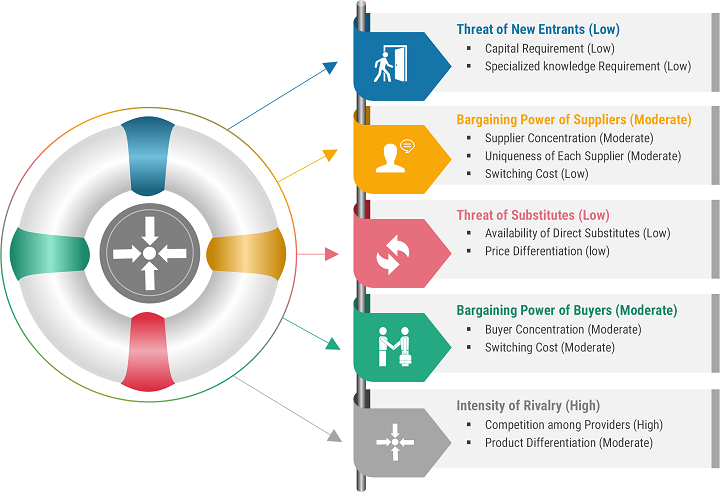
Michael Porter's Five Forces model gives a comprehensive framework for the global Automated Storage and Retrieval System (ASRS) market, influenced by five forces. Strategic managers trying to create an edge over competing firms in the global Automated Storage and Retrieval System (ASRS) market can utilize this model to better comprehend the industry connections in which the firm operates. The elements of each of the forces and the degree of impact of each element in the context of the global Automated Storage and Retrieval System (ASRS) market have been broken down and analyzed.
FIGURE 1 PORTER'S FIVE FORCES ANALYSIS OF the Global Automated Storage and Retrieval System (ASRS)
Source: MRFR Analysis
1.1.1 Threat of New Entrants:
The ASRS market typically requires significant investment in research and development, manufacturing capabilities, and expertise in warehouse automation. This creates a barrier to entry for new players. Additionally, established ASRS manufacturers often have long-standing relationships with key suppliers and customers, making it challenging for new entrants to compete. Therefore, the threat of new entrants in the ASRS market is relatively low.
1.1.2 Bargaining Power of Suppliers:
ASRS manufacturers rely on suppliers for various components and raw materials. The bargaining power of suppliers is influenced by factors such as the availability of alternative suppliers, uniqueness of the supplied components, and the importance of the supplier's contribution to the ASRS system's performance. If there are limited suppliers or unique components involved, suppliers may have more leverage, potentially increasing the costs for ASRS manufacturers. However, with multiple suppliers available and standardization of components, the bargaining power of suppliers is generally moderate in the ASRS market.
1.1.3 Threat of Substitute Products or Services:
The threat of substitutes for ASRS systems is relatively low. While there are alternative methods of material handling and storage, such as manual systems or traditional forklift operations, ASRS solutions offer significant advantages in terms of efficiency, accuracy, and space utilization. The benefits of automation and advanced technology make ASRS difficult to replace with viable substitutes.
1.1.4 Bargaining Power of Buyers:
Buyers of ASRS solutions, such as warehouses and distribution centers, have some degree of bargaining power. This is influenced by factors like the volume of purchases, the availability of alternative solutions, and the level of customization required. If buyers have a high volume of purchases or there are many alternative ASRS providers, they can exert pressure on pricing and terms. However, ASRS systems often provide significant operational benefits, reducing the buyer's ability to switch easily. Overall, the bargaining power of buyers in the ASRS market is moderate.
1.1.5 Competitive Rivalry:
The competitive rivalry in the ASRS market can be intense. Numerous manufacturers compete for market share, and differentiation among offerings may vary. Factors that intensify competition include pricing pressure, technological advancements, product features, and customer relationships. Manufacturers must continuously innovate, improve efficiency, and differentiate their solutions to maintain a competitive edge. Overall, the competitive rivalry in the ASRS market is high.In summary, the ASRS market exhibits a moderate threat of new entrants, moderate bargaining power of suppliers and buyers, low threat of substitute products, and highly competitive rivalry. This analysis highlights the key dynamics and competitive forces within the ASRS market, providing insights into the industry's overall competitiveness and attractiveness.