×
Request Free Sample ×

Kindly complete the form below to receive a free sample of this Report

Leading companies partner with us for data-driven Insights

clients tt-cursor
Hero Background

Automotive Adaptive Front Light Market

ID: MRFR/AT/3884-HCR
111 Pages
Sejal Akre
October 2025

Automotive Adaptive Front Light Market Research Report Information By Type (Halogen and LED), By Vehicle Type (Passenger Vehicle and Commercial Vehicle) And By Region (North America, Europe, Asia-Pacific, And Rest Of The World) –Global Industry Size, Share, Growth, Trends and Forecast To 2035

Share:
Download PDF ×

We do not share your information with anyone. However, we may send you emails based on your report interest from time to time. You may contact us at any time to opt-out.

Automotive Adaptive Front Light Market Infographic
Purchase Options

Automotive Adaptive Front Light Market Summary

As per MRFR analysis, the Automotive Adaptive Front Light Market Size was estimated at 0.82 USD Billion in 2024. The Automotive Adaptive Front Light industry is projected to grow from 1.024 in 2025 to 9.456 by 2035, exhibiting a compound annual growth rate (CAGR) of 24.89 during the forecast period 2025 - 2035.

Key Market Trends & Highlights

The Automotive Adaptive Front Light Market is poised for substantial growth driven by technological advancements and increasing safety concerns.

  • Technological advancements in lighting systems are reshaping the Automotive Adaptive Front Light Market, particularly in North America.
  • The LED segment remains the largest, while the halogen segment is experiencing rapid growth, especially in Asia-Pacific.
  • Passenger vehicles dominate the market, yet commercial vehicles are emerging as the fastest-growing segment.
  • Key market drivers include regulatory compliance and consumer demand for enhanced driving experiences.

Market Size & Forecast

2024 Market Size 0.82 (USD Billion)
2035 Market Size 9.456 (USD Billion)
CAGR (2025 - 2035) 24.89%

Major Players

Valeo (FR), Hella (DE), Osram (DE), Magneti Marelli (IT), Koito Manufacturing (JP), Stanley Electric (JP), Aisin Seiki (JP), Continental (DE), Denso (JP)

Automotive Adaptive Front Light Market Trends

The Automotive Adaptive Front Light Market is currently experiencing a transformative phase, driven by advancements in technology and increasing consumer demand for enhanced safety features. As vehicles become more sophisticated, the integration of adaptive lighting systems is becoming a focal point for manufacturers. These systems adjust the direction and intensity of headlights based on various factors such as speed, steering angle, and road conditions. This adaptability not only improves visibility but also enhances the overall driving experience, making it a desirable feature for modern vehicles. Moreover, the growing emphasis on road safety regulations and the push for energy-efficient solutions are likely to propel the Automotive Adaptive Front Light Market further. Manufacturers are increasingly investing in research and development to innovate and refine these lighting technologies. The trend towards electric and hybrid vehicles also plays a role, as these vehicles often incorporate advanced lighting systems to complement their eco-friendly designs. As the market evolves, it appears that the demand for adaptive front lighting will continue to rise, reflecting broader trends in automotive technology and consumer preferences.

Technological Advancements

The Automotive Adaptive Front Light Market is witnessing rapid technological innovations, particularly in sensor and control systems. These advancements enable headlights to automatically adjust to varying driving conditions, enhancing safety and visibility.

Increased Focus on Safety

There is a growing emphasis on safety features in vehicles, leading to heightened interest in adaptive lighting systems. Consumers are increasingly prioritizing vehicles equipped with advanced lighting technologies that improve nighttime driving safety.

Sustainability Trends

The shift towards sustainable automotive solutions is influencing the Automotive Adaptive Front Light Market. Manufacturers are exploring energy-efficient lighting options, such as LED technology, which not only reduces energy consumption but also aligns with eco-friendly vehicle designs.

Automotive Adaptive Front Light Market Drivers

Integration of Smart Technologies

The Automotive Adaptive Front Light Market is being propelled by the integration of smart technologies into vehicle lighting systems. Innovations such as connectivity with navigation systems and vehicle-to-vehicle communication are enhancing the functionality of adaptive front lights. These systems can now adjust not only based on road conditions but also in response to real-time traffic data. This integration is likely to improve overall road safety and driving efficiency. As smart technologies continue to evolve, the market for adaptive front lighting is expected to expand, with manufacturers investing in research and development to create more sophisticated lighting solutions.

Regulatory Compliance and Safety Standards

The Automotive Adaptive Front Light Market is significantly influenced by stringent regulatory compliance and safety standards imposed by various authorities. Governments are increasingly mandating the use of adaptive lighting systems to improve road safety and reduce accidents. For instance, regulations that require vehicles to be equipped with advanced lighting technologies are becoming more prevalent. This trend is expected to drive the adoption of adaptive front lighting systems, as manufacturers strive to meet these requirements. The market is likely to see a rise in investments aimed at developing compliant lighting solutions, which could further stimulate growth in the sector.

Technological Innovations in Lighting Systems

The Automotive Adaptive Front Light Market is experiencing a surge in technological innovations, particularly with the integration of advanced lighting systems. These systems utilize adaptive technologies that adjust the light beam according to driving conditions, enhancing visibility and safety. The market for adaptive front lighting is projected to grow at a compound annual growth rate of approximately 10% over the next five years. This growth is driven by the increasing demand for high-performance lighting solutions that improve nighttime driving experiences. Furthermore, the incorporation of LED and laser technologies in automotive lighting is likely to enhance energy efficiency and reduce overall vehicle emissions, aligning with broader sustainability goals.

Consumer Demand for Enhanced Driving Experience

The Automotive Adaptive Front Light Market is witnessing a notable shift in consumer preferences towards enhanced driving experiences. As consumers become more aware of the benefits of adaptive lighting systems, there is a growing demand for vehicles equipped with these technologies. Features such as automatic beam adjustment and improved illumination are increasingly sought after, as they contribute to safer and more comfortable driving conditions. Market data indicates that vehicles with adaptive front lighting systems are perceived as more advanced and desirable, which may lead to higher sales figures for manufacturers that prioritize these features in their offerings.

Sustainability and Environmental Considerations

The Automotive Adaptive Front Light Market is increasingly aligning with sustainability and environmental considerations. As the automotive sector shifts towards greener technologies, adaptive front lighting systems that utilize energy-efficient LEDs and other sustainable materials are gaining traction. This shift is not only driven by regulatory pressures but also by consumer preferences for eco-friendly products. Market analysts suggest that the demand for sustainable automotive solutions will continue to rise, potentially leading to a significant increase in the adoption of adaptive lighting systems. Manufacturers that prioritize sustainability in their product development are likely to gain a competitive edge in this evolving market.

Market Segment Insights

By Type: LED (Largest) vs. Halogen (Fastest-Growing)

In the Automotive Adaptive Front Light Market, LED lighting represents the largest segment, making significant strides due to its energy efficiency and longevity. Halogen lights, while historically prevalent, are now being challenged by the superior technology offered by LEDs. The market share distribution reveals a clear preference for LED technology, which has been widely adopted across various automotive segments, driven by increasing consumer demand for advanced lighting systems that enhance visibility and safety.

Lighting Technology: LED (Dominant) vs. Halogen (Emerging)

LED headlights have established themselves as the dominant technology in the automotive industry due to their numerous advantages including lower power consumption, longer lifespan, and superior illumination quality. As manufacturers focus on innovation, the deployment of adaptive front lighting systems utilizing LED technology continues to grow. On the other hand, Halogen lights, once the standard, are now seen as an emerging option particularly in budget vehicles or in regions with cost-sensitive consumers. Though Halogen is on the rise in the emerging markets, their limited efficiency and brightness compared to LEDs may hinder their long-term growth potential.

By Vehicle Type: Passenger Vehicle (Largest) vs. Commercial Vehicle (Fastest-Growing)

The Automotive Adaptive Front Light Market showcases a diversified segmentation based on vehicle types, primarily focusing on Passenger Vehicles and Commercial Vehicles. Passenger Vehicles command a significant share of the market due to their widespread use in personal transportation and the burgeoning demand for enhanced lighting technologies in this segment. Conversely, Commercial Vehicles are emerging with increasing traction as they adopt advanced lighting solutions for safety and efficiency, marking a shift in consumer preferences and regulatory support.

Passenger Vehicle (Dominant) vs. Commercial Vehicle (Emerging)

Passenger Vehicles symbolize the dominant segment within the Automotive Adaptive Front Light Market, characterized by their reliance on innovative lighting solutions to enhance driving safety and comfort. These vehicles typically feature adaptive lighting systems that adjust to various driving conditions, boosting visibility and reducing glare for oncoming traffic. On the other hand, the Commercial Vehicle segment is rapidly emerging, driven by the growing emphasis on fleet safety and operational efficiency. Commercial vehicles are increasingly incorporating advanced adaptive front lighting systems, spurred by regulations demanding safer roadways and the need for effective features in cargo transport, thereby making their adoption a key trend in the sector.

Get more detailed insights about Automotive Adaptive Front Light Market

Regional Insights

North America : Technological Innovation Leader

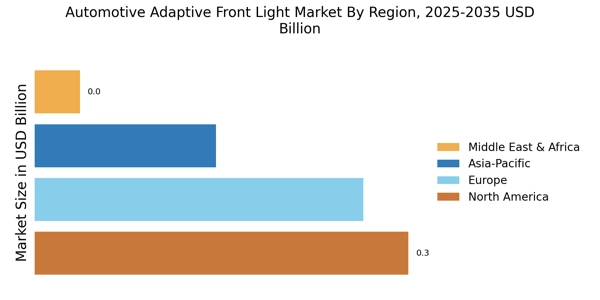
North America is witnessing significant growth in the Automotive Adaptive Front Light Market, driven by technological advancements and increasing consumer demand for safety features. The region holds approximately 40% of the global market share, making it the largest market. Regulatory support for enhanced vehicle safety standards further propels this growth, with initiatives aimed at improving nighttime visibility and reducing accidents. The United States and Canada are the leading countries in this sector, with major automotive manufacturers investing heavily in adaptive lighting technologies. Key players such as Valeo, Hella, and Osram are actively competing to innovate and capture market share. The competitive landscape is characterized by collaborations and partnerships aimed at enhancing product offerings and meeting regulatory requirements, ensuring a robust market presence.

Europe : Regulatory Compliance Focus

Europe is a pivotal region for the Automotive Adaptive Front Light Market, driven by stringent regulations and a strong emphasis on safety and environmental standards. The region accounts for approximately 35% of the global market share, making it the second largest market. The European Union's regulations on vehicle safety and emissions are significant catalysts for the adoption of advanced lighting technologies, pushing manufacturers to innovate and comply with these standards. Germany, France, and Italy are the leading countries in this market, with a strong presence of key players like Hella, Osram, and Magneti Marelli. The competitive landscape is marked by a focus on research and development, with companies investing in smart lighting solutions that enhance driving safety. The collaboration between automotive manufacturers and lighting suppliers is crucial for meeting the evolving demands of consumers and regulatory bodies.

Asia-Pacific : Emerging Market Potential

Asia-Pacific is rapidly emerging as a significant player in the Automotive Adaptive Front Light Market, driven by increasing vehicle production and rising consumer awareness regarding safety features. The region holds approximately 20% of the global market share, with countries like China and Japan leading the charge. Government initiatives to promote vehicle safety and environmental sustainability are key drivers of market growth, encouraging manufacturers to adopt advanced lighting technologies. China and Japan are at the forefront, with major companies such as Koito Manufacturing and Stanley Electric leading the market. The competitive landscape is characterized by a mix of local and international players, all vying for market share through innovation and strategic partnerships. The growing demand for electric vehicles in the region further fuels the need for adaptive lighting solutions, making it a vibrant market for future growth.

Middle East and Africa : Untapped Market Opportunities

The Middle East and Africa region presents untapped opportunities in the Automotive Adaptive Front Light Market, driven by increasing vehicle ownership and a growing focus on road safety. The region holds approximately 5% of the global market share, with potential for significant growth as infrastructure development progresses. Government initiatives aimed at enhancing road safety standards are expected to catalyze the adoption of advanced lighting technologies in the coming years. Countries like South Africa and the UAE are leading the way in this market, with a growing presence of international automotive manufacturers. The competitive landscape is evolving, with both local and global players seeking to establish a foothold. As the region continues to develop its automotive sector, the demand for innovative lighting solutions is anticipated to rise, creating a favorable environment for market expansion.

Automotive Adaptive Front Light Market Regional Image

Key Players and Competitive Insights

Leading market players are investing heavily in research and development to expand their product lines, which will help the automotive adaptive front light market grow even more. Market participants are also undertaking various strategic activities to expand their global footprint, with important market developments including new product launches, contractual agreements, mergers and acquisitions, higher investments, and collaboration with other organizations. To expand and survive in a more competitive and rising market climate, the automotive adaptive front light industry must offer cost-effective items.

Manufacturing locally to minimize operational costs is one of the key business tactics manufacturers use in the Automotive Adaptive Front Light Market industry to benefit clients and increase the market sector. Major players in the automotive adaptive front light market, including Hella GmbH & Co. KGaA, Magneti Marelli S.p.A, Koito Manufacturing, Valeo SA, Stanley Electric Co. Ltd., and others, are attempting to increase market demand by investing in research and development operations.

BMW is an automotive company. It develops, manufactures, and sells automobiles, motorcycles, spare parts, accessories, and engines. The company also offers deposit business, retail customer and dealer financing, insurance, fleet business, and car leasing services. It markets products under the BMW, MINI, Rolls-Royce, Alphabet, John Cooper Works, YOUR NOW, and Motorrad brands. It has production and assembly facilities and a sales network across the world.

In February 2020, BMW launched its Made in India 530i Sport which comes with various safety features such as ABS with brake assist, dynamic stability control, hill descent control, run-flat tires, electronic vehicle immobilizer and cornering brake control. Along with that, it also has adaptive LED headlights and six airbags.

Force Motors Limited is a vertically integrated automobile company that designs, develops and manufactures automotive components, aggregates and vehicles. The company's product offering includes small commercial vehicles, multi-utility vehicles (MUV), and light commercial vehicles (LCV). It also offers sports utility vehicles (SUV), agricultural tractors and other automobile industry products, including diesel engines. Force Motors provides Trax Cruiser, Trax Kargo King, Trax Toofan, Trax Ambulance and Trax Delivery Van, Balwan 550 and Orchard Mini, among other vehicles. The company also provides transport solutions.

In December 2019, Force Motors announced to invest USD 85.85 million to develop two new models over the next two years. Similarly, Morris Garages (MG), which has already invested a huge amount in entering the Indian market, has announced further investing USD 429.25 million in India.

Key Companies in the Automotive Adaptive Front Light Market market include

Industry Developments

January 2024: The new European-adapted Adaptive Headlights by Tesla are now only available for the new Model 3.

When Tesla began producing and delivering the new Model 3 called “Highland,” one of the most obvious changes that can be seen is the headlights, together with other cosmetic updates.

Tesla is currently rolling out the newest Adaptive Headlights for the Model 3 Highland through software update version 2024.2, but at least for now, they're only applicable to European vehicles.

According to the release notes, these novel Adaptive Headlights will “adjust to reduce glare for other drivers and cyclists,” and they also still provide dimmed pixels on headlights that help improve visibility while driving in low light conditions at night:

Now, instead, the high beam adjusts down and away from oncoming drivers or those ahead whom you want to see. It detects other road users and selectively dims individual pixels of its headlights, thereby allowing it to remain on high beam longer and hence improving night vision.

February 2024 : QAF Auto Sdn Bhd has increased its offering in Malaysia based on the BMW3 series. The all-new BMW3 series Touring was presented at the QAF Auto Chinese New Year open house.

Standard adaptive LED headlights include slim contours and daytime driving lights shaped like an L turned upside-down. Additionally, outer elements of daytime running lights act as turn indicators. Adaptive headlight functionality also covers the stop/start operation of dynamic cornering lights and non-dazzling matrix main-beam functionality coupled with dynamic light range control with variable light distribution functions.

BMW has introduced the M Sport Pro package globally into its lineup for the first time, making it standard in the Sultanate.

Some exterior design highlights consist of extended M high-gloss Shadowline trim and signature BMW kidney grille with double bars finished in black. With full-color heads-up displays offered as standard equipment, drivers can additionally have relevant information within their field of view.

March 2023: HELLA, the automotive supplier operating under the FORVIA umbrella brand, is expanding its Black Magic product range with 32 new lightbars. The company is thus continuing a success story in Europe as well, as the headlamp series has already been a top seller in the USA for many years. It was also launched in Europe for off-road applications in early 2022.

Future Outlook

Automotive Adaptive Front Light Market Future Outlook

The Automotive Adaptive Front Light Market is projected to grow at a 24.89% CAGR from 2024 to 2035, driven by technological advancements, increasing safety regulations, and consumer demand for enhanced driving experiences.

New opportunities lie in:

  • Integration of AI-driven adaptive lighting systems for improved road safety.
  • Development of customizable lighting solutions for luxury vehicles.
  • Expansion into emerging markets with tailored adaptive lighting technologies.

By 2035, the market is expected to be robust, reflecting substantial growth and innovation.

Market Segmentation

Automotive Adaptive Front Light Market Type Outlook

  • Halogen
  • LED

Automotive Adaptive Front Light Market Vehicle Type Outlook

  • Passenger Vehicle
  • Commercial Vehicle

Report Scope

MARKET SIZE 20240.82(USD Billion)
MARKET SIZE 20251.024(USD Billion)
MARKET SIZE 20359.456(USD Billion)
COMPOUND ANNUAL GROWTH RATE (CAGR)24.89% (2024 - 2035)
REPORT COVERAGERevenue Forecast, Competitive Landscape, Growth Factors, and Trends
BASE YEAR2024
Market Forecast Period2025 - 2035
Historical Data2019 - 2024
Market Forecast UnitsUSD Billion
Key Companies ProfiledMarket analysis in progress
Segments CoveredMarket segmentation analysis in progress
Key Market OpportunitiesIntegration of advanced sensor technologies enhances safety and performance in the Automotive Adaptive Front Light Market.
Key Market DynamicsRising demand for enhanced safety features drives innovation in Automotive Adaptive Front Light technologies and regulatory compliance.
Countries CoveredNorth America, Europe, APAC, South America, MEA

Market Highlights

Author
Sejal Akre
Senior Research Analyst

She has over 5 years of rich experience, in market research and consulting providing valuable market insights to client. Hands on expertise in management consulting, and extensive knowledge in domain including ICT, Automotive & Transportation and Aerospace & Defense. She is skilled in Go-to market strategy, industry analysis, market sizing, in depth company profiling, competitive intelligence & benchmarking and value chain amongst others.

Leave a Comment

FAQs

What is the projected market valuation of the Automotive Adaptive Front Light Market by 2035?

The projected market valuation for the Automotive Adaptive Front Light Market by 2035 is 9.456 USD Billion.

What was the market valuation of the Automotive Adaptive Front Light Market in 2024?

The market valuation of the Automotive Adaptive Front Light Market in 2024 was 0.82 USD Billion.

What is the expected CAGR for the Automotive Adaptive Front Light Market during the forecast period 2025 - 2035?

The expected CAGR for the Automotive Adaptive Front Light Market during the forecast period 2025 - 2035 is 24.89%.

Which companies are considered key players in the Automotive Adaptive Front Light Market?

Key players in the Automotive Adaptive Front Light Market include Valeo, Hella, Osram, Magneti Marelli, Koito Manufacturing, Stanley Electric, Aisin Seiki, Continental, and Denso.

What are the two main types of automotive adaptive front lights and their market values?

The two main types of automotive adaptive front lights are Halogen, valued at 0.25 to 2.5 USD Billion, and LED, valued at 0.57 to 6.956 USD Billion.

How does the market for passenger vehicles compare to commercial vehicles in the Automotive Adaptive Front Light Market?

In the Automotive Adaptive Front Light Market, the passenger vehicle segment is valued at 0.5 to 6.5 USD Billion, while the commercial vehicle segment is valued at 0.32 to 2.96 USD Billion.

Download Free Sample

Kindly complete the form below to receive a free sample of this Report

Compare Licence

×
Features License Type
Single User Multiuser License Enterprise User
Price $4,950 $5,950 $7,250
Maximum User Access Limit 1 User Upto 10 Users Unrestricted Access Throughout the Organization
Free Customization
Direct Access to Analyst
Deliverable Format
Platform Access
Discount on Next Purchase 10% 15% 15%
Printable Versions