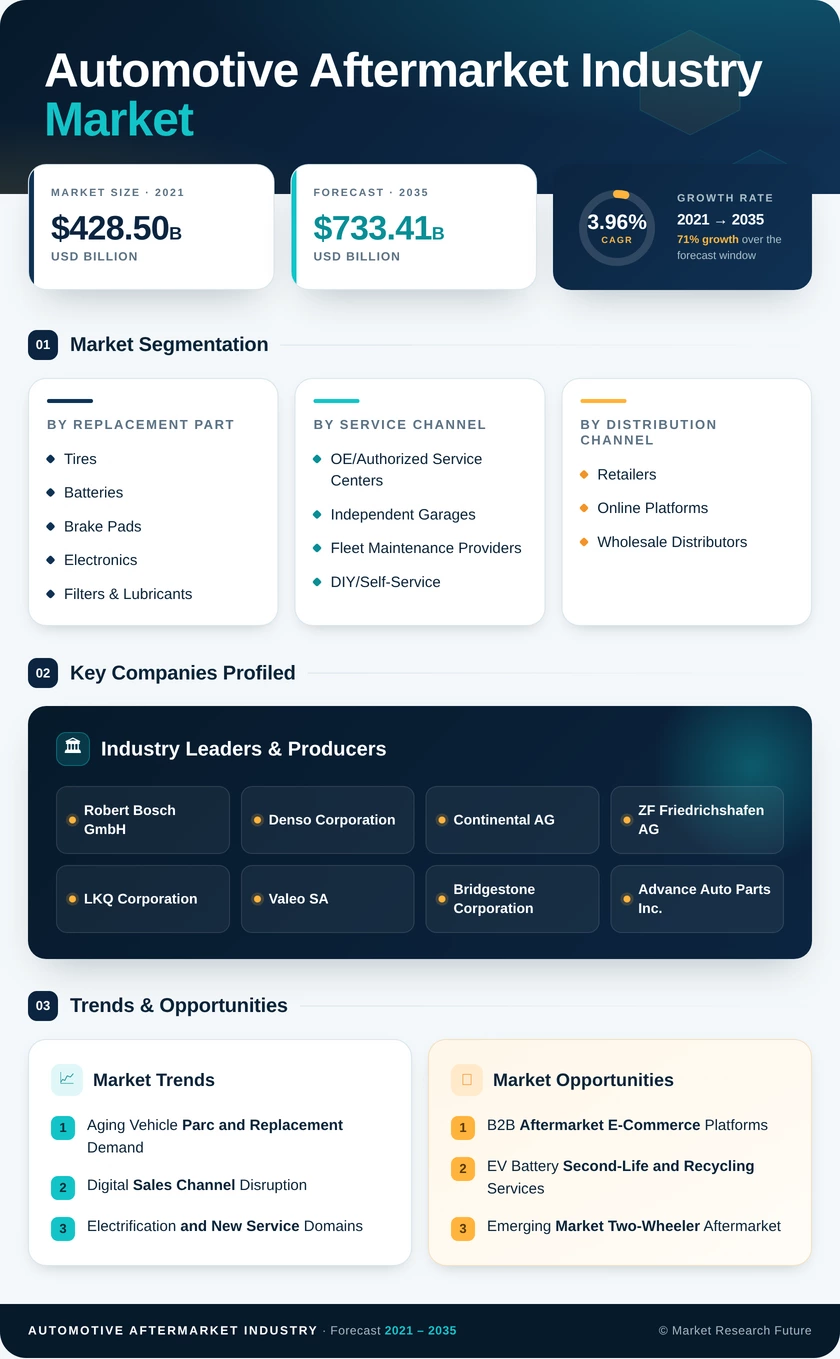
Automotive Aftermarket Industry

ID: MRFR/AT/4790-CR
100 Pages
Triveni Bhoyar
Last Updated: June 17, 2026
Automotive AfterMarket Market Research Report By Replacement Part (Tires, Batteries, Brake Pads, Electronics, Filters & Lubricants, Other Parts), By Service Channel (OE/Authorized Service Centers, Independent Garages, Fleet Maintenance Providers, DIY / Self-Service), By Distribution Channel (Retailers (Brick & Mortar), Online Platforms, Wholesale Distributors), By Vehicle Type (Passenger Cars, Two-Wheelers, Light Commercial Vehicles, Heavy Commercial Vehicles)and By Regional (North America, Europe, South America, Asia Pacific, Middle East and Africa) - Industry Outlook & Forecast to 2035
Download PDF ×

We do not share your information with anyone. However, we may send you emails based on your report interest from time to time. You may contact us at any time to opt-out.

  1. 1 Market Overview |
    1. 1.1 Study Assumptions & Market Definition |
    2. 1.2 Scope of the Study |
    3. 1.3 Research Methodology
  2. 2 Market Summary & Key Takeaways
  3. 3 Market Dynamics |
    1. 3.1 Market Drivers Analysis | |
      1. 3.1.1 Aging Global Vehicle Parc | |
      2. 3.1.2 Aftermarket E-Commerce Platform Expansion | |
      3. 3.1.3 EV Aftermarket Service Demand Growth | |
      4. 3.1.4 Mandatory Vehicle Inspection Regimes | |
      5. 3.1.5 Telematics-Enabled Predictive Maintenance | |
      6. 3.1.6 Remanufactured Auto Parts Exchange Growth | |
      7. 3.1.7 Two-Wheeler Fleet Expansion in Emerging Markets |
    2. 3.2 Market Restraints Analysis | |
      1. 3.2.1 OEM Telematics Data Lock-Out | |
      2. 3.2.2 EV Component Complexity Barriers | |
      3. 3.2.3 Counterfeit Parts Proliferation | |
      4. 3.2.4 Raw Material Cost Volatility | |
      5. 3.2.5 Skilled Technician Shortage |
    3. 3.3 Market Opportunity Analysis | |
      1. 3.3.1 B2B Aftermarket E-Commerce Platforms | |
      2. 3.3.2 EV Battery Second-Life and Recycling Services | |
      3. 3.3.3 Emerging Market Two-Wheeler Aftermarket | |
      4. 3.3.4 Data Monetization Through Predictive Analytics | |
      5. 3.3.5 Remanufacturing Scale-Up in Commercial Vehicles |
    4. 3.4 Industry Value Chain Analysis |
    5. 3.5 Porter's Five Forces Analysis
  4. 4 Global Automotive Aftermarket Market Size & Forecast (2021–2035) |
    1. 4.1 Historical Market Size (2021–2025) |
    2. 4.2 Current & Forecast Market Size (2026–2035) |
    3. 4.3 Market Size by Revenue (USD Billion) |
    4. 4.4 Year-over-Year Growth Analysis
  5. 5 Segmentation Analysis |
    1. 5.1 By Replacement Part | |
      1. 5.1.1 Tires | |
      2. 5.1.2 Batteries | |
      3. 5.1.3 Brake Pads | |
      4. 5.1.4 Electronics | |
      5. 5.1.5 Filters & Lubricants | |
      6. 5.1.6 Other Parts |
    2. 5.2 By Service Channel | |
      1. 5.2.1 OE/Authorized Service Centers | |
      2. 5.2.2 Independent Garages | |
      3. 5.2.3 Fleet Maintenance Providers | |
      4. 5.2.4 DIY / Self-Service |
    3. 5.3 By Distribution Channel | |
      1. 5.3.1 Retailers (Brick & Mortar) | |
      2. 5.3.2 Online Platforms | |
      3. 5.3.3 Wholesale Distributors |
    4. 5.4 By Vehicle Type | |
      1. 5.4.1 Passenger Cars | |
      2. 5.4.2 Two-Wheelers | |
      3. 5.4.3 Light Commercial Vehicles | |
      4. 5.4.4 Heavy Commercial Vehicles
  6. 6 Regional Analysis |
    1. 6.1 North America | |
      1. 6.1.1 United States | |
      2. 6.1.2 Canada | |
      3. 6.1.3 Mexico |
    2. 6.2 Europe | |
      1. 6.2.1 Germany | |
      2. 6.2.2 United Kingdom | |
      3. 6.2.3 France | |
      4. 6.2.4 Italy | |
      5. 6.2.5 Spain | |
      6. 6.2.6 Nordic Countries | |
      7. 6.2.7 Russia | |
      8. 6.2.8 Rest of Europe |
    3. 6.3 Asia-Pacific | |
      1. 6.3.1 China | |
      2. 6.3.2 India | |
      3. 6.3.3 Japan | |
      4. 6.3.4 South Korea | |
      5. 6.3.5 ASEAN | |
      6. 6.3.6 Rest of Asia-Pacific |
    4. 6.4 South America | |
      1. 6.4.1 Brazil | |
      2. 6.4.2 Argentina | |
      3. 6.4.3 Rest of South America |
    5. 6.5 Middle East & Africa | |
      1. 6.5.1 Saudi Arabia | |
      2. 6.5.2 UAE | |
      3. 6.5.3 South Africa | |
      4. 6.5.4 Egypt | |
      5. 6.5.5 Rest of MEA
  7. 7 Competitive Landscape |
    1. 7.1 Market Share Analysis (2025) |
    2. 7.2 Competitive Benchmarking Matrix |
    3. 7.3 Company Profiles | |
      1. 7.3.1 Robert Bosch GmbH | |
      2. 7.3.2 Denso Corporation | |
      3. 7.3.3 Continental AG | |
      4. 7.3.4 ZF Friedrichshafen AG | |
      5. 7.3.5 LKQ Corporation | |
      6. 7.3.6 Genuine Parts Company | |
      7. 7.3.7 Valeo SA | |
      8. 7.3.8 Bridgestone Corporation | |
      9. 7.3.9 Advance Auto Parts Inc. | |
      10. 7.3.10 3M Company
  8. 8 Future Outlook & Strategic Recommendations (2026–2035) |
    1. 8.1 Connected Diagnostics and Predictive Maintenance |
    2. 8.2 Electrification Service Ecosystem |
    3. 8.3 Platform Economics and Market Consolidation |
    4. 8.4 Sustainability and Circular Supply Chains
  9. 9 Recent Developments & News
  10. 10 Frequently Asked Questions (FAQs)
  11. 11 Report Scope & Methodology |
    1. 11.1 Study Period & Base Year |
    2. 11.2 Data Sources & Citations |
    3. 11.3 Abbreviations
  12. 1 LIST OF TABLES |
  13. TABLE 1 Global Automotive Aftermarket Market Size & Forecast, by Revenue (USD Billion), 2021–2035 |
  14. TABLE 2 Global Automotive Aftermarket Market — Year-over-Year Growth Analysis, 2021–2035 |
  15. TABLE 3 Global Automotive Aftermarket Market — Driver Impact Analysis, 2026–2035 |
  16. TABLE 4 Global Automotive Aftermarket Market — Restraint Impact Analysis, 2026–2035 |
  17. TABLE 5 Global Automotive Aftermarket Market Size, by Replacement Part, 2021–2035 (USD Billion) |
  18. TABLE 6 Global Automotive Aftermarket Market Size, by Service Channel, 2021–2035 (USD Billion) |
  19. TABLE 7 Global Automotive Aftermarket Market Size, by Distribution Channel, 2021–2035 (USD Billion) |
  20. TABLE 8 Global Automotive Aftermarket Market Size, by Vehicle Type, 2021–2035 (USD Billion) |
  21. TABLE 9 Global Automotive Aftermarket Market Size, by Region, 2021–2035 (USD Billion) |
  22. TABLE 10 North America Automotive Aftermarket Market Size, by Country, 2021–2035 (USD Billion) |
  23. TABLE 11 Europe Automotive Aftermarket Market Size, by Country, 2021–2035 (USD Billion) |
  24. TABLE 12 Asia-Pacific Automotive Aftermarket Market Size, by Country, 2021–2035 (USD Billion) |
  25. TABLE 13 South America Automotive Aftermarket Market Size, by Country, 2021–2035 (USD Billion) |
  26. TABLE 14 Middle East & Africa Automotive Aftermarket Market Size, by Country, 2021–2035 (USD Billion) |
  27. TABLE 15 Competitive Benchmarking Matrix — Global Automotive Aftermarket Market, 2025 |
  28. TABLE 16 Company Profiles — Key Players, Global Automotive Aftermarket Market |
  29. TABLE 17 Recent Developments & Strategic Announcements, 2023–2025 |
  30. TABLE 18 North America Automotive Aftermarket Market Size, by Replacement Part, 2021–2035 (USD Billion) |
  31. TABLE 19 North America Automotive Aftermarket Market Size, by Service Channel, 2021–2035 (USD Billion) |
  32. TABLE 20 North America Automotive Aftermarket Market Size, by Distribution Channel, 2021–2035 (USD Billion) |
  33. TABLE 21 North America Automotive Aftermarket Market Size, by Vehicle Type, 2021–2035 (USD Billion) |
  34. TABLE 22 Europe Automotive Aftermarket Market Size, by Replacement Part, 2021–2035 (USD Billion) |
  35. TABLE 23 Europe Automotive Aftermarket Market Size, by Service Channel, 2021–2035 (USD Billion) |
  36. TABLE 24 Europe Automotive Aftermarket Market Size, by Distribution Channel, 2021–2035 (USD Billion) |
  37. TABLE 25 Europe Automotive Aftermarket Market Size, by Vehicle Type, 2021–2035 (USD Billion) |
  38. TABLE 26 Asia-Pacific Automotive Aftermarket Market Size, by Replacement Part, 2021–2035 (USD Billion) |
  39. TABLE 27 Asia-Pacific Automotive Aftermarket Market Size, by Service Channel, 2021–2035 (USD Billion) |
  40. TABLE 28 Asia-Pacific Automotive Aftermarket Market Size, by Distribution Channel, 2021–2035 (USD Billion) |
  41. TABLE 29 Asia-Pacific Automotive Aftermarket Market Size, by Vehicle Type, 2021–2035 (USD Billion) |
  42. TABLE 30 South America Automotive Aftermarket Market Size, by Replacement Part, 2021–2035 (USD Billion) |
  43. TABLE 31 South America Automotive Aftermarket Market Size, by Service Channel, 2021–2035 (USD Billion) |
  44. TABLE 32 South America Automotive Aftermarket Market Size, by Distribution Channel, 2021–2035 (USD Billion) |
  45. TABLE 33 South America Automotive Aftermarket Market Size, by Vehicle Type, 2021–2035 (USD Billion) |
  46. TABLE 34 Middle East & Africa Automotive Aftermarket Market Size, by Replacement Part, 2021–2035 (USD Billion) |
  47. TABLE 35 Middle East & Africa Automotive Aftermarket Market Size, by Service Channel, 2021–2035 (USD Billion) |
  48. TABLE 36 Middle East & Africa Automotive Aftermarket Market Size, by Distribution Channel, 2021–2035 (USD Billion) |
  49. TABLE 37 Middle East & Africa Automotive Aftermarket Market Size, by Vehicle Type, 2021–2035 (USD Billion) |
  50. TABLE 38 Report Scope & Methodology Summary |
  51. TABLE 39 Detailed Sources and Citations
  52. 2 LIST OF FIGURES |
  53. FIGURE 1 Automotive Aftermarket Market Dynamics — Drivers, Restraints, and Opportunities |
  54. FIGURE 2 Industry Value Chain Analysis — Automotive Aftermarket |
  55. FIGURE 3 Porter's Five Forces Analysis — Automotive Aftermarket Market |
  56. FIGURE 4 Global Automotive Aftermarket Market Size Trend (USD Billion), 2021–2035 |
  57. FIGURE 5 Automotive Aftermarket Market Share, by Replacement Part (%), 2024 |
  58. FIGURE 6 Automotive Aftermarket Market Share, by Service Channel (%), 2024 |
  59. FIGURE 7 Automotive Aftermarket Market Share, by Distribution Channel (%), 2024 |
  60. FIGURE 8 Automotive Aftermarket Market Share, by Vehicle Type (%), 2024 |
  61. FIGURE 9 Automotive Aftermarket Market Share, by Region (%), 2024 |
  62. FIGURE 10 North America Automotive Aftermarket Market Size Trend, 2021–2035 |
  63. FIGURE 11 Europe Automotive Aftermarket Market Size Trend, 2021–2035 |
  64. FIGURE 12 Asia-Pacific Automotive Aftermarket Market Size Trend, 2021–2035 |
  65. FIGURE 13 South America Automotive Aftermarket Market Size Trend, 2021–2035 |
  66. FIGURE 14 Middle East & Africa Automotive Aftermarket Market Size Trend, 2021–2035 |
  67. FIGURE 15 Competitive Landscape — Market Share of Top 10 Players (%), 2025

Segmentation Quick Reference

DimensionSub-SegmentsDominant SegmentFastest Growing Segment
By Replacement PartTires, Batteries, Brake Pads, Electronics, Filters & Lubricants, Other PartsTires (23.18% share, 2024)Electronics (4.01% CAGR)
By Service ChannelOE/Authorized Service Centers, Independent Garages, Fleet Maintenance Providers, DIY/Self-ServiceIndependent Garages (46.48% share, 2024)Fleet Maintenance Providers (4.10% CAGR)
By Distribution ChannelRetailers, Online Platforms, Wholesale DistributorsRetailers (51.35% share, 2024)Online Platforms (4.04% CAGR)
By Vehicle TypePassenger Cars, Two-Wheelers, Light Commercial Vehicles, Heavy Commercial VehiclesPassenger Cars (54.84% share, 2024)Two-Wheelers (4.06% CAGR)
By GeographyNorth America, Europe, Asia-Pacific, South America, Middle East & AfricaAsia-Pacific (40.65% share, 2024)Asia-Pacific (4.02% CAGR)


Market Segmentation Overview

By Replacement Part

Sub-SegmentKey Trend
TiresSeasonal mandates and all-season premium tire adoption driving consistent replacement volumes
BatteriesStart-stop technology proliferation and EV auxiliary battery demand expanding addressable base
Brake PadsSafety inspection compliance across regulated markets sustaining stable replacement cycles
ElectronicsADAS sensor recalibration and infotainment module upgrades creating high-value service events
Filters & LubricantsRoutine maintenance frequency provides recession-resistant demand floor
Other PartsDiverse wear components including belts, hoses, and suspension elements maintain broad-based demand


Replacement part segmentation reflects the fundamental wear-and-replace dynamics of the global vehicle parc. Tires and filters anchor the volume base, while electronics and batteries represent the growth frontier driven by vehicle electrification and advanced driver assistance system proliferation.

By Service Channel

Sub-SegmentKey Trend
OE/Authorized Service CentersRetaining EV warranty work and complex ADAS calibration services
Independent GaragesExpanding digital capability through cloud-based diagnostic platforms
Fleet Maintenance ProvidersDeploying telematics-driven predictive scheduling and centralized procurement
DIY / Self-ServiceGrowing through YouTube tutorials, aftermarket e-commerce accessibility, and simpler component designs


Service channel dynamics reflect the tension between OEM data control and independent shop innovation. Independent garages continue to dominate by unit volume, leveraging cost advantages and local trust relationships built over decades.

By Distribution Channel

Sub-SegmentKey Trend
Retailers (Brick & Mortar)Investing in omnichannel fulfillment and same-day pickup capabilities
Online PlatformsVIN-specific fitment tools and price transparency accelerating B2C and B2B adoption
Wholesale DistributorsConsolidating regionally through M&A to achieve logistics scale against digital disruptors


Distribution channel transformation is the defining structural shift in the aftermarket. Online platforms are compressing traditional multi-tier wholesale models, rewarding operators with integrated inventory and fulfillment systems.

By Vehicle Type

Sub-SegmentKey Trend
Passenger CarsAging parc and deferred new-vehicle purchases sustaining high aftermarket spend per unit
Two-WheelersRapid motorization in India, ASEAN, and Africa driving fastest volume growth
Light Commercial VehiclesLast-mile delivery fleet expansion generating elevated maintenance frequency
Heavy Commercial VehiclesHighest per-vehicle aftermarket spend due to intensive duty cycles and regulatory compliance


Vehicle type segmentation highlights the dual growth engine of passenger car parc aging in developed markets and two-wheeler adoption in emerging economies. Commercial vehicle segments deliver disproportionate revenue per unit, making them strategically attractive for aftermarket suppliers and distributors.