Automotive Airbag Inflators Market (2026 - 2035)

Automotive Airbag Inflators Market Research Report By Airbag Type (Passenger Airbags, Curtain Airbags, Knee Airbags, Pedestrian-Protection Airbags, Other (Side Torso, Center, Rear)), By Inflator Type (Pyrotechnic Inflators, Hybrid Inflators, Stored-Gas Inflators), By Vehicle Type (Passenger Cars, Commercial Vehicles), By Propellant Chemistry (Azide-Based Formulations, Non-Azide Formulations), By Technology Stage (Single-Stage Inflators, Dual- and Multi-Stage Inflators), By Sales Channel (OEM-Fitted Units, Aftermarket & Recall Replacements) and By Regional (North America, Europe, South America, Asia Pacific, Middle East and Africa) - Forecast to 2035
ID: MRFR/AT/3323-HCR
100 Pages
Triveni Bhoyar, Sejal Akre
Last Updated: August 24, 2026
Automotive Airbag Inflators Market
Market Size
Forecast Period2026-2035
CAGR (2026-2035)8.4%
2025 Market SizeUSD 5.59 Billion
2035 Market SizeUSD 12.51 Billion
Key Players
Autoliv Inc.
ZF Lifetec
Joyson Safety Systems
Daicel Corporation
Nippon Kayaku Co., Ltd.
ARC Automotive Inc.
Opportunities
  • Adaptive Inflators for Autonomous Mobility Pods
  • Emerging-Market Regulatory Catch-Up
  • Digital Diagnostics and Predictive-Maintenance Services

Automotive Airbag Inflators Market Summary

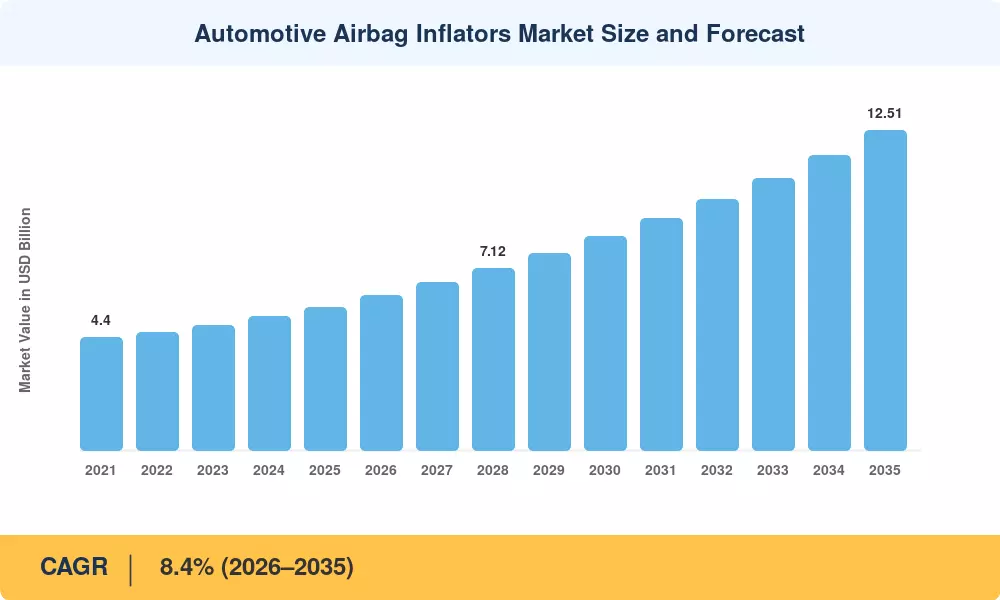
The Automotive Airbag Inflator Market was valued at USD 5.59 billion in 2025 and is projected to reach USD 6.06 billion in 2026 before climbing to USD 12.51 billion by 2035, registering a CAGR of 8.4% during the 2026–2035 forecast period. Two forces are pulling this expansion forward simultaneously: government mandates requiring higher airbag counts per vehicle — the European Union's General Safety Regulation (EU) 2019/2144 now makes side-curtain and knee airbags compulsory on every new passenger car — and the global electric-vehicle production surge, which hit 17.1 million units in 2024 according to IEA estimates [1]. EV skateboard architectures demand fundamentally different inflator packaging, creating a replacement cycle that conventional ICE platforms never triggered.

On the technology front, legacy single-stage inflators are giving way to adaptive multi-stage units that modulate gas output based on crash severity and occupant position. Suppliers invested an estimated USD 1.2 billion globally across R&D programs in 2024 alone, much of it directed at meeting the ISO/TS 5083:2025 framework for adaptive restraint systems [2]. Rising helium costs — up 34% since 2021 — have also accelerated the shift from stored-gas designs toward next-generation propellant-driven architectures that combine compressed inert gas with controlled combustion [3].

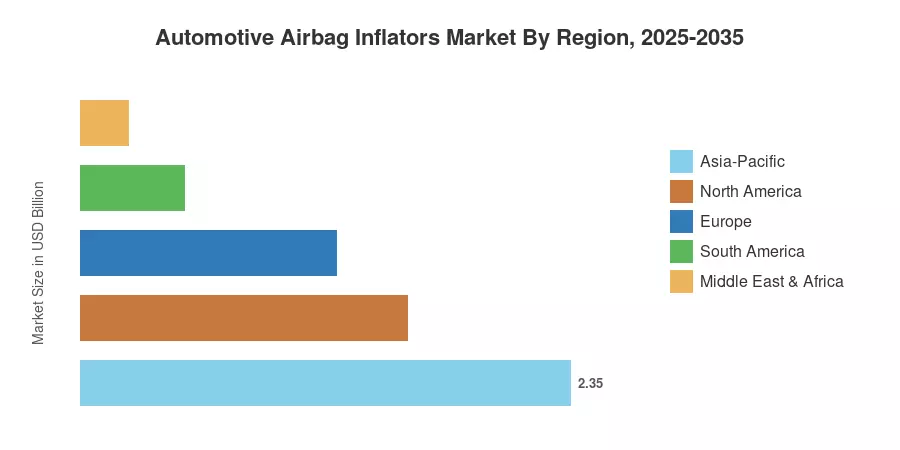
Asia-Pacific dominates the Automotive Airbag Inflator Market with approximately 42% of global revenue in 2025, driven by production scale-ups in China and India. The region is also the fastest-growing, posting a projected CAGR of 10.1% through 2035. North America holds the second-largest position at roughly a 28% share, anchored by stringent NHTSA Federal Motor Vehicle Safety Standards and an ongoing recall replacement cycle that continues to generate aftermarket demand [4]. Europe contributes around 22%, buoyed by Euro NCAP's 2026 protocol updates that weight lateral-impact protection more heavily. As autonomous-driving technologies mature through SAE Levels 3 and 4, inflator designs will need to accommodate non-traditional seating positions — a challenge that should keep R&D intensity high through the next decade.


Key Report Takeaways — Automotive Airbag Inflator Market

By Inflator Type & Technology

  • Pyrotechnic inflators captured approximately 71% of the Automotive Airbag Inflator Market in 2025, reflecting their cost advantage and established OEM integration pathways.
  • Dual- and multi-stage inflator configurations are growing at a projected 9.6% CAGR through 2035, outpacing single-stage units as adaptive restraint mandates take hold.

By Vehicle Type & Sales Channel

  • Passenger cars accounted for roughly 81% of the Automotive Airbag Inflator Market in 2025, though commercial-vehicle adoption is accelerating behind updated UN Regulation No. 94 crash-test requirements.
  • Aftermarket and recall-replacement channels are poised to expand at a 9.3% CAGR over the forecast period, sustained by ongoing safety campaigns across North America and Europe.

By Region

  • Asia-Pacific led the Automotive Airbag Inflator Market with 42% revenue share in 2025, with China alone contributing roughly half of the regional total.
  • North America held approximately 28% of global revenue, underpinned by NHTSA mandates and the largest active recall inventory worldwide.


Automotive Airbag Inflator Market Size and Forecast (2021–2035)

Market sizing draws on a triangulated methodology combining OEM procurement disclosures, tier-one supplier revenue filings, customs trade data for inflator modules, and patent-filing velocity as a leading indicator. Historical figures (2021–2024) reflect audited actuals and trade-association statistics, while the 2025 base year blends preliminary shipment data with econometric modeling. Forecast values (2026–2035) apply a compound annual growth rate derived from regression analysis of regulatory pipeline, vehicle-production outlooks (OICA), and raw-material cost trajectories.
Automotive Airbag Inflators Market Size and Forecast
Our Impact
Enabled $4.3B Revenue Impact for Fortune 500 and Leading Multinationals
Partnering with 2000+ Global Organizations Each Year
30K+ Citations by Top-Tier Firms in the Industry

Driver Impact Analysis

Driver ~% Impact on CAGR Geographic Relevance Impact Timeline
Mandatory airbag-count expansion (EU GSR, Bharat NCAP) 22–26% Global Short-term (≤2 yr)
EV skateboard chassis requiring redesigned inflators 18–22% Asia-Pacific, Europe Medium-term (2–4 yr)
Autonomous-driving adaptive restraint standards 14–18% North America, Europe Long-term (≥4 yr)
Active recall and replacement programs 10–14% North America, Japan Short-term (≤2 yr)
Rising vehicle production in emerging economies 8–12% South America, ASEAN Medium-term (2–4 yr)
Helium cost inflation shifting demand to alternative designs 6–9% Global Medium-term (2–4 yr)
Euro NCAP and JNCAP protocol tightening 5–8% Europe, Japan Short-term (≤2 yr)


Regulatory Mandate Expansion

The single largest growth catalyst for the Automotive Airbag Inflator Market is the progressive tightening of crash-safety regulations across major auto-producing regions. The EU General Safety Regulation (2019/2144), fully enforceable from July 2024, requires side-curtain airbags, knee airbags, and advanced occupant-detection systems on all new M1 and N1 vehicles [2]. India's Bharat NCAP program, launched in 2023, has already pushed domestic OEMs to increase average airbag count from two to six, translating into roughly three additional inflator units per vehicle. Japan's Ministry of Land, Infrastructure, Transport and Tourism updated its J-NCAP scoring matrix in 2024 to reward far-side occupant protection — a change that effectively mandates center-console airbags equipped with dedicated inflator modules [7].

Electric-Vehicle Architecture Disruption

Battery-electric vehicle production crossed 17.1 million units globally in 2024, and IEA projections estimate 30 million units annually by 2030 [1]. EV skateboard platforms position the battery pack beneath the passenger floor, compressing vertical cabin space and forcing inflator suppliers to develop ultra-slim profiles — some as thin as 28 mm — for integration into seat-mounted and roof-rail curtain modules. This architectural shift creates a replacement cycle independent of natural vehicle-fleet turnover, as legacy inflator geometries cannot be retrofitted into new EV body-in-white structures.

Restraints Impact Analysis

Vehicle architectures are shifting toward zone-based electrical platforms with centralized compute units that integrate airbag-control modules with sensor-fusion data from cameras, radar, and LiDAR [15]. This integration enables pre-crash occupant conditioning — tightening seat belts, adjusting headrests, and pre-arming specific inflator stages milliseconds before impact. Suppliers that embed digital communication interfaces (CAN FD, Ethernet) into inflator igniters can participate in the broader connected-vehicle data ecosystem, positioning the Automotive Airbag Inflator Market at the intersection of passive safety and active intelligence.


Automotive Airbag Inflators Market Opportunities

Adaptive Inflators for Autonomous Mobility Pods

As SAE Level 4 robotaxi fleets move into commercial service (Waymo is already providing more than 100,000 paid rides/week in U.S. cities [12]), demand is arising for non-traditional inflator geometries. Autonomous pods with seated face-to-face, swivel seats and flat floor layouts require omnidirectional inflators. Suppliers that are working on 360-degree curtain-inflator modules for these cabins might get into a segment expected to reach USD 1.8 billion by 2032.


Emerging-Market Regulatory Catch-Up

India, Brazil and ASEAN member nations are in varied phases of implementation of required multi-airbag standards. In India, the Road Transport Ministry has made it mandatory for all passenger vehicles to have six airbags from October 2023, which will triple the inflator demand per vehicle in the world’s third-largest auto market [5]. Brazil’s CONTRAN Resolution 973/2024 also raises the minimum airbag requirements. The regulatory waves provide greenfield prospects for suppliers willing to localize production in cost-sensitive markets.


Digital Diagnostics and Predictive-Maintenance Services

Connected-vehicle platforms increasingly monitor airbag-system health in real time, creating a data layer around inflator lifecycle management. OEMs and fleet operators can leverage on-board diagnostics to schedule proactive inflator replacements before warranty-period expiration, reducing field-failure rates and generating recurring service revenue. This diagnostics-as-a-service model transforms inflator suppliers from component vendors into integrated safety-system partners.

Recycling and Circular-Economy Business Models

End-of-life vehicle (ELV) processing regulations in Europe (Directive 2000/53/EC revision) and Japan mandate safe recovery of pyrotechnic devices, including inflators [9]. Companies that develop closed-loop recovery processes for inflator metals (aluminum, steel, zirconium) and inert-gas recapture systems can monetize the decommissioning phase. The European Commission's proposed ELV regulation update, expected to finalize by 2026, will likely tighten inflator-disposal tracking requirements further, enlarging this opportunity.

Commercial-Vehicle Safety Upgrades

Commercial vehicles historically deployed fewer airbag units than passenger cars, but updated UN Regulation No. 94 crash-test protocols and fleet-operator insurance incentives are changing that calculus. The commercial-vehicle segment of the Automotive Airbag Inflator Market is growing at an estimated 10.8% CAGR, driven by logistics fleets in Europe and North America adding cab-mounted curtain and thorax airbags to reduce driver-injury costs.


Automotive Airbag Inflators Market Segmentation

By Airbag Type

Segment Key Metric Primary Demand Driver
Passenger Airbags 33% revenue share (2025) Standard frontal-protection mandates worldwide
Curtain Airbags CAGR 9.2% EU GSR side-curtain requirements
Knee Airbags USD 0.72 Billion (2025) Euro NCAP lower-leg injury scoring
Pedestrian-Protection Airbags CAGR 10.6% Active-hood and external airbag systems
Other (Side Torso, Center, Rear) USD 0.88 Billion (2025) Far-side and rear-seat protection mandates


Passenger airbags remain the volumetric backbone of the Automotive Airbag Inflator Market, present in every vehicle sold across regulated markets. Their sheer installed base — frontal driver and passenger units account for a minimum of two inflators per vehicle — ensures they hold the largest revenue share. Curtain airbags represent the fastest-growing established segment, propelled by EU GSR mandates that require side-curtain coverage across both front and rear rows. Pedestrian-protection airbags, deployed externally at the base of the windshield or along the A-pillar, are an emerging category driven by Euro NCAP's vulnerable-road-user scoring criteria.

By Inflator Type

Segment Key Metric Primary Demand Driver
Pyrotechnic Inflators 71% share (2025) Cost efficiency and compact packaging
Hybrid Inflators CAGR 8.9% Controlled output and temperature stability
Stored-Gas Inflators USD 0.34 Billion (2025) Specialty applications (pedestrian, roof-mounted)


Pyrotechnic inflators dominate through pure economics: their per-unit manufacturing cost sits approximately 30% below hybrid alternatives, and decades of field history provide OEMs with well-characterized performance data [10]. Hybrid inflators — which combine a small pyrotechnic charge with a stored-gas reservoir — are gaining share in premium and EV platforms where thermal consistency and tunable gas output justify the cost premium. The Automotive Airbag Inflator Market is seeing stored-gas units increasingly confined to niche applications such as pedestrian-protection airbags, where rapid but low-force deployment is critical.

By Vehicle Type

Segment Key Metric Primary Demand Driver
Passenger Cars 81% share (2025) High per-vehicle airbag counts
Commercial Vehicles CAGR 10.8% Updated UN R94 cab-protection standards


Passenger cars account for the vast majority of inflator consumption, reflecting higher airbag counts per unit — modern premium sedans and SUVs carry 10 to 14 airbags, each requiring a dedicated inflator. Commercial vehicles are catching up rapidly. Updated UN Regulation No. 94 and fleet-operator insurance programs now incentivize cab-mounted curtain and thorax protection, adding two to four inflator units per truck cab. This regulatory and commercial pressure is making commercial vehicles the fastest-growing vehicle-type segment in the Automotive Airbag Inflator Market.

By Propellant Chemistry

Segment Key Metric Primary Demand Driver
Azide-Based Formulations 42% share (2025) Legacy installed base and proven reliability
Non-Azide Formulations CAGR 9.1% Regulatory pressure on hazardous substances


Azide-based propellants — primarily sodium azide — retain a meaningful share of the Automotive Airbag Inflator Market due to their well-understood combustion characteristics and extensive field data. However, the toxicity of sodium azide and its combustion byproducts has drawn regulatory scrutiny under EU REACH and Japan's CSCL, driving a progressive transition toward guanidine-nitrate and other organic-compound formulations. Non-azide chemistries produce lower volumes of toxic gas upon deployment and simplify vehicle recycling processes at end of life [9].

By Technology Stage

Segment Key Metric Primary Demand Driver
Single-Stage Inflators 63% share (2025) Cost sensitivity in volume segments
Dual- and Multi-Stage Inflators CAGR 9.6% ISO/TS 5083 adaptive restraint standards


Single-stage inflators remain the workhorse of the Automotive Airbag Inflator Market, delivering a fixed volume of gas upon a single ignition command. Their simplicity keeps costs low and reliability high, which appeals to high-volume OEM platforms in emerging markets. Dual- and multi-stage units, which can modulate gas output in two or more discrete steps based on crash severity and occupant weight, are gaining traction in premium vehicles and those designed for autonomous-driving readiness [6].

By Sales Channel

Segment Key Metric Primary Demand Driver
OEM-Fitted Units 78% share (2025) New-vehicle production volumes
Aftermarket & Recall Replacements CAGR 9.3% Active recall campaigns and aging fleet


OEM procurement dominates inflator distribution, as airbag systems are integral to vehicle type-approval processes. The aftermarket and recall-replacement channel, while smaller, is the faster-growing segment — sustained by NHTSA's ongoing ammonium-nitrate inflator recall and parallel programs in Japan and Australia [4]. As vehicle fleets age and second-hand markets expand in developing countries, aftermarket inflator demand within the Automotive Airbag Inflator Market should remain structurally elevated.


Regional Market Share Analysis

Region Key Metric Primary Investment Themes
Asia-Pacific 42% revenue share (2025) EV production scale-up; Bharat NCAP and China C-NCAP mandates
North America 28% revenue share (2025) FMVSS compliance; recall replacement demand
Europe 22% revenue share (2025) EU GSR enforcement; Euro NCAP 2026/2028 updates
South America CAGR 9.0% (2026–2035) CONTRAN airbag mandates; rising vehicle output in Brazil
Middle East & Africa USD 0.23 Billion (2025) GCC fleet modernization; South Africa NCAP adoption
Total USD 5.59 Billion (2025)


North America

Country Key Metric Key Driver
United States 78% of regional share FMVSS 208 compliance and recall replacement
Canada CAGR 7.9% CMVSS harmonization with U.S. standards
Mexico USD 0.11 Billion (2025) Nearshoring of OEM assembly operations


The United States remains the engine of North America's position in the Automotive Airbag Inflator Market, with NHTSA's FMVSS 208 standard governing frontal airbag performance and supplemental regulations addressing side-impact protection [4]. The still-active ammonium-nitrate inflator recall program sustains a significant aftermarket channel, while OEMs are simultaneously specifying next-generation multi-stage units for 2026–2028 model-year platforms. Canada's CMVSS framework mirrors U.S. requirements with minimal deviation, ensuring cross-border supply-chain efficiency. Mexico's role is expanding as OEMs — including BMW, Audi, and KIA — invest in assembly plants that source inflator modules from regional tier-one suppliers.

Europe

Country Key Metric Key Driver
Germany 31% of regional share Premium OEM R&D and tier-one headquarters
United Kingdom CAGR 8.1% Post-Brexit vehicle safety regulation updates
France USD 0.14 Billion (2025) PSA and Renault platform electrification
Italy CAGR 7.6% Fiat/Stellantis small-vehicle airbag integration
Spain USD 0.08 Billion (2025) Export-oriented assembly corridor
Nordic Countries CAGR 8.3% Volvo and Polestar advanced safety leadership
Russia USD 0.04 Billion (2025) Localizing under import-substitution policies
Rest of Europe CAGR 7.4% CEE assembly growth (Slovakia, Czechia, Hungary)


Europe's contribution to the Automotive Airbag Inflator Market reflects the continent's position as the regulatory pioneer for vehicle safety. The EU General Safety Regulation mandates a broader set of airbag types than any other jurisdiction, and Euro NCAP's scoring revisions directly influence OEM procurement volumes [2][7]. Germany anchors the region through the combined influence of Volkswagen Group, BMW, and Mercedes-Benz engineering specifications. At the same time, ZF Lifetec (formerly ZF TRW) operates major inflator facilities in Aschaffenburg and Kocaeli. The United Kingdom has signaled it will align post-Brexit vehicle-safety standards with UNECE protocols, maintaining regulatory equivalence that keeps cross-channel supply chains intact.

Asia-Pacific

Country Key Metric Key Driver
China 48% of regional share C-NCAP upgrades and BEV production leadership
India CAGR 11.2% Six-airbag mandate and Bharat NCAP rollout
Japan USD 0.41 Billion (2025) J-NCAP far-side protection scoring
South Korea CAGR 8.8% Hyundai-Kia platform standardization
ASEAN USD 0.19 Billion (2025) ASEAN NCAP adoption and Thai/Indonesian OEM expansion
Rest of Asia-Pacific CAGR 8.0% Emerging regulatory frameworks in Vietnam and Philippines


Asia-Pacific's leadership of the Automotive Airbag Inflator Market stems from the sheer volume of vehicle production — China produced over 30 million vehicles in 2024 — combined with rapidly tightening safety standards [5]. China's updated C-NCAP 2024 protocol increased the weighting for rear-seat side-curtain protection, directly boosting inflator procurement. India represents the region's standout growth story; the six-airbag mandate effective October 2023 roughly tripled per-vehicle inflator content for the domestic market's best-selling segments. Japan's well-established supply base — led by Daicel Corporation and Nippon Kayaku — continues to export high-specification inflator units worldwide, reinforcing the region's dominance.

South America

Country Key Metric Key Driver
Brazil 68% of regional share CONTRAN Resolution 973 airbag expansion
Argentina CAGR 8.5% Regional OEM assembly for Mercosur export
Rest of South America USD 0.03 Billion (2025) Early-stage adoption of airbag mandates


Brazil's CONTRAN Resolution 973/2024, which increases mandatory airbag installations for domestically manufactured vehicles, is the primary growth lever for the Automotive Airbag Inflator Market in South America [13]. Local production by tier-one suppliers including Autoliv's Taubaté plant positions Brazil as both a consumer and exporter within the Mercosur trade bloc. Argentina's comparatively smaller but growing auto-assembly sector — primarily serving Fiat and Toyota regional platforms — adds incremental demand.

Middle East & Africa

Country Key Metric Key Driver
Saudi Arabia 32% of regional share Vision 2030 automotive manufacturing investment
UAE CAGR 9.4% High vehicle-import safety compliance standards
South Africa USD 0.04 Billion (2025) Global NCAP "Stop the Crash" campaign influence
Egypt CAGR 7.8% Nascent local-assembly safety requirements
Rest of MEA USD 0.03 Billion (2025) Gradual regulatory adoption


The Middle East & Africa region represents the smallest share of the global Automotive Airbag Inflator Market but offers pockets of fast growth. Saudi Arabia's Vision 2030 program includes plans to localize automotive manufacturing — including safety-component production — as part of its industrial diversification strategy [14]. The UAE enforces stringent import-safety standards aligned with UNECE regulations, ensuring that virtually all imported vehicles carry full airbag suites. South Africa's Global NCAP partnership has raised consumer awareness of crash-safety ratings, gradually pushing domestic OEMs toward higher airbag content in entry-level models.


Automotive Airbag Inflators Market By Region, 2025-2035

Competitive Benchmarking

The Automotive Airbag Inflator Market exhibits high concentration: the top five suppliers account for an estimated 72–78% of global revenue. Herfindahl-Hirschman Index estimates place the market in the moderately concentrated range (HHI ~1,800–2,200), reflecting the dominance of a few vertically integrated players that control propellant chemistry, inflator assembly, and OEM qualification processes. Barriers to entry are substantial — new propellant formulations require 3–5 years of validation testing — pushing smaller firms toward strategic partnerships, licensing agreements, or acquisition by tier-one incumbents.

Company Est. Revenue Share Range Key Offerings Strategic Positioning
Autoliv Inc. 18–22% Full inflator portfolio (pyrotechnic, hybrid, stored-gas) Vertically integrated; global OEM relationships
ZF Lifetec (ZF Group) 14–18% Multi-stage pyrotechnic and hybrid inflators Engineering-led; premium European OEM focus
Joyson Safety Systems 10–14% Pyrotechnic inflators; recall-replacement programs Post-Takata restructuring; NA and China capacity
Daicel Corporation 8–11% Pyrotechnic gas generators; propellant R&D Japanese technology leader; export-oriented
Nippon Kayaku Co., Ltd. 6–9% Micro gas generators; specialty pyrotechnic devices Niche high-performance applications
ARC Automotive Inc. 4–7% Pyrotechnic inflators for OEM and aftermarket U.S.-based; capacity expansion in Tennessee
Hirtenberger Automotive Safety 3–5% Initiators and gas generators European specialist; REACH-compliant propellants
Shanxi Changqing Chemical Group 2–4% Pyrotechnic inflators for Chinese OEMs Low-cost domestic leader in China
Continental AG (Safety Division) 2–4% Integrated restraint electronics and inflator systems Systems-integration approach; sensor-to-inflator
Hubei Hang Peng Chemical Power 2–3% Pyrotechnic gas generators Emerging Chinese supplier; cost leadership


Recent News & Developments


  • NHTSA (June 2024): Issued an updated Consent Order extending the ammonium-nitrate inflator recall completion deadline to December 2028, covering an additional 4.7 million vehicles [4].
  • Euro NCAP (April 2024): Published the 2026 assessment protocol update, which increases the weighting for far-side occupant protection and introduces a scored category for pedestrian airbag systems [7].
  • ARC Automotive Inc. (February 2024): Announced a voluntary recall of approximately 67 million frontal-airbag inflators in the United States following an NHTSA investigation into propellant rupture concerns [11].
  • India Ministry of Road Transport (October 2023): Enforced the mandatory six-airbag rule for all passenger vehicles manufactured domestically, effective for new type approvals [5].


Automotive Airbag Inflators Market Report Scope

Parameter Detail
Market Scope Global Automotive Airbag Inflator Market covering inflator hardware, propellants, and integration services
Study Period 2021–2035
CAGR (Forecast) 8.4% (2026–2035)
Base Year Market Size USD 5.59 Billion (2025)
Forecast Endpoint Market Size USD 12.51 Billion (2035)
Fastest Growing Segment Pedestrian-protection airbags by airbag type; commercial vehicles by vehicle type
Companies Profiled Autoliv, ZF Lifetec, Joyson Safety Systems, Daicel, Nippon Kayaku, ARC Automotive, Hirtenberger, Shanxi Changqing, Continental, Hubei Hang Peng
Valuation Currency USD Billion

FAQs

What is the projected market valuation for the Automotive Airbag Inflator Market in 2035?

The projected market valuation for the Automotive Airbag Inflator Market in 2035 is 9.689 USD Billion.

What was the market valuation for the Automotive Airbag Inflator Market in 2024?

The market valuation for the Automotive Airbag Inflator Market in 2024 was 5.977 USD Billion.

What is the expected CAGR for the Automotive Airbag Inflator Market from 2025 to 2035?

The expected CAGR for the Automotive Airbag Inflator Market during the forecast period 2025 - 2035 is 4.49%.

Which company is a key player in the Automotive Airbag Inflator Market?

Takata, Autoliv, and Denso are among the key players in the Automotive Airbag Inflator Market.

What are the projected values for Chemical Airbag Inflators by 2035?

The projected value for Chemical Airbag Inflators is expected to reach 3.8 USD Billion by 2035.

How do the valuations of Passenger Vehicles compare to Commercial Vehicles in 2035?

By 2035, the valuation for Passenger Vehicles is projected to be 5.5 USD Billion, significantly higher than the 2.1 USD Billion for Commercial Vehicles.

What is the expected market size for Multi-Stage deployment mode by 2035?

The expected market size for Multi-Stage deployment mode is projected to reach 4.0 USD Billion by 2035.

What is the projected value for Frontal Airbags in 2035?

The projected value for Frontal Airbags is anticipated to be 4.8445 USD Billion by 2035.

What is the expected growth for Hybrid Airbag Inflators from 2024 to 2035?

The expected growth for Hybrid Airbag Inflators is projected to increase from 1.677 USD Billion in 2024 to 3.189 USD Billion by 2035.

What is the market outlook for Side Airbags by 2035?

The market outlook for Side Airbags indicates a projected value of 1.8925 USD Billion by 2035.

Author
Author
Author Profile
Triveni Bhoyar LinkedIn
Senior Research Analyst
Triveni Bhoyar has over 5 years of experience in the market research industry, specializing in the Automotive and Aerospace & Defense sectors. She has contributed to 200+ reports, including numerous custom projects for leading global companies, delivering solutions to complex business challenges. Renowned for her ability to generate valuable insights, Triveni excels in addressing unique market dynamics with precision and depth. Her expertise spans market sizing, competitive intelligence, and trend analysis, enabling clients to craft data-driven growth strategies. With strong analytical rigor and a client-centric approach, she plays a pivotal role in driving impactful, strategic decision-making.
Co-Author
Co-Author Profile
Sejal Akre LinkedIn
Senior Research Analyst
She has over 5 years of rich experience, in market research and consulting providing valuable market insights to client. Hands on expertise in management consulting, and extensive knowledge in domain including ICT, Automotive & Transportation and Aerospace & Defense. She is skilled in Go-to market strategy, industry analysis, market sizing, in depth company profiling, competitive intelligence & benchmarking and value chain amongst others.
Download Free Sample

Kindly complete the form below to receive a free sample of this Report

* Please use a valid business email

Download PDF ×

We do not share your information with anyone. However, we may send you emails based on your report interest from time to time. You may contact us at any time to opt-out.
















