Automotive Aluminum Extrusion Market (2026 - 2035)

Automotive Aluminum Extrusion Market Research Report By Product Type (Shapes (Hollow & Solid), Rods & Bars, Tubes & Pipes, Others (Flat Bars, Custom Profiles)), By Application (Body Structure, Chassis & Suspension, Battery Enclosures, Bumper & Crash Management, Powertrain Components, Heat Exchangers), By Alloy Series (6xxx Series, 7xxx Series, 5xxx Series, 1xxx / 3xxx Series, Others) and By Regional (North America, Europe, South America, Asia Pacific, Middle East and Africa) - Industry Forecast to 2035
ID: MRFR/AT/33615-HCR
128 Pages
Abbas Raut, Sejal Akre
Last Updated: July 23, 2026
Automotive Aluminum Extrusion Market
Market Size
Forecast Period2026-2035
CAGR (2026-2035)7.8%
2025 Market SizeUSD 5.80 Billion
2035 Market SizeUSD 12.30 Billion
Key Players
Norsk Hydro ASA
Constellium SE
Novelis Inc.
Arconic Corporation
UACJ Corporation
China Zhongwang Holdings
Opportunities
  • EV Battery Enclosure Architectures
  • Closed-Loop Recycled Aluminum Programs
  • India and Southeast Asia Manufacturing Expansion

Automotive Aluminum Extrusion Market Summary

The Automotive Aluminum Extrusion Market reached an estimated USD 5.80 billion in 2025 and is projected to grow from USD 6.25 billion in 2026 to USD 12.30 billion by 2035, registering a CAGR of 7.8% during the forecast period (2026–2035). Two forces are converging to accelerate demand: tightening CO₂ emission standards across the EU, China, and the United States, and the accelerating shift toward battery electric vehicles (BEVs), which consume 30–45% more extruded aluminum per unit than a conventional internal combustion engine (ICE) platform [1]. The Automotive Aluminum Extrusion Market sits at the intersection of lightweighting mandates and platform electrification — a rare double tailwind for a materials category.

Traditional steel-intensive body-in-white architectures are giving way to multi-material designs where extruded aluminum profiles replace stamped steel in rocker panels, shotgun rails, and subframe assemblies. OEMs invested over USD 8.5 billion in aluminum-intensive vehicle programs between 2022 and 2024, per the Aluminum Association's annual report [2]. The European Green Deal's 2035 ICE sales ban and the U.S. EPA's Phase 3 tailpipe rules (finalized March 2024) both reward mass reduction strategies, locking in decades of demand growth for the Automotive Aluminum Extrusion Market.

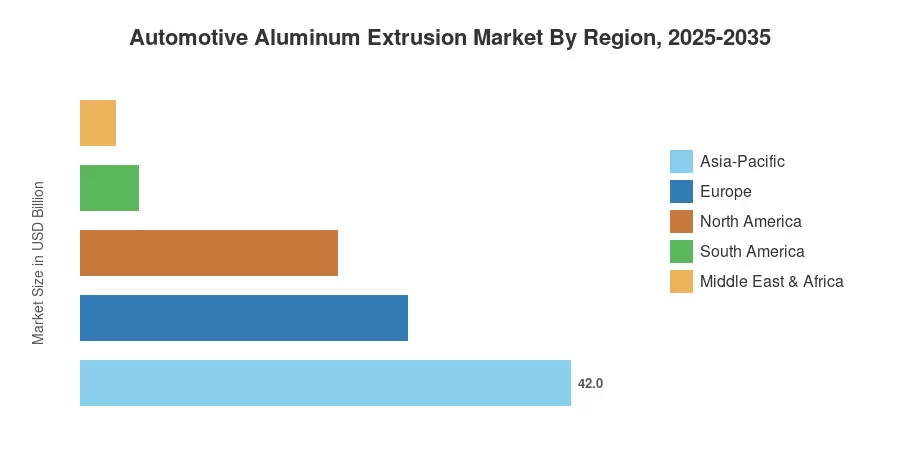
Asia-Pacific commands roughly 42% of global market revenue, driven by China's dominance in both EV production and primary aluminum capacity. Europe holds approximately a 28% share, while North America accounts for around 22%. Asia-Pacific is also the fastest-growing region at an estimated 9.2% CAGR through 2035, with India emerging as a high-potential manufacturing hub for extrusion-intensive vehicle platforms. The Automotive Aluminum Extrusion Market stands poised for structural expansion over the coming decade.


Key Report Takeaways

• By Product Type

  • Shapes (including hollow and solid profiles) led the Automotive Aluminum Extrusion Market with approximately 38% share in 2025, owing to widespread use in structural cross-members and pillar reinforcements.
  • Tubes and pipes represent the fastest-growing product category at a projected 9.1% CAGR, driven by EV thermal management circuits.

• By Application

  • Body structure applications account for roughly USD 2.10 billion in 2025, reflecting the push for lightweight unibody designs.
  • Battery enclosure applications in the Automotive Aluminum Extrusion Market are expanding at an estimated 10.3% CAGR, the highest among all application segments.

• By Region

  • Asia-Pacific leads with 42% revenue share and is expected to grow at 9.2% CAGR through 2035.
  • Europe accounts for approximately 28% of the global Automotive Aluminum Extrusion Market, underpinned by the EU's aggressive CO₂ fleet targets.
  • North America is projected to reach USD 3.20 billion by 2035, lifted by reshoring incentives and IRA-linked EV manufacturing.


Market Size and Forecast (2021–2035)

The Automotive Aluminum Extrusion Market sizing draws on a triangulated methodology combining bottom-up extrusion tonnage models (sourced from trade associations), top-down OEM procurement data, and validated against public filings from leading extrusion houses. Historical figures (2021–2024) reflect actual industry shipments, while the forecast period (2026–2035) applies a constant 7.8% CAGR anchored to projected EV penetration trajectories and regulatory mandates.
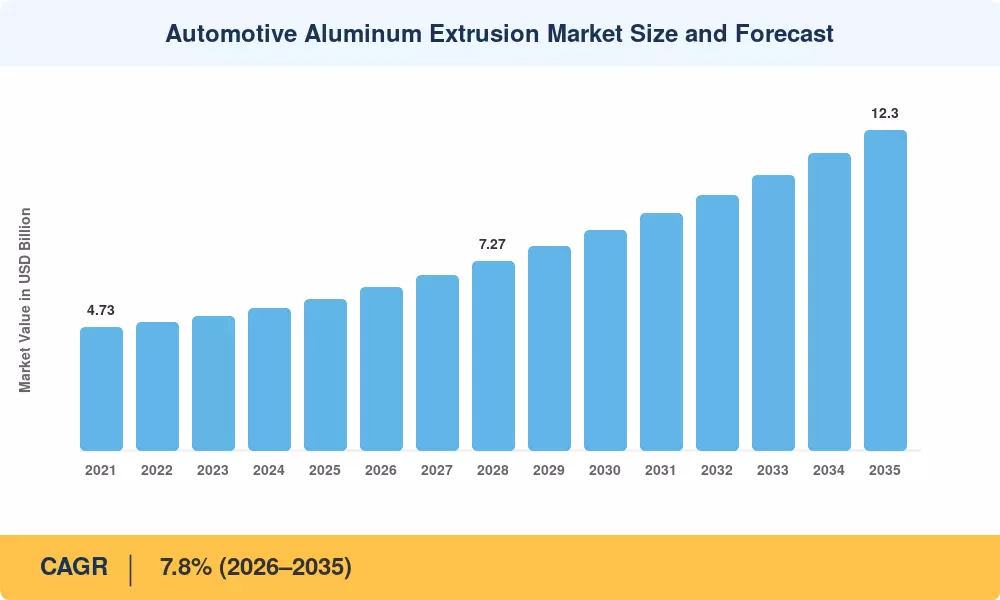
Automotive Aluminum Extrusion Market Size and Forecast
Our Impact
Enabled $4.3B Revenue Impact for Fortune 500 and Leading Multinationals
Partnering with 2000+ Global Organizations Each Year
30K+ Citations by Top-Tier Firms in the Industry

Driver Impact Analysis

Driver ~% Impact on CAGR Geographic Relevance Impact Timeline
BEV platform proliferation +2.2 Global Long-term (≥4 yr)
CO₂ and tailpipe emission regulations +1.8 EU, US, China Medium-term (2–4 yr)
Vehicle lightweighting targets +1.4 Global Medium-term (2–4 yr)
Crash safety rating upgrades (Euro NCAP 2026) +0.8 Europe Short-term (≤2 yr)
Thermal management in EV powertrains +0.7 Asia-Pacific, EU Medium-term (2–4 yr)
Recycled aluminum mandates +0.5 EU, North America Long-term (≥4 yr)
Reshoring and supply-chain localization +0.4 North America Medium-term (2–4 yr)


BEV Platform Proliferation

Electric automobiles require substantially more extruded aluminum compared to ICE vehicles. For example, a typical BEV sedan employs 25–40 kg of extruded profiles in battery enclosures alone, with another 15–20 kg in motor housings and structural reinforcements—an incremental content potential that simply did not exist a decade ago [1]. This single factor underlies the most sustainable expansion vector for the Automotive Aluminum Extrusion Market across every major area as global BEV output is forecast to exceed 30 million units annually by 2030 (IEA Global EV Outlook 2024).


CO₂ and Tailpipe Emission Regulations

Regulatory pressure acts as a non-negotiable demand floor. The EU's fleet-wide target of 0 g CO₂/km by 2035 for new passenger cars (European Green Deal, Regulation 2023/851) pushes automakers to slash curb weight wherever possible [6]. In the United States, the EPA's finalized Phase 3 greenhouse-gas standards demand a fleet-average equivalent of approximately 85g CO₂/mi by model year 2032, rewarding every kilogram removed from vehicle mass. China's Stage 6b limits and Phase V fuel-economy targets create a parallel pull in the world's largest vehicle market, cementing the Automotive Aluminum Extrusion Market as structurally essential.

Vehicle Lightweighting Targets

OEMs have publicly pledged to reduce curb weight by 10-15% for new-generation platforms by 2030 [8]. Aluminum extrusions provide 40-55% weight savings over identical steel parts and have similar crashworthiness. Volkswagen’s MEB and SSP platforms, Toyota’s e-TNGA and Hyundai’s E-GMP all use significant extruded-aluminum content in their skateboard chassis topologies, providing consistent multi-year procurement volumes.


Crash Safety Rating Upgrades

Euro NCAP's 2026 protocol update introduces more demanding side-impact and far-side occupant tests [9]. These changes incentivize high-strength, energy-absorbing aluminum extrusions in rocker sill reinforcements and side-impact beams — components that directly benefit the Automotive Aluminum Extrusion Market. OEMs accelerating redesign timelines to meet the new ratings will front-load procurement through 2027–2028.


Restraints Impact Analysis

Impact estimates for restraints are directional and reflect the degree to which each factor may suppress the overall market CAGR. Actual effects will vary by region and time period.

Restraint ~% Impact on CAGR Geographic Relevance Impact Timeline
Aluminum price volatility (LME swings) −0.9 Global Short-term (≤2 yr)
Competition from hot-stamped ultra-high-strength steel −0.7 Europe, North America Medium-term (2–4 yr)
Mega-casting displacement of multi-piece assemblies −0.6 China, US Long-term (≥4 yr)
High energy cost of primary aluminum smelting −0.5 Europe Medium-term (2–4 yr)
Limited skilled-labor supply for precision extrusion −0.3 Asia-Pacific emerging Short-term (≤2 yr)


Aluminum Price Volatility

LME aluminum prices swung between USD 2,100 and USD 2,800 per metric ton during 2023–2024, creating margin pressure for Tier-1 extrusion suppliers operating on thin conversion-cost premiums [13]. Price spikes tied to Chinese production curtailments or energy-cost shocks in European smelters can lead OEMs to defer tooling commitments or explore steel-substitution alternatives, slowing short-term demand growth in the Automotive Aluminum Extrusion Market.

Mega-Casting Displacement

Tesla’s trailblazing use of 6,000- to 9,000-ton giga-presses to build single-piece rear underbodies has led to fears that die-cast aluminum assemblies will replace multi-part extruded structures. Chinese OEMs, notably NIO and XPeng, have followed similar tactics. However, owing to the various structural requirements of casting and extrusion, the tendency may, in the long run, restrict extrusion quantities for rear-floor and shock-tower applications.


Competition from Advanced High-Strength Steel

Hot-stamped press-hardened steels (PHS) at 1,500–2,000 MPa tensile strength now rival aluminum extrusions in specific stiffness-per-dollar terms for certain A- and B-pillar applications [14]. European OEMs such as Volvo and BMW continue to use PHS extensively, representing a ceiling on aluminum penetration in select structural zones.


Automotive Aluminum Extrusion Market Opportunities

EV Battery Enclosure Architectures

BEV battery enclosures need multi-chamber extruded trays that provide structural stiffness, thermal conductivity and crashworthiness – an application that is ideally suited for large-hollow aluminum extrusions. The global BEV battery housing market is set to surpass USD 4 billion by 2030. Extruded aluminum will have the primary share of tray structures.


Closed-Loop Recycled Aluminum Programs

The EU’s End-of-Life Vehicle Regulation (2023/0284) enforces strict design-for-recycling parameters. However, the immediate mandatory post-consumer recycled content quota dictates a 25% allocation targeted strictly at plastics. The European Commission will only assess and potentially introduce parallel, legally binding recycled content thresholds for aluminum and its structural alloys following detailed future socioeconomic feasibility studies.

India and Southeast Asia Manufacturing Expansion

India's Production-Linked Incentive (PLI) scheme for the auto sector allocated INR 259 billion (USD 3.1 billion) to boost domestic manufacturing capacity, including aluminum component supply chains [18]. Thailand and Indonesia are positioning themselves as ASEAN extrusion hubs, creating greenfield capacity opportunities.

Thermal Management for High-Voltage Powertrains

Next-generation 800 V BEV architectures from Porsche, Hyundai, and Kia demand advanced extruded aluminum heat exchangers and cold plates to manage higher thermal loads. This fast-growing niche within the Automotive Aluminum Extrusion Market is largely incremental to traditional HVAC condenser demand.

Data-Driven Extrusion-as-a-Service Models

Leading extrusion suppliers are piloting digital-twin-enabled design services — offering OEMs optimized cross-section geometries through simulation platforms before tooling commitment. This service-layer monetization shifts revenue from commodity conversion to value-added engineering consulting, improving extrusion-house margins and deepening OEM relationships.


Automotive Aluminum Extrusion Market Future Outlook

Electrification Supercycle and Platform Consolidation

The global BEV parc is expected to exceed 500 million units by 2035 (IEA Net Zero Scenario), implying cumulative demand for millions of metric tons of extruded aluminum profiles in battery enclosures, structural frames, and thermal systems [1]. Platform consolidation — where a single skateboard underbody serves 3–5 vehicle nameplates — will standardize extrusion tooling and improve extrusion-house utilization rates, supporting margin expansion across the Automotive Aluminum Extrusion Market.

AI-Driven Design Optimization

For example, Altair, nTopology, and Autodesk provide generative-design software that can be used by OEMs to produce topology-optimized extrusion profiles that use 12–18% less material but maintain the same crash-load specs [21]. This capability shifts the value proposition from commodity shape supply to co-engineering partnerships, embedding extruders deeper in the vehicle-development cycle and making the Automotive Aluminum Extrusion Market more sticky.


Sustainability and Low-Carbon Aluminum Premiums

Extruders with access to hydropower-based smelting (Hydro, Rio Tinto's ELYSIS) will command green premiums of 8–12%, reshaping competitive dynamics within the Automotive Aluminum Extrusion Market.

Advanced Alloy and Joining Innovation

Development of high-strength 7xxx-series extrusion alloys for crash-relevant structures and friction-stir-welded multi-material joints will expand the addressable applications of extruded aluminum in vehicles. Research programs from Novelis and Constellium targeting 500+ MPa yield-strength extrusion alloys could unlock further steel-replacement opportunities beyond 2030, enlarging the total addressable Automotive Aluminum Extrusion Market [23].


Automotive Aluminum Extrusion Market Segmentation

By Product Type

Segment Key Metric Primary Demand Driver
Shapes (Hollow & Solid) 38% share (2025) Structural cross-members, pillar reinforcements
Rods & Bars USD 0.87 B (2025) Suspension links, steering components
Tubes & Pipes CAGR 9.1% EV thermal management circuits
Others (Flat bars, custom profiles) 9% share (2025) Trim, decorative applications


Shapes dominate the Automotive Aluminum Extrusion Market because hollow profiles provide the highest stiffness-to-weight ratio for structural automotive applications. Multi-void hollow extrusions are particularly critical for battery tray cross-beams, where a single profile can replace three or four stamped and welded steel components. Tubes and pipes are surging in demand thanks to the proliferation of liquid-cooled battery thermal circuits and integrated cooling plates in BEV architectures, positioning this segment as the fastest-growing category through 2035.

By Application

Segment Key Metric Primary Demand Driver
Body Structure USD 2.10 B (2025) Lightweight unibody platforms, B-pillar extrusions
Chassis & Suspension 18% share (2025) Subframe and control-arm applications
Battery Enclosures CAGR 10.3% BEV platform scaling
Bumper & Crash Management USD 0.72 B (2025) Crash energy absorption
Powertrain Components 8% share (2025) Motor housings, transmission cases
Heat Exchangers CAGR 8.4% Micro-channel condenser demand


Body structure applications represent the largest share of the Automotive Aluminum Extrusion Market by application, reflecting decades of aluminum adoption in roof rails, shotgun rails, and door-sill reinforcements. Battery enclosures are the fastest-growing application, driven by the fundamental shift to BEV platforms where a crash-safe, thermally conductive aluminum tray is a non-negotiable structural element. OEMs such as Rivian and BMW are standardizing multi-chamber extrusion designs that integrate structural and thermal functions in a single component.

By Alloy Series

Segment Key Metric Primary Demand Driver
6xxx Series 52% share (2025) Excellent extrudability, balanced strength-corrosion profile
7xxx Series CAGR 11.2% High-strength crash-relevant structures
5xxx Series 14% share (2025) Corrosion resistance for underbody parts
1xxx / 3xxx Series USD 0.55 B (2025) Heat exchangers, decorative trim
Others 4% share (2025) Specialty and experimental alloys


The 6xxx alloy family remains the backbone of the Automotive Aluminum Extrusion Market due to its favorable combination of medium strength, corrosion resistance, and ease of extrusion and age-hardening. The 7xxx series is advancing rapidly as OEMs push for higher-strength alternatives to press-hardened steel in safety-critical components such as side-impact beams and roof headers. Constellium's HSA7 and Novelis's Advanz 7xxx portfolios target yield strengths above 400 MPa, putting them in direct competition with boron steel at a significant weight advantage [23].


Regional Market Share Analysis

Region Key Metric Primary Investment Themes
Asia-Pacific 42% share (2025) BEV supply chains, domestic smelting capacity
Europe 28% share (2025) Emission regulations, recycled-content mandates
North America 22% share (2025) IRA incentives, reshoring, pickup-truck lightweighting
South America 5% share (2025) Low-cost manufacturing, flex-fuel hybrid platforms
Middle East & Africa 3% share (2025) Upstream aluminum integration, CKD assembly
Total 100%

The Automotive Aluminum Extrusion Market follows a regional hierarchy shaped by vehicle production volumes, OEM platform strategies, and the pace of electrification. Asia-Pacific's dominance reflects China's combined position as the world's largest auto producer and primary aluminum supplier.


Asia-Pacific

Country Key Metric Key Driver
China CAGR 9.0% World's largest EV market; integrated smelter-extrusion chains
Japan USD 0.42 B (2025) Premium lightweight platforms (Toyota, Honda)
India CAGR 10.8% PLI scheme, rising domestic OEM output
South Korea 11% of regional share Hyundai-Kia EV platform scaling
Rest of APAC CAGR 8.5% ASEAN assembly expansion (Thailand, Indonesia)


China alone accounted for over 55% of Asia-Pacific extrusion consumption in 2024, propelled by BYD, CATL-adjacent enclosure suppliers, and vertically integrated producers like China Zhongwang [19]. India's extrusion capacity is projected to double by 2030 as Tata Motors and Mahindra localize EV platforms under the PLI framework.

Europe

Country Key Metric Key Driver
Germany 34% of regional share Premium OEM demand (BMW, Mercedes, VW)
France USD 0.29 B (2025) Renault-Stellantis EV programs
United Kingdom CAGR 7.2% Jaguar electrification, Nissan Sunderland
Rest of Europe 28% of regional share Scandinavian low-carbon aluminum focus


European growth in the Automotive Aluminum Extrusion Market is closely tied to the EU's CO₂ fleet targets and the circular-economy push. Hydro's Årdal and Constellium's Singen plants have expanded extrusion press capacity specifically for automotive orders, reflecting OEM pull-through demand [20].

North America

Country Key Metric Key Driver
United States 78% of regional share IRA EV incentives, full-size truck lightweighting
Canada CAGR 7.5% Hydro-Québec-powered low-carbon smelting
Mexico USD 0.16 B (2025) Nearshoring of Tier-1 supply base


The U.S. Inflation Reduction Act's EV tax credits and critical-mineral sourcing rules have redirected aluminum supply-chain investment toward North American production, benefitting the Automotive Aluminum Extrusion Market. Ford's F-150 Lightning and GM's Ultium-based trucks each incorporate over 50 kg of extruded aluminum per vehicle [12].

South America

Country Key Metric Key Driver
Brazil 68% of regional share Flex-fuel hybrid platforms, Companhia Brasileira de Alumínio capacity
Rest of South America CAGR 6.5% CKD assembly growth


Brazil's automotive sector consumes most of South America's extruded aluminum, though electrification remains slower compared to developed markets, limiting the near-term growth trajectory.

Middle East & Africa

Country Key Metric Key Driver
UAE 45% of regional share Emirates Global Aluminium downstream integration
Saudi Arabia CAGR 8.0% Vision 2030 auto localization targets
Rest of MEA USD 0.06 B (2025) Limited domestic OEM base


The UAE's strategic position as a primary aluminum producer (EGA's 2.7 MTPA capacity) provides a cost-advantaged feedstock base, though downstream extrusion finishing remains underdeveloped for automotive-grade tolerances.


Automotive Aluminum Extrusion Market By Region, 2025-2035

Competitive Benchmarking

The Automotive Aluminum Extrusion Market is moderately consolidated, with an estimated HHI of approximately 850 and the top five players accounting for 35–42% of global automotive extrusion revenue. A handful of large integrated producers — Norsk Hydro, Constellium, and Novelis — compete alongside regionally dominant players (UACJ in Japan, Zhongwang in China) and a long tail of specialist extruders serving niche vehicle programs.

Company Est. Revenue Share Range Key Offerings Strategic Positioning
Norsk Hydro ASA ~8–11% Full-range structural profiles, bumper systems Vertically integrated; low-carbon hydro-smelted aluminum
Constellium SE ~7–10% Crash-management systems, battery enclosures Co-development OEM partnerships; R&D in 7xxx alloys
Novelis Inc. (Hindalco) ~6–9% Sheet and extrusion, closed-loop recycling Circular-economy leader; recycled-content premiums
Arconic Corporation ~5–7% Complex multi-void profiles, fastening systems U.S.-focused; advanced aerospace-to-auto technology transfer
UACJ Corporation ~4–6% Heat exchangers, structural extrusions Dominant in Japan and ASEAN markets
China Zhongwang Holdings ~4–6% Large-profile industrial and auto extrusions Lowest-cost producer; massive press capacity
Kaiser Aluminum ~3–5% High-strength automotive extrusions Niche focus on premium North American OEMs
Endurance Technologies ~2–4% Suspension and chassis components Strong in India; growing EV content
Bonnell Aluminum (Tredegar) ~2–3% Standard structural profiles Regional U.S. supplier
Impol Group ~1–2% Custom profiles for European OEMs Specialty extruder; Central European footprint


Recent News & Developments

  • Norsk Hydro (September 2024): Opened a USD 130 million automotive extrusion expansion at its Szekszárd, Hungary plant, adding 25,000 MT/year of press capacity dedicated to EV structural profiles [20].
  • Constellium SE (June 2024): Signed a long-term supply agreement with a major German OEM for battery-tray extrusions using its proprietary CMS (Crash Management System) alloy portfolio [23].


  • U.S. Department of Energy (January 2024): Awarded USD 42 million in grants under the BIL Advanced Manufacturing program to five aluminum extruders investing in decarbonization technologies [12].


  • European Commission (October 2023): Published the draft End-of-Life Vehicle Regulation mandating minimum recycled aluminum content starting 2031, directly affecting sourcing strategies across the Automotive Aluminum Extrusion Market [11].


Automotive Aluminum Extrusion Market Report Scope

Parameter Detail
Market Scope Global Automotive Aluminum Extrusion Market — product types, alloy series, applications, and regions
Study Period 2021–2035
CAGR 7.8% (2026–2035)
Market Size – Base Year (2025) USD 5.80 Billion
Market Size – Forecast End (2035) USD 12.30 Billion
Fastest Growing Segment Battery Enclosures (by Application, 10.3% CAGR); 7xxx Series (by Alloy, 11.2% CAGR)
Companies Profiled 10 major players (Norsk Hydro, Constellium, Novelis, Arconic, UACJ, China Zhongwang, Kaiser Aluminum, Endurance Technologies, Bonnell Aluminum, Impol Group)
Valuation Currency USD (constant 2025 dollars)


FAQs

What alloy grades should procurement teams prioritize for side-impact-beam applications?
7xxx-series alloys (7003, 7108) deliver yield strengths above 400 MPa, approaching press-hardened steel performance at 40% lower weight. Specify T6 or T79 temper for optimal crash-energy absorption [23].
How does friction-stir welding affect extrusion sourcing decisions?
Friction-stir welding enables dissimilar-alloy joining without filler material, letting engineers combine 6xxx and 7xxx profiles in a single assembly. This widens the supplier field beyond single-alloy houses [21].
Are mega-castings eliminating demand for extruded subframes?
Mega-castings primarily replace stamped-and-welded sheet assemblies, not extrusions. Extruded cross-members and tunnel reinforcements remain essential even in giga-press-equipped platforms [15].
What recycled-content thresholds should OEMs anticipate by 2031?
The EU's End-of-Life Vehicles regulatory draft enforces strict vehicle circularity metrics. However, the mandatory 25% post-consumer recycled threshold applies exclusively to plastics, while parallel binding targets for automotive aluminum and structural profiles await future feasibility reviews.
How do 800 V EV architectures change extrusion specifications for thermal components?
Higher voltage raises thermal loads, requiring tighter dimensional tolerances and alloys with superior thermal conductivity. Micro-channel extrusions below 1.5 mm wall thickness are increasingly specified [10].
What lead times should buyers expect for custom automotive extrusion tooling?
Custom die design and qualification typically require 10–16 weeks, depending on profile complexity. Multi-void hollow dies for battery trays can extend to 20 weeks [2].
How does carbon-border adjustment affect aluminum extrusion import costs into the EU?
The EU CBAM, fully operational by 2026, adds a carbon-cost surcharge on imported aluminum based on embedded emissions. Extrusions from coal-powered smelters face 8–15% cost premiums [22].    
Author
Author
Author Profile
Abbas Raut LinkedIn
Research Analyst
Abbas Raut is a Senior Research Analyst with 5+ years of experience delivering data-driven insights and strategic recommendations across the Automotive and Aerospace & Defense sectors. He specializes in emerging technologies, industry value chains, and global market dynamics shaping the future of mobility and defense. In automotive, Abbas has led studies on EVs, charging stations, BMS, superchargers, and more, guiding stakeholders through electrification and regulatory shifts. In Aerospace & Defense, he has analyzed markets for military electronics, drones, radars, and electronic warfare solutions, supporting procurement and investment strategies. With expertise in market sizing, forecasting, benchmarking, and technology adoption, Abbas is known for transforming complex datasets into actionable insights that drive strategy, innovation, and growth.
Co-Author
Co-Author Profile
Sejal Akre LinkedIn
Senior Research Analyst
She has over 5 years of rich experience, in market research and consulting providing valuable market insights to client. Hands on expertise in management consulting, and extensive knowledge in domain including ICT, Automotive & Transportation and Aerospace & Defense. She is skilled in Go-to market strategy, industry analysis, market sizing, in depth company profiling, competitive intelligence & benchmarking and value chain amongst others.

Research Approach


Secondary Research

The secondary research process involved comprehensive analysis of regulatory databases, industry publications, technical journals, and authoritative automotive and materials organizations. Key sources included the US Department of Transportation (DOT), National Highway Traffic Safety Administration (NHTSA), Environmental Protection Agency (EPA), International Energy Agency (IEA), European Automobile Manufacturers Association (ACEA), Aluminum Association (US), European Aluminium Association, International Aluminium Institute, Society of Automotive Engineers (SAE International), International Organization for Standardization (ISO), American Society for Testing and Materials (ASTM), China Association of Automobile Manufacturers (CAAM), Japan Automobile Manufacturers Association (JAMA), International Organization of Motor Vehicle Manufacturers (OICA), US Energy Information Administration (EIA), EU Eurostat Industrial Production Database, and national transportation ministry reports from key markets. These sources were used to collect vehicle production statistics, fuel efficiency regulations, emission standards, aluminum consumption data, and market landscape analysis for chassis components, body parts, transmission housings, suspension components, heat exchangers, and electric vehicle applications.


Primary Research

In order to gather both qualitative and quantitative insights, supply-side and demand-side stakeholders were interviewed during the primary research process. CEOs, VPs of Manufacturing, R&D directors, and commercial directors from rolling mills, OEM suppliers, and aluminum extrusion manufacturers were examples of supply-side sources. Procurement heads, vehicle platform engineers, materials experts, and supply chain directors from passenger car manufacturers, light commercial vehicle manufacturers, heavy commercial vehicle OEMs, and electric vehicle manufacturers made up demand-side sources. In addition to gathering information on alloy acceptance trends, pricing tactics, and lightweighting roadmaps, primary research verified capacity growth schedules and validated market segmentation.

Primary Respondent Breakdown:

By Designation: C-level Primaries (32%), Director Level (31%), Others (37%)

By Region: North America (32%), Europe (30%), Asia-Pacific (28%), Rest of World (10%)


Market Size Estimation

Global market valuation was derived through revenue mapping and production volume analysis. The methodology included:

Identification of 50+ key manufacturers across North America, Europe, Asia-Pacific, and Latin America

Product mapping across structural extrusions, semi-fabricated products, and fabricated parts for chassis, body parts, transmission housings, suspension components, and heat exchangers

Analysis of reported and modeled annual revenues specific to automotive aluminum extrusion portfolios

Coverage of manufacturers representing 75-80% of global market share in 2024

Extrapolation using bottom-up (vehicle production volume × aluminum content per vehicle × ASP by country) and top-down (manufacturer revenue validation) approaches to derive segment-specific valuations

Download Free Sample

Kindly complete the form below to receive a free sample of this Report

Download PDF ×

We do not share your information with anyone. However, we may send you emails based on your report interest from time to time. You may contact us at any time to opt-out.
















