Automotive Brake Fluid Market Summary
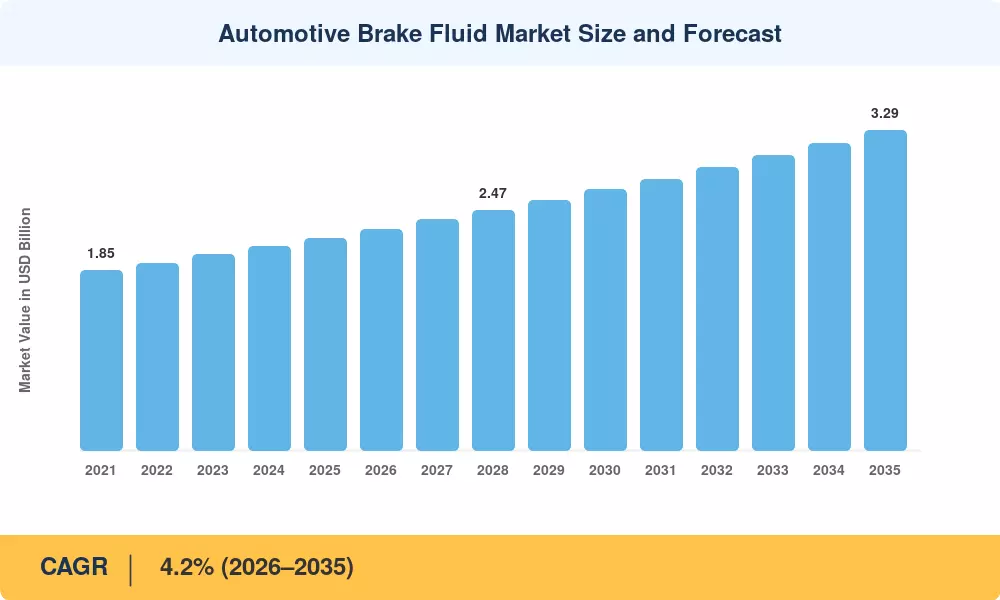
The Automotive Brake Fluid Market reached an estimated USD 2.18 billion in 2025 and is projected to grow from USD 2.27 billion in 2026 to USD 3.29 billion by 2035, registering a CAGR of 4.2% during 2026–2035. Rising vehicle production volumes in Asia and Latin America, paired with tightening safety mandates from regulatory bodies like the UNECE and NHTSA, continue to push demand for higher-specification fluids across both OEM fill and aftermarket channels [1]. The Automotive Brake Fluid Market sits at a crossroads between legacy internal combustion platforms and the rapid scaling of battery electric vehicles — a transition that reshapes fluid formulation priorities.
Conventional glycol-ether formulations still dominate global volumes, yet OEMs are increasingly specifying higher-boiling-point grades to handle the thermal loads generated by regenerative braking systems in electrified powertrains. Continental and Bosch have both invested in advanced fluid testing laboratories since 2023, signaling the industry's push toward next-generation compatibility standards [2]. Government crash-test programs in Europe and China now explicitly score braking performance under sustained high-temperature conditions, creating regulatory pull for premium fluid grades [3].
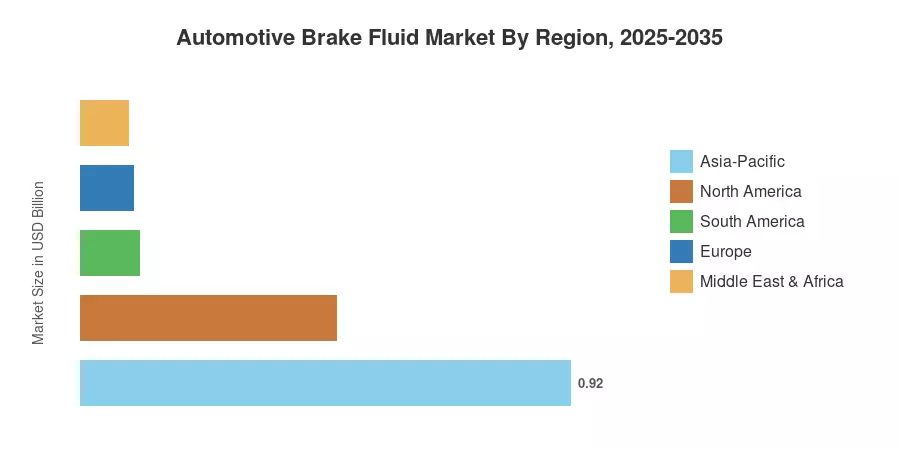
Asia-Pacific commands approximately 42% of the Automotive Brake Fluid Market, driven by passenger vehicle output in China and India. Europe represents the fastest-growing major region at a projected CAGR of 4.8%, buoyed by Euro 7 emissions and safety standards that indirectly raise brake system thermal requirements. North America holds roughly a 22% share, anchored by a mature aftermarket culture and robust pickup-truck production. As EV adoption accelerates globally, fluid manufacturers that align their portfolios with electrified platform requirements stand to capture outsized share gains through 2035.
Key Report Takeaways
• By Fluid Type
- DOT 4 fluids account for the largest revenue share at approximately 48% of the Automotive Brake Fluid Market, reflecting broad OEM adoption across passenger and commercial segments.
- DOT 3 formulations are declining at the slowest pace, posting a CAGR of 2.1% during 2026–2035 as cost-sensitive emerging markets sustain baseline demand.
- DOT 5.1 synthetics represent the fastest-growing segment, driven by performance vehicle and EV platform adoption.
• By Vehicle Type
- Passenger cars generate an estimated USD 1.24 billion in 2025 revenue within the Automotive Brake Fluid Market, supported by the global light-vehicle fleet surpassing 1.5 billion units.
- Commercial vehicles contribute a CAGR of 4.6% as heavy-duty fleets in Asia-Pacific and the Middle East expand.
• By Region
- Asia-Pacific's dominant position reflects China's 28 million annual vehicle output and India's growing aftermarket infrastructure.
- Europe's growth stems from stringent safety regulation upgrades expected through 2030.
- North America's aftermarket-heavy structure supports premium fluid pricing.
Market Size and Forecast (2021–2035)
Data for the Automotive Brake Fluid Market combines primary interviews with OEM procurement teams, fluid manufacturers' annual reports, and customs-trade databases validated against OICA production statistics [4].