Automotive Component Two Wheeler Upside Down Forks Market
Automotive Component Two Wheeler Upside Down Forks Market Summary
As per Market Research Future analysis, the Automotive Component Two Wheeler Upside Down Forks Market was estimated at 1.842 USD Billion in 2024. The market is projected to grow from 1.931 USD Billion in 2025 to 3.089 USD Billion by 2035, exhibiting a compound annual growth rate (CAGR) of 4.81% during the forecast period 2025 - 2035
Key Market Trends & Highlights
The Automotive Component Two Wheeler Upside Down Forks Market is experiencing a dynamic shift driven by technological advancements and changing consumer preferences.
- Technological advancements in suspension systems are reshaping the design and functionality of upside down forks.
- The Asia-Pacific region is emerging as the fastest-growing market, driven by increasing motorcycle adoption and performance demands.
- Customization trends are gaining traction, particularly among high-performance motorcycle enthusiasts seeking tailored solutions.
- Rising demand for high-performance motorcycles and the shift towards lightweight materials are key drivers propelling market growth.
Market Size & Forecast
| 2024 Market Size | 1.842 (USD Billion) |
| 2035 Market Size | 3.089 (USD Billion) |
| CAGR (2025 - 2035) | 4.81% |
Major Players
Showa Corporation (JP), Ohlins Racing AB (SE), Kayaba Industry Co Ltd (JP), WP Suspension (AT), Marzocchi (IT), Bitubo (IT), YSS Suspension (TH), Sachs (DE)
Automotive Component Two Wheeler Upside Down Forks Market Trends
The Automotive Component Two Wheeler Upside Down Forks Market is currently experiencing a dynamic evolution, driven by advancements in technology and shifting consumer preferences. Manufacturers are increasingly focusing on enhancing the performance and safety of two-wheelers, which has led to a growing demand for high-quality upside down forks. These components are recognized for their ability to provide superior handling and stability, making them a preferred choice among performance-oriented riders. As the market expands, the integration of lightweight materials and innovative designs is becoming more prevalent, suggesting a potential shift towards more efficient and agile two-wheeler models. Moreover, the rising popularity of electric two-wheelers is likely to influence the Automotive Component Two Wheeler Upside Down Forks Market significantly. As manufacturers adapt to the changing landscape, there appears to be a concerted effort to develop forks that cater specifically to the unique requirements of electric vehicles. This trend may lead to the introduction of specialized designs that enhance the overall riding experience while ensuring compliance with evolving regulatory standards. Consequently, the market is poised for substantial growth, driven by both technological advancements and the increasing demand for sustainable transportation solutions.
Technological Advancements
The Automotive Component Two Wheeler Upside Down Forks Market is witnessing a surge in technological innovations. Manufacturers are investing in research and development to create forks that offer improved performance, durability, and weight reduction. This trend indicates a shift towards more sophisticated engineering solutions that enhance the overall riding experience.
Sustainability Focus
There is a growing emphasis on sustainability within the Automotive Component Two Wheeler Upside Down Forks Market. As environmental concerns rise, manufacturers are exploring eco-friendly materials and production processes. This focus on sustainability may lead to the development of forks that not only perform well but also minimize environmental impact.
Customization Trends
Customization is becoming increasingly prevalent in the Automotive Component Two Wheeler Upside Down Forks Market. Consumers are seeking personalized solutions that cater to their specific riding styles and preferences. This trend suggests that manufacturers may need to offer a wider range of options to meet diverse consumer demands.
Automotive Component Two Wheeler Upside Down Forks Market Drivers
Shift Towards Lightweight Materials
The shift towards lightweight materials is a significant driver in the Automotive Component Two Wheeler Upside Down Forks Market. Manufacturers are increasingly adopting materials such as aluminum and carbon fiber to reduce the overall weight of motorcycles, thereby enhancing performance and fuel efficiency. Upside down forks, which can be engineered using these materials, offer a competitive advantage in terms of weight reduction without compromising strength. This trend aligns with consumer preferences for more agile and responsive motorcycles. Market forecasts suggest that the use of lightweight materials in motorcycle components will continue to grow, further propelling the demand for advanced suspension systems.
Regulatory Standards and Safety Requirements
Regulatory standards and safety requirements are increasingly influencing the Automotive Component Two Wheeler Upside Down Forks Market. Governments and regulatory bodies are implementing stricter safety regulations for motorcycles, necessitating the use of advanced suspension systems that enhance stability and control. Upside down forks, known for their superior performance, are becoming a preferred choice among manufacturers aiming to comply with these regulations. As safety becomes a paramount concern for consumers, the demand for high-quality suspension components is expected to rise, driving growth in the market. This trend underscores the importance of innovation in meeting regulatory demands.
Rising Demand for High-Performance Motorcycles
The Automotive Component Two Wheeler Upside Down Forks Market is experiencing a surge in demand for high-performance motorcycles. This trend is driven by an increasing number of consumers seeking enhanced riding experiences, which often necessitates advanced suspension systems. Upside down forks are recognized for their superior performance characteristics, including improved stability and handling. As manufacturers respond to this demand, the market for these components is projected to grow significantly. According to recent data, the motorcycle segment is expected to witness a compound annual growth rate of approximately 6% over the next few years, further solidifying the role of upside down forks in modern motorcycle design.
Technological Innovations in Suspension Systems
Technological advancements play a pivotal role in shaping the Automotive Component Two Wheeler Upside Down Forks Market. Innovations such as adjustable damping systems and lightweight materials are enhancing the performance and efficiency of upside down forks. These advancements not only improve ride quality but also contribute to overall vehicle performance. The integration of smart technologies, such as electronic suspension systems, is also gaining traction, allowing for real-time adjustments based on riding conditions. As manufacturers continue to invest in research and development, the market is likely to see a proliferation of innovative products that cater to the evolving needs of consumers.
Increasing Popularity of Adventure and Off-Road Motorcycles
The Automotive Component Two Wheeler Upside Down Forks Market is benefiting from the rising popularity of adventure and off-road motorcycles. These segments require robust suspension systems capable of handling diverse terrains, making upside down forks an ideal choice. The demand for off-road capabilities is driving manufacturers to enhance their product offerings, leading to a notable increase in the adoption of these advanced forks. Market analysis indicates that the adventure motorcycle segment is projected to grow at a rate of 7% annually, further emphasizing the importance of high-quality suspension components in meeting consumer expectations.
Market Segment Insights
By Component Type: Valve (Largest) vs. Damper Rod (Fastest-Growing)
In the Automotive Component Two Wheeler Upside Down Forks Market, the component type segment displays a diverse distribution among various types. The valve component holds the largest share, reflecting its crucial role in fork operation and performance. Following closely, the damper rod is emerging as a vital part, contributing significantly to the overall functionality of the forks. Other components like the piston rod, tube, fork cap, oil seal, and dust seal also play important roles but are comparatively lesser in terms of market dominance. As the market evolves, growth trends indicate a rising demand for damper rods, driven by increasing consumer preferences for enhanced ride quality and performance. This shift is attributed to advancements in materials and engineering that improve the efficacy of suspension systems, thus promoting smoother rides and better handling. Additionally, the growing focus on electric two-wheelers is influencing the development of innovative components, further fueling demand in this segment.
Valve (Dominant) vs. Damper Rod (Emerging)
The valve is a dominant component in the Automotive Component Two Wheeler Upside Down Forks Market, primarily due to its essential function in controlling fluid flow within the suspension system. Its established presence ensures that manufacturers prioritize its development, often leading to innovations that enhance reliability and performance. On the other hand, the damper rod is emerging as a significant player, particularly with the increasing consumer interest in optimizing suspension performance for improved riding experience. As manufacturers enhance their offerings, the damper rod is gaining traction, particularly in high-performance segments. The differentiation between these two components lies in their functionality; while valve components largely focus on maintaining consistency during rides, damper rods are pivotal in absorbing shocks and improving overall ride comfort.
By Material: Steel (Largest) vs. Aluminum (Fastest-Growing)
The Automotive Component Two Wheeler Upside Down Forks Market displays a diverse material landscape characterized by Steel's dominant position and Aluminum's rapid emergence. Steel continues to hold the largest market share due to its superior strength, durability, and cost-effectiveness, making it a preferred choice for manufacturers focused on producing robust two-wheeler components. In contrast, Aluminum is gaining traction, recognized for its lightweight properties and resistance to corrosion, appealing to a growing segment of eco-conscious consumers and manufacturers who aim to enhance fuel efficiency in their vehicles. In terms of growth trends, the increasing demand for lightweight materials has been a significant driver in the rise of Aluminum in the market. Moreover, advancements in manufacturing technologies and processes have improved aluminum's viability, enabling manufacturers to produce high-quality, cost-effective components. As sustainability takes center stage in the automotive industry, both Steel and Aluminum are evolving to meet new regulatory demands and consumer expectations, resulting in a dynamic market landscape that favors innovation and adaptability.
Steel (Dominant) vs. Carbon Fiber (Emerging)
Steel is traditionally seen as the dominant material in the Automotive Component Two Wheeler Upside Down Forks Market. Its characteristics, such as strength, durability, and cost-effectiveness, provide an essential advantage in performance and longevity. Steel forks are well-regarded for their ability to withstand the rigors of everyday use and offer reliability to both manufacturers and consumers. Meanwhile, Carbon Fiber is emerging as a notable alternative that is gradually capturing market interest. Its lightweight nature and high tensile strength make it a desirable option for high-performance models, particularly among enthusiasts and premium manufacturers. Although currently more expensive, the potential for Carbon Fiber to revolutionize fork design is enticing, particularly with ongoing advancements in composite manufacturing aiding in reducing costs.
By Suspension Type: USD (Largest) vs. Telescopic (Fastest-Growing)
The 'Suspension Type' segment in the Automotive Component Two Wheeler Upside Down Forks Market is characterized by a diverse range of offerings, with Conventional, USD (Upside Down), and Telescopic forks sharing prominence. Among these, the USD (Upside Down) forks hold the largest market share due to their superior stability and performance, appealing to performance-oriented motorcycle manufacturers. Telescopic forks are also gaining traction as they offer a solid balance between cost-effectiveness and ride comfort, contributing significantly to the segment's overall dynamics. In recent years, the growth trajectory of the Suspension Type segment has been largely influenced by technological advancements and changing consumer preferences. While the USD forks remain the preferred choice for many high-end models, the Telescopic segment is witnessing rapid growth, driven by increasing demand for lightweight and versatile solutions. Performance enhancements in two-wheelers and a shift towards premium features are also propelling the emergence of newer designs, thereby heightening competition in this segment.
Conventional (Dominant) vs. USD (Emerging)
The Conventional forks have long dominated the market due to their well-established reliability and cost-effectiveness, making them a go-to choice for various two-wheeler manufacturers. They provide a predictable ride experience, which appeals to a vast range of consumers. However, the USD forks are emerging rapidly, driven by their benefits of enhanced suspension performance and reduced weight, making them especially attractive to performance motorcycle segments. The transition towards more sophisticated designs is evident, as manufacturers look to deliver improved ride quality and handling. This creates a dynamic interplay in the market where Conventional forks are challenged by the growing acceptance of USD technology, illustrating the shifting preferences among riders.
By Stroke Length: 150-300 mm (Largest) vs. More than 300 mm (Fastest-Growing)
In the Automotive Component Two Wheeler Upside Down Forks Market, the segment distribution by stroke length reveals that the 150-300 mm range holds the largest market share due to its widespread application in various two-wheeler models. Meanwhile, the 'Less than 150 mm' category demonstrates a smaller market presence but caters to specific lightweight vehicles, which are still popular among certain consumer segments. Growth trends in this segment are primarily driven by advancements in engineering and consumer preferences shifting towards vehicles that offer increased stability and performance. The 'More than 300 mm' category is gaining traction, fueled by demand for high-performance sports bikes and the evolving designs of off-road two-wheelers, showcasing its rapid growth potential within the market.
150-300 mm (Dominant) vs. More than 300 mm (Emerging)
The 150-300 mm stroke length segment is currently dominant in the Automotive Component Two Wheeler Upside Down Forks Market, largely due to its balance of comfort, control, and stability which appeals to a broad range of riders. This range serves both everyday commuting motorcycles and high-performance bikes, making it a versatile choice for manufacturers. On the other hand, the 'More than 300 mm' segment is emerging due to its association with high-end motorcycles, featuring enhanced aerodynamics and performance capabilities. This segment is particularly appealing to enthusiasts who prioritize racing and off-road experiences, thus driving its rapid growth and positioning it as a critical area of focus for future innovations in two-wheeler design.
By End Use: Road (Largest) vs. Off-Road (Fastest-Growing)
The Automotive Component Two Wheeler Upside Down Forks Market showcases a diverse distribution across the end-use segments, notably dominated by the Road segment. This segment encompasses a significant share of the market, leveraging the high demand for two-wheelers in urban transportation. Following closely is the Off-Road segment, which is capturing increasing interest, thanks to the rising popularity of motorcycling as a recreational activity and the growth in adventure sports. The Track segment remains a niche area, contributing a smaller yet stable portion of the market share, primarily driven by specialized racing applications.
Road (Dominant) vs. Off-Road (Emerging)
The Road segment in the Automotive Component Two Wheeler Upside Down Forks Market stands as a dominant force, benefiting from extensive urban mobility needs and a surge in commuter motorcycle sales. Its reliability and performance are pivotal for daily riders. In contrast, the Off-Road segment is emerging rapidly, driven by a cultural shift toward outdoor adventures. This segment appeals to enthusiasts looking for ruggedness and durability, enabling two-wheelers to traverse unpaved terrains. As brands innovate in suspension technology to meet off-road demands, this segment is anticipated to show robust growth, presenting ample opportunities for manufacturers.
Regional Insights
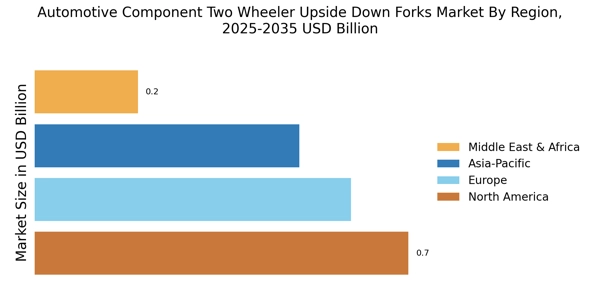
The Automotive Component Two Wheeler Upside Down Forks Market is segmented into North America, Europe, APAC, South America, and MEA. Among these regions, APAC is expected to hold the largest market share in 2023, owing to the increasing demand for two-wheelers in the region. Europe is expected to be the second-largest market, followed by North America. South America and MEA are expected to witness a steady growth in the market over the forecast period.
The growth in the Automotive Component Two Wheeler Upside Down Forks Market is attributed to the increasing popularity of two-wheelers as a mode of transportation, the rising demand for premium and high-performance motorcycles, and the growing awareness of safety features among consumers.
Key Players and Competitive Insights
Key Companies in the Automotive Component Two Wheeler Upside Down Forks Market include
Industry Developments
The global automotive component two-wheeler upside down forks market is projected to grow from USD 1.93 billion in 2025 to USD 2.95 billion by 2034, at a CAGR of 4.81% during the forecast period. Rising demand for premium motorcycles, increasing adoption of adventure and sports bikes, and growing popularity of off-road riding are the key factors driving the market growth.
Recent news developments and current affairs in the market include the launch of new upside down forks by major manufacturers, such as Showa, KYB, and WP Suspension. These new forks offer improved performance, handling, and comfort, which is attracting consumers towards premium motorcycles. Additionally, the growing popularity of electric motorcycles is also expected to boost the demand for upside down forks, as they provide better stability and handling for these vehicles.
Future Outlook
Automotive Component Two Wheeler Upside Down Forks Market Future Outlook
The Automotive Component Two Wheeler Upside Down Forks Market is projected to grow at a 4.81% CAGR from 2025 to 2035, driven by increasing demand for performance and safety enhancements.
New opportunities lie in:
- Development of lightweight materials for enhanced performance
- Integration of smart technology for real-time monitoring
- Expansion into emerging markets with tailored product offerings
By 2035, the market is expected to achieve robust growth, reflecting evolving consumer preferences and technological advancements.
Market Segmentation
Automotive Component Two Wheeler Upside Down Forks Market End Use Outlook
- Road
- Off-Road
- Track
Automotive Component Two Wheeler Upside Down Forks Market Material Outlook
- Steel
- Aluminum
- Magnesium
- Titanium
- Carbon Fiber
Automotive Component Two Wheeler Upside Down Forks Market Stroke Length Outlook
- Less than 150 mm
- 150-300 mm
- More than 300 mm
Automotive Component Two Wheeler Upside Down Forks Market Component Type Outlook
- Valve
- Damper Rod
- Piston Rod
- Tube
- Fork Cap
- Oil Seal
- Dust Seal
Automotive Component Two Wheeler Upside Down Forks Market Suspension Type Outlook
- Conventional
- USD (Upside Down)
- Telescopic
Report Scope
| MARKET SIZE 2024 | 1.842(USD Billion) |
| MARKET SIZE 2025 | 1.931(USD Billion) |
| MARKET SIZE 2035 | 3.089(USD Billion) |
| COMPOUND ANNUAL GROWTH RATE (CAGR) | 4.81% (2025 - 2035) |
| REPORT COVERAGE | Revenue Forecast, Competitive Landscape, Growth Factors, and Trends |
| BASE YEAR | 2024 |
| Market Forecast Period | 2025 - 2035 |
| Historical Data | 2019 - 2024 |
| Market Forecast Units | USD Billion |
| Key Companies Profiled | Showa Corporation (JP), Ohlins Racing AB (SE), Kayaba Industry Co Ltd (JP), WP Suspension (AT), Marzocchi (IT), Bitubo (IT), YSS Suspension (TH), Sachs (DE) |
| Segments Covered | Component Type, Material, Suspension Type, Stroke Length, End Use, Regional |
| Key Market Opportunities | Growing demand for lightweight materials enhances innovation in the Automotive Component Two Wheeler Upside Down Forks Market. |
| Key Market Dynamics | Rising demand for lightweight materials drives innovation in two wheeler upside down forks technology and design. |
| Countries Covered | North America, Europe, APAC, South America, MEA |
FAQs
What is the projected market valuation for the Automotive Component Two Wheeler Upside Down Forks Market in 2035?
The projected market valuation for 2035 is 3.089 USD Billion.
What was the market valuation for the Automotive Component Two Wheeler Upside Down Forks Market in 2024?
The overall market valuation was 1.842 USD Billion in 2024.
What is the expected CAGR for the Automotive Component Two Wheeler Upside Down Forks Market during the forecast period 2025 - 2035?
The expected CAGR during the forecast period 2025 - 2035 is 4.81%.
Which companies are considered key players in the Automotive Component Two Wheeler Upside Down Forks Market?
Key players include Showa Corporation, Ohlins Racing AB, Kayaba Industry Co Ltd, WP Suspension, Marzocchi, Bitubo, YSS Suspension, and Sachs.
What are the projected valuations for the different component types in the market?
Projected valuations for component types include Valve at 0.6108 USD Billion and Damper Rod at 0.4605 USD Billion.
How does the market for Upside Down Forks compare to other suspension types?
The market for Upside Down Forks is projected at 1.5 USD Billion, compared to 0.8 USD Billion for Conventional types.
What materials are primarily used in the production of two-wheeler upside down forks?
Primary materials include Steel valued at 0.999 USD Billion and Aluminum at 0.785 USD Billion.
What is the expected market performance for different stroke lengths in the upcoming years?
The stroke length segment '150-300 mm' is projected to reach 1.194 USD Billion.
What end-use segments are driving the Automotive Component Two Wheeler Upside Down Forks Market?
End-use segments include Road at 1.215 USD Billion and Off-Road at 0.905 USD Billion.
What trends are anticipated in the Automotive Component Two Wheeler Upside Down Forks Market by 2035?
Trends suggest a steady growth trajectory, with increasing demand for advanced suspension technologies.
Kindly complete the form below to receive a free sample of this Report
Customer Stories
“This is really good guys. Excellent work on a tight deadline. I will continue to use you going forward and recommend you to others. Nice job”
“Thanks. It’s been a pleasure working with you, please use me as reference with any other Intel employees.”
“Thanks for sending the report it gives us a good global view of the Betaïne market.”
“Thank you, this will be very helpful for OQS.”
“We found the report very insightful! we found your research firm very helpful. I'm sending this email to secure our future business.”
“I am very pleased with how market segments have been defined in a relevant way for my purposes (such as "Portable Freezers & refrigerators" and "last-mile"). In general the report is well structured. Thanks very much for your efforts.”
“I have been reading the first document or the study, ,the Global HVAC and FP market report 2021 till 2026. Must say, good info! I have not gone in depth at all parts, but got a good indication of the data inside!”
“We got the report in time, we really thank you for your support in this process. I also thank to all of your team as they did a great job.”