×
Request Free Sample ×

Kindly complete the form below to receive a free sample of this Report

Leading companies partner with us for data-driven Insights

clients tt-cursor
Hero Background

Automotive Door Latch Hinges Market

ID: MRFR/AT/21893-HCR
128 Pages
Aarti Dhapte
October 2025

Automotive Door Latch and Hinge Market Research Report By Application (Passenger Cars, Commercial Vehicles, Off-Highway Vehicles), By Latch Type (Mechanical Latches, Electronic Latches, Magnetic Latches), By Hinge Type (Butt Hinges, Continuous Hinges, Piano Hinges, Concealed Hinges), By Material (Steel, Aluminum, Plastic, Composite Materials), By Sales Channel (OEMs, Aftermarket, Retailers) and By Regional (North America, Europe, South America, Asia Pacific, Middle East and Africa) - Forecast to 2035

Share:
Download PDF ×

We do not share your information with anyone. However, we may send you emails based on your report interest from time to time. You may contact us at any time to opt-out.

Automotive Door Latch Hinges Market Infographic
Purchase Options

Automotive Door Latch Hinges Market Summary

As per MRFR analysis, the Automotive Door Latch and Hinge Market Size was estimated at 13.24 USD Billion in 2024. The Automotive Door Latch and Hinge industry is projected to grow from 14.73 USD Billion in 2025 to 42.7 USD Billion by 2035, exhibiting a compound annual growth rate (CAGR) of 11.23 during the forecast period 2025 - 2035.

Key Market Trends & Highlights

The Automotive Door Latch and Hinge Market is poised for growth driven by technological advancements and evolving consumer preferences.

  • The integration of smart technologies is transforming the functionality of automotive door latches and hinges, enhancing user experience.
  • Sustainability initiatives are increasingly influencing manufacturers to adopt eco-friendly materials and production processes.
  • Customization and personalization trends are driving demand for unique latch and hinge designs in passenger cars, the largest segment.
  • Rising vehicle production and consumer preferences for enhanced safety features are key drivers propelling market growth, particularly in North America and the Asia-Pacific region.

Market Size & Forecast

2024 Market Size 13.24 (USD Billion)
2035 Market Size 42.7 (USD Billion)
CAGR (2025 - 2035) 11.23%

Major Players

Magna International (CA), Valeo (FR), Dura Automotive Systems (US), Brose Fahrzeugteile (DE), Aisin Seiki (JP), Gestamp Automocion (ES), Huf Hülsbeck & Fürst (DE), Mitsubishi Electric (JP), Kiekert AG (DE)

Automotive Door Latch Hinges Market Trends

The Automotive Door Latch and Hinge Market is currently experiencing a transformative phase, driven by advancements in technology and evolving consumer preferences. Manufacturers are increasingly focusing on enhancing safety features and improving the overall user experience. This shift is evident in the integration of smart technologies, which not only provide convenience but also bolster security measures. As electric and autonomous vehicles gain traction, the demand for innovative latching and hinging solutions is likely to rise, reflecting the industry's adaptation to new mobility trends. Moreover, sustainability is becoming a pivotal consideration within the Automotive Door Latch and Hinge Market. Companies are exploring eco-friendly materials and manufacturing processes to reduce their environmental footprint. This trend aligns with the broader automotive industry's commitment to sustainability, as consumers increasingly favor products that demonstrate environmental responsibility. The interplay of technology and sustainability is expected to shape the future landscape of this market, presenting both challenges and opportunities for stakeholders.

Integration of Smart Technologies

The Automotive Door Latch and Hinge Market is witnessing a notable trend towards the incorporation of smart technologies. This development enhances vehicle security and user convenience, as features such as remote locking and unlocking become more prevalent. Manufacturers are likely to invest in research and development to create advanced latching systems that integrate seamlessly with modern vehicle electronics.

Sustainability Initiatives

Sustainability is emerging as a critical focus within the Automotive Door Latch and Hinge Market. Companies are increasingly adopting eco-friendly materials and processes to minimize environmental impact. This trend reflects a broader commitment to sustainability in the automotive sector, as consumers show a preference for products that align with their values regarding environmental responsibility.

Customization and Personalization

Customization is becoming a significant trend in the Automotive Door Latch and Hinge Market. Consumers are seeking personalized solutions that cater to their specific needs and preferences. This demand encourages manufacturers to offer a wider range of designs and functionalities, allowing for greater flexibility in vehicle design and enhancing overall customer satisfaction.

Automotive Door Latch Hinges Market Drivers

Rising Vehicle Production

The increasing production of vehicles is a primary driver for the Automotive Door Latch and Hinge Market. As manufacturers ramp up output to meet consumer demand, the need for reliable and efficient door latches and hinges becomes paramount. In recent years, vehicle production has shown a steady upward trend, with millions of units produced annually. This surge in production directly correlates with the demand for high-quality automotive components, including door latches and hinges. The Automotive Door Latch and Hinge Market is likely to benefit from this trend, as manufacturers seek to enhance vehicle safety and functionality through advanced latch and hinge systems. Furthermore, the expansion of electric and hybrid vehicles is expected to further stimulate this market, as these vehicles often require specialized components to accommodate their unique designs.

Technological Advancements

Technological advancements play a crucial role in shaping the Automotive Door Latch and Hinge Market. Innovations such as electronic latching systems and smart hinges are gaining traction, driven by the demand for enhanced vehicle security and convenience. The integration of technology into traditional latch and hinge designs is not only improving functionality but also increasing safety features. For instance, the introduction of remote locking mechanisms and automatic door opening systems is becoming more prevalent. This shift towards smart technology is expected to propel the Automotive Door Latch and Hinge Market forward, as manufacturers invest in research and development to create cutting-edge solutions. The market is projected to grow significantly, with estimates suggesting a compound annual growth rate that reflects the increasing adoption of these advanced technologies.

Growth of Electric and Autonomous Vehicles

The growth of electric and autonomous vehicles is emerging as a significant driver for the Automotive Door Latch and Hinge Market. As the automotive landscape evolves, the demand for specialized components that cater to the unique requirements of electric and autonomous vehicles is increasing. These vehicles often feature innovative designs and technologies that necessitate advanced door latch and hinge systems. The Automotive Door Latch and Hinge Market is likely to experience substantial growth as manufacturers adapt to these changes. The integration of features such as automatic door opening and closing mechanisms aligns with the technological advancements in electric and autonomous vehicles. This trend not only enhances user convenience but also contributes to the overall safety and functionality of these vehicles, indicating a promising future for the market.

Regulatory Compliance and Safety Standards

Regulatory compliance and safety standards are pivotal drivers for the Automotive Door Latch and Hinge Market. Governments worldwide are implementing stringent safety regulations to ensure the protection of vehicle occupants. These regulations often mandate the use of high-quality latches and hinges that meet specific safety criteria. As a result, automotive manufacturers are compelled to invest in superior door latch and hinge systems to comply with these regulations. The Automotive Door Latch and Hinge Market is likely to see increased demand as manufacturers strive to meet these evolving safety standards. Additionally, the emphasis on crash safety and occupant protection is pushing manufacturers to innovate and enhance the performance of their door latch and hinge systems, further driving market growth.

Consumer Preferences for Enhanced Safety Features

Consumer preferences are increasingly leaning towards enhanced safety features in vehicles, which significantly impacts the Automotive Door Latch and Hinge Market. As awareness of vehicle safety rises, consumers are demanding more reliable and advanced door latch and hinge systems. This shift in consumer behavior is prompting manufacturers to prioritize the development of innovative solutions that not only meet but exceed safety expectations. The Automotive Door Latch and Hinge Market is responding to this demand by integrating advanced materials and technologies into their products. The focus on safety is likely to drive market growth, as manufacturers seek to differentiate their offerings in a competitive landscape. Furthermore, the trend towards family-oriented vehicles is amplifying the need for robust and secure door systems, further propelling the market.
Market Segment Insights

By Application: Passenger Cars (Largest) vs. Commercial Vehicles (Fastest-Growing)

The Automotive Door Latch and Hinge Market showcases a significant share for passenger cars, which represent the largest segment due to the enduring demand for personal vehicles worldwide. As manufacturers strive for innovation and enhanced safety features in consumer cars, this segment continues to command a substantial portion of the market. In contrast, the commercial vehicles segment, encompassing delivery and transport trucks, has been gaining momentum, driven by the e-commerce boom and increased freight transport requirements.

Passenger Cars (Dominant) vs. Commercial Vehicles (Emerging)

Passenger cars remain the dominant segment in the Automotive Door Latch and Hinge Market. This category is characterized by a strong emphasis on aesthetic appeal, safety features, and technological integration, making them pivotal in the automotive industry. Manufacturers are focusing on delivering lightweight materials and innovative designs to enhance performance and safety. Meanwhile, the commercial vehicles segment is emerging rapidly, driven by the expanding logistics and transportation sectors. This segment often requires more robust and heavy-duty door latch and hinge solutions to accommodate the more demanding usage patterns of commercial applications, making it a key area for growth.

By Latch Type: Mechanical Latches (Largest) vs. Electronic Latches (Fastest-Growing)

In the Automotive Door Latch and Hinge Market, the distribution of market share among latch types highlights the prominence of mechanical latches, which dominate the market due to their simplicity, reliability, and low cost. On the other hand, electronic latches are gaining traction, with a noticeable share as vehicle manufacturers increasingly demand advanced security and convenience features. Additionally, magnetic latches represent a niche segment, appealing to specialized applications but lagging behind in overall share in comparison to mechanical and electronic counterparts.

Latches: Mechanical (Dominant) vs. Electronic (Emerging)

Mechanical latches are characterized by their traditional designs, providing ease of use and high reliability. They have been the industry standard for many years due to their cost-effectiveness and strong performance. Meanwhile, electronic latches are emerging rapidly, driven by the trend towards enhanced vehicle automation and the need for smart access systems. These latches offer features like remote locking and integration with vehicle security systems, making them increasingly appealing to modern consumers. As the automotive market evolves towards more technologically advanced solutions, electronic latches are expected to see substantial growth, transforming vehicle entry systems.

By Hinge Type: Butt Hinges (Largest) vs. Concealed Hinges (Fastest-Growing)

In the Automotive Door Latch and Hinge Market, butt hinges currently hold the largest market share due to their widespread application in various vehicle types. These hinges are favored for their strength and reliability, making them a preferred choice among manufacturers. Continuous hinges and piano hinges follow, serving niche applications while concealed hinges are gaining momentum in terms of market share as aesthetics and functionality blend in modern automotive design. Growth trends indicate a rising demand for concealed hinges, driven by the automotive industry's focus on sleek designs and advanced engineering. Additionally, innovations in materials and manufacturing techniques are enhancing the appeal of piano hinges and continuous hinges. The increasing adoption of electric vehicles is further fueling the demand for versatile hinge solutions that accommodate new vehicle configurations.

Butt Hinges (Dominant) vs. Concealed Hinges (Emerging)

Butt hinges are renowned for their robust construction and are widely used in automotive applications, favored for their simplicity and effectiveness in providing stability and support for vehicle doors. They are typically manufactured from durable materials, offering longevity and minimal maintenance. On the other hand, concealed hinges represent an emerging trend in the market, particularly appealing to modern vehicles that prioritize minimalism and design aesthetics. These hinges are designed to be hidden when doors are closed, allowing for a clean exterior look while delivering functionality. As automotive designs evolve, concealed hinges are expected to capture an increasingly larger share of the market, driven by consumer preferences for sleek and innovative solutions.

By Material: Steel (Largest) vs. Aluminum (Fastest-Growing)

In the Automotive Door Latch and Hinge Market, steel leads in market share due to its strength, durability, and cost-effectiveness, making it the preferred material for many manufacturers. Aluminum, however, is gaining traction as a lightweight alternative that supports the increasing demand for fuel-efficient vehicles. Overall, the market is diversifying, with components made from various materials, each catering to different vehicle specifications and consumer preferences. The growth trajectory for this segment is being driven by technological advancements and evolving industry standards. Manufacturers are increasingly adopting innovative materials like aluminum to create lighter components that enhance vehicle performance and efficiency. Additionally, the emphasis on sustainability is boosting the adoption of composite materials, making it a vibrant field in a competitive market.

Steel (Dominant) vs. Plastic (Emerging)

Steel remains the dominant material in the automotive door latch and hinge sector, appreciated for its robustness and ability to withstand harsh conditions. Its established supply chain and production processes support its prevalence, especially in vehicle segments that prioritize safety and reliability. In contrast, plastic is emerging as a viable alternative, offering benefits like reduced weight and corrosion resistance. With advancements in polymer technology, plastics are being formulated to meet stringent automotive standards, therefore opening new opportunities for their incorporation in door latches and hinges. The increasing demand for lightweight designs and cost-effective solutions positions plastic as a material that could reshape future automotive design.

By Sales Channel: OEMs (Largest) vs. Aftermarket (Fastest-Growing)

The Automotive Door Latch and Hinge Market presents a diverse sales channel landscape, with Original Equipment Manufacturers (OEMs) commanding the largest share. This distribution reflects the strong reliance on OEMs for high-quality, standardized products used in new vehicle assembly. In contrast, the aftermarket segment continues to expand rapidly, catering to the increasing demand for replacement parts and enhancements in the vehicle ownership lifecycle, especially as the global vehicle fleet grows. As vehicles age, aftermarket sales are projected to increase, creating a dynamic competitive environment. Growth trends in the automotive door latch and hinge market are driven by various factors, including advancements in safety regulations and the growing need for enhanced functionality in vehicle doors. Consumer preferences are also shifting towards more reliable and durable components, prompting manufacturers to invest in innovation. The aftermarket is benefiting from the rise in vehicle servicing and customization trends, as drivers seek to improve performance and aesthetics. This push towards personalization, alongside a robust supply chain, ensures a thriving landscape for aftermarket players in the coming years.

OEMs (Dominant) vs. Aftermarket (Emerging)

The OEM segment is characterized by its dominance in the Automotive Door Latch and Hinge Market, as it supplies essential components directly to automakers for new models. This segment is known for its adherence to stringent quality standards and long-term contracts with major automotive manufacturers, resulting in stable demand. In contrast, the aftermarket segment is depicted as an emerging force, driven by increased consumer interest in vehicle maintenance and modifications. This sector caters to a broad range of consumers who prioritize DIY repairs and enhancements. As a result, aftermarket players are diversifying their product lines to meet specific needs, including specialized latches and hinges that offer improved performance or aesthetic upgrades.

Get more detailed insights about Automotive Door Latch Hinges Market

Regional Insights

North America : Automotive Innovation Leader

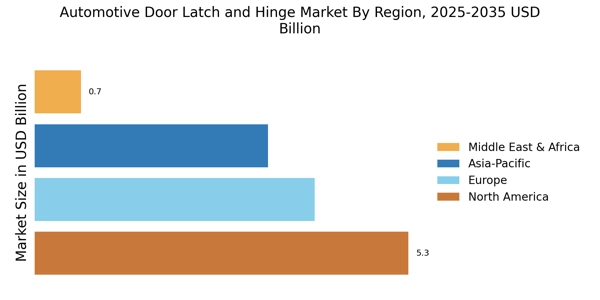
North America is witnessing robust growth in the automotive door latch and hinge market, driven by increasing vehicle production and technological advancements. The region holds approximately 40% of the global market share, making it the largest market. Regulatory support for safety standards and innovations in electric vehicles are further propelling demand. The U.S. and Canada are the primary contributors to this growth, with a focus on enhancing vehicle safety and performance. The competitive landscape in North America is characterized by the presence of key players such as Magna International and Dura Automotive Systems. These companies are investing in R&D to develop advanced latching systems that meet evolving consumer demands. The market is also seeing collaborations between manufacturers and automotive OEMs to integrate smart technologies into door latch systems, ensuring enhanced functionality and safety features.

Europe : Regulatory-Driven Market Growth

Europe is emerging as a significant player in the automotive door latch and hinge market, holding around 30% of the global market share, making it the second-largest region. The growth is fueled by stringent safety regulations and a shift towards sustainable automotive solutions. The European Union's focus on reducing carbon emissions and promoting electric vehicles is driving demand for innovative latching systems that align with these goals. Leading countries in this region include Germany, France, and the UK, where major manufacturers like Valeo and Brose Fahrzeugteile are based. The competitive landscape is marked by a strong emphasis on R&D, with companies investing in smart latching technologies. The presence of established automotive OEMs in Europe further enhances the market's growth potential, as they seek to incorporate advanced features into their vehicles.

Asia-Pacific : Emerging Market Potential

Asia-Pacific is rapidly becoming a key player in the automotive door latch and hinge market, driven by increasing vehicle production and rising consumer demand. The region holds approximately 25% of the global market share, with countries like China and Japan leading the charge. The growth is supported by government initiatives aimed at boosting the automotive sector and enhancing safety standards, which are crucial for market expansion. China is the largest market in the region, with significant investments in automotive manufacturing and technology. Key players such as Aisin Seiki and Mitsubishi Electric are focusing on innovation and quality to capture market share. The competitive landscape is evolving, with local manufacturers emerging alongside established global players, creating a dynamic market environment that fosters growth and innovation.

Middle East and Africa : Untapped Market Opportunities

The Middle East and Africa (MEA) region presents untapped opportunities in the automotive door latch and hinge market, holding about 5% of the global market share. The growth is primarily driven by increasing vehicle sales and a rising middle class, particularly in countries like South Africa and the UAE. Government initiatives to improve infrastructure and promote automotive manufacturing are also contributing to market expansion. In this region, the competitive landscape is still developing, with a mix of local and international players. Companies are focusing on establishing manufacturing facilities to cater to the growing demand. The presence of key players like Huf Hülsbeck & Fürst and Kiekert AG is notable, as they aim to leverage the region's growth potential by introducing innovative products tailored to local market needs.

Automotive Door Latch Hinges Market Regional Image

Key Players and Competitive Insights

The Automotive Door Latch and Hinge Market is currently characterized by a dynamic competitive landscape, driven by innovation, technological advancements, and a growing emphasis on safety and efficiency. Key players such as Magna International (Canada), Valeo (France), and Dura Automotive Systems (United States) are actively shaping the market through strategic initiatives. Magna International (Canada) focuses on enhancing its product portfolio by integrating advanced technologies into its latching systems, thereby improving safety features and user experience. Valeo (France) emphasizes sustainability in its operations, aiming to reduce the environmental impact of its manufacturing processes while expanding its market share through strategic partnerships with automotive manufacturers. Dura Automotive Systems (United States) is concentrating on digital transformation, leveraging data analytics to optimize its supply chain and enhance operational efficiency, which collectively influences the competitive environment by fostering innovation and responsiveness to market demands.

The business tactics employed by these companies include localizing manufacturing to reduce costs and enhance supply chain resilience. The market structure appears moderately fragmented, with several players competing for market share while also collaborating through strategic alliances. This collective influence of key players fosters a competitive atmosphere where innovation and operational efficiency are paramount.

In August 2025, Magna International (Canada) announced a partnership with a leading electric vehicle manufacturer to develop next-generation door latch systems that integrate smart technology. This strategic move is significant as it positions Magna at the forefront of the electric vehicle market, aligning with the industry's shift towards advanced safety features and connectivity. In September 2025, Valeo (France) launched a new line of eco-friendly door hinges made from recycled materials, reflecting its commitment to sustainability and appealing to environmentally conscious consumers. This initiative not only enhances Valeo's product offerings but also strengthens its brand image in a market increasingly focused on sustainability.

In July 2025, Dura Automotive Systems (United States) unveiled a new digital platform designed to streamline its supply chain operations, which is expected to enhance efficiency and reduce lead times. This development is crucial as it allows Dura to respond more swiftly to market changes and customer demands, thereby gaining a competitive edge in a rapidly evolving industry.

As of October 2025, current competitive trends in the Automotive Door Latch and Hinge Market are heavily influenced by digitalization, sustainability, and the integration of artificial intelligence. Strategic alliances are increasingly shaping the landscape, enabling companies to pool resources and expertise to drive innovation. Looking ahead, it is likely that competitive differentiation will evolve from traditional price-based competition to a focus on technological innovation, enhanced supply chain reliability, and sustainable practices, reflecting the changing priorities of consumers and manufacturers alike.

Key Companies in the Automotive Door Latch Hinges Market market include

Industry Developments

The Automotive Door Latch and Hinge Market is projected to reach a valuation of USD 33.13 billion by 2032, expanding at a CAGR of 2.68% from 2024 to 2032. Rising demand for lightweight and fuel-efficient vehicles is driving market growth. Additionally, increasing production of electric vehicles and growing urbanization are contributing to market expansion. Asia Pacific is the largest regional market, with China being a major contributor due to its large automotive industry. Key industry participants are focusing on technological advancements, such as the integration of sensors and electronics in door latches and hinges, to enhance vehicle safety and convenience.

Future Outlook

Automotive Door Latch Hinges Market Future Outlook

The Automotive Door Latch and Hinge Market is projected to grow at 11.23% CAGR from 2024 to 2035, driven by technological advancements, increasing vehicle production, and rising safety standards.

New opportunities lie in:

  • Integration of smart locking mechanisms in vehicles
  • Development of lightweight materials for enhanced durability
  • Expansion into electric vehicle latch and hinge systems

By 2035, the market is expected to achieve robust growth, driven by innovation and evolving consumer demands.

Market Segmentation

Automotive Door Latch Hinges Market Material Outlook

  • Steel
  • Aluminum
  • Plastic
  • Composite Materials

Automotive Door Latch Hinges Market Hinge Type Outlook

  • Butt Hinges
  • Continuous Hinges
  • Piano Hinges
  • Concealed Hinges

Automotive Door Latch Hinges Market Latch Type Outlook

  • Mechanical Latches
  • Electronic Latches
  • Magnetic Latches

Automotive Door Latch Hinges Market Application Outlook

  • Passenger Cars
  • Commercial Vehicles
  • Off-Highway Vehicles

Automotive Door Latch Hinges Market Sales Channel Outlook

  • OEMs
  • Aftermarket
  • Retailers

Report Scope

MARKET SIZE 202413.24(USD Billion)
MARKET SIZE 202514.73(USD Billion)
MARKET SIZE 203542.7(USD Billion)
COMPOUND ANNUAL GROWTH RATE (CAGR)11.23% (2024 - 2035)
REPORT COVERAGERevenue Forecast, Competitive Landscape, Growth Factors, and Trends
BASE YEAR2024
Market Forecast Period2025 - 2035
Historical Data2019 - 2024
Market Forecast UnitsUSD Billion
Key Companies ProfiledMarket analysis in progress
Segments CoveredMarket segmentation analysis in progress
Key Market OpportunitiesIntegration of smart technology in Automotive Door Latch and Hinge Market enhances security and user experience.
Key Market DynamicsTechnological advancements and regulatory changes drive innovation in automotive door latch and hinge design and functionality.
Countries CoveredNorth America, Europe, APAC, South America, MEA

Leave a Comment

FAQs

What is the current valuation of the Automotive Door Latch and Hinge Market?

The market valuation was 13.24 USD Billion in 2024.

What is the projected market size for the Automotive Door Latch and Hinge Market by 2035?

The market is projected to reach 42.7 USD Billion by 2035.

What is the expected CAGR for the Automotive Door Latch and Hinge Market during the forecast period 2025 - 2035?

The expected CAGR for the market is 11.23% during the forecast period.

Which application segment holds the largest market share in the Automotive Door Latch and Hinge Market?

The Passenger Cars segment held a valuation of 17.25 USD Billion in 2024, indicating its dominance.

What are the key types of latches in the Automotive Door Latch and Hinge Market?

The market includes Mechanical Latches, Electronic Latches, and Magnetic Latches, with Mechanical Latches valued at 17.25 USD Billion in 2024.

Which hinge type is projected to have the highest growth in the Automotive Door Latch and Hinge Market?

Concealed Hinges, valued at 17.4 USD Billion in 2024, are likely to show substantial growth.

What materials are predominantly used in the Automotive Door Latch and Hinge Market?

Steel, Aluminum, Plastic, and Composite Materials are utilized, with Steel valued at 17.5 USD Billion in 2024.

Who are the leading players in the Automotive Door Latch and Hinge Market?

Key players include Magna International, Valeo, Dura Automotive Systems, and others.

What sales channels are significant in the Automotive Door Latch and Hinge Market?

The market features OEMs, Aftermarket, and Retailers, with OEMs valued at 17.5 USD Billion in 2024.

How does the Automotive Door Latch and Hinge Market compare across different vehicle types?

In 2024, the Passenger Cars segment was valued at 17.25 USD Billion, outperforming Commercial and Off-Highway Vehicles.

Download Free Sample

Kindly complete the form below to receive a free sample of this Report

Compare Licence

×
Features License Type
Single User Multiuser License Enterprise User
Price $4,950 $5,950 $7,250
Maximum User Access Limit 1 User Upto 10 Users Unrestricted Access Throughout the Organization
Free Customization
Direct Access to Analyst
Deliverable Format
Platform Access
Discount on Next Purchase 10% 15% 15%
Printable Versions