×
Request Free Sample ×

Kindly complete the form below to receive a free sample of this Report

Leading companies partner with us for data-driven Insights

clients tt-cursor
Hero Background

Automotive Hinges Market

ID: MRFR/AT/8949-CR
100 Pages
Sejal Akre
April 2023

Automotive Hinges Market Research Report Information By Material (Steel, Aluminum, Composite Material), By Sales Channel (OEM, Aftermarket), By Vehicle Type (Passenger Cars, Commercial Vehicles), By Product (Door, Cabinet, Hood, Others) And By Region (North America, Europe, Asia-Pacific, And Rest Of The World) –Market Forecast Till 2035

Share:
Download PDF ×

We do not share your information with anyone. However, we may send you emails based on your report interest from time to time. You may contact us at any time to opt-out.

Automotive Hinges Market Infographic
Purchase Options

Automotive Hinges Market Summary

As per MRFR analysis, the Automotive Hinges Market Size was estimated at 4.86 USD Billion in 2024. The Automotive Hinges industry is projected to grow from 5.029 USD Billion in 2025 to 7.08 USD Billion by 2035, exhibiting a compound annual growth rate (CAGR) of 3.48 during the forecast period 2025 - 2035.

Key Market Trends & Highlights

The Automotive Hinges Market is experiencing a transformative shift towards innovation and sustainability.

  • The market is witnessing a notable shift towards lightweight materials, particularly in the steel and aluminum segments.
  • Integration of smart technologies is becoming increasingly prevalent, enhancing functionality and user experience in vehicles.
  • North America remains the largest market, while Asia-Pacific is emerging as the fastest-growing region for automotive hinges.
  • Rising vehicle production and increased focus on vehicle safety are driving market growth, particularly in the OEM segment.

Market Size & Forecast

2024 Market Size 4.86 (USD Billion)
2035 Market Size 7.08 (USD Billion)
CAGR (2025 - 2035) 3.48%

Major Players

Dura Automotive Systems (US), Gestamp Automocion (ES), Thyssenkrupp AG (DE), Aisin Seiki Co., Ltd. (JP), Magna International Inc. (CA), Huf Hülsbeck & Fürst GmbH & Co. KG (DE), Mitsubishi Electric Corporation (JP), Schaeffler AG (DE), Valeo SA (FR)

Automotive Hinges Market Trends

The Automotive Hinges Market is currently experiencing a dynamic evolution, driven by advancements in automotive design and manufacturing processes. As vehicles become increasingly sophisticated, the demand for high-quality hinges that ensure durability and functionality is on the rise. This market appears to be influenced by a growing emphasis on lightweight materials, which not only enhance fuel efficiency but also contribute to overall vehicle performance. Furthermore, the integration of smart technologies into vehicles suggests a potential shift in hinge design, accommodating features such as automated doors and enhanced safety mechanisms. In addition, the Automotive Hinges Market is likely to benefit from the ongoing trend towards electric vehicles. As manufacturers strive to create more efficient and sustainable vehicles, the need for innovative hinge solutions that align with these goals becomes paramount. The market seems poised for growth as companies invest in research and development to create hinges that meet the evolving demands of modern automotive applications. Overall, the Automotive Hinges Market reflects a complex interplay of technological advancements, consumer preferences, and regulatory influences that shape its trajectory.

Shift Towards Lightweight Materials

The Automotive Hinges Market is witnessing a notable shift towards the use of lightweight materials. This trend is primarily driven by the automotive industry's focus on enhancing fuel efficiency and reducing emissions. Manufacturers are increasingly adopting materials such as aluminum and advanced composites, which not only reduce the overall weight of vehicles but also improve performance and handling.

Integration of Smart Technologies

Another emerging trend in the Automotive Hinges Market is the integration of smart technologies. As vehicles evolve into more connected and automated systems, hinges are being designed to accommodate features such as automatic opening and closing mechanisms. This integration enhances user convenience and safety, indicating a significant shift in consumer expectations.

Sustainability and Eco-Friendly Solutions

Sustainability is becoming a critical consideration in the Automotive Hinges Market. Manufacturers are exploring eco-friendly materials and production processes to minimize environmental impact. This trend reflects a broader commitment within the automotive sector to adopt sustainable practices, aligning with consumer demand for greener products.

Automotive Hinges Market Drivers

Rising Vehicle Production

The automotive hinges market is experiencing a notable surge due to the increasing production of vehicles worldwide. As manufacturers ramp up their output to meet consumer demand, the need for high-quality automotive hinges becomes paramount. In 2025, the production of passenger cars is projected to reach approximately 80 million units, which directly correlates with the demand for automotive hinges. This growth is not limited to passenger vehicles; commercial vehicle production is also on the rise, further driving the need for robust hinge solutions. Consequently, the automotive hinges market is poised for expansion as manufacturers seek to enhance vehicle functionality and durability through innovative hinge designs.

Growth of Electric Vehicles

The automotive hinges market is witnessing a transformative shift with the growth of electric vehicles (EVs). As the automotive landscape evolves, manufacturers are increasingly designing vehicles that incorporate unique hinge solutions tailored for electric models. The rise of EVs is expected to contribute to a substantial increase in hinge demand, as these vehicles often require specialized components to accommodate new designs and functionalities. By 2025, the market for electric vehicles is projected to reach over 30 million units, creating a significant opportunity for the automotive hinges market to innovate and adapt to the specific needs of this burgeoning segment.

Increased Focus on Vehicle Safety

The automotive hinges market is also being driven by an increased focus on vehicle safety. As regulatory standards become more stringent, manufacturers are compelled to enhance the safety features of their vehicles, which includes the integration of advanced hinge systems. Hinges play a critical role in ensuring that doors and other components operate safely and reliably. In 2025, it is anticipated that the demand for safety-compliant automotive hinges will rise, as consumers prioritize safety in their purchasing decisions. This trend underscores the importance of investing in high-quality hinge solutions that meet evolving safety standards, thereby propelling the automotive hinges market forward.

Technological Advancements in Design

Technological advancements are significantly influencing the automotive hinges market. Innovations in materials and manufacturing processes are leading to the development of more efficient and durable hinges. For instance, the introduction of computer-aided design (CAD) and simulation technologies allows manufacturers to optimize hinge designs for weight reduction and enhanced performance. This trend is particularly relevant as the automotive sector increasingly focuses on improving fuel efficiency and reducing emissions. As a result, the automotive hinges market is likely to witness a shift towards more sophisticated hinge solutions that not only meet functional requirements but also align with broader industry goals.

Sustainability Initiatives in Manufacturing

Sustainability initiatives are becoming a driving force in the automotive hinges market. As manufacturers strive to reduce their environmental footprint, there is a growing emphasis on using eco-friendly materials and processes in hinge production. This shift is not only beneficial for the environment but also aligns with consumer preferences for sustainable products. In 2025, it is expected that a considerable portion of automotive hinges will be produced using recycled materials or sustainable practices, reflecting a broader trend towards sustainability in the automotive sector. This focus on eco-friendly solutions is likely to enhance the competitiveness of the automotive hinges market, attracting environmentally conscious consumers.

Market Segment Insights

By Material: Steel (Largest) vs. Aluminum (Fastest-Growing)

In the Automotive Hinges Market, the material segment is predominantly led by steel, which holds the largest market share due to its strength, durability, and cost-effectiveness. Aluminum follows, capitalizing on a growing trend towards lightweight materials in automotive design, which enhances fuel efficiency while maintaining performance. Composite materials, though currently trailing, are slowly gaining attention as manufacturers seek innovative solutions to reduce weight and enhance functionality.

Steel (Dominant) vs. Composite (Emerging)

Steel continues to dominate the Automotive Hinges Market due to its robust mechanical properties and widespread acceptance as a standard material in automotive applications. It offers superior strength-to-weight ratios, essential for door hinges and other critical components. On the other hand, composite materials are emerging as a viable option, introducing benefits such as resistance to corrosion and lower weight, thus appealing to manufacturers aiming for enhanced fuel economy and performance. While composites are still in the initial stages of adoption, their unique characteristics position them as an innovative alternative to traditional materials, signaling a gradual shift in market dynamics.

By Sales Channel: OEM (Largest) vs. Aftermarket (Fastest-Growing)

In the Automotive Hinges Market, the sales channel segment is primarily divided into Original Equipment Manufacturer (OEM) and Aftermarket. The OEM channel has established itself as the largest contributor, benefiting from strong relationships with automotive manufacturers and ensuring a steady demand for automotive hinges as vehicles are produced. This channel dominates due to the high reliability and quality standards maintained, which are critical in the automotive industry.

Sales Channels: OEM (Dominant) vs. Aftermarket (Emerging)

The OEM segment is characterized by its long-standing partnerships with automotive manufacturers, providing a consistent and reliable source of automotive hinges that meet stringent quality standards. This dominance stems from the necessity for high-performance hinges in vehicle assemblies, where longevity and durability are paramount. Conversely, the Aftermarket segment is emerging rapidly as consumer preferences shift towards personalized and replacement parts, driven by an increase in vehicle age and maintenance needs. This segment capitalizes on the growing trend of DIY repairs and customization, thereby capturing a significant share of the market as automotive owners seek cost-effective and quality alternatives.

By Vehicle Type: Passenger Cars (Largest) vs. Commercial Vehicles (Fastest-Growing)

In the Automotive Hinges Market, Passenger Cars account for a significant portion of market share, driven by their widespread adoption and production scale. This segment remains the largest contributor, owing to the high volume of passenger vehicle sales globally. Meanwhile, Commercial Vehicles are carving out a remarkable position, appealing to manufacturers motivated by increased freight activities and infrastructure development. This dual performance highlights the varied demands across vehicle categories, impacting hinge design and functionality.

Vehicles: Passenger Cars (Dominant) vs. Commercial Vehicles (Emerging)

Passenger Cars dominate the Automotive Hinges Market due to their consistent demand driven by urbanization and changing consumer preferences towards personal vehicles. They require specialized hinges that cater to design, safety, and durability aspects. In contrast, Commercial Vehicles represent an emerging segment, fueled by trends in e-commerce and logistics that necessitate enhanced performance and reliability. Hinges for this segment must manage heavy-duty uses and withstand rigorous daily operations. As industries evolve, the need for innovative hinge solutions catering to these diverse vehicle types continues to propel both segments forward.

By Product: Door (Largest) vs. Hood (Fastest-Growing)

In the automotive hinges market, the door segment represents the largest share, reflecting the essential role that hinges play in vehicle accessibility and functionality. This segment has been a cornerstone of hinge demand, driven by an increase in vehicle production and a focus on design aesthetics. In comparison, the hood segment has gained traction, characterized by technological advancements in safety features and the rise of lightweight materials, which contribute to its rapid growth within the market.

Door (Dominant) vs. Hood (Emerging)

The door segment in the automotive hinges market stands out as the dominant force, largely due to its critical function in vehicle structure and user experience. With increased vehicle production rates, door hinges are integral to various automobile designs, enhancing durability and ease of use. Meanwhile, the hood segment is emerging as a significant player, driven by innovation in lightweight manufacturing and enhanced safety standards. Manufacturers are focusing on developing hood hinges that not only improve functionality but also contribute to overall vehicle efficiency, thus attracting attention in modern automotive designs.

Get more detailed insights about Automotive Hinges Market

Regional Insights

North America : Automotive Innovation Leader

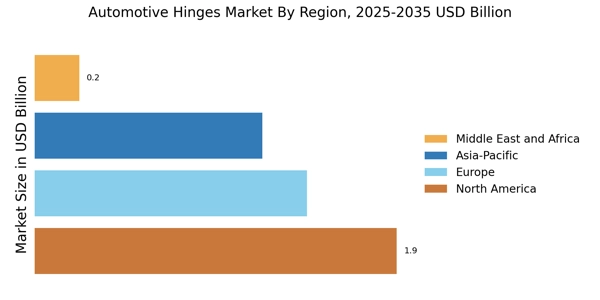
North America is the largest market for automotive hinges, accounting for approximately 40% of the global market share. The region's growth is driven by increasing vehicle production, technological advancements, and a strong focus on safety regulations. The demand for lightweight materials and energy-efficient designs is also propelling market expansion. Regulatory catalysts, such as stringent safety standards, further enhance the market's growth potential. The United States and Canada are the leading countries in this region, with major automotive manufacturers and suppliers establishing a strong presence. Key players like Dura Automotive Systems and Magna International Inc. dominate the market, contributing to a competitive landscape. The focus on innovation and sustainability is evident, as companies invest in research and development to meet evolving consumer demands and regulatory requirements.

Europe : Regulatory-Driven Market Dynamics

Europe is the second-largest market for automotive hinges, holding around 30% of the global market share. The region's growth is significantly influenced by stringent environmental regulations and a shift towards electric vehicles. The European Union's commitment to reducing carbon emissions is driving demand for lightweight and efficient automotive components. Additionally, the increasing focus on safety and comfort features in vehicles is propelling market growth. Germany, France, and the UK are the leading countries in this market, with a robust automotive industry and a strong presence of key players like Thyssenkrupp AG and Valeo SA. The competitive landscape is characterized by innovation and collaboration among manufacturers to develop advanced hinge solutions. The European market is also witnessing a rise in partnerships and mergers, enhancing the overall market dynamics.

Asia-Pacific : Emerging Market Potential

Asia-Pacific is witnessing rapid growth in the automotive hinges market, accounting for approximately 25% of the global market share. The region's expansion is fueled by increasing vehicle production, rising disposable incomes, and a growing middle class. Countries like China and India are leading this growth, with significant investments in automotive manufacturing and infrastructure. The demand for advanced automotive features is also driving the need for innovative hinge solutions. China is the largest market in the region, followed by Japan and India, with key players such as Aisin Seiki Co., Ltd. and Mitsubishi Electric Corporation actively participating in the market. The competitive landscape is marked by a mix of local and international players, focusing on technological advancements and cost-effective solutions. The region's potential for growth is immense, as manufacturers adapt to changing consumer preferences and regulatory requirements.

Middle East and Africa : Untapped Market Opportunities

The Middle East and Africa region is gradually emerging in the automotive hinges market, holding about 5% of the global market share. The growth is driven by increasing vehicle sales, urbanization, and infrastructure development. Countries like South Africa and the UAE are witnessing a rise in automotive manufacturing, supported by government initiatives to boost local production. The demand for automotive hinges is expected to grow as the region's automotive industry expands. South Africa is the leading market in this region, with a growing number of automotive manufacturers establishing operations. The competitive landscape is still developing, with opportunities for both local and international players. Key players are beginning to explore partnerships and collaborations to enhance their market presence and meet the rising demand for automotive components, including hinges.

Automotive Hinges Market Regional Image

Key Players and Competitive Insights

Leading market players are investing heavily in research and development to expand their product lines, which will help the Automotive Hinges Market grow even more. Market participants are also undertaking a variety of strategic activities to expand their global footprint, with important market developments including new product launches, contractual agreements, mergers and acquisitions, higher investments, and collaboration with other organizations. The automotive industry must offer cost-effective items to expand and survive in a more competitive and rising market climate.

Manufacturing locally to minimize operational costs is one of the key business tactics manufacturers use in the global Automotive Hinges industry to benefit clients and increase the market sector. In recent years, the Automotive Hinges industry has offered some of the most significant advantages to medicine. Major players in the Automotive Hinges Market, including Gestamp, Scissor Doors Inc., Orchid International, Midlake Custom Hinges, AISIN SEIKI, Eberhard Manufacturing Company, GaomingLigang Precision Casting Co., Ltd., Multimatic, Magna International, and DURA Automotive Systemsand others, are attempting to increase market demand by investing in research and development operations.

Dura Automotive Systems is an independent designer and manufacturer of automotive components, including control systems, external systems, and lightweight structural systems.Dura Automotive Systems celebrated the formal unveiling of its new state-of-the-art manufacturing facility in Muscle Shoals, Alabama.

Aisin Corporation is a Japanese corporation that develops and produces components and systems for the automotive industry. Aisin is a Fortune Global 500 company, ranked 359 on the 2020 rankings. Aisin is a member of the Toyota Group of companies.AISIN Group Products Adopted the SUV-Style BEV "bZ4X," the First Model of Toyota's bZ Series.

Key Companies in the Automotive Hinges Market market include

Industry Developments

Multimatic Inc

February 2025: Multimatic Inc., a Canadian automotive engineering and manufacturing company, continues to be recognized as a key player in the automotive door hinges market. The company's commitment to innovation and quality has solidified its position among leading industry suppliers.

Midlake Custom Hinges

February 2025: Midlake Products & MFG. CO, INC., based in the U.S., specializes in manufacturing custom hinges tailored to specific customer requirements. Their expertise in producing hinges out of sheet metal to exact specifications has made them a notable player in the industry.

Milan Metal System LLC

As of March 2025, there are no publicly available updates or developments regarding Milan Metal System LLC in the automotive hinges industry.

Saint-Gobain

February 2025: Saint-Gobain, a French multinational corporation, is listed among the key companies in the automotive door hinges market. The company's involvement in this sector highlights its diverse product offerings and its role in the automotive supply chain.

January 2022 Dura Automotive Systems celebrated the formal unveiling of its new state-of-the-art manufacturing facility in Muscle Shoals, Alabama.

August 2021 Dura Automotive Systems announced today that it has entered into a joint venture agreement with ALMAC Co, LTD to manufacture automotive-grade aluminum extrusions and components to enhance the performance of lightweight and electric vehicle modules.

April 2022 AISIN Group Products Adopted the SUV-Style BEV "bZ4X," the First Model of Toyota's bZ Series.

Future Outlook

Automotive Hinges Market Future Outlook

The Automotive Hinges Market is projected to grow at a 3.48% CAGR from 2024 to 2035, driven by advancements in lightweight materials, increasing vehicle production, and rising demand for electric vehicles.

New opportunities lie in:

  • Development of smart hinges with integrated sensors for enhanced vehicle functionality.
  • Expansion into emerging markets with tailored hinge solutions for local manufacturers.
  • Partnerships with electric vehicle manufacturers to supply specialized lightweight hinges.

By 2035, the Automotive Hinges Market is expected to achieve robust growth, reflecting evolving automotive trends.

Market Segmentation

Automotive Hinges Market Product Outlook

  • Door
  • Cabinet
  • Hood
  • Others

Automotive Hinges Market Material Outlook

  • Steel
  • Aluminum
  • Composite

Automotive Hinges Market Vehicle Type Outlook

  • Passenger Cars
  • Commercial Vehicles

Automotive Hinges Market Sales Channel Outlook

  • OEM
  • Aftermarket

Report Scope

MARKET SIZE 20244.86(USD Billion)
MARKET SIZE 20255.029(USD Billion)
MARKET SIZE 20357.08(USD Billion)
COMPOUND ANNUAL GROWTH RATE (CAGR)3.48% (2024 - 2035)
REPORT COVERAGERevenue Forecast, Competitive Landscape, Growth Factors, and Trends
BASE YEAR2024
Market Forecast Period2025 - 2035
Historical Data2019 - 2024
Market Forecast UnitsUSD Billion
Key Companies ProfiledMarket analysis in progress
Segments CoveredMarket segmentation analysis in progress
Key Market OpportunitiesIntegration of lightweight materials and smart technologies enhances design flexibility in the Automotive Hinges Market.
Key Market DynamicsRising demand for lightweight materials drives innovation in automotive hinges, enhancing performance and fuel efficiency.
Countries CoveredNorth America, Europe, APAC, South America, MEA

Market Highlights

Author
Sejal Akre
Senior Research Analyst

She has over 5 years of rich experience, in market research and consulting providing valuable market insights to client. Hands on expertise in management consulting, and extensive knowledge in domain including ICT, Automotive & Transportation and Aerospace & Defense. She is skilled in Go-to market strategy, industry analysis, market sizing, in depth company profiling, competitive intelligence & benchmarking and value chain amongst others.

Leave a Comment

FAQs

What is the projected market valuation of the Automotive Hinges Market by 2035?

The Automotive Hinges Market is projected to reach a valuation of 7.08 USD Billion by 2035.

What was the market valuation of the Automotive Hinges Market in 2024?

In 2024, the Automotive Hinges Market was valued at 4.86 USD Billion.

What is the expected CAGR for the Automotive Hinges Market during the forecast period 2025 - 2035?

The expected CAGR for the Automotive Hinges Market during the forecast period 2025 - 2035 is 3.48%.

Which materials dominate the Automotive Hinges Market?

Steel, aluminum, and composite materials are key segments, with steel valued at 2.73 USD Billion and aluminum at 2.05 USD Billion by 2035.

What are the primary sales channels in the Automotive Hinges Market?

The market is segmented into OEM and aftermarket sales channels, both projected to reach 3.54 USD Billion by 2035.

How does the Automotive Hinges Market segment by vehicle type?

The market segments by vehicle type, with passenger cars expected to reach 4.5 USD Billion and commercial vehicles at 2.58 USD Billion by 2035.

Download Free Sample

Kindly complete the form below to receive a free sample of this Report

Compare Licence

×
Features License Type
Single User Multiuser License Enterprise User
Price $4,950 $5,950 $7,250
Maximum User Access Limit 1 User Upto 10 Users Unrestricted Access Throughout the Organization
Free Customization
Direct Access to Analyst
Deliverable Format
Platform Access
Discount on Next Purchase 10% 15% 15%
Printable Versions