Download Free Sample
Kindly complete the form below to receive a free sample of this Report
Automotive Market Research Report :ing ServicesResearch Report Bying-Services Service Type (Digital Bying, Content Bying, Social Media Bying, Search Engine Optimization, Email Bying), Bying-Services Target Audience (Individual Consumers, Small Businesses, Large Enterprises, Automotive Dealerships, Fleet Operators), Bying-Services Bying Channel (Online Advertising, Traditional Advertising, Event Bying, Influencer Bying, Affiliate Bying) And By Region (North America, Europe, Asia-Pacific, And Rest Of The World) – Market Forecast Till 2035.
As per MRFR analysis, the Automotive Marketing Services size was estimated at 49.0 Billion in 2024. The Automotive Marketing Services industry is projected to grow from 51.52 USD Billion in 2025 to 85.0 USD Billion by 2035, exhibiting a compound annual growth rate (CAGR) of 5.14% during the forecast period 2025 - 2035.
The automotive marketing services market is evolving towards greater personalization and digital integration, driven by changing consumer expectations.
| 2024 Market Size | 49.0 (USD Billion) |
| 2035 Market Size | 85.0 (USD Billion) |
| CAGR (2025 - 2035) | 5.14% |
Dentsu (JP), Omnicom Group (US), WPP (GB), Publicis Groupe (FR), Interpublic Group (US), Havas Group (FR), Cimpress (US), Ascential (GB), Maritz (US)
Our Impact
Enabled $4.3B Revenue Impact for Fortune 500 and Leading Multinationals
Partnering with 2000+ Global Organizations Each Year
30K+ Citations by Top-Tier Firms in the Industry
The landscape of Automotive Marketing Services is evolving rapidly, driven by technological advancements and changing consumer behaviors. As the industry adapts to new digital platforms, marketers are increasingly leveraging data analytics to tailor their strategies. This shift towards personalization allows brands to engage with potential customers in a more meaningful way, enhancing the overall customer experience. Furthermore, the rise of electric vehicles and sustainability concerns is prompting automotive marketers to rethink their messaging and outreach efforts, aligning them with contemporary values and expectations. In December 2025, the emphasis on digital transformation remains paramount. Automotive Marketing Services are integrating artificial intelligence and machine learning to optimize campaigns and improve targeting accuracy. This technological integration not only streamlines operations but also provides insights that were previously unattainable. As the market continues to mature, the focus on customer-centric approaches and innovative solutions is likely to shape the future of marketing within the automotive sector.
Automotive Marketing Services are increasingly focusing on personalized experiences to engage consumers. By utilizing data analytics, marketers can create tailored messages that resonate with individual preferences, enhancing customer satisfaction and loyalty.
With the growing emphasis on environmental responsibility, Automotive Marketing Services are adapting their strategies to highlight sustainability. Brands are promoting eco-friendly practices and electric vehicle offerings to align with consumer values.
The integration of advanced technologies such as artificial intelligence is transforming Automotive Marketing Services. This shift enables marketers to optimize campaigns, improve targeting, and gain valuable insights into consumer behavior.
Technological advancements play a pivotal role in shaping the Automotive Marketing Services. The integration of artificial intelligence and machine learning into marketing strategies allows for enhanced targeting and customer segmentation. For instance, AI-driven tools can analyze vast amounts of consumer data to predict purchasing behavior, enabling marketers to craft more effective campaigns. Moreover, the rise of social media platforms has transformed how automotive brands engage with consumers, providing new avenues for interaction and feedback. As technology continues to evolve, automotive marketers must stay abreast of these changes to maintain competitive advantage and effectively reach their audiences.
The Automotive Marketing Services is currently witnessing a shift in consumer preferences, with an increasing demand for personalized experiences. Consumers are now more inclined towards brands that understand their unique needs and preferences. This trend is evident as 70 percent of consumers express a desire for personalized marketing messages. As a result, automotive marketers are adapting their strategies to leverage data analytics and customer insights, ensuring that their campaigns resonate with target audiences. This evolution in consumer behavior necessitates a more tailored approach in marketing, compelling automotive companies to invest in advanced customer relationship management systems and data-driven marketing strategies.
The shift towards digital marketing is a defining trend in the Automotive Marketing Services. With the proliferation of online platforms, automotive brands are increasingly allocating their marketing budgets towards digital channels. Recent data indicates that digital advertising spending in the automotive sector has surged, with projections suggesting it will account for over 60 percent of total marketing expenditures by 2026. This transition is driven by the need to reach tech-savvy consumers who predominantly engage with brands online. Consequently, automotive marketers are focusing on search engine optimization, social media marketing, and content creation to enhance their online presence and drive customer engagement.
The Automotive Marketing Services is significantly influenced by regulatory changes and compliance requirements. Governments worldwide are increasingly implementing stricter advertising regulations, particularly concerning data privacy and consumer protection. For example, regulations such as the General Data Protection Regulation (GDPR) in Europe have compelled automotive marketers to rethink their data collection and usage strategies. Compliance with these regulations is not merely a legal obligation but also a means to build consumer trust. As such, automotive companies are investing in compliance training and technology to ensure their marketing practices align with current laws, thereby safeguarding their reputation and customer relationships.
Sustainability has emerged as a crucial driver in the Automotive Marketing Services. Consumers are becoming more environmentally conscious, leading to a demand for brands that demonstrate a commitment to sustainability. Research indicates that 65 percent of consumers prefer to purchase from companies that prioritize eco-friendly practices. In response, automotive marketers are increasingly incorporating sustainability messaging into their campaigns, highlighting efforts such as electric vehicle offerings and sustainable manufacturing processes. This focus on ethical marketing not only appeals to environmentally aware consumers but also positions automotive brands as responsible corporate citizens, potentially enhancing brand loyalty and customer retention.
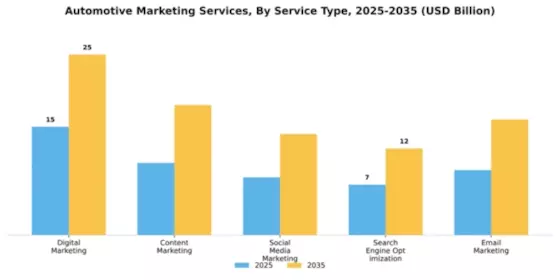
In the Automotive Marketing Services segment, Digital Marketing dominates with a significant share, driven by increased online presence and consumer engagement. The diverse channels within digital marketing, including pay-per-click advertising, display ads, and website optimization, contribute to its substantial market position. In contrast, Email Marketing, while smaller in share, is gaining traction rapidly due to its personalized approach and effectiveness in reaching target audiences directly. This segment is evolving as brands seek to maintain direct communication with consumers, promoting engagement and loyal customer relationships.
Digital Marketing: Dominant vs. Email Marketing: Emerging
Digital Marketing holds a commanding position in Automotive Marketing Services by leveraging multiple online strategies to connect with consumers effectively. Its channels, including social media ads, content marketing, and search engine optimization, are central to comprehensive marketing strategies. Conversely, Email Marketing is swiftly emerging as a powerful tool due to its ability to deliver tailored messages at scale. The growing trend of automation and segmentation in email campaigns supports drastically higher engagement rates and customer retention, making it an essential focus area for automotive companies aiming to enhance user experience and brand loyalty.
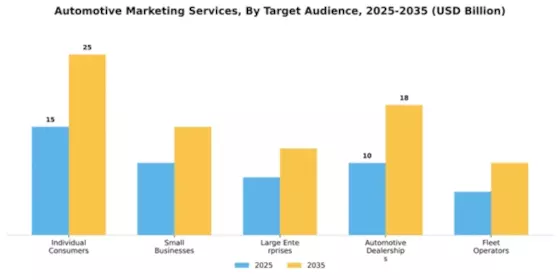
In the Automotive Marketing Services sector, the market share is primarily led by Automotive Dealerships, which account for a significant portion of the overall market due to their extensive need for targeted marketing strategies and customer engagement. Following closely are Fleet Operators and Large Enterprises, both of which rely on efficient marketing channels to reach their specific audiences. Small Businesses and Individual Consumers, while smaller in terms of revenue, are becoming increasingly relevant in the market, especially with the rise of digital marketing tools. The growth trends within this segment show that Individual Consumers are emerging as the fastest-growing group, largely driven by the increasing accessibility of online platforms and personalized marketing. Moreover, Automotive Dealerships maintain their dominance by investing heavily in data analytics and customer relationship management systems. Fleet Operators and Large Enterprises are also focusing on innovative marketing strategies to capture more market share.
Automotive Dealerships (Dominant) vs. Individual Consumers (Emerging)
Automotive Dealerships represent the dominant force in the Automotive Marketing Services market, primarily because they require comprehensive marketing strategies to connect effectively with potential car buyers. They invest significantly in digital advertising, social media campaigns, and customer engagement tactics to create brand loyalty and attract more customers. On the other hand, Individual Consumers are recognized as an emerging segment, fueled by the convenience of online car purchasing and personalized marketing approaches. This segment's growth is characterized by their increasing demand for tailored content, customer reviews, and the influence of social media on purchasing decisions. As online interactions grow, both Automotive Dealerships and Individual Consumers are adapting their strategies to meet new market realities and consumer expectations.
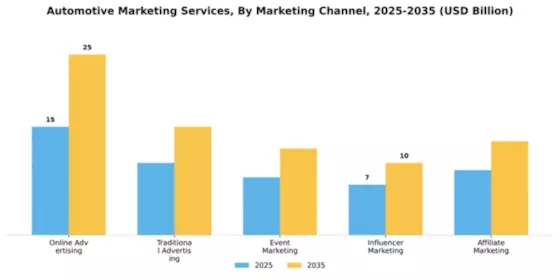
In the realm of Automotive Marketing Services, Online Advertising holds the largest share, significantly outpacing other channels. Its dominance is attributed to the increasing digitization of marketing strategies, with more automotive brands allocating budgets towards online platforms to target tech-savvy consumers. Other channels such as Traditional Advertising and Affiliate Marketing also play a role but lag behind in terms of overall market penetration, signaling a transformative shift in marketing paradigms within the automotive sector. Conversely, Influencer Marketing is rapidly emerging as the fastest-growing segment, driven by the rising influence of social media personalities on consumer purchasing decisions. As brands seek authentic connections with potential customers, the integration of influencer strategies into automotive marketing plans is gaining traction. This change reflects a broader trend of moving away from conventional advertising methods towards more personalized and engaging promotional tactics, particularly among younger demographics that prioritize social media engagement over traditional media consumption.
Online Advertising: Dominant vs. Influencer Marketing: Emerging
Online Advertising in the Automotive Marketing Services sector is characterized by its broad reach and ability to engage a digitally-oriented audience. This channel offers various strategies including pay-per-click advertising, social media campaigns, and targeted display ads that can be tailored to specific demographics. Its dominance is bolstered by advanced analytics that allow for precise measurement of campaign effectiveness. On the other hand, Influencer Marketing is an emerging strategy that leverages the authenticity and reach of social media influencers to connect with audiences in a relatable manner. This method fosters a more personal connection with potential customers, driving higher engagement rates and brand loyalty. The success of Influencer Marketing is reinforced by the trend of consumers increasingly valuing peer recommendations over traditional advertisements.
Get more detailed insights about Automotive Marketing Services Market Request Free Sample
North America continues to lead the automotive marketing services sector, holding a market share of 24.5% as of 2024. The region's growth is driven by technological advancements, increasing consumer demand for personalized marketing, and robust regulatory support for digital advertising. The rise of electric vehicles (EVs) and autonomous driving technologies further fuels this demand, creating new marketing opportunities and strategies. The competitive landscape is characterized by major players such as Omnicom Group, WPP, and Publicis Groupe, which dominate the market with innovative solutions. The U.S. remains the largest market, followed by Canada and Mexico, where local firms are also gaining traction. The presence of key players ensures a dynamic environment, fostering collaboration and competition that drives the industry forward.
Europe's automotive marketing services market is valued at €15.0 billion, reflecting a growing emphasis on sustainability and digital transformation. Regulatory frameworks, such as the General Data Protection Regulation (GDPR), are shaping marketing strategies, pushing companies to adopt more transparent and consumer-friendly practices. The shift towards electric vehicles (EVs) is also a significant driver, as automakers seek innovative ways to engage environmentally conscious consumers. Leading countries in this region include Germany, France, and the UK, where major players like Publicis Groupe and WPP are actively investing in digital marketing solutions. The competitive landscape is evolving, with a focus on data-driven strategies and personalized marketing. As the market matures, collaboration among key players is expected to enhance service offerings and drive further growth.
The Asia-Pacific region, with a market size of $7.5 billion, is rapidly emerging as a powerhouse in automotive marketing services. The growth is fueled by increasing vehicle ownership, urbanization, and a young, tech-savvy population that demands innovative marketing approaches. Countries like China and India are leading this trend, with significant investments in digital marketing and e-commerce platforms that cater to automotive consumers. China stands out as the largest market, with local players like Dentsu and Ascential making significant inroads. The competitive landscape is marked by a blend of global and local firms, each vying for market share through unique strategies. As the region continues to evolve, the focus on digital transformation and customer engagement will be crucial for sustaining growth in this dynamic market.
The Middle East and Africa (MEA) region, with a market size of $2.0 billion, presents untapped potential in automotive marketing services. The growth is driven by increasing vehicle sales, urbanization, and a growing middle class that is becoming more receptive to digital marketing strategies. Regulatory support for automotive industries is also enhancing market dynamics, encouraging investment in marketing services. Countries like South Africa and the UAE are leading the charge, with local and international players exploring innovative marketing solutions. The competitive landscape is still developing, with opportunities for growth as more companies recognize the importance of targeted marketing strategies. As the region matures, the focus will shift towards leveraging technology to enhance consumer engagement and brand loyalty.
The Automotive Marketing Services sector is currently characterized by a dynamic competitive landscape, driven by rapid technological advancements and evolving consumer preferences. Key players such as Dentsu (JP), Omnicom Group (US), and WPP (GB) are strategically positioning themselves through digital transformation and innovative marketing solutions. Dentsu (JP) has focused on integrating AI-driven analytics into its marketing strategies, enhancing customer engagement and targeting precision. Meanwhile, Omnicom Group (US) has emphasized partnerships with automotive manufacturers to create tailored marketing campaigns that resonate with specific demographics, thereby strengthening its market presence. WPP (GB) has adopted a strategy of regional expansion, particularly in emerging markets, to capitalize on the growing demand for automotive marketing services, which collectively shapes a competitive environment that is increasingly reliant on technology and consumer insights.The market structure appears moderately fragmented, with a mix of large multinational corporations and smaller specialized firms. Key players are employing various business tactics, such as localizing their services to better meet regional demands and optimizing supply chains to enhance efficiency. This collective influence of major companies fosters a competitive atmosphere where innovation and adaptability are paramount, allowing them to respond swiftly to market changes and consumer needs.In November Dentsu (JP) launched a new AI-powered platform aimed at revolutionizing customer engagement in the automotive sector. This platform leverages machine learning algorithms to analyze consumer behavior and preferences, enabling automotive brands to deliver personalized marketing messages. The strategic importance of this initiative lies in its potential to significantly enhance customer loyalty and drive sales, positioning Dentsu as a leader in data-driven marketing solutions.In October Omnicom Group (US) announced a strategic partnership with a leading electric vehicle manufacturer to co-develop a comprehensive marketing strategy focused on sustainability. This collaboration is particularly noteworthy as it aligns with the growing consumer demand for environmentally friendly vehicles. By associating with a forward-thinking brand, Omnicom not only enhances its portfolio but also reinforces its commitment to sustainability, which is becoming a critical factor in consumer decision-making.In September WPP (GB) acquired a digital marketing agency specializing in automotive advertising, further solidifying its position in the market. This acquisition is significant as it allows WPP to expand its service offerings and enhance its capabilities in digital marketing, particularly in the automotive sector. The integration of this agency is expected to provide WPP with a competitive edge, enabling it to deliver more innovative and effective marketing solutions to its clients.As of December the competitive trends in the Automotive Marketing Services sector are increasingly defined by digitalization, sustainability, and the integration of AI technologies. Strategic alliances are playing a crucial role in shaping the landscape, as companies seek to leverage each other's strengths to enhance their market offerings. Looking ahead, competitive differentiation is likely to evolve from traditional price-based competition to a focus on innovation, technological advancements, and supply chain reliability, reflecting the changing priorities of consumers and the automotive industry.


The Automotive Marketing Services market is projected to grow at a 5.14% CAGR from 2025 to 2035, driven by digital transformation, consumer engagement, and data analytics advancements.
New opportunities lie in:
By 2035, the market is expected to be robust, driven by innovative strategies and technology adoption.
| MARKET SIZE 2024 | 49.0(USD Billion) |
| MARKET SIZE 2025 | 51.52(USD Billion) |
| MARKET SIZE 2035 | 85.0(USD Billion) |
| COMPOUND ANNUAL GROWTH RATE (CAGR) | 5.14% (2025 - 2035) |
| REPORT COVERAGE | Revenue Forecast, Competitive Landscape, Growth Factors, and Trends |
| BASE YEAR | 2024 |
| Market Forecast Period | 2025 - 2035 |
| Historical Data | 2019 - 2024 |
| Market Forecast Units | USD Billion |
| Key Companies Profiled | Dentsu (JP), Omnicom Group (US), WPP (GB), Publicis Groupe (FR), Interpublic Group (US), Havas Group (FR), Cimpress (US), Ascential (GB), Maritz (US) |
| Segments Covered | Service Type, Target Audience, Marketing Channel |
| Key Market Opportunities | Integration of artificial intelligence in Automotive Marketing Services enhances consumer engagement and personalization. |
| Key Market Dynamics | Shifting consumer preferences towards digital platforms drive innovation in Automotive Marketing Services and competitive strategies. |
| Countries Covered | North America, Europe, APAC, South America, MEA |
The market valuation of Automotive Marketing Services was 49.0 USD Billion in 2024.
The projected market size for Automotive Marketing Services is expected to reach 85.0 USD Billion by 2035.
The expected CAGR for Automotive Marketing Services during the forecast period 2025 - 2035 is 5.14%.
Key players in the Automotive Marketing Services market include Dentsu, Omnicom Group, WPP, Publicis Groupe, Interpublic Group, Havas Group, Cimpress, Ascential, and Maritz.
The primary service types include Digital Marketing, Content Marketing, Social Media Marketing, Search Engine Optimization, and Email Marketing.
Digital Marketing generated between 15.0 and 25.0 USD Billion in revenue.
Automotive Dealerships generated between 10.0 and 18.0 USD Billion in revenue.
Marketing channels include Online Advertising, Traditional Advertising, Event Marketing, Influencer Marketing, and Affiliate Marketing.
Online Advertising generates between 15.0 and 25.0 USD Billion in revenue.
The market for individual consumers generated between 15.0 and 25.0 USD Billion in revenue.


Kindly complete the form below to receive a free sample of this Report

“This is really good guys. Excellent work on a tight deadline. I will continue to use you going forward and recommend you to others. Nice job”


“Thanks. It’s been a pleasure working with you, please use me as reference with any other Intel employees.”


“Thanks for sending the report it gives us a good global view of the Betaïne market.”


“Thank you, this will be very helpful for OQS.”


“We found the report very insightful! we found your research firm very helpful. I'm sending this email to secure our future business.”


“I am very pleased with how market segments have been defined in a relevant way for my purposes (such as "Portable Freezers & refrigerators" and "last-mile"). In general the report is well structured. Thanks very much for your efforts.”


“I have been reading the first document or the study, ,the Global HVAC and FP market report 2021 till 2026. Must say, good info! I have not gone in depth at all parts, but got a good indication of the data inside!”


“We got the report in time, we really thank you for your support in this process. I also thank to all of your team as they did a great job.”


“The Automotive 48V ECU Components Procurement Intelligence Study” was a complex project, but the Market Research Future (MRFR) team handled it with quality, agility, and customer-centricity. They delivered all requested data on time and within the agreed scope. The team, including Shubhendra Anand and Rahul Gotadki, was always readily available to clarify questions and swiftly implement necessary adjustments, driving the project to a successful conclusion within a very demanding timeframe.
I would also like to specifically commend Akshay Agarwal for his responsiveness and support at every stage—from our initial inquiry on May 6th through to final delivery on June 18th. His dedication made the entire process seamless.”



