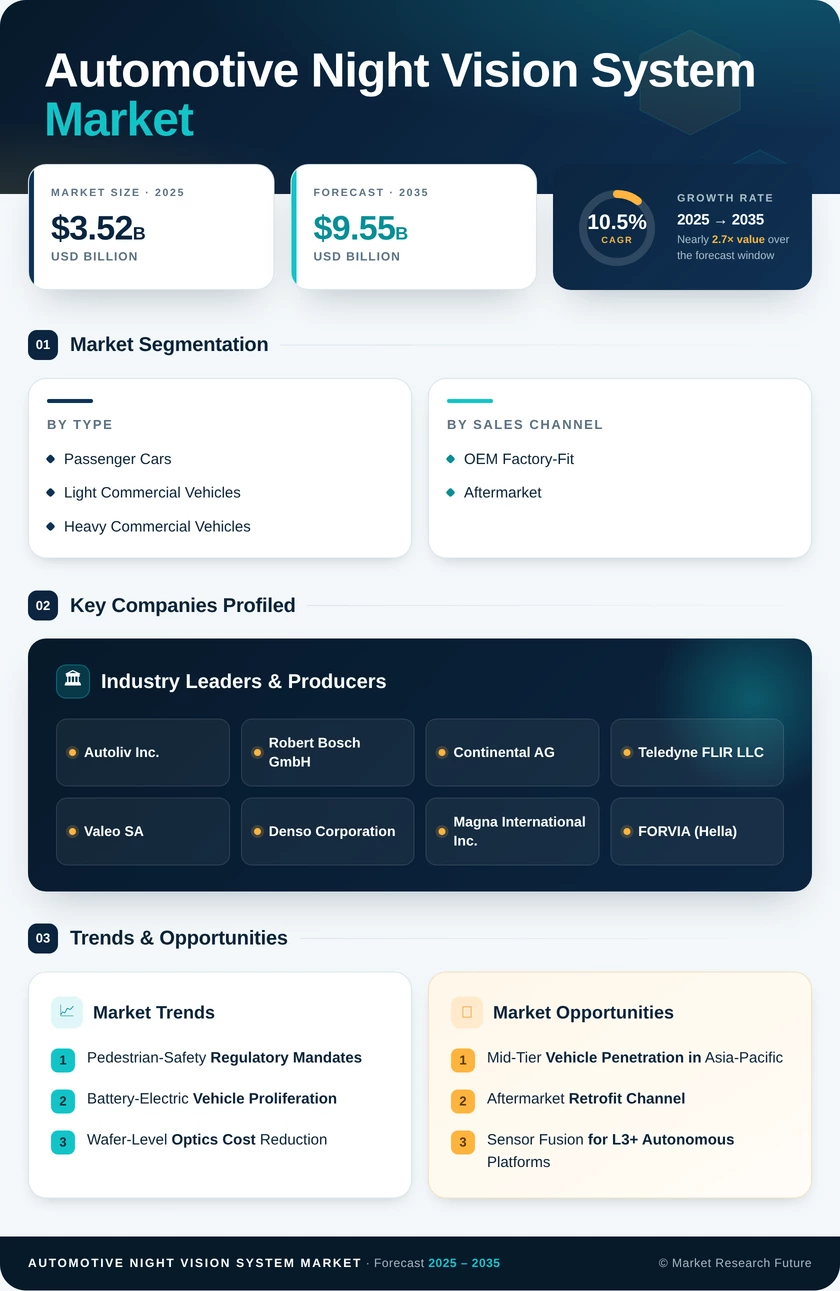
Automotive Night Vision System Market (2025 - 2035)

ID: MRFR/AT/3688-CR
100 Pages
Triveni Bhoyar
Last Updated: June 22, 2026
Automotive Night Vision System Market Research Report Information By Technology Type (Far Infrared (LWIR), Near Infrared (NIR), Short-Wave Infrared (SWIR)), By Display Type (Head-Up Display (HUD), Instrument Cluster, Central Infotainment Screen, Navigation System), By Component Type (Night Vision Cameras, IR Illumination Sources, Image Processing ECUs, Display Modules), By Vehicle Type (Passenger Cars, Light Commercial Vehicles, Heavy Commercial Vehicles), By Sales Channel (OEM Factory-Fit, Aftermarket), And By Region (North America, Europe, Asia-Pacific, And Rest Of The World) - Global Industry Size, Share, Growth, Trends and Forecast To 2035
Automotive Night Vision System Market
Market Size
Forecast Period2025-2035
CAGR (2025-2035)10.5%
2025 Market SizeUSD 3.52 Billion
2035 Market SizeUSD 9.55 Billion
Key Players
Autoliv Inc.
Robert Bosch GmbH
Continental AG
Teledyne FLIR LLC
Valeo SA
Denso Corporation
Opportunities
  • Mid-Tier Vehicle Penetration in Asia-Pacific
  • Aftermarket Retrofit Channel
  • Sensor Fusion for L3+ Autonomous Platforms
  1. 1 Market Overview |
    1. 1.1 Study Assumptions & Market Definition |
    2. 1.2 Scope of the Study |
    3. 1.3 Research Methodology
  2. 2 Market Summary & Key Takeaways
  3. 3 Market Dynamics |
    1. 3.1 Market Drivers Analysis | |
      1. 3.1.1 Pedestrian-Safety Regulatory Mandates | |
      2. 3.1.2 Battery-Electric Vehicle Proliferation | |
      3. 3.1.3 Wafer-Level Optics Cost Reduction | |
      4. 3.1.4 Euro NCAP Protocol Tightening | |
      5. 3.1.5 L3+ Autonomous Driving Requirements | |
      6. 3.1.6 Chinese ADAS Penetration Mandates | |
      7. 3.1.7 Insurance Premium Incentive Programs |
    2. 3.2 Market Restraints Analysis | |
      1. 3.2.1 High Sensor Module Costs for Mass-Market Vehicles | |
      2. 3.2.2 Regulatory Fragmentation Across Emerging Markets | |
      3. 3.2.3 Visible-Light Camera Advancements | |
      4. 3.2.4 Consumer Awareness Gaps in Mid-Tier Segments | |
      5. 3.2.5 Cybersecurity and Data Privacy Concerns |
    3. 3.3 Market Opportunity Analysis | |
      1. 3.3.1 Mid-Tier Vehicle Penetration in Asia-Pacific | |
      2. 3.3.2 Aftermarket Retrofit Channel | |
      3. 3.3.3 Sensor Fusion for L3+ Autonomous Platforms | |
      4. 3.3.4 Data Monetization via Thermal Analytics | |
      5. 3.3.5 Emerging-Market Regulatory Catch-Up |
    4. 3.4 Industry Value Chain Analysis |
    5. 3.5 Porter's Five Forces Analysis
  4. 4 Global Automotive Night Vision System Market Size & Forecast (2021–2035) |
    1. 4.1 Historical Market Size (2021–2025) |
    2. 4.2 Current & Forecast Market Size (2026–2035) |
    3. 4.3 Market Size by Revenue (USD Billion) |
    4. 4.4 Year-over-Year Growth Analysis
  5. 5 Segmentation Analysis |
    1. 5.1 By Technology Type | |
      1. 5.1.1 Far Infrared (LWIR) | |
      2. 5.1.2 Near Infrared (NIR) | |
      3. 5.1.3 Short-Wave Infrared (SWIR) |
    2. 5.2 By Display Type | |
      1. 5.2.1 Head-Up Display (HUD) | |
      2. 5.2.2 Instrument Cluster | |
      3. 5.2.3 Central Infotainment Screen | |
      4. 5.2.4 Navigation System |
    3. 5.3 By Component Type | |
      1. 5.3.1 Night Vision Cameras | |
      2. 5.3.2 IR Illumination Sources | |
      3. 5.3.3 Image Processing ECUs | |
      4. 5.3.4 Display Modules |
    4. 5.4 By Vehicle Type | |
      1. 5.4.1 Passenger Cars | |
      2. 5.4.2 Light Commercial Vehicles | |
      3. 5.4.3 Heavy Commercial Vehicles |
    5. 5.5 By Sales Channel | |
      1. 5.5.1 OEM Factory-Fit | |
      2. 5.5.2 Aftermarket
  6. 6 Regional Analysis |
    1. 6.1 North America | |
      1. 6.1.1 United States | |
      2. 6.1.2 Canada | |
      3. 6.1.3 Mexico |
    2. 6.2 Europe | |
      1. 6.2.1 Germany | |
      2. 6.2.2 United Kingdom | |
      3. 6.2.3 France | |
      4. 6.2.4 Italy | |
      5. 6.2.5 Spain | |
      6. 6.2.6 Nordic Countries | |
      7. 6.2.7 Russia | |
      8. 6.2.8 Rest of Europe |
    3. 6.3 Asia-Pacific | |
      1. 6.3.1 China | |
      2. 6.3.2 India | |
      3. 6.3.3 Japan | |
      4. 6.3.4 South Korea | |
      5. 6.3.5 ASEAN | |
      6. 6.3.6 Rest of Asia-Pacific |
    4. 6.4 South America | |
      1. 6.4.1 Brazil | |
      2. 6.4.2 Argentina | |
      3. 6.4.3 Rest of South America |
    5. 6.5 Middle East & Africa | |
      1. 6.5.1 Saudi Arabia | |
      2. 6.5.2 UAE | |
      3. 6.5.3 South Africa | |
      4. 6.5.4 Egypt | |
      5. 6.5.5 Rest of MEA
  7. 7 Competitive Landscape |
    1. 7.1 Market Share Analysis (2025) |
    2. 7.2 Competitive Benchmarking Matrix |
    3. 7.3 Company Profiles | |
      1. 7.3.1 Autoliv Inc. | |
      2. 7.3.2 Robert Bosch GmbH | |
      3. 7.3.3 Continental AG | |
      4. 7.3.4 Teledyne FLIR LLC | |
      5. 7.3.5 Valeo SA | |
      6. 7.3.6 Denso Corporation | |
      7. 7.3.7 Magna International Inc. | |
      8. 7.3.8 FORVIA (Hella) | |
      9. 7.3.9 Gentex Corporation | |
      10. 7.3.10 Guide Infrared (Wuhan)
  8. 8 Future Outlook & Strategic Recommendations (2026–2035) |
    1. 8.1 Sensor Fusion and Autonomous Driving Convergence |
    2. 8.2 Electrification Supercycle |
    3. 8.3 AI-Driven Thermal Analytics |
    4. 8.4 ESG and Corporate Fleet Mandates
  9. 9 Recent Developments & News
  10. 10 Frequently Asked Questions (FAQs)
  11. 11 Report Scope & Methodology |
    1. 11.1 Study Period & Base Year |
    2. 11.2 Data Sources & Citations |
    3. 11.3 Abbreviations
  12. 12 LIST OF TABLES |
  13. TABLE 1 Automotive Night Vision System Market — Summary Parameters |
  14. TABLE 2 Global Automotive Night Vision System Market Size & Forecast, by Revenue (USD Billion), 2021–2035 |
  15. TABLE 3 Market Driver Impact Analysis, 2026–2035 |
  16. TABLE 4 Market Restraint Impact Analysis, 2026–2035 |
  17. TABLE 5 Regional Market Summary — Automotive Night Vision System Market (2025) |
  18. TABLE 6 North America Automotive Night Vision System Market, by Country |
  19. TABLE 7 Europe Automotive Night Vision System Market, by Country |
  20. TABLE 8 Asia-Pacific Automotive Night Vision System Market, by Country |
  21. TABLE 9 South America Automotive Night Vision System Market, by Country |
  22. TABLE 10 Middle East & Africa Automotive Night Vision System Market, by Country |
  23. TABLE 11 Automotive Night Vision System Market, by Technology Type |
  24. TABLE 12 Automotive Night Vision System Market, by Display Type |
  25. TABLE 13 Automotive Night Vision System Market, by Component Type |
  26. TABLE 14 Automotive Night Vision System Market, by Vehicle Type |
  27. TABLE 15 Automotive Night Vision System Market, by Sales Channel |
  28. TABLE 16 Competitive Benchmarking Matrix — Automotive Night Vision System Market, 2025 |
  29. TABLE 17 Report Scope & Methodology Parameters |
  30. TABLE 18 Detailed Sources and Citations
  31. 13 LIST OF FIGURES |
  32. FIGURE 1 Automotive Night Vision System Market Dynamics — Drivers, Restraints & Opportunities |
  33. FIGURE 2 Value Chain Analysis — Automotive Night Vision System Market |
  34. FIGURE 3 Porter's Five Forces Analysis — Automotive Night Vision System Market |
  35. FIGURE 4 Global Automotive Night Vision System Market Size Trend (USD Billion), 2021–2035 |
  36. FIGURE 5 Automotive Night Vision System Market Share, by Technology Type (2025) |
  37. FIGURE 6 Automotive Night Vision System Market Share, by Display Type (2025) |
  38. FIGURE 7 Automotive Night Vision System Market Share, by Component Type (2025) |
  39. FIGURE 8 Automotive Night Vision System Market Share, by Vehicle Type (2025) |
  40. FIGURE 9 Automotive Night Vision System Market Share, by Sales Channel (2025) |
  41. FIGURE 10 Automotive Night Vision System Market Share, by Region (2025) |
  42. FIGURE 11 North America Automotive Night Vision System Market Share, by Country (2025) |
  43. FIGURE 12 Europe Automotive Night Vision System Market Share, by Country (2025) |
  44. FIGURE 13 Asia-Pacific Automotive Night Vision System Market Share, by Country (2025) |
  45. FIGURE 14 Competitive Landscape — Automotive Night Vision System Market Revenue Share (2025)

Segmentation Quick Reference

DimensionSub-SegmentsDominant SegmentFastest Growing Segment
Automotive Night Vision System Market TypeFar Infrared (LWIR), Near Infrared (NIR), Short-Wave Infrared (SWIR)Far Infrared (LWIR)Short-Wave Infrared (SWIR)
Display TypeHead-Up Display, Instrument Cluster, Central Infotainment Screen, Navigation SystemHead-Up DisplayCentral Infotainment Screen
Component TypeNight Vision Cameras, IR Illumination Sources, Image Processing ECUs, Display ModulesNight Vision CamerasIR Illumination Sources
Vehicle TypePassenger Cars, Light Commercial Vehicles, Heavy Commercial VehiclesPassenger CarsLight Commercial Vehicles
Sales ChannelOEM Factory-Fit, AftermarketOEM Factory-FitAftermarket


Market Segmentation Overview

By Automotive Night Vision System Market Type

Sub-SegmentKey Trend
Far Infrared (LWIR)Passive thermal detection; dominant share due to no active illumination requirement
Near Infrared (NIR)Cost-effective LED/laser-illuminated systems for mid-tier vehicles
Short-Wave Infrared (SWIR)Gallium arsenide sensor advances enabling material discrimination and fog penetration


Far Infrared technology remains the backbone of the Automotive Night Vision System Market, owing to its fully passive operation mode that detects emitted body heat. Short-Wave Infrared is gaining traction in R&D pipelines as next-generation platforms demand multi-spectral classification capabilities for autonomous driving perception stacks.

By Display Type

Sub-SegmentKey Trend
Head-Up Display (HUD)Augmented-reality windshield overlay minimizes driver distraction
Instrument ClusterLegacy pathway leveraging existing digital cluster real estate
Central Infotainment ScreenGrowing with large-format BEV cockpit display architectures
Navigation SystemBudget integration option using the existing navigation screen


Head-Up Displays lead adoption because they project thermal imagery into the driver's forward field of view. Central Infotainment Screens are rapidly gaining share as automakers consolidate cockpit functions onto single large-format displays in electric vehicle platforms.

By Component Type

Sub-SegmentKey Trend
Night Vision CamerasCore hardware integrating a microbolometer array and germanium optics
IR Illumination SourcesGrowing alongside active NIR system deployments
Image Processing ECUsAI classifier demand driving compute-module upgrades
Display ModulesTied to HUD and infotainment integration trends


Night Vision Cameras represent the highest-value component per unit. IR Illumination Sources are the fastest-growing component category, propelled by the expansion of active Near Infrared system architectures in cost-sensitive vehicle segments.

By Vehicle Type

Sub-SegmentKey Trend
Passenger CarsRegulatory mandates and consumer safety expectations drive the dominant share
Light Commercial VehiclesFleet operator safety mandates accelerating adoption
Heavy Commercial VehiclesLong-haul night driving and cargo-carrier safety needs


Passenger Cars dominate in volume, while Light Commercial Vehicles represent the fastest-growing category as fleet procurement policies increasingly require advanced nighttime safety features to reduce liability and insurance costs.

By Sales Channel

Sub-SegmentKey Trend
OEM Factory-FitRegulatory compliance drives factory-level integration as standard or an option
AftermarketRetrofit demand is growing in markets with a large aging vehicle parc


OEM Factory-Fit installations account for the vast majority of revenue because regulatory mandates apply at the manufacturing stage. The Aftermarket channel is expanding as plug-and-play retrofit kits become available at lower price points for vehicles not originally equipped with thermal night-vision capability.


 

Download PDF ×

We do not share your information with anyone. However, we may send you emails based on your report interest from time to time. You may contact us at any time to opt-out.