Automotive NVH Materials Market (2026 - 2035)

Automotive NVH Materials Market Research Report By Material Type (Rubber, Foam, Film & Sheet, Engineered Resins, Others (Fiber Felts, Textile Composites)), By Application (Damping, Absorption, Insulation), By Vehicle Type (Passenger Cars, Light Commercial Vehicles, Heavy Commercial Vehicles, Electric Vehicles) and By Regional (North America, Europe, South America, Asia Pacific, Middle East and Africa) - Forecast to 2035
ID: MRFR/AT/9245-HCR
188 Pages
Triveni Bhoyar, Swapnil Palwe
Last Updated: August 24, 2026
Automotive NVH Materials Market
Market Size
Forecast Period2026-2035
CAGR (2026-2035)5.8%
2025 Market SizeUSD 11.20 Billion
2035 Market SizeUSD 19.68 Billion
Key Players
BASF SE
Henkel AG
Autoneum Holding AG
Sumitomo Riko Co.
Nihon Tokushu Toryo Co.
Huntsman Corporation
Opportunities
  • EV-Specific Acoustic Platforms
  • Bio-Based and Recycled NVH Materials
  • Emerging-Market Volume Growth

Automotive NVH Materials Market Summary

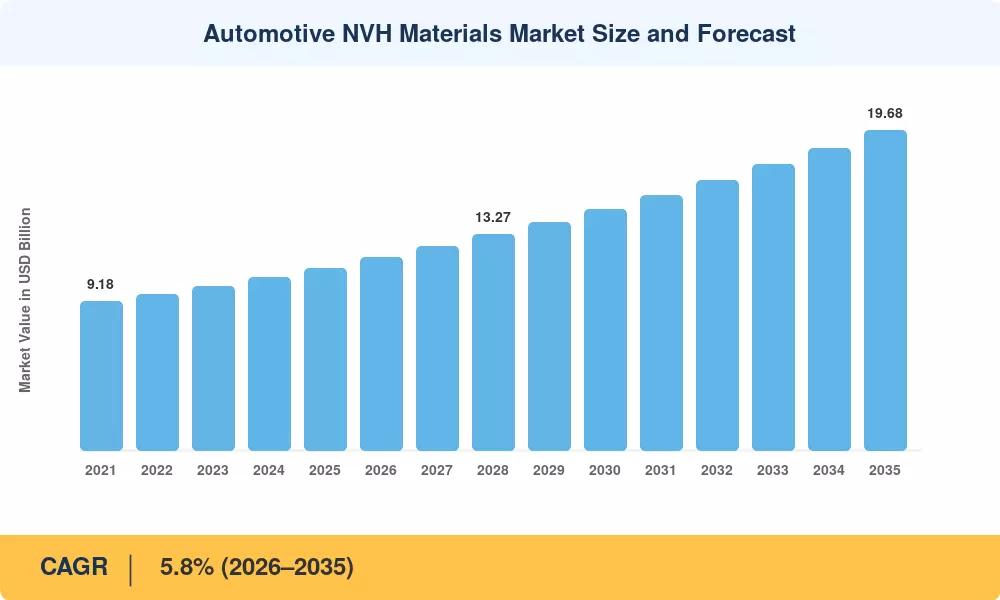
The Automotive NVH Materials Market reached an estimated USD 11.20 billion in 2025 and is projected to grow from USD 11.85 billion in 2026 to USD 19.68 billion by 2035, registering a CAGR of 5.8% during the forecast period (2026–2035). Two forces are accelerating demand: tightening interior noise regulations across the EU and China, and the rapid electrification of passenger vehicles, which has exposed new noise frequencies that legacy insulation simply cannot address. OEMs now treat cabin quietness as a premium differentiator, and NVH material spend per vehicle has climbed roughly 12% since 2021 [2].

The Automotive NVH Materials Market is experiencing a technical revolution. Multi-layer tailored composites are being used to replace traditional felt-and-bitumen layups to give equal acoustic performance at 30–40% lower mass. The European Commission’s revised End-of-Life Vehicles Directive in 2023 has hastened this transition, forcing automakers to pursue recyclable, mono-material NVH solutions [3]. Global investment in lightweight acoustic materials reached about USD 1.4 billion in 2024, according to industry projections [4].


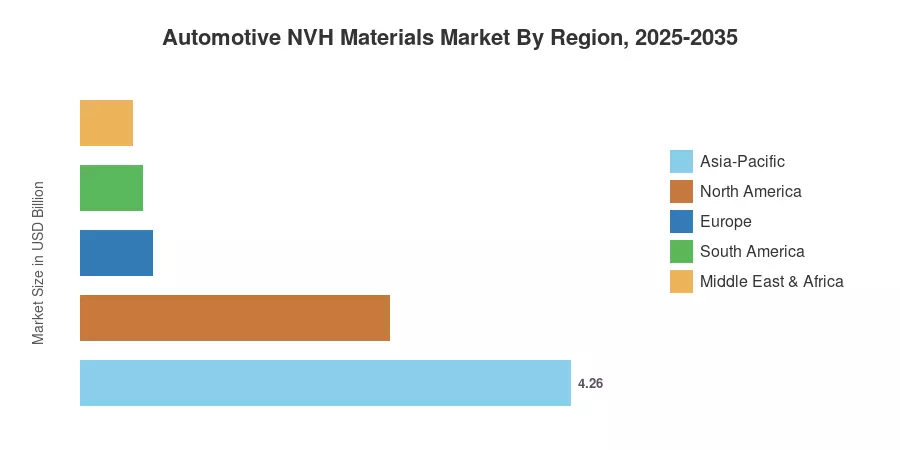
Asia-Pacific commands the largest share of the Automotive NVH Materials Market at roughly 38%, driven by vehicle production volumes in China, India, and Japan. The region also posts the fastest CAGR at 6.5%, supported by rising consumer expectations and stricter Chinese GB standards for pass-by noise. Europe holds approximately 28% share, anchored by German OEM demand, while North America accounts for about 24%, buoyed by EV platform launches from Detroit and new entrants. The decade ahead will reward suppliers who can pair acoustic performance with sustainability credentials.


Key Report Takeaways

• By Material Type

  • Rubber-based NVH materials hold approximately 31% of the Automotive NVH Materials Market, sustained by widespread use in engine mounts and body seals.
  • Foam materials are expanding at a CAGR of 6.4%, propelled by growing adoption in headliners, door panels, and EV battery enclosures.
  • Engineered film and sheet products account for an estimated USD 2.1 billion in 2025, reflecting demand for lightweight barrier layers.

• By Application

  • Damping applications represent roughly 36% of overall demand, as OEMs prioritize structure-borne vibration control.
  • Absorption applications are growing at a CAGR of 6.1%, driven by cabin-focused acoustic comfort programs.

• By Region

  • Asia-Pacific leads the Automotive NVH Materials Market with a 38% revenue share in 2025, reflecting high vehicle output.
  • Europe captures approximately USD 3.14 billion, supported by premium vehicle production and regulatory rigor.
  • North America posts a CAGR of 5.5%, underpinned by EV platform investments and light-truck insulation upgrades.


Market Size and Forecast (2021–2035)

Data sourcing for the Automotive NVH Materials Market combines bottom-up revenue analysis from tier-one supplier filings, OEM procurement disclosures, and trade-association production statistics. Top-down validation uses regional vehicle output data from OICA and material consumption coefficients per vehicle class. Historical figures (2021–2024) are actuals; 2025 is an estimate; 2026–2035 values represent forecast projections at a constant 5.8% CAGR.
Automotive NVH Materials Market Size and Forecast
Our Impact
Enabled $4.3B Revenue Impact for Fortune 500 and Leading Multinationals
Partnering with 2000+ Global Organizations Each Year
30K+ Citations by Top-Tier Firms in the Industry

Driver Impact Analysis

Driver ~% Impact on CAGR Geographic Relevance Impact Timeline
EV powertrain electrification +1.4% Global Long-term (≥4 yr)
Tightening pass-by noise regulations +1.1% EU, China Medium-term (2–4 yr)
Premiumization of cabin experience +0.9% North America, Europe Short-term (≤2 yr)
Vehicle lightweighting mandates +0.8% EU, Japan Medium-term (2–4 yr)
Rising SUV/crossover mix +0.6% North America, India Short-term (≤2 yr)
Autonomous vehicle cabin design +0.5% Global Long-term (≥4 yr)
Aftermarket NVH retrofit demand +0.3% South America, MEA Medium-term (2–4 yr)


EV Powertrain Electrification

Electric vehicles eliminate engine masking noise, making road, wind, and ancillary sounds far more perceptible to occupants. Battery enclosure acoustic treatments alone represent a new application worth roughly USD 800 million annually by 2025.

Tightening Pass-By Noise Regulations

The UN ECE Regulation 51.03 mandates a phased reduction of permissible vehicle exterior noise to 68 dB(A) for passenger cars by 2026, while China's GB 1495-2025 standard introduces comparable limits effective mid-decade [3]. Compliance requires upgraded underbody shields, wheel-arch liners, and front-end acoustic modules.

Premiumization of Cabin Experience

Consumer surveys by J.D. Power consistently rank cabin quietness among the top five purchase-decision criteria for vehicles priced above USD 35,000 [8]. Premium and luxury OEMs now specify triple-layer acoustic glass, microperforated headliners, and tuned floor dampers as standard.

Vehicle Lightweighting Mandates

EU CO₂ fleet-average targets of 93.6 g/km by 2025 and the proposed 2030 tightening push automakers to replace dense traditional materials with lighter alternatives that still meet acoustic targets [9].


Restraints Impact Analysis

The restraint impact percentages below are directional estimates reflecting headwinds on market growth. They do not subtract linearly from the gross CAGR and should be read as relative severity indicators.

Restraint ~% Impact on CAGR Geographic Relevance Impact Timeline
Raw material price volatility –0.6% Global Short-term (≤2 yr)
Cost pressure on mass-market OEMs –0.5% Asia-Pacific, S. America Medium-term (2–4 yr)
Recycling and end-of-life challenges –0.4% Europe Medium-term (2–4 yr)
ICE vehicle production decline –0.3% Europe, North America Long-term (≥4 yr)
Standardization gaps across regions –0.2% MEA, S. America Long-term (≥4 yr)


Raw Material Price Volatility

Butyl rubber, polyurethane precursors, and petrochemical-derived foams account for 55–65% of NVH material production costs [14]. OEMs responded by shortening contract cycles to 12 months, which in turn discouraged capital investment in new NVH production lines.

Cost Pressure on Mass-Market OEMs

In price-sensitive areas – especially India, Southeast Asia and South America – NVH material expenditures per car are below USD 60, ca. one third of the European average [15]. The growing demand for Automotive NVH Materials Market is not directly proportional to the increased production volumes. Automakers in these countries often remove acoustic treatments to reach target pricing ranges.


Recycling and End-of-Life Challenges

Multi-layer NVH composites that bond foam, film, and fabric in a single part are difficult to separate at end of life. The EU's revised ELV Directive sets a 2030 target of 25% recycled-content plastics in new vehicles, putting pressure on suppliers to redesign NVH stacks for mono-material recyclability [3].


Automotive NVH Materials Market Opportunities

EV-Specific Acoustic Platforms

Battery electric vehicles require purpose-designed NVH solutions — battery enclosure wraps, high-frequency cabin barriers, and motor-mount isolators — that have no ICE equivalent. The global EV fleet is forecast to exceed 250 million units by 2030, creating a multi-billion-dollar opportunity exclusively tied to electrification [13].

Bio-Based and Recycled NVH Materials

OEMs including Volvo, BMW, and Stellantis have publicly committed to raising recycled and bio-based content in interior components to 30–50% by 2030 [17]. NVH suppliers offering acoustic foams derived from soy-based polyols, recycled PET fiber felts, or natural-fiber composites can command a premium while helping OEMs meet sustainability scorecards.

Emerging-Market Volume Growth

As these regions introduce stricter noise standards — India's BS VI Phase II includes new pass-by noise limits — NVH material adoption per vehicle will converge toward global norms, unlocking significant volume growth for the Automotive NVH Materials Market.

Digital Acoustic Simulation and Material Optimization

Cloud-based NVH modeling technologies help suppliers simulate material performance in thousands of vehicle variants before they cut a single prototype. And with simulation-as-a-service tools, companies can sell their acoustic know-how beyond physical material sales, generating recurring income streams and more in-depth integration with OEMs.


Autonomous Vehicle Cabin Redesign

Autonomous vehicles of Level 4+ will change the cabin into living and working environments, for which the occupants’ tolerance of noise is much lower [11]. The acoustic treatment regions in these vehicles might be twice the size of traditional layouts, increasing demand for ceiling panels, partition barriers, and floor-to-roof insulation packages that reshape the addressable content per vehicle in the Automotive NVH Materials Market.


Automotive NVH Materials Market Future Outlook

Electrification Supercycle and New Noise Profiles

The global EV share of new-vehicle sales is expected to surpass 50% by 2035, according to IEA projections [20]. Every new EV platform creates demand for purpose-engineered NVH solutions, from traction-motor isolators to high-voltage cable damping sleeves. The Automotive NVH Materials Market will increasingly be defined by suppliers' ability to address tonal frequencies — whine, hum, and buzz — that are unique to electric drivetrains.

Sustainability-Led Material Innovation

Circular economy rules will change the way materials are selected during the next decade. The EU’s targeted 25% recycled plastic content for new vehicles by 2030 will need redesigns of NVH materials on a large scale [3]. Suppliers that invest in closed-loop foam recycling and bio-based polymer feedstocks will have preferential sourcing status with OEMs facing pressure to fulfill Scope 3 emissions targets.


Autonomous Mobility and Cabin Transformation

As Level 3 and Level 4 autonomous vehicle platforms enter commercial deployment, passenger cabin architectures are shifting from traditional driving cockpits toward mobile living, working, and relaxation environments. This functional transformation lowers occupant noise tolerance and drives expanded acoustic isolation requirements—increasing the adoption of floor-to-roof sound insulation, specialized ceiling damping panels, acoustic partitions, and vibration isolators across reconfigurable interior layouts.

AI-Driven NVH Design and Testing

Machine-learning algorithms are compressing NVH development cycles from months to weeks by predicting material-stack performance across virtual vehicle models [21]. Suppliers who integrate AI-based acoustic optimization into their development workflows will reduce prototyping costs, accelerating time-to-market and improving margins within the Automotive NVH Materials Market.


Automotive NVH Materials Market Segmentation

By Material Type

The Automotive NVH Materials Market segments by material type into rubber, foam, film and sheet, engineered resins, and other specialty materials.

Segment Key Metric Primary Demand Driver
Rubber 31% market share (2025) Engine mounts, body seals, suspension bushings
Foam CAGR 6.4% Headliners, door panels, EV battery wraps
Film & Sheet USD 2.10 B (2025) Barrier layers, dash insulators
Engineered Resins CAGR 6.1% Lightweight structural dampers
Others 7% market share Fiber felts, textile composites


Rubber remains the backbone of the Automotive NVH Materials Market by material type, owing to decades of validated performance in vibration isolation and its compatibility with high-volume injection-molding processes. The segment benefits from stable demand across both ICE and EV platforms, as engine mounts transition to motor mounts with similar elastomeric requirements.

Foam materials represent the fastest-growing material category. Polyurethane and melamine foams are increasingly specified for EV battery enclosures, where they provide both acoustic and thermal insulation. Tier-one suppliers have introduced next-generation foams with 20% lower density and improved flame retardancy to meet evolving EV safety standards [4].

By Application

The Automotive NVH Materials Market segments by application into damping, absorption, and insulation.

Segment Key Metric Primary Demand Driver
Damping 36% market share (2025) Structure-borne vibration control
Absorption CAGR 6.1% Cabin acoustic comfort programs
Insulation USD 3.25 B (2025) Firewall, floor, and roof barriers


Damping applications dominate because they address the broadest frequency range of structure-borne noise — from low-frequency road rumble to mid-frequency panel resonances. Constrained-layer damping treatments applied to floor pans, trunk lids, and roof panels account for the bulk of this segment's revenue.

Absorption applications are gaining ground as OEMs pursue premium cabin experiences. Microperforated panels and open-cell foam absorbers tuned to specific frequency bands are replacing generic felt layers, delivering measurable improvements in speech intelligibility scores within the Automotive NVH Materials Market.

By Vehicle Type

The Automotive NVH Materials Market segments by vehicle type into passenger cars, light commercial vehicles, heavy commercial vehicles, and electric vehicles.

Segment Key Metric Primary Demand Driver
Passenger Cars 52% market share (2025) Largest production volume globally
Light Commercial Vehicles USD 1.68 B (2025) Cab comfort regulations; last-mile delivery
Heavy Commercial Vehicles CAGR 4.5% Driver fatigue directives
Electric Vehicles CAGR 7.8% Unique noise profiles; premium expectations


Passenger cars account for the majority of demand by vehicle type, driven by sheer production scale and increasingly stringent interior noise targets. Electric vehicles, treated as a distinct segment, post the highest growth rate as every new EV model requires a bespoke NVH material package that is 18–25% heavier in acoustic content than its ICE counterpart.


Regional Market Share Analysis

Region Key Metric Primary Investment Themes
Asia-Pacific 38% revenue share (2025) Mass-market volume; China EV expansion; India noise regulations
Europe CAGR 5.6% (2026–2035) Premium OEM demand; ELV recyclability; lightweighting
North America USD 2.69 B (2025) EV platform launches; SUV/truck insulation; reshoring
South America CAGR 4.8% (2026–2035) Aftermarket retrofit; rising local assembly
Middle East & Africa USD 0.45 B (2025) Vehicle import standards; localization incentives
Total USD 11.20 B (2025)

The Automotive NVH Materials Market spans five major regions, each shaped by distinct regulatory environments, vehicle-mix profiles, and consumer expectations. Asia-Pacific leads on volume, Europe on value intensity, and North America on EV-transition-driven upgrades.


Asia-Pacific

Country Key Metric Key Driver
China 48% of regional revenue Largest EV market globally; GB noise standards
Japan CAGR 4.9% Premium OEM specifications; hybrid fleet
India USD 0.52 B (2025) Rising production volumes; BS VI noise limits
South Korea 11% of regional share Hyundai-Kia platform standardization
Rest of APAC CAGR 5.7% ASEAN assembly expansion


China alone produces over 30 million vehicles annually and has adopted some of the world's strictest pass-by noise requirements under GB 1495 [7]. Japanese OEMs continue to specify high-performance acoustic materials for hybrid powertrains, where the alternation between electric and combustion modes creates complex noise signatures. India's expanding middle class and the government's Production-Linked Incentive scheme for automotive components are catalyzing local NVH material manufacturing [18].

Europe

Country Key Metric Key Driver
Germany 34% of regional revenue Premium OEM headquarters; Tier-1 NVH R&D
France CAGR 5.4% Stellantis platform consolidation
United Kingdom USD 0.38 B (2025) Jaguar Land Rover electrification
Rest of Europe 28% of regional share Eastern European assembly plants


Europe's Automotive NVH Materials Market benefits from the concentration of premium brands that specify top-tier acoustic packages as standard. The EU's Green Deal Industrial Plan is incentivizing local production of sustainable NVH materials, and several foam suppliers have announced recycled-content production lines in Germany and Poland [3].

North America

Country Key Metric Key Driver
United States 78% of regional revenue EV platform investment; light-truck dominance
Canada CAGR 5.3% EV battery plant buildouts in Ontario
Mexico USD 0.31 B (2025) Nearshoring of Tier-1 component production


The United States dominates North American demand, driven by consumer preference for full-size trucks and SUVs that require extensive underbody and cabin insulation. The Inflation Reduction Act's domestic-content provisions are encouraging NVH material suppliers to establish or expand U.S. manufacturing footprints [19].

South America

Country Key Metric Key Driver
Brazil 62% of regional revenue Largest regional vehicle producer
Argentina CAGR 4.6% Pick-up truck assembly growth
Rest of S. America USD 0.08 B (2025) Aftermarket acoustic upgrades


Brazil's Rota 2030 automotive policy ties tax incentives to R&D investment, indirectly encouraging adoption of improved NVH materials in locally assembled vehicles. The aftermarket segment is proportionally larger in South America than in other regions, as consumers retrofit older vehicles with acoustic treatments.

Middle East & Africa

Country Key Metric Key Driver
Saudi Arabia 35% of regional share Vision 2030 automotive localization
UAE CAGR 5.1% Luxury vehicle import demand
South Africa USD 0.09 B (2025) Regional assembly hub for global OEMs


The Automotive NVH Materials Market in the Middle East and Africa remains nascent but growing. Saudi Arabia's push to establish domestic vehicle assembly under Vision 2030 is creating demand for locally sourced NVH components, while the UAE's high luxury-vehicle penetration sustains premium-grade material consumption.


Automotive NVH Materials Market By Region, 2025-2035

Competitive Benchmarking

The Automotive NVH Materials Market is moderately fragmented, with an estimated top-five supplier share of 35–40% and a Herfindahl-Hirschman Index below 800. Large chemical conglomerates compete alongside specialized acoustic-materials firms, and recent M&A activity suggests consolidation is accelerating. Barriers to entry are moderate — proprietary formulation know-how and OEM qualification cycles of 18–24 months protect incumbents, but regional specialists regularly win niche business.

Company Est. Revenue Share Range Key Offerings for Automotive NVH Materials Market Strategic Positioning
BASF SE ~7–10% PU foams, Basotect melamine foam, damping compounds Vertically integrated chemical major
3M Company ~6–9% Thinsulate acoustic insulation, damping tapes Multi-technology innovation leader
Henkel AG ~5–8% Teroson damping and sealing compounds Adhesive-technology platform
Autoneum Holding AG ~5–8% Lightweight textile-based NVH systems Pure-play automotive acoustics
Sumitomo Riko Co. ~4–7% Rubber mounts, anti-vibration products Japanese OEM supply-chain depth
Nihon Tokushu Toryo Co. ~3–5% Automotive damping sheets, undercoating Niche acoustic coatings specialist
Huntsman Corporation ~3–5% MDI-based flexible and rigid foams Polyurethane value-chain control
Wolverine Advanced Materials ~2–4% Acoustic barriers, thermal-acoustic composites North American specialty player
Lydall Inc. (Unifrax) ~2–4% Engineered fiber-based acoustic products Thermal-acoustic dual capability
Zhuzhou Times New Material ~2–3% Rubber vibration-control products Chinese domestic scale


Recent News & Developments

  • Autoneum (August 2024): Autoneum inaugurated its third Indian production facility in Pune, Maharashtra, expanding its manufacturing footprint to supply lightweight carpet systems, wheelhouse liners, and e-motor acoustic encapsulations made from recycled PET felt to local and international automakers.
  • BASF (November 2025): BASF expanded its acoustic materials portfolio by introducing Basotect Dark EcoBalanced, the first dark-colored melamine resin foam grade manufactured via a biomass balance approach that reduces product carbon footprint for building and automotive sound absorption applications.
  • 3M (May 2024): 3M expanded its automotive electrification portfolio, advancing high-temperature thermal barrier materials and 3M Thinsulate Acoustic Insulation designed to mitigate thermal runaway propagation and reduce cabin noise across next-generation electric vehicle platforms and battery pack enclosures
  • Henkel (January 2024): Henkel expanded its Asian technical research capabilities by opening its new consumer and industrial R&D facility in Shanghai, advancing local formulation testing for acoustic sealants, structural body cavity foams, and liquid-applied sound damping materials.


Automotive NVH Materials Market Report Scope

Parameter Detail
Market Scope Global Automotive NVH Materials Market covering material types, applications, vehicle types, and five geographic regions
Study Period 2021–2035
CAGR 5.8% (2026–2035)
Market Size — 2025 (Base Year) USD 11.20 Billion
Market Size — 2035 (Endpoint) USD 19.68 Billion
Fastest Growing Segment Electric Vehicles (by vehicle type, CAGR 7.8%)
Companies Profiled 10 key players including BASF, 3M, Henkel, Autoneum, Sumitomo Riko
Valuation Currency USD (constant 2025 dollars)

FAQs

How do NVH material requirements differ between battery-electric and plug-in hybrid vehicles?
BEVs (battery electric vehicles) require acoustic solutions targeting electric motor whine and road turbulence, while PHEVs (plug-in hybrid vehicles) need hybrid acoustic packages mitigating both combustion engine and electric drive noise.
What qualification cycle should procurement teams expect when switching NVH suppliers?
OEM qualification for new NVH materials typically spans 18–24 months, including material testing, vehicle-level validation, and production-line trials [2]. Planning for this lead time is essential when sourcing decisions align with new-platform launch schedules.
How are recycled-content mandates affecting NVH material pricing?
Recycled-input felts and bio-foams carry cost penalties due to limited feedstock availability, but pricing is expected to align as collection infrastructure expands globally.
Which testing standards should buyers reference when specifying NVH materials?
SAE J1400 for transmission-loss measurement and ISO 10534 for absorption-coefficient testing are the most widely referenced global standards [11]. Regional OEMs may layer proprietary specifications on top.
What role does simulation software play in reducing NVH development costs?
Predictive acoustic simulation software minimizes physical prototype trials, allowing Tier-1 suppliers to optimize material stack performance virtually and lower vehicle program engineering costs.
Are there material-specific fire-safety standards for EV battery enclosure NVH treatments?
Yes — materials contacting battery enclosures must meet UL 94 V-0 flammability and FMVSS 302 burn-rate requirements, plus OEM-specific thermal-runaway exposure tests [23]. Compliance adds development complexity.
How do tariffs and trade policies influence NVH material sourcing decisions?
Section 301 tariffs on imported Chinese rubber and polymer materials increase landed costs for North American OEMs, driving nearshoring and regional supply-chain diversification.    
Author
Author
Author Profile
Triveni Bhoyar LinkedIn
Senior Research Analyst
Triveni Bhoyar has over 5 years of experience in the market research industry, specializing in the Automotive and Aerospace & Defense sectors. She has contributed to 200+ reports, including numerous custom projects for leading global companies, delivering solutions to complex business challenges. Renowned for her ability to generate valuable insights, Triveni excels in addressing unique market dynamics with precision and depth. Her expertise spans market sizing, competitive intelligence, and trend analysis, enabling clients to craft data-driven growth strategies. With strong analytical rigor and a client-centric approach, she plays a pivotal role in driving impactful, strategic decision-making.
Co-Author
Co-Author Profile
Swapnil Palwe LinkedIn
Team Lead - Research
With a technical background as Bachelor's in Mechanical Engineering, with MBA in Operations Management , Swapnil has 6+ years of experience in market research, consulting and analytics with the tasks of data mining, analysis, and project execution. He is the POC for our clients, for their consulting projects running under the Automotive/A&D domain. Swapnil has worked on major projects in verticals such as Aerospace & Defense, Automotive and many other domain projects. He has worked on projects for fortune 500 companies' syndicate and consulting projects along with several government projects.

Research Approach


Secondary Research

The secondary research process involved comprehensive analysis of regulatory databases, SAE technical literature, peer-reviewed engineering journals, automotive production statistics, and authoritative industry organizations. Key sources included the Organisation Internationale des Constructeurs d'Automobiles (OICA), SAE International, International Organization for Standardization (ISO 26865, ISO 26867), U.S. Environmental Protection Agency (EPA), National Highway Traffic Safety Administration (NHTSA), European Commission (EU Regulation 540/2014), European Automobile Manufacturers Association (ACEA), China Association of Automobile Manufacturers (CAAM), Japan Automobile Manufacturers Association (JAMA), ASTM International, U.S. Department of Transportation (DOT), Eurostat Transport Database, National Bureau of Statistics of China, MarkLines Automotive Industry Portal, BloombergNEF, and S&P Global Mobility. These sources were employed to gather data on vehicle production, regulatory compliance standards (ECE R13, FMVSS 302), NVH testing protocols (SAE J2521, SAE J2598), material innovation patents, and market landscape analysis for polyurethane foams, rubber compounds (EPDM, NBR), thermoplastic polymers, fiberglass, engineering resins, acoustic matting, and composite materials.


Primary Research

Qualitative and quantitative insights were obtained by interviewing supply-side and demand-side stakeholders during the primary research process. The supply-side sources consisted of CEOs, VPs of Research & Development, Chief Technology Officers, and global business directors from NVH material manufacturers, chemical companies, and acoustic component suppliers. Demand-side sources included procurement leaders from original equipment manufacturers (OEMs), Tier 1 automotive suppliers, and commercial vehicle manufacturers, as well as Chief Vehicle Engineers, NVH Engineering Directors, and Platform Development Managers. The primary research validated market segmentation across material types, confirmed the timelines for electric vehicle NVH adaptation, and collected insights on the dynamics of OEM specification dynamics, sustainable material adoption, and lightweighting strategies.

Primary Respondent Breakdown:

• By Designation: C-level Executives (33%), Director Level (30%), Others (37%)

• By Region: North America (32%), Europe (30%), Asia-Pacific (30%), Rest of World (8%)


Market Size Estimation

Revenue mapping and vehicle content analysis were implemented to determine global market valuation. The methodology comprised the following:

• The identification of over 50 key manufacturers in North America, Europe, Asia-Pacific, and Latin America specializing in acoustic textiles, synthetic rubber, glass fiber, and polyurethane systems

• Product mapping for thermoplastic polymers, engineering resins (ABS, PC, nylon), fiberglass, textile materials, acoustic matting, and metal laminates, as well as foams (PU, PE, PP), rubber (EPDM, NBR, silicone), and metal laminates

• Study of annual revenues that are specific to automotive NVH portfolios, as reported and modeled

• In 2024, the coverage of manufacturers will account for 75-80% of the global market share. • Segment-specific valuations are derived through extrapolation using bottom-up (regional vehicle production × NVH material content per vehicle by platform type × average selling price by material category) and top-down (manufacturer revenue substantiation and supply chain analysis) approaches.

Download Free Sample

Kindly complete the form below to receive a free sample of this Report

* Please use a valid business email

Download PDF ×

We do not share your information with anyone. However, we may send you emails based on your report interest from time to time. You may contact us at any time to opt-out.
















