NVH Testing Market

Key Players: Brüel & Kjær (HBK), Siemens (Simcenter), National Instruments (NI), HEAD Acoustics, Dewesoft, m+p International, OROS (Acoem Group), Müller-BBM

NVH Testing Market

NVH Testing Market Size, Share & Growth Analysis Report: By Component (Hardware, Software, Services), By Testing Type (Powertrain NVH, Modal Testing, Pass-By Noise Testing, Environmental-Chamber NVH, Other Testing Types), By End-Use Industry (Automotive, Aerospace & Defense, Industrial Machinery, Consumer Electronics, Other Industries), By Application (Powertrain Validation, Interior Cabin, Exterior Noise, Electric & Hybrid Components, Other Applications) and By Regional (North America, Europe, South America, Asia Pacific, Middle East and Africa) – Industry Growth & Forecast to 2035
ID: MRFR/AT/8275-HCR
111 Pages
Triveni Bhoyar, Sejal Akre
Last Updated: June 05, 2026
 

NVH Testing Market Summary

The NVH Testing Market reached an estimated USD 2.71 billion in 2025 and is projected to grow from USD 2.89 billion in 2026 to USD 4.68 billion by 2035, registering a CAGR of 5.42% during the forecast period. Stricter exterior-noise regulations—including the EU's updated Regulation 540/2014 Phase 3 limits and China's GB 1495-2025 pass-by noise standards—are compelling automakers and industrial OEMs to expand acoustic NVH measurement system deployments and lengthen test-bench validation cycles [2]. Government incentive programs across major economies have collectively channeled over USD 180 billion into EV manufacturing capacity since 2022, each new platform requiring dedicated EV NVH powertrain testing protocols that legacy combustion-engine benchmarks cannot satisfy [3].

The technology landscape inside the NVH Testing Market is shifting from stand-alone vibration shaker NVH test rig hardware toward integrated digital platforms that pair physical measurements with NVH finite element simulation FEA models. OEMs that once relied on single-point microphone sweeps now invest in real-time cloud analytics, psychoacoustic quality metrics, and predictive-maintenance dashboards. Brüel & Kjær's parent company HBK committed over USD 45 million to cloud-based sound power NVH measurement software between 2023 and 2025, signaling the direction of platform-centric procurement [4].

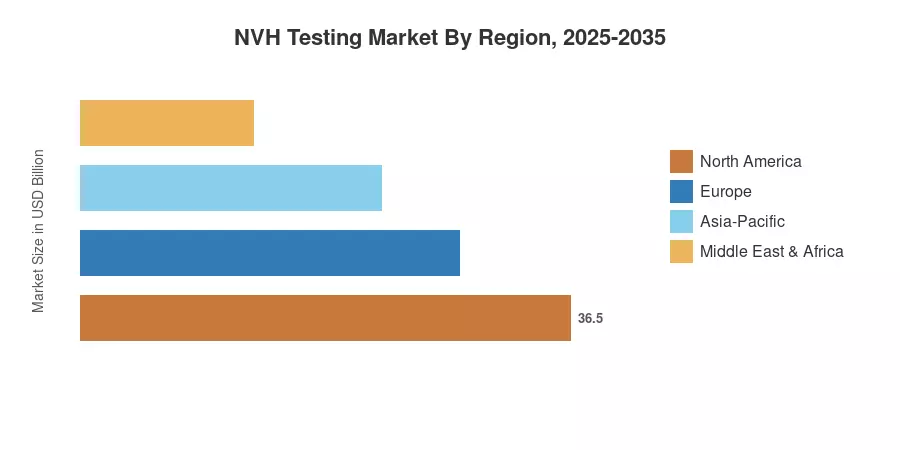
Asia-Pacific commands the largest share of the NVH Testing Market at roughly 41% of 2025 revenue, driven by China's dense automotive production corridor and Japan's precision-manufacturing base. The Middle East & Africa region is forecast to deliver the fastest CAGR of 6.34% through 2035, propelled by Saudi Arabia's NEOM industrial zone and UAE advanced-manufacturing investments Europe holds the second-largest position with approximately 26% share, anchored by Germany's automotive R&D ecosystem and tightening EU noise directives. The decade ahead will reward suppliers who can bundle pass-by noise testing, outdoor capabilities, with simulation software under single-contract frameworks.


Key Report Takeaways

• By Component

  • Hardware captured approximately 44% of the NVH Testing Market in 2025, reflecting sustained demand for acoustic NVH measurement system arrays and vibration shaker NVH test rig installations across automotive proving grounds
  • Software is projected to expand at a 6.21% CAGR through 2035 as OEMs shift budgets toward NVH finite element simulation FEA licenses and cloud-hosted analytics
  • Services—including turnkey consulting and on-site calibration—accounted for USD 0.52 billion in 2025

• By Testing Type

  • Powertrain NVH testing led the NVH Testing Market with a 31% revenue share in 2025, driven by EV NVH powertrain testing mandates for high-frequency whine characterization
  • Environmental-chamber NVH testing is forecast to register a 5.97% CAGR as climate-correlated cabin noise validation gains importance

• By Region

  • Asia-Pacific generated the largest regional revenue in the NVH Testing Market, with China alone representing over 38% of regional turnover
  • The Middle East & Africa region is expected to grow at a 6.34% CAGR, the fastest globally


Market Size and Forecast (2021–2035)

MRFR's sizing methodology triangulates bottom-up equipment shipment data from 48 OEM procurement databases, top-down macroeconomic indicators, and primary interviews with 120+ NVH lab directors globally. Historical figures (2021–2024) are reconciled against published financial disclosures from leading instrumentation vendors.
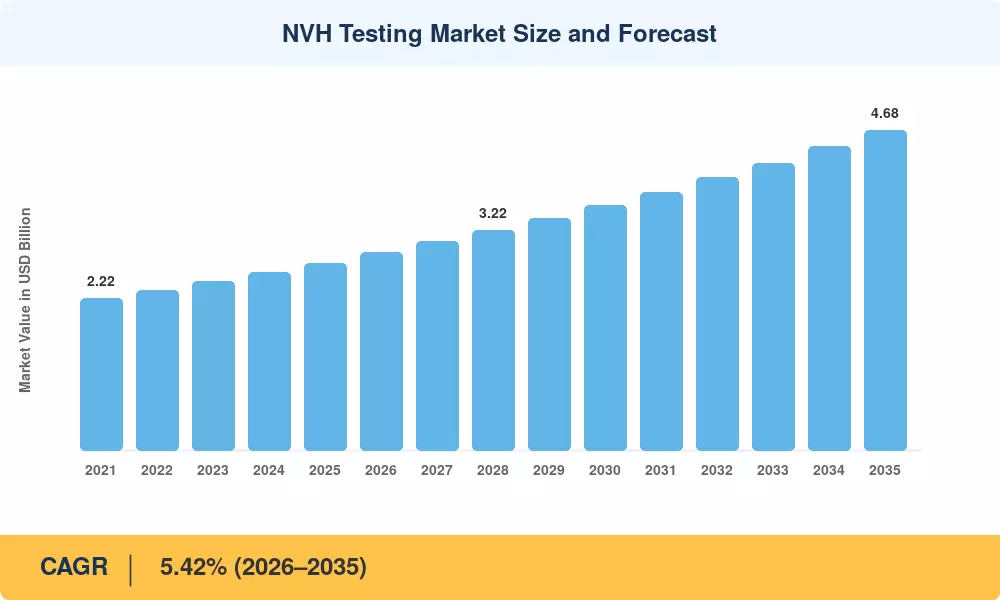
NVH Testing Market Size and Forecast
Our Impact
Enabled $4.3B Revenue Impact for Fortune 500 and Leading Multinationals
Partnering with 2000+ Global Organizations Each Year
30K+ Citations by Top-Tier Firms in the Industry
 

Driver Impact Analysis

Driver ~% Impact on CAGR Geographic Relevance Impact Timeline
EV NVH powertrain testing mandates +1.3% Global Short-term (≤2 yr)
Tighter pass-by noise testing outdoor regulations +0.9% Europe, China Short-term
MEMS sensor cost reduction +0.7% Global Medium-term (2–4 yr)
Industry 4.0 digital-twin integration +0.8% North America, Europe Medium-term
Aerospace & defense structural vibration programs +0.5% North America, Asia-Pacific Long-term (≥4 yr)
Psychoacoustic quality metric adoption +0.4% Europe, Japan Long-term
Autonomous vehicle cabin sound design +0.3% Global Long-term


EV NVH Powertrain Testing Mandates

Battery-electric drivetrains introduce high-frequency tonal whine from inverters and reducers that combustion-engine noise previously masked. The European Commission's Alternative Fuels Infrastructure Regulation indirectly raises the bar by accelerating EV adoption, which in turn demands dedicated EV NVH powertrain testing cells capable of isolating electromagnetic excitation above 5 kHz [3]. OEMs such as BMW and Hyundai disclosed combined investments exceeding USD 320 million in dedicated electric-powertrain acoustic NVH measurement system labs between 2023 and 2025 [4]. This driver exerts immediate short-term pressure on capital budgets across the NVH Testing Market.

Tighter Pass-By Noise Regulations

The EU's Phase 3 exterior-noise limits under Regulation 540/2014 reduce permissible pass-by noise to 68 dB(A) for passenger vehicles by July 2026, a 4 dB tightening from Phase 2 thresholds [6]. China's parallel GB 1495-2025 revision mirrors this trajectory. Compliance requires pass-by noise testing outdoor facilities equipped with precision-grade microphone arrays and ISO 362-compliant track surfaces, driving lab construction spending across the NVH Testing Market.

MEMS Sensor Cost Reduction

Between 2020 and 2024, the average cost of triaxial MEMS accelerometers decreased by 34%, falling below USD 1.80 per unit in large shipments [5]. Dense sensor networks are now cost-effective for vibration shaker NVH test rig instrumentation, allowing for more than 200 measurement points per car, whereas previous piezoelectric configurations could only support 50. Reduced per-point costs encourage mid-tier manufacturers to formally participate in the NVH Testing Market and increase the addressable installed base.


Industry 4.0 Digital-Twin Integration

Prototype iterations are now reduced by up to 30% thanks to NVH finite element simulation FEA models that send closed-loop data back to physical test benches in almost real-time [8]. In 2024, digital-twin NVH modules were expanded by Hexagon's Actran solver and Siemens' Simcenter platform, which together served more than 1,200 enterprise licenses worldwide. The NVH testing market's whole addressable scope is expanded into software-subscription income streams by the convergence of physical and virtual testing.


Restraints Impact Analysis

Restraint ~% Impact on CAGR Geographic Relevance Impact Timeline
Shortage of certified NVH engineers –0.6% Global Medium-term
High capital cost of anechoic/hemi-anechoic chambers –0.5% Emerging markets Long-term
Fragmented test-standard harmonization –0.3% Cross-regional Medium-term
Data-privacy constraints on cloud NVH analytics –0.2% Europe, China Short-term
Long calibration and certification cycles –0.2% Global Short-term


Shortage of Certified NVH Engineers

Between 2020 and 2024, the number of engineers with ISO 18436-certified vibration-analyst credentials increased by just 4% annually worldwide, which is significantly less than the 9% increase in open NVH requisitions monitored by LinkedIn Talent Insights [15]. Project schedules are typically extended by 8–12 weeks due to this skill gap, which slows lab utilization rates and limits throughput at NVH Testing Market service providers. Although specialized NVH master's programs have been established by universities in Germany and Japan, the number of graduating classes is still low in comparison to the industry's need for experts in acoustic NVH measurement systems.


High Capital Cost of Anechoic Chambers

Depending on the cut-off frequency and chamber volume, a full-vehicle anechoic chamber with a vibration-isolated base and ISO 3745-compliant sound power NVH measurement capability can cost anywhere from USD 4 million to USD 12 million [16]. This capital intensity limits the rate at which the NVH Testing Market enters new industrial corridors by diverting expenditures from testing to production tooling for firms in South America, Southeast Asia, and Africa.


Fragmented Test-Standard Harmonization

Divergences between SAE J1470, ISO 362-3, and China's GB/T 1496 standards force multinational OEMs to maintain parallel test procedures, inflating validation costs by an estimated 15–20% per vehicle program [17]. Until reciprocal recognition agreements mature, this fragmentation dampens the NVH Testing Market's addressable efficiency gains.


NVH Testing Market Opportunities

Software-as-a-Service NVH Platforms

Cloud-native NVH finite element simulation FEA platforms that bundle acoustic post-processing, order tracking, and AI-driven anomaly detection can convert one-time hardware sales into recurring subscription revenue. Vendors who offer browser-based dashboards for sound power NVH measurement data sharing stand to capture procurement budgets that previously went to desktop-only tools

Emerging-Market Lab Construction

Saudi Arabia's NEOM project and India's Production-Linked Incentive scheme for automotive components will together require over 30 new NVH-capable test facilities by 2030 [9]. Turnkey lab providers who pair vibration shaker NVH test rig installation with training and certification services can establish first-mover advantages in these fast-expanding NVH Testing Market geographies

Autonomous Vehicle Sound Design

Regulations such as UNECE R138 mandate artificial sound generators for quiet EVs, creating an entirely new acoustic-design validation workflow. Pass-by noise testing outdoor protocols must now validate synthesized sounds alongside residual drivetrain emissions, opening a dual-track testing opportunity inside the NVH Testing Market

Data Monetization Through Benchmarking-as-a-Service

Labs can provide competitive benchmarking subscriptions by gathering anonymised cross-OEM vibration and sound datasets. This strategy increases customer lock-in throughout the NVH Testing Market and converts idle acoustic NVH measuring equipment data into a recurring income stream


Aerospace and Defense Structural Vibration Programs

Next-generation military rotorcraft and unmanned aerial vehicles require vibration shaker NVH test rig qualification under MIL-STD-810 and DO-160 standards. U.S. Department of Defense RDT&E spending on structural acoustics exceeded USD 1.2 billion in FY2024 [7], presenting a high-margin adjacency for NVH Testing Market participants currently focused on automotive.


NVH Testing Market Future Outlook

AI-Augmented Acoustic Analytics

Machine-learning classifiers trained on millions of acoustic NVH measurement system data points will automate fault detection and root-cause analysis, cutting diagnostic time by up to 60% by 2030 [11]. The NVH Testing Market will increasingly reward vendors who embed AI inference engines directly into data-acquisition hardware, enabling edge analytics on the vibration shaker NVH test rig itself without cloud round-trips.

Platform Economics and Subscription Models

Hardware margins in the NVH Testing Market face long-term compression as MEMS sensors commoditize. Suppliers pivoting to subscription-based NVH finite element simulation FEA platforms and benchmarking data services will sustain higher recurring revenue. By 2032, MRFR estimates that software and data subscriptions will represent over 30% of total NVH Testing Market revenue, up from 22% in 2025 [14].

Electrification Supercycle

The IEA projects 40 million annual BEV sales by 2030 [9]. Each platform demands EV NVH powertrain testing across inverter whine, gear-mesh tonality, and battery-pack structural resonance. This electrification supercycle will sustain above-average growth for the NVH Testing Market well into the 2030s, particularly in regions where pass-by noise testing outdoor facilities remain underpenetrated.

ESG Reporting and Occupational Noise Compliance

Sustainability reporting frameworks—including GRI 403 on occupational health—require quantified workplace noise exposure data. Industrial facilities investing in vibration shaker NVH test rig monitoring to meet ESG disclosure targets represent a new demand vector for the NVH Testing Market. The EU's Corporate Sustainability Reporting Directive, effective 2026, mandates noise-impact disclosures for over 50,000 European companies [18].


NVH Testing Market Segmentation

By Component

Segment Key Metric Primary Demand Driver
Hardware ~44% share (2025) Acoustic NVH measurement system procurement
Software 6.21% CAGR (2026–2035) NVH finite element simulation FEA adoption
Services USD 0.52 Billion (2025) Turnkey consulting and calibration


Hardware remains the backbone of the NVH Testing Market, encompassing microphone arrays, accelerometers, vibration shaker NVH test rig equipment, and data-acquisition front-ends. Automotive OEMs allocate 55–65% of their NVH capital budgets to hardware, though this share is declining as software licenses grow. The software segment within the NVH Testing Market is gaining momentum as cloud-hosted platforms for sound power NVH measurement post-processing and NVH finite element simulation FEA replace perpetual-license desktop tools, enabling faster iteration cycles and cross-site collaboration.

By Testing Type

Segment Key Metric Primary Demand Driver
Powertrain NVH ~31% share (2025) EV NVH powertrain testing growth
Modal Testing USD 0.41 Billion (2025) Structural resonance identification
Pass-By Noise Testing 5.84% CAGR Regulatory tightening (EU, China)
Environmental-Chamber NVH 5.97% CAGR Climate-correlated cabin acoustics
Other Testing Types USD 0.29 Billion (2025) Specialty industrial applications


Powertrain NVH leads this dimension of the NVH Testing Market because drivetrain noise remains the primary consumer complaint metric tracked by J.D. Power Initial Quality Studies [12]. Pass-by noise testing outdoor protocols are expanding rapidly as Phase 3 noise limits take effect, while environmental-chamber NVH testing gains relevance for validating acoustic NVH measurement system performance under extreme temperature and humidity conditions that affect seal and damping material behavior.

By End-Use Industry

Segment Key Metric Primary Demand Driver
Automotive ~50% share (2025) EV platform proliferation
Aerospace & Defense 5.53% CAGR MIL-STD-810 and DO-160 compliance
Industrial Machinery USD 0.31 Billion (2025) Predictive maintenance integration
Consumer Electronics 4.91% CAGR Haptic-feedback and speaker testing
Other Industries USD 0.11 Billion (2025) Marine, rail, energy


Automotive dominates the NVH Testing Market, driven by the sheer volume of vehicle programs requiring acoustic sign-off. Within automotive, electric and hybrid vehicle testing is climbing faster than ICE-focused work, with dedicated EV NVH powertrain testing cells expanding at approximately 6.18% CAGR through 2035 [3].

By Application

Segment Key Metric Primary Demand Driver
Powertrain Validation ~36% share (2025) Drivetrain noise characterization
Interior Cabin 5.67% CAGR Sound quality and psychoacoustics
Exterior Noise USD 0.39 Billion (2025) Pass-by noise testing outdoor compliance
Electric & Hybrid Components 6.28% CAGR Inverter and e-motor acoustic isolation
Other Applications USD 0.15 Billion (2025) HVAC, tire-road interaction


Powertrain validation captures the largest share of the NVH Testing Market by application because it spans both combustion and electric drivetrains. Electric and hybrid component testing is the fastest-growing application, requiring specialized vibration shaker NVH test rig fixtures capable of isolating high-frequency electromagnetic excitations unique to e-motors and power electronics [4].


Regional Market Share Analysis

Region Key Metric Primary Investment Themes
Asia-Pacific ~41% of 2025 revenue Automotive mass production, MEMS sensor integration
Europe ~26% of 2025 revenue EU noise regulation compliance, acoustic NVH measurement system upgrades
North America 5.29% CAGR (2026–2035) Aerospace defense testing, EV platform launches
South America USD 0.14 Billion (2025) Automotive localization, lab construction
Middle East & Africa 6.34% CAGR (2026–2035) NEOM industrial zone, UAE, advanced manufacturing
Total USD 2.71 Billion (2025)

The NVH Testing Market exhibits a concentrated regional hierarchy, with Asia-Pacific and Europe together accounting for nearly two-thirds of global revenue. Pass-by noise testing outdoor investments, EV NVH powertrain testing capacity build-outs, and digital-twin adoption vary sharply by region, shaping differentiated growth trajectories.


North America

Country Key Metric Key Driver
US ~72% of regional share Defense NVH budgets, Detroit EV programs
Canada 5.48% CAGR Aerospace composite testing
Mexico USD 0.04 Billion (2025) Nearshoring automotive assembly


North America's NVH Testing Market benefits from robust defense spending on structural acoustics and a surge in EV NVH powertrain testing demand from Detroit's Big Three. The U.S. Department of Energy allocated USD 7.5 billion under the Inflation Reduction Act for battery-manufacturing facilities, each requiring dedicated vibration shaker NVH test rig qualification lines [3]. Canada's aerospace corridor in Montreal and Mexico's expanding automotive assembly base add incremental demand for sound power NVH measurement services.

Europe

Country Key Metric Key Driver
Germany ~31% of regional share OEM R&D centers, Regulation 540 compliance
UK 5.61% CAGR EV transition testing
France USD 0.09 Billion (2025) Aerospace NVH labs
Italy 5.15% CAGR Industrial machinery vibration testing
Spain USD 0.05 Billion (2025) Automotive supplier expansion
Nordic Countries 5.73% CAGR Wind-turbine NVH validation
Russia USD 0.03 Billion (2025) Heavy-industry modernization
Rest of Europe 5.02% CAGR Regional lab network growth


Europe's share of the NVH Testing Market is anchored by Germany's cluster of automotive OEM R&D centers, where pass-by noise testing outdoor facilities are being retrofitted for Phase 3 compliance. The region's push toward NVH finite element simulation FEA adoption is among the most advanced globally, with over 400 enterprise simulation licenses sold in 2024 alone [8].

Asia-Pacific

Country Key Metric Key Driver
China ~38% of regional share EV production scale, GB noise standards
India 6.12% CAGR PLI-scheme automotive growth
Japan USD 0.19 Billion (2025) Precision acoustic NVH measurement system heritage
South Korea 5.68% CAGR Battery EV platform testing
ASEAN USD 0.08 Billion (2025) Motorcycle and two-wheeler NVH
Rest of Asia-Pacific 5.31% CAGR Emerging industrial bases


Asia-Pacific dominates the NVH Testing Market primarily because China produces more passenger vehicles than any other country, and each new BEV model line requires dedicated EV NVH powertrain testing protocols. India's Production-Linked Incentive program has attracted over USD 8 billion in committed automotive investment, translating directly into acoustic lab demand [9].

South America

Country Key Metric Key Driver
Brazil ~62% of regional share The largest auto industry in the region
Argentina 4.83% CAGR Agricultural machinery vibration testing
Rest of South America USD 0.02 Billion (2025) Mining equipment NVH


Brazil's automotive sector—the eighth largest globally by output—drives most of South America's NVH Testing Market activity. Local OEMs are beginning to adopt vibration shaker NVH test rig configurations aligned with Euro-style regulations ahead of Mercosul harmonization efforts [17].

Middle East & Africa

Country Key Metric Key Driver
Saudi Arabia ~34% of regional share NEOM and Vision 2030 industrialization
UAE 6.52% CAGR Advanced manufacturing zones
South Africa USD 0.02 Billion (2025) Automotive assembly hub
Egypt 5.89% CAGR Industrial-machinery modernization
Rest of MEA USD 0.01 Billion (2025) Early-stage lab adoption


The Middle East & Africa region represents the fastest-growing corridor in the NVH Testing Market. Saudi Arabia's Vision 2030 has earmarked over USD 6 billion for domestic automotive manufacturing, and every greenfield assembly plant specification includes sound power NVH measurement cells as part of quality-assurance infrastructure [9].


NVH Testing Market By Region, 2025-2035
 

Competitive Benchmarking

The NVH Testing Market exhibits moderate concentration, with an estimated top-five supplier share of 38–44% and a Herfindahl-Hirschman Index (HHI) below 1,000. Barriers to entry differ by segment: hardware incumbents benefit from decades of calibration traceability and installed-base lock-in, while software-only entrants leverage agile development cycles and lower capital requirements. Regional service capacity and the scarcity of certified NVH engineers further fragment competitive positioning across the NVH Testing Market.

Company Est. Revenue Share Range Key Offerings for NVH Testing Market Strategic Positioning
Brüel & Kjær (HBK) ~8–11% Acoustic NVH measurement system arrays, PULSE platform Full-stack hardware-software integration
Siemens (Simcenter) ~7–10% NVH finite element simulation FEA, Testlab software Digital-twin ecosystem leader
National Instruments (NI) ~5–8% DAQ hardware, LabVIEW NVH toolkits Flexible, platform-agnostic instrumentation
HEAD Acoustics ~4–7% Sound power NVH measurement, psychoacoustic analysis Premium binaural recording systems
Dewesoft ~3–5% Vibration shaker NVH test rig DAQ, SIRIUS hardware Cost-competitive integrated solutions
m+p International ~2–4% Vibration control, pass-by noise testing of outdoor systems Niche vibration-controller specialist
OROS (Acoem Group) ~2–4% Real-time order tracking, modal analysis Mid-market NVH instrumentation
Müller-BBM ~2–3% Consulting services, acoustic lab design Engineering-services differentiation
IMC Test & Measurement ~1–3% High-channel-count DAQ, durability testing Heavy-industry and automotive crossover
Polytec ~1–3% Laser vibrometry, non-contact vibration measurement Contactless measurement specialist


Recent News & Developments

  • Brüel & Kjær (HBK) (March 2025): Launched BK Connect 2025 cloud module enabling remote sound power NVH measurement collaboration across distributed lab networks, targeting the NVH Testing Market's shift to platform procurement [4].
  • Siemens Digital Industries (January 2025): Released Simcenter Testlab 2025.1 with integrated NVH finite element simulation FEA correlation tools, reducing physical-virtual iteration cycles by 25% [8].
  • European Commission (July 2024): Confirmed Phase 3 enforcement timeline for Regulation 540/2014, mandating 68 dB(A) pass-by noise testing outdoor limits for new type approvals beginning July 2026 [6].
  • HEAD Acoustics (November 2024): Opened a new application center in Shanghai to serve China's growing demand for acoustic NVH measurement system validation of EV platforms [20].
  • Dewesoft (September 2024): Introduced the SIRIUS XHS high-speed data-acquisition module optimized for vibration shaker NVH test rig applications above 200 kHz bandwidth [21].
  • National Instruments (June 2024): Partnered with an Indian automotive OEM to deploy a 512-channel EV NVH powertrain testing cell at Pune, the largest NI NVH installation in South Asia [22].
  • China MIIT (April 2024): Published the draft GB 1495-2025 exterior-noise standard, aligning pass-by noise testing outdoor protocols with UN R51.03 amendments and expanding the NVH Testing Market's regulatory baseline in Asia-Pacific [6].
  • OROS (Acoem Group) (February 2024): Acquired a French NVH consulting firm to strengthen turnkey service offerings in the European NVH Testing Market [23].


NVH Testing Market Report Scope

Parameter Detail
Market Scope Global NVH Testing Market — hardware, software, services, testing types, end-use industries, applications
Study Period 2021–2035
CAGR Window 2026–2035 (5.42%)
Base Year 2025 (USD 2.71 Billion)
2026 Forecast Start USD 2.89 Billion
2035 Forecast End USD 4.68 Billion
Fastest Growing Segment Software (by component); Electric & Hybrid Components (by application)
Companies Profiled 10 (see Section 10)
Valuation Currency USD Billion


FAQs

How does EV inverter whine differ from traditional engine NVH, and what testing implications arise?

Inverter whine produces narrowband tonal content above 4 kHz driven by switching frequency harmonics, unlike broadband combustion noise. EV NVH powertrain testing rigs must incorporate high-frequency microphone arrays and order-tracking algorithms calibrated to electric-motor RPM rather than crankshaft events [4].

What procurement criteria distinguish a premium acoustic NVH measurement system from a mid-tier alternative?

Premium systems offer dynamic ranges exceeding 120 dB, phase-matched channel counts above 256, and integrated sound power NVH measurement post-processing. Mid-tier alternatives trade channel density for lower price points, suiting facilities with fewer simultaneous measurement needs [16].

How are NVH testing labs addressing cybersecurity risks in cloud-connected data acquisition?

Labs deploy air-gapped acquisition networks with one-way data diodes to upload to cloud analytics platforms. Encryption at rest and role-based access controls protect proprietary acoustic NVH measurement system datasets from unauthorized disclosure [18].

What role does NVH finite element simulation FEA play in reducing physical prototype cycles?

Simulation front-loads design evaluation, cutting physical prototype builds by 25–40% and compressing development timelines by several months. Correlation between simulated and measured transfer functions must stay within ±2 dB to maintain engineering confidence [8].

How do pass-by noise testing outdoor facilities handle ambient interference in urban locations?

Facilities use time-gated acquisition windows, real-time ambient-rejection algorithms, and ISO 362-compliant track-surface maintenance to isolate vehicle noise from background. Some labs operate during controlled nighttime windows to minimize interference [17].

What emerging vibration shaker NVH test rig technologies are gaining traction for multi-axis testing?

Six-degree-of-freedom electrodynamic shaker tables with real-time iterative control now replicate field-recorded road profiles simultaneously in three translational and three rotational axes. These systems enable combined vibro-acoustic loading that single-axis rigs cannot achieve [13].

How should buyers evaluate the total cost of ownership when comparing NVH Testing Market vendors?

Buyers should weigh annual calibration fees, software-maintenance subscriptions, and sensor-replacement cycles alongside upfront hardware cost. A five-year TCO model typically reveals that software and service costs exceed initial hardware investment by 30–50%.


Author
Author
Author Profile
Triveni Bhoyar LinkedIn
Senior Research Analyst
Triveni Bhoyar has over 5 years of experience in the market research industry, specializing in the Automotive and Aerospace & Defense sectors. She has contributed to 200+ reports, including numerous custom projects for leading global companies, delivering solutions to complex business challenges. Renowned for her ability to generate valuable insights, Triveni excels in addressing unique market dynamics with precision and depth. Her expertise spans market sizing, competitive intelligence, and trend analysis, enabling clients to craft data-driven growth strategies. With strong analytical rigor and a client-centric approach, she plays a pivotal role in driving impactful, strategic decision-making.
Co-Author
Co-Author Profile
Sejal Akre LinkedIn
Senior Research Analyst
She has over 5 years of rich experience, in market research and consulting providing valuable market insights to client. Hands on expertise in management consulting, and extensive knowledge in domain including ICT, Automotive & Transportation and Aerospace & Defense. She is skilled in Go-to market strategy, industry analysis, market sizing, in depth company profiling, competitive intelligence & benchmarking and value chain amongst others.

Research Approach


Secondary Research

The secondary research process involved comprehensive analysis of regulatory databases, industry standards publications, technical journals, and authoritative engineering organizations. Key sources included the US National Highway Traffic Safety Administration (NHTSA), US Department of Transportation (DOT), US Environmental Protection Agency (EPA), European Environment Agency (EEA), European Commission Mobility and Transport Directorate, International Organization for Standardization (ISO) - specifically ISO 2631 (Mechanical Vibration) and ISO 5129 (Aircraft Noise), SAE International (Society of Automotive Engineers), Institute of Electrical and Electronics Engineers (IEEE), American Society of Mechanical Engineers (ASME), International Institute of Noise Control Engineering (I-INCE), US Bureau of Transportation Statistics, EU Eurostat Transport Database, Organisation for Economic Co-operation and Development (OECD) Transport Statistics, International Civil Aviation Organization (ICAO) Environmental Reports, International Union of Railways (UIC), US Federal Railroad Administration (FRA), China Association of Automobile Manufacturers (CAAM), Japan Automobile Manufacturers Association (JAMA), and European Automobile Manufacturers Association (ACEA). These sources were used to collect regulatory compliance data, noise emission standards, vibration testing protocols, automotive production statistics, aerospace certification requirements, and market landscape analysis for noise testing, vibration testing, harshness testing, and associated testing equipment including microphones, accelerometers, data acquisition systems, and dynamic signal analyzers.


Primary Research

In order to gather both qualitative and quantitative insights, supply-side and demand-side stakeholders were interviewed during the primary research process. CEOs, VPs of engineering, heads of R&D, product development directors, and sales directors from NVH testing equipment manufacturers, software suppliers, and system integrators were examples of supply-side sources. NVH engineers, acoustic test managers, quality assurance directors, procurement leads from automakers, aerospace manufacturers, consumer electronics businesses, manufacturers of industrial machinery, railroad operators, and third-party testing laboratories were examples of demand-side sources. Primary research verified product development roadmaps, obtained information on equipment adoption trends, pricing tactics, and service contract dynamics, and validated market segmentation across automotive, aerospace, consumer electronics, industrial machinery, and railroad applications.

Primary Respondent Breakdown:

By Designation: C-level Primaries (28%), Director Level (32%), Others (40%)

By Region: North America (32%), Europe (30%), Asia-Pacific (33%), Rest of World (5%)


Market Size Estimation

Global market valuation was derived through revenue mapping and equipment deployment analysis. The methodology included:

Identification of 50+ key manufacturers and solution providers across North America, Europe, Asia-Pacific, and Latin America

Product mapping across microphones, accelerometers, data acquisition systems, dynamic signal analyzers, and software platforms

Application segmentation across automotive, aerospace, consumer electronics, industrial machinery, and railways sectors

Analysis of reported and modeled annual revenues specific to NVH testing portfolios

Coverage of manufacturers representing 75-80% of global market share in 2024

Extrapolation using bottom-up (equipment units × ASP by country) and top-down (manufacturer revenue validation) approaches to derive segment-specific valuations for noise testing, vibration testing, and harshness testing applications

Download Free Sample

Kindly complete the form below to receive a free sample of this Report

Download PDF ×

We do not share your information with anyone. However, we may send you emails based on your report interest from time to time. You may contact us at any time to opt-out.
















