×
Request Free Sample ×

Kindly complete the form below to receive a free sample of this Report

* Please use a valid business email

Leading companies partner with us for data-driven Insights

clients tt-cursor
Hero Background

Automotive Smart Tire Market

ID: MRFR/AT/5953-HCR
100 Pages
Swapnil Palwe
October 2025

Automotive Smart Tire Market Research Report Information by Technology (Pneumatic and Non-pneumatic Tires), Vehicle Type (Passenger Cars, Commercial Vehicles, Electric Vehicles), Sales Channel (OEM, OES, and IAM) and Region - Global Forecast till 2035

Share:
Download PDF ×

We do not share your information with anyone. However, we may send you emails based on your report interest from time to time. You may contact us at any time to opt-out.

Automotive Smart Tire Market Infographic
Purchase Options

Automotive Smart Tire Market Summary

As per MRFR analysis, the Automotive Smart Tire Market Size was estimated at 2000.0 USD Million in 2024. The Automotive Smart Tire industry is projected to grow from 2100.0 in 2025 to 3600.0 by 2035, exhibiting a compound annual growth rate (CAGR) of 5.54 during the forecast period 2025 - 2035.

Key Market Trends & Highlights

The Automotive Smart Tire Market is poised for substantial growth driven by technological advancements and increasing consumer demand.

  • The integration of IoT technology is transforming tire functionality and connectivity in vehicles.
  • Sustainability initiatives are gaining traction, influencing tire manufacturing processes and materials.
  • Enhanced consumer awareness regarding vehicle safety is driving demand for smart tire solutions.
  • The rise of electric and autonomous vehicles, coupled with the integration of advanced sensor technology, is propelling market growth in North America and Asia-Pacific.

Market Size & Forecast

2024 Market Size 2000.0 (USD Million)
2035 Market Size 3600.0 (USD Million)
CAGR (2025 - 2035) 5.54%

Major Players

Michelin (FR), Bridgestone (JP), Continental (DE), Goodyear (US), Pirelli (IT), Hankook (KR), Dunlop (GB), Toyo Tires (JP), Nokian Tyres (FI)

Automotive Smart Tire Market Trends

The Automotive Smart Tire Market is currently experiencing a transformative phase, driven by advancements in technology and increasing consumer demand for enhanced vehicle performance and safety. These innovative tires are equipped with sensors that monitor various parameters such as pressure, temperature, and tread wear, providing real-time data to drivers and manufacturers. This integration of smart technology not only improves vehicle safety but also contributes to better fuel efficiency and reduced environmental impact. As the automotive industry shifts towards electrification and automation, the relevance of smart tires becomes even more pronounced, suggesting a robust growth trajectory for this market. Moreover, the Automotive Smart Tire Market appears to be influenced by the rising trend of connected vehicles, where tires play a crucial role in the overall vehicle ecosystem. The ability to communicate tire conditions to onboard systems enhances the driving experience and promotes proactive maintenance. Additionally, collaborations between tire manufacturers and technology firms are likely to foster innovation, leading to the development of more sophisticated tire solutions. As consumer awareness regarding tire safety and performance increases, the market is poised for significant evolution, potentially reshaping the future of mobility.

Integration of IoT Technology

The incorporation of Internet of Things (IoT) technology into automotive smart tires is becoming increasingly prevalent. This trend allows for continuous monitoring and data collection, enabling real-time insights into tire performance and condition. Such advancements facilitate predictive maintenance, potentially reducing the risk of tire-related incidents and enhancing overall vehicle safety.

Sustainability Initiatives

There is a growing emphasis on sustainability within the Automotive Smart Tire Market. Manufacturers are exploring eco-friendly materials and production processes to minimize environmental impact. This trend aligns with the broader automotive industry's shift towards greener practices, as consumers increasingly prioritize sustainability in their purchasing decisions.

Enhanced Consumer Awareness

Consumer awareness regarding the benefits of smart tires is on the rise. As educational initiatives and marketing efforts increase, more drivers are recognizing the advantages of using smart tires for improved safety and performance. This heightened awareness is likely to drive demand, encouraging manufacturers to innovate and expand their product offerings.

Automotive Smart Tire Market Drivers

Market Growth Projections

The Global Automotive Smart Tire Market Industry is poised for substantial growth, with projections indicating a market size of 90.6 USD Billion in 2024 and an impressive increase to 215.8 USD Billion by 2035. This growth trajectory suggests a compound annual growth rate of 8.21% from 2025 to 2035. The increasing integration of smart technologies in automotive applications, coupled with rising consumer demand for safety and efficiency, is likely to drive this expansion. The market's evolution reflects broader trends in the automotive sector, emphasizing the importance of innovation and technology in enhancing vehicle performance.

Technological Advancements

The Global Automotive Smart Tire Market Industry is experiencing rapid technological advancements, particularly in sensor technology and data analytics. These innovations enhance tire performance by providing real-time data on tire pressure, temperature, and tread wear. For instance, smart tires equipped with IoT capabilities can communicate with vehicle systems to optimize performance and safety. This trend is likely to drive market growth as consumers increasingly demand enhanced safety features and improved fuel efficiency. The market is projected to reach 90.6 USD Billion in 2024, indicating a robust demand for these advanced tire solutions.

Increased Consumer Awareness

Consumer awareness regarding tire maintenance and performance is rising, which is positively impacting the Global Automotive Smart Tire Market Industry. As consumers become more informed about the benefits of smart tires, including improved safety and efficiency, demand is expected to increase. Educational campaigns and marketing efforts by manufacturers are playing a crucial role in this trend. The anticipated growth in the market, projected to reach 90.6 USD Billion in 2024, suggests that informed consumers are more likely to invest in advanced tire technologies that enhance their driving experience.

Rising Electric Vehicle Adoption

The surge in electric vehicle (EV) adoption is a significant driver for the Global Automotive Smart Tire Market Industry. As EVs become more mainstream, the demand for advanced tire technologies that enhance performance and efficiency is increasing. Smart tires can provide critical data that helps optimize battery life and overall vehicle performance. This trend is particularly relevant as the automotive industry shifts towards electrification, with projections indicating that the market could reach 215.8 USD Billion by 2035. The integration of smart tire technology in EVs is likely to become a standard feature, further propelling market growth.

Growing Demand for Safety Features

Safety remains a paramount concern for consumers, propelling the Global Automotive Smart Tire Market Industry forward. Smart tires offer features such as automatic pressure monitoring and alerts for potential tire failures, which can significantly reduce the risk of accidents. As automotive manufacturers prioritize safety in their designs, the integration of smart tire technology becomes increasingly prevalent. This shift is reflected in the projected market growth, with expectations to reach 215.8 USD Billion by 2035. The emphasis on safety is likely to drive consumer adoption, thereby enhancing the overall market landscape.

Environmental Sustainability Initiatives

The Global Automotive Smart Tire Market Industry is also influenced by the increasing focus on environmental sustainability. Smart tires contribute to fuel efficiency and reduced emissions by optimizing tire performance and extending tire life. Governments worldwide are implementing stringent regulations aimed at reducing carbon footprints, which encourages the adoption of eco-friendly technologies. For example, smart tires can help in achieving better fuel economy, aligning with global sustainability goals. This trend is expected to support a compound annual growth rate of 8.21% from 2025 to 2035, reflecting the market's alignment with environmental objectives.

Market Segment Insights

By Application: Passenger Vehicle (Largest) vs. Commercial Vehicle (Fastest-Growing)

In the Automotive Smart Tire Market, the application segment showcases a diverse distribution of market share among key players. The largest share belongs to Passenger Vehicles, driven by the increasing consumer preference for enhanced safety and real-time monitoring systems. This segment thrives on the growing demand for smart features that elevate driving experiences and optimize vehicle performance. On the other hand, Commercial Vehicles are witnessing rapid growth due to the rise in logistics and freight industries, further fueled by advancements in smart technology that enhance operational efficiency.

Application: Passenger Vehicle (Dominant) vs. Commercial Vehicle (Emerging)

The Passenger Vehicle segment has established itself as the dominant player in the Automotive Smart Tire Market due to strong consumer preferences for innovation and safety features. These vehicles benefit from technologies that optimize performance, fuel efficiency, and provide real-time data analytics. In contrast, the Commercial Vehicle segment is emerging rapidly, driven by the need for improved operational effectiveness and cost reduction in logistics. Fleet operators are increasingly adopting smart tire solutions to monitor tire health, thereby reducing downtime and maintenance costs. As regulations tighten and the industry leans towards sustainability, both segments are evolving, with Passenger Vehicles leading in sales while Commercial Vehicles catch up in growth.

By Technology: Pressure Monitoring System (Largest) vs. Temperature Monitoring System (Fastest-Growing)

In the Automotive Smart Tire Market, the pressure monitoring system holds the largest market share, driven by its essential role in enhancing vehicle safety and performance. As standard technology in modern vehicles, it offers consumers reassurance and helps in minimizing tire blowouts and accidents. Conversely, the temperature monitoring system is emerging rapidly as one of the fastest-growing segments. Its increasing importance in managing tire performance and longevity in real-time is becoming more applicable, especially in electric and hybrid vehicles which demand more sophisticated tire management solutions.

Technology: Pressure Monitoring System (Dominant) vs. Temperature Monitoring System (Emerging)

The pressure monitoring system is the dominant technology within the automotive smart tire market, characterized by its integration into new vehicles and its ability to provide critical real-time data on tire pressure. This technology contributes significantly to vehicle safety by alerting drivers to maintain optimal tire conditions, preventing accidents, and reducing wear on tires. In contrast, the temperature monitoring system is the emerging frontier, gaining traction as a complementary technology that enhances performance diagnostics. It tracks heat buildup during tire use, which is vital for performance-oriented vehicles and fleet management. As electric vehicles gain ground, this technology supports the need for improved efficiency and longevity of tires under varying driving conditions.

By End Use: Original Equipment Manufacturer (Largest) vs. Aftermarket (Fastest-Growing)

In the Automotive Smart Tire Market, the Original Equipment Manufacturer (OEM) segment holds a significant share due to its essential role in vehicle manufacturing. OEMs integrate smart tire technology directly into vehicles during the production process, ensuring these advanced features are standard in new models. As a result, this segment is highly influential, shaping consumer expectations and fostering the adoption of smart tire solutions across the automotive sector. Conversely, the Aftermarket segment, while smaller in size compared to OEMs, is rapidly gaining traction. As vehicle owners increasingly seek to enhance performance and safety, the demand for retrofitting vehicles with smart tire technology is surging, contributing to the segment's growth.

End Use: OEM (Dominant) vs. Aftermarket (Emerging)

The Original Equipment Manufacturer (OEM) segment is the dominant force within the Automotive Smart Tire Market, characterized by close collaboration with manufacturers to embed advanced tire technology into new vehicles. This segment benefits from early adoption trends, extensive research and development partnerships, and a strong focus on innovation tailored to consumer preferences. On the other hand, the Aftermarket segment is emerging as a crucial player, driven by consumer demand for enhanced vehicle performance and safety features. With increasing awareness of smart technology, aftermarket providers are expanding their offerings, providing consumers more options to upgrade their vehicles with smart tire solutions. This dynamic interplay between OEM and aftermarket segments is shaping the landscape of smart tire adoption.

Get more detailed insights about Automotive Smart Tire Market

Regional Insights

North America : Market Leader in Innovation

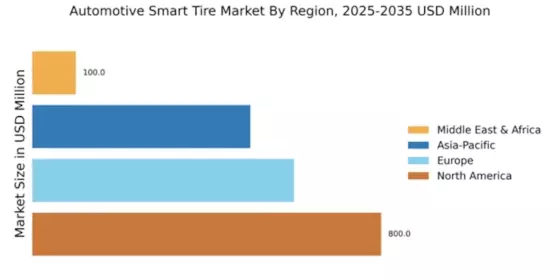
North America is poised to maintain its leadership in the Automotive Smart Tire Market, holding a significant market share of 800.0. The region's growth is driven by increasing consumer demand for advanced safety features and fuel efficiency. Regulatory support for smart technologies further propels market expansion, with initiatives aimed at enhancing vehicle safety and performance. The integration of IoT in automotive applications is also a key catalyst for growth. The competitive landscape in North America is robust, featuring major players like Goodyear and Michelin. The U.S. stands out as the leading country, with a strong focus on R&D and innovation in tire technology. Companies are investing heavily in smart tire solutions that offer real-time data analytics and improved performance metrics. This competitive edge is crucial as the market evolves towards more connected and intelligent automotive solutions.

Europe : Emerging Hub for Smart Tires

Europe is emerging as a significant player in the Automotive Smart Tire Market, with a market size of 600.0. The region's growth is fueled by stringent environmental regulations and a strong push towards sustainable automotive solutions. European countries are increasingly adopting smart tire technologies to enhance vehicle efficiency and reduce carbon footprints. The regulatory landscape is supportive, promoting innovations that align with the EU's green initiatives. Leading countries in Europe include Germany, France, and Italy, where major manufacturers like Continental and Pirelli are based. The competitive environment is characterized by a focus on technological advancements and partnerships aimed at enhancing product offerings. The presence of key players and a strong emphasis on R&D are pivotal in driving market growth, positioning Europe as a leader in smart tire innovations.

Asia-Pacific : Rapidly Growing Market Potential

Asia-Pacific is witnessing rapid growth in the Automotive Smart Tire Market, with a market size of 500.0. The region's expansion is driven by increasing vehicle production and rising consumer awareness regarding safety and performance. Countries like China and Japan are at the forefront, with significant investments in smart tire technologies. Government initiatives aimed at enhancing automotive safety standards are also contributing to market growth. China is the leading country in the region, with a burgeoning automotive sector that is increasingly adopting smart technologies. Key players such as Bridgestone and Hankook are actively involved in developing innovative tire solutions tailored to local market needs. The competitive landscape is evolving, with a focus on integrating advanced technologies to meet the growing demand for smart tires in the region.

Middle East and Africa : Emerging Market with Potential

The Middle East and Africa region is gradually emerging in the Automotive Smart Tire Market, with a market size of 100.0. Growth is primarily driven by increasing infrastructure development and rising vehicle ownership. The demand for smart tire technologies is expected to grow as consumers become more aware of the benefits of enhanced safety and performance. Government initiatives aimed at improving road safety standards are also contributing to market growth. Countries like South Africa and the UAE are leading the way in adopting smart tire technologies. The competitive landscape is still developing, with opportunities for both local and international players to enter the market. Key players are beginning to explore partnerships and collaborations to enhance their product offerings and meet the evolving needs of consumers in this region.

Key Players and Competitive Insights

The Automotive Smart Tire Market is currently characterized by a dynamic competitive landscape, driven by technological advancements and increasing consumer demand for enhanced vehicle safety and performance. Key players such as Michelin (FR), Bridgestone (JP), and Continental (DE) are at the forefront, each adopting distinct strategies to solidify their market positions. Michelin (FR) emphasizes innovation through its development of smart tire technologies that integrate real-time data analytics, while Bridgestone (JP) focuses on strategic partnerships to enhance its product offerings. Continental (DE) is actively pursuing digital transformation initiatives, aiming to leverage AI and IoT to improve tire performance and customer engagement. Collectively, these strategies contribute to a competitive environment that is increasingly focused on technological differentiation and customer-centric solutions.

In terms of business tactics, companies are localizing manufacturing to reduce costs and enhance supply chain efficiency. The market structure appears moderately fragmented, with several key players exerting influence while also facing competition from emerging firms. This fragmentation allows for a diverse range of products and innovations, fostering a competitive atmosphere where established companies must continuously adapt to maintain their market share.

In November 2025, Michelin (FR) announced a collaboration with a leading tech firm to develop a new generation of smart tires equipped with advanced sensors capable of monitoring tire health in real-time. This strategic move is likely to enhance Michelin's product portfolio and strengthen its position in the market by addressing growing consumer concerns regarding safety and performance. The integration of cutting-edge technology into their offerings may also attract a broader customer base, particularly among tech-savvy consumers.

In October 2025, Bridgestone (JP) launched a new initiative aimed at expanding its smart tire production capabilities in Asia. This expansion is indicative of Bridgestone's commitment to meeting the rising demand for smart tire solutions in the region, which is experiencing rapid growth in automotive sales. By increasing its manufacturing footprint, Bridgestone is positioning itself to capitalize on emerging market opportunities while also enhancing its supply chain resilience.

In September 2025, Continental (DE) unveiled a new AI-driven tire management system designed to optimize tire performance and longevity. This innovative system not only provides real-time data analytics but also offers predictive maintenance insights, which could significantly reduce operational costs for fleet operators. The introduction of such technology underscores Continental's focus on digital transformation and its potential to redefine customer engagement in the automotive sector.

As of December 2025, current competitive trends in the Automotive Smart Tire Market are heavily influenced by digitalization, sustainability, and AI integration. Strategic alliances are increasingly shaping the landscape, enabling companies to pool resources and expertise to accelerate innovation. Looking ahead, competitive differentiation is expected to evolve, with a notable shift from price-based competition to a focus on technological innovation and supply chain reliability. This transition may redefine market dynamics, compelling companies to invest in R&D and collaborative ventures to stay ahead in an ever-evolving industry.

Key Companies in the Automotive Smart Tire Market market include

Industry Developments

  • Q1 2024: Bridgestone launches radio-tagged smart tires for commercial use Bridgestone announced the commercialization of its radio-tagged smart tires, enabling real-time tire monitoring and data collection for fleet operators, marking a significant product launch in the automotive smart tire sector.
  • Q2 2024: Goodyear introduces new smart tire line designed for electric vehicles Goodyear launched a new line of smart tires specifically engineered for electric vehicles, featuring embedded sensors for real-time monitoring of tire pressure, temperature, and tread wear.
  • Q2 2024: Continental partners with technology firm to develop advanced tire monitoring systems Continental announced a strategic partnership with a leading technology company to co-develop next-generation tire monitoring systems, enhancing connectivity and safety features in smart tires.
  • Q2 2024: Michelin unveils smart tire with enhanced sensor technology Michelin launched a new smart tire equipped with advanced sensors capable of providing real-time data on tire health, aiming to improve vehicle safety and performance.
  • Q2 2024: Pirelli introduces high-load (HL) smart tire for commercial vehicles Pirelli announced the release of its high-load (HL) smart tire designed for commercial vehicles, featuring integrated sensors for continuous monitoring and improved fleet management.
  • Q2 2024: Bridgestone invests in R&D for sustainable smart tire materials Bridgestone disclosed a significant investment in research and development to create more sustainable materials for its smart tire products, supporting environmental goals and product innovation.
  • Q2 2024: Goodyear wins contract to supply smart tires for autonomous vehicle fleet Goodyear secured a contract to supply its latest smart tires to a major autonomous vehicle fleet operator, providing real-time tire data to enhance safety and operational efficiency.
  • Q3 2024: Continental opens new smart tire technology center in Germany Continental inaugurated a new technology center dedicated to smart tire development in Germany, focusing on advanced sensor integration and digital tire solutions.
  • Q3 2024: Michelin announces partnership with telematics provider for smart tire data integration Michelin entered into a partnership with a leading telematics provider to integrate smart tire data into fleet management platforms, enabling enhanced analytics and predictive maintenance.
  • Q4 2024: Pirelli secures regulatory approval for smart tire technology in Europe Pirelli received regulatory approval for its smart tire technology from European authorities, allowing for broader deployment of its sensor-equipped tires across the region.
  • Q1 2025: Bridgestone announces executive appointment to lead smart tire division Bridgestone appointed a new executive to head its smart tire division, signaling increased focus and investment in connected tire technologies.
  • Q2 2025: Goodyear raises $100M in Series B funding to expand smart tire production Goodyear completed a $100 million Series B funding round to scale up production of its smart tire products and accelerate global market expansion.

The rise of autonomous driving and connected vehicles has accelerated the evolution of the technology housed across all the parts of the vehicle. Automotive tires are the latest focus, providing real time data on pressure & temperature, tread wear & depth, road conditions, load detection, among other factors to meet complexity of vehicle management systems. Integration of sensors helps to track the status of the tire and transmit information related to tread depth, temperature, and pressure to car’s electronic control unit (ECU) which works with car’s inboard computers to enhance stability and ABS adjustments.

The embedded sensors and conductive rubber layer in the tire help in measuring various tire working criteria and the presence of moisture (snow, ice, or rain) on the road to make it work on maximum efficiency. Prominent tire manufacturers such as Continental, Bridgestone, Goodyear, and Michelin are all experimenting with IoT-connected sensors to deliver increased fuel efficiency, longer tire life, and greater safety to the fleet owners. Other than tire manufacturers, software giants such as Microsoft have invested USD 5 billion on IoT programs.

The new IoT platform helps vehicle owners to monitor tire performance in real time to improve operational efficiency and take suitable action for reducing costs and improving profitability.

The report for global Automotive Smart Tire Market of market research future covers extensive primary research. This is accompanied with detailed analysis of qualitative and quantitative aspects by various industry experts and key opinion leaders to gain deeper insights into the market and industry performance. The report gives a clear picture of the current market scenario, which includes the historical and forecasted market size, in terms of value and volume, technological advancement, macroeconomic, and governing factors of the market.

The report provides comprehensive information about the strategies of the top companies in the industry, along with a broad study of the different market segments and regions.

Future Outlook

Automotive Smart Tire Market Future Outlook

The Automotive Smart Tire Market is projected to grow at a 5.54% CAGR from 2024 to 2035, driven by advancements in sensor technology, increasing demand for safety features, and the rise of electric vehicles.

New opportunities lie in:

  • Development of integrated tire monitoring systems for OEMs
  • Partnerships with telematics providers for data analytics
  • Expansion into emerging markets with tailored smart tire solutions

By 2035, the market is expected to be robust, driven by innovation and strategic partnerships.

Market Segmentation

Automotive Smart Tire Market End Use Outlook

  • Original Equipment Manufacturer
  • Aftermarket

Automotive Smart Tire Market Technology Outlook

  • Pressure Monitoring System
  • Temperature Monitoring System
  • Wear Monitoring System
  • Tread Depth Monitoring System

Automotive Smart Tire Market Application Outlook

  • Passenger Vehicle
  • Commercial Vehicle
  • Two-Wheeler
  • Off-Road Vehicle

Report Scope

MARKET SIZE 20242000.0(USD Million)
MARKET SIZE 20252100.0(USD Million)
MARKET SIZE 20353600.0(USD Million)
COMPOUND ANNUAL GROWTH RATE (CAGR)5.54% (2024 - 2035)
REPORT COVERAGERevenue Forecast, Competitive Landscape, Growth Factors, and Trends
BASE YEAR2024
Market Forecast Period2025 - 2035
Historical Data2019 - 2024
Market Forecast UnitsUSD Million
Key Companies ProfiledMichelin (FR), Bridgestone (JP), Continental (DE), Goodyear (US), Pirelli (IT), Hankook (KR), Dunlop (GB), Toyo Tires (JP), Nokian Tyres (FI)
Segments CoveredApplication, Technology, End Use
Key Market OpportunitiesIntegration of advanced sensor technologies enhances performance and safety in the Automotive Smart Tire Market.
Key Market DynamicsTechnological advancements in tire monitoring systems drive demand for Automotive Smart Tires amid evolving consumer preferences.
Countries CoveredNorth America, Europe, APAC, South America, MEA

Market Highlights

Author
Swapnil Palwe
Team Lead - Research

With a technical background as Bachelor's in Mechanical Engineering, with MBA in Operations Management , Swapnil has 6+ years of experience in market research, consulting and analytics with the tasks of data mining, analysis, and project execution. He is the POC for our clients, for their consulting projects running under the Automotive/A&D domain. Swapnil has worked on major projects in verticals such as Aerospace & Defense, Automotive and many other domain projects. He has worked on projects for fortune 500 companies' syndicate and consulting projects along with several government projects.

Leave a Comment

FAQs

Mention the segments included in the study of global smart labels market.

The technology, vehicle type, sales channel are the segments of the market.

What are the three regions of the market?

The three major regions namely North America, Europe, Asia-Pacific, and the Rest of the World.

Which region is to share the significant market share?

Europe will be accounting a significant market share in the automotive smart tire market.

Who are the key players of the market?

Michelin Group (France), The Goodyear Tire & Rubber Co (USA), NEXEN TIRE Corporation (Korea) are the key players of the market.

What is the main factor leading to the market growth?

The rise of autonomous driving and connected vehicles has led the evolution of the technology housed across all the parts of the vehicle.

Download Free Sample

Kindly complete the form below to receive a free sample of this Report

Compare Licence

×
Features License Type
Single User Multiuser License Enterprise User
Price $4,950 $5,950 $7,250
Maximum User Access Limit 1 User Upto 10 Users Unrestricted Access Throughout the Organization
Free Customization
Direct Access to Analyst
Deliverable Format
Platform Access
Discount on Next Purchase 10% 15% 15%
Printable Versions