Automotive Steering Wheel Market
Automotive Steering Wheel Market Summary
As per Market Research Future analysis, the Automotive Steering Wheel Market Size was estimated at 29.01 USD Billion in 2024. The Automotive Steering Wheel industry is projected to grow from 29.92 USD Billion in 2025 to 40.77 USD Billion by 2035, exhibiting a compound annual growth rate (CAGR) of 3.14% during the forecast period 2025 - 2035
Key Market Trends & Highlights
The Automotive Steering Wheel Market is experiencing a transformative shift towards advanced technologies and sustainable practices.
- The integration of smart technologies is reshaping the functionality of steering wheels, enhancing user experience.
- Sustainability is becoming a focal point, with manufacturers increasingly utilizing eco-friendly materials in production.
- The North American market remains the largest, while the Asia-Pacific region is recognized as the fastest-growing market for automotive steering wheels.
- Rising demand for advanced driver assistance systems and the growth of electric vehicles are key drivers propelling market expansion.
Market Size & Forecast
| 2024 Market Size | 29.01 (USD Billion) |
| 2035 Market Size | 40.77 (USD Billion) |
| CAGR (2025 - 2035) | 3.14% |
Major Players
JTEKT Corporation (JP), Robert Bosch GmbH (DE), ZF Friedrichshafen AG (DE), Nexteer Automotive (US), Mitsubishi Electric Corporation (JP), Thyssenkrupp AG (DE), Continental AG (DE), Denso Corporation (JP)
Automotive Steering Wheel Market Trends
The Automotive Steering Wheel Market a key segment of the broader automotive field, is currently experiencing a transformative phase, driven by advancements in technology and evolving consumer preferences. Manufacturers in the automobile sector are increasingly focusing on integrating smart features into steering wheels, such as touch-sensitive controls and haptic feedback systems. This shift not only enhances user experience but also aligns with the broader trend of vehicle automation and connectivity within the automobile field. Furthermore, the growing emphasis on safety and ergonomics is prompting companies in the auto-industrie to innovate in materials and designs, ensuring that steering wheels are not only functional but also comfortable and aesthetically pleasing.
In addition to technological advancements, sustainability is becoming a pivotal factor in the Automotive Steering Wheel Market. As environmental concerns gain traction, manufacturers are exploring eco-friendly materials and production processes. This trend reflects a broader commitment to reducing the automotive industry's carbon footprint. Moreover, the rise of electric vehicles is likely to influence steering wheel design, as these vehicles often require different functionalities compared to traditional combustion engines. Overall, the Automotive Steering Wheel Market appears poised for growth, with a focus on innovation, sustainability, and enhanced user experience.
Integration of Smart Technologies
The Automotive Steering Wheel Market is witnessing a notable trend towards the incorporation of smart technologies. Features such as touch-sensitive controls, voice recognition, and haptic feedback are becoming increasingly prevalent. These innovations aim to enhance driver interaction and improve overall vehicle functionality, aligning with the growing demand for connected vehicles.
Sustainability and Eco-Friendly Materials
Sustainability is emerging as a critical consideration within the Automotive Steering Wheel Market. Manufacturers are exploring the use of eco-friendly materials and sustainable production methods. This shift not only addresses environmental concerns but also caters to a consumer base that is increasingly conscious of their ecological impact.
Focus on Ergonomics and Safety
The emphasis on ergonomics and safety is shaping the design and functionality of steering wheels. Companies are investing in research to create steering wheels that provide better grip, comfort, and control. This trend reflects a broader commitment to enhancing driver safety and overall vehicle performance.
Automotive Steering Wheel Market Drivers
Increasing Focus on Vehicle Customization
The Automotive Steering Wheel Market is witnessing a growing emphasis on vehicle customization, driven by consumer preferences for personalized driving experiences. As automakers strive to differentiate their offerings, steering wheels are becoming a focal point for customization options, including materials, colors, and integrated technologies. This trend is supported by data indicating that nearly 70% of consumers express interest in customizing their vehicles. Consequently, steering wheel manufacturers are exploring innovative designs and materials to meet these demands, thereby enhancing their market presence. The ability to offer tailored steering solutions is likely to be a key differentiator in the competitive landscape of the Automotive Steering Wheel Market.
Growth of Electric and Autonomous Vehicles
The Automotive Steering Wheel Market is significantly influenced by the growth of electric and autonomous vehicles. As the automotive landscape shifts towards electrification, steering wheel designs are adapting to accommodate new functionalities. Electric vehicles (EVs) are projected to account for 30% of total vehicle sales by 2030, necessitating a reevaluation of steering wheel features. Furthermore, autonomous vehicles require steering wheels that can transition between manual and automated driving modes. This evolution presents opportunities for manufacturers to develop innovative steering solutions that cater to the unique needs of EVs and autonomous vehicles, thereby driving growth in the Automotive Steering Wheel Market.
Regulatory Standards and Safety Compliance
The Automotive Steering Wheel Market is increasingly shaped by stringent regulatory standards and safety compliance requirements. Governments worldwide are implementing regulations aimed at improving vehicle safety, which directly impacts steering wheel design and functionality. For instance, regulations mandating the inclusion of features such as airbags and anti-lock braking systems necessitate that steering wheel manufacturers adapt their products accordingly. This compliance not only ensures consumer safety but also influences purchasing decisions, as consumers are more likely to choose vehicles that meet or exceed safety standards. As a result, adherence to regulatory requirements is a crucial driver in the Automotive Steering Wheel Market.
Rising Demand for Advanced Driver Assistance Systems
The Automotive Steering Wheel Market is experiencing a notable surge in demand for advanced driver assistance systems (ADAS). As vehicles increasingly incorporate technology aimed at enhancing safety and convenience, steering wheels are evolving to integrate features such as adaptive cruise control and lane-keeping assistance. This trend is reflected in the projected growth of the ADAS market, which is expected to reach USD 100 billion by 2025. Consequently, steering wheel manufacturers are compelled to innovate, ensuring that their products align with these technological advancements. The integration of ADAS into steering wheels not only improves vehicle safety but also enhances the overall driving experience, making it a pivotal driver in the Automotive Steering Wheel Market.
Technological Advancements in Materials and Manufacturing
The Automotive Steering Wheel Market is benefiting from technological advancements in materials and manufacturing processes. Innovations such as lightweight composites and advanced manufacturing techniques are enabling the production of steering wheels that are not only more durable but also lighter and more efficient. The use of materials like carbon fiber and high-strength plastics is becoming more prevalent, contributing to improved vehicle performance and fuel efficiency. As manufacturers seek to enhance the functionality and aesthetics of steering wheels, these advancements are likely to play a pivotal role in shaping the future of the Automotive Steering Wheel Market. The ongoing evolution in materials technology presents opportunities for differentiation and competitive advantage.
Market Segment Insights
By Material Type: Plastic (Largest) vs. Leather (Fastest-Growing)
In the Automotive Steering Wheel Market, the distribution of material types reveals that plastic dominates the sector due to its cost-effectiveness, lightweight nature, and ability to be molded into various shapes. It constitutes the largest share among materials used in steering wheels, given its robust demand from manufacturers who are looking for economically viable solutions. On the other hand, leather, once considered a luxury option, is gaining traction and becoming increasingly prevalent, appealing to consumers who prioritize aesthetics and premium vehicle interiors. The growth trends for these material types are noteworthy; leather is projected as the fastest-growing segment as consumer preferences shift towards more luxurious experiences in vehicles. Factors driving this shift include rising disposable incomes, changing lifestyle trends, and greater consumer awareness regarding vehicle aesthetics. Manufacturers are capitalizing on this trend, investing in high-quality leather and innovative designs to attract a growing customer base seeking both comfort and style in their automotive interiors.
Plastic (Dominant) vs. Leather (Emerging)
Plastic materials stand out as the dominant choice in the automotive steering wheel market, primarily due to their lightweight properties, cost efficiency, and versatility in design. They facilitate easier manufacturing processes and offer greater flexibility in achieving various textures and finishes. In contrast, leather is emerging as a favored choice for high-end and luxury vehicles, where the emphasis is on aesthetics and tactile experience. Although more expensive, leather steering wheels promote a sense of prestige and comfort, appealing to consumers who value premium materials. Furthermore, both materials are witnessing innovations aimed at improving durability and eco-friendliness, making them competitive in contemporary automotive design.
By Product Type: Standard Steering Wheels (Largest) vs. Performance Steering Wheels (Fastest-Growing)
The Automotive Steering Wheel Market exhibits a diversified landscape with notable contributions from the Standard Steering Wheels, Performance Steering Wheels, and Adjustable Steering Wheels. Among these segments, Standard Steering Wheels command the largest market share due to their widespread adoption in a variety of vehicle types. Their robustness, cost-effectiveness, and essential functionality make them the preferred choice for manufacturers and consumers alike, thus securing their dominant position in the market.
Standard Steering Wheels (Dominant) vs. Performance Steering Wheels (Emerging)
Standard Steering Wheels have established themselves as the cornerstone of the Automotive Steering Wheel Market, accounting for the majority of sales volume across all vehicle categories. Their design caters to a fundamental need for reliability and ease of use, appealing to a broad consumer base. Conversely, Performance Steering Wheels are rapidly emerging, particularly among sports and luxury vehicles. This segment is gaining traction due to the increasing consumer preference for enhanced driving experiences, better handling, and customizable features that enhance vehicle performance. As automotive technology evolves, Performance Steering Wheels are expected to see accelerated growth driven by innovation in materials and design.
By Steering Wheel Type: Electronic Power Steering Wheels (Largest) vs. Conventional Steering Wheels (Fastest-Growing)
In the Automotive Steering Wheel Market, Electronic Power Steering (EPS) Wheels have established themselves as the predominant type due to their advanced technology and efficiency. They dominate market share owing to their ability to enhance fuel economy and improve vehicle handling. In contrast, Conventional Steering Wheels are rapidly gaining traction among consumers, particularly those seeking cost-effective solutions, marking a shift in consumer preference towards more traditional options. This market dynamics underlines the increasing importance of both technology and affordability in steering wheel choices.
Conventional Steering Wheels (Dominant) vs. Hydraulic Power Steering Wheels (Emerging)
Conventional Steering Wheels have long been the standard in the automotive industry, providing a familiar and reliable driving experience. They are favored for their simplicity and cost-effectiveness, which makes them a go-to option for various vehicle segments, particularly budget-friendly models. On the rise are Hydraulic Power Steering Wheels, which offer enhanced steering control and better road feedback. As automakers innovate and compete in the mid-range market, Hydraulic Steering is emerging as a viable alternative to electronic systems, appealing to consumers who desire a blend of traditional feel and modern performance. This segment's growth is bolstered by advancements in hydraulic technology that improve reliability and reduce overall weight.
By End Use Vehicle Type: Passenger Vehicles (Largest) vs. Luxury Vehicles (Fastest-Growing)
In the Automotive Steering Wheel Market, the distribution of market share among different end-use vehicle types showcases that Passenger Vehicles hold the largest portion, reflecting the high volume of daily usage and consumer demand. This dominant share is driven by a robust automotive industry, which places the passenger vehicle segment at the forefront, catering to both personal and family transportation needs. On the other hand, the Luxury Vehicles segment is emerging rapidly, appealing to consumers desiring enhanced features, aesthetics, and performance, thus capturing a notable segment of the market.
Passenger Vehicles (Dominant) vs. Luxury Vehicles (Emerging)
The Passenger Vehicles segment stands as the dominant force in the Automotive Steering Wheel Market, benefiting from mass production and widespread consumer adoption across various demographics. This segment is characterized by a focus on affordability, comfort, and accessibility, meeting the demands of daily commuters and families alike. Conversely, the Luxury Vehicles segment is viewed as an emerging market, driven by rising disposable incomes and a growing preference for premium features such as advanced technology, superior materials, and personalized designs. This shift indicates a significant trend towards premiumization in the automotive industry, as manufacturers strive to attract affluent consumers seeking unique driving experiences.
Regional Insights
North America : Automotive Innovation Hub
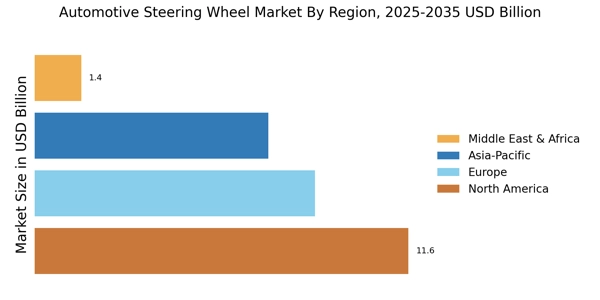
North America is the largest market for automotive steering wheels, holding approximately 40% of the global market share. The region's growth is driven by increasing vehicle production, technological advancements, and a strong focus on safety regulations. The demand for electric and autonomous vehicles is also propelling market growth, as manufacturers seek to enhance user experience and safety features. Regulatory catalysts, such as stringent safety standards, further support this growth. The United States and Canada are the leading countries in this region, with major automotive manufacturers and suppliers establishing a strong presence. Key players like Nexteer Automotive and Robert Bosch GmbH are actively innovating to meet the evolving demands of consumers. The competitive landscape is characterized by collaborations and partnerships aimed at developing advanced steering technologies, ensuring that North America remains at the forefront of automotive innovation.
Europe : Regulatory-Driven Market
Europe is the second-largest market for automotive steering wheels, accounting for around 30% of the global market share. The region's growth is significantly influenced by stringent environmental regulations and a shift towards electric vehicles. The European Union's commitment to reducing carbon emissions is driving manufacturers to innovate and adopt sustainable practices, which is expected to boost demand for advanced steering systems that enhance vehicle efficiency and safety. Germany, France, and the UK are the leading countries in this market, with a robust automotive industry that includes major players like ZF Friedrichshafen AG and Continental AG. The competitive landscape is marked by a focus on research and development, with companies investing heavily in new technologies. The presence of numerous automotive suppliers and a strong regulatory framework further enhance the region's market dynamics.
Asia-Pacific : Emerging Powerhouse
Asia-Pacific is witnessing rapid growth in the automotive steering wheel market, holding approximately 25% of the global market share. The region's expansion is fueled by increasing vehicle production, rising disposable incomes, and a growing middle class. Countries like China and India are leading this growth, with significant investments in automotive manufacturing and infrastructure. Additionally, government initiatives promoting electric vehicles are expected to further drive market demand in the coming years. China is the largest market in the region, followed by Japan and India. The competitive landscape is characterized by the presence of both global and local players, including JTEKT Corporation and Mitsubishi Electric Corporation. The region is also seeing a surge in technological advancements, with companies focusing on smart steering solutions and enhanced safety features to meet consumer expectations and regulatory requirements.
Middle East and Africa : Resource-Rich Frontier
The Middle East and Africa region is emerging as a potential market for automotive steering wheels, currently holding about 5% of the global market share. The growth in this region is driven by increasing vehicle ownership, urbanization, and investments in infrastructure. Additionally, the rise of e-commerce and logistics services is boosting demand for commercial vehicles, which in turn is expected to increase the need for advanced steering systems. Government initiatives to enhance transportation networks are also contributing to market growth. Countries like South Africa and the UAE are leading the automotive market in this region, with a growing number of automotive manufacturers setting up operations. The competitive landscape is evolving, with both local and international players vying for market share. Key players are focusing on adapting their products to meet regional needs, ensuring that the market remains dynamic and responsive to consumer demands.
Key Players and Competitive Insights
In August Continental AG (Germany) announced a strategic partnership with a leading electric vehicle manufacturer to develop next-generation steering systems that incorporate artificial intelligence for enhanced vehicle control. This move is indicative of the growing trend towards integrating AI into automotive components, which could potentially revolutionize user interaction with steering systems and improve overall vehicle safety. The partnership not only positions Continental AG as a leader in innovation but also aligns with the industry's shift towards electrification and smart technologies.
In September Nexteer Automotive (US) unveiled a new line of steer-by-wire systems designed for autonomous vehicles. This launch underscores Nexteer's commitment to advancing steering technology in line with the increasing demand for autonomous driving solutions. By focusing on steer-by-wire systems, Nexteer Automotive (US) is likely to enhance its competitive edge, as these systems offer greater flexibility and integration with autonomous driving algorithms, thus appealing to manufacturers looking to innovate.
In July ZF Friedrichshafen AG (Germany) expanded its production capabilities in Asia, specifically targeting the growing demand for electric vehicles in the region. This strategic move not only enhances ZF's operational efficiency but also positions the company to better serve the burgeoning market for electric and hybrid vehicles, which increasingly require advanced steering technologies. The expansion reflects a broader trend of localization in manufacturing, allowing companies to respond more swiftly to regional market demands.
As of October the competitive trends in the Automotive Steering Wheel Market are increasingly defined by digitalization, sustainability, and the integration of artificial intelligence. Strategic alliances are becoming more prevalent, as companies recognize the need to collaborate in order to leverage complementary strengths and accelerate innovation. The competitive landscape is shifting from traditional price-based competition towards a focus on technological advancement, reliability in supply chains, and the ability to meet evolving consumer expectations. This evolution suggests that future differentiation will hinge on the capacity to innovate and adapt to the rapidly changing automotive environment.
Key Companies in the Automotive Steering Wheel Market include
Industry Developments
- Q2 2024: Automotive Steering Motors Global Strategic Business Report A new strategic business report was released in April 2024, detailing tariff developments and regulatory impacts on the global automotive steering motors market, which includes steering wheel components.
Future Outlook
Automotive Steering Wheel Market Future Outlook
The Automotive Steering Wheel Market is projected to grow at a 3.14% CAGR from 2025 to 2035, driven by technological advancements, increasing vehicle production, and rising consumer demand for safety features.
New opportunities lie in:
- Integration of advanced driver-assistance systems (ADAS) into steering wheels. Development of customizable steering wheel designs for enhanced user experience. Expansion into electric vehicle (EV) steering solutions to meet growing market demand.
By 2035, the market is expected to achieve robust growth, reflecting evolving consumer preferences and technological innovations.
Market Segmentation
Automotive Steering Wheel Market Product Type Outlook
- Standard Steering Wheels
- Performance Steering Wheels
- Adjustable Steering Wheels
Automotive Steering Wheel Market Material Type Outlook
- Plastic
- Leather
- Wood
- Metal
Automotive Steering Wheel Market Steering Wheel Type Outlook
- Conventional Steering Wheels
- Electronic Power Steering Wheels
- Hydraulic Power Steering Wheels
Automotive Steering Wheel Market End Use Vehicle Type Outlook
- Passenger Vehicles
- Commercial Vehicles
- Luxury Vehicles
Report Scope
| MARKET SIZE 2024 | 29.01(USD Billion) |
| MARKET SIZE 2025 | 29.92(USD Billion) |
| MARKET SIZE 2035 | 40.77(USD Billion) |
| COMPOUND ANNUAL GROWTH RATE (CAGR) | 3.14% (2025 - 2035) |
| REPORT COVERAGE | Revenue Forecast, Competitive Landscape, Growth Factors, and Trends |
| BASE YEAR | 2024 |
| Market Forecast Period | 2025 - 2035 |
| Historical Data | 2019 - 2024 |
| Market Forecast Units | USD Billion |
| Key Companies Profiled | JTEKT Corporation (JP), Robert Bosch GmbH (DE), ZF Friedrichshafen AG (DE), Nexteer Automotive (US), Mitsubishi Electric Corporation (JP), Thyssenkrupp AG (DE), Continental AG (DE), Denso Corporation (JP) |
| Segments Covered | Material Type, Product Type, Steering Wheel Type, End Use Vehicle Type, Regional |
| Key Market Opportunities | Integration of advanced driver-assistance systems in the Automotive Steering Wheel Market enhances safety and user experience. |
| Key Market Dynamics | Technological advancements in steering wheel design enhance driver experience and safety, influencing consumer preferences and market competition. |
| Countries Covered | North America, Europe, APAC, South America, MEA |
FAQs
What is the projected market valuation of the Automotive Steering Wheel Market by 2035?
The projected market valuation for the Automotive Steering Wheel Market by 2035 is 40.77 USD Billion.
What was the market valuation of the Automotive Steering Wheel Market in 2024?
The overall market valuation of the Automotive Steering Wheel Market in 2024 was 29.01 USD Billion.
What is the expected CAGR for the Automotive Steering Wheel Market during the forecast period 2025 - 2035?
The expected CAGR for the Automotive Steering Wheel Market during the forecast period 2025 - 2035 is 3.14%.
Which material type segment is projected to have the highest valuation by 2035?
The Plastic material type segment is projected to reach a valuation of 14.0 USD Billion by 2035.
What are the projected valuations for the Performance Steering Wheels segment by 2035?
The Performance Steering Wheels segment is projected to reach a valuation of 12.0 USD Billion by 2035.
Which steering wheel type is expected to dominate the market by 2035?
The Electronic Power Steering Wheels type is expected to dominate the market with a projected valuation of 18.0 USD Billion by 2035.
What is the projected valuation for Luxury Vehicles in the Automotive Steering Wheel Market by 2035?
The projected valuation for Luxury Vehicles in the Automotive Steering Wheel Market by 2035 is 16.77 USD Billion.
Who are the key players in the Automotive Steering Wheel Market?
Key players in the Automotive Steering Wheel Market include JTEKT Corporation, Robert Bosch GmbH, ZF Friedrichshafen AG, and others.
What is the projected valuation for Conventional Steering Wheels by 2035?
The projected valuation for Conventional Steering Wheels by 2035 is 14.0 USD Billion.
How does the market valuation for Commercial Vehicles compare to that of Passenger Vehicles by 2035?
By 2035, the market valuation for Commercial Vehicles is projected at 10.0 USD Billion, whereas Passenger Vehicles are projected at 14.0 USD Billion.
Research Approach
Secondary Research
The secondary research process involved comprehensive analysis of regulatory databases, automotive industry publications, technical standards documentation, and authoritative transportation organizations. Key sources included the National Highway Traffic Safety Administration (NHTSA), US Department of Transportation (DOT), European Commission Directorate-General for Mobility and Transport (DG MOVE), United Nations Economic Commission for Europe (UNECE) - Vehicle Regulation, International Organization for Standardization (ISO/TC 22 - Road Vehicles), Society of Automotive Engineers (SAE International), International Energy Agency (IEA), European Automobile Manufacturers' Association (ACEA), Japan Automobile Manufacturers Association (JAMA), China Association of Automobile Manufacturers (CAAM), US Bureau of Transportation Statistics (BTS), OECD International Transport Forum, World Bank Transport Data, International Council on Clean Transportation (ICCT), and national automotive ministry reports from key manufacturing markets. These sources were used to collect vehicle production statistics, safety regulation compliance data, material standards, technological adoption trends, and market landscape analysis for plastic, leather, wood, and metal steering wheel materials, as well as conventional, electronic power steering (EPS), and hydraulic power steering systems across passenger vehicles, commercial vehicles, and luxury vehicles.
Primary Research
In order to gather both qualitative and quantitative insights, supply-side and demand-side stakeholders were interviewed during the primary research process. CEOs, VPs of Manufacturing, R&D directors, and procurement directors from OEMs, Tier 1 automotive suppliers, and steering wheel manufacturers were examples of supply-side sources. Vehicle design directors, procurement managers from automakers, fleet managers from commercial vehicle operators, and quality assurance leaders from manufacturers of luxury, passenger, and commercial vehicles were examples of demand-side sources. Primary research obtained information on material adoption trends, pricing tactics, and supply chain dynamics in addition to validating market segmentation and product development schedules.
Primary Respondent Breakdown:
By Designation: C-level Primaries (32%), Director Level (31%), Others (37%)
By Region: North America (32%), Europe (30%), Asia-Pacific (33%), Rest of World (5%)
Market Size Estimation
Global market valuation was derived through revenue mapping and production volume analysis. The methodology included:
Identification of 50+ key manufacturers and Tier 1 suppliers across North America, Europe, Asia-Pacific, and Latin America
Product mapping across plastic, leather, wood, and metal material types, as well as standard, performance, and adjustable steering wheel categories
Analysis of reported and modeled annual revenues specific to steering wheel and steering system portfolios
Coverage of manufacturers representing 75-80% of global market share in 2024
Extrapolation using bottom-up (vehicle production volume × ASP by country/region) and top-down (manufacturer revenue validation) approaches to derive segment-specific valuations for conventional steering wheels, electronic power steering wheels, and hydraulic power steering wheels across passenger vehicles, commercial vehicles, and luxury vehicle segments
Kindly complete the form below to receive a free sample of this Report
Customer Stories
“This is really good guys. Excellent work on a tight deadline. I will continue to use you going forward and recommend you to others. Nice job”
“Thanks. It’s been a pleasure working with you, please use me as reference with any other Intel employees.”
“Thanks for sending the report it gives us a good global view of the Betaïne market.”
“Thank you, this will be very helpful for OQS.”
“We found the report very insightful! we found your research firm very helpful. I'm sending this email to secure our future business.”
“I am very pleased with how market segments have been defined in a relevant way for my purposes (such as "Portable Freezers & refrigerators" and "last-mile"). In general the report is well structured. Thanks very much for your efforts.”
“I have been reading the first document or the study, ,the Global HVAC and FP market report 2021 till 2026. Must say, good info! I have not gone in depth at all parts, but got a good indication of the data inside!”
“We got the report in time, we really thank you for your support in this process. I also thank to all of your team as they did a great job.”