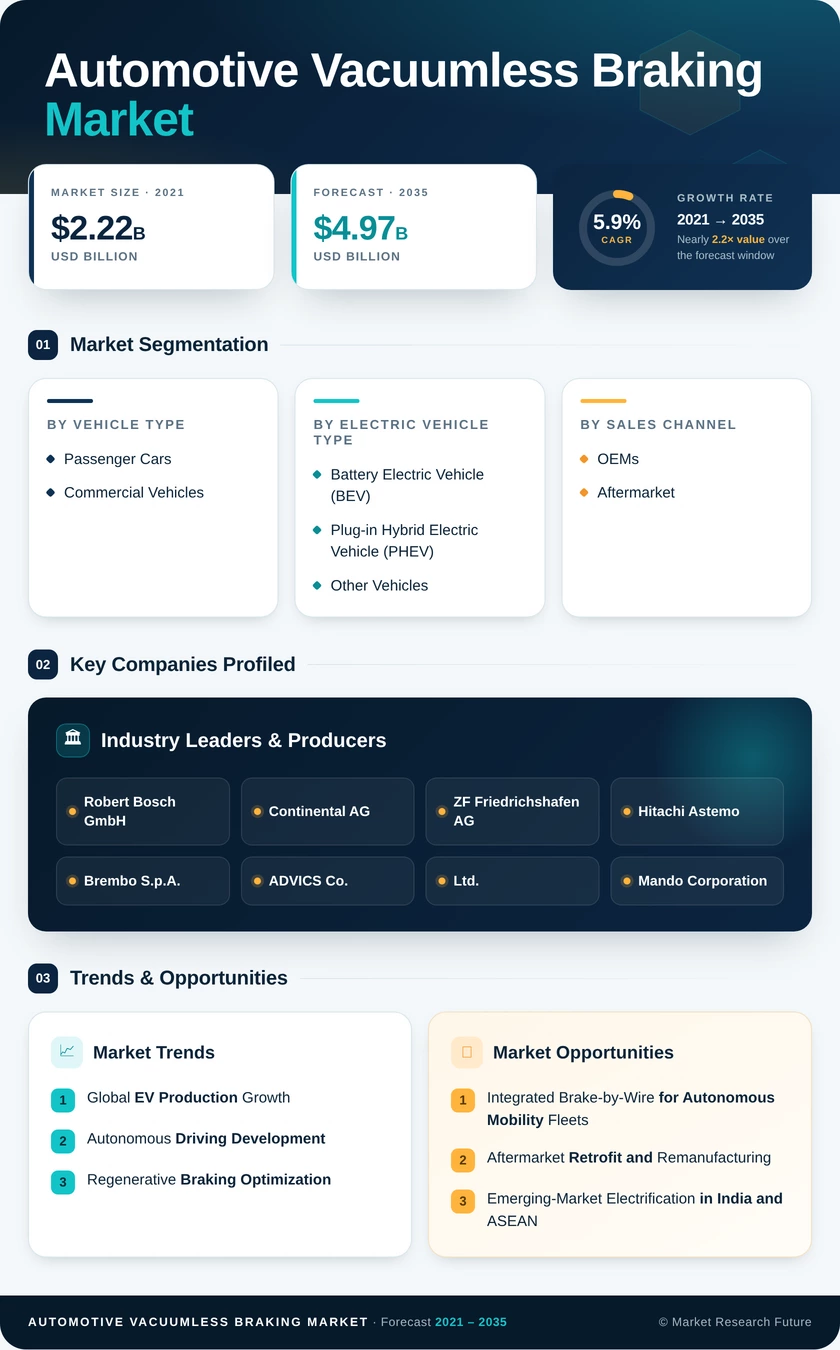
SEGMENTATION QUICK REFERENCE
| Dimension | Sub-Segments | Dominant Segment | Fastest Growing Segment |
| Vehicle Type | Passenger Cars; Commercial Vehicles | Passenger Cars (~68%) | Commercial Vehicles (CAGR ~7.1%) |
| Electric Vehicle Type | Battery Electric Vehicle (BEV); Plug-in Hybrid Electric Vehicle (PHEV); Other Vehicles | Battery Electric Vehicle (~52%) | Plug-in Hybrid Electric Vehicle (CAGR ~6.5%) |
| Sales Channel | OEMs; Aftermarket | OEMs (~89%) | Aftermarket (CAGR ~8.3%) |
| Geography | North America; Europe; Asia-Pacific; South America; Middle East & Africa | Asia-Pacific (~38%) | Asia-Pacific (CAGR ~6.8%) |
MARKET SEGMENTATION OVERVIEW
By Vehicle Type
| Sub-Segment | Key Trend |
| Passenger Cars | Mass EV adoption across sedans, SUVs, and crossovers drives dominant demand for factory-fitted vacuumless braking modules |
| Commercial Vehicles | Electric medium-duty truck launches from Daimler Truck, Volvo Trucks, and BYD Commercial accelerate platform-level brake-by-wire adoption |
Passenger cars remain the revenue foundation of the automotive vacuumless braking market, reflecting the consumer EV transition that is several years ahead of commercial-vehicle electrification. Commercial vehicles are closing the gap as regulatory mandates and total-cost-of-ownership advantages push fleet operators toward electric drivetrains that require vacuumless braking architecture.
By Electric Vehicle Type
| Sub-Segment | Key Trend |
| Battery Electric Vehicle (BEV) | Every BEV requires vacuumless braking by default due to the absence of an engine-driven vacuum source |
| Plug-in Hybrid Electric Vehicle (PHEV) | OEMs increasingly adopt unified braking platforms across EV and PHEV variants to reduce engineering complexity |
| Other Vehicles | Mild hybrids and fuel-cell EVs gradually transition to electric brake boosters for efficiency and packaging benefits |
BEVs constitute the structural core of demand because they entirely lack vacuum generation capability. PHEV growth is accelerating as shared-platform strategies make vacuumless braking the standard specification rather than an EV-exclusive option.
By Sales Channel
| Sub-Segment | Key Trend |
| OEMs | Factory-fit integration on EV platforms accounts for the overwhelming majority of current revenue |
| Aftermarket | Replacement demand from 2018–2022 vintage EVs reaching 7–10 year service windows will unlock a fast-growing secondary channel |
The OEM channel dominates today, but the aftermarket segment is positioned for the highest growth rate as the global EV fleet ages and requires brake-module replacement and remanufacturing services.