×
Request Free Sample ×

Kindly complete the form below to receive a free sample of this Report

* Please use a valid business email

Leading companies partner with us for data-driven Insights

clients tt-cursor
Hero Background

Autonomous Underwater Vehicle Market

ID: MRFR/AD/5915-CR
160 Pages
Swapnil Palwe
April 2020

Autonomous Underwater Vehicle Market Research Report Information By Type (Shallow, Medium and Large), Technology (Communication, Collision Avoidance, Navigation, Imaging and Propulsion), Payload (Sensors, Cameras, Synthetic Aperture Sonars, Echo Sounders, Acoustic Doppler Current Profilers (ADCPs) and Others), Application (Military & Defense, Oil & Gas, Oceanography, Environmental Protection and Monitoring, Archaeological and Exploration and Search and Salvage Operations) - Forecast to 2030

Share:
Download PDF ×

We do not share your information with anyone. However, we may send you emails based on your report interest from time to time. You may contact us at any time to opt-out.

Autonomous Underwater Vehicle Market Infographic
Purchase Options

Autonomous Underwater Vehicle Market Summary

As per MRFR analysis, the Autonomous Underwater Vehicle Market Size was estimated at 18.1 USD Million in 2024. The Autonomous Underwater Vehicle industry is projected to grow from 19.1 in 2025 to 33.0 by 2035, exhibiting a compound annual growth rate (CAGR) of 5.62 during the forecast period 2025 - 2035.

Key Market Trends & Highlights

The Autonomous Underwater Vehicle Market is poised for substantial growth driven by technological advancements and diverse applications.

  • North America remains the largest market for Autonomous Underwater Vehicles, driven by robust defense and scientific research initiatives.
  • The Asia-Pacific region is emerging as the fastest-growing market, fueled by increasing investments in marine research and environmental monitoring.
  • The defense segment continues to dominate the market, while the scientific research segment is experiencing rapid growth due to heightened interest in ocean exploration.
  • Technological advancements and the growing demand for marine research are key drivers propelling the market forward.

Market Size & Forecast

2024 Market Size 18.1 (USD Million)
2035 Market Size 33.0 (USD Million)
CAGR (2025 - 2035) 5.62%

Major Players

Teledyne Technologies (US), Kongsberg Gruppen (NO), Saab AB (SE), Lockheed Martin Corporation (US), Ocean Infinity (GB), General Dynamics Mission Systems (US), Boeing (US), Fugro (NL), Bluefin Robotics (US)

Autonomous Underwater Vehicle Market Trends

The Autonomous Underwater Vehicle Market is currently experiencing a notable evolution, driven by advancements in technology and increasing demand across various sectors. The integration of artificial intelligence and machine learning into these vehicles enhances their operational capabilities, allowing for more efficient data collection and analysis. This trend is particularly evident in marine research, where autonomous vehicles are utilized for environmental monitoring and exploration. Furthermore, the growing interest in underwater exploration for natural resources, such as oil and gas, is propelling the market forward, as these vehicles offer a safer and more cost-effective alternative to traditional methods. In addition to technological advancements, the Autonomous Underwater Vehicle Market is witnessing a shift in applications. Defense and security sectors are increasingly adopting these vehicles for surveillance and reconnaissance missions, indicating a diversification of their use. Moreover, the rise in underwater tourism and recreational activities is also contributing to market growth, as companies seek innovative solutions to enhance the experience. As the market continues to expand, it appears poised for further development, with potential opportunities emerging in various industries, including telecommunications and environmental conservation.

Technological Advancements

The integration of cutting-edge technologies, such as artificial intelligence and machine learning, is transforming the Autonomous Underwater Vehicle Market. These innovations enhance the vehicles' capabilities, enabling them to perform complex tasks with greater efficiency and accuracy.

Diversification of Applications

The market is experiencing a broadening of applications, particularly in defense and security. Autonomous underwater vehicles are increasingly utilized for surveillance and reconnaissance, showcasing their versatility beyond traditional marine research.

Emerging Market Opportunities

As interest in underwater exploration grows, new opportunities are arising within the Autonomous Underwater Vehicle Market. Industries such as telecommunications and environmental conservation are beginning to explore the potential of these vehicles for various applications.

Autonomous Underwater Vehicle Market Drivers

Rising Demand for Marine Exploration

The Global Autonomous Underwater Vehicle Industry experiences a surge in demand driven by the increasing need for marine exploration. Governments and research institutions are investing in AUVs to explore ocean depths, which remain largely uncharted. For instance, the National Oceanic and Atmospheric Administration (NOAA) emphasizes the importance of understanding marine ecosystems, leading to a projected market value of 2.67 USD Billion in 2024. This trend is expected to escalate as more countries recognize the economic and environmental benefits of marine research, potentially contributing to the market's growth trajectory.

Market Segment Insights

By Application: Defense (Largest) vs. Scientific Research (Fastest-Growing)

The Autonomous Underwater Vehicle (AUV) market exhibits a diverse range of applications, with the Defense sector taking the lead in market share. This segment is driven by increasing military investments in advanced surveillance and reconnaissance capabilities. On the other hand, Scientific Research is rapidly emerging as a significant segment, exhibiting the fastest growth as academic institutions and research organizations seek AUVs for deep-sea exploration and data collection. As the need for efficient underwater data gathering and analysis grows, AUV applications in Scientific Research are expected to flourish. Factors such as technological advancements, coupled with funding for marine research initiatives, are propelling the growth of this segment. Additionally, the rising importance of oceanic ecosystem monitoring drives demand for specialized AUV models within this sector.

Defense (Dominant) vs. Scientific Research (Emerging)

In the Autonomous Underwater Vehicle market, the Defense sector remains dominant due to substantial investments in military technology and the need for enhanced underwater capabilities. AUVs deployed in defense applications are characterized by their ability to perform complex missions, including intelligence, surveillance, and reconnaissance (ISR), which are crucial for national security. Conversely, the Scientific Research segment is emerging as an important player, focusing on oceanographic studies, environmental monitoring, and marine biology. This segment's growth is fueled by technological innovations in AUV design, which allow for longer missions and greater data collection capabilities. Both segments leverage advancements in AI and automation, but each addresses distinct operational requirements and challenges.

By End Use: Oil and Gas (Largest) vs. Marine Research (Fastest-Growing)

In the Autonomous Underwater Vehicle (AUV) market, the end-use segment showcases a diverse application landscape. The Oil and Gas sector holds the largest share as companies leverage AUV technology for offshore exploration and infrastructure inspections. Conversely, Marine Research is witnessing rapid uptake, as researchers increasingly rely on AUVs to collect data from uncharted waters and conduct environmental monitoring. Other notable sectors include Search and Rescue, Aquaculture, and Underwater Inspection, each contributing to the growing demand for enhanced underwater capabilities. The growth trends within the AUV market are driven by technological advancements and an increasing need for efficient underwater operations. The Oil and Gas industry continues to invest in innovative AUV solutions, optimizing exploration processes. In contrast, Marine Research is fueled by expanded funding for scientific exploration and climate studies, making it the fastest-growing segment. Additionally, sectors such as Search and Rescue and Aquaculture are evolving, with AUVs being integrated into operational workflows to enhance efficiency and safety in underwater tasks.

Oil and Gas: Dominant vs. Marine Research: Emerging

The Oil and Gas sector remains the dominant force in the Autonomous Underwater Vehicle market, characterized by its extensive investment in Subsea robotics technology. Companies utilize AUVs for critical tasks such as pipeline inspection, seismic surveys, and environmental monitoring, ensuring compliance and safety in offshore operations. As the energy landscape shifts towards sustainable practices, innovations in AUVs are expected to play a pivotal role in enhancing operational efficiency. Meanwhile, Marine Research is emerging as a significant player, driven by its necessity for precision in data collection and environmental conservation efforts. This sector is attracting considerable interest from academic institutions and governmental bodies, fueling advancements in AUV capabilities to explore deeper waters and assess marine biodiversity.

By Vehicle Type: Remotely Operated Vehicle (Largest) vs. Autonomous Underwater Vehicle (Fastest-Growing)

The Autonomous Underwater Vehicle Market is showcasing a diverse range of vehicle types, with Remotely Operated Vehicles (ROVs) commanding the largest share due to their extensive applications in marine research, underwater inspection, and offshore operations. They are favored for their reliability and the ability to provide real-time control over deep-sea explorations. In contrast, Autonomous Underwater Vehicles (AUVs) are the fastest-growing segment, increasingly gaining traction for their autonomous capabilities and innovative technologies that allow for more profound and extensive data collection without the need for direct human intervention.

Vehicle Types: ROV (Dominant) vs. AUV (Emerging)

Remotely Operated Vehicles (ROVs) stand as the dominant choice in the Autonomous Underwater Vehicle Market, largely owing to their traditional use in industries like oil and gas, where they serve critical roles in surveys and inspections. They are equipped with sophisticated imaging and manipulation tools. On the other hand, Autonomous Underwater Vehicles (AUVs) represent an emerging force in this landscape, equipped with advanced sensors and capable of navigating autonomously over extended periods. Their growing adoption in oceanography and environmental monitoring signifies a shift towards more automated, cost-effective solutions, enhancing exploration capabilities.

By Payload Capacity: Lightweight (Largest) vs. Heavyweight (Fastest-Growing)

In the Autonomous Underwater Vehicle (AUV) market, the payload capacity segments present a diverse distribution. The Lightweight segment holds the largest market share, favored for its agility and adaptability in various underwater operations. Meanwhile, the Medium Weight and Heavyweight segments also contribute significantly, catering to applications requiring more substantial payload capacities for complex missions. The Ultra Heavyweight category lags behind in terms of volume but is gaining traction for specialized uses.

Lightweight (Dominant) vs. Heavyweight (Emerging)

The Lightweight AUVs dominate the market by offering exceptional versatility and ease of deployment, making them ideal for research, environmental monitoring, and military reconnaissance. Their design and capability allow for operation in shallow waters with lower costs. On the other hand, Heavyweight AUVs are emerging quickly as advancements in technology enable them to undertake missions that require greater payloads and enhanced endurance. These vehicles are tailor-made for applications like underwater construction and deep-sea exploration, showcasing their substantial growth potential with increasing interest from the defense and scientific communities.

By Technology: Sonar Technology (Largest) vs. Camera Technology (Fastest-Growing)

In the Autonomous Underwater Vehicle (AUV) market, the technology segment is predominantly led by sonar technology, which holds the largest market share. This segment is vital for underwater mapping, object detection, and marine life monitoring, making it indispensable for various applications like defense and environmental studies. Camera technology has emerged as a crucial component as well, significantly enhancing visual data collection and analysis. However, it currently holds a smaller share compared to sonar technology but is rapidly gaining traction due to advancements in imaging techniques and affordability. The growth trends within the technology segment highlight increasing investments in AUV developments and a rising demand for enhanced operational efficiency. As industries recognize the importance of real-time data and autonomous operations, both sonar and camera technologies are expected to witness significant advancements. The integration of emerging technologies like artificial intelligence and machine learning is further driving growth, allowing AUVs to perform complex tasks autonomously, thus attracting more investments and applications across various sectors.

Technology: Sonar (Dominant) vs. Camera (Emerging)

Sonar technology plays a dominant role in the Autonomous Underwater Vehicle market due to its pivotal applications in navigation, obstacle detection, and underwater mapping. It employs sound propagation to facilitate high-resolution mapping and the detection of objects at various depths, which is essential for military and commercial explorations. In contrast, camera technology, characterized by high-definition imaging capabilities and evolving sensor technologies, is gaining momentum as an emerging solution for visual surveillance and data analytics. As operational scopes expand, camera systems are enhancing AUV functionalities by providing critical insights into underwater environments. This technology is increasingly being integrated with sonar systems to offer a comprehensive data suite for users, blending the strengths of both modalities for more effective underwater exploration and monitoring.

Get more detailed insights about Autonomous Underwater Vehicle Market

Regional Insights

North America : Market Leader in Innovation

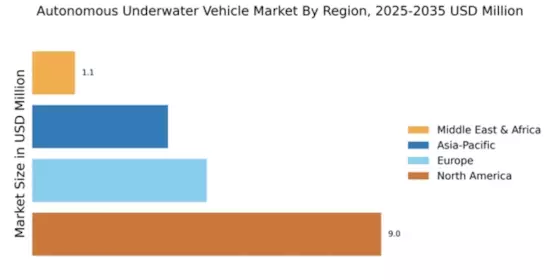
North America is poised to maintain its leadership in the Autonomous Underwater Vehicle (AUV) market, holding a significant share of 9.0 in 2024. The region's growth is driven by increasing investments in defense and marine research, alongside advancements in technology. Regulatory support from government agencies is fostering innovation, particularly in environmental monitoring and underwater exploration, which are key demand drivers. The competitive landscape is robust, with major players like Teledyne Technologies, Lockheed Martin, and Boeing leading the charge. The U.S. is the primary market, benefiting from a strong defense budget and a focus on technological advancements. The presence of established companies and a growing number of startups are enhancing the region's market dynamics, ensuring continued growth and innovation in AUV technologies.

Europe : Emerging Hub for AUVs

Europe is emerging as a significant player in the Autonomous Underwater Vehicle (AUV) market, with a market size of 4.5 in 2024. The region's growth is fueled by increasing demand for marine research and environmental monitoring, supported by stringent regulations aimed at sustainable practices. The European Union's initiatives to enhance marine safety and environmental protection are acting as catalysts for market expansion. Leading countries such as Norway, the UK, and Germany are at the forefront of AUV development, with companies like Kongsberg Gruppen and Saab AB driving innovation. The competitive landscape is characterized by collaboration between private firms and governmental organizations, enhancing research capabilities. The presence of key players and a focus on sustainable technologies position Europe as a vital hub for AUV advancements.

Asia-Pacific : Rapidly Growing Market

The Asia-Pacific region is witnessing rapid growth in the Autonomous Underwater Vehicle (AUV) market, with a market size of 3.0 in 2024. This growth is driven by increasing investments in marine research, defense applications, and underwater exploration. Countries are focusing on enhancing their maritime capabilities, supported by government initiatives aimed at technological advancements and environmental sustainability. Key players in the region include companies from Japan, China, and Australia, with a competitive landscape that is evolving quickly. The presence of firms like Fugro and Bluefin Robotics is indicative of the region's potential. As nations prioritize maritime security and environmental monitoring, the demand for AUVs is expected to rise significantly, positioning Asia-Pacific as a crucial market for future developments.

Middle East and Africa : Emerging Market Potential

The Middle East and Africa region is gradually emerging in the Autonomous Underwater Vehicle (AUV) market, with a market size of 1.6 in 2024. The growth is primarily driven by increasing investments in oil and gas exploration, as well as marine research initiatives. Governments are recognizing the importance of AUVs for enhancing maritime security and environmental monitoring, leading to supportive regulatory frameworks. Countries like South Africa and the UAE are taking the lead in adopting AUV technologies, with a focus on enhancing their maritime capabilities. The competitive landscape is still developing, but the presence of international players is fostering growth. As the region continues to invest in technological advancements, the AUV market is expected to expand, presenting significant opportunities for both local and international companies.

Key Players and Competitive Insights

The Autonomous Underwater Vehicle Market is currently characterized by a dynamic competitive landscape, driven by technological advancements and increasing demand for underwater exploration and surveillance. Key players such as Teledyne Technologies (US), Kongsberg Gruppen (NO), and Lockheed Martin Corporation (US) are at the forefront, each adopting distinct strategies to enhance their market positioning. Teledyne Technologies (US) focuses on innovation through continuous investment in R&D, aiming to develop cutting-edge AUV technologies that cater to both commercial and defense sectors. Meanwhile, Kongsberg Gruppen (NO) emphasizes strategic partnerships, collaborating with various marine research institutions to expand its technological capabilities and market reach. Lockheed Martin Corporation (US) is leveraging its defense expertise to penetrate the AUV market, particularly in military applications, thereby shaping a competitive environment that is increasingly reliant on advanced technology and strategic alliances.

The business tactics employed by these companies reflect a concerted effort to optimize operations and enhance market presence. Localizing manufacturing and optimizing supply chains are prevalent strategies, allowing companies to reduce costs and improve delivery times. The market structure appears moderately fragmented, with several players vying for dominance, yet the collective influence of major companies like Teledyne and Kongsberg suggests a trend towards consolidation as firms seek to enhance their competitive edge.

In November 2025, Teledyne Technologies (US) announced the launch of its latest AUV model, which integrates advanced AI capabilities for real-time data analysis. This strategic move is significant as it positions Teledyne to meet the growing demand for autonomous systems capable of complex underwater tasks, thereby reinforcing its leadership in innovation. Similarly, in October 2025, Kongsberg Gruppen (NO) secured a contract with a leading oil and gas company to provide AUVs for subsea inspections, highlighting its focus on expanding its footprint in the energy sector. This partnership not only enhances Kongsberg's market share but also underscores the increasing reliance on AUVs for critical industrial applications.

In September 2025, Lockheed Martin Corporation (US) entered into a joint venture with a prominent marine technology firm to develop next-generation AUVs tailored for military operations. This collaboration is pivotal, as it combines Lockheed's defense expertise with innovative marine technology, potentially leading to breakthroughs in underwater defense capabilities. Furthermore, in August 2025, Ocean Infinity (GB) announced a strategic acquisition of a smaller AUV manufacturer, which is likely to bolster its technological portfolio and market position, reflecting a trend of consolidation within the industry.

As of December 2025, the competitive trends in the Autonomous Underwater Vehicle Market are increasingly defined by digitalization, sustainability, and the integration of AI technologies. Strategic alliances are becoming more prevalent, as companies recognize the need to collaborate to enhance their technological capabilities and market reach. Looking ahead, it is anticipated that competitive differentiation will evolve, shifting from price-based competition to a focus on innovation, advanced technology, and supply chain reliability. This transition may redefine the competitive landscape, compelling companies to invest in R&D and strategic partnerships to maintain their market positions.

Key Companies in the Autonomous Underwater Vehicle Market market include

Industry Developments

  • Q2 2024: Saab wins $50 million contract to supply autonomous underwater vehicles to the U.S. Navy Saab announced it has secured a $50 million contract to deliver advanced autonomous underwater vehicles (AUVs) for mine countermeasure operations to the U.S. Navy, marking a significant expansion of its defense technology footprint.
  • Q2 2024: Kongsberg opens new AUV manufacturing facility in Norway Kongsberg Gruppen inaugurated a state-of-the-art manufacturing facility dedicated to autonomous underwater vehicles in Horten, Norway, aiming to scale up production to meet rising global demand for maritime robotics.
  • Q1 2024: Ocean Infinity secures $30 million funding round to expand AUV fleet Ocean Infinity, a leader in marine robotics, closed a $30 million funding round led by institutional investors to accelerate the expansion of its autonomous underwater vehicle fleet for deep-sea exploration and data services.
  • Q2 2024: Hydromea partners with Shell for autonomous underwater inspection pilot Swiss startup Hydromea announced a partnership with Shell to deploy its wireless AUVs for subsea infrastructure inspection, marking a major step in commercializing autonomous underwater robotics for the energy sector.
  • Q3 2024: Teledyne Marine launches new G3 AUV platform for scientific research Teledyne Marine unveiled its next-generation G3 autonomous underwater vehicle, designed for extended-range oceanographic research missions, featuring enhanced battery life and advanced sensor integration.
  • Q1 2024: Bluefin Robotics awarded contract for autonomous mine-hunting vehicles by UK Ministry of Defence Bluefin Robotics, a subsidiary of General Dynamics, announced a contract win from the UK Ministry of Defence to supply autonomous underwater vehicles for mine-hunting operations in the Royal Navy.
  • Q2 2025: L3Harris Technologies acquires DeepSea Robotics to expand AUV portfolio L3Harris Technologies completed the acquisition of DeepSea Robotics, a specialist in compact autonomous underwater vehicles, strengthening its position in the defense and commercial maritime robotics market.
  • Q1 2025: ECA Group secures €20 million contract for AUVs with French Navy ECA Group announced it has signed a €20 million contract to deliver autonomous underwater vehicles for mine countermeasure missions to the French Navy, supporting naval modernization efforts.
  • Q3 2024: Fugro launches new deepwater AUV for offshore energy sector Fugro introduced a new deepwater autonomous underwater vehicle designed for high-resolution seabed mapping and inspection, targeting the growing needs of the offshore oil and gas industry.
  • Q2 2024: Sonardyne and SeeByte announce partnership for advanced AUV navigation systems Sonardyne and SeeByte revealed a strategic partnership to co-develop next-generation navigation and autonomy solutions for commercial and defense autonomous underwater vehicles.
  • Q1 2025: China's SMD launches new commercial AUV for marine survey market SMD, a leading Chinese subsea technology company, launched a new commercial autonomous underwater vehicle aimed at the marine survey and environmental monitoring sectors.
  • Q2 2025: Kongsberg Gruppen appoints new CEO to lead AUV business expansion Kongsberg Gruppen announced the appointment of a new CEO, signaling a strategic focus on expanding its autonomous underwater vehicle business in global defense and commercial markets.

Recent Development

In February 2020, Lockheed Martin won a two-year USD 12.3 Million agreement to help the Defense Advanced Projects Agency assemble and exhibit an additional huge Autonomous Underwater Vehicle Market.

In December 2019, Sweden's FMV granted an agreement to Saab AB for a self-impelled maritime mine turn of events. The new maritime mine will be founded on Autonomous Underwater Vehicle Market (UAV) innovation.

Market Report

Market overview

  • Global recognition of Market Analysis
  •  Analysis based upon COVID 19
  • Explanation upon the Market Outlook
  • Value chain analysis for the Market Report.


Future Outlook

Autonomous Underwater Vehicle Market Future Outlook

The Autonomous Underwater Vehicle Market is projected to grow at a 5.62% CAGR from 2024 to 2035, driven by advancements in marine exploration, defense applications, and environmental monitoring.

New opportunities lie in:

  • Development of AI-driven navigation systems for enhanced operational efficiency.
  • Expansion into renewable energy sector for underwater inspections and maintenance.
  • Partnerships with research institutions for innovative underwater data collection solutions.

By 2035, the Autonomous Underwater Vehicle Market is expected to achieve substantial growth and diversification.

Market Segmentation

Autonomous Underwater Vehicle Market End Use Outlook

  • Oil and Gas
  • Marine Research
  • Search and Rescue
  • Aquaculture
  • Underwater Inspection

Autonomous Underwater Vehicle Market Technology Outlook

  • Sonar Technology
  • Camera Technology
  • Navigation Technology
  • Communication Technology

Autonomous Underwater Vehicle Market Application Outlook

  • Defense
  • Scientific Research
  • Commercial Exploration
  • Environmental Monitoring
  • Underwater Construction

Autonomous Underwater Vehicle Market Vehicle Type Outlook

  • Remotely Operated Vehicle
  • Autonomous Underwater Vehicle
  • Hybrid Vehicle
  • Surface Vehicle
  • Unmanned Underwater Vehicle

Autonomous Underwater Vehicle Market Payload Capacity Outlook

  • Lightweight
  • Medium Weight
  • Heavyweight
  • Ultra Heavyweight

Report Scope

MARKET SIZE 202418.1(USD Million)
MARKET SIZE 202519.1(USD Million)
MARKET SIZE 203533.0(USD Million)
COMPOUND ANNUAL GROWTH RATE (CAGR)5.62% (2024 - 2035)
REPORT COVERAGERevenue Forecast, Competitive Landscape, Growth Factors, and Trends
BASE YEAR2024
Market Forecast Period2025 - 2035
Historical Data2019 - 2024
Market Forecast UnitsUSD Million
Key Companies ProfiledTeledyne Technologies (US), Kongsberg Gruppen (NO), Saab AB (SE), Lockheed Martin Corporation (US), Ocean Infinity (GB), General Dynamics Mission Systems (US), Boeing (US), Fugro (NL), Bluefin Robotics (US)
Segments CoveredApplication, End Use, Vehicle Type, Payload Capacity, Technology
Key Market OpportunitiesAdvancements in artificial intelligence enhance operational efficiency in the Autonomous Underwater Vehicle Market.
Key Market DynamicsTechnological advancements and regulatory changes drive innovation and competition in the Autonomous Underwater Vehicle market.
Countries CoveredNorth America, Europe, APAC, South America, MEA

Market Highlights

Author
Swapnil Palwe
Team Lead - Research

With a technical background as Bachelor's in Mechanical Engineering, with MBA in Operations Management , Swapnil has 6+ years of experience in market research, consulting and analytics with the tasks of data mining, analysis, and project execution. He is the POC for our clients, for their consulting projects running under the Automotive/A&D domain. Swapnil has worked on major projects in verticals such as Aerospace & Defense, Automotive and many other domain projects. He has worked on projects for fortune 500 companies' syndicate and consulting projects along with several government projects.

Leave a Comment

FAQs

What is the CAGR for autonomous underwater vehicle industry?

Autonomous underwater vehicle (AUV) market is expected to grow at a CAGR 17.89%by 2030.

What are the top players operating in the Autonomous underwater vehicle (AUV) Market?

Top vendirds anticipated for driving the AUV market growth during the forecast are Boston Engineering Corporation (US),,Kongsberg Maritime (Norway),,The ECA Group (France),,Teledyne Technologies Incorporated (US),,Lockheed Martin Corporation (US),,General Dynamics Corporation (US),,Graal Tech Srl (Italy),,Saab AB (Sweden),,Fugro (Netherlands)

Who are key players of the autonomous underwater vehicle market?

Lockheed Martin Corporation (US), General Dynamics Corporation (US), Fugro (Netherlands), and Kongsberg Maritime (Norway) are some reputed names in the autonomous underwater vehicle market.

What is the autonomous underwater vehicle industry driver?

Rapid development in GPS technology can promote the autonomous underwater vehicle market.

What is the autonomous underwater vehicleindustry restrain?

The unavailability of expertise to hinder the autonomous underwater vehicle market.

What is the valuation of the autonomous underwater vehicle market?

By 2030, the autonomous underwater vehicle market value can touch USD 9,389.9 million.

Download Free Sample

Kindly complete the form below to receive a free sample of this Report

Compare Licence

×
Features License Type
Single User Multiuser License Enterprise User
Price $4,950 $5,950 $7,250
Maximum User Access Limit 1 User Upto 10 Users Unrestricted Access Throughout the Organization
Free Customization
Direct Access to Analyst
Deliverable Format
Platform Access
Discount on Next Purchase 10% 15% 15%
Printable Versions