
×
Hero Background
English
Chinese
French
Japanese
Korean
German
Spanish

Aviation Asset Management Market Share

ID: MRFR/AD/7201-HCR
168 Pages
Sejal Akre
October 2025

Aviation Asset Management Market Research Report Information by Service Type (Leasing Services, Technical Services, and Regulatory Certification), End-Use (Commercial Platforms and Maintenance, Repair and Overhaul [MRO] Services) and Region (North America, Europe, Asia-Pacific, Middle East & Africa and Latin America) - Forecast till 2035

Share:
Download PDF ×

We do not share your information with anyone. However, we may send you emails based on your report interest from time to time. You may contact us at any time to opt-out.

Aviation Asset Management Market Infographic
Purchase Options

Market Share

Aviation Asset Management Market Share Analysis

In the aerospace sector, where businesses oversee and maximize the entire lifespan of airplanes and related assets, aviation asset management is essential. In this quick-paced sector, market share positioning strategies are critical to success and longevity. Businesses employ a variety of vital strategies to gain traction and grow their market share. A well-known tactic is to specialize and narrow your emphasis. Certain Aviation Asset Management organizations establish a specialty by focusing on particular asset classes, including cargo planes, regional jets, or helicopters. They can provide specialized solutions and services catered to the particular requirements of clients functioning within that niche by becoming into specialists in that particular market. With this focused strategy, businesses may set themselves apart and take a sizable chunk of the market in their niche. Leaders in the market also frequently place a high priority on technological advancement and adoption. Companies who embrace the latest innovations and provide creative solutions get a competitive edge in an industry known for its rapid advances. This could involve using advanced analytics for making decisions based on data, integrating machine learning for predictive maintenance, or utilizing blockchain for safe and transparent asset transfers. Companies can increase their market share by attracting consumers looking for cutting-edge and effective asset management solutions by being on the cutting edge of technology innovations. In addition, cooperation and strategic alliances are essential for market positioning. In order to establish a complete ecosystem, aviation asset management organizations frequently collaborate with airlines, leasing firms, and maintenance providers. They are able to provide end-to-end solutions, encompassing asset purchase, maintenance, and retirement, thanks to their agreements. This integrated strategy, which offers a one-stop shop for all aircraft asset management needs, improves the value offering for clients and aids businesses in gaining a greater market share. Moreover, a typical tactic to gain market share is regional expansion. Firms that extend their reach into new areas might take advantage of opportunities as the requirement for aviation asset management solutions rises worldwide. Through partnerships, mergers and acquisitions or the construction of new offices, businesses can broaden their geographic reach and grow their market share. Another successful market share positioning tactic is cost leadership. Businesses can sustain profitability while offering competitive pricing by reducing operations, deploying cost-effective technology, and maximizing operational efficiency. This draws in customers who are price conscious and establishes the business as a provider of affordable solutions, both of which eventually help to increase market share. In summary, there is intense competition in the aviation asset management sector, and businesses use a range of tactics to position themselves advantageously. Market leaders employ several strategies such as technology innovation, collaboration, specialization, geographic expansion, and expense leadership to increase their market share. Successful businesses will be those who adjust and put into practice efficient solutions to handle the challenges of aircraft asset management as the aerospace sector continues to change.


Author
Sejal Akre
Senior Research Analyst

She has over 5 years of rich experience, in market research and consulting providing valuable market insights to client. Hands on expertise in management consulting, and extensive knowledge in domain including ICT, Automotive & Transportation and Aerospace & Defense. She is skilled in Go-to market strategy, industry analysis, market sizing, in depth company profiling, competitive intelligence & benchmarking and value chain amongst others.

Leave a Comment

FAQs

What is the projected CAGR of the Global Aviation Asset Management Market?

Global aviation asset management market is projected to acquire market value of USD 8034.98 billion by 2030

At what CAGR is the global aviation asset management market estimated to thrive?

Global aviation asset management market is estimated to thrive at a CAGR of 4.04% by 2030

What is the market USP of the global aviation asset management market?

The increasing investment in the aviation industry is the market USP of the global aviation asset management market.

What are the impeding factors of the global aviation asset management market?

The strict rules and regulations prevailing in the industry are likely to impede the global aviation asset management market.

Who are the key players in the global aviation asset management market?

AerData BV (U.S.), G.E. Capital Aviation Services (U.S.), Aercap Holdings NV (Netherlands), G. Telesis, LLC (U.S.), are some of the established players of the global aviation asset management market.

Market Summary

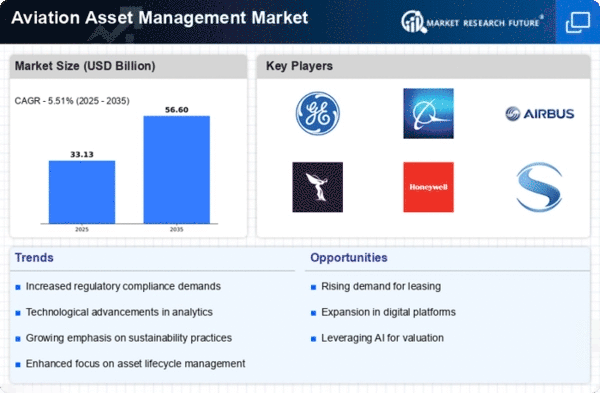
As per MRFR analysis, the Aviation Asset Management Market Size was estimated at 31.4 USD Billion in 2024. The Aviation Asset Management industry is projected to grow from 33.1 in 2025 to 56.6 by 2035, exhibiting a compound annual growth rate (CAGR) of 5.51 during the forecast period 2025 - 2035.

Key Market Trends & Highlights

The Aviation Asset Management Market is poised for substantial growth driven by digital transformation and sustainability initiatives.

  • Digital transformation is reshaping asset management practices, enhancing efficiency and decision-making.
  • Sustainability initiatives are increasingly influencing investment strategies within the aviation sector.
  • Collaborative ecosystems are emerging, fostering partnerships that drive innovation and operational excellence.
  • Technological advancements and a growing focus on sustainability are key drivers propelling the demand for fleet optimization in North America and Asia-Pacific.

Market Size & Forecast

2024 Market Size 31.4 (USD Billion)
2035 Market Size 56.6 (USD Billion)
CAGR (2025 - 2035) 5.51%
Largest Regional Market Share in 2024 North America

Major Players

<p>GE Aviation (US), Boeing (US), Airbus (FR), Rolls-Royce (GB), Honeywell (US), Safran (FR), Lufthansa Technik (DE), Aviation Capital Group (US), Air Lease Corporation (US)</p>

Market Trends

The Aviation Asset Management Market is currently experiencing a transformative phase, driven by advancements in technology and evolving industry demands. The integration of digital solutions, such as artificial intelligence and data analytics, is reshaping how assets are monitored and managed. This shift not only enhances operational efficiency but also optimizes asset utilization, thereby potentially reducing costs for operators. Furthermore, the increasing focus on sustainability and regulatory compliance is prompting stakeholders to adopt more responsible asset management practices. As a result, companies are likely to invest in innovative tools that facilitate better decision-making and improve overall asset performance. In addition, the Aviation Asset Management Market appears to be influenced by the growing trend of collaboration among various stakeholders, including manufacturers, operators, and service providers. This collaborative approach fosters knowledge sharing and resource pooling, which may lead to enhanced service offerings and improved customer satisfaction. Moreover, the rise of remote monitoring technologies is enabling real-time tracking of asset conditions, which could further streamline maintenance processes and reduce downtime. Overall, the Aviation Asset Management Market is poised for continued growth as it adapts to the changing landscape of the aviation industry.

Digital Transformation

The Aviation Asset Management Market is witnessing a significant shift towards digital transformation. Companies are increasingly adopting advanced technologies such as artificial intelligence and machine learning to enhance asset tracking and management. This trend not only improves operational efficiency but also enables predictive maintenance, thereby reducing unexpected downtimes.

Sustainability Initiatives

There is a growing emphasis on sustainability within the Aviation Asset Management Market. Stakeholders are prioritizing eco-friendly practices and compliance with environmental regulations. This shift encourages the adoption of sustainable asset management strategies, which may lead to reduced carbon footprints and improved corporate responsibility.

Collaborative Ecosystems

The trend towards collaborative ecosystems is becoming more pronounced in the Aviation Asset Management Market. Various stakeholders, including manufacturers, operators, and service providers, are forming partnerships to share resources and knowledge. This collaboration enhances service offerings and fosters innovation, ultimately benefiting the entire aviation sector.

Aviation Asset Management Market Market Drivers

Market Growth Projections

The Global Aviation Asset Management Market Industry is poised for substantial growth, with projections indicating a market size of 5544.7 USD Billion in 2024 and an anticipated increase to 9048.7 USD Billion by 2035. This growth trajectory suggests a compound annual growth rate (CAGR) of 4.55% from 2025 to 2035. The increasing complexity of aviation operations, coupled with the demand for efficient asset management solutions, is likely to drive this expansion. As airlines and operators continue to invest in advanced technologies and sustainable practices, the market is expected to evolve, presenting new opportunities for stakeholders.

Regulatory Compliance and Safety Standards

The Global Aviation Asset Management Market Industry is significantly influenced by stringent regulatory compliance and safety standards. Governments and aviation authorities are enforcing regulations that require airlines to maintain high safety and operational standards. This necessitates effective asset management strategies to ensure compliance and mitigate risks. As a result, airlines are increasingly investing in asset management solutions that facilitate adherence to these regulations. The focus on safety and compliance is expected to drive market growth, as operators seek to enhance their asset management capabilities to meet evolving regulatory requirements.

Growing Demand for Efficient Asset Management

The Global Aviation Asset Management Market Industry is experiencing a surge in demand for efficient asset management solutions. Airlines and operators are increasingly recognizing the need to optimize their asset utilization to enhance operational efficiency and reduce costs. This trend is driven by the rising complexity of aviation operations and the need for real-time data analytics. As a result, the market is projected to reach 5544.7 USD Billion in 2024, reflecting a growing emphasis on maximizing the value of aviation assets. Companies are investing in advanced technologies to streamline asset management processes, which is likely to further propel market growth.

Technological Advancements in Asset Management

Technological innovations are playing a pivotal role in shaping the Global Aviation Asset Management Market Industry. The integration of advanced technologies such as artificial intelligence, machine learning, and the Internet of Things is transforming asset management practices. These technologies enable predictive maintenance, real-time monitoring, and data-driven decision-making, which enhance operational efficiency and reduce downtime. As airlines adopt these innovations, the market is expected to witness substantial growth, with projections indicating a rise to 9048.7 USD Billion by 2035. The ongoing digital transformation in aviation is likely to create new opportunities for asset management providers.

Increasing Fleet Size and Expansion of Airlines

The expansion of airlines and the increasing fleet size are key drivers of the Global Aviation Asset Management Market Industry. As airlines expand their operations to meet growing passenger demand, they are acquiring new aircraft and enhancing their existing fleets. This growth necessitates robust asset management strategies to optimize fleet performance and ensure efficient resource allocation. The market is projected to grow at a CAGR of 4.55% from 2025 to 2035, driven by the need for effective management of larger and more diverse fleets. Airlines are likely to invest in comprehensive asset management solutions to support their expansion efforts.

Focus on Sustainability and Environmental Impact

Sustainability is becoming a central theme in the Global Aviation Asset Management Market Industry. Airlines are increasingly prioritizing environmental impact and seeking ways to reduce their carbon footprint. This focus on sustainability is driving the adoption of asset management practices that promote fuel efficiency and reduce waste. As regulatory pressures and public awareness of environmental issues grow, airlines are likely to invest in sustainable asset management solutions. This trend is expected to contribute to the overall growth of the market, as operators align their asset management strategies with sustainability goals.

Market Segment Insights

By Application: Fleet Management (Largest) vs. Compliance Management (Fastest-Growing)

<p>Within the Aviation Asset Management Market, Fleet Management stands strong as the largest segment, commanding the majority share, significantly outpacing the other segments. In contrast, Compliance Management is dynamically emerging as the fastest-growing segment, reflecting heightened regulatory focus and the need for improved oversight in aviation operations. The robust demand for efficient fleet tracking and management solutions highlights the paramount importance placed on effective asset utilization in the industry.</p>

<p>Fleet Management (Dominant) vs. Compliance Management (Emerging)</p>

<p>Fleet Management is characterized by its comprehensive approach to tracking and managing airline fleets, focusing on operational efficiency and cost reduction. Its dominance stems from airlines seeking scalable solutions to optimize routes, schedules, and maintenance processes. Conversely, Compliance Management is becoming an essential part of operational methodologies as organizations strive to meet increasingly stringent regulations and safety standards. This segment emphasizes risk mitigation through systematic audits and reporting tools, enabling operators to ensure compliance while also enhancing their operational protocols. The interplay of both segments reflects a maturing market eager to leverage data-driven decision-making in aviation operations.</p>

By End Use: Commercial Aviation (Largest) vs. Cargo Aviation (Fastest-Growing)

<p>The Aviation Asset Management Market is distinctly segmented by end use, with Commercial Aviation holding the largest market share. This segment encompasses passenger fleets operated by airlines globally, contributing significantly to asset management demands due to extensive operations. Conversely, Cargo Aviation is experiencing rapid expansion, driven by the increasing need for efficient logistics networks and e-commerce growth. This shift in focus towards cargo operations showcases a pivotal change in asset management strategies among aviation stakeholders. Growth trends indicate a paradigm shift in the Aviation Asset Management Market, where technology and digitalization play critical roles. As airlines modernize fleets and cargo operations leverage advanced tracking and management tools, the demand for effective asset management becomes paramount. The evolution towards more sustainable practices and increased regulatory requirements further fuel this segment’s growth, as stakeholders seek to optimize asset utilization and enhance operational efficiency.</p>

<p>Commercial Aviation (Dominant) vs. Military Aviation (Emerging)</p>

<p>Commercial Aviation serves as the dominant force in the Aviation Asset Management Market, driven by the sheer volume of passenger travel and the operations of major airlines worldwide. This segment prioritizes efficiency, cost-effectiveness, and compliance with stringent regulations, investing heavily in advanced asset management systems. On the other hand, Military Aviation is emerging as a critical sector with unique demands; however, its growth is characterized by distinct regulations and procurement processes. The military focus on advanced technologies and readiness creates a niche market, emphasizing the need for tailored asset management solutions. Both segments reflect different priorities and operational structures, shaping the future landscape of aviation asset management.</p>

By Asset Type: Aircraft (Largest) vs. Engines (Fastest-Growing)

<p>In the Aviation Asset Management Market, the segment distribution reveals that Aircraft is the dominant category, holding the largest share due to the high demand for efficient fleet management and asset optimization. Engines and Components follow closely, as operators seek to maximize efficiency and reduce operational costs through effective management practices. Ground Support Equipment, while vital, occupies a smaller portion of the market as it supports primarily the operational aspects of aviation management.</p>

<p>Aircraft (Dominant) vs. Engines (Emerging)</p>

<p>Aircraft assets command a significant presence in the Aviation Asset Management Market, serving as the backbone of airline operations. Their management involves intricate processes, including acquisition, maintenance, and retirement, which are critical for maximizing lifecycle value. On the other hand, engines are becoming an emerging focus within this market sector. As technology advances, and with increasing emphasis on fuel efficiency and sustainability, engine management is rapidly evolving. This rapidly changing landscape highlights the competitive dynamics between Aircraft and Engine management as airlines strive for operational excellence.</p>

By Service Type: Software Solutions (Largest) vs. Consulting Services (Fastest-Growing)

<p>The Aviation Asset Management Market is characterized by a diverse array of service types, with Software Solutions emerging as the most significant contributor to market share. This segment encompasses various software applications designed for asset management, fleet operations, and maintenance tracking—providing efficiency and automation that many airlines rely on. Consulting Services, while also critical, represent a smaller portion of the market but are rapidly gaining traction as more companies seek expertise in optimizing asset utilization and operational strategies. In terms of growth, Consulting Services are witnessing the fastest expansion due to increasing globalization and complexity in aviation operations. Companies are increasingly investing in consulting to enhance their operational efficiency and compliance with regulations. Meanwhile, Software Solutions benefit from technological advancements and the rising importance of data analytics in aviation. This bifurcation indicates a shifting focus within the Aviation Asset Management Market, driven by the need for modernization and strategic operational insights.</p>

<p>Software Solutions (Dominant) vs. Maintenance Services (Emerging)</p>

<p>The Software Solutions segment plays a dominant role in the Aviation Asset Management Market by providing advanced technological tools that automate operations and streamline management processes. Companies in this segment offer extensive functionalities, including inventory management, predictive maintenance, and compliance tracking, thereby enhancing efficiency and decision-making capabilities. Conversely, Maintenance Services represent an emerging segment that emphasizes the maintenance, repair, and overhaul (MRO) of aviation assets. As airlines and operators prioritize asset longevity and reliability, this segment is expected to grow rapidly. Maintenance Services not only ensure operational safety but are also becoming more integrated with digital tools, thus complementing Software Solutions to form a comprehensive approach to aviation asset management.</p>

Get more detailed insights about Aviation Asset Management Market Research Report - Global Forecast till 2035

Regional Insights

North America : Market Leader in Aviation

North America is poised to maintain its leadership in the Aviation Asset Management Market, holding a significant market share of 15.0 in 2025. The region's growth is driven by increasing air travel demand, technological advancements, and stringent regulatory frameworks that promote safety and efficiency. The presence of major players like GE Aviation and Boeing further fuels market expansion, supported by government initiatives aimed at enhancing aviation infrastructure and sustainability. The competitive landscape in North America is robust, with key players such as Honeywell and Aviation Capital Group leading the charge. The U.S. remains the largest market, benefiting from a well-established aviation sector and a high volume of aircraft operations. The region's focus on innovation and digital transformation in asset management solutions positions it favorably for future growth, ensuring that it remains at the forefront of The Aviation Asset Management.

Europe : Emerging Aviation Hub

Europe is witnessing a dynamic shift in the Aviation Asset Management Market, with a market size of 10.0 in 2025. The region's growth is propelled by increasing investments in fleet modernization and a rising emphasis on sustainability. Regulatory bodies are actively promoting initiatives that enhance operational efficiency and reduce environmental impact, creating a favorable environment for market expansion. The European Union's commitment to green aviation technologies is a significant catalyst for growth. Leading countries such as Germany, France, and the UK are at the forefront of this transformation, with major players like Airbus and Rolls-Royce driving innovation. The competitive landscape is characterized by collaborations between manufacturers and service providers, enhancing the overall value chain. As Europe continues to adapt to changing market demands, its aviation sector is set to thrive, supported by a strong regulatory framework and a focus on technological advancements.

Asia-Pacific : Rapidly Growing Market

The Asia-Pacific region is emerging as a significant player in the Aviation Asset Management Market, with a projected market size of 5.0 in 2025. This growth is driven by increasing air travel demand, expanding middle-class populations, and investments in airport infrastructure. Governments are implementing policies to enhance aviation safety and efficiency, which are crucial for market development. The region's focus on digital transformation in asset management is also a key growth driver. Countries like China and India are leading the charge, with a surge in aircraft acquisitions and fleet expansions. The competitive landscape is becoming increasingly dynamic, with both local and international players vying for market share. Key companies such as Honeywell and Aviation Capital Group are establishing a strong presence, contributing to the region's growth. As the Asia-Pacific aviation market continues to evolve, it is set to become a vital hub for asset management solutions.

Middle East and Africa : Emerging Aviation Frontier

The Middle East and Africa region is gradually establishing itself in the Aviation Asset Management Market, with a market size of 1.4 in 2025. The growth is primarily driven by increasing investments in aviation infrastructure and a rising demand for air travel. Governments are focusing on enhancing regulatory frameworks to improve safety and operational efficiency, which are essential for attracting foreign investments and boosting market growth. The region's strategic location as a global transit hub further supports its aviation sector development. Countries like the UAE and South Africa are leading the way, with significant investments in airport expansions and fleet modernization. The competitive landscape is characterized by collaborations between local and international players, enhancing service offerings. As the region continues to develop its aviation capabilities, it is poised for growth, supported by a favorable regulatory environment and increasing air traffic.

Key Players and Competitive Insights

The Aviation Asset Management Market is currently characterized by a dynamic competitive landscape, driven by technological advancements, regulatory changes, and the increasing demand for efficient asset utilization. Major players such as GE Aviation (US), Boeing (US), and Airbus (FR) are strategically positioned to leverage their extensive portfolios and technological capabilities. GE Aviation (US) focuses on digital transformation and predictive maintenance solutions, enhancing operational efficiency for airlines. Boeing (US) emphasizes partnerships and collaborations to expand its service offerings, while Airbus (FR) is investing in sustainable aviation technologies, indicating a collective shift towards innovation and sustainability among these key players.

In terms of business tactics, companies are increasingly localizing manufacturing and optimizing supply chains to enhance responsiveness and reduce costs. The market appears moderately fragmented, with a mix of established players and emerging firms. The collective influence of these key players shapes competitive dynamics, as they vie for market share through differentiated service offerings and technological advancements.

In November 2025, GE Aviation (US) announced a strategic partnership with a leading data analytics firm to enhance its predictive maintenance capabilities. This collaboration aims to integrate advanced analytics into their asset management solutions, potentially improving aircraft uptime and reducing operational costs for airlines. Such a move underscores GE Aviation's commitment to leveraging data-driven insights to optimize asset performance.

In October 2025, Boeing (US) launched a new suite of digital tools designed to streamline asset management processes for airlines. This initiative reflects Boeing's focus on enhancing customer experience through technology, allowing airlines to manage their fleets more effectively. The introduction of these tools may position Boeing as a leader in digital asset management solutions, catering to the evolving needs of the aviation sector.

In September 2025, Airbus (FR) unveiled its new sustainability initiative aimed at reducing the carbon footprint of its aircraft fleet. This initiative includes the development of eco-friendly materials and technologies for asset management. By prioritizing sustainability, Airbus not only addresses regulatory pressures but also aligns with the growing demand for environmentally responsible aviation solutions, potentially enhancing its competitive edge in the market.

As of December 2025, current trends in the Aviation Asset Management Market are heavily influenced by digitalization, sustainability, and the integration of artificial intelligence (AI). Strategic alliances among key players are shaping the landscape, fostering innovation and collaboration. The competitive differentiation is likely to evolve from traditional price-based competition to a focus on technological innovation, reliability in supply chains, and sustainable practices. This shift indicates a transformative phase in the market, where companies that prioritize innovation and sustainability may gain a significant advantage.

Key Companies in the Aviation Asset Management Market market include

Industry Developments

GE Capital Aviation Services (GECAS):

 In March 2023, GECAS announced expanding its services to include data analytics and predictive maintenance for aviation assets, aiming to optimize performance and minimize downtime.

Airbus:

 In November 2023, Airbus partnered with Air Liquide and VINCI Airports to advance the use of hydrogen in aviation, potentially revolutionizing the industry and impacting asset management strategies for greener solutions.

Avolon:

 In February 2022, Avolon signed a partnership agreement with AirAsia to lease electric vertical takeoff and landing (eVTOL) aircraft. This deal highlights the potential of emerging technologies and their impact on the future of aviation asset management.

Report Overview

In this report, an in-depth and detailed market analysis has been carried out—several strategic tools such as the SWOT analytical model. PESTEL framework has been used to evaluate the micro and macro factors that exist in the market setting. The competitive intensity that prevails in the potential to influence the market growth during the forecasted period has been evaluated with the help of Porter's Five Force model. Based on the comprehensive aviation asset management market forecast, it can be stated that the market would showcase positive performance in the future. 

Key Industrial segments

By Service Type

  • Leasing Services
  • Technical Services 
  • Regulatory Certification

By End-User

  • Commercial Platforms
  • Maintenance, Repair, and Overhaul (MRO) Services

Future Outlook

Aviation Asset Management Market Future Outlook

<p>The Aviation Asset Management Market is projected to grow at a 5.51% CAGR from 2024 to 2035, driven by technological advancements, increasing fleet sizes, and demand for operational efficiency.</p>

New opportunities lie in:

  • <p>Integration of AI-driven predictive maintenance solutions</p>
  • <p>Development of blockchain-based asset tracking systems</p>
  • <p>Expansion of digital twin technology for asset optimization</p>

<p>By 2035, the market is expected to achieve robust growth, reflecting evolving industry needs and technological advancements.</p>

Market Segmentation

Aviation Asset Management Market End Use Outlook

  • Commercial Aviation
  • Cargo Aviation
  • Military Aviation
  • Private Aviation

Aviation Asset Management Market Asset Type Outlook

  • Aircraft
  • Engines
  • Components
  • Ground Support Equipment

Aviation Asset Management Market Application Outlook

  • Fleet Management
  • Maintenance Management
  • Inventory Management
  • Compliance Management
  • Financial Management

Aviation Asset Management Market Service Type Outlook

  • Consulting Services
  • Software Solutions
  • Training Services
  • Maintenance Services

Report Scope

MARKET SIZE 202431.4(USD Billion)
MARKET SIZE 202533.1(USD Billion)
MARKET SIZE 203556.6(USD Billion)
COMPOUND ANNUAL GROWTH RATE (CAGR)5.51% (2024 - 2035)
REPORT COVERAGERevenue Forecast, Competitive Landscape, Growth Factors, and Trends
BASE YEAR2024
Market Forecast Period2025 - 2035
Historical Data2019 - 2024
Market Forecast UnitsUSD Billion
Key Companies ProfiledGE Aviation (US), Boeing (US), Airbus (FR), Rolls-Royce (GB), Honeywell (US), Safran (FR), Lufthansa Technik (DE), Aviation Capital Group (US), Air Lease Corporation (US)
Segments CoveredApplication, End Use, Asset Type, Service Type
Key Market OpportunitiesIntegration of advanced analytics and artificial intelligence in Aviation Asset Management Market enhances operational efficiency.
Key Market DynamicsTechnological advancements and regulatory changes drive competitive dynamics in the Aviation Asset Management Market.
Countries CoveredNorth America, Europe, APAC, South America, MEA

FAQs

What is the projected CAGR of the Global Aviation Asset Management Market?

Global aviation asset management market is projected to acquire market value of USD 8034.98 billion by 2030

At what CAGR is the global aviation asset management market estimated to thrive?

Global aviation asset management market is estimated to thrive at a CAGR of 4.04% by 2030

What is the market USP of the global aviation asset management market?

The increasing investment in the aviation industry is the market USP of the global aviation asset management market.

What are the impeding factors of the global aviation asset management market?

The strict rules and regulations prevailing in the industry are likely to impede the global aviation asset management market.

Who are the key players in the global aviation asset management market?

AerData BV (U.S.), G.E. Capital Aviation Services (U.S.), Aercap Holdings NV (Netherlands), G. Telesis, LLC (U.S.), are some of the established players of the global aviation asset management market.

  1. Executive Summary
    1. Market Attractiveness Analysis
      1. Global Aviation Asset Management Market, by Service Type
      2. Global Aviation Asset Management Market, by End Use
      3. Global Aviation Asset Management Market, by Region
  2. Market Introduction
    1. Market Definition
    2. Scope of the Study
    3. Market Structure
    4. Key Buying Criteria
    5. Market Factor Indicator Analysis
  3. Research Methodology
    1. Research Process
    2. Primary Research
    3. Secondary Research
    4. Market Size Estimation
    5. Forecast Model
    6. List of Assumptions
  4. Market Insights
  5. Market Dynamics
    1. Introduction
    2. Drivers
      1. Increase in Air Passenger Traffic
      2. Development of New Aircraft Models
      3. Drivers Impact Analysis
    3. Restraints
      1. Stringent Industry Regulations
      2. Restraints Impact Analysis
    4. Opportunities
      1. Green Initiatives by the Aviation Industry
      2. Increasing Number of Low-Cost Carriers
    5. Market/Technological Trends
    6. Patent Trends
    7. Regulatory Landscape/Standards
  6. Market Factor Analysis
    1. Supply Chain Analysis
      1. R&D
      2. Manufacturing
      3. Distribution & Sales
      4. Post-Sales Monitoring
    2. Porter’s Five Forces Analysis
      1. Threat of New Entrants
      2. Bargaining Power of Buyers
      3. Bargaining Power of Suppliers
      4. Threat of Substitutes
      5. Intensity of Rivalry
  7. Global Aviation Asset Management Market, by Service Type
    1. Introduction
    2. Leasing Services
    3. Technical Services
    4. Regulatory Certification
  8. Global Aviation Asset Management Market, by End Use
    1. Introduction
    2. Commercial Platforms
    3. Maintenance, Repair, and Overhaul (MRO) Services
  9. Global Aviation Asset Management Market, by Region
    1. Introduction
    2. North America
      1. US
      2. Canada
    3. Europe
      1. UK
      2. Germany
      3. France
      4. Spain
      5. Russia
      6. Rest of Europe
    4. Asia-Pacific
      1. China
      2. India
      3. Japan
      4. Australia
      5. Rest of Asia-Pacific
    5. Middle East & Africa
      1. Saudi Arabia
      2. UAE
      3. Rest of the Middle East & Africa
    6. Latin America
      1. Brazil
      2. Rest of Latin America
  10. Competitive Landscape
    1. Competitive Overview
    2. Competitor Dashboard
    3. Major Growth Strategies in the Global Aviation Asset Management Market
    4. Competitive Benchmarking
    5. Market Share Analysis
    6. Leading Player in Terms of Number of Developments in the Global Aviation Asset Management Market
    7. Key Developments & Growth Strategies
      1. Product Launches/Service Deployments
      2. Mergers & Acquisitions
      3. Joint Ventures
  11. Company Profiles
    1. Key Market Players
      1. AerData BV
      2. Airbus SAS
      3. Aercap Holdings NV
      4. GE Capital Aviation Services
      5. Charles Taylor Aviation (Asset Management) Ltd
      6. BBAM Aircraft Leasing & Management
      7. Aviation Asset Management, Inc.
      8. Skyworks Capital, LLC
      9. GA Telesis, LLC
      10. Acumen
    2. (Company overview, products & services offered, financial overview, key developments, SWOT analysis, and key strategies to be covered for public companies)
  12. Appendix
    1. References
    2. Related Reports
    3. List of Abbreviations
    4. List of Tables
  13. LIST OF ASSUMPTIONS
  14. GLOBAL AVIATION ASSET MANAGEMENT MARKET, BY SERVICE TYPE, 2020-2030 (USD MILLION)
  15. GLOBAL AVIATION ASSET MANAGEMENT MARKET, BY END USE, 2020-2030 (USD MILLION)
  16. GLOBAL AVIATION ASSET MANAGEMENT MARKET, BY REGION, 2020-2030 (USD MILLION)
  17. NORTH AMERICA: AVIATION ASSET MANAGEMENT MARKET, BY COUNTRY, 2020-2030 (USD MILLION)
  18. NORTH AMERICA: AVIATION ASSET MANAGEMENT MARKET, BY SERVICE TYPE, 2020-2030 (USD MILLION)
  19. NORTH AMERICA: AVIATION ASSET MANAGEMENT MARKET, BY END USE, 2020-2030 (USD MILLION)
  20. US: AVIATION ASSET MANAGEMENT MARKET, BY SERVICE TYPE, 2020-2030 (USD MILLION)
  21. US: AVIATION ASSET MANAGEMENT MARKET, BY END USE, 2020-2030 (USD MILLION)
  22. CANADA: AVIATION ASSET MANAGEMENT MARKET, BY SERVICE TYPE, 2020-2030 (USD MILLION)
  23. CANADA: AVIATION ASSET MANAGEMENT MARKET, BY END USE, 2020-2030 (USD MILLION)
  24. EUROPE: AVIATION ASSET MANAGEMENT MARKET, BY COUNTRY, 2020-2030 (USD MILLION)
  25. EUROPE: AVIATION ASSET MANAGEMENT MARKET, BY SERVICE TYPE, 2020-2030 (USD MILLION)
  26. EUROPE: AVIATION ASSET MANAGEMENT MARKET, BY END USE, 2020-2030 (USD MILLION)
  27. UK: AVIATION ASSET MANAGEMENT MARKET, BY SERVICE TYPE, 2020-2030 (USD MILLION)
  28. UK: AVIATION ASSET MANAGEMENT MARKET, BY END USE, 2020-2030 (USD MILLION)
  29. GERMANY: AVIATION ASSET MANAGEMENT MARKET, BY SERVICE TYPE, 2020-2030 (USD MILLION)
  30. GERMANY: AVIATION ASSET MANAGEMENT MARKET, BY END USE, 2020-2030 (USD MILLION)
  31. FRANCE: AVIATION ASSET MANAGEMENT MARKET, BY SERVICE TYPE, 2020-2030 (USD MILLION)
  32. FRANCE: AVIATION ASSET MANAGEMENT MARKET, BY END USE, 2020-2030 (USD MILLION)
  33. SPAIN: AVIATION ASSET MANAGEMENT MARKET, BY SERVICE TYPE, 2020-2030 (USD MILLION)
  34. SPAIN: AVIATION ASSET MANAGEMENT MARKET, BY END USE, 2020-2030 (USD MILLION)
  35. RUSSIA: AVIATION ASSET MANAGEMENT MARKET, BY SERVICE TYPE, 2020-2030 (USD MILLION)
  36. RUSSIA: AVIATION ASSET MANAGEMENT MARKET, BY END USE, 2020-2030 (USD MILLION)
  37. REST OF EUROPE: AVIATION ASSET MANAGEMENT MARKET, BY SERVICE TYPE, 2020-2030 (USD MILLION)
  38. REST OF EUROPE: AVIATION ASSET MANAGEMENT MARKET, BY END USE, 2020-2030 (USD MILLION)
  39. ASIA-PACIFIC: AVIATION ASSET MANAGEMENT MARKET, BY COUNTRY, 2020-2030 (USD MILLION)
  40. ASIA-PACIFIC: AVIATION ASSET MANAGEMENT MARKET, BY SERVICE TYPE, 2020-2030 (USD MILLION)
  41. ASIA-PACIFIC: AVIATION ASSET MANAGEMENT MARKET, BY END USE, 2020-2030 (USD MILLION)
  42. CHINA: AVIATION ASSET MANAGEMENT MARKET, BY SERVICE TYPE, 2020-2030 (USD MILLION)
  43. CHINA: AVIATION ASSET MANAGEMENT MARKET, BY END USE, 2020-2030 (USD MILLION)
  44. INDIA: AVIATION ASSET MANAGEMENT MARKET, BY SERVICE TYPE, 2020-2030 (USD MILLION)
  45. INDIA: AVIATION ASSET MANAGEMENT MARKET, BY END USE, 2020-2030 (USD MILLION)
  46. JAPAN: AVIATION ASSET MANAGEMENT MARKET, BY SERVICE TYPE, 2020-2030 (USD MILLION)
  47. JAPAN: AVIATION ASSET MANAGEMENT MARKET, BY END USE, 2020-2030 (USD MILLION)
  48. AUSTRALIA: AVIATION ASSET MANAGEMENT MARKET, BY SERVICE TYPE, 2020-2030 (USD MILLION)
  49. AUSTRALIA: AVIATION ASSET MANAGEMENT MARKET, BY END USE, 2020-2030 (USD MILLION)
  50. REST OF ASIA-PACIFIC: AVIATION ASSET MANAGEMENT MARKET, BY SERVICE TYPE, 2020-2030 (USD MILLION)
  51. REST OF ASIA-PACIFIC: AVIATION ASSET MANAGEMENT MARKET, BY END USE, 2020-2030 (USD MILLION)
  52. MIDDLE EAST & AFRICA: AVIATION ASSET MANAGEMENT MARKET, BY COUNTRY, 2020-2030 (USD MILLION)
  53. MIDDLE EAST & AFRICA: AVIATION ASSET MANAGEMENT MARKET, BY SERVICE TYPE, 2020-2030 (USD MILLION)
  54. MIDDLE EAST & AFRICA: AVIATION ASSET MANAGEMENT MARKET, BY END USE, 2020-2030 (USD MILLION)
  55. SAUDI ARABIA: AVIATION ASSET MANAGEMENT MARKET, BY SERVICE TYPE, 2020-2030 (USD MILLION)
  56. SAUDI ARABIA: AVIATION ASSET MANAGEMENT MARKET, BY END USE, 2020-2030 (USD MILLION)
  57. UAE: AVIATION ASSET MANAGEMENT MARKET, BY SERVICE TYPE, 2020-2030 (USD MILLION)
  58. UAE: AVIATION ASSET MANAGEMENT MARKET, BY END USE, 2020-2030 (USD MILLION)
  59. REST OF THE MIDDLE EAST & AFRICA: AVIATION ASSET MANAGEMENT MARKET, BY SERVICE TYPE, 2020-2030 (USD MILLION)
  60. REST OF THE MIDDLE EAST & AFRICA: AVIATION ASSET MANAGEMENT MARKET, BY END USE, 2020-2030 (USD MILLION)
  61. LATIN AMERICA: AVIATION ASSET MANAGEMENT MARKET, BY COUNTRY, 2020-2030 (USD MILLION)
  62. LATIN AMERICA: AVIATION ASSET MANAGEMENT MARKET, BY SERVICE TYPE, 2020-2030 (USD MILLION)
  63. LATIN AMERICA: AVIATION ASSET MANAGEMENT MARKET, BY END USE, 2020-2030 (USD MILLION)
  64. BRAZIL: AVIATION ASSET MANAGEMENT MARKET, BY SERVICE TYPE, 2020-2030 (USD MILLION)
  65. BRAZIL: AVIATION ASSET MANAGEMENT MARKET, BY END USE, 2020-2030 (USD MILLION)
  66. REST OF LATIN AMERICA: AVIATION ASSET MANAGEMENT MARKET, BY SERVICE TYPE, 2020-2030 (USD MILLION)
  67. REST OF LATIN AMERICA: AVIATION ASSET MANAGEMENT MARKET, BY END USE, 2020-2030 (USD MILLION)
  68. THE MOST ACTIVE PLAYERS IN THE GLOBAL AVIATION ASSET MANAGEMENT MARKET
  69. CONTRACTS & AGREEMENTS
  70. MERGERS & ACQUISITIONS
  71. PRODUCT DEVELOPMENTS
  72. EXPANSIONS & INVESTMENTS
  73. JOINT VENTURES & PARTNERSHIPS
    1. List of Figures
  74. MARKET SYNOPSIS
  75. GLOBAL AVIATION ASSET MANAGEMENT MARKET: MARKET ATTRACTIVENESS ANALYSIS
  76. GLOBAL AVIATION ASSET MANAGEMENT MARKET ANALYSIS, BY SERVICE TYPE
  77. GLOBAL AVIATION ASSET MANAGEMENT MARKET ANALYSIS, BY END USE
  78. GLOBAL AVIATION ASSET MANAGEMENT MARKET ANALYSIS, BY REGION
  79. GLOBAL AVIATION ASSET MANAGEMENT MARKET: MARKET STRUCTURE
  80. RESEARCH PROCESS OF MRFR
  81. NORTH AMERICA: MARKET SIZE & MARKET SHARE, BY COUNTRY, 2020 VS 2027
  82. EUROPE: MARKET SIZE & MARKET SHARE, BY COUNTRY, 2020 VS 2027
  83. ASIA-PACIFIC: MARKET SIZE & MARKET SHARE, BY COUNTRY, 2020 VS 2027
  84. MIDDLE EAST & AFRICA: MARKET SIZE & MARKET SHARE, BY COUNTRY, 2020 VS 2027
  85. LATIN AMERICA: MARKET SIZE & MARKET SHARE, BY COUNTRY, 2020 VS 2027
  86. MARKET DYNAMICS OVERVIEW
  87. DRIVERS IMPACT ANALYSIS: GLOBAL AVIATION ASSET MANAGEMENT MARKET
  88. RESTRAINTS IMPACT ANALYSIS: GLOBAL AVIATION ASSET MANAGEMENT MARKET
  89. PORTER’S FIVE FORCES ANALYSIS OF THE GLOBAL AVIATION ASSET MANAGEMENT MARKET
  90. SUPPLY CHAIN: GLOBAL AVIATION ASSET MANAGEMENT MARKET
  91. GLOBAL AVIATION ASSET MANAGEMENT MARKET SHARE, BY SERVICE TYPE, 2020 (% SHARE)
  92. GLOBAL AVIATION ASSET MANAGEMENT MARKET SHARE, BY END USE, 2020 (% SHARE)
  93. GLOBAL AVIATION ASSET MANAGEMENT MARKET SHARE, BY REGION, 2020 (% SHARE)
  94. NORTH AMERICA: AVIATION ASSET MANAGEMENT MARKET SHARE, BY COUNTRY, 2020 (% SHARE)
  95. EUROPE: AVIATION ASSET MANAGEMENT MARKET SHARE, BY COUNTRY, 2020 (% SHARE)
  96. ASIA-PACIFIC: AVIATION ASSET MANAGEMENT MARKET SHARE, BY COUNTRY, 2020 (% SHARE)
  97. MIDDLE EAST & AFRICA: AVIATION ASSET MANAGEMENT MARKET SHARE, BY COUNTRY, 2020 (% SHARE)
  98. LATIN AMERICA: AVIATION ASSET MANAGEMENT MARKET SHARE, BY COUNTRY, 2020 (% SHARE)
  99. COMPETITOR DASHBOARD: GLOBAL AVIATION ASSET MANAGEMENT MARKET
  100. CAPITAL MARKET RATIO AND FINANCIAL MATRIX
  101. CONTRACTS & AGREEMENTS: THE MAJOR STRATEGY ADOPTED BY KEY PLAYERS IN THE GLOBAL AVIATION ASSET MANAGEMENT MARKET
  102. BENCHMARKING OF MAJOR COMPETITORS
  103. MAJOR MANUFACTURERS MARKET SHARE ANALYSIS, 2020

Aviation Asset Management Market Segmentation

Market Segmentation Overview

  • Detailed segmentation data will be available in the full report
  • Comprehensive analysis by multiple parameters
  • Regional and country-level breakdowns
  • Market size forecasts by segment
Infographic

Free Sample Request

Kindly complete the form below to receive a free sample of this Report

Get Free Sample

Customer Strories

Compare Licence

×
Features License Type
Single User Multiuser License Enterprise User
Price $4,950 $5,950 $7,250
Maximum User Access Limit 1 User Upto 10 Users Unrestricted Access Throughout the Organization
Free Customization
Direct Access to Analyst
Deliverable Format
Platform Access
Discount on Next Purchase 10% 15% 15%
Printable Versions