×
Request Free Sample ×

Kindly complete the form below to receive a free sample of this Report

* Please use a valid business email

Leading companies partner with us for data-driven Insights

clients tt-cursor
Hero Background

Ball Valves Market

ID: MRFR/SEM/2398-CR
310 Pages
Ankit Gupta
July 2024

Ball Valves Market Research Report Information By Size (Up to 1”, 1"-3", and 4"-6"), By Ball Valve Pieces (1 Piece, 2 Pieces, And 3 Pieces), By Design Technology (Floating Ball Design, And Trunnion Mounted Ball Design), By Method of Actuation (Manual, Control, and On-Off Valve), By Application (Metal & Mining, Oil & Gas, Water & Wastewater Treatment, LNG, LPG, Steel Industry, Sugar Industry, Chemical & Petro Chemical, Pulp & Paper, Energy & Power, Building & Construction, Food & Beverage, A... read more

Share:
Download PDF ×

We do not share your information with anyone. However, we may send you emails based on your report interest from time to time. You may contact us at any time to opt-out.

Ball Valves Market Infographic
Purchase Options

Ball Valves Market Summary

As per MRFR analysis, the Ball Valves Market Size was estimated at 7904.46 USD Million in 2024. The Ball Valves industry is projected to grow from 8374.14 in 2025 to 14915.0 by 2035, exhibiting a compound annual growth rate (CAGR) of 5.94 during the forecast period 2025 - 2035.

Key Market Trends & Highlights

The Ball Valves Market is poised for robust growth driven by sustainability and technological advancements.

  • North America remains the largest market for ball valves, driven by extensive industrial applications.
  • Asia-Pacific is emerging as the fastest-growing region, fueled by rapid urbanization and infrastructure development.
  • The oil and gas segment continues to dominate the market, while the water and wastewater segment is experiencing the fastest growth.
  • Key market drivers include rising demand in the oil and gas sector and an increased focus on energy efficiency.

Market Size & Forecast

2024 Market Size 7904.46 (USD Million)
2035 Market Size 14915.0 (USD Million)
CAGR (2025 - 2035) 5.94%

Major Players

Emerson (US), Flowserve (US), Kitz Corporation (JP), Crane Co. (US), Valmet (FI), Pentair (US), Honeywell (US), AVK Holding (DK), Cameron (US)

Ball Valves Market Trends

The Ball Valves Market is currently experiencing a dynamic phase characterized by evolving consumer preferences and technological advancements. The demand for efficient flow control solutions is driving innovation in valve design and materials. Manufacturers are increasingly focusing on developing products that offer enhanced durability, reliability, and performance. This shift is likely influenced by the growing emphasis on sustainability and energy efficiency across various industries. As a result, the market is witnessing a surge in the adoption of advanced materials and smart technologies that facilitate better monitoring and control of fluid systems. Moreover, the competitive landscape of the Ball Valves Market is becoming more intricate, with numerous players striving to differentiate their offerings. Strategic partnerships and collaborations are emerging as common tactics to enhance product portfolios and expand market reach. Additionally, the rise of automation in industrial processes is prompting a reevaluation of traditional valve solutions, leading to a potential increase in demand for automated ball valves. Overall, the Ball Valves Market appears poised for continued growth, driven by innovation and the need for efficient fluid management solutions across diverse sectors.

Sustainability Initiatives

The Ball Valves Market is increasingly influenced by sustainability initiatives, as industries seek to minimize their environmental impact. Manufacturers are focusing on creating eco-friendly products that reduce waste and energy consumption. This trend reflects a broader commitment to sustainable practices, which may enhance the market's appeal to environmentally conscious consumers.

Technological Advancements

Technological advancements are reshaping the Ball Valves Market, with innovations in materials and design leading to improved performance. The integration of smart technologies allows for better monitoring and control of fluid systems, potentially increasing efficiency and reliability. This trend suggests a shift towards more sophisticated solutions that meet the demands of modern applications.

Automation Integration

The integration of automation within the Ball Valves Market is gaining traction, as industries look to enhance operational efficiency. Automated ball valves offer precise control and reduced manual intervention, which may lead to increased productivity. This trend indicates a growing preference for solutions that align with the broader movement towards automation in various sectors.

Ball Valves Market Drivers

Market Trends and Projections

The Global Ball Valves Market Industry is projected to experience robust growth, with key metrics indicating a market size of 7.9 USD Billion in 2024 and an anticipated increase to 15.0 USD Billion by 2035. The compound annual growth rate (CAGR) is estimated at 5.98% from 2025 to 2035, reflecting a strong demand across various sectors. This growth is driven by factors such as technological advancements, industrialization in emerging economies, and increasing regulatory compliance. The market dynamics suggest a favorable environment for stakeholders, with opportunities for innovation and expansion in the ball valve sector.

Growing Demand in Oil and Gas Sector

The Global Ball Valves Market Industry experiences substantial growth driven by the increasing demand for oil and gas. As energy consumption rises globally, the need for efficient flow control solutions becomes paramount. Ball valves are favored for their reliability and ability to handle high-pressure applications, making them essential in upstream and downstream operations. In 2024, the market is projected to reach approximately 7.9 USD Billion, with the oil and gas sector accounting for a significant share. This trend is expected to continue, as the industry seeks to enhance operational efficiency and reduce downtime, thereby solidifying the role of ball valves in energy infrastructure.

Regulatory Compliance and Safety Standards

The Global Ball Valves Market Industry is significantly impacted by stringent regulatory compliance and safety standards across various sectors. Industries such as oil and gas, chemicals, and pharmaceuticals are subject to rigorous regulations that mandate the use of high-quality valves to ensure safety and environmental protection. Compliance with these standards drives the demand for reliable and durable ball valves, as companies seek to mitigate risks associated with leaks and failures. This focus on safety and compliance is likely to sustain market growth, as industries prioritize investments in advanced valve technologies to meet regulatory requirements.

Technological Advancements in Valve Design

Technological advancements in valve design and manufacturing processes are propelling the Global Ball Valves Market Industry forward. Innovations such as smart valves equipped with IoT capabilities enhance monitoring and control, leading to improved operational efficiency. These advancements allow for real-time data analysis, predictive maintenance, and reduced energy consumption. As industries increasingly adopt automation and digital solutions, the demand for technologically advanced ball valves is likely to rise. This trend aligns with the projected CAGR of 5.98% from 2025 to 2035, indicating a robust growth trajectory as industries seek to optimize their operations through innovative valve technologies.

Expansion of Water and Wastewater Treatment

The Global Ball Valves Market Industry is significantly influenced by the expansion of water and wastewater treatment facilities. As urbanization accelerates, the demand for clean water and effective wastewater management intensifies. Ball valves are integral to these systems, providing reliable sealing and flow control. Governments worldwide are investing in infrastructure projects to improve water quality and availability, which is likely to drive market growth. The increasing focus on sustainable practices and regulatory compliance further emphasizes the need for advanced valve solutions. This sector's growth contributes to the overall market, which is expected to reach 15.0 USD Billion by 2035.

Rising Industrialization in Emerging Economies

The Global Ball Valves Market Industry is witnessing a surge in demand due to rising industrialization in emerging economies. Countries such as India, Brazil, and China are investing heavily in infrastructure development, manufacturing, and energy sectors. This industrial growth necessitates the use of reliable flow control solutions, with ball valves being a preferred choice due to their durability and efficiency. As these economies continue to expand, the demand for ball valves is expected to increase, contributing to the overall market growth. This trend highlights the importance of ball valves in supporting industrial processes and ensuring operational reliability.

Market Segment Insights

By Application: Oil and Gas (Largest) vs. Water and Wastewater (Fastest-Growing)

In the Ball Valves Market, the Oil and Gas sector commands the largest share, driven by the high demand for efficient fluid control in exploration and extraction processes. This segment's robustness is reinforced through technological advancements and stringent environmental regulations that necessitate efficient valve solutions. The Water and Wastewater application, while smaller in comparison, is witnessing rapid growth due to increasing urbanization and the urgent need for efficient water management systems to cater to rising population demands.

Oil and Gas (Dominant) vs. Water and Wastewater (Emerging)

The Oil and Gas sector remains the dominant force in the Ball Valves Market, primarily due to its extensive application in various upstream and downstream processes. Companies in this sector demand high-performance valves that ensure safety and reliability under extreme conditions. Meanwhile, the Water and Wastewater segment is emerging rapidly, driven by increasing regulations on water quality and investments in infrastructure. This segment focuses on durable and corrosion-resistant valves, reflecting the need for sustainable and efficient water management practices. As municipalities continue to invest in modernization, this sector's growth outlook appears promising.

By End Use: Industrial (Largest) vs. Commercial (Fastest-Growing)

In the Ball Valves Market, the end use segment is characterized by a diverse range of applications including industrial, commercial, residential, and agricultural sectors. The industrial segment holds the largest market share, owing to the critical role of ball valves in various manufacturing processes, energy production, and water treatment facilities. Meanwhile, the commercial segment is also significant, driven by the growing demand for efficient and reliable valve solutions in commercial establishments such as hotels, malls, and office buildings.

Industrial (Dominant) vs. Agricultural (Emerging)

In the context of the Ball Valves Market, the industrial segment is the dominant force, primarily due to its extensive use in heavy industries, HVAC systems, and automated processes. Industrial applications require robust and durable ball valves that can withstand high pressure and temperature fluctuations, leading to increased reliability in operations. On the other hand, the agricultural segment is emerging, driven by innovations in irrigation systems and water management practices. As farming practices become more efficient and technology-driven, the use of ball valves in agricultural applications is gaining traction, ensuring optimal flow control and resource management in this critical sector.

By Material: Stainless Steel (Largest) vs. Brass (Fastest-Growing)

In the Ball Valves Market, the material segment is primarily divided among four key types: Stainless Steel, Brass, Plastic, and Carbon Steel. Among these, Stainless Steel holds the largest market share due to its durability and resistance to corrosion, making it suitable for a wide range of applications. Brass, while smaller in comparison, is witnessing substantial growth due to increasing demand in residential and commercial plumbing systems, positioning it as the fastest-growing material in this segment.

Stainless Steel (Dominant) vs. Brass (Emerging)

Stainless Steel has firmly established itself as the dominant material in the Ball Valves Market, owing to its exceptional strength, longevity, and resistance to high temperatures and pressures. As a result, it is extensively utilized in critical applications across industries such as oil and gas, water treatment, and chemicals. Brass, on the other hand, is emerging as a preferred choice for applications that require a blend of durability and aesthetic appeal, particularly in plumbing and HVAC systems. Its low friction and excellent machinability are driving its adoption, especially in residential and commercial sectors. As demand evolves, Brass is poised to capture an increasing share of the market, aligning well with trends toward sustainable and efficient materials.

By Size: Large (Largest) vs. Small (Fastest-Growing)

In the ball valves market, the size segment is categorized into Small, Medium, and Large valves, with the Large size holding the largest share. Large ball valves are primarily favored in applications where high flow capacity and durability are crucial, such as in the oil and gas sector. Following closely, the Medium size valves signify a substantial portion of the market, implicating their versatile application across various industries. Meanwhile, the Small segment is rapidly gaining traction, primarily in sectors that require precise flow control without occupying extensive space. Growth trends in the size segment reveal a significant shift towards smaller ball valves due to increasing demand for compact and efficient systems in industries like HVAC and water treatment. The emphasis on sustainable solutions is driving the adoption of Small valves, as they typically consume less energy and resources. Additionally, advancements in materials technology are enhancing the performance characteristics of Small ball valves, contributing to their rising popularity and market share gains.

Size: Large (Dominant) vs. Small (Emerging)

Large ball valves dominate the market, often preferred for high-capacity systems that require robust flow management and exceptional reliability. Their applications are predominant in industries where high pressures and large volumes of fluids are managed. In contrast, Small ball valves are an emerging option favored for their efficiency in smaller, tighter spaces with precise flow regulation needs. Their growing presence in sectors focusing on energy efficiency and reducing footprints reflects a significant market trend. The Smaller size's ability to fit into compact piping systems makes them increasingly relevant in modern engineering applications. Consequently, the juxtaposition of both segments illustrates the broad spectrum of utilities and industrial needs catered to by ball valves in today's diverse marketplace.

By Type: Floating Ball Valve (Largest) vs. Trunnion Ball Valve (Fastest-Growing)

In the Ball Valves Market, the Floating Ball Valve segment holds the largest market share, stemming from its widespread application in various industries like oil and gas, water treatment, and manufacturing. This segment is favored for its simple design and reliability, making it the preferred choice for many applications, contributing significantly to its dominant market position. Conversely, the Trunnion Ball Valve segment is recognized as the fastest-growing segment within the market. This growth is driven by the increasing demand for enhanced control and reduced torque performance in high-pressure applications, positioning it as a key player in modern industrial processes. The innovative designs and material advancements are further fueling this segment's expansion, capturing significant interest from end-users.

Floating Ball Valve (Dominant) vs. V-Port Ball Valve (Emerging)

The Floating Ball Valve is renowned for its ability to provide tight sealing capabilities and is commonly utilized in applications requiring reliable performance at varying pressures. Its simple structure results in ease of maintenance and cost-effectiveness, making it a staple in various industries. On the other hand, the V-Port Ball Valve is emerging as a significant player in sectors where flow control is essential. It features a unique V-shaped opening that allows for precise throttling, making it increasingly popular for applications requiring fine control of fluid flow. This contrast in functionality and application showcases the diversity within the Ball Valves Market, highlighting the floating ball valve's dominant role versus the expanding capabilities of the V-port variant.

Get more detailed insights about Ball Valves Market

Regional Insights

North America : Market Leader in Ball Valves

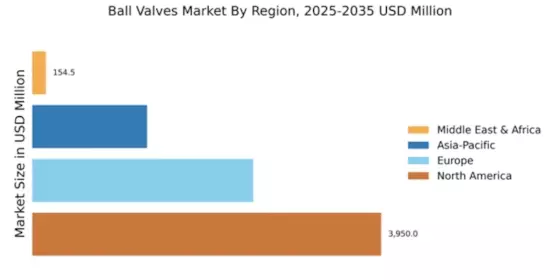
North America continues to lead the ball valves market, holding a significant share of 3950.0. The region's growth is driven by increasing investments in infrastructure, energy, and water management sectors. Regulatory support for modernization and efficiency improvements further fuels demand. The focus on automation and smart technologies in industrial applications is also a key driver, enhancing operational efficiency and safety. The United States is the primary market in this region, with major players like Emerson, Flowserve, and Crane Co. leading the competitive landscape. The presence of advanced manufacturing capabilities and a strong distribution network supports the growth of ball valve applications across various industries. The market is characterized by innovation and a push towards sustainable solutions, ensuring a robust future for the sector.

Europe : Emerging Market with Growth Potential

Europe's ball valves market is projected to grow significantly, with a market size of 2500.0. The region is witnessing a surge in demand due to stringent regulations aimed at enhancing energy efficiency and reducing emissions. The European Union's commitment to sustainability and green technologies is a major catalyst for market growth, driving investments in modern infrastructure and industrial applications. Leading countries such as Germany, France, and the UK are at the forefront of this expansion, supported by key players like Valmet and Kitz Corporation. The competitive landscape is marked by innovation and collaboration among manufacturers to meet regulatory standards. The focus on digitalization and smart manufacturing is reshaping the market, positioning Europe as a vital player in the global ball valves sector. "The European market is adapting to new regulations that prioritize sustainability and efficiency," European Commission report, European Commission.

Asia-Pacific : Rapid Growth in Emerging Markets

The Asia-Pacific region is experiencing rapid growth in the ball valves market, with a size of 1300.0. This growth is driven by increasing industrialization, urbanization, and infrastructure development across countries like China and India. The demand for energy-efficient solutions and automation in manufacturing processes is propelling the market forward, supported by favorable government policies and investments in technology. China stands out as a leading country in this market, with significant contributions from local manufacturers and international players like Honeywell and Pentair. The competitive landscape is evolving, with a focus on innovation and cost-effective solutions. As the region continues to develop, the ball valves market is expected to expand, driven by the need for modern infrastructure and efficient resource management.

Middle East and Africa : Emerging Powerhouse in Valves

The Middle East and Africa region is gradually emerging in the ball valves market, with a market size of 154.46. The growth is primarily driven by increasing investments in oil and gas, water management, and infrastructure projects. Regulatory frameworks aimed at enhancing operational efficiency and safety are also contributing to market expansion. The region's rich natural resources and ongoing development projects are key growth drivers. Countries like the UAE and South Africa are leading the market, with a growing presence of international players. The competitive landscape is characterized by partnerships and collaborations to meet the rising demand for advanced valve solutions. As the region continues to develop its industrial capabilities, the ball valves market is poised for significant growth, supported by strategic investments and technological advancements.

Key Players and Competitive Insights

The Ball Valves Market is currently characterized by a dynamic competitive landscape, driven by increasing demand across various sectors such as oil and gas, water treatment, and power generation. Key players are actively engaging in strategies that emphasize innovation, regional expansion, and digital transformation. For instance, Emerson (US) has positioned itself as a leader in automation solutions, focusing on integrating advanced technologies into its product offerings. Similarly, Flowserve (US) has been enhancing its operational capabilities through strategic partnerships and acquisitions, thereby strengthening its market presence. These collective strategies not only enhance their competitive edge but also contribute to a more robust market environment.

In terms of business tactics, companies are increasingly localizing manufacturing to reduce lead times and optimize supply chains. The market structure appears moderately fragmented, with several key players exerting influence over their respective segments. This fragmentation allows for a diverse range of products and services, catering to specific customer needs while fostering healthy competition among the major players.

In November 2025, Kitz Corporation (JP) announced the launch of a new line of eco-friendly ball valves designed to meet stringent environmental regulations. This strategic move underscores Kitz's commitment to sustainability and positions the company favorably in a market that is increasingly prioritizing environmentally responsible solutions. The introduction of these products is likely to enhance Kitz's competitive positioning, particularly among environmentally conscious consumers.

In October 2025, Crane Co. (US) completed the acquisition of a regional valve manufacturer, which is expected to bolster its product portfolio and expand its market reach. This acquisition reflects Crane's strategy to enhance its operational capabilities and diversify its offerings, thereby allowing it to better serve its customers across various industries. The integration of the acquired company’s technologies and expertise could potentially lead to innovative product developments in the near future.

In September 2025, Valmet (FI) launched a digital platform aimed at optimizing valve performance through real-time monitoring and predictive maintenance. This initiative highlights Valmet's focus on digital transformation and its commitment to providing customers with advanced solutions that enhance operational efficiency. By leveraging data analytics and IoT technologies, Valmet is likely to gain a competitive advantage in a market that increasingly values technological integration.

As of December 2025, current competitive trends indicate a strong shift towards digitalization, sustainability, and AI integration within the Ball Valves Market. Strategic alliances are becoming increasingly prevalent, as companies seek to leverage complementary strengths to enhance their market positions. The competitive landscape is evolving from a focus on price-based competition to one that emphasizes innovation, technology, and supply chain reliability. This shift suggests that companies that prioritize these aspects will likely emerge as leaders in the market.

Key Companies in the Ball Valves Market market include

Industry Developments

  • In July 2023, Flomatic released a new swing check valve that meets AWWA C508 requirements and AIS provisions, ensuring superior performance and reliability.
  • In June 2023, Alfa Laval launched two new hygienic valves, the Alfa Laval Unique Mixproof CIP and Unique Mixproof Process, expanding their double-seat valve range. These valves enhanced product safety, process efficiency, and sustainability, meeting market demands.
  • In July 2023, Valmet and ThyssenKrupp Industries India have recently established a cooperative agreement to enhance their collaboration in the field of process automation.

Future Outlook

Ball Valves Market Future Outlook

The Ball Valves Market is projected to grow at a 5.94% CAGR from 2024 to 2035, driven by industrial automation, energy efficiency, and increasing demand in water management.

New opportunities lie in:

  • Expansion into renewable energy sector applications
  • Development of smart ball valves with IoT integration
  • Customized solutions for niche industries like pharmaceuticals

By 2035, the Ball Valves Market is expected to achieve robust growth, reflecting evolving industrial needs.

Market Segmentation

Ball Valves Market Size Outlook

  • Small
  • Medium
  • Large

Ball Valves Market Type Outlook

  • Floating Ball Valve
  • Trunnion Ball Valve
  • V-Port Ball Valve

Ball Valves Market End Use Outlook

  • Industrial
  • Commercial
  • Residential
  • Agricultural

Ball Valves Market Material Outlook

  • Stainless Steel
  • Brass
  • Plastic
  • Carbon Steel

Ball Valves Market Application Outlook

  • Oil and Gas
  • Water and Wastewater
  • Chemical Processing
  • Power Generation
  • Pharmaceutical

Report Scope

MARKET SIZE 20247904.46(USD Million)
MARKET SIZE 20258374.14(USD Million)
MARKET SIZE 203514915.0(USD Million)
COMPOUND ANNUAL GROWTH RATE (CAGR)5.94% (2024 - 2035)
REPORT COVERAGERevenue Forecast, Competitive Landscape, Growth Factors, and Trends
BASE YEAR2024
Market Forecast Period2025 - 2035
Historical Data2019 - 2024
Market Forecast UnitsUSD Million
Key Companies ProfiledEmerson (US), Flowserve (US), Kitz Corporation (JP), Crane Co. (US), Valmet (FI), Pentair (US), Honeywell (US), AVK Holding (DK), Cameron (US)
Segments CoveredApplication, End Use, Material, Size, Type
Key Market OpportunitiesIntegration of smart technologies enhances efficiency and monitoring in the Ball Valves Market.
Key Market DynamicsRising demand for energy-efficient solutions drives innovation and competition in the ball valves market.
Countries CoveredNorth America, Europe, APAC, South America, MEA

Market Highlights

Author
Ankit Gupta
Senior Research Analyst

Ankit Gupta is an analyst in market research industry in ICT and SEMI industry. With post-graduation in "Telecom and Marketing Management" and graduation in "Electronics and Telecommunication" vertical he is well versed with recent development in ICT industry as a whole. Having worked on more than 150+ reports including consultation for fortune 500 companies such as Microsoft and Rio Tinto in identifying solutions with respect to business problems his opinions are inclined towards mixture of technical and managerial aspects.

Leave a Comment

FAQs

How much is the Ball Valves Market?

The Ball Valves Market size is expected to be valued at USD 14915.00 billion by 2035.

What is the growth rate of the Ball Valves Market?

The global market is projected to grow at a CAGR of 5.94% during the forecast period, 2025 to 2035.

Which region held the largest market share in the Ball Valves Market?

North America had the largest share of the global market.

Who are the key players in the Ball Valves Market?

The key players in the market are Alfa Laval, Swagelok Company, Emerson Electric Company, MRC Global Inc, Velan Inc, The Weir Group Plc, Valmet, Flowserve Corporation, Dwyer Instruments Ltd, and Flomatic Corporation.

Which Application led the Ball Valves Market?

The others category dominated the market in 2023.

Which size had the largest market share in the Ball Valves Market?

4"-6" segment had the largest revenue share of the global market.

Download Free Sample

Kindly complete the form below to receive a free sample of this Report

Compare Licence

×
Features License Type
Single User Multiuser License Enterprise User
Price $4,950 $5,950 $7,250
Maximum User Access Limit 1 User Upto 10 Users Unrestricted Access Throughout the Organization
Free Customization
Direct Access to Analyst
Deliverable Format
Platform Access
Discount on Next Purchase 10% 15% 15%
Printable Versions